34
Hanna Kivistö-de Souza, Angélica Carlet, Izabela Anna Jułkowska, and Anabela Rato, Vowel inventory size...Introduction1
Acquiring a target-like pronunciation in a foreign language is frequently seen as a more challenging task than acquiring second language (L2) grammar or vocabulary. One of the reasons L2 phonological acquisition is seen to be an arduous task is that it relies on “hard-wired biological processes that cannot easily be inluenced by conscious learning eforts” (Jilka, 2009, p.5). Whereas native-like pronunciation is rarely the desired or realistic aim, accurate and luent L2 speech is highly beneicial for foreign language learners in daily communicative situations.
Vowel sounds usually present great diiculties for foreign language learners and inaccurate vowel production and perception afect intelligibility. According to current inluential L2 speech learning models, such as Speech Learning Model (Flege, 1995) and PAM-L2 (Best & Tyler, 2007), the perceptual similarity of the irst language (L1) and L2 vowels is one of the important predictors of accurate L2 vowel acquisition. More speciically, more target-like acquisition is expected to occur when the L2 sound is perceived as diferent to the existing L1 speech sounds. Some researchers have suggested that L2 vowel acquisition, apart from perceptual similarity, is afected by the learners’ L1 vowel inventory size, so that speakers of languages with large vowel inventories have a beneit over speakers of languages with smaller vowel inventories (Fox, Flege, & Munro, 1995; Frieda & Nozawa, 2007; Hacquard, Walter, & Marantz, 2007; Iverson & Evans, 2007). his is because speakers of languages with large vowel inventories would have gained experience in tuning to small-scale spectral diferences from their L1, making the perception of L2 vowels an easier task. When the learners are unable to perceive the spectral diferences between the L2 vowels, they may resort to duration and mistakenly employ it as a cue to discern the problematic vowels (Bohn, 1995; Escudero, 2000). For example, English instructors frequently teach that some English vowels contrast in duration (long/short) such as those in the pairs ‘feet-it’ or ‘pool-pull’, rather than in quality or tenseness of the speech organs.
he aim of this article was to determine whether the size of L1 vowel inventory afects the use of perceptual cues used to discern between L2 vowels. In total, 62 English as a foreign language (EFL) learners were tested from four L1 backgrounds: Danish, European Portuguese, Catalan and Russian. hese languages difer in the size of their vowel inventory, and also in the cues used to discern between the L1 vowels (quality only vs. quality and duration). We assumed that these diferences could result in diferent cue-weighting strategies in the perception of English high front vowels. Whereas the role of vowel inventory on L2 vowel perception has been studied previously (e.g., Bohn, 1995; Fox et al., 1995; Hacquard et al., 2007; Iverson & Evans, 2007), to the best of our knowledge, no study has examined this particular language combination before.
1. Review of literature
1.1. Cue-weighting in English high front
vow-els by native and non-native speakers
he acquisition of English /i-ɪ/ has been examined amongst a wide variety of language learners. Mastering this distinction is important for EFL learners due to the high functional load of this English vowel pair. hat is, many high frequency minimal pairs are distinguished by /i-ɪ/. For example, Higgins (2013) lists 466 minimal pairs. he acquisition of this vowel distinction is of particular interest for the foreign language learners of the present study as none of the L1s (Danish, Portuguese, Catalan and Russian) has a short lax vowel spectrally similar to the English /ɪ/, whereas all of them have a high front vowel similar to the English /i/. We could thus expect that accurate distinction of the vowel pair might pose some diiculties for the EFL learners of the present study.
learners from several L1 backgrounds have been shown to weight temporal cues over spectral ones (e.g. Bohn, 1995; Flege, Bohn & Jang, 1997; Ylinen et al., 2009).
Several reasons have been proposed as to why non-native English speakers seem to favor the secondary temporal cues. Some researchers have attributed the non-target like weighting of duration cues to negative L1 transfer so that when duration is employed contrastively in the L1, it can be transferred incorrectly into the L2. However, negative transfer from the L1 cannot be accounted for as the only reason for over-reliance on duration cues, since speakers of both quantity languages (Finnish: Ylinen et al., 2009; Japanese: Morrison, 2002; Korean: Flege et al., 1997) and of languages that do not use duration contrastively (Mandarin: Bohn, 1995; Flege et al., 1997; Spanish: Escudero, 2006; Russian: Kondaurova & Francis, 2008) have been shown to rely on temporal cues.
Others have suggested that insuicient instruction contributes to EFL learners’ over-reliance on duration cues. Anecdotal evidence and researchers’ reports (e.g. Flege et al., 1997) from several countries suggest that many EFL learners (e.g. Spanish and Brazilian Portuguese) learn that the diference between the two vowels is that of length: long/short. his might be due to the teacher’s inexperience with English phonetics and phonology.
Escudero (2000) and Morrison (2008) suggest that reliance on temporal cues might be a developmental stage in the acquisition of the L2 phonology. In studying L1 Spanish EFL learners, both authors discovered that less proicient EFL learners were more inclined to rely on temporal cues than more proicient EFL learners. he authors suggest that as language proiciency and language experience increase, the learners’ cue-weighting strategies tend to become more target-like.
Yet through studying L1 Spanish EFL learners, Escudero and Boersma (2004) suggested that it is more efective to add a duration distinction to the ive existing L1 vowels than to acquire the new English vowels based on spectral diferences. hey argue that it is easier to create new categories in a dimension which is not exploited contrastively in the L1 (duration) than to split the existing L1 phonemes into several L2 phonemes.
However, even though a language would not use duration contrastively, as is the case with Spanish, language users still have some experience with duration. Kondaurova and Francis (2008) note that speakers of languages that do not use duration contrastively (L1 Russian and L1 Spanish speakers in their study) have experience with duration in their L1s through vowel lengthening before voiced consonants and in stressed syllables. Kondaurova and Francis (2008), as well as Morrison (2008), propose that this experience with allophonic vowel duration variation in the L1 could be an explanation as to why EFL learners tend to overuse temporal cues.
Another contributing reason could be perceptual salience. Temporal cues have been suggested to be more salient perceptually than spectral ones so that even if the speakers lack experience with contrastive temporal distinctions in their L1, they can still exploit this dimension in the L2 (Bohn, 1995; Bohn & Flege, 1990). Bohn’s Desensitization Hypothesis states that “Whenever spectral diferences are insuicient to diferentiate vowel contrasts because previous linguistic experience did not sensitize listeners to these spectral diferences, duration diferences will be used to diferentiate the non-native vowel contrast” (Bohn, 1995, p. 294-295).
he organization of the L1 vowel space desensitizes the language learner to spectral diferences so that when the L1 does not employ small-scale spectral diferences as a whole (e.g. three- or ive-vowel systems) or in a given portion of the vowel space (e.g. the high front area, as in the present study), the learner has diiculties in perceiving small-scale spectral diferences, such as the English /i/ and /ɪ/, and turns into duration diferences instead. Consequently, following Bohn’s hypothesis, speakers of languages with small vowel inventories are expected to show more diiculties in discerning diferences in vowel quality than speakers of languages with large L1 vowel inventories (Bohn, 1995).
36
Hanna Kivistö-de Souza, Angélica Carlet, Izabela Anna Jułkowska, and Anabela Rato, Vowel inventory size...(Fox et al., 1995, p. 2548). Similar conclusions were obtained from a study conducted by Iverson and Evans (2007) who examined L1 Spanish, French, German, and Norwegian EFL learners’ perception of the English vowel system. he speakers from the languages with more complex L1 vowel systems (Norwegian and German) recognized the L2 vowels more accurately than speakers of languages with simpler vowel systems. Recent neurolinguistics research investigating the expansion of the perceptual vowel space as a function of vowel inventory size and organization has arrived at the same conclusion. he results from Hacquard et al. (2007) suggest that speakers of languages with large vowel inventories perceive the same sounds as more distinct than speakers of languages of smaller vowel inventories. he organization of the vowels within the vowel space, nevertheless, did not appear to play a role.
1.2. Vowel systems of the L1s of the present
study
he participants in the study came from ive L1 backgrounds: English, Danish, European Portuguese, Catalan and Russian. Our aim was to investigate languages difering in L1 vowel inventory size. Consequently we chose Danish with a large L1 vowel inventory (20+) and a crowded high front vowel space, European Portuguese and Catalan with medium-sized vowel inventories (9 & 8, respectively) with comparable high front vowel space (1 high front vowel) and Russian with a small L1 vowel inventory (5). Additionally, Danish was the only language which employs duration contrastively, and Portuguese was the only language which has nasal vowels. Interestingly, nasal vowels have been shown to be longer than oral vowels (Sampson, 1999) and it could thus be argued that speakers of languages with nasal vowels might perform diferently when employing temporal cues to discern between vowels than speakers with languages which only have oral vowels. his section presents the vowel inventories of their L1s beginning with the target language.
Standard Southern British English (SSBE), the target language of the present study, has 12 vowels which are distinguished by means of spectral diferences.
SSBE has two high front vowels which difer in spectral quality and tenseness: /i/ and /ɪ/. he tense high front vowel, /i/, is somewhat more fronted and more close than the lax high front vowel /ɪ/. Traditionally, the two are also described to difer in duration so that everything else being equal, /i/ is somewhat longer than /ɪ/. However, as mentioned in the previous section, native English speakers do not tend to rely on duration when diferentiating between the two vowels, spectral quality being a more important cue of the vowel’s identity.
Danish has at least 20 stressed monopthongs (Steinlen, 2005) distinguished primarily by means of temporal diferences and by small spectral diferences. Danish vowels occur in long-short pairs, namely / i-iː, e-eː, ɛ-ɛː, a-aː, u-uː, o-oː, ɔ-ɔː, y-yː, ø-øː, oe-oeː/. Almost all the vowels are located in the upper half of the acoustic vowel space. Danish has four high front vowels: the unrounded /i/ and /iː/ and the rounded /y/ and /yː/. he members of each vowel pair are distinguished mainly by means of duration. According to acoustic measurements performed by Steinlen (2002), the English /ɪ/ and the Danish /e/ do not signiicantly difer in their quality. Moreover, her results did not ind large diferences between the Danish /i/ and the English /i/, and according to Bohn and Caudery (2012), the use of the Danish /i/ instead of the English /i/ does not contribute notably to a foreign accent. In examining Danish listeners’ English vowel perception, Bohn and Steinlen (2003) reported that English /i/ is easily assimilated into the Danish counterpart due to its similarity, whereas the English /ɪ/ may pose more problems to Danish speakers, as it was identiied with either Danish /e/ or /i/.
he European Portuguese (EP) vowel system includes nine oral vowels (/i/, /e/, /ɛ/, /ɨ/, /ɐ/, /a/,
Interestingly, the nasal vowels are acoustically and perceptually longer than their oral counterparts due to the presence of the nasal murmur which lengthens them. Nasality also afects the vowels’ bandwidth and modiies the frequencies of the irst (F1) and second (F2) formants, resulting in larger bandwidths and diferent formant frequencies (Santos, 2003). he EP front vowel space has three front vowels (/i/, /e/, /ɛ/) that contrast in spectral quality and have intrinsic vowel duration diferences (Escudero, Boersma, Rauber & Bion, 2009). he English vowel contrasts /i/-/ɪ/ and /ɛ
/-/æ/ present both production and perception diiculties for adult native EP speakers. English /ɪ/ and /æ/ tend to be assimilated into the Portuguese vowel sounds /i/ and /ɛ/ respectively, and no distinction between the two vowels of each pair is made due to their acoustic and articulatory proximity (Rato, 2014; Rato et al., 2014).
he L1 Catalan participants of the study spoke the Eastern Catalan variety of the language. Easter Catalan has eight simple vowels (/i e ɛ u o ɔ a ə/), seven occurring in stressed positions and one schwa-like vowel occurring in unstressed positions. Catalan does not employ duration contrastively. he high front vowel region of Catalan is only occupied by vowel /i/. Acoustic comparisons indicate that English /i/ and the Catalan /i/ are highly similar, whereas the English /ɪ/ is acoustically closest to the Catalan /e/ (Cebrian, 2006). In vowel perception, Catalan speakers tend to assimilate the English /i/ into the native /i/, whereas the English /ɪ/ is perceived as more dissimilar and is assimilated into either the Catalan /e/, /i/ or /ɛ/. We could thus conclude that whereas the English /i/ can be easily assimilated into Catalan/i/, the English /ɪ/ is less straightforward and it might pose more problems to the L2 learners. his is because it could be perceived as a new vowel but its assimilation pattern could also correspond to that of two-category assimilation, single-category assimilation or category-goodness diference (Best & Tyler, 2007).
he L1 Russian participants were native speakers of Standard Russian (Moscow dialect). Standard Russian vowel inventory consists of ive distinct vowel sounds /i eu oa/ occurring in stressed syllables (Barnes, 2007; Padgett, 2004). In non-stressed syllables, the vowel contrast is reduced to two to three vowels depending on
the palatalization context. A long-standing discussion has been held among linguists concerning the high central unrounded vowel [ɨ] and its status as a distinct phonological segment in the Russian vowel inventory. Following Padgett & Tabain (2005), we assume that the vowel sound [ɨ] is an allophone of /i/ occurring in complementary distribution in palatalized context. Palatalization results in the fronting of the vowels so that ater palatalized consonants, the /i/ is realized as [i], whereas ater non-palatalized consonants it is realized as [ɨ]. In Russian, vowel contrast is primarily distinguished by spectral diferences. However, vowel duration is used to distinguish diferent levels of stress in Russian (Bondarko, 1998). In stressed syllables, the vowels are realized as long, before stressed syllables the vowels are produced shorter, and in unstressed syllables they are the shortest (Kondaurova & Francis, 2008). In the perception of English high front vowels, Russian listeners were found to use duration cue exclusively, whereas spectral diferences were not a predictor of vowel contrast (Kondaurova & Francis, 2008). Consequently, we could expect L1 Russian speakers to show diiculties in discerning English /i-ɪ/ accurately due to their over-reliance on temporal cues.
1.3. Research question and objectives
he present research project is an extension of Kivistö-de Souza and Carlet (2014) cue-weighting study in which the cue-weighting strategies of L1 Catalan and L1 Danish learners of English were examined. In the present study, two more groups of EFL learners were tested: L1 Portuguese and L1 Russian. he study aimed at answering the following research question:
RQ: Is the size of the L1 vowel inventory associated with the use of temporal cues in the perception of English /i -ɪ/ contrast?
38
Hanna Kivistö-de Souza, Angélica Carlet, Izabela Anna Jułkowska, and Anabela Rato, Vowel inventory size...spectral distances between L2 vowels than speakers with smaller L1 vowel inventories (Bohn, 1995; Hacquard et al., 2007). Consequently, we expected that the L1 Danish speakers would identify the vowels to the most accurate extent, followed by the L1 Portuguese speakers, then the L1 Catalan speakers and inally the L1 Russian speakers, whose L1 vowel inventory is the smallest.
2. Method
2.1. Participants
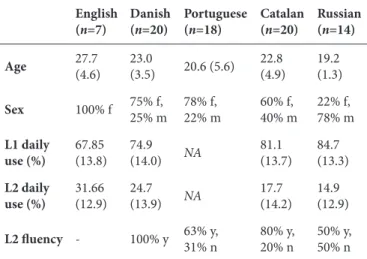
Participants from ive language backgrounds were tested: L1 English, L1 Danish, L1 Portuguese, L1 Catalan and L1 Russian. he demographic characteristics of the participants are shown in Table 1 below.
Table 1. Demographic characteristics of the participants grouped by L1
he L1 Danish, L1 Catalan and L1 Portuguese participants were irst year English majors at the universities of Aarhus, Barcelona and Minho respectively. he L1 Russian participants were irst and second year students at the Moscow State University of Mechanical Engineering with a high command of English. he participants reported using little English on a daily basis overall (“L2 daily use”): he L1 Danish participants reported employing English on average 24% of the time, being the L1 participants’ with the highest L2 use, the Catalan and the Russian participants
English (n=7)
Danish (n=20)
Portuguese (n=18)
Catalan (n=20)
Russian (n=14)
Age 27.7
(4.6)
23.0
(3.5) 20.6 (5.6)
22.8 (4.9)
19.2 (1.3)
Sex 100% f 75% f,
25% m 78% f, 22% m 60% f, 40% m 22% f, 78% m L1 daily use (%) 67.85 (13.8) 74.9 (14.0) NA 81.1 (13.7) 84.7 (13.3) L2 daily use (%) 31.66 (12.9) 24.7 (13.9) NA 17.7 (14.2) 14.9 (12.9)
L2 luency - 100% y 63% y, 31% n
80% y, 20% n
50% y, 50% n
reported somewhat lower L2 use.2 All L1 Danish participants considered themselves luent in English, followed by 80% of the Catalans and 63% of the L1 Portuguese participants. he L1 Russian participants had the lowest self-perceived luency with only 50% considering themselves luent in English.
In order to compare the language learners’ vowel perception to native standards, a control group of native English speakers (n=7) living in Barcelona during the time of data collection was recruited. hree of the native English speakers were from Southern England and four from the United States. In a previous study (Kivistö-de Souza, 2011), the British and American participants’ vowel production data as well as perception scores were submitted to a set of Mann-Whitney U tests. None of the tests yielded signiicant diferences, indicating that the British and American participants did not perform signiicantly diferently, enabling their grouping together.
2.2. Vowel Identiication Task
he 144 target words were presented in a random order aurally and orthographically through DmDx sotware (Forster & Forster, 2012). he participant heard a stimulus and had to select from two orthographically presented answering options the one corresponding to the auditory stimulus.
2.3. Procedure
he L1 English, L1 Russian, L1 Danish and L1 Catalan participants were tested individually in a
quiet room in their respective universities. he L1 Portuguese participants were tested in a computer room in a joint session. Despite testing being conducted in diferent testing locations, due to the nature of the study, the exact same instructions were followed by the researchers, in the attempt to minimize any diferences in the testing setting. At the beginning of the data collection session, the participants read and signed a consent form and illed in a language background questionnaire. Before the vowel identiication task, the participants performed a familiarization task which presented the target words aurally together with pictures. he aim of the familiarization task was to make sure that participants knew the meaning of the target words. Replaying of the stimuli was allowed as many times as desired by the participant. Ater inishing the familiarization task, the participants could ask the researcher for clariications, and once the meaning of all the test
words was clear, the participants performed the vowel identiication task. he vowel identiication task took around 10 minutes to complete.
2.4. Results
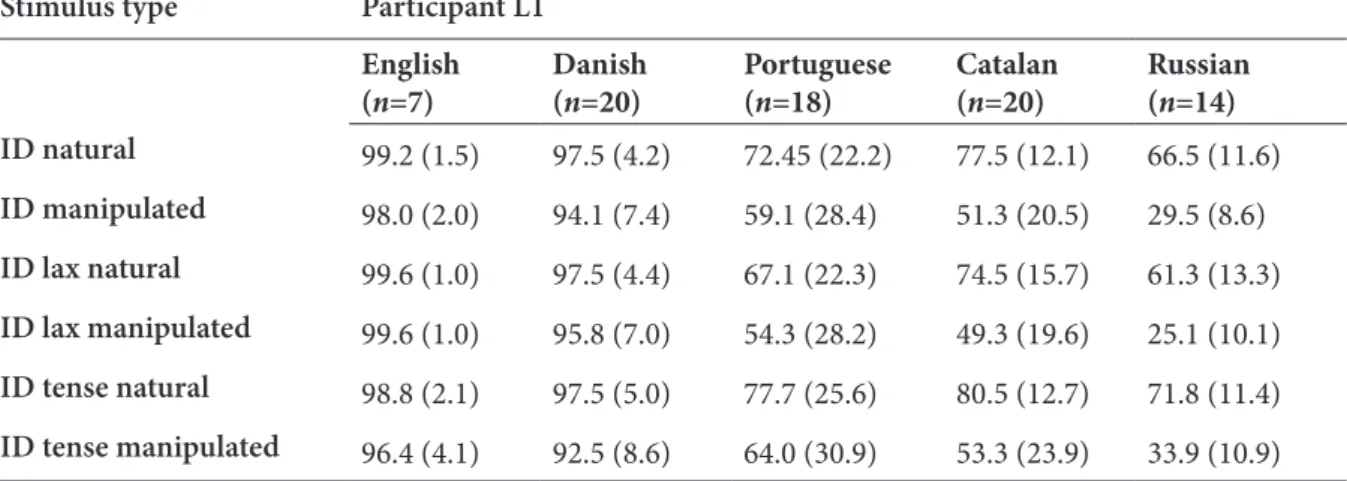
Participants’ responses to the vowel identiication task were analyzed and the percentage of accurate responses for each condition (vowel/stimulus type) was computed. Descriptive statistics are presented in Table 2.
Table 2. Response accuracy (%). Standard deviations in brackets.
In the identiication of the natural stimuli, the L1 Danish participants performed most accurately of the EFL learners groups (M=97.5%), whereas the Russian participants performed worst (M=66.5%). he L1 Portuguese group showed large individual variation as revealed by the large standard deviations. In the duration-manipulated stimuli, the L1 Danish participants again outperformed the other EFL learners (M=94.1%), whereas the L1 Russian participants had diiculty in identifying duration-manipulated stimuli, being able to do so accurately on average in only 29.5% of the cases. Overall, there was a tendency for the tense vowel to be better identiied than the lax vowel in the natural and duration-manipulated contexts for the EFL learners.
he response data were not normally distributed (Kolmogorov-Smirnov p <.05) which is why non-Stimulus type Participant L1
English
(n=7)
Danish (n=20)
Portuguese (n=18)
Catalan (n=20)
Russian (n=14)
ID natural 99.2 (1.5) 97.5 (4.2) 72.45 (22.2) 77.5 (12.1) 66.5 (11.6)
ID manipulated 98.0 (2.0) 94.1 (7.4) 59.1 (28.4) 51.3 (20.5) 29.5 (8.6)
ID lax natural 99.6 (1.0) 97.5 (4.4) 67.1 (22.3) 74.5 (15.7) 61.3 (13.3)
ID lax manipulated 99.6 (1.0) 95.8 (7.0) 54.3 (28.2) 49.3 (19.6) 25.1 (10.1)
ID tense natural 98.8 (2.1) 97.5 (5.0) 77.7 (25.6) 80.5 (12.7) 71.8 (11.4)
42
Hanna Kivistö-de Souza, Angélica Carlet, Izabela Anna Jułkowska, and Anabela Rato, Vowel inventory size...to discern the vowel pair based on spectral diferences, as no diferences were observed between the identiication of the natural and the duration-manipulated stimuli. he L1 Danish speakers did not difer signiicantly from the native English speakers in their vowel identiication accuracy. his is in line with our hypothesis that the large vowel space of Danish sensitizes Danish speakers for perceiving small-scale spectral diferences, a strategy which is successfully transferred into L2 vowel perception. In spite of their near native perception, the L1 Danish participants still showed a small efect of reliance on duration cues (identiication natural: 97.5% vs. identiication duration-manipulated: 94.16%). his might be due to the fact that duration is employed contrastively in Danish. It might be that the L1 Danish speakers also make use of their L1 contrastive duration when identifying the target L2 vowels. However, this seems to be a secondary strategy and we conclude that the L1 Danish participants of the study discerned the target vowel pair mainly based on spectral cues.
As already mentioned, the L1 Portuguese (59.1%) and L1 Catalan participants (51.3%) did not difer signiicantly from each other in the identiication of the duration-manipulated stimuli. Both EFL learner groups manifested identiication accuracy barely above the chance level in the trials in which the duration of the two vowels was exchanged. he poorer performance in the duration-manipulated trials indicates that L1 Portuguese and L1 Catalan participants were relying heavily on duration when discerning the target vowel pair. We thus conclude that the L1 Portuguese and L1 Catalan participants relied mainly on temporal cues in identifying the English high front vowels. Following the Desensitization Hypothesis (Bohn, 1995), we expected the L1 Portuguese participants to perform more accurately than the L1 Catalan participants, due to the former’s larger L1 vowel inventory. Even though this occurred, the diferences were not statistically signiicant. his does not clearly support the Desensitization Hypothesis, but it may indicate that the presence of one oral vowel will not afect the use of cue-weighting strategies. Another reason for this result could be that European Portuguese and Catalan are comparable in terms of the high front vowel space, both languages presenting only
one oral high front vowel, in comparison to Danish, for example, whose high front vowel area is more crowded. More research is required on the matter.
he L1 Russian participants had the lowest performance accuracy in the duration-manipulated stimuli (29.5%). In fact, their identiication accuracy, which was well below the chance-level, might suggest that the L1 Russian participants were relying on duration solely. In other words, they might have based their responses only on the duration of the target item without attending to spectral cues at all or to a very small extent. In practice, this would mean that when they identiied the duration of the vowel as short, they mapped it with // and when they considered the duration of the vowel to be long, they mapped it to /i/. his type of strategy would clearly be inefective and lead to poor identiication accuracy, as the duration-manipulated tense and lax vowels had exchanged their durations.
One explanation of the poor results of the L1 Russian participants could be found in their vowel perception baseline data. he L1 Russian participants were the least accurate in identifying the target vowels in the natural condition (66.5%), suggesting that their category formation for the L2 vowels was weaker than for the other EFL groups. Another explanation could be found in how duration is employed in their L1. Russians might have more experience with the duration than the L1 Catalan and L1 Portuguese speakers, as lexical stress is phonologically distinctive in Russian so that two words may difer only in terms of stress placement (Kondaurova & Francis, 2008).3 Nevertheless, Danish is the only one of the languages studied which employs duration contrastively and the L1 Danish speakers performed with the highest accuracy. Consequently, being experienced with duration in the L1 might not be related to cue-weighting strategies in the L2.
poor examples of the L1 [], which would be relected in the poor identiication accuracy of the L2 /i/ and //. However, the palatalization context did not vary in the test words, i.e., all of the target vowels occurred in non-palatalized context, meaning that the possible efect should be similar to the duration-manipulated and natural trials as well as for the two target vowel trials. Clearly, more studies are needed to determine the efect of palatalization on L1 Russian speakers’ L2 vowel perception.
Finally, we should consider an alternative explanation for the results taking into account the role of L2 proiciency. Our hypothesis stated that L1 vowel inventory size would have an efect on L2 vowel perception. However, it is possible that L2 proiciency plays a role as well, as proposed by Escudero (2000). he poor identiication results of the L1 Russians speakers might be contributed to their possibly lower English proiciency level. Due to methodological limitations, we could not measure the L1 Catalan and L1 Danish participants’ L2 vocabulary size. he L1 Portuguese and L1 Russian participants’ L2 vocabulary size was measured with X_lex and Y_lex vocabulary size tests (Meara, 2005; Meara & Miralpeix, 2006) whose scores have been shown to relate to L2 proiciency levels (Miralpeix, 2012). We made an efort to match the Portuguese participants to the Russian participants in terms of vocabulary size, but there was still a diference between the two groups (Portuguese M=6097, Russian M=5192, max. 10,000). Nevertheless, the Portuguese and Russian participants did not signiicantly difer from each other in the identiication of the natural stimuli, indicating that their baseline vowel perception was similar. On the other hand, if we examine the self-reported luency data, we see some diferences between the EFL groups’ self-perceived English luency that might partly explain the obtained results. Recall that all of the L1 Danish speakers considered themselves luent in English, followed by 80% of the L1 Catalan speakers and 63% of the L1 Portuguese speakers, whereas only half of the L1 Russian learners considered themselves luent in English. When mapping the self-reported L2 luency data to the perception results, we see some similarities, as the L1 Danish speakers performed most
accurately and the L1 Russians least accurately. he L1 Catalan and L1 Portuguese speakers’ vowel perception results were comparable, but the former’s self-perceived luency was higher than the latter’s. As noted by an anonymous reviewer to this manuscript, this might be because the L1 Portuguese speakers’ larger vowel inventory might have compensated for lower (self-perceived) L2-luency.4 Consequently, future studies on cue-weighting should measure the participants’ L2 proiciency in order to statistically control for its efect on L2 vowel perception. Furthermore, the L2 proiciency and/or luency measures should be based on objective tests rather than on subjective measurements as was the case of self-reported luency in the present study.
To summarize, the results of the present research ofer partial support to Bohn’s (1995) Desensitization Hypothesis and suggest that L1 vowel inventory size is a contributing factor in L2 vowel perception. he L1 Danish participants, with the largest L1 vowel inventory, showed less reliance on temporal cues than the other EFL learners, indicating that the large L1 vowel inventory had successfully sensitized the L1 Danish speakers to small-scale spectral diferences. he participants from the two medium-sized vowel inventories, Portuguese and Catalan, identiied the L2 vowels less accurately than the L1 Danish participants, but more accurately than the L1 Russian participants. he Russian participants, with the smallest L1 vowel inventory, relied heavily on temporal cues in discerning the target vowels. It would thus appear that the smaller vowel inventory of Russian desensitized the Russian participants to the small spectral diferences present in the English /i-/, forcing them to rely on temporal cues instead. More support for the role of L1 vowel inventory size on L2 cue-weighting could be obtained by examining diferent language combinations. We especially recommend comparing languages which difer in the size of the vowel inventory (large/small) but not in the use of temporal cues. One possible pairing would then be to compare L1 Arabic (a three-vowel system) or L1 Finnish (a ive-three-vowel system) with L1 Danish EFL learners.
44
Hanna Kivistö-de Souza, Angélica Carlet, Izabela Anna Jułkowska, and Anabela Rato, Vowel inventory size...towards more relevant (e.g. spectral) cues. Our results imply that L1 Russian learners of English, and to a smaller extent, L1 Portuguese and L1 Catalan EFL learners, might beneit from perceptual cue-training employing duration-manipulated English vowels. Such training might lead to diferences in cue-weighting strategies, resulting in a progressive shit from over-reliance on temporal cues to more target-like employment of spectral cues. his in turn might result in more accurate perception, and possibly production, of the L2.
Acknowledgements
We would like to show our gratitude to professors Ocke Schwen-Bohn and Camilla Søballe Horslund for providing insight into the complex Danish vowel system. We would also like to thank Olga Ivanova and Varvara Molodtsova for their assistance with the data collection in Moscow. Finally, we are immensely grateful for the anonymous reviewers for their comments on an earlier version of the manuscript.
Notes
1. A previous version of this paper was presented at the 8th International Conference on Second Language Speech in Aarhus 10-12th June, 2016.
2. Due to a technical failure in the data collection, there are no data on the L1 Portuguese speakers’ language use.
3. An anonymous reviewer brought to our attention the fact that in Portuguese, words can also difer in terms of lexical stress (e.g. ‘sá.bi.a - sa’bi.a). his occurs in Spanish and Catalan as well (‘hab.lo - hab’ló; ‘par.la - par’là) but in these languages, syllable duration is not a reliable cue for word-stress (Llisterri et al. 2003). We are not aware of any empirical studies measuring the correlates of lexical stress in (European) Portuguese, thus we cannot conirm whether Portuguese would behave similarly to Russian or to Spanish and Catalan. 4. We thank the anonymous reviewer for bringing this
into our attention
References
Barnes, J. (2007). Phonetics and phonology in Russian unstressed vowel reduction: A study in hyperarticulation. (Unpublished Master’s thesis). Boston University, Boston, MA.
Barroso, H. (1999). Forma e subst̂ncia da express̃o da ĺngua portuguesa. Coimbra: Livraria Almedina.
Best, C.T., & Tyler, M.D. (2007). Nonnative and second-language speech perception: Commonalities and complementarities. In M.J Munro & O. ‐S. Bohn (Eds.), Second language speech learning: he role of language experience in speech perception and production (pp.13-34). Amsterdam: John Benjamins.
Bohn, O.‐S. (1995). Cross language speech perception in adults: First language transfer doesn’t tell it all. In W. Strange (Ed.), Speech Perception and Linguistic Experience: Issues in Cross‐language research (pp.279‐304). Timonium, MD: York Press.
Bohn, O.‐S., & Caudery, T. (2012). he Sounds of English: An Activity‐Based Course in English Phonetics and Phonology. Aarhus, DK: Aarhus University.
Bohn, O., & Flege, J. E. (1990). Interlingual identiication and the role of foreign language experience in L2 vowel perception. Applied Psycholinguistics, 11(03), 303. doi:10.1017/s0142716400008912
Bohn, O. -S., & Steinlen, A. K. (2003). Consonantal context afects cross‐language perception of vowels. In Proceedings of the 15th International Congress of Phonetic Sciences (pp. 2289‐2292). Barcelona: Universitat Autònoma de Barcelona.
Bondarko L. V. (1998). “Fonetika Sovremennogo Russkogo Jazyka” (Phonetics of Modern Russian Language). University of St. Petersburg, St. Petersburg, Russia. Cebrian, J. (2006). Experience and the use of non-native
duration in L2 vowel categorization. Journal of Phonetics, 34(3), 372-387. doi:10.1016/j.wocn.2005.08.003
Escudero, P. (2000). Developmental patterns in the adult L2 acquisition of new contrasts: he acoustic cue weighting in the perception of Scottish tense/lax vowels by Spanish speakers. (Unpublished Master’s thesis). University of Edinburgh, Scotland, UK.
______. (2006). he phonological and phonetic development of new vowel contrasts in Spanish learners of English. In B. Baptista & M. Watkins (Eds.), English with a Latin Beat. Studies in Portuguese/Spanish‐ English Interphonology (pp. 51‐55). Amsterdam: John Benjamins.
Escudero, P., & Boersma, P. (2004). Bridging the Gap Between L2 Speech Perception Research and Phonological heory. Studies in Second Language Acquisition, 26(04), 551-585. doi:10.1017/ s0272263104040021
the Acoustical Society of America, 126(3), 1379-1393. doi:10.1121/1.3180321
Flege, J. E. (1995). Second language speech learning: heory, indings and problems. In W. Strange (Ed.), Speech perception and linguistic experience: heoretical and methodological issues in cross‐language speech research (pp. 233‐277). Timonium, MD: York Press.
Flege, J. E., Bohn, O., & Jang, S. (1997). Efects of experience on non-native speakers’ production and perception of English vowels. Journal of Phonetics, 25(4), 437-470. doi:10.1006/jpho.1997.0052
Forster, K. I., Forster, J.C. (2012). DMDX (Version 4.0.6.0) [Computer sotware]. Retrieved from http:// www.u.arizona.edu/~jforster/dmdx.htm
Fox, R. A., Flege, J. E., & Munro, M. J. (1995). he perception of English and Spanish vowels by native English and Spanish listeners: A multidimensional scaling analysis. he Journal of the Acoustical Society of America, 97(4), 2540-2551. doi:10.1121/1.411974
Frieda, E. & Nozawa, T. (2007). You are what you eat phonetically. he efect of linguistic experience on the perception of foreign vowels. In O.‐S. Bohn & M. Munro (Eds.), Language Experience in Second Language Speech Learning. In honor of James Emil Flege (pp.79‐96). Amsterdam: John Benjamins.
Gilabert, R., Mora, J. C., & Muñoz, C. (2010). Phonological short-term memory and working memory capacity in foreign language acquisition. Paper presented at SLRF 2010 (Second Language Research Forum. Invited colloquium on Aptitude and Individual Diferences in SLA), University of Maryland, Washington, USA. Hacquard, V., Walter, M. A., & Marantz, A. (2007). he
efects of inventory on vowel perception in French and Spanish: An MEG study. Brain and Language, 100(3), 295-300. doi:10.1016/j.bandl.2006.04.009
Higgins, J. (2013). Minimal pairs for English RP. Retrieved from http://myweb.tiscali.co.uk/wordscape/wordlist/ minpairs.html
Iverson, P., & Evans, B. G. (2007). Learning English vowels with diferent irst-language vowel systems: Perception of formant targets, formant movement, and duration. he Journal of the Acoustical Society of America, 122(5), 2842-2854. doi:10.1121/1.2783198
Jilka, M. (2009). Talent and proiciency in language. In G. Dogil & S. Reiterer (Eds.), Language talent and brain activity (pp.1-16). Berlin: Mouton De Gruyter.
Kivistö-de Souza, H. (2011). Efects of speech style on the use of temporal and spectral cues in the production and perception of a non-native vowel contrast (Unpublished Master’s thesis). University of Barcelona, Barcelona, Spain.
Kivistö-de Souza, H., & Carlet, A. (2014). Vowel inventory size and the use of temporal cues in non-native vowel perception by Catalan and Danish EFL learners. Concordia Working Papers in Applied Linguistics, 5, 322-336.
Kondaurova, M. V., & Francis, A. L. (2008). he relationship between native allophonic experience with vowel duration and perception of the English tense/lax vowel contrast by Spanish and Russian listeners. he Journal of the Acoustical Society of America, 124(6), 3959-3971. doi:10.1121/1.2999341
Llisterri, J., Machuca, M., de la Mota, C., Riera, M., and Rios, A. (2003). he perception of lexical stress in Spanish, in Proceedings of the 15th International Congress of Phonetic Sciences, edited by M. J. Sole, D. Recasens, and J. Romero, Barcelona, 3–9 August, casual productions [CDROM].
Mateus, M. H. M., Falé, I., & Freitas, M. J. (2005). Fonética e fonologia do português. Lisboa: Universidade Aberta.
Meara, P. M. (2005). X_Lex: he Swansea vocabulary levels test (Version 2.05.) [Computer sotware]. Swansea: Lognostics.
Meara, P. M., & Miralpeix, I. (2006). Y_Lex: he Swansea advanced vocabulary levels test (Version 2.05.) [Computer sotware]. Swansea: Lognostics.
Miralpeix, I. (2012). X_Lex and Y_Lex: A validation study. Paper presented at the 22nd VARG Conference (Vocabulary Acquisition Research Group), Newtown, UK.
Mora, J.C., & Cerviño-Povedano, E. (2010). Phonological short-term memory and L2 vowel perception. Paper presented at the 20th Annual Conference of the European Second Language Association (EUROSLA-20), Università di Modena e Reggio Emilia, Reggio Emilia, Italy.
Morrison, G.S. (2002). Perception of English /i/ and // by Japanese and Spanish listeners: Longitudinal results. In G.S. Morrison & L. Zsoldes (Eds.), Proceedings of the North West Linguistics Conference (pp.29‐48). Burnaby, BC, Canada: Simon Fraser University.
______. (2008). L1-Spanish Speakers’ Acquisition of the English /i /--/I/ Contrast: Duration-based Perception is Not the Initial Developmental Stage. Language and Speech, 51(4), 285-315. doi:10.1177/0023830908099067
Moya‐Galé, G. (2010). Overcoming non‐native over‐ reliance: a study on English vowel duration manipulation and neutralization. (Unpublished Master’s thesis). Universitat de Barcelona, Barcelona, Spain.
46
Hanna Kivistö-de Souza, Angélica Carlet, Izabela Anna Jułkowska, and Anabela Rato, Vowel inventory size...Padgett, J., & Tabain, M. (2005). Adaptive Dispersion heory and Phonological Vowel Reduction in Russian. Phonetica, 62(1), 14-54. doi:10.1159/000087223
Rato, A. (2014). Efects of Perceptual Training on the Identiication of English Vowels by Native Speakers of European Portuguese. Proceedings of the International Symposium on the Acquisition of Second Language Speech - Concordia Working Papers in Applied Linguistics, 5, 529-546.
Rato, A., Rauber, A., Soares, L., & Lucas, L. (2014).
Challenges in the perception and production of English front vowels by native speakers of European Portuguese.
Diacŕtica - série ciências da linguagem, 28(1), 137-155.
Sampson, R. (1999). Nasal vowel evolution in Romance.
Oxford: Oxford University Press.
Santos, G. B. (2003). Análise fonético-acústica das
vogais orais e nasais do português: Brasil e Portugal. (Unpublished Doctoral Dissertation). Universidade Federal de Goiás, Brasil. Retrieved from: https:// repositorio.bc.ufg.br
Steinlen, A.K. (2002). A cross‐linguistic comparison of the efects of consonantal contexts on vowels produced by native and non‐native speakers (Unpublished Doctoral dissertation). Aarhus University, Aarhus, DK.
______. (2005). he inluence of consonants on native and non-native vowel production: a cross-linguistic study (Vol. 30). T̈bingen: Gunter Narr.
Ylinen, S., Uther, M., Latvala, A., Vepsäläinen, S., Iverson, P., Akahane-Yamada, R., & Näätänen, R. (2009). Training the Brain to Weight Speech Cues Diferently: A Study of Finnish Second-language Users of English. Journal of Cognitive Neuroscience, 22(6), 1319-1332. doi:10.1162/jocn.2009.21272