SOIL SEED BANK VARIATION PATTERNS ACCORDING TO ENVIRONMENTAL FACTORS IN A
NATURAL GRASSLAND
11 Submetido em 15/03/2004. Aceito para publicação em 16/06/2004. Parte da dissertação de Mestrado em Ecologia do primeiro autor, bolsista CAPES, apresentada a UFRGS/IB.
2 Pesquisador, Fundação Estadual de Pesquisa Agropecuária, Centro de Pesquisa da Região Sul – FEPAGRO SUL, BR 392, km 36, CEP 96200-970, Domingos Petrolini, Rio Grande – RS, Brasil. [email protected]
FERNANDA COSTA MAIA2, RENATO BORGES DE MEDEIROS3, VALÉRIO DE PATTA PILLAR4, TELMO FOCHT5
ABSTRACT - This research aimed to determine the soil seed bank and its relationship with environmental factors that have an influence in the distribution of the vegetation above the ground in an excluded area of natural grassland in the South of Brazil. Most of the 122 identified species in the seed bank were perennials. Data analysis indicated three distinct community groups, according to the size and composition of the soil seed bank in lowlands with permanent wet soils, in lowlands and in other areas. In general, lowlands were characterized by low-fertility soils, high moisture and aluminum contents, being spatially homogeneous habitats and, therefore, more restricted to vegetation heterogeneity than other parts of the relief. Environmental factors most associated with soil seed bank size and composition were relief position and their co-related soil variables such as: soil moisture content, potassium content, organic matter, basic saturation of cation exchange soil capacity, exchangeable basics sum of the soil and clay soil content. According to that, relief position, associated with combined effects of soil chemical properties related to it, determines the observed variation pattern of the soil seed bank, as a reflection of the vegetation above the area.
Index terms: buried seeds, moisture, grassland ecosystem.
PADRÕES DE VARIAÇÃO DO BANCO DE SEMENTES DO SOLO DE UM CAMPO NATURAL EM FUNÇÃO DE FATORES DE AMBIENTE
RESUMO - O trabalho objetivou determinar o banco de sementes presente em uma área excluída de campo natural localizado na região sul do Brasil e sua correspondência com fatores abióticos que possuem influência no desenvolvimento e distribuição da vegetação presente. Foram identificadas 122 espécies, sendo a maioria perenes. Observou-se uma nítida separação entre o banco de sementes dos campos uliginosos, o banco de sementes de áreas baixas não alagáveis do relevo e o banco de sementes das outras porções do relevo. Os extremo inferiores alagáveis do relevo (campos uliginosos) apresentaram solos menos férteis, com maiores graus de umidade e de alumínio, constituindo habitat espacialmente homogêneo e, portanto, mais restritivo à heterogeneidade da vegetação em relação às demais áreas. Os fatores do ambiente mais associados à composição e tamanho do banco de sementes do solo foram a posição do relevo e variáveis correlacionadas como: grau de umidade, teor de potássio, matéria orgânica, saturação da capacidade de troca catiônica por bases, soma de bases trocáveis e teor de argila do solo. Desta forma, a posição do relevo, associada aos efeitos combinados das propriedades químicas do solo dele decorrentes, determinaram o padrão de variação observado no banco de sementes do solo, através da influência na vegetação da área.
Termos para indexação: sementes enterradas, umidade, ecossistema campestre.
3 Dr. Professor, Faculdade Agronomia, UFRGS. C. Postal 776, Porto Alegre-RS, Brasil. [email protected]
4 Ph.D. Professor, Instituto Biociências, UFRGS, C. Postal 15007, Porto Alegre – RS, Brasil. [email protected]
INTRODUCTION
The Southern region of Brazil has an area around 10.5 million hectares of natural grasslands, which corresponds to 37% of total surface of Rio Grande do Sul state, with almost 400 species of Poaceae and 150 species of Fabaceae (Boldrini, 1997) contributing with 90% of food used for almost 14 million cattle and 5 million sheep (UCPEL/ITEPA, 2001). Besides sheep and cattle, the natural grassland feeds other domestic herbivores and wild fauna, all of which influence the natural vegetation present in the area. However, these natural grassland ecosystems are in a permanent state of degradation due to overgrazing, intensive burn and tillage practices. Wealth and heterogeneity are declining due to a drastic frequency reduction observed in the most palatable winter C3 Poaceae and Fabaceae species. An expressive number of these elements are considered endangered species. Successful guidelines for the recovery of these plants require the best scientific information concerning the ecological factors affecting the directional dynamic of this natural grassland ecosystem.
Generally the perenniality of most species can rely on vegetation propagation in a natural grassland ecosystem. However, Milberg (1992) claimed that soil seed bank (SSB) reflects the past local vegetation and absent species from vegetation that can sometimes stay buried in the soil for decades, and represents the most important regeneration strategy that occurs in terrestrial vegetation (Grime, 1989). Bekker et al. (1998) emphasized that where plant species have disappeared, due to catastrophic events such as burning, long dry spells and others, buried seeds can play an important role in the conservation and restoration of the plant community. The effect of SSB in maintaining a natural reserve of genetic biodiversity is also becoming more apparent in the context of declining biodiversity (Fenner, 1955).
Soil seed bank composition relies basically on past and present community vegetation production and composition, as well as on the seed longevity of each species (López-Mariño et al., 2000). Studies on seed bank composition have revealed considerable differences between soil seed banks under grassland communities (Bekker et al., 1997). According to the authors, the effects of fertilization or abandonment on the vegetation and soil seed bank were similar in the beginning, but then diverge in time, and in the case of fertilization this divergence occurs more rapidly, showing that soil fertility can affect differently both vegetation and the soil seed bank. It is also well-known that fluctuations in light, temperature, and moisture content of the soil are the main environmental
factors that can affect seed dormancy and viability (Cook, 1980; Samimy & Khan, 1983; Egley, 1986; Hilhorst & Karssen, 1990; Karssen & Hilhorst, 1993; Baskin & Baskin, 1989, 1992), modifying soil seed bank size and composition.
Therefore, it is important to develop knowledge that contributes to a better comprehension of natural grassland ecosystem dynamics. The aim of this study was to determi-ne the size and composition of soil seed banks present in these ecosystems and identify associations between the seed bank and different environmental factors of the study area, thereby establishing their effects on buried seeds.
MATERIAL AND METHODS
Site Description
The study was developed in an area of 100 hectares at the Agronomic Experimental Station of the Federal University of Rio Grande do Sul (UFRGS), in Eldorado do Sul-RS, South of Brazil (aproximately 30º05´27´´S and 51º40´18´´W). This area has been grazed in the last 30 years by cattle, sheep and occasionally by horses. There is no registration of fertilizer utilization or soil cropping disturbances.
The region’s climate is humid subtropical Cfa, with average temperatures of 14ºC in the coldest months and 24ºC in the hottest months (SARS, 1979), and average annual precipitation of 1440 mm (Bergamaschi & Guadagnin, 1990). Soil type is typical Dystrophic Red Argissoil (Embrapa 1999) in higher places and Gley in lower places (Mello et al.,
1966). There are patches of granitic outcrops on the banks of the Corticeiras river, which crosses the study area and in some places, in the nearby field close to a gallery forest (Focht, 2001).
Most of the vegetation present in that region is formed by dry short grasslands and gallery forest around streams and lowlands (Moreno, 1961). The physiognomy is very homogeneous and it is formed mostly by the Poaceae, Asteraceae, Fabaceae, Cyperaceae, Rubiaceae and Apiaceae species (Escosteguy, 1990; Boldrini, 1993). In a vegetation study by Focht (2001) in the same area, the most frequent species were Paspalum notatum Fl., Andropogon lateralis
Nees, Piptochaetium montevidense (Spreng.) Parodi, Oxalis
sp., Rhynchospora microcarpa Baldw. ex Gray, Baccharis trimera (Less.) DC. and Eryngium horridum Malme.
Soil Seed Bank Sampling
around each one of the 46 permanent squares of 0.75m2 (1.5
x 0.5m) arranged in 18 transects located preferentially on relief gradients in upper area, intermediate and lower relief positions, with some of the last ones located in permanent wet areas (Focht, 2001). A total of 1854.15cm3 were sampled
in the site in March 2000, when most spring/summer species had finished seed dispersion. Each set of 20 soil cores from the same squares were pooled to provide one sample. Pooled samples were dried for three days, at 30 to 35ºC and stored in a refrigerator at 5ºC. After that, samples were broken in a pin mill (Tecnal), homogenized and weighed, thereby defining the work samples (1/20 of sample weight) (Medeiros & Steiner, 2002).
Work samples were spread out in aluminum trays (12 x 20cm), in a 3cm layer with equal volume of vermiculite (Favreto et al., 2000; Medeiros & Steiner, 2002). The trays were then placed in a greenhouse to allow germination to occur (Gross, 1990), and kept moistened by surface irrigation. Air temperatures inside the greenhouse were monitored daily. Three germination cycles were done to promote germination of most seeds. To remove seed dormancy, trays were kept dry, between each germination cycle for a period of seven days. Seedlings were identified, counted and removed, at least once a week, when possible. Non-identified seedlings were transplanted to larger pots and grown to maturity for identification (Medeiros & Steiner, 2002).
Environmental Variables Analysis
As far as the other soil samples go, chemical analyses were also carried out. The following analyses were conducted: clay (%), pH (H2O), P (mg.L-1), organic matter (%), Al
(cmolc.L-1), Ca (cmol c. L
-1), Mg (cmol c.L
-1), Al + H (cmol c.L
-1), cation exchange capacity (cmol c.L
-1), basic saturation of
the cation exchange capacity (%), saturation of the cation exchange capacity with Al (%), proportion Ca/Mg, Ca/K and Mg/K, S (mg.L-1), Zn (mg.L-1), Cu (mg.L-1), B (mg.L-1) and
Mn (mg.L-1). With these analyses, the exchangeable basics
sum (cmol.L-1) was calculated by the following formula: S =
(Ca + Mg) + K + Na (meg.100ml-1 or cmol c.L
-1); Na
(meg.100ml-1) = ppm Na/230; K (meg.100ml-1) = ppm K/
390.
Soil was classified in classes of texture and fertility, according to Casalinho (1997). Data were interpreted and other variables were also sorted in classes (Comissão de Fer-tilidade do Solo-RS/SC, 1995).
Relief position (upland-1, intermediate sites-2, lowland-3) and soil moisture (moist only after rain-1, periodically wet-2, permanently wet-3) were determined in each square, the last one by tactile and visual estimate. However, the few
transects (10,13,15 and 17) classified as upland (ES) are at the top of the hill. Furthermore, a few relief positions classified as lowland (EI) are in wet lowlands areas, while all intermediate positions (I) are in the middle part of the hill (Focht, 2001).
These variables were chosen due to their influence in the soil fertility and, consequently, in the vegetation growth and reproduction.
Statistics
Multivariate analyses were done using software MULTIV 2.0.3 (Pillar, 1997, 1994-2001) aiming at the detection of variation patterns of the SSB and its relation with environmental factors.
Cluster analysis of sample units, groups’ significance tests, ordination, ordination axis significance tests and randomization tests were done using square root transformed data.
Species that identified each group (differential species) were sorted by randomization tests for each species individually, according to the cluster analysis. The test was similar as the one done by Wildi & Orlóci (1990) and Jancey (1979). Species were classified according to the calculated probability of the test, adding the information of percentage of presence and mean value of abundance when present (Mp), calculated by the formula: Mp = (total species number in the group x number of squares with the species)/total number of squares in the group.
RESULTS AND DISCUSSION
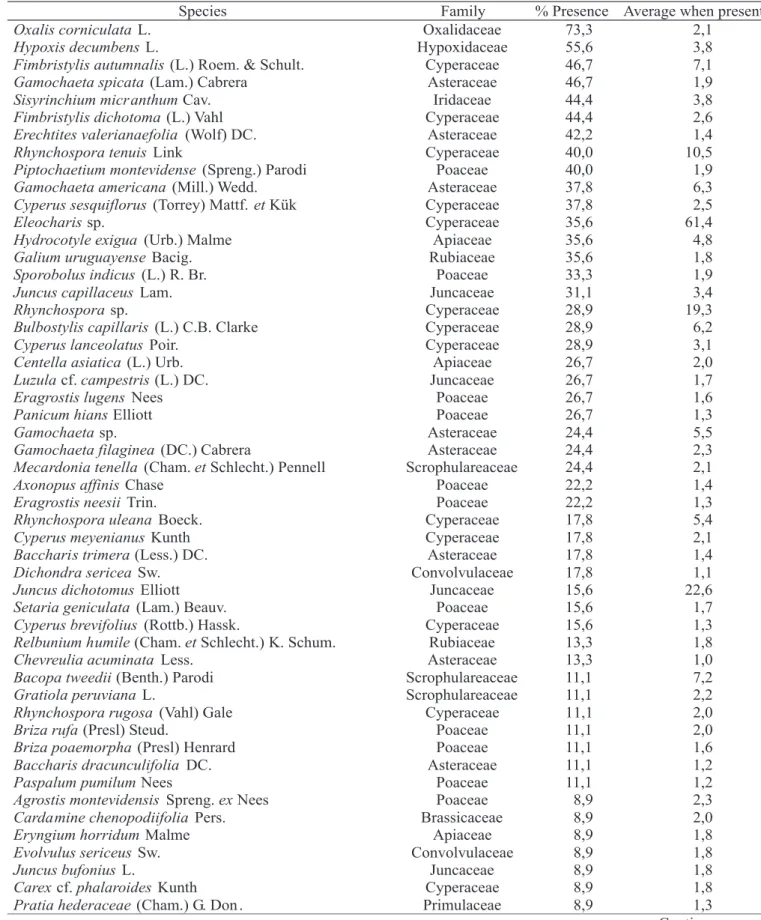
Species Family % Presence Average when present
Oxalis corniculataL. Oxalidaceae 73,3 2,1
Hypoxis decumbens L. Hypoxidaceae 55,6 3,8
Fimbristylis autumnalis (L.) Roem. & Schult. Cyperaceae 46,7 7,1
Gamochaeta spicata (Lam.) Cabrera Asteraceae 46,7 1,9
Sisyrinchium micr anthumCav. Iridaceae 44,4 3,8
Fimbristylis dichotoma(L.) Vahl Cyperaceae 44,4 2,6
Erechtites valerianaefolia (Wolf) DC. Asteraceae 42,2 1,4
Rhynchospora tenuis Link Cyperaceae 40,0 10,5
Piptochaetium montevidense (Spreng.) Parodi Poaceae 40,0 1,9
Gamochaeta americana (Mill.) Wedd. Asteraceae 37,8 6,3
Cyperus sesquiflorus (Torrey) Mattf.etKük Cyperaceae 37,8 2,5
Eleocharissp. Cyperaceae 35,6 61,4
Hydrocotyle exigua (Urb.) Malme Apiaceae 35,6 4,8
Galium uruguayense Bacig. Rubiaceae 35,6 1,8
Sporobolus indicus (L.) R. Br. Poaceae 33,3 1,9
Juncus capillaceus Lam. Juncaceae 31,1 3,4
Rhynchosporasp. Cyperaceae 28,9 19,3
Bulbostylis capillaris (L.) C.B. Clarke Cyperaceae 28,9 6,2
Cyperus lanceolatus Poir. Cyperaceae 28,9 3,1
Centella asiatica (L.) Urb. Apiaceae 26,7 2,0
Luzulacf.campestris(L.) DC. Juncaceae 26,7 1,7
Eragrostis lugens Nees Poaceae 26,7 1,6
Panicum hiansElliott Poaceae 26,7 1,3
Gamochaetasp. Asteraceae 24,4 5,5
Gamochaeta filaginea (DC.) Cabrera Asteraceae 24,4 2,3
Mecardonia tenella (Cham.etSchlecht.) Pennell Scrophulareaceae 24,4 2,1
Axonopus affinis Chase Poaceae 22,2 1,4
Eragrostis neesii Trin. Poaceae 22,2 1,3
Rhynchospora uleana Boeck. Cyperaceae 17,8 5,4
Cyperus meyenianus Kunth Cyperaceae 17,8 2,1
Baccharis trimera(Less.) DC. Asteraceae 17,8 1,4
Dichondra sericeaSw. Convolvulaceae 17,8 1,1
Juncus dichotomus Elliott Juncaceae 15,6 22,6
Setaria geniculata (Lam.) Beauv. Poaceae 15,6 1,7
Cyperus brevifolius (Rottb.) Hassk. Cyperaceae 15,6 1,3
Relbunium humile(Cham.etSchlecht.) K. Schum. Rubiaceae 13,3 1,8
Chevreulia acuminata Less. Asteraceae 13,3 1,0
Bacopa tweedii(Benth.) Parodi Scrophulareaceae 11,1 7,2
Gratiola peruviana L. Scrophulareaceae 11,1 2,2
Rhynchospora rugosa (Vahl) Gale Cyperaceae 11,1 2,0
Briza rufa(Presl) Steud. Poaceae 11,1 2,0
Briza poaemorpha(Presl) Henrard Poaceae 11,1 1,6
Baccharis dracunculifolia DC. Asteraceae 11,1 1,2
Paspalum pumilumNees Poaceae 11,1 1,2
Agrostis montevidensis Spreng.exNees Poaceae 8,9 2,3
Cardamine chenopodiifolia Pers. Brassicaceae 8,9 2,0
Eryngium horridum Malme Apiaceae 8,9 1,8
Evolvulus sericeusSw. Convolvulaceae 8,9 1,8
Juncus bufonius L. Juncaceae 8,9 1,8
Carexcf.phalaroides Kunth Cyperaceae 8,9 1,8
Pratia hederaceae(Cham.) G. Don . Primulaceae 8,9 1,3
Continue...
...continuation
Species Family % Presence Average when present
Panicum sabulorumLam. Poaceae 8,9 1,0
Bacopa monnieri(L.) Penn. Scrophulareaceae 6,7 4,3
Stipa nutansHack. Poaceae 6,7 2,7
Chevreulia sarmentosa(Pers.) Blake Asteraceae 6,7 2,0
Eragrostis bahiensisSchrad.exSchult. Poaceae 6,7 1,7
Oxalis lasiopetalaZucc. Oxalidaceae 6,7 1,3
Sisyrinchium vaginatumSpreng. Iridaceae 6,7 1,3
Cyperus aggregatus(Willd.) Endl. Cyperaceae 6,7 1,0
Briza macrostachya(Presl) Steud. Poaceae 6,7 1,0
Scleria hirtella(L.) Urb. Cyperaceae 6,7 1,0
Fimbristylis diphylla(Retz.) Vahl Cyperaceae 4,4 8,5
Bulbostylissp. Cyperaceae 4,4 4,5
Briza uniolae(Nees) NeesexSteud. Poaceae 4,4 3,5
Micropsis spathulata(Pers.) Cabrera Asteraceae 4,4 3,5
Cyclospermum leptophyllum(Pers.) SpragueexBrittonetP. Nilson.
Apiaceae 4,4 2,5
Sisyrinchiumcf.laxumOttoexSims Iridaceae 4,4 2,5
Conyza bonariensis(L.) Cronquist Asteraceae 4,4 2,0
Kyllinga vaginataLam. Cyperaceae 4,4 2,0
Spermacoce verticillataL. Rubiaceae 4,4 1,5
Plantago tomentosaLam. Plantaginaceae 4,4 1,5
Andropogon lateralisNees Poaceae 4,4 1,5
Oxalis corymbosaDC. Oxalidaceae 4,4 1,5
Mitracarpus hirtus(L.) DC. Rubiaceae 4,4 1,5
Richardia brasiliensisGomes Rubiaceae 4,4 1,0
Lotus subbiflorusLag. Fabaceae 4,4 1,0
Relbunium richardianum(Gill. exHook.etArn.) Hicken Rubiaceae 4,4 1,0
Gamochaeta simplicicaulis(Will.) Cabrera Asteraceae 4,4 1,0
Andropogon selloanus(Hack.) Hack. Poaceae 4,4 1,0
Richardia humistrata(Cham.etSchlecht.) Steud. Rubiaceae 4,4 1,0
Soliva pterosperma(Juss.) Less. Asteraceae 4,4 1,0
Tibouchinasp. Melastomataceae 4,4 1,0
Stipa filiculmisDelile Poaceae 4,4 1,0
Pterocaulonsp. Asteraceae 2,2 4,0
Stemodiacf.hyptoidesCham. & Schltdl. Scrophulareaceae 2,2 4,0
Pseudognaphalium cf.cheiranthifolium (Lam.) Hilliard & Burt
Asteraceae 2,2 3,0
Wahlenbergia linarioides (Lam.) DC. Campanulaceae 2,2 3,0
cf.Cyperussp. Cyperaceae 2,2 2,0
Gamochaeta calviceps(Fernald) Cabrera Asteraceae 2,2 1,0
Cyperus reflexusVahl Cyperaceae 2,2 1,0
Hypochoerissp. Asteraceae 2,2 1,0
Conyzasp. Asteraceae 2,2 1,0
Spermacoce capitataRuizetPav. Rubiaceae 2,2 1,0
Mikaniasp. Asteraceae 2,2 1,0
Facelis retusa(Lam.) Sch. Bip. Asteraceae 2,2 1,0
Schizachyrium tenerumNees Poaceae 2,2 1,0
Hyptissp. Lamiaceae 2,2 1,0
Paspalumsp. Poaceae 2,2 1,0
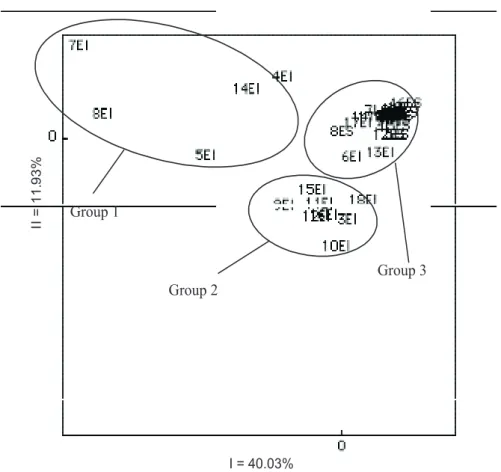
of environment, with low disturbance, is associated with a high abundance of perennial species (Harper, 1977). This fact determines an increase in the longevity of the vegetation species (Cook, 1980) and, a decrease in the vegetation spaces for regeneration. This community condition determines a reduction in the soil seed bank size, mainly for annual species. The result of ordination analysis of soil seed bank data is the dispersion diagram of sample units in Figure 1, considering axis I and II. This diagram allows visualization of three distinct groups or clusters of sample units, distributed according to environmental gradients of moisture and relief position: the first group is characterized by sample units from permanently wet grassland (permanently wet lowland areas-EI); the second group is comprised by other sample units from the lowlands (periodically wet soils in lowland areas-EI); and the third group is characterized by sample units from the uplands (ES) and intermediate sites (I), with three sample units of periodically wet lowland (6EI, 13EI and 17EI) areas included.
The significance test of the axis determined that only axis I is deemed significant (P=0.02), for a=0.05. Axis I represented 40% of data total variation. Axis II and III have probabilities of 0.246 and 0.17, respectively. Axis 1 most
correlated species were: Eleocharis sp. (-0.97), Bulbostylis capillaris (-0.79), Centella asiatica (-0.67), Rhynchospora tenuis (-0.60), Elyonurus cf. candidus (-0.58), Hyptis sp. (-0.58), Paspalum plicatulum (-0.58), Stemodia cf. hyptoides
(-0.58), Rhynchospora sp. (-0.53), Cuphea cf. lindmaniana
(-0.53), Cyperus sp. (-0.53), Hypericum silenoides (-0.53),
Panicum decipiens (-0.53), Gratiola peruviana (-0.51),
Cyperus lanceolatus (-0.49), Bacopa monnieri (-0.49), Oxalis lasiopetala (-0.41), Galium uruguayense (0.39), Relbunium humile (-0.36), Briza poaemorpha (-0.35), Paspalum pumilum
(-0.34), Hypoxis decumbens (0.34) and Piptochaetium montevidense (0.31). Species that showed high negative correlation with this axis characterize sample units on the left part of the diagram (wet grasslands), while species with high positive correlation characterize sample units more on the right.
Therefore, as well as in the vegetation, seed banks of the Eleocharis sp., Bulbostylis capillaris and Centella asiatica
species are associated with wetter habitats (permanently wet areas) and lowlands, represented by sample units on the left part of the diagram (Group 1); Rhynchospora sp., Cyperus lanceolatus, Cuphea cf. lindmaniana, Panicum decipiens,
...continuation
Species Family % Presence Average when present
Panicum decipiensNeesexTrin. Poaceae 2,2 1,0
Rhynchosporacf.rufa(Nees) Boeck. Cyperaceae 2,2 1,0
Paspalum plicatulumMichx. Poaceae 2,2 1,0
Senecio selloi(Spreng.) DC. Asteraceae 2,2 1,0
Luzulasp. Juncaceae 2,2 1,0
Mollugo verticillataL. Aizoaceae 2,2 1,0
Verbena litoralis Kunth Verbenaceae 2,2 1,0
Cyperussp. Cyperaceae 2,2 1,0
Cupheacf.lindmanianaKoehneexBacig. Lythraceae 2,2 1,0
Cupheacf.carthagenensis(Jacq.) J. F. Macbr. Lythraceae 2,2 1,0
Hypericum silenoidesJuss. Clusiaceae 2,2 1,0
Eragrostissp. Poaceae 2,2 1,0
Paspalum urvilleiSteud. Poaceae 2,2 1,0
Cerastiumsp. Cariophyllaceae 2,2 1,0
Briza subaristataLam. Poaceae 2,2 1,0
Cliococca selaginoides(Lam.) C.M. Rogers & Mildner Linaceae 2,2 1,0
Trifolium vesiculosumSavi Fabaceae 2,2 1,0
Elyonuruscf.candidus(Trin.) Hack. Poaceae 2,2 1,0
Bacchariscf.conyzoidesDC. Asteraceae 2,2 1,0
Desmanthus virgatus(L.) Willd. Fabaceae 2,2 1,0
Pterocauloncf.rugosum(Vahl) Malme Asteraceae 2,2 1,0
Panicum bergiiArechav. Poaceae 2,2 1,0
Pluchia laxifloraVell. Styracaceae 2,2 1,0
Paspalum plicatulum, Paspalum pumilum and Briza poaemorpha also have seed banks associated with wet habitats and lowlands in transition with intermediate sites (Group 2); soil seed banks of Galium uruguayense, Hypoxis decumbens
and Piptochaetium montevidense are associated with less wet habitats and uplands and intermediate sites, represented by sample units on the right part of the diagram (Group 3).
Cluster analysis of soil seed bank data confirmed these three groups shown in the ordination diagram (Figure 1). The cluster significance test was done for 2, 3 and 4 groups, resulting in probabilities of 0.19, 0.129 and 0.098, respectively. So, the null hypothesis that groups are stable, for a=0.05 must be accepted, which agrees with the hypothesis on the three distinct groups of sample units shown before.
Focht (2001) described two distinct groups in the vegetation communities of the study area: the first one comprised of sample units in lowlands and the second one constituted by sample units in uplands and intermediate sites, which differs from the three distinct soil seed banks groups observed in the area. In regards to size and composition of the soil seed bank, separation between upland and intermediate
sites was not observed. However, the third group registered by soil seed bank data analysis is due to the distinction of permanently wet and non-wet areas in the lowlands, probably because of the great accumulation of Eleocharis sp. seeds in wet areas, pointed out by the resemblance measure used for data analysis. It was possible to observe that Eleocharis sp. is a species with great potential to accumulate seeds in the soil, around 40958 seeds.m-2, even when present in only in
35.6% of the sample units, thus showing then an aggregated distribution. The species was responsible for the biggest quantity of buried seeds from the permanently wet soils in lowland areas (more details about soil seed bank size in Maia
et al., 2003). In this way, it is possible to say that the soil seed bank variation pattern was very similar to the vegetation variation pattern observed by Focht (2001) in the same study area.
The typical arc or shoe horse pattern formation of a gradual substitution of the species through an environmental gradient, which is very frequent in floristic vegetation studies such as the one registered in this area and year by Focht (2001) was not observed for soil seed bank data. However, I = 40.03%
II
=
11.
93%
Group 3 Group 2
Group 1
in the present study, soil seed bank composition and size characteristic of each sample unit in the diagram promoted a close distribution with clear distinction according to the moisture gradient and relief position.
Secondarily, the combined effects of superficial water run off moving seeds from the upper to the lower parts of the relief and a high frequency of gaps in intermediate parts of the relief can reduce soil seed bank size and contribute to this close distribution of the soil seed bank.
The ordination analysis of soil seed bank data done using euclidian distance measure, that considers the size or quantity of seeds in the soil, showed differences in seed bank size and composition between permanently wet areas in lower parts of the relief and less wet areas in upper parts of the relief were emphasized, showed a more abrupt transition than the one observed by Focht (2001) to the aboveground flora, using chord distance, that emphasizes just species wealth.
Based on the three groups identified in the soil seed bank,
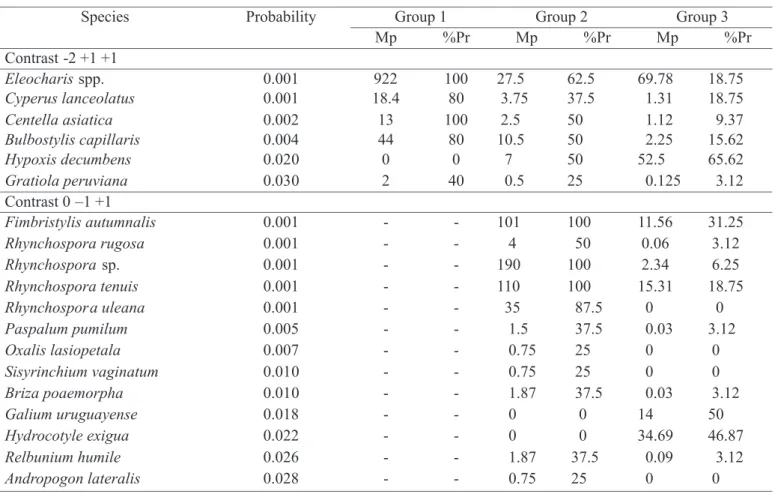
randomization tests were done according to the presence of each species, individually, trying to identify the species that could differentiate these three groups. Table 2 shows the rank of each differential species by its presence or absence, according to the probability in each contrast, besides species abundance average when present and percentage of presence in the squares of the group. Some of these species were the ones that showed the highest correlation with axis I of the ordination diagram (Figure 1) and that characterized the seed banks of the groups, in accordance with this analysis.
Group 1, constituted by sample units in permanently wet areas in low parts of the relief, was characterized by seed banks of Eleocharis sp., Cyperus lanceolatus, Centella asiatica, Bulbostylis capillaris and Gratiola peruviana.
Eleocharis sp. and C. asiatica were present in all sample units of this group, with an average of 922 and 13 per square, respectively (Table 2), showing that Eleocharis sp. was the most abundant. B. capillaris and C. lanceolatus were also
Group 1 Group 2 Group 3 Species Probability
Mp %Pr Mp %Pr Mp %Pr
Contrast -2 +1 +1
Eleocharisspp. 0.001 922 100 27.5 62.5 69.78 18.75
Cyperus lanceolatus 0.001 18.4 80 3.75 37.5 1.31 18.75
Centella asiatica 0.002 13 100 2.5 50 1.12 9.37
Bulbostylis capillaris 0.004 44 80 10.5 50 2.25 15.62
Hypoxis decumbens 0.020 0 0 7 50 52.5 65.62
Gratiola peruviana 0.030 2 40 0.5 25 0.125 3.12
Contrast 0 –1 +1
Fimbristylis autumnalis 0.001 - - 101 100 11.56 31.25
Rhynchospora rugosa 0.001 - - 4 50 0.06 3.12
Rhynchosporasp. 0.001 - - 190 100 2.34 6.25
Rhynchospora tenuis 0.001 - - 110 100 15.31 18.75
Rhynchospora uleana 0.001 - - 35 87.5 0 0
Paspalum pumilum 0.005 - - 1.5 37.5 0.03 3.12
Oxalis lasiopetala 0.007 - - 0.75 25 0 0
Sisyrinchium vaginatum 0.010 - - 0.75 25 0 0
Briza poaemorpha 0.010 - - 1.87 37.5 0.03 3.12
Galium uruguayense 0.018 - - 0 0 14 50
Hydrocotyle exigua 0.022 - - 0 0 34.69 46.87
Relbunium humile 0.026 - - 1.87 37.5 0.09 3.12
Andropogon lateralis 0.028 - - 0.75 25 0 0
abundant (44 and 18.4 per square, respectively), but present in only 80% of the sample units (Table 2). Boldrini (1993), in a survey carried out at the same Experimental Station, also observed that plants of Eleocharis sp. and C. asiatica
constituted a typical wet area community, and C. asiatica
shows a growing and well distinct increase along bad drained soils. The absence of Hypoxis decumbens also characterized this group.
Group 2, formed by sample units in low and not permanently wet parts of the relief, was characterized by the presence of Fimbristylis autumnalis, Rhynchopora rugosa, Rhynchopora sp., Rhynchospora tenuis, Rhynchopora uleana, Paspalum pumilum, Oxalis lasiopetala, Sisyrinchium vaginatum, Briza poaemorpha, Relbunium humile and
Andropogon lateralis soil seed banks. Table 2 shows that F. autumnalis and R. rugosa were identified in all sample units of the group, and were also the most abundant of the differential species (101 and 110 per square, respectively). Plants of A. lateralis, P. pumilum and C. lanceolatus are associated with poorly-drained soils, characterizing habitats in low parts of the relief (Boldrini, 1993). Briza poaemorpha, encountered in the Group 1, also occurs preferentially in low topographical zones of the relief as reported in the literature (Girardi-Deiro & Gonçalves, 1987; Boldrini, 1993). The absence of Galium uruguayense and Hydrocotyle exigua
promoted a difference in the composition of groups 2 and 3. Group 3, constituted by other sample units, was characterized by the presence of Galium uruguayense and
Hydrocotyle exigua soil seed banks and the absence of
Rhynchospora uleana, Oxalis lasiopetala, Sisyrinchium vaginatum and Andropogon lateralis species. H. exigua was the most abundant of the differential species of this group (34.69 per square), being present in 46.87% of the sample units of the group.
Jancey (1979) used a procedure similar to the one carried out in this study, ranking species with great diagnostic value in the differentiation between relief positions and finding groups of species able to reproduce successfully a group structure correlated with relief position. The methodological difference was that the author used the F Test for probabilities distribution.
Regarding the ranking of the differential species, in some cases, the presence of some variables that do not contribute to groups structure can, instead, obscure them (Wishart, 1969), so we cannot consider them as differential or diagnostic species even if they are those with high frequency in the group.
Variables that have shown deemed significant differences (P<0.1) in soil seed bank size and composition were relief position of the squares and soil factors correlated to moisture content, K, Al, organic matter, clay, basic saturation of the cation exchange capacity and exchangeable basics sum. These variables related to soil fertility determine the habitat conditions that permit the growth and reproduction of some species better adapted to it. In this way, it is important to emphasize that the relation between the environmental similarity and the soil seed bank variation pattern observed is indirect, as the environmental influence of soil fertility is in the distribution pattern of the vegetation above the ground.
In order to make it more visible, the variation pattern of the seed bank and the environmental factors that have influenced significant differences in soil seed bank size and composition, the ordination diagram of sample units according to the size and composition of the seed bank was done (Figu-re 2) by changing sample units´ names by the state of the variables. To draw a cluster analysis, sample units represented only by these eight variables were used. The result showed groups equivalent to the same pattern of the variable relief position that by itself can demonstrate the behavior of all the others.
According to these groups, sample units of groups 1 and 2, placed in lowlands, are in wet areas and, in some cases, permanently wet ones, with the highest organic matter content, lowest K content, lowest basic saturation of the cation exchange capacity, lowest exchangeable basics sum, and highest Al content, sometimes in levels toxic to the vegetation, characterizing habitats with medium and, mainly, low fertility.
Species such as Eleocharis sp., Bulbostylis capillaris, Centella asiatica, Rhynchospora tenuis, Elyonurus cf. candidus, Hyptis sp., Paspalum plicatulum, Stemodia cf. hyptoides, Cuphea
cf. lindmaniana, Cyperus sp. and Hypericum silenoides have a great correlation with these habitats, that can also be shown by their buried seeds.
According to McNaughton (1983), vegetation patterns are related to soil patterns influenced by water availability. It also happened in the pattern of the seed bank of the present study, as well as in other studies done in natural grasslands at the same Agronomic Experimental Station (Boldrini, 1993; Favreto et al., 2000). The study by Franceschi & Paro (1998), apud Boldrini (1993), showed that the relations observed among vegetation community groups demonstrate that some environmental factors are greatly associated with topographical gradients, in which species and communities regulate their distribution. The soil seed bank, in this case, shows similar behavior, where the relief position, which is related mainly to soil moisture, and other soil variables, promotes differences in its size and composition.
factor that can explain the variation in the seed bank size and composition in the study area, the cluster analysis of the sample units done with only eight significant environmental variables showed that some soil properties, such as moisture content, K, Al, organic matter, clay, basic saturation of the cation exchange capacity and exchangeable basics sum, associated with the relief, promote the variation pattern observed in the soil seed bank, which agrees with the distribution pattern of the vegetation above the ground observed by Focht (2001).
CONCLUSIONS
Most of the species identified in the soil seed bank were perennial, due to the low disturbed environment.
Relief position, associated with the combined effects of some soil properties related to it such as moisture content, K, Al, organic matter, clay, basic saturation of the cation exchange capacity and exchangeable basics sum, determines the observed variation pattern of the soil seed bank, as a reflection of the vegetation above the area.
REFERENCES
I = 40,03%
II
=
1
1
,9
3
%
Group 3
Group 2
Group 1
Baskin, J.M.; Baskin, C.C. Physiology of dormancy and germination in relation to seed bank ecology. In: Leck, M.A.; Parker, V.T.; Simpson, R.L. (Ed.). Ecology of soil seed banks. San Diego: Academic Press, 1989. p.53-63.
Baskin, J.M.; Baskin, C.C. Role of temperature and light in the germination ecology of buried seeds of weedy species of disturbed forests. Canadian Journal of Botany, Ottawa, v.70, p.589-592, 1992. Bekker, R.M., Verweij, G.L., Smith, R.E.N., Rein, R., Bakker, J.P.; Schneider, S. Soil seed banks in European grasslands: does land use affect regeneration perspectives? Journal of Applied Ecology,
London, v.34, p.1293-1310, 1997.
Bekker, R.M., Knevel, I.C., Tallowin, J.B.R., Troost, E.M.L.; Bakker, J.P. Soil nutrient input effects on seed longevity: a burial experiment with fen-meadow species. Journal of Functional
Ecology, London, v.12, p.673-682, 1998.
Bergamaschi, H.; Guadagnin, M.R. Agroclima da Estação
Experimental Agronômica/UFRGS. Porto Alegre: Universidade
Federal do Rio Grande do Sul, 1990. 41p.
Boldrini, I.I. Dinâmica de vegetação de uma pastagem natural sob diferentes níveis de oferta de forragem e tipos de solos, Depressão
Central, RS. 1993. 262f. Tese (Doutorado em Zootecnia)
-Faculdade de Agronomia, Universidade Federal do Rio Grande do Sul, Porto Alegre, 1993.
Boldrini, I.I. Campos do Rio Grande do Sul: caracterização fisionômica e problemática ocupacional. Boletim do Instituto de
Biociências/UFRGS, Porto Alegre, v.56, p.1-39, 1997.
Casalinho, H. D. Manual para levantamento utilitário do meio
físico em nível de propriedade agrícola. Pelotas: UFPel, 1997.
28p.
Comissão de Fertilidade do Solo RS/SC. Recomendações de adubação e de calagem para os estados do Rio Grande do Sul e de
Santa Catarina. Passo Fundo: EMBRAPA/CNPQ, 3 ed., 1995.
223p.
Cook, R. The biology of seeds in the soil. In: Solbrig, O.T. (Ed.). Demography and evolution in plant populations. Botanical
Monographs, Berkeley, v.15, p.107-129, 1980.
Egley, G.H. Simulation of weed seed germination in soil. Weed
Science, Lawrence,v.2, p.67-89, 1986.
EmPRESA braSILEIRA DE pESQUISA aGROPECUÁRIA
Classificação dos solos brasileiros. Brasília: EMBRAPA, 1999.
412p.
Escosteguy, C.M.D. Avaliação agronômica e uma pastagem
natural sob níveis de pressão de pastejo. 1990. 231f. Dissertação
(Mestrado em Zootecnia) - Faculdade de Agronomia, Universidade Federal do Rio Grande do Sul, Porto Alegre, 1990. Favreto, R., Medeiros, R.B.; Pillar, V.P. Composição do banco de sementes do solo de um campo natural sujeitos a intensidades de pastejo e posições de relevo. In: Reunião do Grupo Técnico em Forrageiras do Cone Sul - Zona Campos, 18, 2000, Guarapuava.
Anais... Guarapuava: UFPR, 2000. v.1, p.233-235.
Fenner, M. Ecology of seed banks. In: Kigel, J.; Galili, G. (Ed.).
Seed development and germination. New York: Marcel de Dekker
Inc., 1955. p.507-528.
Focht, T. Padrões espaciais em comunidades vegetais de um campo
pastejado e suas relações com fatores de ambiente. Porto Alegre.
2001. 157f. Dissertação (Mestrado em Ecologia) - Instituto de Biociências, Universidade Federal do Rio Grande do Sul, 2001. Girardi-Deiro, A.M.; Gonçalves, J.O.N. Estrutura da vegetação de um campo natural submetido a 3 cargas animais na região sudoeste do RS. In: EMPRESA BRASILEIRA DE PESQUISA AGROPECUÁRI A. Coletânea de pesquisas: forrageiras. Bagé: EMBRAPA/CNPO, 1987. p.33-62.
Grime, J.P. Seed banks in ecological perspective. In: LECK, M.A.; PARKER, V.T.; SIMPSON, R.L. (Ed.). Ecology of soil seed banks. London: Academic Press, 1989. p.15-22.
GROSS, K.L. A comparison of methods for estimating seed numbers in the soil. Journal of Ecology, London, v.78, p.1079-1093, 1990. HARPER, J. L. Population biology of plants. London: Academic Press., 1997. p.33-111.
HILHORST, H.W.M.; KARSSEN, C.V. The role of light and nitrate in seed germination. In: TAYLORSON, R.B. (Ed.). Recent advances
in the development and germination of seed. New York: Plenum
Press, 1990. p.191-206.
JANCEY, R.C. Species ordering on a variance criterion. Vegetatio
Helvetica, Neuchâtel, v.39, n.1, p.59-63, 1979.
KARSSEN, C.M.; HILHORST, H.W.M. Effect of chemical environment on seed germination. In: FENNER, M. (Ed.). Seed -The Ecology of Regeneration in Plant Communities. Oxon: CAB International, 1993. p.327-348.
LÓPEZ-MARIÑO, A., LUIS-CALABUIG, E., FILLAT, F.; BERMUDEZ, F.F. Floristic composition of established vegetation and the soil seed bank in pasture communities under different traditional management regimes. Journal of Agricultural
Ecosystems and Environment, Amsterdam, v.78, n.3, p.273-282,
2000.
MAIA, F.C.; MEDEIROS, R.B.; PILLAR, V.P.; CHOLLET, D.M.S.; OLMEDO, M.O.M. Composição, riqueza e padrão de variação do banco de sementes do solo em função da vegetação de um ecossistema de pastagem natural. Iheringia, Porto Alegre, v.58, n.1, p.61-80, 2003.
MCNAUGHTON, S.J. Serengeti grassland ecology: the role of composite environmental factors and contingency in community organization. Journal of Ecological Monographs, Durham, v.53, n.6, p.291-320, 1983.
MEDEIROS, R.B.; STEINER, J.J. Influence of temperate grass seed rotation systems on weed seed soil bank composition. Revista
Brasileira de Sementes, Campinas, v.24, n.1, p. 118-128, 2002.
MELLO, O., LEMOS, R.C., ABRÃO, P.U.R., SANTOS, M.C.L.; CARVALHO, A.M. Levantamento em séries do Centro Agronômico. Revista da Faculdade de Agronomia e Veterinária, Porto Alegre, v.1, p.7-155, 1966.
MILBERG, P. Seed bank in a 35-year-old experiment with different treatments of a semi-natural grassland. Acta
Oecologica-International Journal of Ecology, London, v.13, n.6, p.793-752,
1992.
MORENO, J.A. Clima do Rio Grande do Sul. Porto Alegre: Secretaria da Agricultura, 1961. 41p.
testing with MULTIV. Coenoses, Gorizia, v.12, p.145-148, 1997. PILLAR, V.P. MULTIV: aplicativo para análise multivariada e testes de hipóteses - versões para Macintosh e Windows. Porto Alegre: UFRGS/Departamento de Ecologia, 1994-2001.
ROBERTS, H.A.; NEILSON, J.E. Seed bank of soils under vegetable cropping in England. Weed Research, London, v.22, p.13-16, 1982. SAMIMY, C.; KHAN, A.A. Secondary dormancy, growth-regulator effects, and embryo growth potential in curly dock (Rumex crispus) seeds. Weed Science, Lawrence, v.31, p.153-158, 1983.
SECRETARIA DA AGRICULTURA E DO
ABASTECIMENTO-RS. Observações meteorológicas no estado do Rio Grande do
Sul. Porto Alegre: Secretaria da Agricultura, 1979. 270p.
SESTREN-BASTOS, M.C. Estudo da vegetação e suas relações
com gradientes ambientais em ecótono de campo e mata ciliar em Eldorado do Sul, RS. 1997. 166f. Dissertação (Mestrado em Ecologia) - Instituto de Biociências, Universidade Federal do Rio Grande do Sul, Porto Alegre, 1997.
UNIVERSIDADE CATÓLICA DE PELOTAS/INSTITUTO TÉCNICO DE PESQUISA E ASSESSORIA. Vinte e cinco anos de agropecuária na zona sul-RS: levantamento estatístico 1975/2000. Pelotas: Educat, 2001. 606p.
WILDI, O.; ORLÓCI, L. Numerical exploration of community patterns. The Hague: SPB Academic Publishing, 1990.