Atlantic Rain Forest of Ilha Grande, Angra dos Reis, RJ, Brazil
Nunes, GKM.* and Santos, SB.
Programa de Pós-Graduação em Ecologia e Evolução – PPGEE, Laboratório de Malacologia Límnica e Terrestre, Universidade do Estado do Rio de Janeiro – UERJ,
Rua São Francisco Xavier, 524, PHLC, sala 224, CEP 20550-013, Rio de Janeiro, RJ, Brazil *e-mail: [email protected]
Received November 30, 2010 – Accepted February 1, 2011 – Distributed February 29, 2012 (With 4 figures)
Abstract
The distribution and abundance of terrestrial molluscs are affected by environmental factors, but data are lacking for Brazilian land snails. The aim of this study was to understand the relationship between measured environmental factors and the land-snail species composition of two hillsides covered with Atlantic Rain Forest on Ilha Grande. On each
hillside, five plots located at 100 m intervals between 100 to 500 m asl were chosen. Each plot was sampled by carrying
out timed searches and collecting and sorting litter samples from ten quadrats of 25 × 75 cm. A range of environmental data was measured for each of the quadrats in a plot. A Cluster Analysis was carried out for the richness and abundance data. The environmental variables were analysed using a Pearson Correlation Matrix and Discriminant Analysis. Our results show that the two mountains are similar in species richness, but species composition and abundance are
different, probably reflecting observed differences in environmental conditions. The environmental factors associated
with compositional variation between the two mountains were: atmospheric temperature, soil temperature, litter depth, and relative air humidity. Distinct luminosity and canopy closure conditions were related to the composition of the land-snail community of one hillside.
Keywords: canopy closure, Gastropoda, litter depth, relative air humidity, temperature.
Fatores ambientais afetando a distribuição de moluscos terrestres
na Mata Atlântica da Ilha Grande, Angra dos Reis, RJ, Brasil
Resumo
A distribuição e a abundância de moluscos terrestres são afetadas por fatores ambientais, mas não existem dados para moluscos terrestres no Brasil. O objetivo deste trabalho foi entender a relação entre as variáveis ambientais aferidas e a composição da malacofauna terrestre em duas vertentes cobertas por Mata Atlântica, na Ilha Grande. Em cada vertente, foram escolhidos cinco plots, com intervalos de 100 m de altitude, de 100 a 500 m de altitude. Em cada plot, foram feitas a coleta direta e a coleta de serapilheira, utilizando 10 quadrats de 25 × 75 cm. Os dados ambientais foram quantificados
em cada quadrat. Com riqueza e abundância, realizou-se análise de grupamento. Com as variáveis ambientais, foram feitas a Matriz de Correlação de Pearson e a Análise Discriminante. Os resultados obtidos mostraram que, nas duas vertentes, a riqueza foi semelhante, mas a composição e a abundância foram diferentes, o que provavelmente ocorreu
devido a diferenças encontradas nas variáveis ambientais. Os fatores do ambiente que influenciaram a distribuição
dos moluscos terrestres nas duas vertentes foram: temperatura ambiente e do solo, profundidade da serapilheira e
umidade relativa do ar. A luminosidade e o percentual de fechamento do dossel também influenciaram a distribuição
da malacofauna na vertente continental.
1. Introduction
Studies of the relationship between the distribution and abundance of terrestrial molluscs and environmental factors are scarce (Hermida et al., 1995; Barker and Mayhill,
1999; Millar and Waite, 2002; Horsák et al., 2007), and
there are no published data on Brazilian land snails. Despite the importance of such research for developing appropriate conservation strategies (Lange and Mwinzi,
2003; Horsák et al., 2007), much of the literature on land
molluscs focuses on taxonomy, with ecological studies
being few and far between (Tattersfield et al., 2001).
Land snails have an important role in the ecosystems in which they live: they contribute to litter decomposition and concentration of soil calcium and are an important food
source for other animals (Lange, 2003). Their generally short life span (i.e. a few months or years) and their limited
powers of dispersal make them excellent bioindicators
(Watters et al., 2005).
The Atlantic Rain Forest is a biodiversity hotspot
(Myers et al., 2000). Although the land snails account for a significant component of faunistic endemism in this
region, it has been poorly studied (Thomé et al., 2006).
Our study attempted to address this gap in knowledge by investigating the relationship between species composition and the environmental variation for the land snails of two
hillsides on Ilha Grande (Angra dos Reis, Rio de Janeiro),
which forms part of the Atlantic Rain Forest.
2. Material and Methods
The study was conducted on two hillsides on Ilha
Grande (23° 05’-23° 15’ S and 44° 05’-44° 23’ W), Angra dos Reis (RJ) (Figure 1): Jararaca’s Trail (oceanic hillside) and Pico do Papagaio’s Trail (continental hillside).
Sampling was carried out from December 2004 to
March 2005. On each hillside, five plots were sampled
at 100 m elevation intervals between 100 to 500 m, with each plot being located at least 50 m from the main trail to
minimise edge effects (Tattersfield et al., 2001; Santos et al., 2006). Each of the plots was sampled by collecting litter
and carrying out time searches for shells and live animals
(Getz and Uetz, 1994; Emberton et al., 1996).
Litter was collected down to the soil surface from ten quadrats of 25 × 75 cm, stored in labelled plastic bags, and later, transported to the laboratory of the Centro de Estudos
Ambientais e Desenvolvimento Sustentável (CEADS) at
Vila Dois Rios, Ilha Grande, where it was searched for snails with the naked eye. All specimens detected were observed
under a stereomicroscope (maximum magnification of 70×), and morphotypes separated and quantified. The time
searches involved seven people sampling for 30 minutes, totalling 3.5 man hours per plot.
The following environmental variables were measured for each of the quadrats in a plot: litter depth, atmospheric
temperature (maximum, average and minimum), soil
temperature, relative air humidity (maximum, average and
minimum), luminosity, canopy closure, litter moisture (leaf and branch), number of individuals and morphotypes of
herbaceous plants up to 50 cm height, number of individuals and morphotypes of individuals of herbaceous plants up
to 50 cm height (Menez, 2002).
We used cluster analysis to assess the similarity in species composition among plots. As the groups formed in the biological cluster analysis, the collection areas were grouped to perform a discriminant analysis using environmental data.
A Pearson correlation matrix was constructed for the environmental variables to see if there was a high inter-correlation among them. When two variables were highly
inter-correlated (value > 0.65 in module), one was excluded from the discriminant analysis (Klecka, 1982) in order to
minimise overestimating their effect. The variables excluded from both hillsides were: average atmospheric temperature, number of morphotype of plants from 50 cm to one metre in height and minimum relative air humidity. The minimum atmospheric temperature and number of morphotype of
herbaceous plants up to 50 cm high were excluded for the oceanic hillside, and moisture of the branches in the litter was excluded for the continental hillside.
To compare the environmental data of the two hillsides we used Analysis of Variance.
3. Results
On the oceanic hillside we collected 523 specimens and 33
species. The most abundant family was Systrophiidae (42%).
The most abundant species were Happiella sp. (15.5%), Stephanoda sp. (14%) and Habroconus semenlini Moricand,
1846 (11%). The species Radiodiscus sp. A, Megaspira sp., Bulimulidae A, Rhinus sp. A, Systrophiidae A and
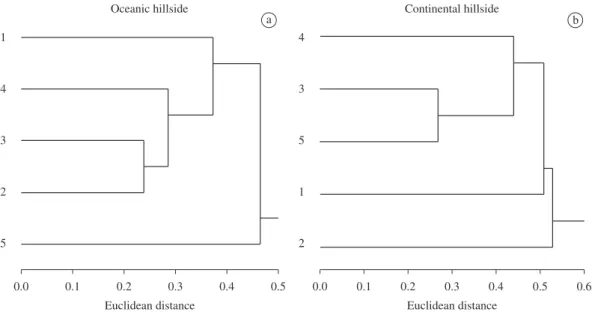
Streptartemoncrossei (Pfeiffer, 1867) were exclusive of this hillside (Table 1). The Cluster Analysis yielded three
clear groups: group A consisting of the plot at 100 m asl, group B with the plots at 200, 300 and 400 m asl and group
C with the plot at 500 m asl (Figure 2a).
On the continental hillside we collected 458 specimens and 32 species. The most abundant family
was Diplommatinidae (34%), followed by Systrophiidae (32%). The more abundant species were Adelopoma sp.
(34%), Happiella sp. (16%) and Opeas beckianum (Pfeiffer,
1846) (8.5%). The species Ptychodon sp. A, Ptychodon sp. B, Stephanoda sp. A, Stephanoda sp. B and Systrophiidae
B were exclusive of this hillside (Table 1). Again, three
groups were generated by the Cluster Analysis: group A with the plot at 100 m asl, group B with the plot at of 200 m asl and group C joining the plots at 300, 400 and
500 m asl (Figure 2b).
Except for litter depth and number of herbaceous plant from 50 cm to one metre high, the measured environmental
b a
Table 1. Species collected abundance on two hillsides at Ilha Grande, RJ, Brazil.
Species Oceanic hillside Continental hillside
1 2 3 4 5 Total 1 2 3 4 5 Total
Alcadia sp. 0 8 3 0 6 17 1 0 0 0 0 1
Helicina sp. 0 3 2 4 5 14 3 2 0 0 0 5
Neocyclotus prominulus (d’Orbigny, 1835) 1 8 10 4 0 23 0 8 3 3 0 14
Adelopoma sp. 0 4 3 1 6 14 0 140 6 0 10 156
Radiodiscus sp. 4 0 0 0 0 4 0 1 1 0 7 9
Radiodiscus sp. A 0 0 0 0 1 1 0 0 0 0 0 0
Ptychodon schuppi (Suter, 1900) 0 0 7 0 4 11 0 1 1 0 0 2
Ptychodon sp. A 0 0 0 0 0 0 1 26 3 0 0 30
Ptychodon sp. B 0 0 0 0 0 0 0 2 0 1 0 3
Stephanoda sp. 0 5 0 5 63 73 0 1 0 1 1 3
Stephanoda sp. A 0 0 0 0 0 0 0 1 0 0 1 2
Stephanoda sp. B 0 0 0 0 0 0 0 1 1 0 0 2
Lilloiconcha superba (Thiele, 1927) 3 2 1 4 2 12 0 3 0 0 0 3
Habroconus semenlini Moricand, 1846 14 3 8 26 7 58 0 4 1 3 0 8
Leptinaria unilamellata (d’ Orbigny, 1835) 0 1 0 0 0 1 5 0 1 0 1 7
Lamellaxis gracilis (Hutton, 1834) 1 0 0 1 1 3 0 0 0 1 1 2
Opeas beckianum (Pfeiffer, 1846) 7 0 0 0 0 7 39 0 0 0 0 39
Obeliscus sp. 2 1 1 1 0 5 0 0 0 3 0 3
Megaspira sp. 0 5 0 0 0 5 0 0 0 0 0 0
Bulimulidae A 0 0 0 0 5 5 0 0 0 0 0 0
Rhinus sp. A 2 14 3 1 0 20 0 0 0 0 0 0
Rhinus sp. B 0 0 0 0 2 2 0 1 0 0 0 1
Rhinus ciliatus (Gould, 1846) 0 1 4 2 0 7 1 1 0 0 0 2
Simpulopsis sp. A 0 1 0 0 0 1 1 0 1 0 1 3
Simpulopsis sp. B 0 0 2 0 0 2 0 0 1 0 0 1
Happia sp. 6 1 2 8 0 17 0 9 2 0 5 16
Happia vitrina (Wagner, 1827) 1 3 1 6 9 20 0 3 0 0 0 3
Happiella banghaasi (Thiele, 1927) 1 4 4 0 2 11 3 4 4 0 3 14
Happiella sp. 35 10 14 10 12 81 8 22 24 7 13 74
Miradiscops sp. 5 17 9 12 2 45 2 26 3 2 2 35
Systrophiidae A 7 18 13 10 0 48 0 0 0 0 0 0
Systrophiidae B 0 0 0 0 0 0 6 0 0 0 0 6
Scolodonta sp. 0 1 0 1 0 2 0 2 1 0 0 3
Streptartemon crossei (Pfeiffer, 1867) 0 1 0 0 0 1 0 0 0 0 0 0
Streptaxis sp. 0 1 1 1 0 3 3 2 0 0 0 5
Solaropsis brasiliana (Deshayes, 1831) 0 1 0 1 1 3 1 0 0 0 1 2
Zonitoides sp. 0 0 1 1 0 2 2 1 0 0 0 3
Veronicellidae 0 3 2 0 0 5 0 0 0 0 1 1
Abundance 89 116 91 99 128 523 76 261 53 21 47 458
Richness 14 24 20 19 16 33 14 22 15 8 13 32
variables were significantly different between the hillsides (Table 2).
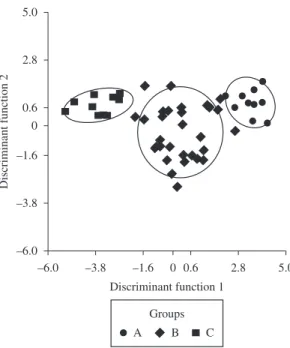
The result of Discriminant Analysis significantly
distinguished the biological groups from the oceanic hillside (Wilks’ lambda = 0.111; Df = 11, 2, 47; p = 0.0000) (Figure 3)
and from the continental side (Wilks’ lambda = 0.021;
Df = 12, 2, 47; p = 0.0000) (Figure 4).
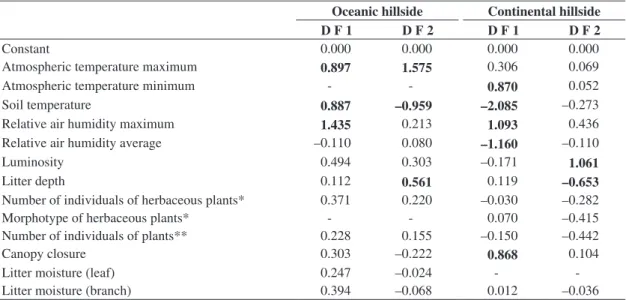
The relative air humidity, the litter depth, the atmospheric temperature and soil temperature determined the biological groups found on both hillsides. The luminosity and the canopy closure also determined the biological groups
found on the continental hillside (Table 3).
4. Discussion
Systrophiidae was the most abundant family on the two hillsides, corroborating previous results from Ilha
Grande (Santos and Monteiro, 2001) and from the Lower Urubamba Forest, Peru (Ramírez et al., 2001). Systrophiidae
seems to be found frequently and often abundantly across Central and South America from Mexico to Argentina
and Chile (Hausdorf, 2006). Species richness was similar
for both hillsides, but the composition and abundance of species varied. This is probably related to differences in environmental variables between the studied hillsides, differences in disturbance history and naturally patchy distribution of species. Adelopoma sp. and Stephanoda sp. showed high abundance, apparently because of their gregarious behaviour in the present collection site.
There was significant environmental variation between
the two hillsides, with all variables being different except for litter depth and number of individuals of herbaceous plants up to 50 cm height. Environmental variation may
reflect the fact that the hillsides face in different directions,
with humid winds from the sea resulting in higher rates of
precipitation on the oceanic hillside (Rocha et al., 2003), and this may influence the other environmental variables
measured.
The environmental factors which were associated with variation in species composition between the two hillsides were atmospheric temperature, litter depth, soil temperature and relative air humidity. It is well known that snails depend on water or high humidity for an active life
(Baker, 1958) being relatively susceptible to desiccation,
Table 2. Analysis of variance performed with the environmental data comparing the two hillsides on Ilha Grande, Angra dos Reis, RJ.
F p
Atmospheric temperature maximum 8.36 0.00
Atmospheric temperature average 10.15 0.00
Atmospheric temperature minimum 25.89 0.00
Soil temperature 4.90 0.02
Relative air humidity maximum 16.11 0.00
Relative air humidity average 13.21 0.00
Relative air humidity minimum 74.82 0.00
Luminosity 15.85 0.00
Litter depth 0.16 0.68
Number of individuals of herbaceous plants* 0.39 0.53
Morphotype herbaceous plants* 4.32 0.04
Number of individuals of herbaceous plants** 11.38 0.00
Morphotype of herbaceous plants** 10.47 0.00
Canopy closure 6.17 0.01
Litter moisture (leaf) 161.40 0.00
Litter moisture (branch) 84.65 0.00
*Up to 50 cm height; **: from 50 cm to one metre height; bold numbers indicate p < 0.05.
which tends to restrict them (Getz, 1974). Moist conditions
are necessary for land-snail respiration and reproduction
(Coney et al., 1982) and for the production of mucus, which is vital for locomotion (Cameron, 1970). Our results agree with Boycott’s (1934) pioneering work on
land snails as well as with studies carried out over the last decade in several countries (Millar and Waite, 2002;
Martin and Sommer, 2004; Tattersfield et al., 2006; Horsák et al., 2007). According to Emberton et al. (1999)
snail diversity can be explained by the increased humidity
of the environment. The influence of litter depth on the
communities of terrestrial molluscs was also reported by
Getz and Uetz (1994) and Cameron (1986).
Two additional environmental variables, luminosity and canopy closure, were associated with the composition of the land-snail fauna of the continental hillside. These variables are related, and are likely to have a substantial
impact on land snail distributions through their influence
on humidity and atmospheric temperature. Similar results
were found by Shimek (1930), Millar and Waite (2002), Lange and Mwinzi (2003) and Martin and Somer (2004) for canopy closure, and by Nekola (2003) for luminosity.
Shimek (1930) stated that an association exists between
vegetation type and distribution of molluscs. A similar
result was found by Emberton et al. (1996), Baker and Mayhill (1999), Millar and Waite (2002) and Martin and Somer (2004). However, this study did not find a
consistent relationship between the distribution of molluscs with the number and the abundance of morphotypes of herbaceous plants, which could be partially explained by the heterogeneity of the Atlantic Forest.
Our study showed that despite similar species richness, the two hillsides are characterised by differences in land-snail composition and abundance, which are associated to distinct environmental conditions on the two hillsides. The luminosity and the canopy closure also determined the biological groups found on the continental hillside. The relative air humidity, the litter depth, the atmospheric and soil temperature affected the distribution of land snails on both studied hillsides.
Table 3. Coefficients of the Canonical Discriminant Function constructed from the biological groups on two hillsides on Ilha Grande, RJ, Brazil.
Oceanic hillside Continental hillside
D F 1 D F 2 D F 1 D F 2
Constant 0.000 0.000 0.000 0.000
Atmospheric temperature maximum 0.897 1.575 0.306 0.069
Atmospheric temperature minimum - - 0.870 0.052
Soil temperature 0.887 –0.959 –2.085 –0.273
Relative air humidity maximum 1.435 0.213 1.093 0.436
Relative air humidity average –0.110 0.080 –1.160 –0.110
Luminosity 0.494 0.303 –0.171 1.061
Litter depth 0.112 0.561 0.119 –0.653
Number of individuals of herbaceous plants* 0.371 0.220 –0.030 –0.282
Morphotype of herbaceous plants* - - 0.070 –0.415
Number of individuals of plants** 0.228 0.155 –0.150 –0.442
Canopy closure 0.303 –0.222 0.868 0.104
Litter moisture (leaf) 0.247 –0.024 -
-Litter moisture (branch) 0.394 –0.068 0.012 –0.036 *Up to 50 cm height; **: from 50 cm to one metre height; D F: Discriminant function; bold numbers indicate high values.
Acknowledgements - This study is part of GKMN’s Master’s Dissertation at the Programa de Pós- Graduação em Biologia at UERJ. SBS received financial support from Faperj (APQ1 E-26-110.430/2007 and APQ1 E-26/110.402/2010). We thank CNPq for GKMN’s undergraduate scholarship (135134/2005-7); CAPES for GKMN’s scholarship (2009-2013). IBAMA for the Sisbio license (10812-1); INEA for license (18/2007); Dr. R.S. Absalão (UFRJ) for helping in statistic analyses; Dr. D. Raheem (The Natural History Museum) for a critical reading of this manuscript; LEM Lacerda for the map; the team of the Laboratory of Malacology (UERJ) for helping with fieldwork and CEADS of UERJ for logistic support.
References
BAKER, HB., 1958. Land snail dispersal. The Nautilus, vol. 71, p. 141-148.
BARKER, GM. and MAYHILL, PC., 1999. Patterns of diversity and habitat relationships in terrestrial mollusc communities of the Pukeamaru Ecological District, northeastern New Zealand. Journal of Biogeography, vol. 26, p. 215-238. http://dx.doi. org/10.1046/j.1365-2699.1999.00267.x
BOYCOTT, AE., 1934. The habitats of land mollusca in Britain. Journal of Ecology, vol. 22, p. 1-38. http://dx.doi. org/10.2307/2256094
CAMERON, RAD., 1970. The survival, weight-loss and behaviour of three species of land snail in conditions of low humidity. Journal of Zoology, vol. 160, p. 143-157.
-, 1986. Environment and diversities of forest snail faunas from Coastal British Columbia. Malacologia, vol. 27 p. 341-355. CONEY, CC., TARPLEY, WA., WARDEN, JC. and NAGEL, JW., 1982. Ecological studies of land snails in the Hiwassee river basin of Tennessee, U.S.A. Malacological Review, vol. 15, p. 69-106.
EMBERTON, KC., PEARCE, TA. and RANDALANA, R., 1996. Quantitatively sampling land-snail species richness in Madagascan rainforest. Malacologia, vol. 38, no. 1-2, p. 203-212.
-, 1999. Molluscan diversity in the unconserved Vohimena and the conserved Anosy Mountain Chains, Southeast Madagascar. Biological Conservation, vol. 89 p. 183-188. http://dx.doi. org/10.1016/S0006-3207(98)00135-9
GETZ, LL., 1974. Species diversity of terrestrial snails in the great Smoky Montains. The Nautilus, vol. 88, p. 6-9.
GETZ, LL. and UETZ, GW., 1994. Species diversity of terrestrial snail in the Southern Appalachian Mountains, U.S.A. Malacological Review, vol. 27, p. 61-74.
HAUSDORF, B., 2006. The systematic position of Scolodonta Doring, 1875 and Scolodontidae H.B. Baker, 1925 (Gastropoda: Pulmonata). Zoologischer Anzeiger, vol. 245, p. 161-165. http:// dx.doi.org/10.1016/j.jcz.2006.05.007
HERMIDA, J., ONDINA, P. and OUTEIRO, A., 1995. Ecological factors affecting the distribution of the gastropods Aegopinella nitidula (Draparnaud, 1805) and Nesovitrea hammonis (Ström, 1765) in nortwest Spain. Journal of Conchology, vol. 35, p. 275-282. HORSÁK, M., HÁJEK, M., TICHÝ, L. and JURICKOVÁ, L., 2007. Plant indicator values as tool for land mollusc autecology
assessment. Acta Oecologica, vol. 32, p. 161-171. http://dx.doi. org/10.1016/j.actao.2007.03.011
KLECKA, W., 1982. Discriminant analysis. Sage Publications. 71p. Sage University Paper Series on Quantitative Applications in the Social Sciences, 07-0119.
LANGE, CN., 2003. Environmental factors influencing land snail diversity patterns in Arabuko Sokoke forest, Kenya. African Journal of Ecology, vol. 41, p. 352-355. http://dx.doi. org/10.1111/j.1365-2028.2003.00482.x
LANGE, CN. and MWINZI, M., 2003. Snail diversity, abundance and distribution in Arabuko Sokoke forest, Kenya. African Journal of Ecology, vol. 41, p. 61-67. http://dx.doi.org/10.1046/j.1365-2028.2003.00412.x
MARTIN, K. and SOMMER, M., 2004. Relationships between land snail assemblage patterns and soil properties in temperate-humid forest ecosystems. Journal of Biogeography, vol. 31, p. 531- 545. http://dx.doi.org/10.1046/j.1365-2699.2003.01005.x MENEZ, A., 2002. The standardization of abiotic variable data collection in land mollusc research. Journal of Conchology, vol. 37, no. 5, p. 581- 583.
MILLAR, AJ. and WAITE, S., 2002. The relationship between snails, soil factors and calcitic earthworm granules in a coppice woodland in Sussex. Journal of Conchology, vol. 37, no. 5, p. 483- 503.
MYERS, N., MITTERMEIER, RA., MITTERMEIER, CG., FONSECA, GAB. and KENT, J., 2000. Biodiversity hotspots for conservation priorities. Nature, 403, p. 853-858. PMid:10706275. http://dx.doi.org/10.1038/35002501
NEKOLA, JC., 2003. Large-scale terrestrial gastropod community composition patterns in the Great Lakes region of North America. Diversity and Distribution, vol. 9, p. 55-71.
RAMÍREZ, R., CÓRDOVA, S. and CARO, K., 2001. Diversity of Land Mollusks in the Bamboo-dominated Forest of the Lower Urubamba Region, Peru. In ALONSO, A., DALLMEIER, F. and CAMPBELL, P. Urubamba: The Biodiversity of a Peruvian Rain Forest. Smithsonian Inst. p. 49-53.
ROCHA, CFD., BERGALLO, HG., ALVES, MAS. and SLUYS MV., 2003. A biodiversidade nos grandes remanescentes florestais do Estado do Rio de Janeiro e nas restingas da Mata Atlântica. São Carlos: Editora Rima. 160 p.
SANTOS, M S., LOUZADA, JNC., DIAS, N., ZANETTI, R., DELABIE, JHC. and NASCIMENTO, IC., 2006. Riqueza de formigas (Hymenoptera, Formicidae) da serapilheira em fragmentos de floresta semidecídua da Mata Atlântica na região do Alto do Rio Grande, Minas Gerais, Brasil. Iheringia, Série Zoologia, vol. 96, no. 1, p. 95-101.
SANTOS, SB. and MONTEIRO, DP. 2001. Composição dos gastrópodes terrestres em duas áreas do Centro de Estudos Ambientais e Desenvolvimento Sustentado (CEADS), Vila Dois Rios, Ilha Grande, RJ, Brasil - um estudo piloto. Revista Brasileira de Zoologia, vol. 18, p. 181-190. http://dx.doi.org/10.1590/ S0101-81752001000500014
TATTERSFIELD, P., WARUI, CM., SEDDON, MB. and KIRINGE, JW., 2001. Land - snail faunas of afromontane forests of Mount Kenya: ecology, diversity and distribution patterns. Journal of Biogeography, vol. 28, p. 843-861.
TATTERSFIELD, P.,SEDDON, MB., NGEREZA, C. and ROWSON, B., 2006. Elevational variation in diversity and composition of land- snail in Tanzanian forest. African Journal of Ecology, vol. 44, p. 47-60. http://dx.doi.org/10.1111/j.1365-2028.2006.00612.x
THOMÉ, JW., GOMES, SR. and PICANÇO, JB., 2006. Guia ilustrado: Os caracóis e as lesmas dos nossos bosques e jardins. USEB. 123 p.