Effe ct o f die tary (n-3 ) highly
unsaturate d fatty acids o n gro wth
and survival o f fat sno o k (
Centrop om us
p arallelus
, Pisce s: Ce ntro po m idae )
larvae during first fe e ding
1Departamento de Aquicultura, Centro de Ciências Agrárias, and
2Central de Análises, Departamento de Q uímica, Centro de Ciências Físicas e
Matemáticas, Universidade Federal de Santa Catarina, Florianópolis, SC, Brasil M.E.B. Seiffert1,
V.R. Cerqueira1 and L.A.S. Madureira2
Abstract
The effect of rotifers, Brachionus rotundiformis (S-type), fed three different diets: A (rotifer fed Nannochloropsis oculata), B (rotifer fed
N. oculata and bakers yeast, 1:1), and C (rotifer fed N. oculata and bakers yeast, 1:1, and enriched with Selcoâ), was evaluated based on the survival, growth and swim bladder inflation rate of fat snook larvae. Rotifers of treatment A had higher levels (4.58 mg/g dry weight) of eicosapentaenoic acid (EPA) than B (1.81 mg/g dry weight), and similar levels (0.04 and 0.06 mg/g dry weight, respectively) of docosahexaenoic acid (DHA). Rotifers of treatment C had the highest levels of EPA (13.2 mg/g dry weight) and DHA (6.08 mg/g dry weight). Fat snook eggs were obtained by spawning induction with human chorionic gonadotropin. Thirty hours after hatching, 30 larvae/ liter were stocked in black cylindric-conical tanks (36-liter capacity). After 14 days of culture, there were no significant differences among treatments. Mean standard length was 3.13 mm for treatment A, 3.17 mm for B, and 3.39 mm for C. Mean survival rates were very low (2.7% for treatment A, 2.3% for B, and 1.8% for C). Swim bladder inflation rates were 34.7% for treatment A, 27.1% for B, and 11.9% for C. The lack of differences in growth and survival among treatments showed that the improvement of the dietary value of rotifer may not have been sufficient to solve the problem of larval rearing. Some other factor, probably pertaining to the quality of the larvae, may have negatively influenced survival.
Co rre spo nde nce
V.R. Cerqueira
Departamento de Aquicultura CCA, UFSC
Caixa Postal 476
88040-970 Florianópolis, SC Brasil
Fax: + 55-48-331-9653
E-mail: ronzani@ mbox1.ufsc.br
Research supported by CNPq and FBB.
Received December 7, 1999 Accepted February 6, 2001
Ke y wo rds ·Fish
·Larvae
·Centropom us parallelus ·Feeding
·Highly unsaturated fatty acid
Intro ductio n
Fat snook (robalo or camorim), Centro-pomus parallelus Poey, 1860, is a highly valued sport fish which inhabits the tropical and subtropical western Atlantic (1).
Rela-tively little is known about the biological requirements of this species as a basis for commercial cultivation or restocking pro-grams.
mortality that occurs in the first two weeks. This mortality may be associated with many factors but, according to previous work (2), priority should be given to the investigation of the influence of light intensity on the feeding habits of larvae and the nutritional quality of live feed.
The rotifer Brachionus spp is widely used in aquaculture because they are an ideal link in the food chain for different stages of fish and shrimp larvae. Its nutritional value is strictly dependent on the nutritional value of its food source, particularly the content of highly unsaturated fatty acids ((n-3) HUFA), like docosahexaenoic acid (DHA, 22:6(n-3)) and eicosapentaenoic acid (EPA, 20:5(n-3)). Low dietary HUFA levels can lead to high mortality in fish larviculture (3-5). Koven et al. (6) suggested that such acids function as essential components of bio-membranes, and their levels in the tissue phospholipid fraction are associated with larval growth. Rainuzzo et al. (7) empha-sized the relevance of DHA to the develop-ment of neural tissues such as brain and retina, considering that the larval head con-stitutes a significant part of the body mass, and that predatory fish larvae rely on vision to capture their food.
Sorgeloos et al. (8) reported a strong correlation between the dietary EPA content and survival, and between DHA and growth of the Asian sea bass larvae. Watanabe (9) concluded that DHA and EPA increased survival and growth of several marine fish larvae. Kanazawa (10) observed that high DHA levels increased the tolerance of red sea bream larvae to various stressful condi-tions. Barreto and Cavalcanti (11) reviewed live food enrichment techniques with HUFA and its importance to the larvae of marine organisms. All of these findings are relevant to the production of high quality larval fish; however, there are no data concerning Cen-tropomus species or other indigenous Bra-zilian marine finfish.
In the present study we compared
sur-vival, growth, and swim bladder inflation of fat snook larvae fed rotifers reared on differ-ent diets, resulting in differdiffer-ent fatty acid compositions.
Mate rial and Me tho ds
O rigin o f the larvae
Wild male and female snook captured by local fishermen in coastal waters near Lagoa da Conceição (Florianópolis, SC, Brazil) were induced to spawn within three days with an intramuscular injection of human chorionic gonadotropin (500 and 1000 IU/ kg body weight, respectively). Gametes were obtained by hand-stripping followed by arti-ficial fertilization. In the incubation process, fiberglass cylindric-conical tanks of 36-liter capacity were placed inside a rectangular tank of 1000-liter capacity, with a stocking density of approximately 2000 eggs/liter. Sa-linity (35 g/l) and temperature (26o
C) were kept constant, and water renewal rate was 2 l/min.
Live fe e d culture
Microalgae Nannochloropsis oculata and rotifers Brachionus rotundiformis (strain obtained from Dr. A. Hagiwara, Nagasaki University, Japan) were cultured in a green-house as a semi-continuous system (harvest-ing 20-30% daily), us(harvest-ing fiberglass tanks of 2500- and 500-liter capacity, respectively. A mixture of agricultural-grade fertilizers was the culture medium used for microalgae (1 liter of freshwater solution, containing 150 g ammonium sulfate, 25 g super phosphate, and 7.5 g urea, for 1000 liters of seawater added to the culture). Temperature range was 22-26oC. One of the rotifer cultures received 100 x 103
enrichment was done with a commercial emulsion (Selco® from INVE Aquaculture NV, Baasrode, Belgium), in 40-liter cylin-dric-conical tanks at a density of 400 x 103 individuals/liter over 15 h with 0.2 g/l of the product, following manufacturer instructions. Rotifers were fed three different diets which represented the three treatments, with three replicates: treatment A, rotifers fed only microalgae; treatment B, rotifers fed microalgae and bakers yeast (1:1); treat-ment C, rotifers fed microalgae and bakers yeast (1:1) enriched with commercial emul-sion.
Larviculture
Approximately 30 h after hatching, lar-vae were placed in 9 black cylindric-conical fiberglass tanks (36 liters) at a density of 30 individuals/liter. Each tank was equipped with an airlifting system. Daylight fluores-cent lights provided a light intensity of 1000 lux at the water surface, with a photoperiod of 14 h, from 9:00 to 23:00 h. Larvae were fed rotifers from day 3 after hatching on-wards, at a density of 10/ml. Microalgae were added to the tanks at 200 x 103
cells/ml daily.
Water exchange was approximately 15% per day. Temperature was monitored at 8:00 h daily, while salinity, ammonia, pH and dissolved oxygen were measured every six days, in one tank of each treatment. Temper-ature (21.3-26.0o
C), non-ionized ammonia (0.07-0.10 mg/l), dissolved oxygen (4.0-5.5 mg/l), salinity (35 g/l) and pH (8.0) did not differ significantly among treatments.
On the 14th day after hatching all surviv-ing larvae were counted and 30 larvae per treatment were measured (standard length) using a dissecting microscope equipped with an ocular micrometer. Growth was consid-ered as the difference between final and initial standard length. Individuals with a functional swim bladder in each treatment were counted.
Fatty acid analysis
Every three days, approximately one mil-lion rotifers were filtered from the different cultures through 65-µm mesh screens, and then frozen at -20o
C. After lyophilization of the samples and addition of internal standards (nonadecanol and colestane dis-solved in chloroform) the fatty acids were extracted with 1:3 dichloromethane-metha-nol (3x) by ultrasound, followed by cen-trifugation.
The total combined extracts were evapo-rated and the fatty acids methylated under N2 using anhydrous 5% methanolic HCl in tolu-ene at 50o
C for 12 h (13). After esterifica-tion, 1 ml aqueous NaCl (5%) was added and the methylated products were extracted into dichloromethane. The samples were then analyzed using a Shimadzu Gas Chromatog-rapher (GC) model 14A equipped with a split/splitless injector and flame ionization detector, using a 25 m x 0.25 mm ID CBP1 column (film thickness 0.25 µm). The tem-perature program was 40-300o
C at 10o C/ min. Nitrogen was used as a carrier gas. GC-mass spectrometry (MS) analyses (EI mode, 70 eV) were carried out on a QP2000A Shimadzu GC-MS. Conditions for GC-MS analyses were as for GC except that helium was used as the carrier gas (14).
There were no chemical reactions to iden-tify the position of the first unsaturation in the fatty acids (series (n-3), (n-6), etc.). The 20:5(n-3) and 22:6(n-3) fatty acids were com-pared to a standard product (Super Selco® from INVE Aquaculture NV).
Statistical analysis
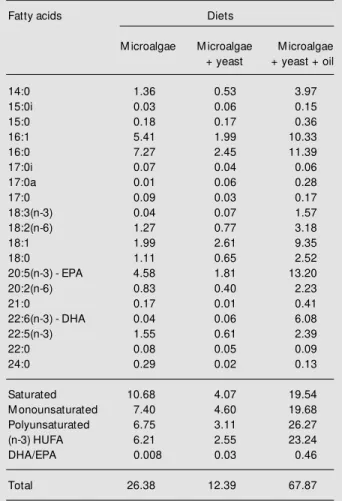
almost all fatty acids. The most notable were 20:5(n-3), 22:6(n-3), 22:5(n-3), 16:1, 16:0, and 14:0. The enrichment process increased the total saturated fatty acid content by 380%, the monounsaturated fatty acid content by 328%, and the polyunsaturated fatty acid content by 744% in relation to the rotifers fed microalgae and bakers yeast.
The levels of HUFA tested in treatment C of the present study were within the range recommended in the literature for other ma-rine species. Lavens and Sorgeloos (16) stated that rotifers grown on a formulated feed had an excellent HUFA composition, containing 5.4, 4.4 and 15.6 mg/g dry weight of EPA, DHA and (n-3) HUFA, respectively. Rodrí-guez et al. (17) found that the minimum requirement for larval gilthead sea bream (0-17 days) fed rotifers was 6 mg/g of EPA, 8 mg/g of DHA and 15 mg/g dry weight of (n-3) HUFA.
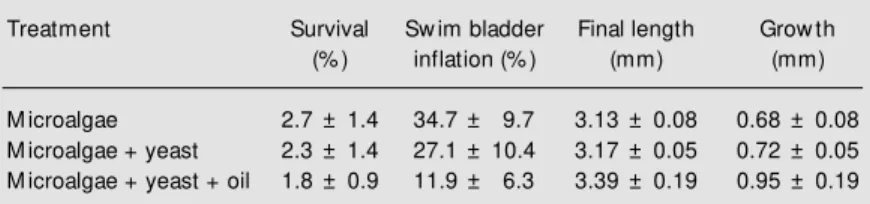
There was no significant effect of treat-ment on survival (c2
o = 5.8 < c 2
c = 7.8) or swim bladder inflation (c2
o = 3.7 < c 2
c = 7.8). Survival rates were particularly low, the high-est being 2.7% in treatment A. Swim bladder inflation rates were 11.9-34.7% (Table 2).
One important observation about survival, which was not quantified, is that most losses occurred from 6 to 9 days after hatching for all treatments. By this time, with the yolk sac exhausted, most larvae had not fed, were motionless, apparently weak and starving in comparison to a few healthy individuals.
About 30 h after hatching larvae pre-sented a mean standard length of 2.45 ± 0.038 mm (N = 30). After 14 days of rearing, there were no significant differences among treatments in final length (ANOVA: F = 1.35, d.f. = 2, P = 0.263) or growth (Table 2). Despite the differences in the composi-tion of essential fatty acids in each rotifer treatment, there was no influence on the larviculture performance of fat snook. Simi-larly, Tamaru et al. (18), by replacing 50% of the microalgae with bakers yeast in the rotifer diet, obtained small differences in
Table 1. Fatty acid content (mg/g dry w eight) of rotifers fed on different diets and used as feed for fat snook larvae.
Fatty acids Diets
M icroalgae M icroalgae M icroalgae +yeast + yeast + oil
14:0 1.36 0.53 3.97
15:0i 0.03 0.06 0.15
15:0 0.18 0.17 0.36
16:1 5.41 1.99 10.33
16:0 7.27 2.45 11.39
17:0i 0.07 0.04 0.06
17:0a 0.01 0.06 0.28
17:0 0.09 0.03 0.17
18:3(n-3) 0.04 0.07 1.57
18:2(n-6) 1.27 0.77 3.18
18:1 1.99 2.61 9.35
18:0 1.11 0.65 2.52
20:5(n-3) - EPA 4.58 1.81 13.20
20:2(n-6) 0.83 0.40 2.23
21:0 0.17 0.01 0.41
22:6(n-3) - DHA 0.04 0.06 6.08
22:5(n-3) 1.55 0.61 2.39
22:0 0.08 0.05 0.09
24:0 0.29 0.02 0.13
Saturated 10.68 4.07 19.54
M onounsaturated 7.40 4.60 19.68
Polyunsaturated 6.75 3.11 26.27
(n-3) HUFA 6.21 2.55 23.24
DHA/EPA 0.008 0.03 0.46
Total 26.38 12.39 67.87
i: iso, a: anteiso; DHA: docosahexaenoic acid; EPA: eicosapenta-enoic acid; HUFA: highly unsaturated fatty acids.
Re sults and D iscussio n
survival and growth of milkfish and striped mullet larvae. While Koven et al. (6) ob-served that enriching rotifers with different oils enhanced the growth rate of gilthead sea bream larvae, but found no influence on survival and swim bladder inflation. Mou-rente et al. (19) and Rodríguez et al. (17), working with the same species, also ob-served a positive effect of (n-3) HUFA only on the growth of first-feeding larvae (0-17 days). Dhert et al. (20), rearing Asian sea bass larvae (0-21 days), obtained no im-provement in growth or survival of larvae fed (n-3) HUFA-enriched food; however, an increase in larval resistance to the salinity stress test was observed.
Some authors have concluded that DHA is superior to EPA as an essential fatty acid for larval fish. Watanabe (9) studied the larviculture of five marine fish (red sea bream, yellowtail, striped knifejaw, Japanese floun-der, and turbot) and found that DHA was necessary in greater quantities than EPA, and that its presence in adequate quantities increased survival and growth. Similarly, Rodríguez et al. (21), rearing gilthead sea bream larvae, observed that the best growth rate was achieved with a DHA:EPA ratio of about 1:3. Ibeas et al. (22) obtained the best growth of gilthead sea bream larvae with a ratio of 2, while in the juvenile stage the best ratio was found to be 0.5. The highest DHA:EPA ratio found in the present study was 0.46 (treatment C with oil-enriched roti-fers).
Some investigators have proposed that the presence of (n-3) HUFA may not be important for young (newly hatched) larvae. Kraul (23) reported that the first stage sur-vival (0-9 days) of mahimahi larvae was not affected by the content of fatty acids in the feed, and suggested that this is probably due to high levels of endogenous EPA and DHA stored in the larval yolk sac. Watanabe (9) reported that DHA is high in the eggs of marine fish and rapidly decreases during the first ten days after hatching. Mourente et al.
(19) suggested that the presence of DHA in the diet of larval gilthead sea bream may not be necessary, because they could retain DHA from the yolk. Thus, if the first-feeding fat snook does not depend on the (n-3) HUFA content of the exogenous feed, as observed with other species, rotifer enrichment at this stage may not be necessary, thus simplifying and lowering the cost of larviculture.
The (n-3) HUFA requirements of marine larval fish are highly variable. Such differ-ences could be explained by species-specific nutritional requirements, culture period, or quality of larvae. The latter can be influ-enced by both the nutritional conditions dur-ing gonad formation (24) and the process used for spawning induction of broodstock (25). Tamaru et al. (26) also correlated dif-ferences in growth and survival of striped mullet larvae to the quality of broodstock nutrition. Abi-Ayad et al. (27) found a corre-lation with DHA and EPA levels in the broodstock diet, and stress resistance and survival of perch larvae.
The low survival rates (under 2.7%) ob-tained in the present study can also be corre-lated with factors other than the nutritional value of the rotifers. For example, the use of wild spawners, probably not well acclimated, and artificial reproduction methods could have resulted in low quality larvae. Wallace et al. (28) observed in common snook, Cen-tropomus undecimalis, that adult fish ap-peared to be unusually traumatized by the stress of capture and translocation, and that 48 h after capture ovaries began to
degener-Table 2. Survival, sw im bladder inflation, final standard length and grow th of fat snook larvae reared for 14 days on rotifers fed different diets.
Treatment Survival Sw im bladder Final length Grow th
(% ) inflation (% ) (mm) (mm)
M icroalgae 2.7 ± 1.4 34.7 ± 9.7 3.13 ± 0.08 0.68 ± 0.08
M icroalgae + yeast 2.3 ± 1.4 27.1 ± 10.4 3.17 ± 0.05 0.72 ± 0.05
M icroalgae + yeast + oil 1.8 ± 0.9 11.9 ± 6.3 3.39 ± 0.19 0.95 ± 0.19
ate. The swim bladder inflation rates ob-served (lower than 34.7%) are indicative of a state of weakness. Brügger (29), working with fat snook larvae of the same age under conditions very similar to those of the pre-sent study, obtained highly variable rates (37 to 100%) of swim bladder inflation. It was observed in other species that lack of an inflated swim bladder affects mainly larval growth, but affects survival only later during weaning (30). With snook, inflation occurs very early, around 5-7 days after hatching, and larvae are able to feed even without a normally inflated swim bladder (2,29). This phenomenon has already been described for several marine species (30,31). Concerning larval mortality, other studies (2,29, and Cerqueira VR, unpublished results) achieved survival rates up to 20% and occasionally higher with fat snook larvae fed non-en-riched rotifers (low HUFA levels).
Another sign of low quality larvae was a period between 6 and 9 days after hatching of high mortality rates coincident with yolk sac depletion. Larvae might have had diffi-culty capturing prey if there was some kind of weakness or malformation (induced, for
example, by a biochemical deficiency in the eggs), and might have starved to death. The transition from endogenous to exogenous feeding is normally a vulnerable period for many species, when endogenous factors may acquire some importance (32). Rodríguez et al. (17) observed a notable mortality of gilthead sea bream larvae during the first 2-3 days of external feeding. Brügger (29) also noticed the same problem in some experi-ments with fat snook.
Finally, the improvement of the dietary value of rotifers was not sufficient to solve the problem of larval rearing. The high mor-tality obtained just after yolk absorption was probably due to some other factor. In order to improve survival of first-feeding fat snook larvae, factors other than the dietary HUFA level should also be considered in the future.
Ackno wle dgm e nts
We thank Drs. N. Yamanaka, E. Zaniboni Filho, L. Alvarez-Lajonchere and D. Fraca-lossi for their comments, and Mr. Shelby Banner for revising the English manuscript.
Re fe re nce s
1. Rivas LR (1986). Systematic review of the perciform fishes of the genus Centropo-mus. Copeia, 3: 579-611.
2. Cerqueira VR, M acChiavello JAG & Brügger AM (1995). Produção de alevinos de robalo, Centropomus parallelus Poey, 1860, através de larvicultura intensiva em laboratório. In: Castagnolli N (Editor),
Anais do Encontro Nacional de Aqüicul-tura, VII SIM BRAq, II ENBRAPOA. Peruí-be, SP, Brazil. Publicação ACIESP, 191-197.
3. Scott AP & M iddleton C (1979). Unicellu-lar algae as a food for turbot ( Scophthal-mus maxiScophthal-mus L.) larvae - The importance of dietary long-chain polyunsaturated fatty acids. Aquaculture, 18: 227-240. 4. Watanabe T, Kitajima C & Fujita S (1983).
Nutritional values of live organisms used in Japan for mass propagation of fish.
Aquaculture, 34: 115-143.
5. Caric M , Sanko-Njire J & Skaramuca B (1993). Dietary effects of different feeds on the biochemical composition of the rotifer (Brachionus plicatilis M üller). Aqua-culture, 110: 141-150.
6. Koven WM , Tandler A, Kissil GW, Skland D, Friezlander O & Harel M (1990). The effect of dietary (n-3) polyunsaturated fatty acids on grow th, survival and sw im bladder development in Sparus aurata lar-vae. Aquaculture, 91: 131-141.
7. Rainuzzo JR, Reitan KI & Olsen Y (1997). The significance of lipids at early stages of marine fish: a review . Aquaculture, 155: 103-115.
8. Sorgeloos P, Léger PH & Lavens P (1988). Improved larval rearing of European and Asian seabass, seabream , m ahim ahi, siganid and milkfish using enrichment di-ets for Brachionus and Artemia. World Aquaculture, 19: 78-79.
9. Watanabe T (1993). Importance of doco-sahexaenoic acid in marine larval fish.
Journal of the World Aquaculture Society, 24: 153-161.
10. Kanazaw a A (1997). Effects of docosahex-aenoic acid and phopholipids on stress tolerance of fish. Aquaculture, 155: 129-134.
11. Barreto O & Cavalcanti D (1997). Enrique-cimento de alimentos vivos para alimen-tação de larvas de organismos marinhos: uma breve revisão. Boletim do Instituto de Pesca, 24: 139-159.
12. Fulks W & M ain K (1991). Rotifer ( Brachi-onus plicatilis) production systems. In: Fulks W & M ain K (Editors), Rotifer and M icroalgae Culture Systems.Proceedings of a US-Asia Workshop. Oceanic Institute, Honolulu, 23-46.
14. M adureira LAS, Conte M H & Eglinton G (1995). Early diagenesis of lipid biomarker compounds in North Atlantic sediments.
Paleoceanography, 10: 627-642. 15. Sokal RR & Rohlf FJ (1981). Biometry.
The Principles and Practice of Statistics in Biological Research. 2nd edn. WH Free-man, New York.
16. Lavens P & Sorgeloos P (1996). M anual on the Production and Use of Live Food for Aquaculture. FAO Fisheries Technical Paper No. 361. FAO, Rome.
17. Rodríguez C, Pérez JA, Badía P, Izquierdo M S, Fernández-Palacios H & Lorenzo Hernández A (1998). The n-3 highly unsat-urated fatty acid requirements of gilthead seabream (Sparus aurata L.) larvae w hen using an appropriate DHA/EPA ratio in the diet. Aquaculture, 169: 9-23.
18. Tamaru CS, Lee C & Ako H (1991). Im-proving the larval rearing of striped mullet (M ugil cephalus) by manipulating quantity and quality of the rotifer, Brachionus pli-catilis. In: Fulks W & M ain K (Editors),
Rotifer and M icroalgae Culture Systems. Proceedings of a US-Asia Workshop. Oce-anic Institute, Honolulu, 89-103. 19. M ourente G, Rodriguez A, Tocher DR &
Sargent JR (1993). Effects of dietary do-cosahexaenoic acid (DHA; 22-6w3) on li-pid and f at t y acid com posit ions and grow th in gilthead sea bream (Sparus aurata L.) larvae during first feeding. Aqua-culture, 112: 79-98.
20. Dhert P, Lavens P, Duray M & Sorgeloos P (1990). Improved larval survival at meta-morphosis of Asian seabass (Lates calca-rifer) using (n-3)-HUFA enriched live food.
Aquaculture, 90: 63-74.
21. Rodríguez C, Pérez JA, Días M , Izquierdo M S, Fernández-Palacios H & Lorenzo A (1997). Influence of EPA/DHA ratio in roti-fers on gilthead seabream (Sparus aurata) larval development. Aquaculture, 150: 77-89.
22. Ibeas C, Cejas JR, Flores R, Badía P, Gómez T & Lorenzo Hernández A (1997). Influence of eicosapentaenoic to docosa-hexaenoic acid ratio (EPA/DHA) of dietary lipids on grow th and fatty acid composi-tion of gilthead seabream (Sparus aurata) juveniles. Aquaculture, 150: 91-102. 23. Kraul S (1993). Larviculture of the
mahi-mahi Coryphaena hippurus in Haw aii, USA. Journal of the World Aquaculture Society, 24: 410-421.
24. Lavens P & Sorgeloos P (1991). Variation in egg and larval quality in various fish and crustacean species. In: Lavens P, Sorge-loos P, Jaspers E & Ollevier F (Editors),
Larvi’91 - Fish and Crustacean Larviculture Symposium. Vol. 15. European Aquacul-ture Society, Special Publication, 221-222. 25. Lam TJ (1991). Hormones and egg/larval quality in fish. In: Lavens P, Sorgeloos P, Jaspers E & Ollevier F (Editors), Larvi’91 -Fish and Crustacean Larviculture Sympo-sium. Vol. 15. European Aquaculture
So-ciety, Special Publication, 197.
26. Tamaru CS, M urashige R & Lee C (1994). The paradox of using background phy-toplankton during the larval culture of striped mullet, M ugil cephalus L. Aqua-culture, 119: 167-174.
27. Abi-Ayad S-M E-A, M elard C & Kestemont P (1997). Effects of (n-3) fatty acids in Eurasian perch broodstock diet on egg fatty acid composition and larvae stress resistance. Aquaculture International, 5: 161-168.
28. Wallace RA, Boyle SM , Grier HJ, Selman K & Petrino TR (1993). Preliminary obser-vations on oocyte maturation and other aspects of reproductive biology in captive female snook, Centropomus undecimalis.
Aquaculture, 116: 257-273.
29. Brügger AM (1995). Efeito da intensidade luminosa na sobrevivência e na insuflação da bexiga gasosa de larvas de robalo
Centropom us parallelus (Poey, 1860). M aster’s thesis, Universidade Federal de Santa Catarina, Florianópolis, SC, Brazil. 30. Chat ain B (1997). Developm ent and
achievements of marine fish-rearing tech-nology in France over the last 15 years.
Hydrobiologia, 358: 7-11.
31. Planas M & Cunha I (1999). Larviculture of marine fish: problems and perspectives.
Aquaculture, 177: 171-190.