juvenile fat snook,
Centropomus parallelus
(POEY)
Sterzelecki, FC.
a*, Rodrigues, E.
b, Fanta, E.
aand Ribeiro, CAO.
a aSetor de Ciências Biológicas, Departamento de Biologia Celular, Universidade Federal do Paraná,Centro Politécnico, CEP 81531-990, Curitiba, PR, Brazil b
Departamento de Bioquímica, Universidade de Taubaté, CEP 12030-180, Taubaté, SP, Brazil *e-mail: [email protected]
Received: February 3, 2012 – Accepted: September 3, 2012 – Distributed: August 31, 2013 (With 2 figures)
Abstract
Eurihaline fish support waters with different salt concentration. However, numerous studies have shown that salinity can affect fish development. Thus, the effect of salinity change from 20 to 5 and 35 on survival, weight, length, gill chloride cell ultrastructure and gill Na+, K+ ATPase activity was evaluated in
Centropomus parallelusfollowing
short-term (6, 24 and 96 hours) and long-term exposure (30 and 60 days). Salinity did not affectC. parallelussurvival, final weight and length. The quantity of chloride cells increased visibly at salinities of 5 and 35, with the cells exhibit-ing the typical features of uptake and secretory cells, respectively. Na+, K+ATPase activity in the gill of theC.
paralleluswas significantly greater at a salinity of 5 than at a salinity of 20 or 35 after 96 hours, but not after 30 or
60 days. These results indicate that salinity change from high to low salt water induces gill chloride cell and Na+, K+
ATPase activity adaptations after short-term exposure. However, after long-term exposure at salinity 5, gill Na+, K+
ATPase activity is no more necessary at high levels. The increase in salinity to 35 does not induce significant change in gills. Juveniles ofC. parallelusmay thus be capable of acclimating to salinities of 5 to 35 for 60 days without signifi-cant effects on development.
Keywords:Centropomus parallelus, chloride cell, osmoregulation, Na+, K+ATPase.
O efeito da salinidade sobre a osmoregulação e o desenvolvimento do juvenil
de robalo-peva, Centropomus parallelus (POEY)
Resumo
Peixes eurihalinos suportam águas com diferentes concentrações de sal. Contudo, muitos estudos têm mostrado que a salinidade pode afetar o desenvolvimento do peixe. Portanto, o efeito da mudança de salinidade de 20 para 5 e 35 na taxa de sobrevivência, peso, comprimento, morfologia das células de cloreto branquiais e atividade da Na+, K+ATPase
foram avaliadas noCentropomus parallelusapós curto (6, 24 e 96 horas) e longo tempo de exposição (30 e 60 dias). A salinidade não afetou a sobrevivência, o peso e comprimento final do robalo-peva. A quantidade de células de cloreto aumentou visivelmente nas salinidades 5 e 35, exibindo morfologias típicas de células que absorvem e secretam sal, respectivamente. A atividade da Na+, K+ATPase nas brânquias do
C. parallelus foi significativamente maior na
salinidade 5 do que nas salinidades 20 ou 35 após 96 horas, mas não após 30 e 60 dias. Esses resultados indicam que a mudança de alta para baixa salinidade provoca adaptações nas células de cloreto e na atividade da Na+, K+ATPase
branquial em curto prazo. Contudo, após longa exposição na salinidade 5, a alta atividade da Na+, K+ATPase branquial
não é mais necessária. O aumento de salinidade para 35 não induz mudanças significativas nas brânquias. Portanto, juvenis deC. paralleluspossuem a capacidade de aclimatação nas salinidades de 5 a 35 sem efeitos significativos no
desenvolvimento após 60 dias.
Palavras-chave:Centropomusparallelus, célula de cloreto, osmoregulação, Na+, K+ATPase.
1. Introduction
The fat snook,Centropomus parallelus, is important for commercial and recreational fisheries as well as for aquaculture. This fish has been considered to be a good candidate for cultivation due to its resistance to diseases,
satisfactory growth rate and suitability for human con-sumption. Although technology for the mass production of juvenileC. parallelusis currently available, Cerqueira
The fat snook is a species of the genusCentropomus
that lives in and around estuarine waters located in south-eastern Florida to the southern coast of Brazil (Rivas, 1986). Although juveniles ofC. parallelusare naturally found in a wide salinity environment, it has been shown that salinity does affect fish development (Boeuf and Payan, 2001). In previous experiments, salinity specifi-cally affectedC. parallelusfood intake, growth (Rocha et
al., 2005) and digestive enzyme activity (Tsuzuki et al., 2007b). Nevertheless, the relationship between the os-moregulatory system and development at different salini-ties has yet to be explored in C. parallelus. Several
studies have associated the rapid growth of some species with a reduction in osmoregulatory costs (Boeuf and Payan, 2001; Sampaio and Bianchini, 2002; Laiz-Car-rión et al., 2005).
The environmental salinity different from the inter-nal osmotic concentration of teleost fish provokes loss or gain of salt and water. To maintain the ionic concentra-tion of body fluids, the osmoregulatory organs work to-gether (McCormick, 2001). The gills are probably the organs that consume the most energy during osmo-regulation (Sangiao-Alvarellos et al., 2003). More spe-cifically, the gill Na+, K+ ATPase, located mainly in
chloride cells, requires energy input and plays an impor-tant role in osmoregulation in both hyperosmotic (Jobling, 1995; Evans et al., 2005) and hyposmotic (Ev-ans, 2008; Parks et al., 2008) environments. The activity of this ATPase spends at least half of the energy con-sumed during Na+/H+exchange in ionocytes (Kirschner,
2004). For this reason, Na+, K+ATPase is considered to
be a good biomarker of osmoregulation in teleosts. Un-derstanding the activity of this pump at different salt con-centrations may help to clarify the appropriate salinity for farm juvenile fat snooks. The goal of the present study was to assess the relationship between Na+, K+ATPase
activity, chloride cell ultrastructure, survival, final weight and length inC. parallelusfollowing acclimation
to different salinities.
2. Materials and Methods
2.1. Experimental design
The experiment was conducted in February (experi-ment I) and repeated under the same conditions in May, 2007 (experiment II). A total of 328 juvenile of C. paralleluswere obtained from the Marine Fish Culture Laboratory (LAPMAR) at the Universidade Federal de Santa Catarina, Brazil. Both trial fish derived from the same broodstock, but from a different spawning time. They were studied 65 days after hatching, weighing 0.14±0.05 g and 0.13±0.04 g (mean±SD) in experi-ment I and experiexperi-ment II, respectively. They were trans-ported to the Universidade Federal do Paraná and sepa-rated into three 100-L glass aquariums filled with water at a salinity of 20, at a stocking density of 0.6 fish/L. Fil-tered dechlorinated tap water and CORELIFE®artificial
salt were used to reach the desired salinity, which was
confirmed using a refractometer (±1). Over an acclima-tion period of nine days, low levels of total-ammonia-nitrogen (TAN), nitrite and nitrate (0.3 to 0.6 mg/L, 0.1 mg/L and 5-10 mg/L, respectively) were maintained using a recirculation system with biological and mechan-ical filters. Dissolved oxygen was maintained between 4-5 mg/L and pH at 8-8.2. The snooks were kept at 26±2 °C , under natural photoperiod and fed once a day to satiation with adult of frozenArtemia. After feeding, all waste at the bottom of the tank was siphoned.
Following the acclimation period, the salinity was progressively increased and decreased in two aquariums to 35 and 5, respectively. The third group was cultivated at a salinity of 20, although the same volume of water was exchanged as in the other groups to maintain consistency. Additional chemical properties of the water were main-tained at levels similar to those achieved during the accli-mation period by monitoring with Sera® Kit and
changing weekly 20% of water.
2.2. Fish measurements and sample collection
From experiment I, 54 to 58 fish in each aquarium started the trial. After acute (6, 24 and 96 hours) and chronic period (30 and 60 days) of salinity change, 3 to 10 fish were sampled. From the experiment II, 51 to 57 fish in each aquarium started the trial and 2 to 10 fish were sampled at the same time point as before. For both experiments, sampled fish were anesthetised with benzo-caine (50 mg/L), weighed, measured and sacrificed to evaluate Na+, K+ATPase activity and gill chloride cells.
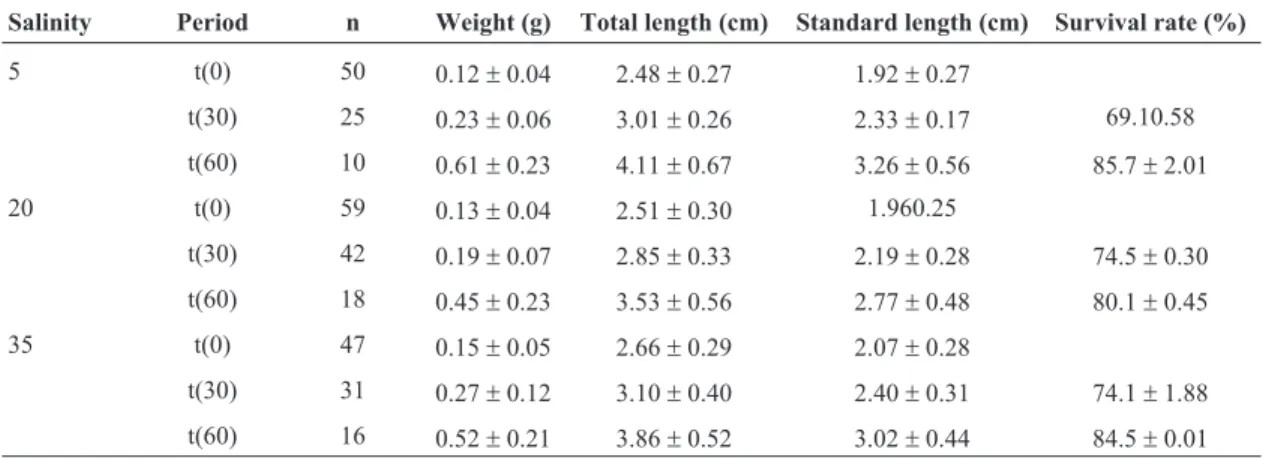
After 96(t0) hours, 30 (t30) and 60 (t60) days all the fish were measured and weighed to biometric comparison (see Table I). The sampling variation occurred due to the sacrifice to biochemical analysis, mortality and cannibal-ism.
2.3. Na+, K+ATPase activity
The branchial arches from sacrificed fish, with the exception of the second arch, were frozen immediately in liquid nitrogen and stored at -80 °C until the biochemical assays were performed. A method obtained from McCormick (1993) was used to evaluate Na+, K+ATPase
activity. The gills were homogenised in 100mL of SEI buffer (pH 7.5; 250 mM sucrose; 10 mM Na2EDTA and
50 mM imidazole) and 50mL of SEID (0.1 g sodium deoxycholic acid in 33.3 mL of SEI). Following ho-mogenisation, the gills were centrifuged at 5,000 g for 2 min. The insoluble material was separated, and 10mL of supernatant in duplicate was added into microplate wells to 200 mL of the reaction mixture containing 50 mM imidazole (pH 7.5), 189 mM NaCl, 10.5 mM MgCl2, 2.86 U/mL LDH, 3.57 U/mL PK, 2 mM PEP,
150mM NADH and 0.5 mM ATP. In addition, other two wells of microplate were filled with the same mixture plus 0.5 mM ouabain. NADH oxidation levels at 28 °C were used to quantify Na+, K+ATPase activity by
from the total activity with ouabain. A Bradford (1976) assay was also used to evaluate the total protein concen-tration. Na+, K+ATPase activity was expressed as
micro-moles of ADP per milligramme of protein per hour.
2.4. Ultrastructure
The second gill arch was sectioned and fixed in a so-lution of 2.5% glutaraldehyde, 2% paraformaldehyde and 0.2 M cacodylate (pH 7.2) for 24 hours, and post-fixed in 1% osmium tetroxide and 0.1 M cacodylate buffer for 2 hours. Samples were contrasted in 2% uranyl, dehydrated in graded acetone and embedded in PolyEmbed 812. Ultra-thin sections were contrasted in 5% uranyl acetate and lead citrate. Electron micrographs were then captured using the JEOL TEM 1200 EXII transmission electron microscope.
2.5. Statistical analysis
Because the body measurement data did not meet the requirements of variance analysis (ANOVA), a Kruskal-Wallis non-parametric test was used instead. Two-way ANOVA was used to test for salinity and time effects on Na+, K+ATPase activity. Significant
differ-ences were compared using a Bonferroni post-test (p < 0.05). Survival was compared after 30 and 60 days of salinity challenge. We pooled the data for each salinity because no significant differences were found between experimental aquariums at any salinity or at different sampling times.
3. Results
All of the experimental groups ofC. parallelus
ini-tially had similar weights and after 60 days, mean weights were significantly higher. However, there was no difference between salinity treatments. Survival was also not significantly affected by salinity (see Table 1).
Chloride cells can be easily recognised by their large numbers of mitochondria, which may be visualised by
electron microscopy (see Figure 1). After 24 hours at a salinity of 5, the number and size of the ionocytes in-creased visibly in the interlamellar area (see Figure 1A). The apical membrane surface increased and at times pro-jected into the external medium. After 96 hours, some chloride cells were observed with a convex apical mem-brane in the secondary lamella (see Figure 1B). During the whole experiment, fish exposed to a salinity of 20 ex-hibited few gill chloride cells in the interlamellar region (see Figure 1C). The apical membrane in this salinity invaginated to form a crypt with an opening smaller than that of a membrane exposed to a hyposmotic environ-ment (see Figure 1D). The quantity of chloride cells in-creased slightly after a 96-hour exposure to a salinity of 35, while after 60 days, the number was even higher (see Figure 2E). The apical membrane showed a deep crypt associated with accessory cells (see Figure 1F).
Ninety-six hours after a change in the surrounding environment’s salinity, the Na+, K+ATPase activity in
the gill of theC. paralleluswas significantly greater at a salinity of 5 (15.39±8.62mmol ADP.mg protein-1.h-1)
than at salinities of 20 (3.22±1.28mmol ADP.mg pro-tein-1.h-1) and 35 (4.743 ± 1.91 mmol ADP.mg
pro-tein-1.h-1). However, after 30 or 60 days, there was no
dif-ference in ATPase activity between treatments (see Fig-ure 2).
4. Discussion
C. parallelus survival was not affected 30 and 60 days after salinity challenge. This finding indicates excellent resistance to a wide range of salt concentrations. Previ-ous studies have also demonstrated no difference in the survival rates ofC. parallelusreared in environments of different salinities (Tsuzuki et al., 2007b). Nevertheless, an abrupt salinity change should be avoided due to the high mortality rate observed when small juveniles are di-rectly transferred from seawater to freshwater (Tsuzuki et al., 2007a).
Table 1- Average weight, length, standard and length (±S.D.) of juveniles ofCentropomus paralleluspooled from both ex-periments.
Salinity Period n Weight (g) Total length (cm) Standard length (cm) Survival rate (%)
5 t(0) 50 0.12±0.04 2.48±0.27 1.92±0.27
t(30) 25 0.23±0.06 3.01±0.26 2.33±0.17 69.10.58 t(60) 10 0.61±0.23 4.11±0.67 3.26±0.56 85.7±2.01 20 t(0) 59 0.13±0.04 2.51±0.30 1.960.25
t(30) 42 0.19±0.07 2.85±0.33 2.19±0.28 74.5±0.30 t(60) 18 0.45±0.23 3.53±0.56 2.77±0.48 80.1±0.45 35 t(0) 47 0.15±0.05 2.66±0.29 2.07±0.28
t(30) 31 0.27±0.12 3.10±0.40 2.40±0.31 74.1±1.88 t(60) 16 0.52±0.21 3.86±0.52 3.02±0.44 84.5±0.01
The effect of salinity on the growth of several species of fish has previously been tested. Although salinity level usually influences growth, it occasionally does not have an effect (Boeuf and Payan, 2001). For example,
Dicentrarchus labrax (Rubio et al., 2005), Trinectes maculatus fasciatus (Peterson-Curtis, 1997) and
Lutjanus griseus (Wuenschel et al., 2004) have shown no
difference in growth after salinity challenge. In the pres-ent study, we have not verified the specific growth rate of theC. parallelus, because of the low number of
growth after 50 days at a salinity of 5, 15 or 35 and the fi-nal mean weight was similar from the individuals of the present study, between 0.84 to 0.91 g. Other experiments with juveniles ofC. parallelusalso observed this weight
range (Corrêa and Cerqueira, 2007; Ferraz et al., 2011) at this stage. These results indicate that juvenile C. parallelusare capable of acclimating to a wide range of salinity without significant effects on growth.
Depending on the salinity of the surrounding envi-ronment, gill chloride cells can assume different mor-phologies in teleosts. Chloride cells with a deep apical crypt are usually associated with hyperosmotic medium, while those with a broad apical region and microvilli are associated with hyposmotic waters (Sakamoto and McCormick, 2006). Evidence suggests that there is a cor-relation between chloride cell subtype and osmo-regulatory function, such that the hyperosmotic subtype is involved in salt secretion and the hyposmotic subtype is involved in salt uptake (Hwang and Lee, 2007). In the current study,C. parallelusgill chloride cells responded
to salinity as expected, assuming the morphology ob-served in the majority of other teleosts. It was possible to observe the hyposmotic subtype inC. parallelusgills af-ter 24 hours at a salinity of 5 (Fig. 2B). The hyposmotic subtype has a larger apical membrane to enable increased ion absorption in low-salinity waters (Fernandes and Perna-Martins, 2002). After 96 hours at a salinity of 5,C. parallelus chloride cells were found in the secondary lamella. This result is consistent with what is observed when many teleost species are transferred to freshwater (Perry, 1998). In contrast, hyperosmotic medium at a sa-linity of 20 or 35 did not promote this hyposmotic cell subtype in the secondary lamella ofC. parallelusgills. These results suggest that the chloride cell, with a broad opening in the secondary lamella ofC. parallelus, is
in-volved in salt uptake. Consistent with this concept, at a salinity of 20, the juvenileC. parallelusexhibited
charac-teristic hyperosmotic chloride cells, which are responsible for salt extrusion. Increasing the salinity to 35 provoked a noticeable proliferation of these chloride cells in the interlamellar space after 60 days. Increasing the salt concentration augments the number of gill chlo-ride cells in other species as well, such as the Japanese eel (Wong et al., 1999), killifish (Lima and Kültz, 2004) and sturgeon (Martínez-Álvares et al., 2005). Thus, the salin-ity change to hypotonic and hypertonic waters provoke morphological adaptations on gill chloride cells of C. parallelusas does in many eurihaline species.. Carmona et al. (2004) suggested that these modifications involve an increase in cellular activity.
The gill Na+, K+ATPase plays a large role in teleost
osmoregulation and has been shown to be involved in both seawater (McCormick et al., 1989; Sardella and Brauner, 2008) and freshwater (Sampaio and Bianchini, 2002; Laiz-Carrión et al., 2005; Nebel et al., 2005) toler-ance in many species. In addition, this enzyme accounts for the most energy expenditure within the cell (Marshall and Bryson, 1998). In the present study,C. parallelusat a
salinity of 5 showed an augmentation at 96 hours, fol-lowed by a return to initial levels after 30 days. This os-cillation indicates that high ATPase activity is only required for the initial acclimatisation to low salinity. McCormick and Bradshaw (2006) pointed out that some alterations in teleost gill membrane permeability and ion transport can occur after long periods in hyposmotic en-vironments and that this adaptation is mediated by the hormone prolactin. It is possible that the gill ion perme-ability ofC. parallelusis also altered after long-term
ex-posure to low salinity, enabling reduction of Na+, K+
ATPase activity. Salinity 20 and 35 induced no signifi-cant changes on Na+, K+ATPase activity, although the
augment in salinity to 35 has increased the number of chloride cells after 60 days. As evidenced by Foskett et al. (1983), seawater adaptation provokes increases in the size and/or number of chloride cells, which is related to an increased activity in gill Na+, K+ATPase in most, but
not all species. For instance, at the end of the 84-day ex-perimental period,Umbrina cirrosa showed no
differ-ence on Na+, K+ATPase activity at low and high salinity
water, although the number of chloride cell had increased (Mylonas et al., 2009). The enhanced number of gill chloride cell suggests that a reduction in branchial water permeability decreases water loss and permit a low activ-ity of Na+, K+ATPase.
In summary, a salinity of 5 provoked a significant change in Na+, K+ATPase activity after 96 hours, which
coincided with morphological modifications in the gill chloride cells. Seawater acclimation induced only chlo-ride cell proliferation. These results indicate that C. parallelusgill activity for the purpose of osmoregulation
may have been higher at a salinity of 5 than at other sa-linities during short-term acclimation, but not after long-term exposure. Thus, juvenileC. parallelusare ca-pable of acclimatising and farming at salinities of 5 and 35 without significant effects on weight and length after 60 days. However, additional studies investigating the
ef-Figure 2 - Na+, K+ ATPase activity in
Centropomus parallelusafter 60 days at salinities of 5, 20 and 35 (mean±
fects of salinity on the osmoregulatory and non-osmo-regulatory organs ofC. parallelusover longer periods are
necessary to better understand the direct and indirect in-fluences of salinity on the growth phase.
Acknowledgments
The authors would like to thank the staff of LAPMAR at the Universidade de Santa Catarina for pro-viding the individual fat snooks used in the present study and the researchers at the Universidade de Taubaté and the Universidade Federal do Paraná for lending their fa-cilities and equipment. We thank Dr. Stephen D. McCor-mick for sharing his laboratory protocols and for his assistance with this study.
References
BOEUF, G. and PAYA, P., 2001. How should salinity influence fish growth?Comparative Biochemistry and Physiology-Part C: Pharmacology and Toxicology, vol. 130, p. 411-423.
BRADFORD, MM., 1976. A rapid and sensitive method for the quantitation of microgram quantities of protein utilizing the principle of protein-dye binding.Analytical Biochem-istry, vol. 72, p. 248-254.
CARMONA, R., GARCIA-GALLEGO, M., SANZ, A., DO-MEZAÍN, A. and OSTOS-GARRIDO, MV., 2004. Chlo-ride cells and pavement cells in gill epithelia of Acipenser naccarii: ultrastructural modifications in seawater-acclimated specimens.Journal of Fish Biology, vol. 64, p. 553-566.
CERQUEIRA, VR. and TSUZUKI, MY., 2009. A review of spawning induction, larviculture, and juvenile rearing of the fat snook,Centropomus parallelus.Fish Physiology and Biochemistry, vol. 35, p. 17-28.
CÔRREA, CF. and CERQUEIRA, VR., 2007. Effects of stock-ing density and size distribution on growth, survival and cannibalism in juvenile fat snook (Centropomus parallelus Poey). Aquaculture Research, vol. 38, p. 1627-1634.
EVANS, DH., 2008. Teleost fish osmoregulation: What have we learned since August Krogh, Homer Smith, and Ancel Keys?American Journal of Physiology- Regulatory Com-parative Integrative and Physiology, vol. 295, p. 704-713. EVANS, DH., PIERMARINI, PM. and CHOE, KP., 2005. The Multifunctional Fish Gill: Dominant Site of gas exchange, osmoregulation, acid-base regulation, and excretion of ni-trogenous waste.Physiology Reviews, vol. 85, p. 97-177. FERNANDES, MN. and PERNA-MARTINS, SA., 2002. Chlo-ride cell responses to long-term exposure to distilled and hard water in the gill of the armored catfish,Hypostomus tietensis (Loricariidae). Acta Zoologica (Stockholm),
vol. 83, p. 321-328.
FERRAZ, EM., CARVALHO, GCS., SHAEFER, ALC., NA-RAHARA, MY. and CERQUEIRA, VR., 2011. Influên-cia da temperatura de cultivo sobre crescimento e diferen-ciação sexual de robalo-peva, Centropomus parallelus
Poey, 1860.Revista Brasileira de Engenharia de Pesca, vol. 6, p.1-16.
FOSKETT, JK., BERN, HA., MACHEN, TE. and CONNER, M., 1983. Chloride cells and the hormonal control of tele-ost fish osmoregulation.Journal of experimental Biology,
vol. 106, p. 255-281.
HWANG, PP. and LEE, TH., 2007. New insights into fish ion regulation and mitochondrion-rich cells. Comparative Biochemistry and Physiology - Part A: Molecular and In-tegrative Physiology, vol. 148, p. 479-497.
JOBLING, M., 1995.Enviromental biology of fishes. London: Chapman and Hall. 445 p.
KIRSCHNER, LB., 2004. The mechanism of sodium chloride uptake in hyperregulating aquatic animals.Journal of Ex-perimental and Biology, vol. 207, p. 1439-1452. LAIZ-CARRIÓN, R., SANGIAO-AVARELLOS, S.,
GUZ-MÁN, JM., DEL RIO, MPMJ., SOENGAS, L. and MAN-CERA, JM., 2005. Growth performance of gilthead sea breamSparus auratain different osmotic conditions: im-plications for osmoregulation and energy metabolism.
Aquaculture, vol. 250, p. 849-861.
LIMA, RN. and KÜLTZ, D., 2004. Laser scanning cytometry and tissue microarray analysis of salinity effects on kil-lifish chloride cells.Journal of Experimental Biology, vol. 207, p. 1729-1739.
MARSHALL, WS. and BRYSON, SE., 1998. Transport Mecha-nisms of Seawater Teleost Chloride Cells: An Inclusive Model of a Multifunctional Cell.Comparative Biochemis-try and Physiology - Part A Molecular and Integrative Physiology, vol. 119, p. 97-106.
MARTÍNEZ-ÁLVAREZ, RM., SANZ, A., GARCIA-GALLE-GO, M., DOMEZAIN, A., DOMEZAIN, J., CARMONA, RV., OSTOS-GARRIDO, M. and MORALES, AE., 2005. Adaptive branchial mechanisms in the sturgeon
Acipenser naccariiduring acclimation to saltwater. Com-parative Biochemistry and Physiology- Part A: Molecular and Integrative Physiology, vol. 141, p. 183-190. McCORMICK, SD., 1993. Methodos for nonlethal gill biopsy
and measurement of Na+, K+ATPase activity.Canadian Journal of Fisheries and Aquatic Sciences, vol. 50, p. 656-658.
-, 2001. Endocrine control of osmoregulation in teleost fish.
American Zoologist, vol. 41, p. 781-794.
McCORMICK, SD. and BRADSHAW, D., 2006. Hormonal control of salt and water balance in vertebrates.General and Comparative Endocrinology, vol. 147, p. 3-8. McCORMICK, SD., SAUNDERS, RL. and MACLNTYRE,
AD., 1989. Mitochondrial enzyme and Na+, K+-ATPase
activity, and ion regulation during parr-smolt transforma-tion of Atlantic Salmon (Salmo Salar).Fish Physiology and Biochemistry, vol. 6, p. 231-241.
MYLONAS, CC., PAVLIDIS, M., PAPANDROULAKIS, N., ZAISS, MM., TSAFARAKIS, D., PAPADAKIS, IE. and VARSAMOS, S., 2009. Growth performance and osmo-regulation in the shi drum (Umbrina cirrosa) adapted to different environmental salinities.Aquaculture, vol. 287, p. 203-210.
NEBEL, C., ROMESTAND, B., NÈGRE-SADARGEUS, G., GROUSSET, E., AUJOULAT, F., BACAL, JFB. and CHARMANTIER, G., 2005. Differential freshwater ad-aptation in juvenile sea-bassDicentrarchus labrax: in-volvement of gills and urinary system.Journal of Experi-mental Biology, vol. 208, p. 3858-3871.
PARKS, SK., TRESGUERRES, M. and GOSS, GG., 2008. Theoretical considerations underlying Na+uptake
mecha-nisms in freshwater fishes.Comparative Biochemistry and Physiology- Part C: Pharmacology and Toxicology,
vol. 148, p. 411-418.
PETERSON-CURTIS, TL., 1997. Effects of salinity on sur-vival, growth, metabolism, and behavior in juvenile hogchokers,Trinectes maculatus fasciatus (Achiridae). Environmental Biology of Fishes, vol. 49, p. 323-331. RIVAS, LR., 1986. Systematic review of the perciform fishes of
the genus centropomus.Copeia, vol. 3, p. 579-611. ROCHA, AJ., GOMES, V., NGAN, PV., PASSO, SMJACR.
and FURIA, RR., 2005. Metabolic demand and growth of juveniles ofCentropomus parallelusas function of salin-ity.Journal of Experimental Marine Biology and Ecol-ogy, vol. 316, p. 157-165.
RUBIO, VC., SÁNCHEZ-VÁSQUEZ, FJ. and MADRID, JA., 2005. Effects of salinity on food intake and macronutrient selection in European sea bass.Physiology and Behavior, vol. 85, p. 333-339.
SAKAMOTO, T. and McCORMICK, SD. 2006. Prolactin and growth hormone in fish osmoregulation.General Com-parative Endocrinology, vol. 147, p. 24-30.
SAMPAIO, LA. and BIANCHINI, A., 2002. Salinity effects on osmoregulation and growth of the euryhaline flounder Paralichthys orbignyanus.Journal of Experimental Ma-rine Biology and Ecology, vol. 269, p. 187-196. SANGIAO-ALVARELLOS, SR., LAIZ-CARRIÓN, JM.,
GUZMÁN, MP., MARTIN DEL RÍO, MP., MIGUEZ, JM., MANCERA, JM. and SOENGAS, JL., 2003. Accli-mation ofS. auratato various salinities alters energy
me-tabolism of osmoregulatory and nonosmoregulatory organs.American Journal of Physiology Regulatory Inte-grative Comparative Physiology, vol. 285, p. 897-907.
SARDELLA, BA. and BRAUNER, CJ., 2008. The effect of ele-vated salinity on ‘California’ Mozambique tilapia (Oreochromis mossambicusx O. urolepis hornorum) me-tabolism. Comparative Biochemistry and Physiology-Part C: Pharmacology and Toxicology, vol. 148, p.
430-436.
TSUZUKI, MY., CERQUEIRA, VR., TELES, A. and DO-NEDA, S., 2007a. Salinity tolerance of laboratory reared juviniles of the fat snook Centropomus parallelus. Brazil-ian Journal of Oceanography, vol. 55, p. 1-5.
TSUZUKI, MY., SUGAI, JK., MACIEL, JC. FRANCISCO, CJ. and CERQUEIRA, VR., 2007b. Survival, growth and digestive enzyme activity of juveniles of the fat snook (Centropomus parallelus) reared at different salinities.
Aquaculture, vol. 271, p. 319-325.
WONG, CKC. and CHAN, DKO., 1999. Chloride cell subtypes in the gill epithelium of Japanese eel Anguilla japonica.
American Journal of Physiology- Regulatory, Integrative, Comparative and Physiology, vol. 277, p. 517-522. WUENSCHEL, MJ., JUGOVICH, AR. and HARE, JA., 2004.