Received: 4 April, 2012. Accepted: 14 October, 2013
ABSTRACT
We investigated the distribution of epiphytic macroalgae on the thalli of their hosts at eight localities along the sou-theastern coast of Cuba between June 2010 and March 2011. We divided he epiphytes in two groups according to their distribution on the host: those at the base of the thallus and those on its surface. We determining the dissimilarity between the zones and the species involved. We identified 102 taxa of epiphytic macroalgae. There were significant differences between the two zones. In 31 hosts, the number of epiphytes was higher on the surface of the thallus, whereas the number of epiphytes was higher at the thallus base in 25 hosts, and the epiphytes were equally distributed between the two zones in five hosts (R=−0.001, p=0.398). The mean dissimilarity between the two zones, in terms of the species composition of the epiphytic macroalgae, was 96.64%. Hydrolithon farinosum and Polysiphonia atlantica
accounted for 43.76% of the dissimilarity. Among macroalgae, the structure of the thallus seems to be a determinant of their viability as hosts for epiphytes.
Key words: Chlorophyta, epiphytism, distribution, Phaeophyceae, Rhodophyta
Distribution of epiphytic macroalgae on the thalli of their hosts in Cuba
Yander Luis Diez García1, Abdiel Jover Capote2,6, Ana María Suárez Alfonso3,
Liliana María Gómez Luna4 and Mutue Toyota Fujii5
1 Administración Portuaria Santiago de Cuba, Santiago de Cuba, Cuba 2 Universidad de Oriente, Departamento de Biología, Santiago de Cuba, Cuba 3 Universidad de La Habana, Centro de Investigaciones Marinas, Ciudad Habana, Cuba
4 Universidad de Oriente, Centro Nacional de Electromagnetismo Aplicado, Laboratorio de Ecotoxicología, Santiago de Cuba, Cuba 5 Instituto de Botânica, Seção de Ficologia, São Paulo, SP, Brazil
6 Author for correspondence: [email protected]
Introduction
The structure of intertidal marine communities is deter-mined by a combination of physical factors and biotic interac-tions (Little & Kitching 1996; Wernberg & Connell 2008). The establishment of marine macroalgae involves a number of complex physical interactions, as well as biological, ecological and chemical processes at the microscale, from the release of propagules by reproductive adults to their migration to appropriate substrates, initial adhesion to a surface, perma-nent attachment and development (Reed 1990a; Brawley & Johnson 1992; Vreeland & Epstein 1996). Because macroalgae constitute a key component of coastal communities, they are associated with other organisms and processes and have been central to the debate about the nature and scope of the structure and dynamics of those communities (Foster 1990, 1991; Paine 1991; Underwood 2000).
In the intertidal zone, environmental gradients also occur at smaller scales, such as within the host zone of re-ceptivity, where there is a light intensity gradient between the periphery and the interior of the thallus, and along host fronds, where there is a gradient in biomass, which decreases progressively from the holdfast to the frond tip. The investigation of the distribution of epiphytes at different
scales is a potentially productive approach. It is important to understand the patterns of abundance of all sympatric epiphytic species along the various gradients, because in-terspecific relationships could represent one of the factors that explain their distribution (Longtin et al. 2009).
The texture and structure of the host thalli are frequently exploited by epiphytes, thus increasing habitat complexity (Hacker & Steneck 1990). The epiphytic macroalgae with a filamentous or branched structure usually present a high degree of structural complexity and might therefore increa-se the suitability of host algae as habitats for mesoherbivores (Martin-Smith 1993).
In marine communities, the plant substrates that are the most widely colonized by are seagrasses and macroalgae, be-cause they provide the necessary space, shelter and nutrition (Aguilar-Rosas & Galindo 1990). Macroalgae morphology might be related to the density of the community (Reed 1990b; Ang & DeWreede 1992). High densities of adults can help reduce desiccation during low tide due to overlapping thalli, as well as reducing water flow, providing shade and microhabitats below, which can affect the structure of the community (Bruno et al. 2003).
related to the longevity of the species, which is a determining factor in the process of substrate colonization by epiphytes; in some cases, this phenomenon is more evident in the older parts of the thallus (Aguilar-Rosas & Galindo 1990). In
Zostera noltii, Lebreton et al. (2009) found that the number of diatoms was higher on young leaves than on old leaves. The suitability of macroalgae as substrates for epiphytes can also vary depending on the morphological characte-ristics of the base; the degree of branching; the roughness and texture of the surface; the production of allelopathic substances such as mucilage; and the thallus growth rate (Lobban & Harrison 1997). When the thallus surface has little mucilage, it provides favorable conditions for the establishment of epiphytes (Paula & Oliveira-Filho 1980; Széchy et al. 2006).
In tropical and subtropical regions, studies have shown reductions in the size of communities that develop on rocky shores, especially communities of macroalgae and epiphytes. Such studies have been limited to identifying epiphytic macroalgae species without studying the basic aspects of their ecology (Aguilar et al. 1998; Saad-Navarro & Riosmena-Rodrígez 2005). Understanding the spatial scales at which the rocky intertidal zone communities vary provides the necessary information to initiate the study of the relative importance of the various factors that can affect these communities and how those factors interact (Underwood et. al. 2000). Therefore, the objective of the present study was to determine the distribution of epiphytic macroalgae on the thallus of their hosts.
Material and methods
Study area
The study was conducted in the rocky intertidal zone be-tween the municipalities of Aguadores and Baconao, Cuba, within the Baconao Biosphere Reserve (Managed Resource Protected Area), at eight locations (Fig. 1.): Aguadores 1, Aguadores 2; Sardinero; Juticí; Cajobabo; Verraco, Acuario and Baconao. Located east of the city of Santiago de Cuba, the study zone occupies an area of 5635 hectares of sea on the southeastern coast of the country, between Maisí and Cabo Cruz. It is characterized by a rocky intertidal zone with extensive fields of limestone (surface karst formation).
Sampling design
Samples were collected on a quarterly basis between June 2010 and March 2011, although inclement weather precluded sample collection in the month of September. Therefore, with the aim of collecting the greatest number of epiphytic species (Lecha & Chugaev 1989), we performed three samplings: one during the rainy season (in June); and two during the dry season (in December and in March). Samples were collected at low tide in the intertidal zone, which is characterized by short intervals of immersion and emersion.
We collected all epiphytic macroalgae and their hosts in 15 square metal containers (25 cm × 25 cm × 25 cm) distributed at random (Jover et al. 2012). All macroalgae
that were growing on other macroalgae were classified as epiphytes, according to the criteria of Borowitzka et al.
(2006). In accordance with Montañés et al. (2003), the epiphytic macroalgae were separated into two groups by their location on the thallus of the host: at the base or on the surface. The morphofunctional classification of the groups followed the criteria established by Littler & Littler (1984) and Steneck & Dethier (1994).
The macroalgae were identified down to the lowest possible taxonomic level on the basis of the specialized literature (Børgesen 1915-20; Taylor 1960; Littler et al.
1989; Littler & Littler 1997, 2000; Castro et al. 2008; Dawes & Mathieson 2008; Littler et al. 2008). The species list was created according to the taxonomic criteria established by Wynne (2011). For the higher classes (class, division, and kingdom), we followed the criteria established by Guiry & Guiry (2011) in Algaebase (http://www.algaebase.org/).
Data analysis
For each host macroalga and each zone of the thallus, we determined epiphyte species richness on the basis of the number of species observed (Ludwing & Reynolds 1988).
The origin and significance of differences between the zones of the host thalli were determined by analysis of simi-larity, with 999,999 permutations applied to the similarity matrix (Clarke & Warwick 2001). The similarity matrix was derived from the species presence and absence data using
the Jaccard index. The principal species responsible for the dissimilarity were identified by similarity percentage analysis (Clarke 1993). These nonparametric multivariate tests were conducted with the statistical program Primer, version 6 (Clarke & Gorley 2006).
Results
Epiphytic macroalgae and their hosts: flora
The observed number in the rocky intertidal zone of the Aguadores-Baconao sector, we observed 102 taxa of epiphytic macroalgae (18 Phaeophyceae, 53 Rhodophyceae and 31 Chlorophyceae), belonging to 14 orders, 25 families and 52 genera. The most well-represented order was Cera-miales, with 30 species, accounting for 29.4% of the total. Among the Phaeophyceae and Chlorophyceae, respectively, the most well-represented orders were Dictyotales and Cladophorales, with 13 species each.
Among the host macroalgae, we identified 61 taxa: 17 Phaeophyceae, 25 Rhodophyceae and 19 Chlorophyceae, belonging to 14 orders, 23 families and 39 genera. The most well-represented orders were Dictyotales and Ceramiales, with 11 species each. The orders Cladophorales and Sipho-nocladales presented six species each. The Phaeophyceae genus Dictyota presented the greatest number of species, with six.
Systematic list of epiphytic macroalgae (species listed)
Domain: Eukaryota Kingdom: Chromista
Subkingdom: Chromobiota Division: Heterokontophyta
Class: Phaeophyceae Order: Dictyotales
Family: Dictyotaceae Genus: Dictyopteris
1- Dictyopteris delicatula J.V.Lamour. Genus: Dictyota
2- Dictyota bartayresiana J.V.Lamour. 3- Dictyota ciliolata Sonder ex Kützing 4- Dictyota crenulata J.Agardh
5- Dictyota guineensis (Kützing) P.L.Crouan & H.M.Crouan 6- Dictyota menstrualis (Hoyt) Schnetter, Hörning & Weber-Peukert 7- Dictyota mertensii (Martius) Kützing
8- Dictyota pulchella Hörnig & Schnetter
Genus: Canistrocrpus
9- Canistrocarpus cervicornis (J.V.Lamour.) DePaula & De Clerck 10- Canistrocarpus crispatus (J.V.Lamour.) De Paula & De Clerck
Genus: Lobophora
11- Lobophora variegata (J.V.Lamour.) Womersley ex E.C.Oliveira Genus: Padina
13- Padina gymnospora (Kützing) Sonder Order: Sphacelariales
Family: Sphacelariaceae Genus: Sphacelaria
14- Sphacelarianovae-hollandiae Sonder Order: Ectocarpales
Family: Scytosiphonaceae Genus: Chnoospora
15- Chnoospora minima (Hering) Papenfuss Order: Fucales
Family: Sargassaceae Genus: Sargassum
16- Saregassum buxifolium (J.Agardh) M.J.Wynne 17- Sargassum polyceratium Montagne
Genus: Turbinaria
18- Turbinaria tricostata E.S.Barton Kingdom: Plantae
Subkingdom: Biliphyta Division: Rhodophyta
Class: Florideophyceae Order: Corallinales Family: Hapalidiaceae
Genus: Mesophyllum
19- Mesophyllum sp.
Family: Corallinaceae Genus: Hydrolithon
20- Hydrolithonfarinosum (J.V.Lamour.) D.Penrose & Y.M.Chamberlain Genus: Jania
21- Jania adhaerens J.V.Lamour. 22- Jania capillacea Harvey
23- Jania cubensis Montagne ex Kützing 24- Jania rubens (Linnaeus) J.V.Lamour.
Genus: Amphiroa
25- Amphiroa beauvoisii J.V.Lamour.
26- Amphiroa fragilissima (Linnaeus) J.V.Lamour. 27- Amphiroa rigida J.V.Lamour.
Order: Ceramiales Family: Ceramiaceae
Genus: Ceramium
28- Ceramium brasiliense A.B.Joly
29- Ceramium brevizonatum var. caraibicum H.E.Petersen & Børgesen 30- Ceramium cimbricum H.E.Petersen
31- Ceramium codii (H.Richards) Mazoyer 32- Ceramium comptum Børgesen 33- Ceramium corniculatum Montagne 34- Ceramium dawsonii A.B.Joly 35- Ceramium sp.
Genus: Gayliella
36- Gayliella transversalis (Collins & Hervey) T.O.Cho & Fredericq Genus: Centroceras
37- Centroceras clavulatum (C.Agardh) Montagne Family: Wrangeliaceae
Genus: Griffithsia
39- Ptilothamnion speluncarum (Collins & Hervey) D.L.Ballantine & M.J.Wynne Family: Dasyadaceae
Genus: Dasya
40- Dasya sp.
Genus: Heterosiphonia
41- Heterosiphonia crispella (C.Agardh) M.J.Wynne Family: Rhodomelaceae
Genus: Chondrophycus
42- Chondrophycus iridescens (M.J. Wynne & D.L. Ballantine) Garbary & Harper Genus: Palisada
43- Palisada perforata (Bory) K.W.Nam Genus: Laurencia
44- Laurencia caraibica P.C.Silva
45- Laurencia obtusa (Hudson) J.V.Lamour. 46- Laurencia sp.
Genus: Digenia
47- Digenea simplex (Wulfen) C.Agardh
Genus: Lophosiphonia
48- Lophosiphonia cristata Falkenberg
Genus: Herposiphonia
49- Herposiphonia bipinnata M.Howe
50- Herposiphonia secunda (C.Agardh) Ambronn Genus: Neosiphonia
51- Neosiphonia sphaerocarpa (Børgesen) M.S.Kim & I.K.Lee 52- Neosiphonia howei (Hollenberg) Skelton & G.R. South
Genus: Polysiphonia
53- Polysiphonia atlantica Kapraun & J.N.Norris 54- Polysiphonia havanensis Montagne
55- Polysiphonia schneideri Stuercke & Freshwater 56- Polysiphonia scopulorum Harvey
57- Polysiphonia scopulorum var. villum (J.Agardh) Hollenberg Order: Gelidiales
Family: Gelidiaceae Genus: Gelidium
58- Gelidium americanum (W.R.Taylor) Santelices 59- Gelidium pusillum (Stackhouse) Le Jolis
Family: Gelidiellaceae Genus: Gelidiella
60- Gelidiella acerosa (Forsskål) Feldmann & G.Hamel Genus: Parviphycus
61- Parviphycus setaceus (Feldmann) Afonso-Carrillo, Sansón, Sangril & Díaz-Villa 62- Parviphycus trinitatensis (W.Rtaylor) M.J.Wynne
Order: Gigartinales Family: Cystocloniaceae
Genus: Hypnea
63- Hypnea musciformis (Wulfen) J.V.Lamour. 64- Hypnea spinella (C.Agardh) Kützing 65- Hypnea valentiae (Turner) Montagne
Order: Rhodymeniales Family: Rhodymeniales
Genus: Botryocladia
66- Botryocladia pyriformis (Børgesen) Kylin Family: Champiaceae
Genus: Champia
8- Champia vieillardii Kützing
Family: Lomentariaceae Genus: Ceratodictyon
69- Ceratodictyon intricatum (C.Agardh) R.E.Norris
70- Ceratodictyon scoparium (Montagne & Millardet) R.E.Norris 71- Ceratdictyon variable (Grefville ex J.Agardh) R.E.Norris
Kingdom: Plantae
Subkingdom: Viridaeplantae Division: Chlorophyta
Class: Ulvophyceae Order: Ulvales
Family: Ulvaceae
Genus: Pringsheimiella
72- Pringsheimiellascutata (Reinke) Marchewianka Genus: Ulva
73- Ulva fasciata S.F.Gray 74- Ulva flexuosa Wulfen
75- Ulva flexuosa subsp. paradoxa (C.Agardh) M.J.Wynne 76- Ulva lactuca Linnaeus
77- Ulva rigida C.Agardh
Order: Cladophorales Family: Anadyomenaceae
Genus: Anadyomene
78- Anadyomene stellata (Wulfen) C.Agardh Family: Cladophoraceae
Genus: Cladophora
79- Cladophora albida (Nees) Kutzing 80- Cladophora brasiliana G.Martens 81- Cladophora cf. liniformis Kützing 82- Cladophora prolifera (Roth) Kützing 83- Cladophora vagabunda (Linnaeus) C.Hoek 84- Cladophora sp.
Genus: Chaetomorpha
85- Chaetomorpha aerea (Dillwyn) Kützing 86- Chaetomorpha antennina (Bory) Kützing 87- Chaetomorpha clavata Kützing
88- Chaetomorpha gracilis Kützing
89- Chaetomorpha vieillardii (Kützing) M.J.Wynne Genus: Bryobesia
90- Bryobesia johannae Weber-van Bosse Order: Siphonocladales
Family: Boodleaceae Genus: Cladophoropsis
91- Cladophoropsis macromeres W.R.Taylor
92- Cladophoropsismembranacea (Bang ex C.Agardh) Børgesen Genus: Boodlea
93- Boodlea struveoides M.A. Howe
Genus: Phyllodictyon
94- Phyllodictyon anastomosans (Harvey) Kraft & M.J.Wynne Family: Siphonocladaceae
Genus: Dictyosphaeria
95- Dictyosphaeria ocellata (M.Howe) J.L.Olsen-Stojkovich Family: Valoniaceae
Genus: Valoniopsis
97- Valonia ventricosa J.Agardh
Class: Bryopsidophyceae Order: Bryopsidales
Family: Bryopsidaceae Genus: Bryopsis
98- Bryopsis plumosa (Hudson) C.Agardh Family: Udoeaceae
Genus: Boodleopsis
99- Boodleopsis pusilla (F.S.Collins) W.R.Taylor, A.B.Joly & Bernatowicz Family: Halimedaceae
Genus: Halimeda
100- Halimeda sp.
Class: Dasycladophyceae Order: Dasycladales
Family: Polyphysaceae Genus: Acetabularia
101- Acetabularia crenulata J.V.Lamour. Genus: Parvocaulis
102- Parvocaulis polyphysoides (P.Crouan & H.Crouan) S. Berger, U. Fettweiss, S. Gleissberg, L. B. Liddle, U. Richter, H. Sawitsky, H. & G. C. Zuccarello
Distribution of epiphytic macroalgae on the host thalli
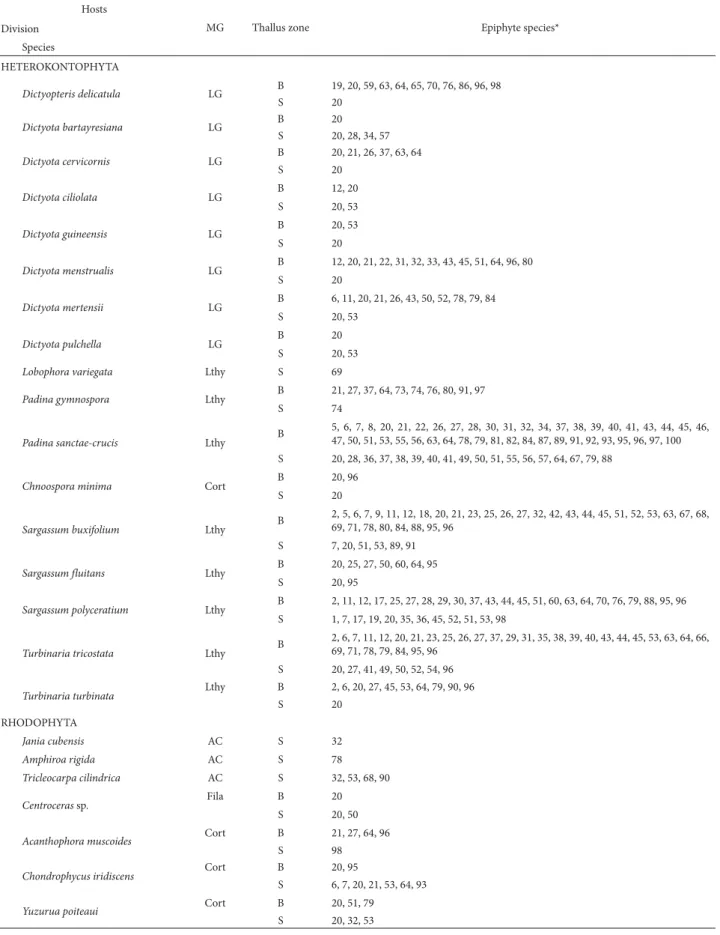
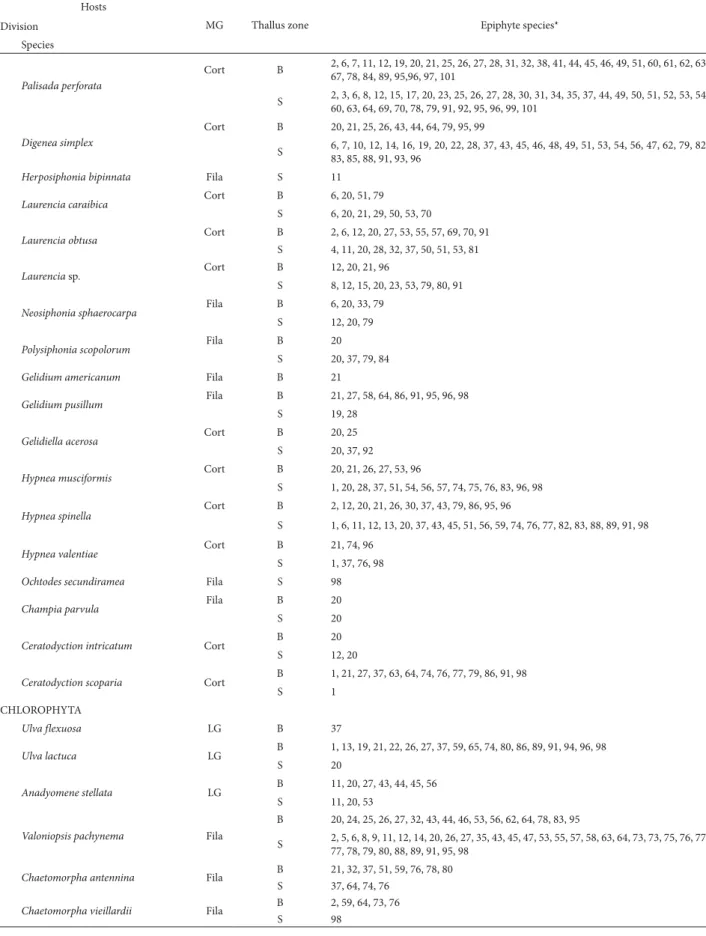
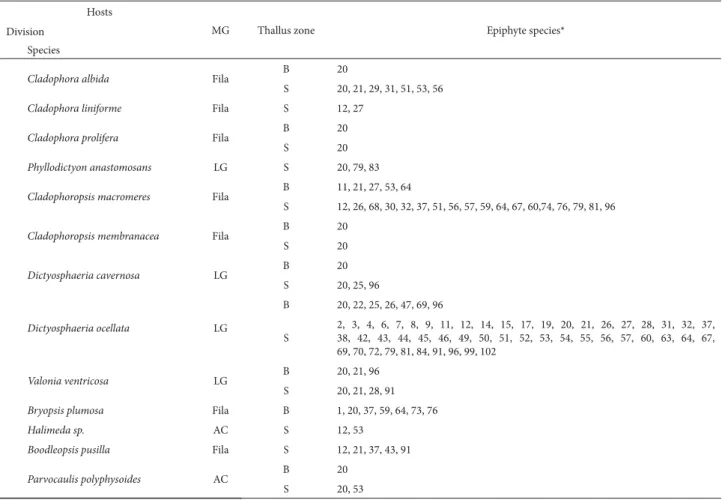
The distribution of epiphytes on the host thalli varied considerably. In 31 host species, the number epiphyte species was higher on the surface of the thallus than at its base, whereas the inverse was observed in 25, and the number epiphyte species was comparable between the two zones in five host species. Epiphytes were located only on the surface of the thallus in nine host species and only at its base in three. The cumulative species richness (both zones) was 89 species. The greatest epiphyte species richness was recorded for macroalgae with thalli that were more com-plex, belonging to the corticated, leathery, leafy and globose morphofunctional groups (Tab. 1).
The total R value for the comparison between the two areas was −0.001 (p=0.398). The mean dissimilarity between the surface and the base of the host thallus, in terms of the species composition of epiphytic macro-algae, was 96.64%. The species Hydrolithon farinosum
(J.V.Lamouroux) D.Penrose & Y.M.Chamberlain and
Polysiphonia atlantica Kapraun & J.N.Norris accounted for 43.76% of the dissimilarity.
The species that accounted for the majority of the mean similarity among epiphytic macroalgae at the base of the host thallus (2.99%) was Hydrolithon farinosum, which ac-counted for 59.36%. In addition, H. farinosum accounted for 92.37% of the mean similarity among epiphytic macroalgae on the surface of the host thallus (4.51%).
Among the species occurring at the base of the thallus, the following were the most common: Dictyosphaeria ocella-ta (M.Howe) J.L.Olsen-Stojkovich (n = 11); Cladophora albida (Nees) Kutzing (n = 13); Valoniopsis pachynema
(G.Martens) Børgesen(n = 19); Hypnea spinella (C.Agardh) Kützing (n = 19); Palisada perforata (Bory) K.W.Nam
(n = 10); Centroceras clavulatum (C.Agardh) Montagne (n = 11); Amphiroa rigida J.V.Lamouroux(n = 18); Amphi-roa fragilissima (Linnaeus)J.V.Lamouroux (n = 12); Jania adhaerens J.V.Lamouroux(n = 21); Hydrolithon farinosum (n = 39); and Dictyota menstrualis (Hoyt) Schnetter, Hörning & Weber-Peukert(n = 10). There were 20 host species that showed no epiphytes at the base of the thallus.
The following were the most common species occurring on the surface of the thallus: Padina sanctae-crucis Børgesen (n = 12); Hydrolithon farinosum (n = 40); Centroceras cla-vulatum (n = 15); Ceramium brasiliense A.B.Joly(n = 11);
Neosiphonia sphaerocarpa (Børgesen) M.S.Kim & I.K.Lee (n = 10); Polysiphonia atlantica (n = 18); and Cladophora albida
(n = 10). There were only three host species that showed no epiphytes on the surface of the thallus (Tab. 1): Gelidium americanum (W.R.Taylor) Santelices; Ulva flexuosa Wulfen; and Bryopsis plumosa (Hudson) C.Agardh.
Discussion
Epiphytic macroalgae and their hosts: typical flora
The 102 taxa of epiphytic macroalgae observed here correspond to 21% of those identified for the waters of Cuba, whereas the host species correspond to 12.5% (Suárez 2005). The level of species richness observed here was high in comparison with those previously reported for Cuban waters. That might be due, in part, to the community appro-ach taken in our study of the hosts, given that the majority of investigations of the hosts of epiphytic macroalgae have been conducted at the population level.
Table 1. Characteristics of the macroalgae hosting epiphytic macroalgae, including morphofunctional group, thallus zone in which the epiphytes were found, and epiphyte species composition, in a rocky intertidal zone in the Baconao Biosphere Reserve, in Cuba.
Hosts
MG Thallus zone Epiphyte species*
Division Species
HETEROKONTOPHYTA
Dictyopteris delicatula LG B 19, 20, 59, 63, 64, 65, 70, 76, 86, 96, 98
S 20
Dictyota bartayresiana LG B 20
S 20, 28, 34, 57
Dictyota cervicornis LG B 20, 21, 26, 37, 63, 64
S 20
Dictyota ciliolata LG B 12, 20
S 20, 53
Dictyota guineensis LG B 20, 53
S 20
Dictyota menstrualis LG B 12, 20, 21, 22, 31, 32, 33, 43, 45, 51, 64, 96, 80
S 20
Dictyota mertensii LG B 6, 11, 20, 21, 26, 43, 50, 52, 78, 79, 84
S 20, 53
Dictyota pulchella LG B 20
S 20, 53
Lobophora variegata Lthy S 69
Padina gymnospora Lthy B 21, 27, 37, 64, 73, 74, 76, 80, 91, 97
S 74
Padina sanctae-crucis Lthy B
5, 6, 7, 8, 20, 21, 22, 26, 27, 28, 30, 31, 32, 34, 37, 38, 39, 40, 41, 43, 44, 45, 46, 47, 50, 51, 53, 55, 56, 63, 64, 78, 79, 81, 82, 84, 87, 89, 91, 92, 93, 95, 96, 97, 100 S 20, 28, 36, 37, 38, 39, 40, 41, 49, 50, 51, 55, 56, 57, 64, 67, 79, 88
Chnoospora minima Cort B 20, 96
S 20
Sargassum buxifolium Lthy B
2, 5, 6, 7, 9, 11, 12, 18, 20, 21, 23, 25, 26, 27, 32, 42, 43, 44, 45, 51, 52, 53, 63, 67, 68, 69, 71, 78, 80, 84, 88, 95, 96
S 7, 20, 51, 53, 89, 91
Sargassum fluitans Lthy B 20, 25, 27, 50, 60, 64, 95
S 20, 95
Sargassum polyceratium Lthy B 2, 11, 12, 17, 25, 27, 28, 29, 30, 37, 43, 44, 45, 51, 60, 63, 64, 70, 76, 79, 88, 95, 96 S 1, 7, 17, 19, 20, 35, 36, 45, 52, 51, 53, 98
Turbinaria tricostata Lthy B
2, 6, 7, 11, 12, 20, 21, 23, 25, 26, 27, 37, 29, 31, 35, 38, 39, 40, 43, 44, 45, 53, 63, 64, 66, 69, 71, 78, 79, 84, 95, 96
S 20, 27, 41, 49, 50, 52, 54, 96
Turbinaria turbinata Lthy B 2, 6, 20, 27, 45, 53, 64, 79, 90, 96
S 20
RHODOPHYTA
Jania cubensis AC S 32
Amphiroa rigida AC S 78
Tricleocarpa cilindrica AC S 32, 53, 68, 90
Centroceras sp. Fila B 20
S 20, 50
Acanthophora muscoides Cort B 21, 27, 64, 96
S 98
Chondrophycus iridiscens Cort B 20, 95
S 6, 7, 20, 21, 53, 64, 93
Yuzurua poiteaui Cort B 20, 51, 79
S 20, 32, 53
Hosts
MG Thallus zone Epiphyte species*
Division Species
Palisada perforata
Cort B 2, 6, 7, 11, 12, 19, 20, 21, 25, 26, 27, 28, 31, 32, 38, 41, 44, 45, 46, 49, 51, 60, 61, 62, 63, 67, 78, 84, 89, 95,96, 97, 101
S 2, 3, 6, 8, 12, 15, 17, 20, 23, 25, 26, 27, 28, 30, 31, 34, 35, 37, 44, 49, 50, 51, 52, 53, 54, 60, 63, 64, 69, 70, 78, 79, 91, 92, 95, 96, 99, 101
Digenea simplex
Cort B 20, 21, 25, 26, 43, 44, 64, 79, 95, 99
S 6, 7, 10, 12, 14, 16, 19, 20, 22, 28, 37, 43, 45, 46, 48, 49, 51, 53, 54, 56, 47, 62, 79, 82, 83, 85, 88, 91, 93, 96
Herposiphonia bipinnata Fila S 11
Laurencia caraibica Cort B 6, 20, 51, 79
S 6, 20, 21, 29, 50, 53, 70
Laurencia obtusa Cort B 2, 6, 12, 20, 27, 53, 55, 57, 69, 70, 91
S 4, 11, 20, 28, 32, 37, 50, 51, 53, 81
Laurencia sp. Cort B 12, 20, 21, 96
S 8, 12, 15, 20, 23, 53, 79, 80, 91
Neosiphonia sphaerocarpa Fila B 6, 20, 33, 79
S 12, 20, 79
Polysiphonia scopolorum Fila B 20
S 20, 37, 79, 84
Gelidium americanum Fila B 21
Gelidium pusillum Fila B 21, 27, 58, 64, 86, 91, 95, 96, 98
S 19, 28
Gelidiella acerosa Cort B 20, 25
S 20, 37, 92
Hypnea musciformis Cort B 20, 21, 26, 27, 53, 96
S 1, 20, 28, 37, 51, 54, 56, 57, 74, 75, 76, 83, 96, 98
Hypnea spinella Cort B 2, 12, 20, 21, 26, 30, 37, 43, 79, 86, 95, 96
S 1, 6, 11, 12, 13, 20, 37, 43, 45, 51, 56, 59, 74, 76, 77, 82, 83, 88, 89, 91, 98
Hypnea valentiae Cort B 21, 74, 96
S 1, 37, 76, 98
Ochtodes secundiramea Fila S 98
Champia parvula Fila B 20
S 20
Ceratodyction intricatum Cort B 20
S 12, 20
Ceratodyction scoparia Cort B 1, 21, 27, 37, 63, 64, 74, 76, 77, 79, 86, 91, 98
S 1
CHLOROPHYTA
Ulva flexuosa LG B 37
Ulva lactuca LG B 1, 13, 19, 21, 22, 26, 27, 37, 59, 65, 74, 80, 86, 89, 91, 94, 96, 98
S 20
Anadyomene stellata LG B 11, 20, 27, 43, 44, 45, 56
S 11, 20, 53
Valoniopsis pachynema Fila
B 20, 24, 25, 26, 27, 32, 43, 44, 46, 53, 56, 62, 64, 78, 83, 95
S 2, 5, 6, 8, 9, 11, 12, 14, 20, 26, 27, 35, 43, 45, 47, 53, 55, 57, 58, 63, 64, 73, 73, 75, 76, 77, 77, 78, 79, 80, 88, 89, 91, 95, 98
Chaetomorpha antennina Fila B 21, 32, 37, 51, 59, 76, 78, 80
S 37, 64, 74, 76
Chaetomorpha vieillardii Fila B 2, 59, 64, 73, 76
S 98
Table 1. Continuation.
Hosts
MG Thallus zone Epiphyte species*
Division Species
Cladophora albida Fila B 20
S 20, 21, 29, 31, 51, 53, 56
Cladophora liniforme Fila S 12, 27
Cladophora prolifera Fila B 20
S 20
Phyllodictyon anastomosans LG S 20, 79, 83
Cladophoropsis macromeres Fila B 11, 21, 27, 53, 64
S 12, 26, 68, 30, 32, 37, 51, 56, 57, 59, 64, 67, 60,74, 76, 79, 81, 96
Cladophoropsis membranacea Fila B 20
S 20
Dictyosphaeria cavernosa LG B 20
S 20, 25, 96
Dictyosphaeria ocellata LG
B 20, 22, 25, 26, 47, 69, 96
S
2, 3, 4, 6, 7, 8, 9, 11, 12, 14, 15, 17, 19, 20, 21, 26, 27, 28, 31, 32, 37, 38, 42, 43, 44, 45, 46, 49, 50, 51, 52, 53, 54, 55, 56, 57, 60, 63, 64, 67, 69, 70, 72, 79, 81, 84, 91, 96, 99, 102
Valonia ventricosa LG B 20, 21, 96
S 20, 21, 28, 91
Bryopsis plumosa Fila B 1, 20, 37, 59, 64, 73, 76
Halimeda sp. AC S 12, 53
Boodleopsis pusilla Fila S 12, 21, 37, 43, 91
Parvocaulis polyphysoides AC B 20
S 20, 53
MG – morphofunctional group; LG – leafy, globose; Lthy – leathery; Cort – corticate; AC – articulated calcareous; Fila –filamentous. *For the names of the species corresponding to the numbers shown, see the taxonomic list in the Results section.
Table 1. Continuation.
Suárez et al. (1989) identified 98 species of epiphytic macro-algae on Stypopodium zonale (Lamouroux) Papenfuss in a rocky subtidal ecosystem. That discrepancy can be explained by the differences between the two host species, in terms of the complexity of the thallus (greater in S. zonale) and in terms of habitat (species richness is typically greater in rocky subtidal ecosystems than in estuarine ecosystems).
Zayas et al. (2006) found only 13 species of epiphytic macroalgae within the community of macroalgae in the reef lagoon at Guardalavaca Beach. That low level of spe-cies richness could be attributed to the fact that epiphytic macroalgae more adhere to Thalassia testudinum Banks & Sol. ex K.D.Koenig, in algal beds, or to angiosperms (Bo-rowitzka et al. 2006).
The greater epiphyte richness observed among hosts belonging to the morphofunctional groups with higher thallus complexity is due to the fact that those groups pre-sent morphological differences among their component species, which makes them responsible for increasing the spatial heterogeneity of the community. In addition, species with differentiated blades and thalli have greater morpho-logical complexity, are more resistant to adverse conditions
and confer greater stability upon the community (Littler & Littler 1980; 1984).
Distribution of epiphytic macroalgae on the host thallus
Greater epiphyte species richness on the surface of the thallus might be determined by the protection that provides against the extreme conditions in the intertidal zone, such as desiccation and wave exposure, as well as avoiding the compe-tition for light that could lead to the overlapping of host thalli. In turn, macroalgae hosts with more epiphytes at the thallus base could better withstand those adversities and tolerate competition for light. The various structures that give rise to the thalli differ in terms of desiccation and solar irradiation. Longtin et al. (2009) found that these two factors were more intense in the distal segments of the thallus than at its base.
different parts of the host. The morphology of the host thallus is also crucial, it is expected that structurally complex thalli favor colonization by a greater number of epiphytes, because they create a greater number of niches and shelters (Ayala & Martín 2003). Apparently morphologically com-plex thalli, such as those of leathery corticate algae, create protected microhabitats (Kendrick & Burt 1997; Lavery & Vanderklift 2002). In addition, the texture and structure of the thalli are frequently used by epiphytes, increasing the complexity of the habitat (Hacker & Steneck 1990).
The fact that the similarity in overall shape was near zero indicates no difference in the distribution of epiphytic macroalgae, which might be attributable to the similarity between the base of the thallus and its surface, in terms of epiphyte species richness. However, the dissimilarity values are very high, given the existence of quite significant differences in epiphyte species composition and in the pro-portional contributions of individual species.
Species such as Hydrolithon farinosum, Centroceras cla-vulatum and Cladophora albida showed no preference for any specific area of the host thallus, presenting high values of frequency of appearance at its base and on its surface. This behavior could be determined by the low complexity of the host thalli, given the possibility that the developmental requirements of those species might not be as specific as are those of other epiphytes.
The hosts that did not have epiphytes adhering to the thallus base were typically the simpler forms, with few occurrences during the sampling periods. Macroalgae that host a great number of epiphytes in general or at the thallus base might have greater viability in the ecosystem, as has been suggested by various authors (Davis et al. 1989; Wahl 1989). The significantly low number of species hosting epiphytes of the thallus surface might be attributable to the epiphytes having a preference for zones that provide more light and more nutrients (Pedersen & Borum 1996; Lobban & Harrison 1997; Kraberg & Norton 2007). Ulva flexuosa
and Bryopsis plumosa both present thalli that are structurally simple, with very smooth blade surfaces.
We conclude that the development of epiphytes can be influenced not only by the extreme physical conditions in the rocky intertidal zone but also by the structural characte-ristics of the host thalli and of the epiphytes, their ability to adhere to other macroalgae thalli or allow their own thalli to be adhered to by others.
Acknowledgments
The authors would like to thank Michael Wynne, for the corrections to the taxonomic nomenclature, and Humberto Morris, for the translation of the abstract to Portuguese and for the unconditional assistance. The authors are also grateful to Gary Kendrick and Lizette Quan for their help in constructing the bibliography, as well as to the peer reviewers, whose comments and suggestions resulted in substantial improvement of the manuscript.
References
Aguilar, M.; Aguilar-Rosa L. & Aguilar-Rosas R. 1998. Algas marinas de la región central del Estado de Quintana Roo, México. Polibotánica 7: 15-32. Aguilar-Rosas, R. & Galindo A. 1990. Ecological aspects of Sargassum
muticum (Fucales, Phaeophyta) in Baja California: reproductive phenology and epiphytes. Hydrobiologia 204/205: 185-190. Ang, P. & DeWreede R. 1992. Density-dependence in a population of Fucus
distichus. Marine Ecology Progress Series 90: 169-181.
Ayala, Y. & A. Martin. 2003. Relaciones entre la comunidad de anfípodos y las macroalgas a las que están asociados, en una plataforma rocosa del litoral central de Venezuela. Boletino Del Instituto Espanol De Oceanografia 19: 171.184.
Børgesen, F. 1915-20. II. Rhodophyceæ, with addenda to the Chlorophyceæ, Phæophyceæ and Rhodophyceæ. Dansk Botanisk Arkiv 3: 1-504. Borowitzka, M.A.; Lavery, P.S. & van Keulen, M. (2006) Epiphytes of
seagrass-es, Pp. 441-461. In: Larkum, A.W.D.; Orth, P.J. & Duarte, C.M. (Eds.). Seagrasses: Biology, Ecology and Conservation. Berlín, Springer. Brawley, S. & Johnson L. 1992. Gametogenesis, gametes and zygotes: an
ecological perspective on sexual reproduction in the algae. British Phycological Journal 27: 233-252.
Bruno, J.; Stachowicz J. & Bertness M. 2003. Inclusion of facilitation into ecological theory. Trends in Ecology and Evolution 18(3): 119-125. Cabrera, R.; Moreira, Á.; Primelles, J. & Suárez, A. 2005. Variación de la
Biomasa de Chondrophycus papillosus (C. Agardh) Garvary et Harper (Ceramiales: Rhodophyta) y su epifitismo en la Bahía de Nuevitas, Cuba. Revista de Investigaciones Marinas 26(1): 15-20.
Castro, J. de; Barros-Barreto, M. & Pita, S. 2008. A família Ceramiaceae (Ceramiales, Rhodophyta) no estado da Bahia, Brasil. Pp. 75-159. En: A. Santíes y K. Dreckmann (Eds.). Monografías Ficológicas 3. Universidad Autónoma de México.
Clarke, K. 1993. Non-parametric multivariate analyses of changes in community structure. Australian Journal of Ecology 18: 117-143. Clarke, K. & Gorley, R. 2006. PRIMER v 6: User manual/tutorial,
PRIMER-E. United Kingdom, Plymouth.
Clarke, K. & Warwick, R. 2001. Change in marine communities: an ap-proach to statistical analysis and interpretation. PRIMER-E. United Kingdom, Plymouth.
Davis, A.; Targett, N.; McConnell, O. & Young, C. 1989. Epibiosis of marine algae and benthic invertebrates: natural product chemistry and other mechanisms inhibiting settlement and overgrowth. Pp. 85-114. In: Scheuer, P. (Ed.). Bioorganic Marine Chemistry. V. 3. Berlin, Springer-Verlag.
Dawes, C. & Mathieson, A. 2008. The Saeweeds of Florida. Florida, University of Florida Press.
Foster, M. 1990. Organization of macroalgal assemblages in the Northeast Pacific: the assumption of homogeneity and the illusion of generality. Hydrobiologia 192: 21-34.
Foster, M. 1991. Rammed by the Exxon Valdez: a reply to Paine. Oikos 62: 93-96.
Guiry, M. & Guiry, G. 2011. AlgaeBase. World-wide electronic publica-tion, National University of Ireland, Galway. http://www.algaebase.org. (Consultado: 16 mayo 2011).
Hacker, S. & Steneck R. 1990. Habitat architecture and body- size-depend-ent habitat selection of a phytal amphipod. Ecology 71: 2269-2285. Jover, A.; Reyes, L.; Gómez, L. & Suárez, A. 2012. Variación espacial y
tem-poral de las macroalgas del mesolitoral rocoso en Aguadores-Baconao, Cuba I: Composición. Revista de Investigaciones Marinas 32: 38-49. Kraberg, A. & Norton, T. 2007. Effect of epiphytism on reproductive and vegetative lateral formation in the brown, intertidal seaweed Ascophyl-lum nodosum (Phaeophyceae). Phycological Research 55: 17-24. Kendrick G. & Burt, J. 1997. Seasonal changes in epiphytic macro-algae
assemblages between offshore exposed and inshore protected Posido-nia sinuosa Cambridge et Kuo seagrass meadows, Western Australia. Botanica Marina 40: 77-85
Lebreton, B.; Richard P.; Radenac G.; Bordes M.; Bréret M.; Arnaud C.; Mornet F. & Blanchard G. 2009. Are epiphytes a significant component of intertidal Zostera noltii beds? Aquatic Botany 91: 82-90. Lecha, L. & Chugaev, A. 1989. La bioclimatología y algunas de sus
aplicaciones en condiciones de clima tropical húmedo. La Habana, Editorial Academia, Cuba.
Little, C. & Kitching J. 1996. The biology of rocky shores. Oxford, Oxford University Press.
Littler, M.M. & D.S. Littler. 1980. The evolutions of thallus form and sur-vival strategies in benthic marine macroalgae: field and laboratory test of and functional: forms model. American Naturalist 116(1): 25-44. Littler, D.S. & M.S. Littler. 1984. Relationships between macoalgal functional
form groups and substrata stability in a subtropical rocky-intertidal sys-tem. Journal of Experimental Marine Biology and Ecology 74: 13-34. Littler, D. & Littler, M. 1997. An illustrated marine flora of the Pelican
Cays, Belize. Boletim de Botânica 9: 1-149.
Littler, D. & Littler, M. 2000. Caribbean Reef Plants. An identification to tha reef plants of the Caribbean, Bahamas, Florida and Gulf of Mexico. Florida, Offshore Graphics, Inc.
Littler, D.; Littler, M. & Dennis, M. 2008. Submersed Plants of the Indian River Logoon. Florida, Offshore Graphics, Inc.
Littler, D.; Littler, M.; Rucher, K. & Noris, J. 1989. Marine Plants of the Caribbean. A fiel guide from Florida to Brazil. New York, Smitho-sonian Institution Press.
Lobban, C. & Harrison P. 1997. Seaweed ecology and physiology. Cam-bridge, Cambridge University Press.
Longtin, C. & Scrosati, R. 2009. Role of surface wounds and brown algal epi-phytes in the colonization of Ascophyllum nodosum (Phaeophyceae) fronds by Vertebrata lanosa (Rhodophyta). Journal of Phycolgy 45: 535-539. Longtin, C.; Scrosati, R.; Whalen, G. & Garbary, D. 2009. Distribution
of algal epiphytes across environmental gradients at different scales: intertidal elevation, host canopies and host fronds. Journal of Phy-colgy 45: 820-827.
Ludwig, J. & Reynolds, J. 1988. Statistical Ecology. Nueva York, John Wiley and Sons.
Martin-Smith, K. 1993. Abundante of mobile epifauna: the role of habitat complexity and predation by fishes. Journal of Experimental Marine Biology and Ecology 174: 243-260.
Montañes, M.; Reyes, J. & Senzón, M. 2003. La comunidad de epífitos de
Zonaria tournefortiien el norte de Tenerife (islas Canarias): análisis florístico y comentarios sobre su epifauna. Vieraea 31: 121-132. Paine, R. 1991. Between Scylla and Charybdis: do some kinds of criticism
merit a response? Oikos 62: 90-92.
Paula, E. & Oliveira-Filho E. 1980. Phenology of two populations of Sargas-sum cymoSargas-sum (Phaeophyta- Fucales) of São Paulo State coast, Brazil. Boletim de Botânica 8: 21-39.
Pedersen, M. & Borum, J. 1996. Nutrient control of algal growth in es-tuarinen waters. Nutrient limitation and the importance of nitrogen requirements and nitrogen storage among phytoplankton and species of macroalgae. Marine Ecology Progress Series 142: 261-272. Reed, D. 1990a. The effects of variable settlement and early competition
on patterns of kelp recruitment. Ecology 71(2): 776-787.
Reed, D. 1990b. An experimental evaluation of density dependence in a subtidal algal population. Ecology 71: 2286-2296.
Saad-Navarro, G. & Riosmena-Rodrígez R. 2005. Variación espacial y temporal de la riqueza florística de macroalgas en la zona rocosa de Bahía de Muertos, B.C.S. México. Ciencia y Mar IX (26): 19-32. Steneck, R.S. & M.N. Dethier. 1994. A functional group approach to the
structure of algal dominated communities. Oikos 69: 476-498. Suárez, A. 2005. Lista de las macroalgas marinas cubanas. Revista de
Investigaciones Mararinas 26(2): 93-148.
Suárez, A.; Gil, L. & Poseck R. 1989. Variación del epifitismo en Stypopo-dium zonale (Lamouroux) Papenfuss a lo largo de un año. Revista de Investigaciones Mararinas 10(1): 3-20.
Széchy, M.; Galliez M. & Marconi M. 2006. Quantitative variables applied to phenological studies on Sargassum vulgare C. Agardh (Phaeophy-ceae, Fucales) from Ilha Grande Bay, state of Rio de Janeiro. Revista Brasileira de Botânica 29: 27-37.
Taylor, W. 1960. Marine algae of the Eastern Tropical and Subtropical coast of the Americans. Michigan, The University of Michigan Press. Underwood, A. 2000. Experimental ecology of rocky intertidal habitats:
what are we learning? Journal of Experimental Marine Biology and Ecology 250: 51-76.
Underwood, A; Chapman M. & Connell S. 2000. Observations in ecol-ogy: You can´t make progress on processes without understanding the patterns. Journal of Experimental Marine Biology and Ecology 250: 97-115.
Vreeland, V. & Epstein L. 1996. Analysis of plant-substratum adhesives. Pp. 95-116. In: Linskens & Jackson, J. (Eds.). Modern Methods of Plant Analysis. Plant Cell Wall Analysis. v. 17. Berlin, Springer-Verlag. Wahl, M. 1989. Marine epibiosis: I. Fouling and antifouling: some basic
aspects. Marine Ecology Progress Series 58: 175-189.
Wernberg, T. & Connell S. 2008. Physical disturbance and subtidal habitat structure on open coasts: effects of wave exposure, extent and intensity. Journal of Sea Research 59: 237-248.
Wynne, M. 2011. A checklist of benthic marine algae of the tropical and subtropical western Atlantic: third revision. Beiheft Nova Hedwigia. 140: 1-166.
Zayas, C.; Ocaña, F.; Suárez, A. & La O, J. 2006. Variación estacional del epifitismo del fitobentos marino de Playa Guardalavaca, Cuba. Revista de Investigaciones Marinas 27: 95-101.