Transcriptome analysis of resistant soybean roots infected
by
Meloidogyne javanica
Maria Eugênia Lisei de Sá
1,5, Marcus José Conceição Lopes
2,3, Magnólia de Araújo Campos
2,3,
Luciano Vilela Paiva
3, Regina Maria Amorim dos Santos
5, Magda Aparecida Beneventi
5,
Alexandre Augusto Pereira Firmino
4,5and Maria Fátima Grossi de Sá
51
Empresa de Pesquisa Agropecuária de Minas Gerais, Uberaba, MG, Brazil.
2
Universidade Federal de Campina Grande, Centro de Educação e Saúde, Cuité, PB, Brazil.
3Universidade Federal de Lavras, Lavras, MG, Brazil.
4Universidade Federal do Rio Grande do Sul, Porto Alegre, RS, Brazil.
5
Laboratório Interação Molecular Planta-Praga, Embrapa Recursos Genéticos e Biotecnologia,
Brasília, DF, Brazil.
Abstract
Soybean is an important crop for Brazilian agribusiness. However, many factors can limit its production, especially root-knot nematode infection. Studies on the mechanisms employed by the resistant soybean genotypes to prevent infection by these nematodes are of great interest for breeders. For these reasons, the aim of this work is to charac-terize the transcriptome of soybean line PI 595099-Meloidogyne javanica interaction through expression analysis. Two cDNA libraries were obtained using a pool of RNA from PI 595099 uninfected andM. javanica (J2) infected roots,
collected at 6, 12, 24, 48, 96, 144 and 192 h after inoculation. Around 800 ESTs (Expressed Sequence Tags) were sequenced and clustered into 195 clusters.In silico subtraction analysis identified eleven differentially expressed genes encoding putative proteins sharing amino acid sequence similarities by using BlastX: metallothionein, SLAH4 (SLAC1 Homologue 4), SLAH1 (SLAC1 Homologue 1), zinc-finger proteins, AN1-type proteins, auxin-repressed proteins, thioredoxin and nuclear transport factor 2 (NTF-2). Other genes were also found exclusively in nematode stressed soybean roots, such as NAC domain-containing proteins, MADS-box proteins, SOC1 (suppressor of overexpression of constans 1) proteins, thioredoxin-like protein 4-Coumarate-CoA ligase and the transcription factor (TF) MYBZ2. Among the genes identified in non-stressed roots only were Ser/Thr protein kinases, wound-induced basic protein, ethylene-responsive family protein, metallothionein-like protein cysteine proteinase inhibitor (cystatin) and Putative Kunitz trypsin protease inhibitor. An understanding of the roles of these differentially expressed genes will provide insights into the resistance mechanisms and candidate genes involved in soybean-M. javanica interac-tion and contribute to more effective control of this pathogen.
Key words:gene expression, root knot nematode, transcriptome.
Introduction
Soybean is the most important agricultural commod-ity in the world, both in terms of value and quantcommod-ity. Be-sides, it is an attractive crop for the production of renewable fuels such as biodiesel. Root-knot nematode
(RKN-Meloidogynespp.) is a serious constraint for many crops, and can significantly affect crop productivity worldwide. In Brazil, this pathogen was responsible for economic losses of over US$52.2 million during the 1999/2000 harvest (Yorinori, 2000).
The use of nematode-resistant cultivars is the most economical and environmentally friendly management strategy for the control of the pathogen (Boerma and Hus-sey, 1992). The Plant Introduction (PI) 595099, a soybean genotype that is highly resistant to RKN species and to the soybean cyst nematode (SCN)Heterodera glycines(Davis
et al., 1998), has been successfully used as a new source of nematode resistance in Brazilian breeding programs (Silva, 2001).
Many physiological changes associated with stress response in plants are controlled at the transcriptional level. Several studies of gene expression have contributed to elu-cidate the physiological response to infection of soybean roots with Heterodera glycines (Alkharouf et al., 2004, 2005; Khan et al., 2004; Klink et al., 2005; Ithal et al.,
Genetics and Molecular Biology, 35, 1 (suppl), 272-282 (2012) Copyright © 2012, Sociedade Brasileira de Genética. Printed in Brazil www.sbg.org.br
Send correspondence to Maria Eugênia Lisei de Sá. Parque Estação Biológica, Av. W5 Norte (final), 70770-917 Brasília, DF, Brazil. E-mail: [email protected].
2007a,b). Through microarray analysis, it was possible to identify 429 differentially expressed genes during suscepti-ble soybean-H. glycines interaction (Ithal et al., 2007a). These included genes encoding enzymes involved in plant secondary metabolism, such as the biosynthesis of phenolic compounds, lignin, and flavonoids that were up-regulated early during nematode infection and remained overexpres-sed throughout nematode development. Similarly, genes related to stress and defense responses like pathogenesis-related proteins (PR), cell wall modification enzymes, cel-lular signaling proteins, and transcriptional regulation fac-tors were consistently up-regulated. Transcript profiling analysis of developing syncytia induced in susceptible soy-bean by SCN showed interplay among phytohormones that likely regulate synchronized changes in the expression of genes encoding cell wall-modifying proteins. This process appears to be tightly controlled and coordinated with cell wall rigidification processes that may involve lignification of feeding cell walls (Ithalet al., 2007b).
Expressed sequence tags analyzed in other plants in-oculated withMeloidogyne spp. identified several genes similar to the ones found in compatible soybean- Hetero-derainteraction. For instance, in susceptibleArachisspp. inoculated withM. arenaria,arp(auxin-repressed protein) genes were up-regulated whereas cytokynine oxygenase, metallothionein and resveratrol synthase were down-regulated (Proite K, 2007, Doctoral thesis, Universidade de Brasília). The characterization of the transcriptional profile of a compatible tomato response to Javanese nematode demonstrated significant changes in the steady-state tran-script levels of several functional categories, including pathogenesis-related genes, hormone-associated genes and development-associated transcription factors (Bar-Or et al., 2005). Responses toM. incognitainfection in roots of a resistant cowpea (Vigna unguiculataL. Walp.) genotype and a susceptible near-isogenic line showed that a greater number and proportion of genes were down-regulated in the resistant than in the susceptible genotype, whereas more genes were up-regulated in the susceptible than in the resis-tant genotype (Daset al., 2010).
In this work we used EST sequence analysis from cDNA libraries of soybean PI 595099 roots at 6, 12, 24, 48, 96, 144 and 192 h after infection (h.a.i.) withM. javanicato assess the gene expression changes during this interaction. This study could lead to new target genes for nematode control and identify candidates for broadening plant resis-tance to this pathogen through over-expression or gene si-lencing.
Material and Methods
Nematode inoculum
M. javanicaeggs cultured on susceptible tomato host plants were extracted from roots using 0.5% bleach solu-tion (Boneti and Ferraz, 1981) and cleaned with caulim
(Coolen and D’Herde, 1972). Eggs were hatched at room temperature and J2were collected in fresh deionized water.
Root infections for microarray analysis
Soybean PI 595099 seeds were surface sterilized us-ing 10% (v/v) bleach solution, sown in sterilized sand and maintained under controlled environmental conditions at 26.7±2.0 °C temperature and a 16-h photoperiod. After three days, the seedlings were transplanted to seedling growth pouches with sterilized substrate. Eight days after transplant each plantlet was inoculated with 500 J2 M.
javanicalarvae in 5 mL of deionized water. Five repetitions of inoculated and non-inoculated roots (mock control) were collected at 0, 6, 12, 24, 48, 96, 144 and 192 h after inocula-tion (h.a.i.). Infected and non-infected plants were arranged in a completely randomized design under greenhouse con-ditions.
RNA isolation
Total RNA from nematode infected and non-infected roots was isolated using Trizol (Invitrogen) reagent and cleaned with RNeasy Mini Kit for RNA cleanup (Qiagen Inc., Valencia, CA, USA) according to the manufacturer’s protocol. RNA was treated with RNase-Free DNase (Qia-gen) to digest any remaining genomic DNA. RNA was quantified using a UV-spectrophotometer and its quality and integrity was examined in 1.2% agarose gel containing ethidium bromide.
cDNA cloning
Two cDNA libraries were constructed comprising the control and the pooled infected root tissues from all inter-vals. The libraries were prepared using the SMART cDNA Library Construction Kit (Clontech Laboratories, Palo Al-to, CA, USA) according to the manufacturer’s instructions. Briefly, the double-stranded cDNAs were fractioned and cloned in the pTriplEx 2 vector of the same kit according to the manufacturer’s protocol. The library was amplified in
Escherichia coli DH-5 cells (Invitrogen), placed on LB agar and grown overnight at 37 °C. Plasmid preparations of the individual transformants were performed in 96-well plates.
EST sequencing
cDNA inserts were sequenced using specific primers PTR2 (5’CCGCATGCATAAGCTTGCTC3’ - Reverse) and PTF2 (5’GCGCCATTGTGTTGGTACCC3’ - For-ward) at Embrapa Genetic Resources and Biotechnology, Brazil. Nucleotide sequences and predicted amino acid se-quences were analyzed using the SisGen software (Pappas
et al., 2008) and Fisher (1932) statistical tests to reveal dif-ferential gene expression (Table 1). The criteria applied were a minimum of 30-base similarity between sequences and at least 90% identity. Semiautomatic annotation was performed by BlastX 2.2.3 (Altschul et al., 1990),
SwissProt (Bairoch and Apweiler, 1997) and sequences were clustered according to their putative functions by us-ing COG (Clusters of Orthologous Groups of Proteins) (Tatusovet al., 2003). The sequences were grouped into contigs. The EST database is housed at the Soybean Ge-nome Project Database (SGPD).
Results
EST validation
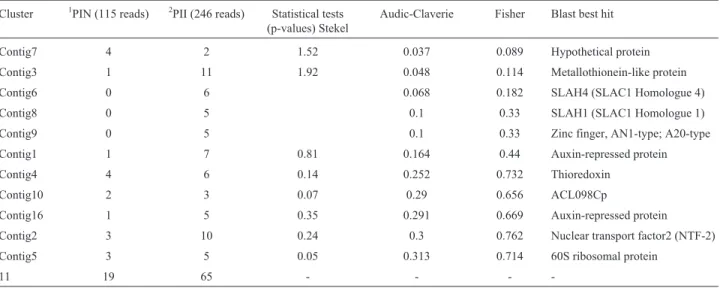
Throughout the analysis of the two (RKN-infected and mock control) sequenced cDNA libraries a total of 2,112 sequence reads were obtained and 877 accepted (41%). The valid ESTs were distributed in 195 clusters, these being 79 contigs, and 116 singletons. From these, 55 contigs originated from inoculated (Table 2) and 24 from non-inoculated (Table 3) roots.In silicocomparison of the two libraries using the statistical tests of Stekel et al.
(2000), Audic andClaverie (1997) and Fisher (1932) (p < 0.005) revealed 11 contigs with significant variation in their transcript levels (Table 1). These transcriptional changes might result from the up-regulation of transcrip-tion level or from reduced mRNA expression due to nema-tode infection.
Functional classification of ESTs homologous to genes of known function
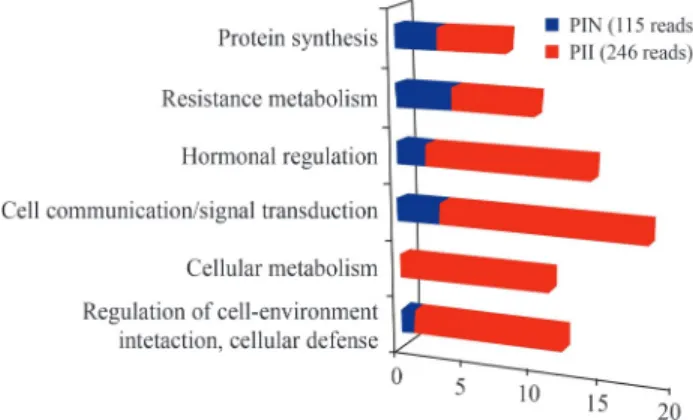
Overall, the most abundant transcripts observed in PI 595099 roots included ESTs encoding genes involved in cell communication/signal transduction [(zinc finger, AN1-type; A20-type); (Nuclear transport factor 2 (NTF-2)], followed by hormonal regulation (Auxin-repressed protein), cellular metabolism [(SLAH4 (SLAC1 Homo-logue 4); SLAH1 (SLAC1 HomoHomo-logue 1)], regulation of cell-environment interaction, cellular defense
(metallo-thionein-like proteins), protein synthesis (60S ribosomal proteins) and resistance metabolism (thioredoxin) (Figure 1 and Table 1).
Discussion
In general, the onset of responses governing pest re-sistance in plants depends on the genotype/species, magni-tude and rapidity in which the genes are expressed during the infection. Recently modulated transcript abundance was demonstrated in resistant and susceptible soybean roots during SCN interactions (Mazareiet al., 2011) and also during susceptible soybean- RKN interaction (Ibrahim
et al., 2011). The goal of this work was to describe trans-criptional changes in PI 595099 resistant soybean line roots during the early stages (6, 12, 24, 48, 96, 144 and 192 h) of infection withM. javanica. Thein silicofunctional charac-terization of the transcribed reads from both libraries re-vealed a number of genes related either to biotic or abiotic stresses. Here, among the defense responses of PI 595099 towardsM. javanica are included up-regulated genes en-coding for zinc finger, AN1-type; A20-type; Nuclear trans-port factor 2 (NTF-2); Auxin-repressed protein; SLAH4 (SLAC1 Homologue 4); SLAH1 (SLAC1 Homologue 1); metallothionein-like proteins, 60S ribosomal proteins and thioredoxin.
Metallothioneins belong to a family of cysteine-rich low molecular weight metal-binding proteins in which the presence of thiol groups promotes its high affinity to heavy metal ions, such as zinc and copper (Inácio AF, 2006, Mas-ter’s thesis, Escola Nacional de Saúde Pública – FIOCRUZ). Plants expressing metallothioneins better tol-erate soils and substrates that are rich in heavy metal ions and are capable of mitigating the damage caused by reac-tive oxygen species (ROS) (Chianget al., 2006), which is associated with hypersensitive response (Wong et al.,
274 Transcriptome ofM. javanicainfected soybean
Table 1- Differentially expressed genes in soybean (PI 595999) resistant roots uninfected and infected withM. javanica.
Cluster 1PIN (115 reads) 2PII (246 reads) Statistical tests (p-values) Stekel
Audic-Claverie Fisher Blast best hit
Contig7 4 2 1.52 0.037 0.089 Hypothetical protein Contig3 1 11 1.92 0.048 0.114 Metallothionein-like protein Contig6 0 6 0.068 0.182 SLAH4 (SLAC1 Homologue 4) Contig8 0 5 0.1 0.33 SLAH1 (SLAC1 Homologue 1) Contig9 0 5 0.1 0.33 Zinc finger, AN1-type; A20-type Contig1 1 7 0.81 0.164 0.44 Auxin-repressed protein Contig4 4 6 0.14 0.252 0.732 Thioredoxin
Contig10 2 3 0.07 0.29 0.656 ACL098Cp
Contig16 1 5 0.35 0.291 0.669 Auxin-repressed protein Contig2 3 10 0.24 0.3 0.762 Nuclear transport factor2 (NTF-2) Contig5 3 5 0.05 0.313 0.714 60S ribosomal protein
11 19 65 - - -
Sá
et
al.
275
Table 2- Expressed genes during soybean (PI 595099) root andM. javanica-interaction.
Contig Blast best hit Organism Accession code E-value Number of
ESTs PIN1
Number of ESTs PII2
Total num-ber of ESTs
Contig1 Auxin-repressed protein-like protein, Positives = 48/72 (66%) Nicotiana tabacum AY183722.1 1e-11 2 12 14
Contig2 Nuclear transport factor 2 (NTF-2), Positives = 113/124 (91%) Arabidopsis thaliana sp|Q9C7F5.1|NTF2_ARATH 7e-57 3 10 13
Contig3 Metallothionein-like protein 2 (MT-2) Cicer arietinum sp|Q39459.2|MT2_CICAR 5e-15 1 11 12
Contig4 Thioredoxin-like 4, Positives = 77/104 (74%) Arabidopsis thaliana sp|Q8LDI5.2|TRXL4_ARATH 4e-27 5 6 11
Contig5 60S ribosomal protein L23,Positives = 92/93 (98%) Zea mays gb|ACG48540.1| 5e-69 3 5 8
Contig6 SLAH4 (SLAC1 HOMOLOGUE 4) Positives = 134/176 (76%) Arabidopsis thaliana ref|NP_001077757.1| 5e-49 0 7 7
Contig8 SLAH1 (SLAC1 HOMOLOGUE 1); transporter Positives = 79/113 (69%),
Arabidopsis thaliana ref|NP_176418.2| 2e-29 0 6 6
Contig9 Zinc finger A20 and AN1 domain-containing stress-associated protein 8 (OsSAP8) Positives = 127/169 (75%)
Oryza sativa sp|A2YEZ6.2|SAP8_ORYSI 8e-56 0 5 5
Contig10 ACL098Cp, Positives = 28/59 (47%) Ashbya gossypii ref|NP_983306.1| 2.7 2 3 5
Contig11 N-methyltransferase Positives = 133/160 (83%) Arabidopsis thaliana ref|NP_565246.1| 8e-70 0 4 4
Contig13 Ubiquitin-conjugating enzyme E2-17 kDa 8 Positives = 148/148 (100%) Arabidopsis thaliana 834173 UBC8 2e-82 0 4 4
Contig14 Probable glutathione S-transferase (Heat shock protein 26A) (G2-4), Positives = 56/57 (98%)
Glycine max gb|AAG34798.1|AF243363_1 2e-25 0 4 4
Contig16 CL1Contig2
Auxin-repressed protein Positives = 69/131 (52%) Zea mays gb|ACG37064.1| 5e-13 1 5 6
Contig17 Probableaquaporin PIP-type 7a (Turgor-responsiveprotein 7ª, 31), Posi-tives = 107/108 (99%)
Medicago truncatula gb|AAK66766.1|AF386739_1 1e-54 0 3 3
Contig18 Histone-lysine N-methyltransferase ASHR1, Positives = 30/54 (55%) Arabidopsis thaliana sp|Q7XJS0.2|ASHR1_ARATH 6.1 1 2 3
Contig19 Auxin response factor 2 (ARF1-binding protein) (ARF1-BP) Positives = 49/57 (85%).
Lycopersiconesculentum gb|ABC69711.1| 9e-16 0 3 3
Contig20 Adenine phosphoribosyl transferase 1 (APRT 1), Positives = 164/174 (94%)
Solanum tuberosum gb|ABB86271.1| 2e-81 0 3 3
Contig21 Acetyl-CoAcarboxylase, alpha subunit Positives = 31/56 (55%) Flavobacterium sp. MED217 ref|ZP_01059904.1| 34.7 0 3 3
Contig25 Chloroplast 50S ribosomalprotein L14, Positives = 94/94 (100%). Glycine max ref|YP_538801.1| 5e-45 0 3 3
Contig33 Acyl carrier protein, mitochondrial precursor (ACP)
(NADH-ubiquinoneoxidoreductase 9.6 kDasubunit) (MtACP-1), Posi-tives = 79/120 (65%)
Arabidopsis thaliana sp|P53665.1|ACPM_ARATH
9e-25 0 2 2
Contig34 Kinesin light chain 3 (Kinesin light chain KLCt) Positives = 122/137 (89%)
Arabidopsis thaliana gb|AAM63491.1| 1e-54 0 2 2
Contig35 Predicted protein Positives = 30/57 (52%) Pichia guilliermondii gb|EDK41815.2| 0.90 0 2 2
Contig36 Putative non-LTR retroelement reverse transcriptase, related Positives = 49/115 (42%)
276
Transcriptome
of
M.
javanica
infected
soybean
Contig Blast best hit Organism Accession code E-value Number of
ESTs PIN1
Number of ESTs PII2
Total num-ber of ESTs
Contig37 ATP synthase 6 kDa subunit, mitochondrial Positives = 20/23 (86%) Solanum tuberosum sp|P80497.1|ATPY_SOLTU 4e-05 0 2 2
Contig38 Transcription factor MYBZ2 Positives = 131/131 (100%) Glycine max gb|ABI73970.1| 6e-119 0 2 2
Contig39 Thioredoxin-like protein 1 Positives = 149/169 (88%) Zea mays gb|ACG24478.1| 1e-66 0 2 2
Contig41 No hit blast 0 2 2
Contig42 Dolichyl-diphosphooligosaccharide—protein glycosyltransferase subunit DAD1 (Defender against cell death 1) (DAD-1) (AtDAD1), Positives = 111/113 (98%),
Arabidopsis thaliana ref|NP_174500.1| 3e-52 0 2 2
Contig43 Anaphase-promoting complex subunit 11 (APC11) (Cyclosome subunit 11), Positives = 67/83 (80%)
Mus musculus sp|Q9CPX9.1|APC11_MOUSE 2e-36 0 2 2
Contig44 Unnamed protein product Positives = 39/54 (72%) Vitis vinifera emb|CAO40176.1| 5e-05 1 1 2
Contig46 Inner membrane magnesium transporter mrs2, mitochondrial precursor (RNA-splicing protein mrs2), Positives = 58/120 (48%),
Schizosaccharomyces pombe sp|P87149.1|MRS2_SCHPO 8e-05 0 2 2
Contig48 F-box/LRR-repeat protein 16 (F-box and leucine-rich repeat protein 16) Positives = 131/144 (90%)
Malus x domestica gb|ACB87911.1| 6e-57 0 2 2
Contig50 Glucose-6-phosphate 1-dehydrogenase, cytoplasmicisoform (G6PD) Positives = 89/93 (95%)
Solanum tuberosum gb|ABB55386.1| 1e-44 0 2 2
Contig51 Hypothetical protein MtrDRAFT_AC136139g5v2, Positives = 35/38 (92%).
Medicago truncatula gb|ABE93033.1| 8e-12 0 2 2
Contig52 USP family protein Positives = 27/30 (90%) Zea mays gb|ACG42306.1| 6e-06 0 2 2
Contig53 Unnamed protein product Positives = 111/119 (93%) Vitis vinifera emb|CAO42347.1| 6e-53 0 2 2
Contig54 39S ribosomal protein L41-A, mitochondrial precursor Positives = 79/89 (88%)
Arabidopsis thaliana ref|NP_568574.1| 8e-35 0 2 2
Contig57 Chalconereductase Positives = 89/106 (83%) Sesbania rostrata emb|CAA11226.1| 3e-33 0 2 2
Contig58 Probable rhamnose biosynthetic enzyme 1 Positives = 94/103 (91%) Arabidopsis thaliana sp|Q9SYM5.1|RHM1_ARATH 7e-46 0 2 2
Contig60 Ubiquinol—cytochrome-c reductase-like protein Positives = 83/85 (97%) Arabidopsis thaliana dbj|BAD95225.1| 5e-43 0 2 2
Contig61 Translation initiation factor IF-2 Positives = 39/80 (48%) Plasmodium yoelii ref|XP_730210.1| 3.0 0 2 2
Contig62 UPF0497 membrane protein At2g28370, Positives = 49/55 (89%) Arabidopsis thaliana sp|Q9SKN3.1|U4977_ARATH 1e-20 0 2 2
Contig63 MADS-box protein SOC1 (protein suppressor of constans overexpression 1) Positives = 77/82 (93%)
Glycine max gb|ABC75835.1| 3e-33 0 2 2
Contig64 SAP domain-containing protein Positives = 84/117 (71%) Arabidopsis thaliana ref|NP_201151.2| 3e-22 0 2 2
Contig65 No blast hit - - - 0 2 2
Contig66 Histone H2A.F/Z Positives = 115/116 (99%) Arabidopsis thaliana emb|CAA73155.1| 4e-54 0 2 2
Contig68 Hypothetical protein MGG_13574 Positives = 28/54 (51%) Magnaporthe grisea ref|XP_001408018.1| 5.9 0 2 2
Contig69 No significant - - - 0 2 2
2004). InArachisspp., metallothionein-3 expression was observed only in roots inoculated withM. arenariarace 1 (Proite K, 2007, Doctoral thesis, Universidade de Brasilia). Infected roots of PI 595099 over-expressing the metallo-thionein gene might use its protein product as a defense mechanism, acting directly in the cell, affecting ROS con-centration, in order to avoid damage to the cell wall and even nucleic acids.
SLAC1 (Slow Anion Channel-Associated 1) has been shown to be essential for stomata closure in response to CO2, abscisic acid, ozone, light/dark transitions, humidity,
calcium ions, hydrogen peroxide and nitric oxide (Negiet al., 2008). The twoSLAC1genes (SLAH4andSLAH1), ex-pressed only in inoculated root libraries, are possibly involved in ionic regulation, suggested as a defense mecha-nism of this genotype.
The gene that encodes a 60S ribosomal protein was also significantly regulated in stressed PI 595099 roots. This gene plays an important role in the elongation step of protein synthesis and in this study it might be related to an increase in protein synthesis from genes involved in the de-fense response toM. javanica. InPoncirus trifoliataits ex-pression was up-regulated when infected byCitrus tristeza virus(Cristofani-Yalyet al., 2007).
There are other transcripts that might be induced in resistant soybean roots during nematode infection, such as the zinc finger protein (Zinc finger, AN1-type, A20-type), which belongs to the gene superfamily SAP (Stress Associated Proteins). Members of this family have been classified according to the number of Cys-His residues that bind the zinc ion (Ciftci-Yilmaz and Mittler, 2008) and are involved in DNA recognition, RNA packaging, transcrip-tional activation, regulation of apoptosis, protein folding and assembly, and lipid binding (Laity et al., 2001). In cDNA libraries ofPoncirus trifoliatainfected withCitrus tristeza virus(CTV), zinc finger genes were up-regulated, suggesting the importance of this gene in the plant response to viral infection (Cristofani-Yalyet al., 2007). The exclu-sive expression of this gene in PI 595099 inoculated roots may indicate the activation of cellular metabolism related to stress in an attempt to control larvae development.
Twoarp(Auxin Repressed Protein)genes were dif-ferentially expressed in response to nematode infection (Table 1). These genes were previously described in straw-berry (Reddy and Poovaiah, 1990), tobacco (Steineret al., 2003) and pepper (Hwanget al., 2005). They are very simi-lar to genes involved in a dormancy mechanism, with dor-mancy gene expression being repressed by auxin (Reddy and Poovaiah, 1990; Brinkleret al., 2004; Shimizuet al., 2006). The expression ofarpgenes is associated with sev-eral stresses, such as water stress (Kohleret al., 2003), salt and low temperature (Hwanget al., 2005), fungus (Coram and Pang, 2006), as well as nematode infection (Alkharouf
et al., 2004; Proite K, 2007, Doctoral thesis, Universidade de Brasília), among others. Nevertheless, little is known of
Sáet al. 277
278
Transcriptome
of
M.
javanica
infected
soybean
Table 3- Expressed genes in uninoculated soybean (PI 595099) roots.
Contig Name Organism Accession code E-value Number of
ESTs PIN1
Number of ESTs PII2
Total num-ber of ESTs
Contig7 Hypothetical protein Positives = 66/70 (94%) Vitis vinífera emb|CAN65763.1 3e-31 4 2 6
Contig12 ADP-ribosylation factor Positives = 181/181 (100%) Hyacinthus orientalis gb|AAT08648.1| 2e-99 3 1 4
Contig15 Polyprotein Positives = 29/58 (50%) Potato virus Y gb|ABC70481.1 0.6 3 0 3
Contig22 No hit blast - - - 3 0 3
Contig23 Methionine-R-sulfoxidereductase B1 protein Positives = 130/148 (87%) Capsicum annuum gb|ABO64854.1| 1e-72 3 0 3
Contig24 Ser/Thr protein kinase Positives = 31/31 (100%). Lotus japonicus dbj|BAD95894.1| 7e-10 2 1 3
Contig26 Wound-induced basic protein, Positives = 46/47 (97%), Vitis vinífera emb|CAO15234.1| 5e-17 2 1 3
Contig27 No hit blast - - - 3 0 3
Contig28 Auxin-repressed 12.5 kDa protein, Positives = 52/55 (94%) Robinia pseudoacacia gb|AAG33924.1| 1e-23 3 0 3
Contig29 60S ribosomal protein L27a-2 Positives = 124/134 (92%). Arabidopsis thaliana sp|Q9LR33.1|R27A2_ARATH 5e-54 3 0 3
Contig30 No hit blast - - - 3 0 3
Contig31 Putative Kunitz trypsin protease inhibitor Positives = 109/109 (100%.) Glycine max gb|ACA23205.1| 2e-59 3 0 3
Contig32 Metallothionein-like protein 1 Positives = 45/57 (78%) Trifolium repens sp|P43399.1|MT1_TRIRP 8e-13 3 0 3
Contig40 Cysteine proteinase inhibitor (Cystatin) Positives = 88/94 (93%), Vigna unguiculata sp|Q06445.1|CYTI_VIGUN 5e-41 2 0 2
Contig45 Grx_I1 - glutaredoxin subgroup III, Positives = 94/170 (55%) Zea mays gb|ACG27551.1| 2e-27 2 0 2
Contig47 Ethylene-responsive family protein, Positives = 97/121 (80%) Arabidopsis thaliana ref|NP_194639.1| 7e-42 2 0 2
Contig49 Histidine-containing phosphotransfer protein 1 Positives = 130/154 (84%)
Arabidopsis thaliana sp|Q9ZNV9.1|AHP1_ARATH 7e-46 2 0 2
Contig55 Putative mitochondrial ABC transporter ATM1b Positives = 39/79 (49%) Antonospora locustae gb|AAY27418.1| 5.1 2 0 2
Contig56 Hypothetical protein Positives = 73/77 (94%) Vitis vinifera emb|CAN70604.1| 5e-32 2 0 2
Contig59 Ribosomal protein L19 Positives = 78/82 (95%) Hyacinthus orientalis gb|AAT08672.1| 5e-26 2 0 2
Contig67 Small nuclear ribonucleoprotein, putative Positives = 52/53 (98%) Arabidopsis thaliana gb|AAM63846.1| 1e-22 2 0 2
Contig75 Hypothetical protein OsI_20016 Positives = 32/63 (50%) Oryza sativa gb|EEC79253.1| 9.0 2 0 2
Contig76 Putative lysine decarboxylase, Positives = 31/32 (96%) Musa balbisiana dbj|BAG70979.1| 5e-08 2 0 2
Contig78 Far-red impaired responsive family protein / FAR1 family protein, Posi-tives = 178/235 (75%)
Arabidopsis thaliana ref|NP_567085.1| 2e-65 2 0 2
24 61 6 67
1
the importance ofarpgenes during plant-nematode interac-tion (de Almeida-Engleret al., 1999). This study provides insights into thearpgene as a possible target of future in-vestigation during plant stress responses, especially in ne-matode-interactions, since root knot formation is controlled by plant hormones such as auxin (Kimet al., 2007)
In addition to the genes mentioned previously, two
Thioredoxin (Trxs) genes were found exclusively in the cDNA libraries from stressed soybean roots. Trxs are small proteins with a redox-active disulfide bridge and are impor-tant regulatory elements in plant metabolism (Gelhayeet al., 2005). Two newTrxsisoforms were found specifically in legume with redox potential values similar to those of the classical Trxs, and one of them was shown to act as a sub-strate for the Medicago truncatula NADP-Trx reductase (Alkhalfiouiet al., 2008). In tomato, it was first demon-strated that a CITRX (Cf-9-interacting binding thioredoxin) plays a role in the regulation of plant disease resistance induced through Cf-9 (Rivaset al., 2004). The
Trxgene revealed herein as differentially expressed in soy-bean infected roots may exert negative regulation on plant metabolism and then enhance defense and hypersensitive response (HR).
Gene transcripts with homology toNuclear Trans-port Factor 2(NTF2) were significantly up-regulated in in-fected soybean roots. A previous study has shown that the overexpression of anNTF2(IAtNF2a) blocked the nuclear import of a plant transcription factor inNicotiana bentha-mianaleaves, indicating that the excess of AtNTF2a dis-rupted nuclear import of a small multifunctional GTPase (Ran) involved in nucleo-cytoplasmic transport, mitotic spindle assembly, and nuclear envelope formation, in a Ran-binding dependent manner (Zhao et al., 2006). The
NTF2gene was up-regulated threefold in PI595099 stres-sed roots, and this gene is probably contributing to an occa-sional abnormal cellular disorganization associated with nematode infection observed in these roots (data not shown).
Many compounds involved in plant defense are syn-thesized in the phenylpropanoid biosynthesis pathway, such as lignin and phytoalexins. Several stress-induced phenylpropanoids can lead to cell wall polymerization, which is the first physical barrier for pathogen resistance (Dixon and Paiva, 1995). MYB represents the largest tran-scription factor family inArabidopsis thaliana(Chenet al., 2005) and is reported to contribute to defense response and regulatory processes in higher plants (Yanhuiet al., 2006). The expression patterns herein observed for MYB TFs might be indirectly involved in soybean cell wall resis-tance, and we infer that they may prevent larvae from pene-trating, and therefore would reduce and/or delay gall for-mation, as observed in PI 595099 roots (data not shown).
An important gene encoding a NAC-domain protein (such asNAM, ATAF1andCUC2genes) was detected in the stressed PI 595099 libraries only (Contig73, Table 2). Members of this superfamily of transcription factors pos-sess an N-terminal conserved amino acid sequence named NAC domain and are widely distributed in the plant ge-nomes. The importance of this protein family in a range of biological processes has been reviewed by Olsen et al.
(2005). These processes include embryonic, floral and veg-etative development, lateral root formation, senescence and auxin signaling, as well as defense and wounding stresses. Members of this family were extensively studied in A. thaliana, which contains more than 90 representatives of NAC domain proteins (AtNAC). It has been also reported that theAtNAC2gene plays a role in the ethylene and auxin signaling pathways, and is involved in the salt stress re-sponse and lateral root development (Heet al., 2005).
Another member of this family, the SND1 gene (Secondary wall-associated NAC Domain proteins), is a key regulator compound in the secondary wall of A. thalianafibers (Zhonget al., 2006). In studies based on the Afimettrix soybean GeneChip, NAC transcription factor probe sets were consistently induced in the resistant TN02 line and suppressed in the susceptible soybean TN02-275 line sister during SCN race 2-interaction (Mazareiet al., 2011). The role of this gene in the resistance response toM. javanicainfection in soybean is unknown, but it might be induced by ethylene during injuries caused in the roots by larvae, or in cell-wall strengthening during J2penetration.
Aquaporin transcripts, such as PIP (plasma mem-brane intrinsic protein), one of the four groups of plant aquaporins, were also represented in the RKN-infected roots. Aquaporin is a water channel protein that shows in-creased expression levels in cell membranes and has an im-portant function in cell expansion and division (Okubo-Kuriharaet al., 2009). Aquaporin genes have been demon-strated to be associated with H. glycines-inoculated soybean roots (Klinket al., 2005) and rice leaves resistant toMagnaporthe grisea(Jantasuriyarat et al., 2005), indi-cating that these genes might have relevant roles in plant defense responses. We infer that the presence ofaquaporin
Sáet al. 279
PIPin PI 595099 stressed roots may elicit the plant defense machinery via water deficit signaling.
Many other genes encoding proteins involved in plant defense were identified in this study, such as the DAD1 (de-fender against cell death 1) protein, MADS-box protein SOC 1 (suppressor of overexpression constans 1) protein, cytochrome C reductase,SAP(Stress Associated Proteins-domain), glutathione-S-transferase, as well as proteins re-lated to secondary metabolism pathways, such as chalcone synthase and 4-coumarate-CoA. Further studies on these genes will certainly contribute considerably to the under-standing of the PI 595099 resistance mechanisms to M. javanica.
It was expected that the gene expression pattern in non-stressed roots would reflect normal root development, and not surprisingly, several ESTs encoding proteins that are involved in plant stress response, including Ser/Thr pro-tein kinase, putative Kunitz trypsin protease inhibitor, cys-teine proteinase inhibitor, ethylene-responsive family protein and Metallothionein-like protein 1, were repre-sented in the libraries (Table 3). Apparently, the presence of these genes at a low level might indicate an efficient basal resistance, or an injury response due to root develop-ment. Provided that these genes have been described to be involved in both injury and insect attack response (Singhet al., 2008; Luo et al., 2009), certain features of the PI 595099 resistance mechanism are probably present in the plant even before pathogen penetration, and the genes dis-cussed in this study (and probably others) are up-regulated so as to to fully express the resistance phenotype.
In conclusion, this study provided a global profile of gene expression changes in soybean PI 595099 during RKN attack, elucidating some elements involved in an in-compatible interaction withM. javanica. Validation of the most relevant genes by quantitative PCR should provide a better understanding of RKN parasitism of soybean and aid in the identification of potential targets for genetic im-provement of several crops. In addition, histological char-acterization studies, by monitoring various time points in the penetration and development ofM. javanicajuveniles (J2) in soybean PI 595099 roots, will provide insights by associating these plant resistance responses with the RKN interaction, and this is the subject of our current studies.
Acknowledgments
This work received financial support from Fundação de Amparo à Pesquisa do Estado de Minas Gerais (Fa-pemig) and Conselho Nacional de Desenvolvimento Cien-tífico e Tecnológico (CNPq).
References
Alkhalfioui F, Renard M, Frendo P, Keichinger C, Meyer Y, Gelhaye E, Hirasawa M, Knaff DB, Ritzenthaler C and Montrichard F (2008) Novel type of thioredoxin dedicated to symbiosis in legumes. Plant Physiol 148:424-435.
Alkharouf N, Khan R and Matthews B (2004) Analysis of ex-pressed sequence tags from roots of resistant soybean in-fected by the soybean cyst nematode. Genome 47:380-388.
Alkharouf NW, Klink VP, Chouikha IB, Beard HS, MacDonald MH, Meyer S, Knap HT, Khan R and Matthews BF (2005) Time course microarray analyses reveal global changes in gene expression of susceptibleGlycine max(soybean) roots during infection byHeterodera glycines(soybean cyst nem-atode). Planta 224:838-852.
Altschul SF, Gish W, Miller W, Myers EW and Lipman DJ (1990) Basic local alignment search tool. J Mol Biol 215:403-410.
Audic S and Claverie JM (1997) The significance of digital gene expression profiles. Genome Res 7:986-995.
Bairoch A and Apweiler R (1997) The SWISS-PROT protein se-quence data bank and its supplement TREMBL. Nucleic Acids Res 25:31-36.
Bar-Or C, Kapulnik Y and Koltai H (2005) A broad characteriza-tion of the transcripcharacteriza-tional profile of the compatible tomato response to the plant parasitic root knot nematode
Meloidogyne javanica. Eur J Plant Pathol 111:181-192. Boerma D and Hussey RS (1992) Breeding plants for resistance to
nematodes. J Nematol 24:242-252.
Boneti JIS and Ferraz S (1981) Modificação do método de Hussey e Barker para extração de ovos deMeloidogyne exiguade cafeeiro. Fitopatol Bras 6:553.
Brinkler M, Van-ZYL L, Liu W, Craig D, Sederoff RR, Clapham DH and von Arnould S (2004) Microarray analysis of gene expression during adventitious root development in Pinus contorta. Plant Physiol 135:1-13.
Chen R, Ni Z, Nie X, Qin Y, Dong G and Sun Q (2005) Isolation and characterization of genes encoding Myb transcription factor in wheat (Triticum aestivumL.). Plant Sci 169:1146-1154.
Chiang HC, Lo JC and Yeh KC (2006) Genes associated with heavy metal tolerance and accumulation in Zn/Cd hyper-accumulator Arabdopsis halleri: A genomic survey with cDNA microarray. Environ Sci Technol 40:6792-6798. Ciftci-Yilmaz S and Mittler R (2008). The zinc finger of network
of plants. Cell Mol Life Science 65:1150-1160.
Coram TE and Pang EC (2006) Expression profiling of chickpea genes differentially regulated during a resistance response to
Ascochytarabiei. Plant BioJ 4:647:666.
Cristofani-Yaly M, Berger IJ, Targon MLPN, Takita MA, De Dorta S, Freitas-Astúa J, De Souza AA, Boscoriol-Camargo RL, Reis MS and Machado MA (2007) Differenttial expres-sion of genes identified fromPoncirustrifoliatatissue inocu-lated with CTV analysis andin silicohybridization. Genet Mol Biol 30(Suppl 3):972-979.
Coolen WA and D’Herde CJ (1972) A Method for the Quantita-tive Extraction of Nematodes from Plant Tissue Culture. State Agriculture Research Centre, Ghent, 77 pp.
Das S, Ehlers JD, Close TJ and Roberts PA (2010) Transcriptional profiling of root-knot nematode induced feeding sites in cowpea (Vigna unguiculataL. Walp.) using a soybean ge-nome array. BMC Genomics 11:e480.
Davis EL, Meyers DM, Burton JW and Barker KR (1998) Resis-tance to root-knot, reniform, and soybean cyst nematodes in selected soybean breeding lines.J Nematol 30:530-541.
de Almeida-Engler J, Vleesschauwer VDE, Burssens S, Celen-za-Junior JL, Inzé D, Montagu MV, Engler G and Gheysen G (1999) Molecular markers and cell cycle inhibtors show the importance of cell cycle progression in nematode-in-duced galls and syncytia. Plant Cell 11:793-808.
Dixon RA and Paiva NL (1995) Stress-induced phenylpropanoid metabolism. Plant Cell 7:1085-1097.
Fisher RA (1932) Statistical Methods for Research Workers.4th
edition. Oliver & Boyd, London, 307 pp.
Gelhaye E, Rouhier N, Navrot N and Jacquot JP (2005) The plant thioredoxin system. Cell Mol Life Sci 62:24-35.
He X-J, Um RL, Cao W-H, Zhang Z-G, Zhang J-S and Chen S-Y (2005) AtNAC2, a transcription factor downstream of ethyl-ene and auxin signaling pathways, is involved in salt stress response and lateral root development. Plant J 44:903-916. Hwang EW, Kim KA, Park SC, Jeong MJ, Byun MO and Kwon
HB (2005) Expression profiles of hot pepper (Capsicum annuum) genes under cold stress conditions. J Biosci 30:101-111.
Ibrahim HMM, Hosseini P, Alkharouf NW, Hussein EHA, El-Din AEKYG, Aly MAM and Matthews BF (2011) Analysis of gene expression in soybean (Glycine max) roots in response to the root-knot nematodeMeloidogyne incognitausing mi-croarrays and KEGG pathways. BMC Genomics 12:e220. Ithal N, Recknor J, Nettleton D, Hearne L, Maier T, Baum TJ and
Mitchum MG (2007a) Parallel genome-wide expression profiling of host and pathogen during soybean cyst nema-tode infection of soybean. Mol Plant-Microbe Interact 20:293-305.
Ithal N, Recknor J, Nettleton D, Maier T, Baum TJ and Mitchum MG (2007b) Developmental transcript profiling of cyst nematode feeding cells in soybean roots. Mol Plant-Microbe Interact 20:510-525.
Jantasuriyarat C, Gowda M, Haller K, Hatfiel J, Lu G, Stahlberg E, Zhou B, Li H, Kim H, Yu Y,et al.(2005) Large-scale Identification of expressed sequence tags involved in rice and rice blast fungus interactions genome analysis. Plant Physiol 138:105-115.
Khan R, Alkharouf N, Beard H, Mcdonald M, Chouikha I, Meyer S, Grefenstette J, Knap H and Matthews B (2004) Micro-array analysis of gene expression in soybean roots suscepti-ble to the soybean cyst nematode two days post invasion. J Nematol 36:241-248.
Kim HB, Lee H, Oh CJ, Lee NH and An CS (2007) Expression of EuNOD-ARP1 encoding auxin-repressed protein homolog is upregulated by auxin and localized to the fixation zone in root nodules ofElaeagnus umbellate. Mol Cells 23:115-121. Klink VP, Alkharouf N, Macdonald M and Mahews B (2005) La-ser capture microdissection (LCM) and expression analyses ofGlycine max(soybean) syncytium containing root regions formed by the plant pathogen Heterodera glycines (soybean cyst nematode). Plant Mol Biol 59:965-979.
Kohler A, Delaruelle C, Martin D, Encelot N and Martin F (2003) The poplar root transcriptome: Analysis of 7000 expressed sequence tags. FEBS Lett 542:37-41.
Laity JH, Lee BM and Wright PE (2001) Zinc finger proteins: New insights into structural and functional diversity. Curr Opin Struct Biol 11:39-46.
Luo ZB, Janz D, Jiang X, Göbel C, Wildhagen H, Tan Y, Ren-nenberg H, Feussner I and Polle A (2009) Upgrading root physiology for stress tolerance by ectomycorrhizas: Insights
from metabolite and transcriptional profiling into repro-gramming for stress anticipation. Plant Physiol 151:1902-1917.
Mazarei M, Liu W, Al-Ahmad H, Arelli PR, Pantalone VR and Stewart Jr CN (2011) Gene expression profiling of resistant and susceptible soybean lines infected with soybean cyst nematode. Theor Appl Genet 123:1193-1206.
Negi J, Matsuda O, Nagasawa T, Oba Y, Takahashi H, Kawai-Yamada M, Uchimiya H, Hashimoto M and Iba K (2008) CO2regulator SLAC1 and its homologues are essential for
anion homeostasis in plant cells. Nature 452:483-486. Okubo-Kurihara E, Sano T, Higati T, Kutsuna N and Hasezawa S
(2009) Acceleration of vacuolar regeneration and cell growth by overexpression of an aquaporin NtTIP1; in toca-bacco BY-2 cells. Plant Cell Physiol 50:151-160.
Olsen AN, Ernst HA, Leggio LL and Skriver K. (2005) Trans-criptional networks in plants NAC transcription factors: Structurally distinct, functionally diverse. Trends Plant Sci 10:79-87.
Pappas GR, Miranda RP, Martins NF, Fogawa RC and Costa MMC (2008) SisGen; A CORBA based data managenent program for DNA sequencing projects. Lect NotesComp Sci 5109:116-123.
Reddy ASN and Poovaiah BW (1990) Molecular cloning and se-quencing of a cDNA for an auxin-repressed mRNA: Corre-lation between fruit growth and repression of the auxin regu-lated gene. Plant Mol Biol 14:127-136.
Rivas S, Rougon-Cardoso A, Smoker M, Schauser L, Yoshioka H and Jones JDG (2004) CITRX thioredoxin interacts with the tomato Cf-9 resistance protein and negatively regulates de-fence. EMBO J 23:2156-65.
Shimizu M, Suzuki K and Miyazawa Y (2006) Differential accu-mulation of the mRNA of the auxin-repressed gene CsGRP1 and the auxin induced peg formation during gravimorpho-genesis of cumcuber seedlings. Planta 225:13-22.
Silva JFV (2001) Relações Parasito-Hospedeiro nas Meloidogi-noses da Soja.Sociedade Brasileira de Nematologia e Em-brapa Soja, Londrina, 227 pp.
Singh A, Singh IK and Verma PK (2008) Differential transcript accumulation inCicerarietinumL. in response to a chewing insectHelicoverpa armigeraand defence regulators corre-late with reduced insect performance. J Exp Bot 59:2379-2392.
Steiner C, Bauer J, Amrhein N and Bucher M (2003) Two novel genes are differentially expressed during early germination of the male gametophyte ofNicotiana tabacum. Biochim Biophys Acta 1625:123-133.
Stekel DJ, Git Y and Falciani F (2000) The comparison of gene expression from multiple cDNA libraries. Genome Res 10:2055-2061.
Tatusov R, Federova ND, Jackson JD, Jacobs AR, Kiryutin B, Koonin EV, Krylov DM, Mazumder R, Mekhedov SL, Nikolskya AN,et al.(2003) The COG database: An up-dated version includes eukaryotes. BMC Bioinformatics 4:e41.
Wong HL, Sakamoto T, Kawasaki T, Umemura K and Shi-mamoto, K (2004) Down-regulation of metallothionein, a reactive oxygen scavenger, by the small GTPase OsRac1 in rice. Plant Physiol 135:1447-1456.
Yanhui C, Xiaoyuan Y, Kun H, Meihua L, Jigang L, Zhaofeng G, Zhiqiang L, Yunfei Z, Xiaoxiao W, Xiaoming Q,et al.
(2006) The MYB transcription factor superfamily of Arabidopsis: Expression analysis and phylogenetic com-parison with the rice MYB family. Plant Mol Biol 60:107-124.
Yorinori JT (2000) Riscos de surgimento de novas doenças na cultura da soja. In: Anais do Congresso de Tecnologia e Competitividade da Soja no Mercado Global, Fundação MT, Cuiabá, pp 165-169.
Zhao Q, Leung S, Corbett A and Meier I (2006) Identificaton and characterization of the Arabidopsis orthologs of Nuclear Transport Factor 2, the nuclear import factor of Ran1. Plant Physiol 140:869-878.
Zhong R, Demura T and Ye ZH (2006) SND1, a NAC domain transcription factor, is a key regulator of secondary wall syn-thesis in fibers ofArabidopsis. Plant Cell 18:3158-3170.
Internet Resources
Soybean Genome Project Database (SGPD, http://bioinfo03.ibi.unicamp.br/soja/ (September 21, 2011).
License information: This is an open-access article distributed under the terms of the Creative Commons Attribution License, which permits unrestricted use, distribution, and reproduction in any medium, provided the original work is properly cited.