online | memorias.ioc.fiocruz.br
Diversity and microdistribution of black fly (Diptera: Simuliidae)
assemblages in the tropical savanna streams of the Brazilian cerrado
Ronaldo Figueiró1,2,3/+, Leonardo Henrique Gil-Azevedo1,5, Marilza Maia-Herzog1, Ricardo Ferreira Monteiro2
1Laboratório de Simulídeos e Oncocercose, Instituto Oswaldo Cruz-Fiocruz, Av. Brasil 4365, 31040-900 Rio de Janeiro, RJ, Brasil 2Laboratório de Ecologia de Insetos, Departamento de Ecologia, Instituto de Biologia, Universidade Federal do Rio de Janeiro, Rio de Janeiro,
RJ, Brasil 3Centro Universitário Estadual da Zona Oeste, Rio de Janeiro, RJ, Brasil 4Centro Universitário de Volta Redonda, Volta Redonda, RJ,
Brasil 5Departamento de Zoologia, Instituto de Biologia, Universidade do Estado do Rio de Janeiro, Rio de Janeiro, RJ, Brasil
We describe the abiotic factors affecting the distribution of black flies at a microhabitat scale, rather than at the regional scale usually present in the literature on the Neotropics. Black fly larvae were sampled from the Tocantins River and three tributaries, located in the Brazilian savanna (state of Tocantins, Brazil) during six bi-monthly sam-pling periods from October 2004-August 2005. At each samsam-pling site, 15 random quadrats (30 x 30 cm) were sampled each period and for each quadrat were determined mean water velocity, predominant substrate type (rocks, riffle lit-ter or riparian vegetation) and depth detrended correspondence analysis (DCA) was used to delit-termine associations with current velocity, whereas correspondence analysis (CA) was used to estimate site specific current velocity asso-ciations. Canonical correspondence analysis (CCA) was used to identify general microhabitat assoasso-ciations. The CCA showed that most species had a trend towards riffle litter, except for Simulium nigrimanum associated with rocky substrate and Simulium cuasiexiguum associated with riparian vegetation. The DCA showed a well defined pattern of water velocity associations. The CA revealed that the species showed different speed associations from one site to another, suggesting different competitive pressures resulting in the occurrence of different realized niches.
Key words: Neotropical Region - microhabitat associations - diversity - species richness - water current range
Hamada et al. (2002) pointed out the relative scar-city of ecological studies on the black fly fauna of the Neotropical Region. In addition to this limited number of studies, most of the literature on this subject is restricted to a few geographical areas; in the specific case of Bra-zil, a large number of biomes lack ecological studies on their black fly fauna (Figueiró & Gil-Azevedo 2010), as most of the studies concentrate on the central Amazon (e.g., Hamada et al. 2002), southeastern (e.g., Araújo-Coutinho et al. 2004, Figueiró et al. 2006, Pepinelli et al. 2005) and southern (Strieder 2004, Santos et al. 2010) Mata Atlântica biomes. Another issue raised in Hamada et al. (2002) is that most of the studies on Neotropical black flies approach the ecology of the individual species population (e.g., Hamada & McCreadie 1999), rather than the whole black fly community. In recent years, some au-thors attempted to research the ecology of the black fly community (Hamada et al. 2002, McCreadie et al. 2004, Pepinelli et al. 2005, Figueiró et al. 2006, 2008, Landeiro et al. 2009); however, contributions to this particular field of Neotropical black fly ecology are still very limited.
Financial support: CNP� (to RF, LHGA, RFM), FI�CR��, �N�R-CNP� (to RF, LHGA, RFM), FI�CR��, �N�R-P�IX�
This paper was part of a PhD Thesis of the Graduate Program in �cology/�FRJ.
+ Corresponding author: [email protected] Received 28 June 2011
Accepted 1 February 2012
The cerrado is a savanna biome characterized by low pH dystrophic soils, little availability of calcium and magnesium and high aluminium content (Furley & Ratter 1988). The typical vegetation consists of a grass-land ecosystem characterized by trees that are suffi-ciently small or widely spaced so that the canopy does not close; this allows sufficient light to reach the ground to support an unbroken herbaceous layer consisting pri-marily of C4 grasses and a riparian vegetation denomi-nated “gallery forests” along the watercourses. These gallery forests are of particular importance to the lotic systems, as they act as a physical barrier, regulating the processes between the terrestrial and the aquatic systems (Ratter et al. 1997). Several descriptive studies of a number of different cerrado regions in Brazil have been published over the years. However, most of this literature is focused mainly on the botanical aspects of this biome (�liveira & Marquis 2002).
& Colbo 1993), substrate type (Ciborowski & Adler 1990, Halgos et al. 2001), water current velocity (e.g., McCreadie & Colbo 1993, Figueiró et al. 2008) and water temperature (McCreadie et al. 2005, Nascimento et al. 2007).
The present study, together with the work of Lan-deiro et al. (2009), stands as one of the first contributions to the literature about the ecological traits of the Bra-zilian cerrado black flies. Although biotic factors can influence community structure in lotic systems, abiotic factors probably play a dominant role in defining species assemblages (Allan 1995). Thus, the main objective of the present paper is to describe the abiotic factors affect-ing the distribution of black flies at a microhabitat scale, rather than at the regional scale usually found in the lit-erature on the Neotropical Region. We sampled black fly assemblages in microhabitats, defined here as 30 x 30 cm areas (quadrats), at four sites and assessed abiotic factors that might facilitate coexistence of the species and contribute to the diversity of the assemblages.
�ven though laboratorial studies have shown that variations in micro-scale water flow dynamics can cre-ate appropricre-ate habitat for many specialized lotic organ-isms, consequently playing a pivotal role in defining the spatial distribution of the benthic community (Statzner et al. 1988), the number of field studies which actually quantified micro-velocities is extremely limited, due to the technical difficulties of such measurements (Hart et al. 1996). In this present study we employ in our analy-ses the local macro-velocities, that is, the velocity within each habitat patch in a water course.
MAteRiALS AnD MetHoDS
Study areas - The study areas are located in southern state of Tocantins (T�), in an area which ranges from the typical cerrado sensu stricto, dominated by shrubs and small trees, to the cerradão, composed of larger trees up to 15 m tall (Fig. 1).
Córrego do Mato (S12º39’33.0’’ W48º18’27.3’’) - This is a first order (Strahler 1952) tributary of the Tocantins River. It has a mean width of approximately 5 m and a 1 m mean depth. It is characterized by a dense canopy cover which provides shade for the water course and it has a predominantly rocky bed. It also features a small artificial reservoir.
Ribeirão das Lages (S12º35’7.7’’ W48º2’29.2’’) - This is a first order (Strahler 1952) tributary of the Paranã Riv-er, which has an average depth of 1 m and a mean width of 10 m, thus resulting in no canopy cover (there is vegeta-tion along the water course margins, but its canopy does not provide shade for the stream) and a sandy bottom.
Piabanha (S12º45’07.8” W48º17’16.6”) - This is a second order (Strahler 1952) tributary of T�, which has an average depth of 1 m and a mean width of 8 m. It is characterized by a rocky bottom and by riparian vegeta-tion formed by 50 cm to 1 m tall small shrubs very close to the stream, which provide little shade for the margins and have partially submerged branches.
Tocantins River (12º13’05.5”S 48º25’56.7”W) - This is a river which averages 4.5 m depth and 600 m average
width, shows very pronounced riparian vegetation with branches submerged in water; however, due to the great width of the river, this vegetation provide little shade.
Sampling - Black fly larvae of later instars were sam-pled by hand during six bi-monthly sample periods, from �ctober 2004-August 2005 (Fig. 1). At each sampling site, which consisted of a 15 m stream/river section, a random stratified sample of 15 quadrats (30 x 30 cm) was taken during each campaign. Approximately half of the quadrats in a given site was collected at the margin and the other half was collected in the middle, when this was possible (in the middle of the Tocantins River, there were no suitable substrates). In each quadrat were de-termined mean water velocity, depth and predominant substrate type, such as rocks, riffle litter (dead leaves trapped in the riffles) or riparian vegetation. In the tribu-taries, the head rod method for measuring water velocity was applied (Wilm & Storey 1944); this is a method in which the sharp edge of a ruler is placed facing upstream in order to measure the depth and then it is revolved 90 degrees, so the flat edge is opposed to the stream flow, in order to measure the increase in water elevation by looking at the impingement of water against the broad edge of the ruler. In the Tocantins River, where the appli-cation of such method was not possible, due to its depth, a flowmeter was used instead.
Larval identification - Larvae were sorted in mor-photypes and their final instar specimens were dissect-ed and identifidissect-ed using direct comparison with pupae collected in the sites and with the material deposited at the Laboratório de Simulídeos e �ncocercose/Insti-tuto �swaldo Cruz (LS�-I�C) and thanks to the aid of taxonomic bibliography (e.g., Hamada & Adler 2001, Coscarón & Coscarón-Arias 2007). The specimens are currently deposited at LS�-I�C.
Statistical methods - First, to avoid potential collect-ing bias, we correlated the number of larvae sampled during each sample period and at each site with the number of species identified, following Hamada et al. (2002). Secondly, to test the null hypothesis of random
co-occurrence, we employed the null modelling soft-ware �C�SIM (Gotelli & �ntsminger 2009) to create null models first for co-occurrence, in which we em-ployed the C-score index (Stone & Robert 1990) with fixed sums for row and column constraints and then for niche overlap. For the niche overlap, we measured cur-rent velocity, assumed equiprobable resource states, re-laxed niche breadth and retained zero states. The metrics used for quantifying niche overlap was Pianka’s index.
To test the hypothesis that local black fly species richness and diversity are associated with water current variation range (the difference between the highest and lowest water current velocity found in a given site, dur-ing a given campaign) (Figueiró et al. 2008), we deter-mined the species richness and the Shannon diversity index for each sampling site, in each sample period, as well as the water velocity range and we performed lin-ear regressions to test whether they were related. Cook’s distances were calculated in order to identify possible outliers. Species richness and Shannon diversity indices were also calculated for the assemblage of each quadrat and then, with these values, the mean diversity and spe-cies richness were calculated for each current velocity.
As our objective was to describe microhabitat as-sociations, we opted for statistical methods that assume modal distribution to find the optimal conditions for each species. To determine general microhabitat as-sociations, we performed a canonical correspondence analysis (CCA) using the CAN�C� and PAST statisti-cal packages. To test the significance of individual en-vironmental variables used in the model, 5,000 Monte Carlo permutations were conducted for each of these, where only those variables with p < 0.05 were used in the model. Because water velocity is an extremely important niche dimension for black fly larvae, as it is directly
re-lated to food acquisition (Malmqvist & Sackmann 1996, Hart & Merz 1998, Palmer & Craig 2000), we elected to analyze this data set separately: we applied a detrended correspondence analysis (DCA) using PAST v2.10 for the whole grouped data set in order to estimate general velocity associations and correspondence analysis (CA) using Statistica v7.0 for the smaller data sets of each sampling site, to determine the site specific velocity as-sociations. For these analyses, data was sorted in water current velocity classes.
ReSuLtS
A total of 2,385 larvae representing 12 species were collected(Table I). Simulium pertinax Kollar, 1832 and Simulium dekeyseri Shelley & Py-Daniel, 1981 larvae are indistinct, as Simulium subnigrum Lutz, 1910 and Simu-lium inaequale (Paterson & Shannon, 1927) immature larvae. When we found both species in the localities, the pairs were treated as the same entity in this work. The correlation between the number of larvae sampled and the number of species identified was not significant, so we assumed there was no sampling bias, according to the methodology described in Hamada et al. (2002).
The null model for co-occurrence found our observed index significantly above the simulated indices [observed index = 110.71, mean of simulated indices = 92.87,
vari-ance of simulated indices = 9.55, p (observed ≤ expected) = 1.00, p (observed ≥ expected) = 0.00] and in the null
model for niche overlap, our mean niche overlap (Pianka index) was significantly below the simulated indices [ob-served mean = 0.197, mean of simulated indices = 0.345,
variance of simulated indices = 0.001, p (observed ≤ ex
-pected) = 0.000, p (observed ≥ ex-pected) = 1.000] (Fig.
2); therefore, the distributional patterns of species were not considered random.
TABL� I
Larvae sampled in the state of Tocantins, Brazil, during the study (�ctober 2004-August 2005)
Localities
Species
Córrego Piabanha
Córrego do Mato
Ribeirão do Lages
Tocantins
River All sites
Simulium subpallidum Lutz, 1909 147 342 359 19 867
Simulium minusculum Lutz, 1910 4 0 0 50 54
Simulium quadrifidum Lutz, 1910 6 0 0 0 6
Simulium incrustatum Lutz, 1910 25 392 0 32 449
Simulium subnigrum Lutz, 1910/
Simulium inaequale (Paterson & Shannon, 1927)
89 5 0 4 98
Simulium pertinax Kollar, 1832/
Simulium dekeyseri Shelley & Py-Daniel, 1981
10 0 0 0 10
Simulium cuasiexiguum Shelley et al. 2001 18 0 89 132 239
Simulium nigrimanum Macquart, 1838 26 430 0 0 456
Simulium guianense Wise, 1911 0 23 0 11 34
Simulium perflavum Roubaud, 1906 0 172 0 0 172
The linear regressions were significant, pointing to-wards a tendency for more diverse [y = 0.9036x - 0.337, F = 10.74, p = 0.0096, R2 = 0.5440, degrees of freedom (DF)
= 9, F = 10.74] and species rich (y = 1.5161x + 0.8573, F = 7.185, p = 0.0252, R2 = 0.4439, DF = 9, F = 7.185)
as-semblages in streams with wider water current ranges (Fig. 3). The Cook distances were interpreted according to Cook and Weisberg (1994) and revealed no outliers.
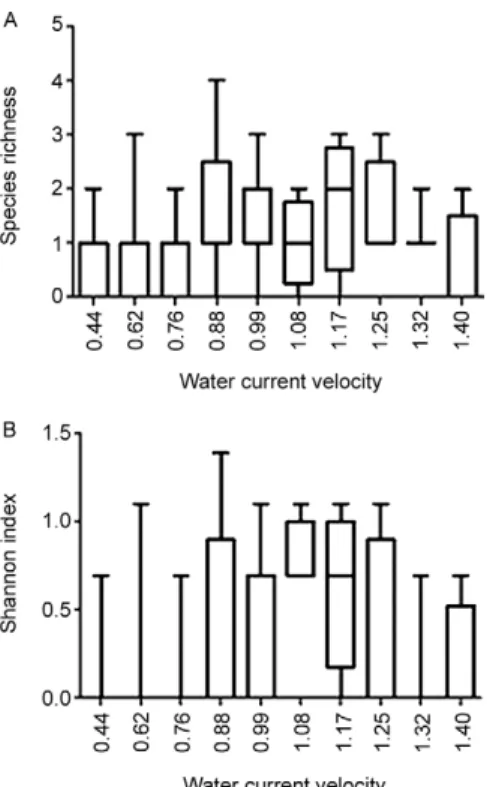
The mean species richness of the assemblages in the current velocity gradient was a unimodal distribu-tion skewed to the left, where the highest richness values were observed between 0.88 m.s-1-1.17 m.s-1. However,
the average diversity of the assemblages from patches within the current velocity gradient showed a bimodal distribution, with diversity peaks at 0.76 m.s-1 and 1.17
m.s-1 (Fig. 4). CCA (Fig. 5) showed that riffle litter was
the most frequent substrate type for most species. How-ever, Simulium nigrimanum Macquart, 1838 showed an association with the rocky substrate, whereas Simulium cuasiexiguum Shelley et al., 2001 was strongly associ-ated with the riparian vegetation. This analysis showed a general trend towards larvae occurrence in the middle of the streams, instead of at the margin, except for S. nigrimanum and S. cuasiexiguum.
The DCA (Fig. 6) showed three distinct groups: the first one between 0.19-0.88 m.s-1, composed of
Simuli-um quadrifidSimuli-um Lutz, 1910, S. subnigrSimuli-um/S. inaequale, Simulium minusculum Lutz, 1910, Simulium guianense Wise, 1911 and Simulium perflavum Roubaud, 1906; the second one was between 0.99-1.32 m.s--1, composed of
Fig. 3: linear regressions for Shannon diversity index (y = 0.9036x - 0.337, F = 10.74, p = 0.0096, R2 = 0.5440, DF = 9, F = 10.74) (A)
and species richness (y = 1.5161x + 0.8573, F = 7.185, p = 0.0252, R2
= 0.4439, DF = 9, F = 7.185) (B) in relation to water current velocity ranges (independent variable).
S. cuasiexiguum and S. pertinax/S. dekeyseri; finally, a third group was between 1.4-1.8 m.s-1, composed of
Simu-lium subpallidum Lutz, 1910, SimuSimu-lium incrustatum Lutz, 1910 and S. nigrimanum.
The CA performed for each site showed that water velocity associations for each species varied between sites (Fig. 7, Table II).
DiScuSSion
�ven though several other studies, such as Horne et al. (1992) and Scheder and Waringer (2002), among others, also rely on the distributional patterns of stream macroinvertebrates to infer their microhabitat preferenc-es, this premise can be controversial. Fonseca and Hart (2001) suggested that stream insects, such as Simuliidae, may have their ability to reach preferred microhabitats limited by dispersal constraints of drifting larvae, which means that the observed patterns would be influenced more by chance than by habitat preferences.
The null model analysis for co-occurrence indicates that the assemblages observed in the present study are not random. We employed a system that measures the tendency for species not to co-occur, so it should be ex-pected that, in a community structured by competition, the index value would be greater than that which would be observed in a randomly assembled community. As the observed index was significantly above the simu-lated indices, it is likely that competition played a role in the patterns observed and that the pattern is not random. Schoener (1974) suggested that niche overlaps observed
Fig. 2: null models for co-occurrence [observed index = 110.71, mean of simulated indices = 92.87, variance of simulated indices = 9.55, p
(observed ≤ expected) = 1.00, p (observed ≥ expected) = 0.00] (A) and
niche overlap [observed mean = 0.197, mean of simulated indices =
in nature should happen less and be of smaller degree than what is expected to happen randomly: a signifi-cantly small observed overlap may imply interspecific competition and resource partitioning (Gotelli & Graves 1996), which was also observed in our niche overlap null model. Thus, the results from our simulations are con-sistent with the hypothesis that the patterns observed are not random and that the and that the community struc-ture might be driven partially by competition and parti-tioning of a possible limiting resource, in this case the available space in microhabitats with suitable current ve-locities. The relationship between the microdistribution of black fly larvae throughout the water current gradient and their respective filter feeding is well established in the literature (McCreadie & Colbo 1993); thus, different species may present their optimal feeding rates at differ-ent water velocities. Studies have shown that other biotic factors, such as predation, may influence microdistribu-tion, as in the case of larvae occurring in microhabitats above their optimal feeding water velocity in order to avoid natural predators (Hart & Merz 1998).
We suggest that this positive relation between water current range and local species richness and diversity proposed by Figueiró et al. (2008) can possibly be ex-trapolated to be applied to other filter feeding lotic mac-roinvertebrates, which depend on the water velocity as much as Simuliidae do.
Many studies show riffle litter association for many Neotropical black fly species (e.g., Shelley et al. 2000, Figueiró et al. 2006) as well as the association of S.
ni-grimanum to rocky substrates (Shelley et al. 2000). S. cuasiexiguum was probably associated with riparian vegetation because it was common to find in the Tocan-tins River, where the only suitable microhabitat patches for black fly immatures were riparian vegetation patches at the margin. The association of S. minusculum with current velocity in the larger Tocantins River confirms previous studies (Coscarón 1983, Shelley et al. 2000).
CA revealed that the same species could show local variation of water velocity associations amongst sites, probably due to the overall differences amongst the as-semblages from each site and thus to the different
com-Fig. 4: box-plot graphics exhibiting the mean values for species rich-ness (A) and Shannon diversity index of the black fly assemblages found in the water current velocity gradient (B).
Fig. 6: detrended correspondence analysis ordination diagrams of species from the survey sites along the water current velocity gradient (axis 1: eigenvalues = 0.31; axis 2: eigenvalues = 0.031) showing three distinct groups: species associated to velocities between 0.19-0.88 m.s-1 composed of Simulium quadrifidum Lutz, 1910, Simulium
sub-nigrum/Simulium inaequale, Simulium minusculum Lutz, 1910, Simu-lium guianense Wise, 1911and Simulium perflavum Roubaud, 1906, species associated to velocities between 0.99-1.32 m.s-1 composed of
Simulium cuasiexiguum and Simulium pertinax/ Simulium dekeyseri
and species associated to velocities between 1.4-1.8 m.s-1 composed of
Simulium subpallidum Lutz, 1910, Simulium incrustatum Lutz, 1910 and Simulium nigrimanum.
Fig. 7: ordination diagrams extracted by correspondence analyses for each sampling site showing site-specific water current velocity associa-tions of black flies for Piabanha (A), Córrego do Mato (B), Ribeirão do Lages (C) and Tocantins River (D).
TABL� II
Water velocity ranges for the localities and its respective associated species
0.19 m.s-1-0.88 m.s-1 0.99 m.s-1-1.32 m.s-1 1.4 m.s-1-1.85 m.s-1
Córrego Piabanha Simulium incrustatum Simulium subpallidum
Simulium minusculum Simulium cuasiexiguum
Simulium quadrifidum Siulium subnigrum/ Simulium inaequale
Simulium nigrimanum Simulium pertinax/ Simulium deseykeri
Córrego do Mato S. subnigrum/S. inaequale Simulium perflavum Simulium guianense
S. subpallidum
S. nigrimanum S. incrustatum
Ribeirão do Lages S. cuasiexiguum S. subpallidum
Tocantins River S. subpallidum S. subnigrum S. cuasiexiguum S. minusculum
the water velocity (m.s.) associations for each species varied amongst sites.
petitive pressures resulting in different realized niches. As we observe the two most common species, S. subpal-lidum and S. nigrimanum, we notice that the first one is restricted to velocities between 0.19 m.s-1-0.88 m.s-1
when the second one is present and that in the absence of S. nigrimanum, S. subpallidum would occur at and above the velocities where the previous species is common.
Species richness variation observed along the current velocity gradient indicates that intermediate velocities
AcKnoWLeDGeMentS
To Sixto Coscarón, Jorge Luís Nessimian and Steven Ju-liano, for the revision of the paper, and to the staffs of Labo-ratório de Referência Nacional em Simulídeos e �ncocercose and Laboratório de �cologia de Insetos, for all the support.
ReFeRenceS
Allan JD 1995. Stream ecology: structure and function of running waters, Springer, New York, 388 pp.
Araújo-Coutinho CJPC, Nascimento �S, Figueiró R, Becnel JJ 2004. Seasonality and prevalence rates of microsporidia in Simulium pertinax (Diptera: Simuliidae) larvae in the region of Serra dos Órgãos, Rio de Janeiro, Brasil. J Invertebr Pathol 85: 188-191.
Ciborowski JJ, Adler PH 1990. �cological segregation of larval black flies (Diptera: Simuliidae) in northern Saskatchewan, Canada.
Can J Zool 68: 2113-2122.
Colbo MH, Porter GN 1979. �ffects of the food supply on the life his-tory of Simuliidae (Diptera). Can J Zool 57: 301-306.
Cook RD, Weisberg S 1994. An introduction to regression graphics, John Wiley, New York, 280 pp.
Coscarón S 1983. Notas sobre simulidos neotropicales. XII. Las es-pecies de Simulium “Grupo Amazonicum” de Argentina, sur de Brasil y Paraguay (Simuliidae: Diptera). Rev Soc Entomol Argent 42: 89-99.
Coscarón S, Coscarón-Arias CL 2007. Neotropical Simuliidae (Diptera: Insecta). In J Adis, JR Arias, G Rueda-Delgado, KM Wantzen (eds.), Aquatic biodiversity in Latin America (ABLA), Vol. 3, Pensoft, Sofia-Moscow, 685 pp.
Figueiró R, Araújo-Coutinho CJPC, Gil-Azevedo LH, Nascimen-to �S, Monteiro RF 2006. Spatial and temporal distribution of blackflies (Diptera: Simuliidae) in the Itatiaia National Park, Brazil. Neotrop Entomol 35: 542-550.
Figueiró R, Gil-Azevedo LH 2010. The role of the Neotropical blackflies (Diptera: Simuliidae) as vectors of the onchocerciasis: a short over-view of the ecology behind the disease. Oecol Aust 14: 745-755.
Figueiró R, Nascimento �S, Gil-Azevedo LH, Maia-Herzog M, Mon-teiro RF 2008. Local distribution of blackfly (Diptera: Simuli-Local distribution of blackfly (Diptera: Simuli-idae) larvae in two adjacent streams: the role of water current velocity in the diversity of blackfly larvae. Rev Bras Entomol 52: 452-454.
Fonseca DM, Hart DD 2001. Colonization history masks habitat preferences in local distributions of stream insects. Ecology 82: 2897-2910.
Furley PA, Ratter JA 1988. Soil resources and plant communities of the central Brazilian cerrado and their development. J Biogeogr 15: 97-108.
Gotelli NJ, �ntsminger GL 2009. �coSim: Null models software for ecology, v.7. Acquired Intelligence Inc and Kesey-Bear [software
on the Internet]. Published by the authors. [cited 2011 Apr 18].
Available from: garyentsminger.com/ecosim.
Gotelli NJ, Graves GR 1996. Null models in ecology, Smithsonian Institution Press, Washington DC, 368 pp.
Halgos J, Illésová D, Krno I 2001. The effect of some ecological fac-The effect of some ecological fac-tors on longitudinal patterns of black fly community structure (Diptera: Simuliidae) in a foothill stream. Biologia 56: 513-523.
Hamada N, Adler PH 2001. Bionomia e chave para imaturos e adultos de Simulium (Diptera: Simuliidae) na Amazônia central, Brasil.
Acta Amaz 31: 109-132.
Hamada N, McCreadie JW 1999. �nvironmental factors associated with the distribution of Simulium perflavum (Diptera: Simuliidae) among streams in Brazilian Amazonia. Hydrobiologia 397: 71-78.
Hamada N, McCreadie JW, Adler PH 2002. Species richness and spa-tial distribution of black flies (Diptera: Simuliidae) in streams of central Amazonia, Brazil. Freshw Biol 47: 31-40.
Hart DD 1986. The adaptive significance of territoriality in filter-feeding larval black flies (Diptera: Simuliidae). Oikos 46: 88-92.
Hart DD, Clark BD, Jasentuliyana A 1996. Fine-scale field measure-ment of benthic flow environmeasure-ments inhabited by stream inverte-brates. Limnol Oceanogr 41: 297-308.
Hart DD, Merz RA 1998. Predator-prey interactions in a benthic stream community: a field test of flow-mediated refuges. Oeco-logia 114: 263-273.
Horne P, Bennison G, Davis J 1992. The water velocity preferences of Austrosimulium furiosum and Simulium ornatipes (Diptera: Simuliidae) larvae and the implications for micro-habitat parti-tioning. Hydrobiologia 230: 31-36.
Landeiro VL, Pepinelli M, Hamada N 2009. Species richness and distribution of black flies (Diptera: Simuliidae) in the Chapada Diamantina region, Bahia, Brazil. Neotrop Entomol 38: 332-339.
Malmqvist B, Sackmann G 1996. Changing risk of predation for a filter-feeding insect along a current velocity gradient. Oecologia 108: 450-458.
McCreadie J, Adler PH, Hamada N 2005. Patterns of species richness for blackflies (Diptera: Simuliidae) in the Nearctic and Neotropi-cal regions. Ecol Entomol 30: 201-212.
McCreadie JW, Colbo MH 1993. Larval and pupal microhabitat se-lection by Simulium truncatum Lundström, S. rostratum Lund-ström and S. verecundum AA (Diptera: Simuliidae). Can J Zool 71: 358-367.
McCreadie JW, Hamada N, Grillet M� 2004. Spatial-temporal distri-bution of preimaginal black flies in Neotropical streams. Hydro-biologia 513: 183-196.
McIntosh AR, Townsend CR 1996. Interactions between fish, graz-ing invertebrates and algae in a New �ealand stream: a trophic cascade mediated by fish induced changes to grazer behaviour.
Oecologia 108: 174-181.
Nascimento �S, Figueiró R, Becnel JJ, Araújo-Coutinho CJPC 2007. Influence of temperature on microsporidia infections in a natural population of Simulium pertinax Kollar, 1832 (Diptera; Simulii-dae).Braz J Biol 67: 519-526.
�liveira PS, Marquis RJ 2002. The cerrados of Brazil. Ecology and natural history of a neotropical savanna, Columbia �niversity Press, New York, 424 pp.
Palmer RW, Craig DA 2000. An ecological classification of primary labral fans of filter-feeding black fly (Diptera: Simuliidae) lar-vae. Can J Zool 78: 199-121.
Pepinelli M, Trivinho-Strixino S, Hamada N, 2005. Imaturos de Si-muliidae (Diptera: Nematocera) e caracterização de seus cria-douros no Parque �stadual Intervales, SP, Brasil. Rev Bras En-tomol 49: 527-530.
Ratter JA, Ribeiro JF, Bridgewater S 1997. The Brazilian cerrado veg-etation and threats to its biodiversity. Ann Bot 80: 223-230.
SantosRB, Lopes J, Santos KB 2010. Distribuição espacial e varia-ção temporal da composivaria-ção de espécies de borrachudos (Dip-tera: Simuliidae) em uma microbacia situada no norte do Paraná.
Scheder C, Waringer J 2002. Distribution patterns and habitat charac-Distribution patterns and habitat charac-terization of Simuliidae (Insecta: Diptera) in a low-order sandstone stream (Weidlinbach, Lower Austria). Limnologica 32: 236-247.
Schoener TW 1974. Resource partitioning in ecological communities.
Science 185: 27-39.
Shelley AJ, Maia-Herzog M, Lowry CA, Luna-Dias APA, Garritano PR, Camargo M, Carter HG 2000. The Simuliidae (Diptera) of the secondary onchocerciasis focus at Minaçu in central Brazil.
Bull Nat Hist Mus Entomol 69: 171-221.
Statzner BV, Resh H, Gore JA 1988. Hydraulic stream ecology: ob-Hydraulic stream ecology: ob-served patterns and potential applications. J North Am Benthol Soc 7:307-360.
Stone L, Roberts A 1990. The checkerboard score and species distri-butions. Oecologia 85: 74-79.
Strahler AN 1952. Hypsometric (area-altitude) analysis of erosional topology. Geol Soc Am Bull 63: 1117-1142.
Strieder MN 2004. �spécies de Simulídeos (Diptera: Nematocera: Si-muliidae) no Rio Grande do Sul, Brasil: distribuição geográfica.
Entomol Vectores 11: 113-143.
Wilm HG, Storey HC 1944. Velocity head-rod calibrated for measur-Velocity head-rod calibrated for measur-ing streamflow. Civ Eng 14: 475-476.