INTRODUCTION
The genus Lathyrus L. of the family Leguminosae consists of annual and perennial species, most of which are self-pollinating (Rees and Narayan, 1977; Narayan and McIntyre, 1989). According to Allkin et al. (1983), the genus comprises approximately 190 species and varie-ties, with centers of diversification in the Old and New Worlds. These are located in temperate zones. All spe-cies have 2n = 2x = 14 chromosomes, with the basic num-ber being n = x = 7. Although there is no variation in chromosome number, there are variations in chromosome size, in centromere location, and in the number, size and location of secondary constrictions (Sharma and Datta, 1959; Roy and Singh, 1967; Federov, 1969; Fouzard and Tandon, 1975; Broich, 1989; Battistin and Fernández, 1994), and in DNA content, involving euchromatin and heterochromatin, as well as repetitive and non-repetitive DNA sequences (Lavania and Sharma, 1980; Narayan and Durrant, 1983; Kuryan and Narayan, 1987; Murray et al., 1992). Another important variation observed in these species is in the number and location of nucleolar organizer regions (NORs) (Nazeer et al., 1982; Murray et al., 1992; Battistin and Fernández, 1993).
The objective of the present study was to compare the chromosomal characteristics within and between four species of Lathyrus.
MATERIAL AND METHODS
Fifteen populations of four species of Lathyrus L. were collected (Table I). Four mitotic metaphases were selected at random from plants of each population. Metaphases were obtained by the method of Battistin and Fernández (1994). The number of chromosomes, karyo-type formula, mean chromosome length (µm), total length of the haploid complement, mean long/short arm ratio, and centromeric index were determined. These were com-pared among populations within each species by analy-sis of variance and by the t-test, and between species by the Tukey test (Steel and Torrie, 1960). The karyogram was mounted by arranging the chromosomes in pairs in decreasing order of size according to the method of Singh (1993). Chromosome nomenclature based on centromere location followed that proposed by Levan et al. (1964), i.e., metacentric (m), submetacentric (sm) and subte-locentric (st).
Eight metaphases and 300 interphase nuclei se-lected at random from four plants of each species were analyzed for NOR bands. The NORs and nucleoli were identified by AgNO3 staining as described by Howell and Black (1980) for L. odoratus, and Herickoff et al. (1992) for the remaining species.
RESULTS AND DISCUSSION
The 15 populations of the four Lathyrus species studied were diploid, with 2n = 2x = 14 chromosomes (Table II). All species of Lathyrus from Europe, North America, Australia, New Zealand and South America, in-cluding polyploid and aneuploid individuals, have the same basic number x = 7 (Khawaja, 1988; Broich, 1989; Murray et al., 1992; Battistin and Fernández, 1994;
Schifino-CHROMOSOMAL CHARACTERIZATION OF THREE NATIVE AND ONE CULTIVATED
SPECIES OF Lathyrus L. IN SOUTHERN BRAZIL
Alice Battistin1, Elaine Biondo2 and Liliana Gressler May Coelho3
A
BSTRACTMitotic metaphase chromosomes and interphase nuclei of nine populations of three South American species of Lathyrus (L. pubescens, L. nervosus and L. crassipes) and six populations of the cultivated species L. odoratus were analyzed. All popu-lations had 2n = 2x = 14 chromosomes. There were significant differences among popupopu-lations within each species and among species in the number of metacentric, submetacentric and subtelocentric chromosomes, the number and location of second-ary constrictions, chromosome length (longest and shortest), total haploid complement, arm ratio, and centromeric index. L. odoratus showed the highest tendency towards karyotype symmetry whereas the three South American species showed a moderate tendency towards asymmetry, with L. pubescens being the most asymmetrical. Silver staining was used to identify the nucleolar organizer regions (NORs) and the number of nucleoli per interphase nucleus in each species. In L. pubescens
and L. nervosus, the NORs were located on the secondary constriction of the long arm of pair 7, in L. crassipes, the NOR was proximal being located in the pair of metacentric chromosomes, and in L. odoratus there were four terminal NORs on the short arms of pairs 4 and 5. The four species had a maximum of four nucleoli per interphase nucleus, indicating the presence of four regions with active ribosomal genes in each case.
1Laboratório de Citogenética Vegetal e Biotecnologia, Departamento de Biologia, Centro de Ciências Naturais e Exatas da Universidade Federal de Santa Maria, 97105-900 Santa Maria, RS, Brasil. Send correspondence to A.B. E-mail: [email protected]
Wittmann et al., 1994). A conserved chromosome number is a common phenomenon in the species of this genus.
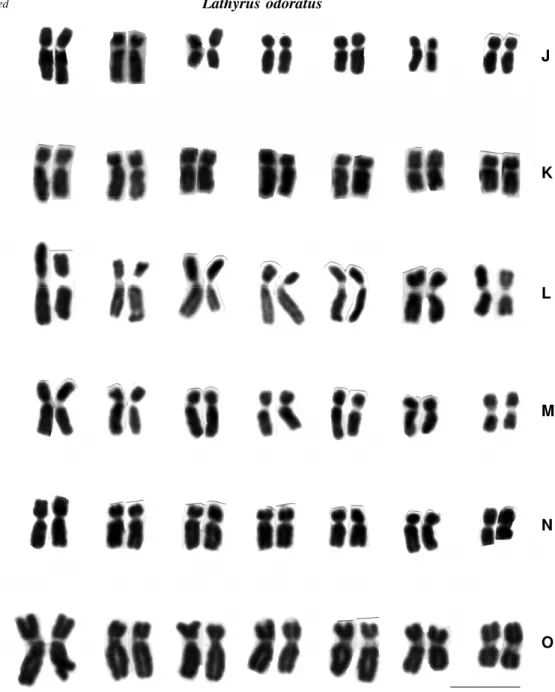
Populations 1 and 2 (Table II) of L. pubescens had similar karyotypes, with only submetacentric and sub-telocentric chromosomes. However, they diverged in the position of secondary constrictions (Figure 1). In the karyo-type of population 1, the secondary constriction was
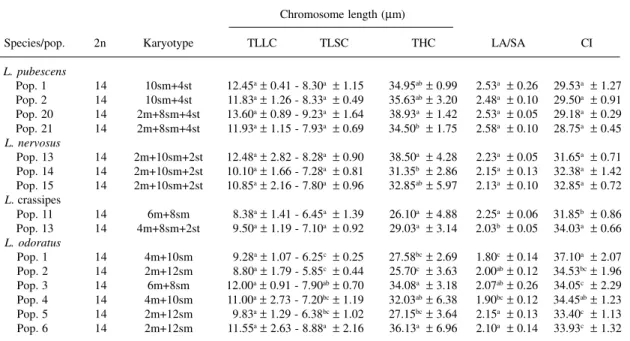
proxi-mal on the short arm of pair 1, followed by a macrosatellite, whereas in population 2, the constriction was on the long arm of pair 7, followed by a macrosatellite. Populations 20 and 21 of L. pubescenes, all populations of L. nervosus and population 13 of L. crassipes also showed similarities in their karyotypes, with metacentric, submetacentric and subtelocentric chromosomes, which differed only in num-Table II - Chromosome number (2n), karyotype formula, total length of the longest chromosome (TLLC), total length
of the shortest chromosome (TLSC), total haploid complement (THC), ratio long arm/short arm (LA/SA) and centromeric index (CI), in 10 populations (Pop.) of four Lathyrus species.
Chromosome length (µm)
Species/pop. 2n Karyotype TLLC TLSC THC LA/SA CI
L. pubescens
Pop. 1 14 10sm+4st 12.45a± 0.41 - 8.30ac± 1.15 34.95ab± 0.99 2.53ac± 0.26 29.53ac± 1.27 Pop. 2 14 10sm+4st 11.83a± 1.26 - 8.33ac± 0.49 35.63ab± 3.20 2.48ac± 0.10 29.50ac± 0.91 Pop. 20 14 2m+8sm+4st 13.60a± 0.89 - 9.23ac± 1.64 38.93ac± 1.42 2.53ac± 0.05 29.18ac± 0.29 Pop. 21 14 2m+8sm+4st 11.93a± 1.15 - 7.93ac± 0.69 34.50bc± 1.75 2.58ac± 0.10 28.75ac± 0.45
L. nervosus
Pop. 13 14 2m+10sm+2st 12.48a± 2.82 - 8.28ac± 0.90 38.50ac± 4.28 2.23ac± 0.05 31.65ac± 0.71 Pop. 14 14 2m+10sm+2st 10.10a± 1.66 - 7.28ac± 0.81 31.35bc± 2.86 2.15ac± 0.13 32.38ac± 1.42 Pop. 15 14 2m+10sm+2st 10.85a± 2.16 - 7.80ac± 0.96 32.85ab± 5.97 2.13ac± 0.10 32.85ac± 0.72
L. crassipes
Pop. 11 14 6m+8sm 8.38a± 1.41 - 6.45ac± 1.39 26.10ac± 4.88 2.25ac± 0.06 31.85bc± 0.86 Pop. 13 14 4m+8sm+2st 9.50a± 1.19 - 7.10ac± 0.92 29.03ac± 3.14 2.03bc± 0.05 34.03ac± 0.66
L. odoratus
Pop. 1 14 4m+10sm 9.28a± 1.07 - 6.25cc± 0.25 27.58bc± 2.69 1.80cc± 0.14 37.10ac± 2.07 Pop. 2 14 2m+12sm 8.80a± 1.79 - 5.85cc± 0.44 25.70cc± 3.63 2.00ab± 0.12 34.53bc± 1.96 Pop. 3 14 6m+8sm 12.00a± 0.91 - 7.90ab± 0.70 34.08ac± 3.18 2.07ab± 0.26 34.05cc± 2.29 Pop. 4 14 4m+10sm 11.00a± 2.73 - 7.20bc± 1.19 32.03ab± 6.38 1.90bc± 0.12 34.45ab± 1.23 Pop. 5 14 2m+12sm 9.83a± 1.29 - 6.38bc± 1.02 27.15bc± 3.64 2.15ac± 0.13 33.40cc± 1.13 Pop. 6 14 2m+12sm 11.55a± 2.63 - 8.88ac± 2.16 36.13ac± 6.96 2.10ac± 0.14 33.93cc± 1.32
Lowercase letters indicate significant differences (P < 0.05, t-test). The results are shown as the mean ± SD when appropriate. Table I - Details of the species, collection sites and number of plants studied in 15
populations of four species of Lathyrus L.
Species Voucher No.* Pop. No. Origin Number of plants
Lathyrus pubescens Hook et Arn. SMDB 3493 1 Caçapava do Sul/ RS - Brazil 5
2 Bagé/RS - Brazil 4
20 São Gabriel/RS - Brazil 8 21 Lavras do Sul/RS - Brazil 7
Lathyrus nervosus Lam. SMDB 3825 13 Caçapava do Sul/RS - Brazil 4
14 Bagé/RS - Brazil 6
15 Torres/RS - Brazil 4
Lathyrus crassipes Hook et Arn. SMDB 3813 11 Caçapava do Sul/RS - Brazil 8 13 Santa Maria/RS - Brazil 10
Lathyrus odoratus L. SMDB 4117 1 ISLA SA, Lote 1293, Porto
Alegre/RS - Brazil 5
2 ISLA SA, Lote 1635, Porto
Alegre/RS - Brazil 5
3 Royal Fleur, Lote 76, France 5 4 Royal Fleur, Lote 74, France 5 5 Royal Fleur, Lote 73, France 5 6 Feltrin, Lote 9014,
Farroupilha/RS - Brazil 5
Continued on next page
Lathyrus pubescens
A
B
C
D
Lathyrus nervosus
E
F
G
H
ber. This finding suggests a more restricted degree of ho-mology among these populations compared to the others. The similarity between the karyotypes of L. pubescens and L. nervosus was reported by Battistin and Fernández (1994). Another characteristic shared by the above popu-lations was the location of secondary constrictions on the long arm of pair 7, followed by a macrosatellite. An ex-ception was population 20 of L. pubescens which, in ad-dition to the secondary constriction on pair 7, had a proxi-mal secondary constriction on the short arm of pair 1, similar to population 1.
Population 11 of L. crassipes (Table II and Figure 1H) and all the populations of L. odoratus (Table II and Figure 1J-O) had metacentric and submetacentric chro-mosomes which differed in number. Two distal secondary constrictions were identified on the short arms of pair 4 in population 6 of L. odoratus. No secondary constrictions were seen in the remaining populations.
Although the material originated from different locations, the karyotypes of the L. odoratus populations maintained a stable composition of chromosome types (metacentric and submetacentric), in contrast to popula-Figure 1 continued
Figure 1 - Karyograms: Lathyrus pubescens: A - pop. 1; B - pop. 2; C - pop. 20; D - pop. 21. Lathyrus nervosus: E - pop. 13; F - pop. 14; G - pop. 15. Lathyrus crassipes: H - pop. 11; I - pop. 13. Lathyrus odoratus: J pop. 1; K pop. 2; L pop. 3; M -pop. 4; N - -pop. 5; O - -pop. 6. Scale = 10 µm.
Lathyrus odoratus
J
K
L
M
N
tions of the native species, L. pubescens, L. nervosus and L. crassipes. This difference may indicate that during evo-lution L. odoratus reached greater stability, with a higher symmetry present in its chromosomes than in the three South American species.
Another morphological trait that showed signifi-cant variation among populations within and among spe-cies was chromosome length (Tables II and III). The mean lengths of the largest chromosomes did not differ signifi-cantly among species (Table III); the highest value was found in L. pubescens (12.45 µm) and the lowest in L. crassipes (8.94 µm). There were only slight differences in the mean length of the smallest chromosome among the populations of L. odoratus. L. pubescens had the greatest mean length (8.44 µm), which was significantly different from that of L. crassipes (6.78 µm) and L. odoratus. For the total haploid length (µm), which reflects the size of the karyotype, there were significant differences among populations within each species, except for L. crassipes. The largest mean was that of L. pubescens (36 µm), which differed significantly from the smallest mean, found in L. crassipes (27.56 µm), and also from L. odoratus. The mean for L. nervosus differed significantly from that for L. crassipes. Variation in chromosome size is often the result of the amplification or deletion of a chromatin segment during species diversification. According to Rees and Narayan (1977), the within- and between-species varia-tion in chromosome size in Lathyrus indicates marked dif-ferences in the amount of DNA affecting complement size; a high percentage of this DNA is moderately repetitive. Murray et al. (1992) indicated that at the molecular level the changes in the amount of DNA occurred over a very short time during formation of the species.
Comparative analyses of the arm ratios allowed us to characterize each karyotype. The populations of L. pubescens and L. nervosus showed no important varia-tions, whereas the populations of L. crassipes and L. odoratus diverged in their means. The arm ratios varied (Table III), the highest value being found in L. pubescens and the lowest in L. odoratus.
The centromeric index (CI) was stable among the populations of L. pubescens and L. nervosus, whereas it differed significantly among populations of L. crassipes and L. odoratus. L. odoratus had the highest means for all populations when compared with the means for popula-tions of the three South American species (Tables II and III). A similar relationship was observed when the means were compared among species (Table III). In the South American species, L. pubescens had the lowest means com-pared to L. nervosus and L. crassipes (Tables II and III), showing clearly that two opposite trends have occurred in karyotype symmetry within the genus.
The arm ratios and CI data revealed opposite trends in karyotype symmetry among the Lathyrus species stud-ied. L. odoratus, with the highest mean CI and the lowest arm ratio, showed the greatest tendency towards karyo-type symmetry, while L. pubescens, L. nervosus and L. crassipes tended towards karyotype asymmetry. L. pubescens was the most asymmetrical of these species and had the lowest CI and the highest arm ratio. Levan et al. (1964) described these karyotypes as having a moderately tendency towards asymmetry.
Based on the chromosomal traits studied here, the exotic species L. odoratus was the most symmetrical, a tendency towards more primitive species in this genus (Stebbins, 1971). On the other hand, karyotype assymetry in the three South American species suggests that evolu-tionarily they are more recent species. Of these three spe-cies, L. crassipes is considered to be the most primitive and L. pubescens the most recent. Rees and Narayan (1977) and Murray et al. (1992) indicated that L. pubescens is outstanding because of its greater mean karyotype length, indicative of a greater chromatin gain in its chromosome complement over a shorter period than in the other three species.
NOR bands
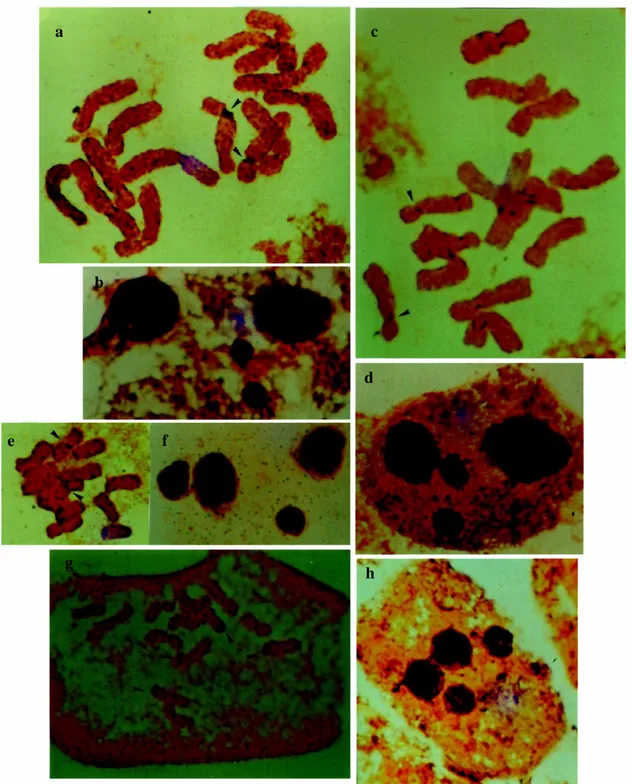
Silver nitrate staining of mitotic metaphases (Fig-ure 2) allowed the identification of NORs in the chromo-somes of the four species examined. Population 20 of L. pubescens and population 13 of L. nervosus were studied. Both showed NORs on the secondary constrictions of the long arm of pair 7. The NOR of L. pubescens stained deeply (Figure 2a), whereas that of L. nervosus stained weakly (Figure 2c). In population 13 of L. crassipes, the NOR was located in the proximal region of metacentric pair 3 (Figure 2e). In population 6 of L. odoratus, four deeply stained terminal NORs were seen on the short arms of pairs 4 and 5 (Figure 2g). Nazeer et al. (1982) and Murray et al. (1992) also identified two chromosome pairs with termi-nal NORs in L. odoratus. These investigators also found three NORs in the secondary constrictions of L. sativus and a pair of chromosomes with AgNO3-positive second-ary constrictions in L. blepharicarpus, L. cassius and L. hirsutus. Not all secondary constrictions are NOR sites, Table III - Chromosome characteristics in the four species
of Lathyrus studied. Chromosome length (µm)
Species TLLC TLSC THC LA/SA CI
L. pubescens 12.45a 8.44a 36.00a 2.53a 29.24c
L. nervosus 11.14ab 7.78ab 34.23ab 2.17b 32.29b
L. crassipes 8.94c 6.78b 27.56c 2.14bc 32.94b
Figure 2 - Mitotic metaphases and maximum number of nucleoli in interphase cells. a-b Lathyrus pubescens;c-d Lathyrus nervosus; e-f Lathyrus crassipes;g-h Lathyrus odoratus. Arrowheads indicate NORs. Scale = 10 µm.
but all NORs are located in secondary constrictions. Each species has a characteristic number and size, which indi-cated the quantity of active ribosomal genes. Silver nitrate staining also showed the maximum number of nucleoli in interphase cells. Each species had a maximum of four nucleoli per cell, indicating the existence of four regions with active ribosomal genes. The fact that only one NOR
pair was observed in metaphases from L. pubescens (Figure 2a,b), L. nervosus (Figure 2c,d) and L. crassipes (Figure 2e,f) may reflect the presence of small NORs represented by two smaller nucleoli in each cell, which may have im-paired the detection of NORs in metaphase chromosomes. In L. odoratus, the four interphase nucleoli reflected the four NOR bands in the metaphases (Figure 2g,h).
a c
b
e f
g
ACKNOWLEDGMENTS
The authors thank FAPERGS, CNPq and FIPE/UFSM for financial support.
RESUMO
Cromossomos em metáfases mitóticas e núcleos inter-fásicos em 9 populações de 3 espécies sul-americanas de Lathyrus
(L.pubescens,L.nervosus e L.crassipes)e 6 populações da espé-cie cultivada L. odoratus foram analisados. Todas as populações apresentaram 2n = 2x = 14 cromossomos. As diferenças signi-ficativas observadas entre as populações dentro de cada espécie e entre as espécies foram: número de cromossomos metacên-tricos, submetacêntricos e subtelocêntricos; número e localização das constrições secundárias; comprimento dos cromossomos (maior e menor); complemento total haplóide; razão braço longo/ braço curto e índice centromérico. L. odoratus é a espécie com maior tendência simétrica em seu cariótipo, enquanto que nas três espécies sul-americanas os cariótipos têm tendência moderada para assimetria, sendo L. pubescens o mais assimétrico. Com nitrato de prata foi possível identificar as NORs e o número máximo de nucléolos por núcleo interfásico em cada espécie. Em L. pubescens e L. nervosus as NORs estão localizadas na constrição secundária do braço longo do par 7, em L. crassipes a NOR é proximal, localizada no par de cromossomos metacên-tricos, e em L. odoratus foram observadas quatro NORs terminais nos braços curtos dos pares 4 e 5. As quatro espécies possuem número máximo de quatro nucléolos em cada núcleo interfásico, indicando quatro regiões com genes ribossomais ativos em cada espécie.
REFERENCES
Allkin, R., Macfarfarlane, T.D., White, R.J., Bisby, F.A. and Adey, M.E. (1983). Names and Synonyms of Species and Subspecies in the Vicieae: Issue 2. VicieaeDatabase Project. University of Southa-mpton, England.
Battistin, A. and Fernández, A. (1993). Bandas C, Q, Hoechst e RON em 4 espécies sul-americanas e uma cultivada de Lathyrus. XXXIX Con-gresso Nacional de Genética, Caxambú, MG, Brasil. Rev. Bras. Genet. 16 (Suppl.): 189 (Abstract).
Battistin, A. and Fernández, A. (1994). Karyotypes of four species of South America natives and one cultivated species of Lathyrus L. Caryologia
47: 325-330.
Broich, S.L. (1989). Chromosome numbers of North American Lathyrus
(Fabaceae). Madroño36: 41-48.
Federov, A.N.A. (1969). Chromosome Numbers of Flowering Plants. Acad-emy of Sciences of the USSR, Leningrad.
Fouzard, A. and Tandon, S.L. (1975). Cytotaxonomic investigations in the genus Lathyrus. Nucleus 18: 24-33.
Herickoff, L., Stack, S. and Robertson, J. (1992). Staining plant cells with silver. III. Biotech. Histochem. 67: 171-182.
Howell, W.M. and Black, B.A. (1980). Controlled silver-staining of nucleo-lus organizer regions with a protective colloidal developer: a 1-step method. Experientia 36: 1014-1015.
Khawaja, H.I.T. (1988). A new interspecific Lathyrus hybrid to introduce the yellow flower colour into sweet pea. Euphytica 37: 69-75. Kuryan, N.P. and Narayan, R.K.J. (1987). Distribution and divergence
during evolution of classes or repetitive DNA sequences in Lathyrus
species. Heredity 59: 318 (Abstract No. 37).
Lavania, U.C. and Sharma, A.K. (1980). Giemsa C-banding in Lathyrus.
Bot. Gaz. 141: 199-203.
Levan, A., Fredga, K. and Sandberg, A.A. (1964). Nomenclature for cen-tromeric position on chromosomes. Hereditas 52: 201-220. Murray, B.G., Bennett, M.D. and Hammett, K.R.W. (1992). Secondary
constrictions and NORs of Lathyrus investigated by silver staining and in-situ hybridization. Heredity68: 473-478.
Narayan, R.K.J. and Durrant, A. (1983). DNA distribution in chromo-somes of Lathyrus species. Genetica61: 47-53.
Narayan, R.K.J. and McIntyre F.K. (1989). Chromosomal DNA varia-tion, genomic constraints and recombination in Lathyrus. Genetica 79: 45-52.
Nazeer, M.A., Subrahmanyam, G.V. and Ohri, D. (1982). Intraspecific variation in chromosome phenotype and meiotic system in Lathyrus odoratus L. Cytologia 47: 287-293.
Rees, H. and Narayan, R.K.J. (1977). Evolutionary DNA variation in
Lathyrus. Chromosomes Today 6: 131-139.
Roy, R. and Singh, M.K. (1967). Cytological studies in the genus Lathyrus.
J. Cytol. Genet. 2: 128-140.
Schifino-Wittmann, M.T., Lau, A.H. and Simioni, C. (1994). The genera
Vicia and Lathyrus (Leguminosae) in Rio Grande do Sul (Southern Brazil): cytogenetics of native, naturalized and exotic species. Rev. Bras. Genet.17: 313-319.
Sharma, A.K. and Datta, P.C. (1959). Application of improved technique in tracing karyotypic differences between strains of Lathyrus odoratus
L. Cytologia 24: 389-402.
Singh, R.J. (1993). Plant Cytogenetics. CRC Press, Boca Raton. Stebbins, G.L. (1971). Chromosomal Evolution in Higher Plants.
Addison-Wisley Publishing Company, London.
Steel, R.C.D. and Torrie, J.H. (1960). Principles and Procedures of Sta-tistics. McGraw-Hill, New York.