Diversity of shrub tree layer, leaf litter decomposition and N release
in a Brazilian Cerrado under N, P and N plus P additions
Tamiel Khan Baiocchi Jacobson
1, Mercedes Maria da Cunha Bustamante
*,
Alessandra Rodrigues Kozovits
2Departamento de Ecologia, Universidade de Brasília, Brasília-DF 70919-970, Brazil
a r t i c l e
i n f o
Article history: Received 16 July 2010 Received in revised form 3 October 2010 Accepted 15 October 2010
Keywords: Savannas
Ecosystem processes NOfluxes Species richness Fertilization
a b s t r a c t
This study investigated changes in diversity of shrub-tree layer, leaf decomposition rates, nutrient release and soil NOfluxes of a Brazilian savanna (cerradosensu stricto) under N, P and N plus P additions. Simultaneous addition of N and P affected density, dominance, richness and diversity patterns more significantly than addition of N or P separately. Leaf litter decomposition rates increased in P and NP plots but did not differ in N plots in comparison to control plots. N addition increased N mass loss, while the combined addition of N and P resulted in an immobilization of N in leaf litter. Soil NO emissions were also higher when N was applied without P. The results indicate that if the availability of P is not increased proportionally to the availability of N, the losses of N are intensified.
Ó2010 Elsevier Ltd. All rights reserved.
1. Introduction
The functioning of ecosystems is defined primarily by organic matter production, accumulation and decomposition. Nutrient cycling is one of the most important functions in the organization and maintenance of an ecosystem and includes inputs (atmo-spheric deposition, biological fixation, rock weathering) and outputs (runoff, runoff water from rivers, leaching and gas losses). Nutrient transfer between plant and soil represents a key factor in ecosystem functioning and organization (Attwill and Adams, 1993). Shifts in global biogeochemical cycles due to human disturbance in environments have affected biotic interactions and resource avail-ability patterns in different ecosystems (Vitousek et al., 1997; Bobbink et al., 2010). Nutrient anthropogenic introduction ampli-fied N and P global cycles at 100% and 400% after the Industrial Revolution (Falkowski et al., 2000). Particularly in tropical systems, N cycling had been modified by urbanization and agricultural intensification (Filoso et al., 2006).
In the case of the savannas of central Brazil, known as Cerrado, the expansion of cattle ranching and mechanization of agriculture since the 1970s has led to widespread conversion of native vege-tation (one of the world’s biodiversity hotspots defined byMyers et al. (2000), with intensive fertilizer addition and rapid loss of habitats (Klink and Machado, 2005)).
Cerrado is the second largest Brazilian biome and it is characterized by a vegetation mosaic ranging from grassland to forest formations (Eiten, 1972), where fire is a common occur-rence (Kauffman et al., 1994). In Cerrado ecosystems, the seasonal distribution of rainfall and highly weathered soils with low nutrient content have probably acted as selection drivers for species with high nutrient retention. Among the adaptive strat-egies of Cerrado plants, economy of nutrients is a crucial point that allows them to establish themselves in highly weathered soils (Meinzer et al., 1999). Thus, phenological groups have different root system and resource exploration strategies (Scholz et al., 2008); leaf scleromorphism and high resorption rates that result in low decomposition rates are common in Cerrado plant communities (Nardoto et al., 2006). Nutrient cycling, especially N, has been shown to be conservative in this ecosystem. Changing patterns of rainfall distribution and nutrient pulses can disrupt the supply and demand of nutrients, resulting in higher losses (Bustamante et al., 2006).
It is known that soil fertility significantly influences species composition in Cerrado ecosystems (Ratter and Dargie, 1992). *Corresponding author.
E-mail addresses: [email protected](T.K.B. Jacobson),[email protected](M.M.C. Bustamante),[email protected](A.R. Kozovits).
1 Present address: LEdoC, Universidade de Brasília, Faculdade UnB Planaltina,
Planaltina-DF 73300-000, Brazil.
2 Present address: Departamento de Biodiversidade, Evolução e Meio Ambiente,
Universidade Federal de Ouro Preto, Ouro Preto-MG 35400-000, Brazil.
Contents lists available atScienceDirect
Environmental Pollution
j o u r n a l h o m e p a g e : w w w . e l s e v i e r . c o m / l o c a t e / e n v p o l
0269-7491/$esee front matterÓ2010 Elsevier Ltd. All rights reserved. doi:10.1016/j.envpol.2010.10.019
Changes in soil chemical properties may possibly result in changes between soileplant and planteplant interaction patterns. In addi-tion to individual nutriaddi-tional adaptaaddi-tions, competiaddi-tion is an important factor in community establishment under altered nutrient availability conditions. The aim of this study was to compare the diversity of the shrub-tree layer in fertilized (þN,þP, þNP) and unfertilized plots and to evaluate how nutrient additions affect leaf litter nutrient concentration, decomposition rates, nutrient release from decomposition and soil NOfluxes in a cerrado
sensu strictoarea. The following hypotheses were tested:
1. Fertilizer addition will change soil nutrient availability (N and P) and species richness and diversity will be lower in fertilized plots. Changes in analyzed attributes will be more intense when N and P are applied in combination.
2. N and P addition will increase N and P leaf litter concentration, leaf decomposition and N and P mass loss. These changes will be more intense when N and P are supplied together. 3. N addition will enhance NOfluxes compared to the unfertilized
plots, but the combined addition of P will result in lower NO emissions, as P may facilitate N uptake by plants and immo-bilization by decomposers, diminishing N availability.
2. Material and methods
2.1. Study area and fertilization treatments
This study was carried out in an area located in the Roncador Ecological Reserve belonging to the Brazilian Institute of Geography and Statistics (RECOR/IBGE), near BrasíliaeFederal District, Brazil (15560S, 47530N, average altitude¼1100 m). Soil of the study area is classified as Oxisols (Haplustox), which is acidic, with high Al levels and low cation exchange capacity (Haridasan, 1994). Total precipitation was 1667 mm in 2006 and 1183.7 mm in 2007. Air temperature ranged from 10.1C to
31.9C during the study period. The vegetation is classified as cerradosensu stricto,
which is characterized by a continuous grassy layer and a woody layer of trees and shrubs varying in cover from 20 to 60%: this is the most common vegetation found in the Cerrado region (Eiten, 1972).
The fertilization experiment began in 1998 and the experimental design was completely randomized, with four nutrient addition treatments and four replicates randomly divided into 16 plots of 225 m2, separated by a 10 m buffer area. The treatments were: control (C; without fertilization),þN (single addition of ammo-nium sulfate (NH4)2 SO4), þP (single addition of 20% superphosphate e Ca (H2PO4)2þCaSO4$2H2O) andþNP (simultaneous addition of Ammonium sulfate/ 20% superphosphate) applied in litter layer without incorporation. Between 1998 and 2006, 100 kg ha 1of N, P and N plus P was added, applied twice a year (at beginning and end of rainy season). The study area burned accidentally twice, in 1994 (before the beginning of the treatments) and in 2005. After the accidentalfire in 2005, the plots were re-installed in the same locations. The last fertilizer appli-cation was made in April 2006.
2.2. Soil sampling and analysis
In October 2007, composite soil samples were collected and consisted of two samples in each plot, atfive depths (0e10, 10e20, 20e30, 30e40; 40e50 cm). Analyses were performed to determine pH in water and CaCl2(0.01 M), total N (Microkjeldahl method), P (extraction with Mehlich 1 and colorimetric deter-mination) and Al (extraction with 1M KCl and titulation with NaOH) (EMBRAPA, 1999).
2.3. Vegetation survey
In January and July 2008, we performed vegetation surveys in all plots including all tress and shrubs with circumference>5 cm at soil height. The absolute and relative phytosociological parameters of density, frequency and dominance were calculated for each species within each treatment. These parameters were calculated according toMueller-Dumbois and Ellenberg (1974). The index of value of impor-tance (IVI) was calculated for each species within each treatment according toKent and Coker (1992).
In order to estimate woody vegetation diversity, we used the ShannoneWiever (H0) diversity index and Pielou evenness index (J0) for each treatment. To assess the
floristic similarity between fertilized and control plots, we used Sørensen similarity index (Kent and Coker, 1992).
2.4. Leaf litter decomposition
Leaf litter was collected at the end of the dry season (September 2006). Only the fresh litter deposited between June and September was collected (top of the litter layer). In each plot a 100 L bag of litter was collected. In the laboratory, the samples were cleaned to remove dust and other possible contaminants and oven dried at 60C for 72 h. Approximately ten grams (10.115 g, sd¼0.209) of mixed leaf litter
was weighed (0.001 g). In October 2006, litter bags (2 mm; 20 cm20 cm) were placed randomly on litter layer in each plot. A total of 576 litter bags were placed, 36 per plot (144 per treatment). At approximately 60-day intervals, we randomly collected four litter bags per plot (n¼16). Initial mass of each litter bag corre-sponded to time zero (T0). Collection dates were: 61, 125, 189, 248, 309, 369 and 453 days after the beginning of incubation. Litter from collected litter bags was oven-dried at 60C until it reached constant weight and was then ground in a Willey mill
(40-mesh sieve). Simple negative exponential model was used to determine decomposition rate (Olson, 1963). Litter half-life (T50%) and litter residence time were also calculated.
2.5. Leaf litter nutrient concentration
Samples (n¼4) corresponding to T0 (initial mass, October 2006), T1 (61 days), T4 (248 days) and T7 (453 days) were analyzed for N and P concentration. Extraction was performed using wet digestion method (nitric, perchloric and sulfuric acid; 10:2:1). N was determined via distillation, using the Microkjeldahl method. P was determined by colorimetric analysis with ammonium molybdate and ascorbic acid (EMBRAPA, 1999). Litter N and P concentrations were used to calculate nutrient release through litter decomposition.
2.6. NOflux and ancillary data
Soil surfacefluxes of NO were measured using dynamic chamber technique and a Scintrex LMA-3 as described byPinto et al. (2002). Two PVC rings per plot (314.2 cm2), totaling six rings per treatment, were installed at least 30 min before the beginning offlux measurements. NO concentration was recorded over a period of 5 min in each chamber. Fluxes were calculated from the rate of increase of NO concentration using the linear portion of the accumulation curve. Calibration curves were done twice (before and after measurements) a day. Data sampling occurred almost monthly, except for measurements in April 2004, whenfluxes were measured some hours before fertilization (April 22), and three and ten days after it.
Chamber and soil (2.5 and 5.0 cm depth) temperatures were measured during
flux measurements. Soil samples from 0e5 cm were collected within the chambers every sampling day for gravimetric water content, NO3and NH4þdetermination. Soil samples were extracted with 1 mol/L KCl for 1 h. NH4þwas determined through reaction with Nessler reagent and NO3-was determined by UV-absorption according to the method proposed byMeier (1991). Results were expressed on a dry mass basis.
2.7. Statistical analysis
Soil nutrient concentrations at each depth were tested for normality using the KolmogoroveSmirnov test (p<0.05) and tested withFand studentttest (p<0.05). The data that did not present normal distribution, even after transformation, were compared with the ManneWhitney nonparametric test (p<0.05). Comparisons with the control were made for each depth (n¼4). Diversity indices among fertil-ized plots were compared with control plots using Shannon diversity t test (p<0.05). All tests involving soil and woody vegetation data were performed using the statistical software PAST (Paleontological Statistics Software Package for Education and Data Analysis, UK).
Decomposition data were tested for normal distribution using the Kolmo-goroveSmirnov test and submitted to regression analysis for each treatment. Decomposition constant (k), % of mass remaining, litter half-life and residence time were compared between treatments using ANOVA and Student-t test. Nutrient litter concentrations throughout the incubation process were tested for normal distribution using the KolmogoroveSmirnov test and were compared considering the various time periods and treatments using repeated measures ANOVA, followed by Bonferroni adjustment for multiple comparisons and Dun-nett test.
Soil NOfluxes, NO3and NH4þavailability and soil water content data were tested for normal distribution using the KolmogoroveSmirnov test and compared between months and treatments using repeated measures ANOVA, followed by Bonferroni adjustment for multiple comparisons and Dunnett test.
Pvalues of<0.05 were considered significant. These analyses were performed using SPSS 15.0 package for Windows (SPSS Inc. USA).
3. Results
3.1. Responses of soil chemical parameters and plant diversity
N, P and NP plots showed lower soil pH values (water and CaCl2) than those observed in control plots in the first 30 cm of depth. Total N soil concentrations did not differ between fertilized and unfertilized plots, but available P soil concentrations were signifi -cantly higher in P and NP plots at thefirst 40 cm depth. N and NP plots showed higher available concentration of soil Al in compar-ison to control plots (all depths in NP plots and in thefirst 30 cm in N plots). Soil pH values (water and CaCl2) increased with depth in all treatments, while total N, P and Al concentrations showed the inverse pattern (Fig. 1).
Regarding species richness, 479 individuals of 47 species belonging to 29 families were sampled in control plots, 461 indi-viduals belonging to 53 species and 34 families in N plots, 448 individuals from 54 species and 31 families in P plots and 336 individuals of 40 species belonging to 24 families in NP plots. N and NP plots showed significantly lower Shannon diversity (H0) and evenness (J0) indices compared to control plots (Table 1). Sørensen floristic similarity index was still high when fertilized and unfer-tilized plots were compared but decreased in the following order: P plots (0.81), N plots (0.78) and NP plots (0.76).
3.2. Changes in decomposition rates and nutrient release
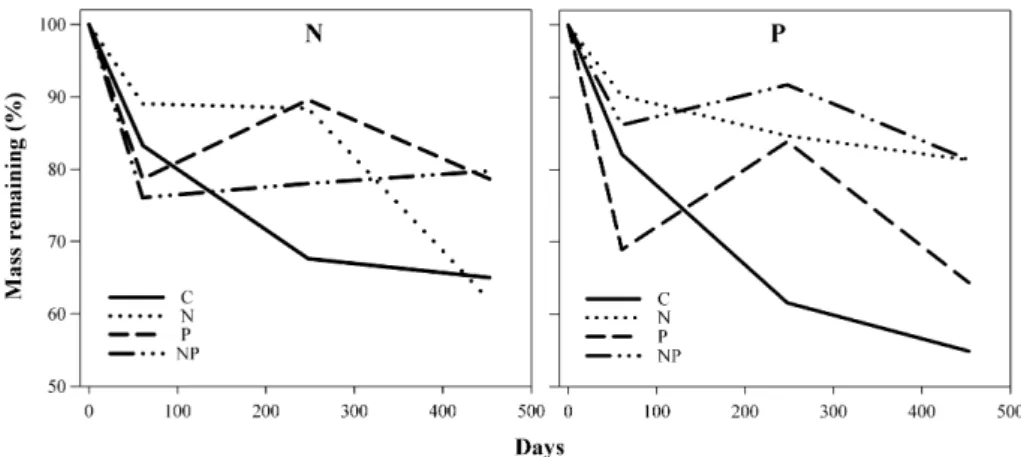
Percentage of litter mass remaining was 58.7% (SD¼7.8) in control plots, 56.0% (SD¼10.9) in N plots, 51.9% (SD¼9.1) in P plots and 48.0% (SD¼9.1) in NP plots. Leaf litter decomposition rate in N plots did not differ from that in control plots. In P plots, the percentage of mass remaining was lower compared to that observed
in control plots only at the end of incubation process (453 days), while in NP plots the percentage of mass remaining was significantly lower relative to control plots at 125 days, 309 days and 453 days. Litter residence time in control plots was higher (2.3 years) than that observed in N plots, but this difference was not significant. P and NP plots had significantly lower litter residence time in comparison to that observed in control plots (Fig. 2).
Higher N leaf concentration in leaf litter was observed in samples from NP plots while higher P concentrations in leaf litter were observed in those from P and NP plots in comparison to control plots (Fig. 3). N concentration in leaf litter increased significantly (by 50% in P plots and by 66% in NP plots) from the beginning to the end of incubation period. During the decomposition process N concentra-tion was also significantly higher in N plots (248 days) and in NP plots (248 and 453 days) relative to control plots. Lower N mass loss was observed in P (21.4%) and NP (20.3%) plots, while the highest N mass loss (38.1%) was observed in N plots. In P and NP plots, N immobilization was higher than in the other treatments.
P concentration in leaf litter from P and NP plots increased (by 23% in P plots and by 70% in NP plots) comparing the beginning and the end of the incubation period. These concentrations were significantly
Fig. 1.Soil chemical characteristics (mean and standard deviation) atfive depths (0e10, 10e20, 20e30, 30e40, 40e50 cm) of a cerrado sensu stricto under fertilization treatments (N, P, NP) (n¼4). * Indicates significant differences in comparison to unfertilized treatment (C) (t-test,p<0.05).
Table 1
Density, species richness, number of genera and families, Shannon’s diversity index (H0), Pielou
’s evenness index (J0) of the shrub treeflora in fertilized (þN,þP,þNP)
and unfertilized (C) plots in a cerrado sensu stricto area near BrasíliaeBrazil. * Indicates significant differences in comparison to control plots (Diversityt-test, p<0.05).
Treatment Density Richness Genus Families Shannon (H0
) Pielou (J)
C 479 47 38 29 3.40 0.88
þN 461 53 43 34 3.20* 0.80
þP 448 54 41 31 3.39 0.85
þNP 336 40 34 24 2.89* 0.78
higher than those observed in control plots during the incubation period (with the exception of 61 days in P plots). Higher P mass loss (45.1%) was measured in control plots during litter decomposition, followed by P (35.6%), N and NP plots (both 18.7%) (Fig. 4).
3.3. NOfluxes and soil N availability
N addition alone and in combination with P resulted in higher soil NOfluxes than those found in the control plots, even several
months after N addition (Fig. 5A). Comparing withfluxes measured in control plots (0.07 to 4.94 ng NeNO cm 2h 1), significant differences were found on ten and on six of the 13 sampling dates in the N and in the NP plots, respectively. Highestfluxes were found in the plots fertilized only with N (1.5 to 16.6 ng NeNO cm 2h 1), which were about twice as high as those in the NP plots (0.81 to 9.22 ng NeNO cm 2h 1).
Four days after N and NP addition, ammonium (but not nitrate) concentration increased by about 14 (in NP plots) and 5.6 (in N plots) Fig. 2.% of mass remaining, values ofkand half life (T 50%) of leaf litter under N, P and N plus P additions in a cerrado area in Central Brazil. Bars indicate standard deviation. * Indicates significant differences with control (Fandt-test,p<0.05).
Fig. 3.N (A) and P (B) concentration (mg g 1) in leaf litter during the decomposition process. Bars indicate standard deviation. * Indicates significant differences from control
times in the soil surface compared to control plots, and declined 20 days later to levels similar to those found before fertilization (Fig. 5D). Ammonium and nitrate availability increased over the dry season (Fig. 5B and D), reaching higher values between July and October, and declined with the onset of the summer rains in November. Concentrations of NH4þ in the N (34.8 to 229.1 NeNH4mg kg 1) and NP (31.1 to 446.6 NeNH4mg kg 1) plots were significantly higher than those measured in the control (20.4 to 84.0 NeNH4mg kg 1) plots, respectively in six andfive of the 13 sampled dates. On the other hand, NO3-availability was significantly higher in the N (0.7 to 25.8 NeNO3 mg kg 1) plots on eight of the dates, and only on three days in the NP plots (0.4 to 19.9 NeNO3 mg kg 1). Although the levels of NO3 and NH4þ, as well as the NO emissions, followed a trend in which, in general, higher values occurred in the N
plots followed by NP and control plots, no significant relationships between N availability and soil NOfluxes were found. Soil NOfluxes were also not explained by soil water content. However, soil temperature explained about 59% of the variability in NOfluxes in NP plots, 75% in control and 89% in N plots.
4. Discussion
Soil acidification and increased Al concentration are common under ammonium sulfate addition and are considered key mech-anisms in plant diversity loss in several ecosystems (Bobbink et al., 2010). Comparing the results with an earlier study in the same area (Kozovits et al., 2007), fertilization changed pH and P availability in deeper soil layers. On the other hand, total N availability showed Fig. 4.N and P mass remaining (%) during decomposition process of leaf litter in fertilized and unfertilized plots in a cerrado area in Central Brazil.
Fig. 5.Mean NOfluxes (A), NeNO3- (B) and NeNH4þ(C) concentrations and soil water content (D) from March 22nd 2004 to March 24th 2005 in fertilized and unfertilized plots in a cerrado area in Central Brazil. Bars indicate standard deviation. * indicates significant differences in comparison to control plots (Dunnett,p<0.05).
a decrease in surface soil layer but increased with depth. Decreases in evenness and diversity occurred, especially in N and NP plots, where P and Al availability and pH values were significantly different. Changes in species density and dominance patterns in N and NP plots led to lower similarity relative to unfertilized plots. Species that are abundant in control plots presented lower density in N and NP plots (data not shown). Considering that the area was accidentally burned in 2005, high post-fire regenerative capacity could be involved in the differential responses of the species (Hoffmann and Solbrig, 2003). Some particular traits could be also relevant. For example, one of the dominant species,Roupala mon-tanaAubl. (whose density was twice as high in fertilized plots), belongs to the Proteaceae family, associated with the presence of proteoid roots, which allow P absorption in forms not available to other species (Watt and Evans, 1999; Turner, 2008). In the case of
Blepharocalyx salicifolius (Kunth) O. Berg, another dominant species, the increasing dominance in fertilized plots may be due to its ability to utilize the higher nutrient availability; as it is also found in nutrient-rich soils (Proença and Gibbs, 1994) unlike most Cerrado species. The effects of adding combined N and P on species density, dominance, richness and diversity patterns were more significant than those observed by single additions, as stated in the first hypothesis. The observed changes in this study, however, can be dynamic on a greater time scale than the relationship between adaptive strategies; competitive ability, composition and diversity have different effects over time. In structurally diverse ecosystems, as tropical savannas and forests, responses are often species-specific or are specific to a particular life form. Interactions within and among life forms and at multiple hierarchical levels of func-tional diversity have to be considered (Bobbink et al., 2010; Siddique et al., 2010).
Besides changes in community diversity, nutrient additions affected ecosystem processes. Cerradosensu strictoareas are asso-ciated with low decomposition rates (Peres et al., 1983). Although environmental characteristics control decomposition rates on a global scale, nutrient initial concentrations in litter are associated with increases in decomposition rates on the ecosystem scale (Zhang et al., 2008). As discussed byCornwell et al. (2008), within biomes and sites, green leaves treats might differ widely among species, reflecting different economic strategies for carbon gain and growth, and this functional differentiation seems to have a consis-tent effect on the rate of decomposition of senesced leaves. Thus, shifts in the relative species abundance due to anthropogenic actions would lead to species-based variation in leaf composition, and thus, altering decomposition rate. Higher N and P initial concentrations in the litter from NP plots and higher P initial concentration in litter from P plots influenced decomposition rates, corroborating hypothesis 2. If nutrients (especially N and P) were available for longer, decomposers would spend less energy on nutrient acquisition and invest more energy in enzymes that degrade cellulose, hemicellulose and lignin (Weedon et al., 2009). On a global scale, N addition has no significant influence on litter mass loss compared with other nutrients (Knorr et al., 2005). However, Hobbie (2008) suggests that N addition increases C retention, lowering decomposition rates in grassland, coniferous forest and oak forest on sandy weathered soils. P addition did not influence decomposition rates in tropical rain forest (Cleveland et al., 2006) but increased decomposition rates in Australian Eucalyptus forest (O’Connel, 1994). On the other hand, the addition of combined N and P produced synergistic positive effects on decomposition rates in Cerrado (Kozovits et al., 2007) and in Hawaiian rainforests (Allison and Vitousek, 2004). Co-limitation of N and P is a common situation in terrestrial ecosystems and was widely discussed in the work ofElser et al. (2007). Due to signifi -cant interactions between the supply and demand of these
nutrients, the addition of one nutrient may increase the limitation by the other. Therefore mitigating the restriction of both by the joint addition of N and P produces synergistic effects on primary production, as suggested byElser et al. (2007)andDavidson and Howarth (2007). In this work, P (single or combined) addition positively influenced decomposition rates, while N addition only increased N litter initial concentration and accelerated decompo-sition when applied with P, indicating P limitation. According to Vitousek (2004), long-term fertilization experiments incorporate edaphic and plant chemical modifications, while short-term experiments do not usually reproduce these effects. Like plants, the soil community responds slowly to changes in nutrient availability. This can be verified when the present results are compared with results from thefirst years of fertilization in the same experimental area (Kozovits et al., 2007). Nine years after thefirst fertilization, control litter half-life (1.6 years) was not modified. Decomposition rate in NP plots is still significantly higher than that observed in control, but with less intensity (by 42% in 1999 and by 27.4% in 2007). In N plots, decomposition rate increased by 21.8% over the rate estimated byKozovits et al. (2007). However, in P plots the decomposition rate increased significantly, which was not observed after thefirst fertilization.
The results demonstrate that in spite of higher N and P concentrations in litter, nutrient return to soil through leaf litter decomposition did not increase. This may be due to nutritional limitation of the decomposer community, which immobilizes nutrients in litter in response to increased microorganism activity (Allison and Vitousek, 2004). N and P litter retention patterns in fertilized plots indicate that the decomposer community appears to be limited by these nutrients. High N mass loss in N plots may be due to the fact that limitation of microbial biomass by C was reached earlier than N limitation. N initial immobilization seems to have reversed due to the fast turnover of the microorganism pop-ulation in response to increased N availability, as observed byFisk and Fahey (2001). All treatments showed P immobilization rela-tive to control plots, and N addition (N and NP) reduced about 58% P mass loss. This effect was less intense in P plots (21% reduction in mass loss). P fertilization has a major impact on activity of litter decomposers, in some cases exceeding N fertilization effects (Hobbie and Vitousek, 2004).
Patterns of nutrient release from decomposition in fertilized plots are closely related to the soil NO emissions, which were higher in the N plots than in the NP and control plots, suggesting that the higher N release due to litter decomposition in N plots might promote higher N losses to the atmosphere, but the combined addition with P results in higher N demand by microbial biomass, confirming hypothesis 3. As described byManzoni et al. (2008), the initial chemical composition of the litter and the stoi-chiometric requirements of the decomposers seemed to be the most relevant parameters controlling the N release of litter during decomposition. In fact, studies have shown that functional groups of plants and microorganisms may differ in their N:P tissue ratios, responding differently to the N to P proportions in the environment (Güsewell, 2005; Wassen et al., 2005) according to their own demands on these limiting nutrients. Results suggest that some plants may not even respond to N fertilization if P is not available at levels that can maintain plant internal N:P demands, leading to P limitation (Güsewell, 2004; Kozovits et al., 2007).
In addition to N availability, soil NOfluxes are controlled by a set of other interacting factors, such as soil temperature, water and air content (Davidson et al., 2000). Although the fertilization treat-ments affected decomposition and N release (net mineralization rate), NO emissions could also be partially explained by other changes in response to nutrient inputs. For example, soil surface temperature was higher in the N and NP plots than in the control
plots (data not shown) and correlated positively with NO emis-sions. To which extent these results might be explained by changes in plant density, diversity and community structure, however, is still uncertain. It is clear that fertilization might select certain plant species to the detriment of others; thus, some plant functional groups and plant architecture patterns might become dominant, altering the functioning of the whole ecosystem in terms of nutrient cycling, water and heat balance, and hence affecting soil NOfluxes.
5. Conclusions
Nutrient inputs resulted in changes in species richness, even-ness and consequently in diversity, but the effects were more intense when N and P were applied in combination. Responses in terms of litter nutritional quality, decomposition and soil NOfluxes were more significant for the combined addition of N and P than those observed with single additions. When nutrients are supplied separately, there is greater N mass loss with N addition and greater P mass loss with P addition compared to that observed when N and P are supplied together. This indicates that if increases in N depo-sition in these systems are not accompanied by P additions, higher N losses through leaching and gas emissions can occur with other ecosystem impacts.
Acknowledgments
We would like to thank Mardocheu Rocha, Regina Sartori, Gil-berto B. Cosac, Lucas E. Gonçalves and the UnB Ecology Lab staff for valuable help. We are also grateful to the administration and staff of RECOR-IBGE. This study was funded by the Graduate Program in Ecology of UnB, IAI, CNPq (grant 474071/2006-5) and LBA-NASA (ND-07).
References
Allison, S.D., Vitousek, P.M., 2004. Rapid nutrient cycling in leaf litter from invasive plants in Hawai’i. Oecologia 141, 612e619.
Attwill, P.M., Adams, M.A., 1993. Nutrient cycling in forests. New Phytologist 124, 561e582.
Bobbink, R., Hicks, K., Galloway, J., Spranger, T., Alkemade, R., Ashmore, M., Bustamante, M., Cinderby, S., Davidson, E., Dentener, F., Emmett, B., Erisman, J.W., Fenn, M., Gilliam, F., Nordin, A., Pardo, L., de Vries, W., 2010. Global assessment of nitrogen deposition effects on terrestrial plant diversity: a synthesis. Ecological Applications 20, 30e59.
Bustamante, M.M.C., Medina, E., Asner, G.P., Nardoto, G.B., Garcia-Montiel, D.C., 2006. Nitrogen cycling in tropical and temperate savannas. Biogeochemistry 79, 209e237. Cleveland, C.C., Reed, S.C., Townsend, A.R., 2006. Nutrient regulation of organic
matter decomposition in a tropical rain forest. Ecology 87, 492e503. Cornwell, W.K., Cornelissen, H.C., Amatangelo, E.D., Dorrenpaal, E., Eviner, V.T.,
Godoy, O., Hobbie, S.E., Hoorens, B., Kurokawa, H., Pérez-Harguindeguy, N., Quested, H.M., Santiago, L.S., Wardle, D.A., Wright, I.J., Aerts, R., Allison, S.D., Bodegon, P.V., Brovkin, V., Chatain, A., Callaghan, T.V., Díaz, S., Garnier, E., Gurvich, D.E., Kazakou, E., Klein, J.A., Read, J., Reich, P.B., Soudzilovskaia, N.A., Vaieretti, M.V., Westoby, M., 2008. Plant species traits are the predominant control on litter decomposition rates within biomes worldwide. Ecology Letters 11, 1065e1071.
Davidson, E.A., Howarth, R.W., 2007. Nutrients in synergy. Nature 449, 1000e1001. Davidson, E.A., Keller, M., Erickson, H.E., Veldkamp, E., 2000. Testing a conceptual model of soil emissions of nitrous and nitric oxides. BioScience 50, 667e680. Eiten, G., 1972. The cerrado vegetation of Brazil. Botanical Review 38, 201e341. Elser, J.J., Bracken, M.E.S., Cleland, E.E., Gruner, D.S., Harpole, W.S., Hillebrand, H.,
Ngai, J.T., Seabloom, E.W., Shurin, J.B., Smith, J.E., 2007. Global analysis of nitrogen and phosphorus limitation of primary producers in freshwater, marine and terrestrial ecosystems. Ecology Letters 10, 1e8.
EMBRAPA, 1999. Manual de análises químicas de solos, plantas e fertilizantes,first ed. Embrapa, Brazil.
Falkowski, P.G., Scholes, R.J., Boyle, E., Canadell, J., Canfield, D., Elser, J., 2000. The global carbon cycle: a test of our knowledge of Earth as a system. Science 290, 291e296.
Filoso, S., Martinelli, L.A., Howarth, R.W., Boyer, E.W., Dentener, F., 2006. Human activities changing the nitrogen cycle in Brazil. Biogeochemistry 79, 61e89.
Fisk, M.C., Fahey, T.J., 2001. Microbial biomass and nitrogen cycling responses to fertilization and litter removal in Young northern hardwood forests. Biogeo-chemistry 53, 201e223.
Güsewell, S., 2004. N: P ratios in terrestrial plants: variation and functional significance. New Phytologist 164, 243e266.
Güsewell, S., 2005. Responses of wetland graminoids to the relative supply of nitrogen and phosphorus. Plant Ecology 176, 35e55.
Haridasan, M., 1994. Solos do Distrito Federal. In: Novaes-Pinto, M. (Ed.), Cerrado: Caracterização, ocupação e perspectivaseO caso do Distrito Federal. Editora da Universidade de Brasília/SEMATEC, Brasília, pp. 321e344.
Hobbie, S.E., Vitousek, P.M., 2004. Nutrient limitation of decomposition in Hawaiian forests. Ecology 81, 1867e1877.
Hobbie, S.E., 2008. Nitrogen effects on decomposition: afive-year experiment in eight temperate sites. Ecology 89, 2633e2644.
Hoffmann, W.A., Solbrig, O.T., 2003. The role of topkill in the differential response of savanna woody species tofire. Forest Ecology and Management 180, 273e286. Kauffman, J.B., Cummings, D.L., Ward, D.E., 1994. Relationships offire, biomass and nutrient dynamics along a vegetation gradient in the Brazilian Cerrado. Journal of Ecology 82, 519e531.
Kent, M., Coker, P., 1992. Vegetation Description and Analysis. John Wiley & Sons, London.
Klink, C.A., Machado, R.B., 2005. Conservation of the Brazilian Cerrado. Conserva-tion Biology 19, 707e713.
Knorr, M., Frey, S.D., Curtis, P.S., 2005. Nitrogen additions and litter decomposition: a meta analysis. Ecology 86, 3252e3257.
Kozovits, A.R., Bustamante, M.M.C., Garofalo, C.R., Bucci, S., Franco, A.C., Goldstein, G., Meinzer, F.C., 2007. Nutrient resorption and patterns of litter production and decomposition in a Neotropical Savanna. Functional Ecology 21, 1034e1043.
Manzoni, S., Jackson, R.B., Trofymow, J.A., Porporato, A., 2008. The global stoichi-ometry of litter nitrogen mineralization. Science 321, 684e686.
Meinzer, F.C., Goldstein, G., Franco, A.C., Bustamante, M., Igler, E., Jackson, P., Caldas, L.S., Rundel, P.W., 1999. Atmospheric and hydraulic limitations on transpiration in Brazilian cerrado woody species. Functional Ecology 13, 273e282.
Meier, M., 1991. Nitratbestimmung in Boden-Proben (N-min-Methode). Labor Praxis, 244e247.
Mueller-Dumbois, D., Ellenberg, H., 1974. Aims and Methods of Vegetation Ecology. John Wiley & Sons, New York.
Myers, N.R.A., Mittermeier, C.G., Mittermeier, G.A.B., Kent, J., 2000. Biodiversity hotspots for conservation priorities. Nature 403, 853e858.
Nardoto, G.B., Bustamante, M.M.C., Pinto, A.S.P., Klink, C.A., 2006. Nutrient use efficiency at ecosystem and species level in savanna areas of Central Brazil and impacts offire. Journal of Tropical Ecology 22, 191e201.
O’Connel, A.M., 1994. Decomposition and nutrient content of litter in a fertilized eucalypt forest. Biology and Fertility of Soils 17, 159e166.
Olson, J.S., 1963. Energy storage and the balance of producers and decomposers in ecological systems. Ecology 44, 322e331.
Peres, J.R.R., Suhet, A.R., Vargas, M.A.T., Drozdowicz, A., 1983. Litter production in areas of Brazilian“cerrados”. Pesquisa Agropecuária Brasileira 18, 1037e1043. Pinto, A.S., Bustamante, M.M.C., Kisselle, K., Burke, R., Zepp, R., Viana, L.T.,
Varella, R.F., Molina, M., 2002. Soil emissions of N2O, NO, and CO2in Brazilian Savannas: effects of vegetation type, seasonality, and prescribedfires. Journal of Geophysical Research 107, 571e579.
Proença, C.E.B., Gibbs, P.E., 1994. Reproductive biology of eight sympatric Myrtaceae from Central Brazil. New Phytologist 126, 343e354.
Ratter, J.A., Dargie, T.C.D., 1992. An analysis of thefloristic composition of 26 cerrado areas in Brazil. Edinburgh Journal of Botany 49, 235e250.
Scholz, F.G., Bucci, S.J., Goldstein, G., Moreira, M.Z., Meinzer, F.C., Domec, J.C., Vil-lalobos-Vega, R., Franco, A.C., Miralles-Wilhelm, F., 2008. Biophysical and life-history determinants of hydraulic lift in Neotropical savanna trees. Functional Ecology 22, 773e786.
Siddique, I., Vieira, I.C.G., Schmidt, S., Lamb, D., Carvalho, C.J.R., Figueiredo, R.O., Blomberg, S., Davidson, E.A., 2010. Nitrogen and phosphorus additions nega-tively affect tree species diversity in tropical Forest regrowth trajectories. Ecology 91 (7), 2121e2131.
Turner, B.L., 2008. Resource partitioning for soil phosphorus: a hypothesis. Journal of Ecology 96, 698e702.
Vitousek, P.M., Mooney, H.A., Lubchenco, J., Melilo, J.M., 1997. Human domination of earth’s ecosystem. Science 227, 494e499.
Vitousek, P.M., 2004. Nutrient Cycling and Limitation: Hawai’i as a Model System. Princeton Environmental Institute Series. Princeton University Press, New Jersey.
Wassen, M.J., Venterink, H.O., Lapshina, E.D., Tanneberger, F., 2005. Endangered plants persist under phosphorus limitation. Nature 437, 547e550.
Watt, M., Evans, J.R., 1999. Proteoid roots. Physiology and development. Plant Physiology 121, 317e323.
Weedon, J.T., Cornwell, K., Cornelissen, J.H.C., Zanne, A.E., Wirth, C., Coomes, D.A., 2009. Global meta-analysis of wood decomposition rates: a role for trait vari-ation among species? Ecology Letters 12, 45e56.
Zhang, D., Hui, D., Luo, Y., Zhou, G., 2008. Rates of litter decomposition in terrestrial ecosystems: global patterns and controlling factors. Journal of Plant Ecology 1, 85e93.