Project Manager ‘Management Competency’ vs. ‘Technical
Competency’. Which is more important to overall project
management success?
Barry Jon Bauer*, Tracey M. Richardson**, James W. Marion***
**(Department of Management Science, Embry-Riddle Aeronautical University, USA) ***(Department of Management Science, Embry-Riddle Aeronautical University, USA)ABSTRACT
Project managers apply multiple skills and competencies in the course of successfully delivering projects. Management and technical competencies represent two major competency categories associated with project management. In this study, the relationship between management and technical competency was investigated and a weak, yet positive correlation was observed as an outcome of this quantitative study.
Keywords
– Project Success, Project Managers, Project Management Competencies
I.
INTRODUCTION
Project managers play a critical role in an
aerospace corporation‟s success in today‟s highly
technical and fiercely competitive business environment, and their selection, assignment, and ongoing development is often the key to a project‟s ultimate success. Too often project managers are selected primarily based on their technical competence, but are lacking in management competency. In support of this claim, research conducted by Nellore and Blachandra [1] concluded that it is common for project managers to be promoted to the position based on technical ability, despite their lack of important management skills. Pressman [2] claims that the number one cause of project failure is poor project management.
Within the aerospace industry, project managers are generally selected based on their technical expertise, which relates primarily to competency in the engineering or science disciplines. The problem is that while selection of project managers based on technical competence may lead to brilliant solutions to the customer‟s stated or written technical needs, a lack of management ability can lead to failed projects that over-run on cost, are late to critical path schedules, fail to fully utilize the diversity of talent available within the project team, neglect to address a customer‟s unspoken needs, or otherwise do not meet the expectations of key stakeholders [3].
II.
P
ROJECTM
ANAGERC
OMPETENCIES The maturity of the project management methodology has changed the skill requirements of effective project managers [4, 5, 6]. In the early days of project management, emphasis was placed on technical skills – traditional project management.Over time however, project teams involved more and more non-engineering personnel, and behavior skills became equally important as technical skills [7]. Projects, and the organizations which execute them, are becoming so large and complex that it was simply no longer possible for a project manager to remain a technical expert in all aspects of a project [8]. Project managers were spending more of their time scheduling, performing cost control, and monitoring progress rather than providing technical direction [9].
1.1 Technical Competency
According to Murch [10], project managers should possess sufficient technical knowledge and skill to perform their jobs. This is particularly vital in the aerospace industry where projects are highly technical and complex, and an understanding of engineering principles and scientific application are essential. In this environment, the project manager should have at least a working level understanding of the technical challenges the project team is facing. Technical skills enhance the ability of the project manager to lead and manage, through an understanding of the complex issues that develop during a project life cycle [11]. However, according
to research conducted by Monson [12], “… technical
expertise does not correlate directly to successful project management. This is commonly reflected in the organizational structure, as the most technically competent personnel are frequently used as consultants rather than as project managers” (p. 3).
1.2 Management Competency
The Project Management Institute (PMI) views management competency as tightly integrated
within the five process groups – a set of
relationships “is such that if one factor changes, at least one other factor is likely to be affected” (p. 6)
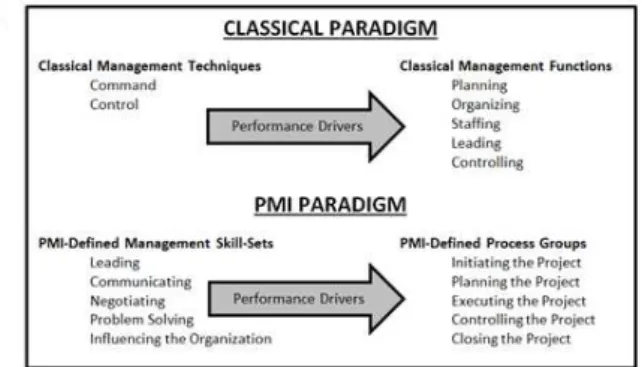
[13]. The PMI view is in contrast to the classical management functions that are commonly aligned to a command and control mentality, focusing on managerial control [14]. As illustrated in Fig 1, this is a paradigm-shift change from the prevailing status quo. In the classical paradigm, functional management serves as a performance driver through the techniques of managerial control, applied through the five management functions of: planning, organizing, staffing, leading, and controlling [15, 16]. In the PMI paradigm, command and control is replaced by: leading, communicating, negotiating, problem-solving, and influencing the organization [17], all of which connote a more interactive and proactive relationship between the skill sets and the process groups that are integral to the project: initiating, planning, executing, controlling, and closing.
Figure 1: Comparison of Classical Management Functions to PMI Model
III.
P
URPOSE OF THIS STUDYThe purpose of this quantitative correlational study was to identify the relationship of management competency versus technical competency to project management success at a Fortune 100 aerospace corporation based in the United States. The study seeks to determine the perceived degree of importance ascribed to management versus technical competency as it influences project management success for a major aerospace corporation providing products and. As shown in Fig 2, the study considered the perceived effect of the independent variables of technical competence versus the perceived effect of management competence on the dependent variable of project management success.
Figure 2: Variables List
In the context of this study, technical competency is defined as proficiency in the engineering skill (the effective application of scientific and mathematical principles to practical ends such as design, manufacture, and operation of efficient and economical structures, machines, processes, and systems) or scientific skill (the effective application of physics, aerodynamics, thermodynamics, chemistry, astronomy, and so forth, toward investigation and analysis of the properties of matter and energy). Management competency is defined as proficiency in the key management skills promulgated by the Project
Management Institute‟s Guide to the Project
Management Body of Knowledge (PMBOK), which include: leading, communicating, negotiating, problem solving, and influencing the organization [18]. In the framework of this study, project
management success is defined “as having achieved
the project objectives: within time, within cost, at the desired performance/technology level, while utilizing the assigned resources effectively and
efficiently, accepted by the customer” (p. 3) [19].
IV.
M
ETHODOLOGYThe purpose of this quantitative correlational study was to identify the relationship of management competency versus technical competency to project management success at a Fortune 100 aerospace corporation in the United States. The researcher utilized a non-experimental quantitative survey evaluation design. The results obtained enabled the researcher to generalize the findings so that inferences may be made to the general population of project managers involved in the survey, and also the aerospace industry in general.
variables, a degree of correlational relationship was investigated.
The researcher used the survey questionnaire which was developed in collaboration with academic mentors, industry subject matter experts, and members of a focus group. The SurveyMonkey web-based platform was used to create the survey, control the logic of the responses, provide guidance to respondents, and automate collection of responses, and reporting of results.
V.
R
ESEARCHH
YPOTHESES In order to accomplish the stated purpose of this research study, the following research hypotheses were investigated:H10: There is no relationship between project managers‟ management competency and technical competency in achieving overall project management success in the aerospace industry.
H1A: There is a significant perceived relationship between project managers‟ management competency versus technical competency in achieving overall project management success in the aerospace industry.
VI.
S
URVEYI
NSTRUMENTD
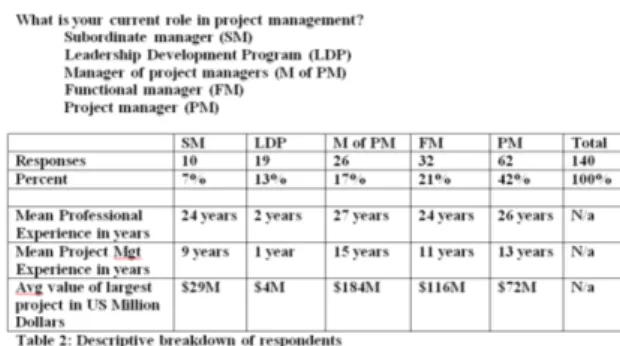
ESIGN Due to the uniqueness of this research study, no preexisting instruments were found during the literature review that could be tailored to this peculiar application. Accordingly, the survey instrument was created with the end in mind – to draw out information needed to complete the data analysis. In order to gain an appreciation for the demographics of survey participants, the researcher solicited information regarding gender, role in project management, years of professional experience, years of project management experience, dollar value of the largest program ever managed, and beliefs about project management competencies.VII.
V
ALIDATION ANDR
ELIABILITY Quality and robustness of the research was dependent on the survey instrument, and driven by the insight and experience of the researcher and his advisors. The survey questions were developed for each of the independent and dependent variables, with the recognition that there was potential to introduce measurement error if questions were not appropriately presented to or framed for the respondents [20].VIII.
S
URVEYP
OPULATIONThe population of interest for this research study included persons with project management experience exposure at a Fortune 100
aerospace corporation located in the United States. For the primary survey, the researcher selected 95% as the degree of confidence and maximum error allowed (confidence interval) for the survey sample, which is commonly used
for this type of research [21, 22]. In order to calculate the sample size needed, the researcher used The Survey System (http://www.surveysystem.com/sscalc.htm), which provided a web-based sample size calculator. To determine the sample size needed for a 95% confidence level, the researcher specified a confidence interval of 3.64, and a population of 177. These specifications resulted in a needed sample size of 142.
IX.
D
ATAC
LEANINGPrior to analysis, the survey data was examined to discover any obvious errors in input or other discrepancies or inconsistencies within the data sets. There were a total of 177 persons included in the survey population. Of those, there were 153 responses to the survey, four of which were discarded during the data cleaning process (149 valid responses). Seven persons declined to participate, and 17 did not respond. The overall participation rate was 86.5 percent.
X.
D
ATAA
NALYSISThe researcher used Microsoft Excel (spreadsheet) as a tool for downloading the survey data from Surveymonkey.com, organizing the data, and performing data cleaning. The data was examined to determine the degree to which overall management competencies versus technical competencies correlate to project management success. If the data were found to be significant, and fail to reject the null hypotheses, the alternative hypotheses may be accepted.
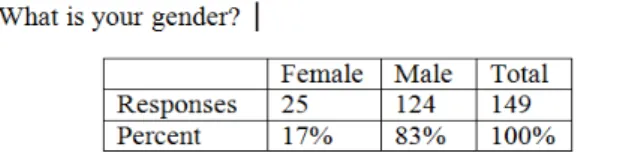
Table 1 is the descriptive statistics from 149 survey participants regarding gender.
Of the 149 survey participants, all 149 (100 percent) agreed that project management is vital to corporate success. A total of 144 (97 percent) participants stated a belief that continuing education is important to project manager success. A total of 141 (95 percent) participants felt that management competency has a positive effect on technical competence. In contrast, only 127 (85 percent) felt that technical competency has a positive effect on management competence.
Recognizing that the data set associated with the survey is small, and many responses are ranked equally due the five-point Likert scale used in the survey instrument, the researcher concluded
that Kendall‟s Tau is an appropriate statistical test of
the hypotheses [23, 24].
XII.
H
YPOTHESEST
ESTINGThe set of descriptive statistics and correlation test results represent the survey data regarding the perceived importance of project management competency to overall project management success.
1.1 Hypothesis – Overall Project Management Success
H10: There is no relationship between project managers‟ management competency and technical competency in achieving overall project management success in the aerospace industry.
H1A: There is a significant perceived relationship between project managers‟ management competency versus technical competency in achieving overall project management success in the aerospace industry.
Table 3 is the descriptive statistics from 149 survey participants regarding the perceived importance of management competency to overall project management success.
Table 3 is the descriptive statistics from 149 survey participants regarding the perceived importance of technical competency to overall project management success.
Table 4 represents mean score „Management Competency‟ and „Technical Competency‟ to
overall project management success.
1.2 Test of Hypothesis
A test of the hypothesis using Kendall‟s
Tau revealed a weak positive correlation of 0.158 between management competency and overall project management success. Although the correlation test itself is significant at 0.05 using a two-tailed test, the small value of Kendall‟s tau suggests a very weak association. Although the association is weak, it is greater than zero, so the null hypothesis is rejected. Comparatively, there was no positive correlation between technical competency and project management success. In the case of technical competency, the Tau value was negative, very small, and not significant at the 95% level.
technical capability in the choice of project manager, the data suggests, albeit weakly, that both domains of competence are related.
XIV.
R
ECOMMENDATIONS FOR FUTURE RESEARCHThe population for this research was taken from the aerospace industry. It is recommended that this study be carried out in other industries to determine if the relationship observed in this research holds within other industries.
R
EFERENCES[1] Nellore, R., & Blachandra, R. (2001).
“Factors influencing success in integrated
product development (IPD) projects.”
IEEE Transactions on Engineering
Management, 48(2), pp. 164-176.
[2] Pressman, R. (1998). “Fear of trying: the plight of rookie project managers.” IEEE
Engineering Management Review, 26(4),
pp. 18-20.
[3] Lampel, J. (2001). The core competencies of effective project execution: the challenge of diversity. International Journal of Project Management, 19(8), 471-483. [4] Kerzner, H. (2000). Applied project
management: best practices on
implementation. New York: NY. John
Wiley & Sons, Inc.
[5] Larson, E., & Gray, Clifford. (2011).
Project management the managerial
approach. (5th ed.) New York: NY. John Wiley & Sons, Inc.
[6] Meredith, J. R., & Mantel Jr, S. J. (2012). Project management: a managerial approach. (8th ed.) John Wiley & Sons. [7] Liu, J. Y. C., Chen, H. H. G., Jiang, J. J., &
Klein, G. (2010). Task completion competency and project management performance: The influence of control and user contribution. International journal of project management, 28(3), 220-227. [8] Verburg, R. M., Bosch-Sijtsema, P., &
Vartiainen, M. (2013). Getting it done: Critical success factors for project managers in virtual work settings.
International Journal of Project
Management, 31(1), 68-79.
[9] Kerzner, H. (2000). Applied project
management: best practices on
implementation. New York: NY. John
Wiley & Sons, Inc.
[10] Murch, R. (2001). Project management.
Upper Saddle River, NJ: Prentice Hall, Inc. [11] Lewis, J. P. (1998). Fundamentals of
project management (2nd ed.). New York,
NY: American Management Association. [12] Monson, R. J. (2000). The contribution of
personality traits and context to the career success of project managers. Dissertation Abstracts International, 61(1), p. 465. (UMI No. 9957671)
[13] PMI (2013). A guide to the project management body of knowledge. (5th ed.). Newtown Square, PA: Project Management Institute.
[14] Bateman, T. S., & Snell, S. (2012). Management: Building competitive
advantage. (10th ed). Boston:
Irwin/McGraw-Hill.
[15] Koontz, H., & Weihrich, H. (1993).
Management: a global perspective (10th ed.). New York, NY: McGraw-Hill Book Company.
[16] Bateman, T. S., & Snell, S. (2012). Management: Building competitive
advantage. (10th ed). Boston:
Irwin/McGraw-Hill.
[17,18]PMI (2004). A guide to the project management body of knowledge. (4th ed.). Newtown Square, PA: Project Management Institute.
[19] Kerzner, H. (2009). Project management:
A systems approach to planning,
scheduling, and controlling (10th ed.).
Hoboken, NJ: John Wiley & Sons.
[20] Huck, S. W., & Cormier, W. H. (2007).
Reading statistics and research (5th ed.).
New York, NY: Harper Collins Publishers.
[21] Cooper, D. R., & Schindler, P. S. (2010).
Business research methods (11th ed.).
Boston, MA: McGraw-Hill Irwin.
[22] Creative Research Systems (n.d.). The survey system: sample size calculator.
Retrieved from
http://www.surveysystem.com/sscalc.htm [23] Somekh, B., & Lewin, C. (2005). Research
methods in social sciences. Thousand
Oaks, CA: SAGE Publications.
[24] O‟Leary, Z. (2004). The essential guide to
doing research. Thousand Oaks, CA: