
International Journal for Quality research UDK – 005.8
Short Scientific Paper (1.03)
Tamara Gvozdenovic,
Hydro Power Plants on the
Trebišnjica, Trebinje,
Republic of Srpska
Mirjana Miljanovic
Faculty for Production and
Management, Trebinje,
Republic of Srpska
Aleksandar Jegdic
Regulatory Commission for
Electricity of Republic of
Srpska, Trebinje,
Republic of Srpska
Zeljko Crnogorcic
Swisslion - Industrija alata,
Trebinje,
Republic of Srpska
Bodies Of Knowledge In Project Management And
Project Quality Management
Abstract:
One of the main trends is standardisation of
project management. Some of the most important bodies of
knowledge in project management, which were created by
professional associations for project management are given
in this paper. The main of the project management, apart
from minimisation of time, resources and costs, is to finish
the project in the required quality, i.e. it is very important
during the whole process of project management to provide
realizing the project without any deviations from the
previously set quality standards. Basic processes of project
quality management are: quality planning, quality
assurance and quality control.
Keywords: Project management, Bodies of Knowledge,
Quality, Project Quality Management
1. INPRODUCTION
Modern organizations nowadays do their business under very complex and changeable conditions, which require a constant adjustment to very turbulent environment, in order to exist and carry on with efficient work. Without project management organisations cannot adjust themselves to all changes and function efficiently. Project management, as a special management discipline, is developing more and more and is in accord with fast management development as a general science about managing the business and other systems and undertakings. From using basic concept based on software packages, we have reached forming and using new areas such as project quality management, project risk management, human resources management, project communications management, project changes management...
defining profession and setting criteria in project management.
2. BODIES OF KNOWLEDGE IN
PROJECT MANAGEMENT
A number of project management associations have formed chapters around the world to encourage the development of project management as a profession. More than fifty years a considerable body of knowledge has built up around the world project management tools, skills and techniques. The purpose of the body of knowledge is to identify and describe the best practices that are applicable to most projects most of the time [1]. There is a common approval about their value and usefulness. In the continuation some bodies of knowledge in project management are briefly discussed.
PMI's PMBOK Guide
PMI (Project Management Institute), based in the USA, has created the oldest and the most often used body of knowledge of project management. It has been complemented during the time. The ascendant of PMBOK was PMI`s ESA (Ethics, Standards and Accreditation) report from 1983. which nominated six basic
components: the management of scope, cost, time, quality, human resources and communications.
PMBOK from 1987. was a completely new document and the first published body of knowledge of project management. It added contract/procurement management and risk management to the previous six primary components.[3]
PMBOK Guide from 1996. was a completely processed document to which project integration management was added to the previous eight components. Nine components were later renamed as Project Management Knowledge Areas with special chapters for each one. Each area of knowledge has numerous component processes from which each was examined in advance under conditions of inputs, tools and techniques and outputs. There are thirty-nine component processes altogether. A Guide to the Project Management Body of Knowledge from 1996. was revised twice in 2000. and 2004. but with no changes in its structure from 1996.
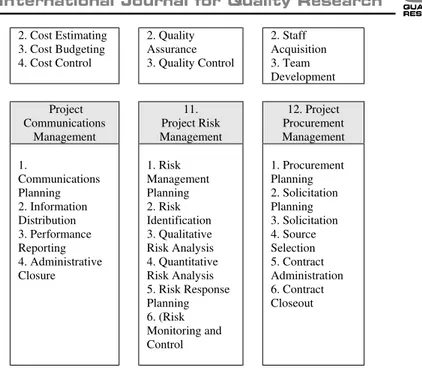
PMBOK Guide, Third Edition, from 2004. contains forty-four component processes (Figure1.) [3]
PROJECT
MANAGEMENT
4. Project Integration Management
5. Project Scope Management
6. Project Time Management
1. Project Plan Development 2. Project Plan Execution 3. Integrated Change Control
1. Initiation 2. Scope Planning 3. Scope Definition 4. Scope Verification 5. Scope Change Control
1. Activity Definition 2. Activity Sequencing 3. Activity Duration Estimating 4. Schedule Development 5. Schedule Control
7. Project Cost Management
8. Project Quality Management
9. Project Human Resource
Management
1. Resource Planning
1. Quality Planning
2. Cost Estimating 3. Cost Budgeting 4. Cost Control
2. Quality Assurance 3. Quality Control
2. Staff Acquisition 3. Team Development
Project Communications
Management
11. Project Risk Management
12. Project Procurement Management
1.
Communications Planning 2. Information Distribution 3. Performance Reporting 4. Administrative Closure
1. Risk Management Planning 2. Risk Identification 3. Qualitative Risk Analysis 4. Quantitative Risk Analysis 5. Risk Response Planning 6. (Risk Monitoring and Control
1. Procurement Planning 2. Solicitation Planning 3. Solicitation 4. Source Selection 5. Contract Administration 6. Contract Closeout
Figure 1. The Project Management Knowledge Areas
Different versions of PMBOK Guide focus on management skills that are applied to most projects most of the time, and it does not include in the knowledge areas those general management skills, which can be required just in some projects or/and in some occasions.
The Association of Project Management Body of Knowledge (APMBoK)
APM from UK launched its body of knowledge in 1988. which was quite different from PMI`s. It incorporates not only inward focused project management topics (such as planning and control techniques), but also broader topics in which the project is being managed (such as social and ecological environment), as well as specific areas ( such as technology, economics, finance, organisation,
procurement and people, as well as general management) [1].
One of the key differences between the PMI and APM approaches is that, in its own words, the PMBOK Guide’s Knowledge areas include only knowledge and practices that “are applicable to most projects most of the time”, with contextual issues and are discussed separately in its Framework section. [3] The APMBOK includes knowledge and practices that may apply to some projects and/or part of the time which is much more inclusive approach.
The fourth edition of APMBOK from 2000. consists seven main titles, with forty-two items that are shown in the figure 2. In this body of knowledge a short examination of all titles and topics as well as recommendation for each topic are given.
APMBoK
1. GENERAL 4.
TECHNICAL
6.
ORGANIZATIONAL
- Project management - Program management - Project control
- Design, implementation, and handover management - Requirements
management - Estimating - Technology management Value engineering - Modeling and testing - Configuration management
- Implementation - Handover - (Post-) project evaluation review - Organization structure
- Organization roles
2. STRATEGIC 5.
COMMERCIAL
7. PEOPLE
- Project success criteria - Strategy/project mgt. plan - Value management - Risk management - Quality management - Health, safety, environment
- Business case - Marketing and sales
- Financial management - Procurement - Legal awareness
- Communications - Teamwork - Leadership - Conflict management - Negotiation - Personnel management
3. CONTROL
- Work content and scopemgt. - Time
scheduling/phasing - Resource management - Budgeting and cost mgt. - Change control - Earned value management - Information management
Figure 2. The Association of Project Management Body of Knowledge [3]
The IPMA's BOK - The International Project Management Association (IPMA)
The International Project Management Association (IPMA), a federation of national project management associations, mainly European was spawned by the APM and registered as an international organization in Switzerland in 1998.
The IPMA developed an IPMA Competence Baseline (ICB) in 1999. which
primary purpose is to provide basic recommendations for its members of the associations for development their own National Competence Baselines. Most members have developed their own baselines, which provide a base for the certification of their project managers. The other purpose of ICB was a harmonisation of previously existed European bodies of knowledge.
elements of knowledge and experiences of project management. Each member of National Competence Baseline-s must have twenty-eight basic elements.
Japan's P2M
Japan’s Engineering Advancement Association (ENAA) founded a committee for the introduction, development and research on project management in 1999, which created A Guidebook of Project and program Management for Enterprise Innovation – officially abbreviated P2M in 2001. Development of P2M and certification system appeared as the result of Japan’s enterprises needs to develop more innovative approaches for the development of their business. This is a very long and detailed document that contains 420 pages and it does not include only one project management but contains areas of program management.
P2M has the following chapters in project management:
• Project Strategy Management • Project Finance Management • Project Systems Management • Project Organization Management • Project Objectives Management • Project Resources Management • Risk Management
• Project Information Technology Management
• Project Relations Management • Project Value Management
• Project Communications
Management
The AIPM's Australian National Competency Standards for Project
Management (ANCSPM)
The Australian Institute for Project Management (AIPM) developed and documented their standards in 1977 as the Australian National Competency Standards for Project Management (ANCSPM).
The format of ANCSPM emphasises performance-oriented recognition of competence in the workplace, and includes the following main components [3]:
§ Units of competency: the significant major functions of the profession.
§ Elements of competency: the building blocks of each unit of competency.
§ Performance criteria: the type of performance in the workplace that would constitute adequate evidence of personal competence.
§ Range indicators: describe more precisely the circumstances in which the performance criteria would be applied.
Elements of competency are shown in the following words: determine, conduct, guide, implement and others. There are three main elements of competency foe each unit.
The ANCSPM incorporated the nine knowledge areas of the PMI`s PMBOK directly into the knowledge part of their qualification program.
South African unit standards
South Africa developed its own performance-based competency standards. Standards have been completed for a National Certificate in Project Management.
3. PROJECT QUALITY
MANAGEMENT
Applying the concept of project management it is possible to provide all needed support and create conditions to achieve already planned results, as well as to organize and monitor the process project realisation. Having in mind that the project is being realised to fulfill required needs of all stakeholders, the focus is on the project quality. Project quality management is one of the most important functions of the global concept of project management. Project quality
management can be more precisely defined as a part of the process of project management, which provides project realisation without any deviations from already set standards.
technological standards, lower prices as well as the fewer number of defective products.
Project management as one of the functional areas of project management includes the following processes:
§ Quality Planning
§ Quality Assurance
§ Quality Control
3.1 Quality Planning
Quality planning includes identification which quality standards are relevant for project and how to meet them. Implementation of those standards in the project is a key part of quality planning. Figure 3 shows inputs, tools and techniques and outputs of project planning process.
Figure 3. Quality Planning [8]
Techniques of quality planning from figure 3. are the ones that are most frequently used in projects.
Quality project management in the domain of project, should start from determining project requirements, regulations and standards that must be applied. A project engineer which runs the whole project or just a part of it must provide that all set project requirements and conditions must be fulfilled as well as during doing the project regulations and standards must be strictly followed in order to meet required quality of the project.
One of the input details for quality planning is quality policy. Quality policy is a document made by experts for quality and approved by top management. It defines which quality aims should be achieved, quality level that is acceptable for the organisation as well as individual responsibilities for conducting and assuring quality.
3.2 Quality Assurance
Quality assurance includes management
processes that provide performance standards. Quality assurance is focused on reducing the possibility of appearing possible mistakes and errors and creating all necessary conditions in the organization in order to achieve planned and required products and services quality. It is the way of doing business that enables improving the production efficiency and business on the whole.
Quality assurance includes periodical examination of project performance in order to assure that the project meets suitable quality standards during its realisation. Process of quality assurance means taking responsibility for quality during and after the end of the project. Quality assurance is a managerial function, and project manager may have the strongest effect on project quality in this phase through processes and procedures that assure that activity realisation meets client’s requirements.
Figure 4. Quality Assurance [8]
3.3 Quality Control
Quality control includes the process of determining primary project requirements and examining coordination of the project realisation with required standards and defining the way of eliminating the causes of non-
fulfillment of quality standards.
Quality control activities include continually monitoring processes, identifying and eliminating problem causes, use of statistical process control to reduce the variability and increase the efficiency of processes [8].
Figure 5. Quality control [8]
Project management team should have a working knowledge of statistical quality control, especially sampling and probability, to
help quality control outputs. [9] In figure 5 inputs, tools and techniques, as well as outputs of quality control phase are shown.
4. CONCLUSION
Adjustment to modern business conditions needs fundamentally different work organization and business operations of organizations. Projects and project management are becoming a more important component in modern business conditions. Project management is a modern multidiscipline concept that became a legal base in well-developed countries, standardized. Around the world numerous bodies of knowledge in project management have been developed which are standards of knowledge in accord with
geographical domains.
Concept of project management is nowadays enriched with new areas of project management knowledge. A separate area of project management is project quality management, which means a line of processes and activities to support the project to meet the requirements and needs because of which it has started.
REFERENCES:
[1] Burke R., “Project Management Planning and Control Techniques“, John Wiley & Sons, New York 2003., (english language)
[2] Cagle R., “Your Successful Project Management Career“, Amacom, New York 2005., (english language)
[3] Dinsmore P., Cabanis-Brewin J., “The AMA Handbook of Project Management“, Amacom, USA 2006., (english language)
[4] Horine G., “Absolute Beginner' Guide to Project Management“, Indianapolis, USA 2005., (english language)
[5] Kerzner H., “Project Management: A system Approach to Planning, Scheduling and
Controlling“, John Wiley & Sons, USA 2003., (english language)
[6] Jovanović P., “Upravljanje projektom“, Grafoslog, Beograd 2002., (serbian language)
[7] Perović M., “Management – Informatics - Quality“, CIM Center, 2003., Kragujevac (serbian
language)
[8] Project Management Institute, “A Guide to the Project Management Body of Knowledge
(PMBOK Guide)“, Pennsylvania, USA 2000., (english language)
[9] Project Management Institute, “A Guide to the Project Management Body of Knowledge –
PMBOK Guide Third Edition“, Pennsylvania, USA 2004., (english language)
![Figure 2. The Association of Project Management Body of Knowledge [3]](https://thumb-eu.123doks.com/thumbv2/123dok_br/18330363.350791/4.808.204.586.98.744/figure-association-project-management-body-knowledge.webp)
![Figure 3. Quality Planning [8]](https://thumb-eu.123doks.com/thumbv2/123dok_br/18330363.350791/6.808.118.601.157.451/figure-quality-planning.webp)
![Figure 4. Quality Assurance [8]](https://thumb-eu.123doks.com/thumbv2/123dok_br/18330363.350791/7.808.181.609.106.322/figure-quality-assurance.webp)
