Extraction of Silica and other related products from Rice Husk
Abhishek Mehta,
1Dr. R. P Ugwekar
2.
1M.Tech final year student, 2Head of Chemical Engineering Department, Laxminarayan Institute of Technology,
Rashtrasant Tukadoji Maharaj Nagpur University, Nagpur, Maharashtra State, India.
ABSTRACT
The main objective of the present work is the synthesis of silica from rice husk and to study its characterization studies. The alkaline method succeeded by acid precipitation is done for the extraction of silica. The optimization of the concentration of sodium hydroxide and the amount of rice husk ash that goes with it for attaining the maximum yield of silica is done. X-ray Diffraction and Fourier Transform Infrared Spectrometry studies are executed for acquiring its characteristic. Activated carbon and silica gel are the intermediate products formed during the synthesis process of silica.
Key word:
Precipitation method, Rice husk ash, Rich husk, Silica, X-RD.I.
INTRODUCTION
Rice husk is widely available waste found in India. The outcome of rice husk from rice mills is 25 million tons per annum in India. Rice husk contain about 20% of ash which can be recovered as amorphous silica. This silica finds wide relevance as filler, adsorbent, catalyst support, star gels and a source for orchestrate superior quality silicon and its compounds. Various metal ions and unburned carbon impact the pureness and color of the ash. Under specific condition prescribed burning of the husk after removing these ions can produce high purity white silica. [1][2]
Silica within the years has gained major significance and various application in different industries such as rubber industry, pharmaceuticals and medicine. Industries use rice husk as fuel in boiler and power generation , the smoke generated because of burning often has unfavorable consequences on domestic as well as international environmental problems. Rice husk is generally not appropriate as cattle feed since its cellulose and other sugar contents are low. Rice husk ash which is produced during the burning of rice husk contains about 85-95% silica and is a great environment threat causing damage to the land and the surrounding area in which it is dumped therefore rice husk is the desirable raw material chosen.[1][2]
II.
EXPERIMENTAL PROCEDURE
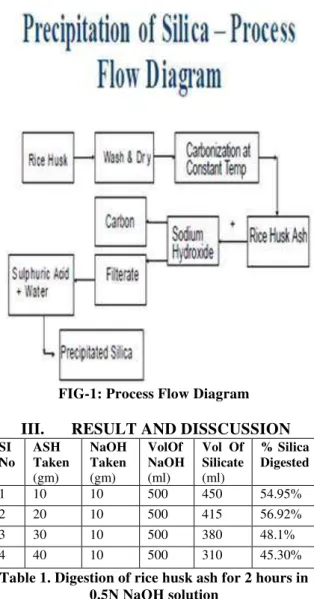
1. Rice Husk gradation (sieving):Rice Husk is sieved using 20-200 mesh size sieves. The major fraction, which usually consists of 20 mesh size, is used for the experiment
2. Washing and drying:
Rice husk obtained after sieving is washed with distilled water for cleaning purpose and sun dried for 48 hours.
3. Carbonization of rice husk:
The rice husk obtained above is carbonized at 500 0C and 700 0C separately. At or below 500 0C
incomplete carbonization is obtained. At or above 700 0C complete carbonization and nano-silica is
obtained.
Minimum time of duration of carbonization is 2 hours. During the experiment 3 hours of carbonization is done.
4. Treating with activating agent (alkaline extraction):
The carbonization process result Rice Husk Ash from Rice Husk is further treated with activating agent that is Sodium Hydroxide ,Stirred in Magnetic stirrer for period of 2 hrs at 60 0C. This makes the
silica soluble in the activating agent and subjects the rice husk to have more surface area.
5. Filtration:
The above solution obtained is filtered with whatman filter paper. The residue that is obtained on the filter paper is CARBON which is further washed ,treated with Phosphoric acid and carbonized at 700-900 0C to get ACTIVATED
CARBON Pure sodium silicate solution is obtained through filtration.
6. Formation of Silica gel (precipitation method Silica gel formation is obtained by adding concentrated sulfuric acid to the filtered solution until PH 7 is reached. As PH <10 gel starts forming and at PH=7 SILICA GEL is formed.
7. Drying:
Silica gel is then dried in an oven for a period of 18 hours at 100 oC, this yields very pure SILICA
. [3][4]
FIG-1: Process Flow Diagram
III.
RESULT AND DISSCUSSION
SI No ASH Taken (gm) NaOH Taken (gm) VolOf NaOH (ml)
Vol Of Silicate
(ml)
% Silica Digested
1 10 10 500 450 54.95%
2 20 10 500 415 56.92%
3 30 10 500 380 48.1%
4 40 10 500 310 45.30%
Table 1. Digestion of rice husk ash for 2 hours in 0.5N NaOH solution
SI No ASH Take n (gm) NaOH Taken (gm)
Vol Of NaOH (ml)
Vol Of Silicate (ml)
% Silica Digested
1 10 20 500 490 64%
2 20 20 500 450 61.59%
3 30 20 500 375 63.19%
4 40 20 500 340 68.35%
Table 2. digestion of rice husk ash for 2 hours in 1N NaOH solution
2N NaOH solution
SI No Normality of NaOH ASH TAKEN Silica Digested 1 0.5 20 56.92% 2 1 40 68.35% 3 2 80 71.15% Table 4. summarizing the result observed
3.1 characterization studies
Two samples of silica one which is prepared from rice husk carbonized at 500 oC(SILICA 500)
and one which is prepared from rice husk carbonized at 700 oC (SILICA 700) are subjected to
X-ray diffraction and Fourier transform infrared spectrometry.
3.1.1 X-ray diffraction
In this technique the primary X rays are made to fall on the sample substance under study, because of its wave nature like light waves its get diffracted to a certain angle. This angle of diffraction which differ from the incident beam, will give the information regarding the properties of the sample. The wavelength of the X-rays can be varied for the application by using a grating plate.
Measurement condition:
Scan Axis Gonio
Start Position [°2Th.] 10.0116 End Position [°2Th.] 99.9846
Step Size [°2Th.] 0.0130
Scan Step Time [s] 4.8450
Scan Type Continuous
PSD Mode Scanning
PSD Length [°2Th.] 3.35
Offset [°2Th.] 0.0000
Divergence Slit Type Fixed Divergence Slit Size [°] 0.8709 Specimen Length [mm] 10.00 Measurement Temperature [°C] 25.00
Anode Material Cu
K-Alpha1 [Å] 1.54060
K-Alpha2 [Å] 1.54443
K-Beta [Å] 1.39225
K-A2 / K-A1 Ratio 0.50000
Generator Settings 30 mA, 40 kV
Diffractometer Type 0000000083005420 Diffractometer Number 0
Goniometer Radius [mm] 240.00 Dist. Focus-Diverg. Slit [mm] 100.00 Incident Beam Monochromator No
Spinning No
SI N o ASH Take n (gm) NaO H Take n(gm)
Vol Of NaOH (ml)
Vol Of Silicate (ml) % Silica Digeste d
1 50 40 500 340 66.11
%
2 60 40 500 305 67%
3 70 40 500 345 68.66
%
4 80 40 500 275 71.15
Fig-2 ( X-RD of Silica 500 sample)
Fig-3 (X-RD of silica 700 sample)
The major reflection or peaks of crystalline form
of silica occur at Bragg 2θ angles of 20.856°, 26.636°
and 36.541. It can be seen that no defined peaks
corresponding to these Bragg 2θ angles are found in
both the cases.
A rather broad peak spanning 2θ angle at 19⁰, 230, 280, 320, 330 which is characteristic of
amorphous structures is observed.[5][6]
Position [°2Theta] (Copper (Cu))
20 30 40 50 60 70 80 90
Counts
0 1000 2000 3000
Silica-500
Position [°2Theta] (Copper (Cu))
20 30 40 50 60 70 80 90
Counts
0 1000 2000
3.1.2 Fourier transform infrared spectrometry: If two beams of light of the same wavelength are brought together in a phase, the beam reinforce each other and continue down the light. However, if the two beams of light are out of phase, destructive interference take place. This interference is at maximum when the two beams of light are 180 degree out of phase. Advantage is taken of this fact in fourier transform spectrophotometer. The system consist of four optical arms, usually at right angle to each other with a beam splitter at their point of intersection. Radiation passes down the first arm and is separated by a beam splitter into two perpendicular half beam of equal intensity that pass down into other arms of the spectrometer. At the ends of these arms the two half beams are reflected by mirrors back to beam splitter, where the recombine and are reflected together onto the detector. If the initial radiation is at one wavelength and in phase with itself and if the side arms path are equal in length, then when the two half- beam are recombined, they will still be in phase, reinforcing each other, and the max signal will be obtained on the detector. If the mirror in one arm is moved up by one quarter of a wavelength, then the half beam will be one half of a wavelength out of phase with each other, that is why they will interfere with each other. In practice, the mirror in one arm is kept stationary and that in a second arm is moved slowly in the direction of the beam splitter. The net signal falling on the detector will then be a cosine wave with the usual maxima and minima when ploted against the travel of the mirror. In practice, it
at a controlled known steady velocity. The velocity is controlled by using a laser beam.
FTIR OF SILICA (SILICA-500) which is made by rice husk carbonized at 500 0C.
The bands at 3851.69 corresponded to the O-H stretching and bending vibrations.
The peaks at 1122.25 and 801.93 cm−1 are due
to the Si-O-Si asymmetric and symmetric stretching modes, respectively.
The band centered at 614.31 cm−1 is due to the bending frequency of Si-O-Si No peak was found
between 2,800 and 3,000 cm−1. It means that there
Were no original organic compounds in the silica after controlled combustion and extraction.[3][4]
FTIR OF SILICA (SILICA 700) which is made from rice husk carbonized at 700 0C
The bands at 1695.93 corresponded to the O-H stretching and bending vibrations also is assigned to the bending vibration of water molecules bound to the silica matrix.
The peaks at 1115.27 and 799.28 cm−1 are due
to the Si-O-Si asymmetric and symmetric stretching modes, respectively.
The band centered at 615.28 cm−1 is due to the bending frequency of Si-O-Si No peak was found
between 2,800 and 3,000 cm−1. It means that there
Were no original organic compounds in the silica after controlled combustion and extraction.[3][4].
Fig-5 FTIR of Silica700
Fig-6 Silica powder Fig-7 Silica gel Fig-8 Activated carbon Extracted Products
IV.
CONCLUSION
The silica extraction and its morphological study is done. Amorphous nature of silica is observed. The recycling of major disposable product that is rice husk is developed. The effect of concentration of alkaline solution is reviewed and the 2N NaOH solution combined with 80 grams of rice husk ash showed the maximum yield of silica. Taking consideration the feasibility of the project at the
laboratory scale alkaline extraction method for extracting the silica by using the muffle furnace for carbonizing the rice husk is used. Tubular reactor or cyclonic furnace is used for carbonizing the rice husk at commercial scale.
V. ACKNOWLEDGMENT
REFERENCES
[1.] M.R. Gidde And A.P. Jivani , Waste To Wealth - Potential Of Rice Husk In India A Literature Review, Proceedings Of The International Conference On Cleaner Technologies And Environmental Management PEC, Pondicherry, India.
January 4-6,2007. Pp.586-590
[2.] Rosario Madrid, C. A. Nogueira And F. Margarido , Production And Characterisation Of Amorphous Silica From Rice Husk Waste , 4th International Conference On Engineering For Waste And Biomass Valorisation, September 10-13
2012.
[3.] Ezzat Rafiee, Shabnam Shahebrahimi, Mostafa Feyzi And Mahdi Shaterzadeh, Optimization Of Synthesis And Characterization Of Nanosilica Produced From Rice Husk, International Nano Letters
2012, 2:29.
[4.] U. Kalapathy A, A. Proctor A, J. Shultz B, A Simple Method For Production Of Pure Silica From Rice Hull Ash, Bioresource Technology 73 (2000) 257±262.
[5.] V.P. Della A, I. Kuhna,B, D Hotza, Rice Husk Ash As An Alternate Source For Active Silica Production , Materials Letters 57 (2002) 818–821
[6.] V.R. Shelke , S.S. Bhagade , And S.A. Mandavgane , Mesoporous Silica From Rice Husk Ash, Bulletin Of Chemical Reaction Engineering & Catalysis, 5 (2), 2010, 63 -
67.