INTRODUCTION
The search for the use and exploitation of industrial and agricultural wastes of commercial interest is increasingly intense. This can be observed especially in agribusiness, representing a potential source of income and a way of reducing waste generation and environmental impacts. Moreover, the increasing improvement of the ceramics industry, the need for technological advancements for a better cost / benefi t ratio of materials have encouraged the diversifi cation in the supply of raw materials, seeking to integrate different production chains. Creating products from this waste adds value and creates wealth, which makes them very attractive. Reducing waste generation in industrial and agricultural processes, better using them, creating routes with lower cost, cheaper products and reducing the release of wastes into the environment are the goal of any economy seeking modernization and preservation of natural resources. In the Brazilian context, one of these examples is rice husk.
According to the National Supply Company [1], the national production of paddy rice for the year 2011 was estimated at 13,733,200 ton. In rice husks, the main constituents are cellulose (about 48%), lignin (about 23%) and the rest are other organic compounds such as oils and proteins [2]. In the plant straw, which corresponds to about 10% by weight of paddy rice [3], there is a high concentration of silica, with approximately 13% by weight. Other compounds such as K2O, CaO, Na2O, Al2O3, MnO, P2O5 are also found in proportions that depend on soil nature and plant variety. These compounds are considered impurities, since they modify the properties of silica [4]. Their burning under controlled conditions produces a black residue, the rice husk ash, which is rich in amorphous silica.
Among mesoporous materials, M41S-type materials stand out, which were discovered by Mobil Oil Co. in 1992 [5]. MCM-41 (Mobil Composition of Matter) is a mesoporous molecular sieve with hexagonal arrangement of pores, specifi c area over 700 m²/g, controllable pore size. Due
Use of rice husk ash as only source of silica in the
formation of mesoporous materials
(Emprego da cinza da casca de arroz como única fonte
de sílica na formação de materiais mesoporosos)
A. J. Schwanke1, D. M. A. Melo2, A. O. Silva2, S. B. C. Pergher2
1Programa de Pós-Graduação e Ciência e Engenharia de Matérias, 2Instituto de Química
Universidade Federal do Rio Grande do Norte - Campus Universitário Lagoa Nova, Natal, RN 59072-970 [email protected], [email protected]
Abstract
This paper reports the synthesis of molecular sieves similar to MCM-41 using rice husk ash as only source of silica. For comparison purposes, a standard synthesis was performed using aerosil 200 commercial silica. The rice husk silica was obtained by heating treatment at 600 ºC and leaching for 2 h in refl ux with HCl 1mol.L-1 and used in the synthesis. The samples prepared were
characterized by N2 adsorption, X-ray diffraction (XRD), scanning electronic microscopy (SEM) and thermogravimetric analysis (TG). By type-IV adsorption isotherms, the formation of mesoporous materials was observed. XRD showed the formation of hexagonal unidirectional pore materials similar to MCM-41. By SEM, it could be observed that the rice husk has fi brous aspect and that synthesis using calcined and leached rice husk did not react entirely because silica was only partially dissolved.
Keywords: MCM-41, rice husk ash, mesoporous materials.
Resumo
Este trabalho relata o estudo da síntese de peneiras moleculares semelhantes à MCM-41, empregando cinza da casca de arroz como única fonte de sílica. Para critérios de comparação uma síntese foi realizada com sílica comercial aerosil 200. A sílica da casca de arroz foi obtida mediante tratamento térmico a 600 ºC e lixiviação em refl uxo por 2 h com HCl 1 mol/L e empregada na síntese. As amostras preparadas foram caracterizadas por adsorção de N2, difração de raios X, microscopia eletrônica de varredura (MEV) e termogravimetria. Por meio das isotermas de adsorção, do tipo IV, observa-se a formação de material mesoporoso. Nos difratogramas de raios X é identifi cada a formação hexagonal unidirecional de poros, indicando que material apresenta semelhanças com a MCM-41. Por MEV observa-se que a casca de arroz possui aspecto fi broso e que a síntese empregando a casca de arroz calcinada e lixiviada não reagiu na sua totalidade devido a dissolução parcial da sílica.
to these characteristics, these materials are used in various processes such as adsorption [6], catalysis [7], controlled release of drugs [8], gas capture [9], enzyme immobilization [10], among others. The synthesis of these materials requires a source of silica, usually commercial, which is the structure directing agent, a solvent and a mineraliser agent. There are reports in literature on the use of alternative sources of silica for the synthesis of these materials [11-13]. Some researchers use rice husks together with some other source of silica, usually commercial, but syntheses are performed in several days [14, 15].
This work aims the synthesis of materials similar to MCM-41 in short periods of time, using rice husk as a single source of silica in their composition. Thus, this study searches to add value to rice husk, an abundant and cheap material, considered a byproduct or waste from the rice benefi ciation process, which can be used in adsorption and catalysis processes.
EXPERIMENTAL STAGE
The literature shows that it is possible to obtain pure silica from rice husk [16]. Thus, rice husk was submitted to two treatment processes, thermal and chemical. In the thermal treatment, based on adopted procedures, husk was calcined in heating rate of 4 °C/min up to 600 °C, where it remained for additional 4 h. Later the rice husk was submitted to chemical treatment; 25 g of calcined rice husk was leached in refl ux at 100 °C with 500 mL of HCl 1 mol/L for 2 h. Afterwards the residual husk was washed with deionized water and dried at 110 °C overnight, which was called calcined and leached rice husk (CACL). The synthesis of MCM-41 was based on the reported procedure [17]. Two solutions were prepared: solution A: 5 g of hexadecyltrimethylammonium bromide (Aldrich) are dissolved in 33.5 g of distilled water. Solution B: on 8.65 g of a solution of 25% tetramethylammonium hydroxide (Aldrich), 0.96 g silica from rice husks were dispersed. Solution A was added to solution B, hydrolyzing additional 4.52 g of rice husk, leaving under stirring for 1 h.
The resulting gel was transferred to autoclaves with tefl on bottom and led to the oven for 24 h at 135 ºC. The sample was called CACLMCM-41. Comparing to this procedure, the same methodology was tested, using silica Aerosil 200 as source of silica, which was named SiMCM-41. All samples were calcined in fi xed bed reactor under fl owing nitrogen and synthetic air at 550 ºC/11 h.
Characterization of samples
XRD analyses were performed in a Minifl ex II Rigaku diffractometer with Ni fi lter and Cu-kα radiation ( = 1.54 Å). For measurements of nitrogen adsorption, a Quanta Chrome Nova 1000 device was used; samples were pre-treated for 3 h at 300 °C under vacuum. Scanning electron microscopy (SEM) was performed on a ESEM-XL30 Philips microscope, and samples were coated with a gold layer to prevent surface charges that could lead to image distortion. Thermogravimetric analyses were performed on a TGA-50H Shimadzu thermal analyzer with heating rate 10 ºC/min under synthetic air fl ow.
RESULTS AND DISCUSSION
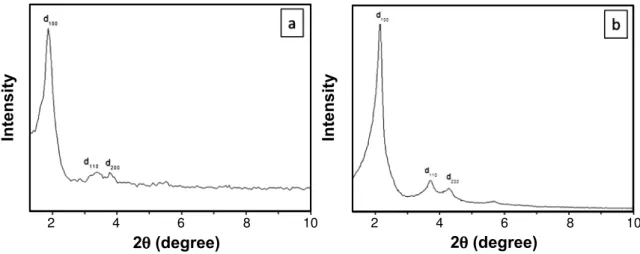
Fig. 1 shows the X-ray diffractograms of the synthesized samples. It was observed in image (a) the synthesized sample CACLMCM-41, where the existence of the plane d100 indicates the formation of mesoporous material with hexagonal structure. Planes d100 and d200 indicate the degree of organization of the pore system, and in comparison with standard sample SiMCM-41, image (b), this image shows that these refl ections are little resolved, indicating that the material has a low-order hexagonal pore system, as already reported [18]. The absence of refl ections at higher angles indicates that the material is not crystalline; however, there is a hexagonal arrangement, which also can be observed by the high intensity of the fi rst refl ection of plane d100. Furthermore, it could be concluded that the materials have good thermal stability, since they were submitted to
Figure 1: X-ray diffraction patterns of synthesized samples. Image (a) CACLMCM-41 and (b) SiMCM-41.
[Figura 1: Difratogramas de raios X das amostras sintetizadas. Imagem (a) CACLMCM-41 e (b) SiMCM-41.]
2 2
2θ (degree)
Intensity
2θ (degree)
4 6 8 10 4 6 8 10
calcination at maximum temperatures of 550 °C, and there was no destruction of their structure.
Table I shows a comparison between the two procedures. The analyses of N2 adsorption showed that the reference material, SiMCM-41, has higher s pecifi c area compared to CACLMCM-41. Despite this difference, the material has high specifi c area, a feature of mesoporous materials, which can also be proved by type-IV isotherms, characterizing its mesoporosity in Fig. 6. The newtork parameter can be calculated in a simplifi ed manner through the expression a0= 2d100/ 31/2, where d
100 corresponds to the diffraction plane (d100), related to the pore diameter Dp, estimated by the Barrett-Joyner-Halenda method ( BJH), and (Wt) as the wall thickness, calculated as the difference between the newtork parameter a0 and the pore diameter Dp.
The similarity between the values of pore diameter found in samples, that occurs due to the synthesis temperature, is primarily due to the use of the structure directing agent, hexadecyltrimethylammonium bromide, in which the pore size is controlled by the size of the alkyl chain, both factors are similar in the two syntheses.
For average wall thickness values, Wt, there is an increase of 0.30 nm in sample CACLMCM-41, which is probably due to the poor hexagonal organization of the unidirectional system of pores.
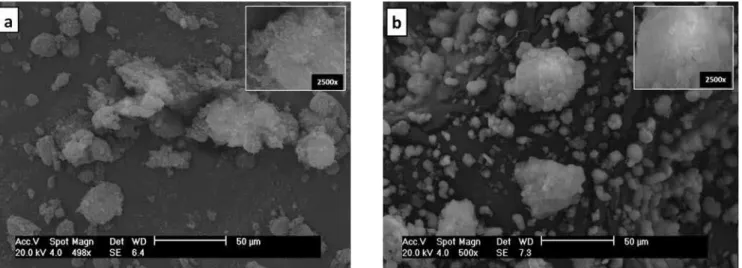
Scanning electron microscopy analysis of calcined and leached rice husk (CACL), Fig. 3a, indicates clusters and through the insert, irregular morphology of the material was observed, as already reported [19]. The SEM image obtained for CACLMCM-41, Fig. 3b, shows clusters with irregular morphology with particles larger than 50 μm. The fi brous
Figure 3: Scanning electron microscopy micrographs of samples (a) CACL and (b) CACLMCM-41.
[Figura 3: Micrografi as obtidas por microscopia eletrônica de varredura das amostras (a) CACL e (b) CACLMCM-41.]
Sample BET area (m2/g)
d100 (nm)
a0 (nm)
Dp (nm)
Wt (nm)
SiMCM-41 1086 4.43 5.11 3.2 1.91 CACLMCM-41 468 4.69 5.41 3.2 2.21 Table I - Comparison between both synthesized materials.
[Tabela I - Comparação entre ambos materiais sintetizados.]
Figure 2: N2 adsorption and desorption isotherms of synthesized materials. Image (a) CACLMCM-41 and (b) SiMCM-41.
[Figura 2: Isotermas de adsorção e dessorção de N2dos materiais sintetizados. Imagem (a) CACLMCM-41 e (b) SiMCM-41.]
250 550
450
350
250
150
50 500
400
300
200
100
0 250
50 200
100
0
0,2 0,2
P/P0
Adsorbed volume (cm
3.g)
Adsorbed volume (cm
3 .g)
P/P0
0,4 0,6 0,8 1,0 0,4 0,6 0,8 1,0
that, possibly, chemical treatment did not totally dissolved silica present in rice husk, indicating that the material did not react in its entirety.
Microscopy of aerosil 200 commercial silica samples (image a) and synthesized sample SiMCM-41 (image b) are shown in Fig. 4. The starting commercial silica (image a) has greater porosity, which facilitates the dissolution of silica and its reaction with the base. Image b shows that the standard synthesized sample SiMCM-41 displays particle with size of 50 m and particles with size of 7 m in larger amounts. Comparing to sample CACLMCM-41, there is a better distribution of less clustered particles, which can be explained by the fact that aerosil 200 commercial silica is more reactive than CACL.
Fig. 5 shows the results of thermogravimetric analysis of CACLMCM 41 and SiMCM-41 samples, respectively. MCM-41 has three mass loss events [21]. From 25 to 134 ºC there is desorption of water physically adsorbed, with mass losses of 5% in both samples. From 134 to 345 °C there is
decomposition of hexagonally arranged surfactant, indicating that the sample SiMCM-41 has mass loss approximately 9% higher than sample CACLMCM-41, meaning that it has a larger amount of template and, consequently, increased formation of mesopores. These results are in agreement with specifi c area and X-ray diffraction analyses. Above 345 °C the mass loss occurs due to condensation of silanol groups present on the network.
CONCLUSIONS
Calcined and leached rice husk may be used for the formation of mesoporous materials. The synthesis provided material similar to the reference sample, showing median values of specifi c area, type-IV isotherms and pore hexagonal system, typical of MCM-41-type mesoporous materials. The scanning electron microscopy images show that the material did not react entirely due to the uncomplete dissolution of the silica present in rice husk. The thermogravimetric analysis
Figure 5: Thermogravimetric curves of synthesized samples (a) CACLMCM-41 and (b) SiMCM-41.
[Figura 5: Curvas termogravimétricas das amostras sintetizadas (a) CACLMCM-41 e (b) SiMCM-41.]
Figure 4: Scanning electron microscopy of samples (a) aerosil 200 commercial silica and (b) standard sample SiMCM-41.
[Figura 4: : Micrografi as obtidas por microscopia eletrônica de varredura das amostras (a) sílica comercial aerosil 200 e (b) amostra padrão SiMCM-41.]
0 0
Temperature (ºC)
Mass loss (%) Mass loss (%)
Temperature (ºC)
200 400 600 800 200 400 600 800
100 100
90 95
75
80 90
70
70 85
65
60 80
show that mass losses are similar to that of the the standard sample, confi rming the possibility of synthesis.
ACKNOWLEDGMENTS
To Capes for the scholarship, to UFRN and URI (Campus-Erechim) for the facilities.
REFERENCES
[1] CONAB - Companhia Nacional de Abastecimento,
Acompanhamento de safra brasileira: grãos, Quarto levantamento, janeiro 2011, Brasília, Conab (2011).
[2] J. James, M. S. Rao, Thermochim. Acta 97 (1986) 329-336.
[3] N. Yalçin, V. Sevinç, Ceram. Int. 27 (2001) 219-224. [4] M. Persegil, M. Souza, W. Magalhães, Adv. Mater. Res.
5 (2002) 467.
[5] C. T. Kresg, M. E. Leonowicz, W. J. Roth, J. C. Vartuli, J. S. Beck, Nature 359 (1992) 710-712.
[6] S. Eftekhari, A. Habibi-Yangjeh, Sh. Sohrabnezhad, J. Hazard. Mater. 178(2010) 349-355.
[7] W. Zhang, J. Wang, P. T. Tanev, T. J. Pinnavaia, J. Chem. Soc. - Chem. Comm. (1996) 979-980.
[8] M. Vallet-Regi, A. Rámila, R. P. del Real, J. Pérez-Pariente. Chem. Mater. 13 (2001).
[9] M. R. Mello, D. Phanon, G. Q. Silveira, P. L. Llewellyn, C. M. Ronconi, Microporous Mesoporous Mater. 143 (2011)
174-179.
[10] J. F. Diaz, K. J. Balkus, J. Mol. Cat. B: Enzymatic 2
(1996) 115-126.
[11] F. Kang, Q. Wang, S. Xiang, Mater. Lett. 59 (2005) 1426-1429.
[12] K. S. Hui, C. Y. H. Chao, J. Hazard. Mater. 137 (2006) 1135-1148.
[13] M. L. P. Silva, Tese Dr., UFRN, Natal, RN (2009). [14] R. M. Braga, D. A. A. Melo, M. A. F. Melo, J. M. F. Barros, G. P. Oliveira, R. G. S. A. Filho, Anais 22o Cong. Ibero-americano Catálise (2010).
[15] M. Halina, S. Ramesh, B. Shahida, A. Y. Mohd, J. Mater. Process. Techn. 186 (2007) 8-13.
[16] E. L. Foletto, R. Hoffmann, R. S. Hoffmann, U. L. Portugal Jr., S. L. Jahn, Quim. Nova, 28, 6 (2005), 1055-1060.
[17] M. T. N. Villalba, Tese Dr., ITQ, Valência, Espanha (1995).
[18] C. Y. Chen, S. Q. Xiao, M. E. Davis, Microporous Mater. 4 (1995) 1-20.
[19] D. I. Petkowicz., R. T. Rigo, C. Ratdke, S. B. C. Pergher, J. H. Z. Santos, Microporous Mesoporous Mater. 116 (2008) 548-554.
[20] A. Bharadwaj, Y. Wang, S. Sridhar, V. S. Arunachalam, Current Sci. 87 (2008) 981-986.
[21] C. Y. Chen, H. X. Li, M. E. Davis, Microporous Mater.
2 (1993) 17-26.