ANNALS OF THE UNIVERSITY OF ORADEA FASCICLE OF TEXTILES, LEATHERWORK
31
IMPLEMENTATION OF MODERN EDUCATIONAL TECHNOLOGIES
IN DEVELOPING THE PERSONALITY OF FUTURE ENGINEERS
FASHION DESIGNERS
DANILA Victoria
11
Technical University of Moldova (UTM) 168, Stefan cel Mare Blvd., MD-2004, Chisinau, Republic of Moldova
Corresponding author: Danila, Victoria, E-mail: [email protected]
Abstract: Applying the model of implementation process of modern educational technologies in higher education involved in technical implementation of educational technology in the educational activity based on critical thinking development strategies, future engineers’ personality development of students. Through educational technologies correlation occurs between educators and educated, which places them in a position promoter of educational paradigms. At present, the efficiency of the educational process depends largely on the use of modern technologies.
To determine the student's level of development through the integration of modern educational technologies is necessary to reveal aspects of operating in the thinking of students, which is their way of analysis of reality, to compare, to generalize certain concepts or processes.
Methodological peculiarities of modern educational technology based on application of interactive engagement between the two actors in the process of training / preparation and which involved the use of interactive teaching methods adapted to technical higher education. These groups have benefited greatly from the introduction in teaching and learning of modern educational strategies. The intervention was the catalyst that accelerated skills training. Qualitative aspects allow us to generalize the results of experiments performed. A student lays views representing a structure, a generalization, reasoning that arises from their previous experience.
Key words: modern educational technology, design engineer, personality, humanization.
1.
INTRODUCTION
Research on intellectual development engineers denotes the fact that the true burden of teachers is to guide the student toward tomorrow. It is significant need for connection of science education in modern educational technologies humanistic role very significant to design an operational perspective humanist pedagogy.
The educational process contributes significantly to the training of young specialists, engineers not only educational technologies applied and the master teacher to motivate students to learn, to engage in the act of learning, boosting independent learning and personal evaluation.
32
2. GENERAL INFORMATION
2.1 Concept - modern educational technologies
In Romanian term technology [1] is assigned acceptance of science methods and means of the processing of materials, assembly processes, methods, operations employed in order to obtain a product.
Any educational technology is:
• Dependent system of training and education purposes and psychological structure; • Set of activities undertaken to achieve these goals;
• Psychological characteristics of teachers who realize these goals, using selected activities;
• Psychological characteristics of recipients; • Means used to achieve these goals;
• Training and education principles, those serve as the basis for the formulation of goals.
Educational technology [2, 3] can be classified pedagogical objectives that were at the basis of their achievement:
• Technology training; • Technology education; • Development technologies; • Technology assessment; • Diagnostic technologies.
In developing modern educational technologies are taken into account the following development trends of contemporary educational process:
A. Democratization training process.
Very often students, who do not participate in the planning of training, fail to recognize the importance and necessity of studying the proposed material, they are not sufficiently motivated for learning and studying at a level that does not match their capabilities. Developing students' motivation for learning is achieved by transmission of those functions that they can perform:
• Independent study of topics; • Self-assessment;
• Creating presentations, projects and portfolios. B. Humanization pedagogical process.
The term "humanization of pedagogical process" shall mean use of educational technologies; they employ teachers and students in some relationships, developing personality characteristics that determine:
• Working with others; • Positivist conception of ego; • Personal responsibility.
C. The development of social competence of students.
The training should form the trained knowledge, skills and abilities of interaction with others. Educational aspect must meet certain requirements: to liaise with life and reality; have varied in nature; provide the reasonableness of forms of work, holistic approach to student personality, rational and judicious distribution volume of educational [4, p. 12].
Training and personal development engineer requires direct involvement of students considering their needs and interests, the objectives of development of lifelong learning, self-education, independent learning. This requires a new form of design self-education, modern educational systems.
2.2. Implementation of modern educational technologies
In research-conducted observation, we aim to influence modern educational technologies used by the teacher in the classroom as well as laboratory. The aim of the research is to present the influence of modern educational methods on personality development of future design engineers. This will enable us argumentation idea that is supported by more research, renowned teachers as student achievement and success is the teacher, and intellectual development of one is closely related to the development of the other.
ANNALS OF THE UNIVERSITY OF ORADEA FASCICLE OF TEXTILES, LEATHERWORK
33
In the pedagogical experiment involving a total of 116 students, the form of education, the daily low frequency of Light Industry Faculty, Technical University of Moldova, specialties Textiles and Leather Products Engineering (IPTP), Engineering and Management in Industry Lightweight (IMIU) and Fashion Design Industrial (DVI).
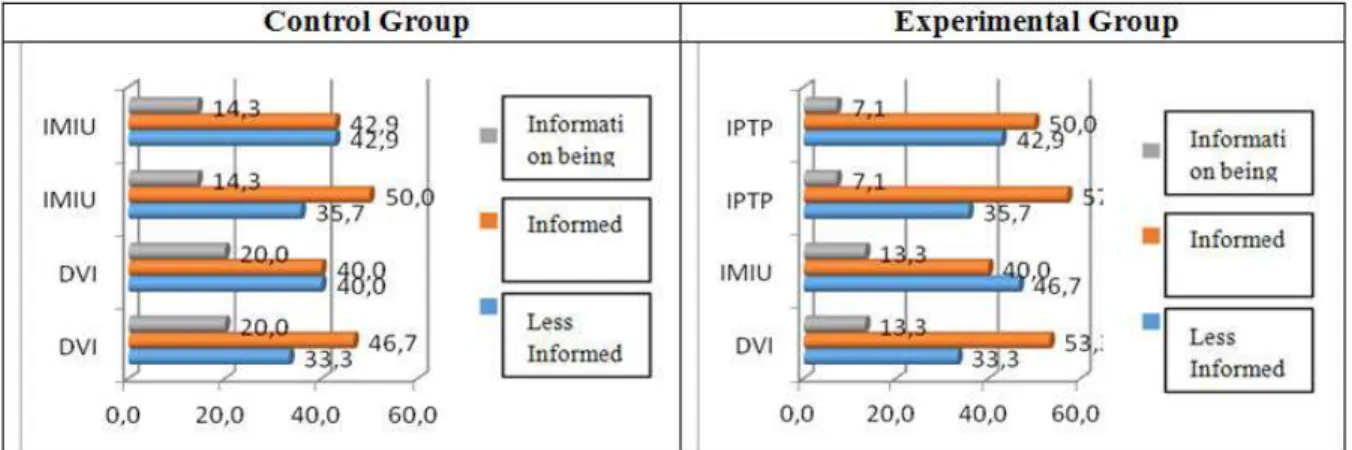
1. Experiment findings include evidence that determine students' knowledge and skills regarding notions about anthropometry, costume, product, form and others related to the design clothing. In developing the theme of finding evidence for the experiment took into account the particularities of preparation, the availability and content of information presented. Topics for students as part of their sphere of concern belong to their value system and adapted to their level of knowledge. In the experiment of finding knowledge, students have been established at the time of their inclusion in the process of experimentation. Students were assessed according to three criteria previously established which shall be informed, less informed and current information. It took into account the fact that the questionnaire contains 32 items open type to fit into the category of informed must earn 25-32 points, 15-24 points category less informed and current information category 8-14 points.
After the questionnaire in control and experimental groups were obtained following data shown in the graphs below.
Fig. 1: Interpretation of research results at the stage of finding
From the results presented, we find that in control groups, informed students are on average 29% and experimental groups as 39.7% less informed media students in the control group was 44.9%, while the experimental group 50%, and student information under the control group average is 17.1% and the average experimental group is 10.2%.
We conclude the following: students of both groups are informed about the basics of the discipline of study, but in addition there are also those who are in the process of information. This will allow us to address issues of learning / teaching from different perspectives, which will allow us to apply objective methods of instruction.
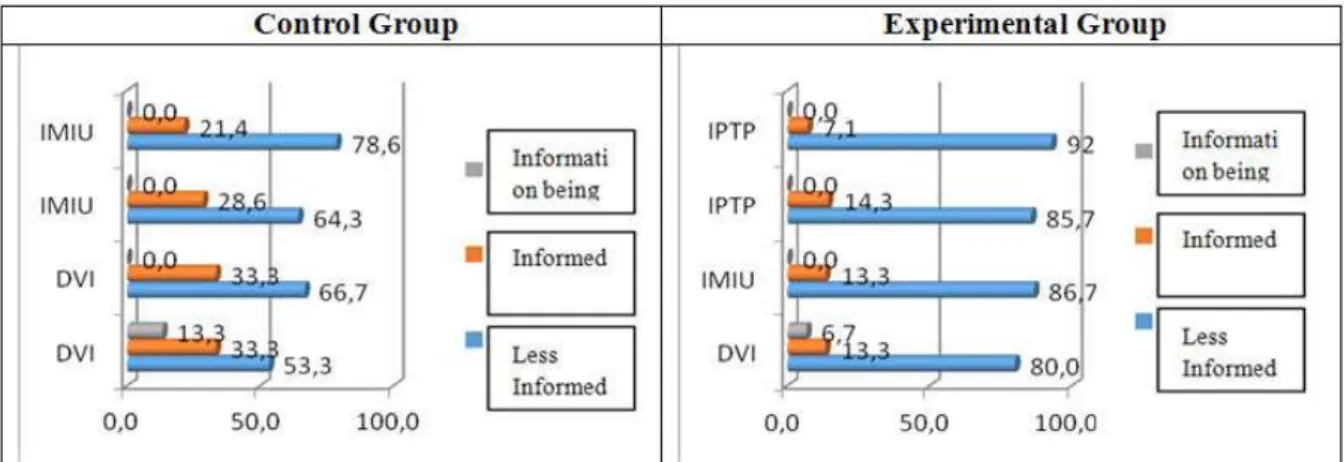
2. When applying the final questionnaire includes 39 items and open type that have established the following criteria: informed 30-39 points 20-29 points less informed and course information in 20 points, it was found that control groups and experimental groups were established positive, although there were also students who were classified as current information criterion. However, this may be argued by the lack of responsibility or not shown at all times discipline for health reasons or personal reasons.
From the results we conclude that the graphs presented below average students informed control groups are 65.7% and 86.3% in the experimental groups, fewer students in control groups informed media is 26.4% and experimental groups of 12%, students in course information media control groups is 3.3% and 1.7% experimental groups.
These results allow us to argue that the application of modern educational technologies have had a significant contribution to the training of young specialists as professionals with personality.
34
reproduce material, develop imaginative and creative ability, spirit observation, creative learning and humanistic personality. There is a cooperation and mutual respect between teacher and student through the humanistic approach. This shows that the involvement and mutual help lead to the development and fruitful cooperation between the two subjects, two partners of education.
Fig. 2: Results of the final questionnaire
CONCLUSIONS
Interpretation of results at the stage of finding allowed us to highlight that in formulating ideas to students more prevalent operation analysis and generalization operation. During structuring activities, the teacher must give further explanation comes in student aid. The interaction between student / teacher becomes an obvious source of learning, a way of cooperation. At the same time, the teacher becomes an observer and facilitator in the work. This actually enhances mutual aid and beneficial interaction between the student and the teacher.
The objective of the training experiment consists predominantly logical cognitive skills training, representation, power to expose, interpret, explain, argue some notions, opinions, ability to actively interact with peers, to make certain judgments, the structure some ideas. Training strategies were organized as follows. On the one hand were designed learning situations from simple to complex. On the other hand, the organization of specific sequences of instruction, students were ranked to present some simulation topics.
To justify the situation on the research results we conclude the following fact: experimental group situation actually worked in the experiment and training has changed, namely, if we consider the degree of intervention on them.
REFERENCES
[1] Sorin Cristea. Dictionar de pedagogie, Editura Litera, 2000, 400 p.
[2] Singer, M., Sarivan, L. (coord.), Quo vadis, Academia. Repere pentru o reformă de profunzime în învăţământul superior (Temă de cercetare ISE). Bucureşti: Editura Sigma, 2006.
[3] Young, M., Knowledge, learning and the curriculum of the future. British Educational Research Journal. 1999, 25, 4, p. 463–477.
[4] Vinnicenco, E. Integrarea tehnologiilor educaţionale moderne în învăţământul primar – o condiţie de dezvoltare şi formare a personalităţii elevului. Specialitatea 13.00.01 – Pedagogie generală, Autoreferat al terzei de doctor în pedagogie, Chişinău, 2012, Disponibil pe http://www.cnaa.md/files/theses/2012/22109/Elena_Vinnicenco_Abstract.pdf, accesat la 15.08.2013
[5] Cerghit, Ioan. Metode de învăţământ. / Ioan Cerghit. – Iaşi: Polirom, 2006. -315 p.
[6] Cojocaru, Venera Mihaela. Teoria şi metodologia instruirii. / Venera Mihaela Cojocaru. - Bucureşti: Ed. Didacticăşi Pedagogică, 2008. - 168 p.