ABSTRACT:Objectives: This study aimed to describe “pulmonary sepsis” reported as a cause of death, measure its association to pneumonia, and the signiicance of the coding rules in mortality statistics, including the diagnosis of pneumonia on death certiicates (DC) with the mention of pulmonary sepsis in Rio de Janeiro, Brazil, in 2011. Methods: DC with mention of pulmonary sepsis was identiied, regardless of the underlying cause of death. Medical records related to the certiicates with reference to “pulmonary sepsis” were reviewed and physicians were interviewed to measure the association between pulmonary sepsis and pneumonia. A simulation was performed in the mortality data by inserting the International Classiication of Diseases (ICD-10) code for pneumonia in the certiicates with pulmonary sepsis. Results: “Pulmonary sepsis” constituted 30.9% of reported sepsis and pneumonia was not reported in 51.3% of these DC. Pneumonia was registered in 82.8% of the sample of the medical records. Among physicians interviewed, 93.3% declared pneumonia as the most common cause of “pulmonary sepsis.” The simulation of the coding process resulted in a diferent underlying cause of death for 7.8% of the deaths with sepsis reported and 2.4% of all deaths, regardless the original cause. Conclusion: The conclusion is that “pulmonary sepsis” is frequently associated to pneumonia and that the addition of the ICD-10 code for pneumonia in DC could afect the mortality statistics, highlighting the need to improve mortality coding rules.
Keywords: Information systems. ICD. Death certiicates. Mortality registries. Underlying cause of death. Sepsis.
Coding pulmonary sepsis and mortality
statistics in Rio de Janeiro, RJ
Codiicação da sepse pulmonar e o peril de mortalidade no Rio de Janeiro, RJ
Bruno Baptista CardosoI, Pauline Lorena KaleII ORIGINAL ARTICLE / ARTIGO ORIGINAL
IMunicipal Health Secretariat of Rio de Janeiro, Technical Management of Vital Data – Rio de Janeiro (RJ), Brazil. IIUniversidade Federal do Rio de Janeiro, Institute of Public Health Studies – Rio de Janeiro (RJ), Brazil.
Corresponding author: Bruno Cardoso. Secretaria Municipal de Saúde do Rio de Janeiro. Gerência Técnica de Dados Vitais. Rua Voluntários da Pátria, 402/701, Botafogo, CEP: 22270-010, Rio de Janeiro, RJ, Brasil. E-mail: [email protected]
Conlict of interests: nothing to declare – Financial support: Private funding by the authors; DMTZ partially funded by Conselho
Nacional de Desenvolvimento Cientíico e Tecnológico (CNPq), protocol no. 71.702/2011-0.
Article based on Master’s Thesis “The Codiication of Pulmonary Septicemia in Death Certiicates of the Municipality of Rio de Janeiro
RESUMO:Objetivo: Descrever os óbitos com menção de sepse pulmonar, medir a associação entre sepse pulmonar e pneumonia, assim como avaliar o impacto da regra de codiicação no peril de mortalidade, com a inclusão simulada do diagnóstico de pneumonia, nas declarações de óbito (DO) com menção de sepse pulmonar, no Rio de Janeiro, em 2011. Métodos: Foram identiicados os óbitos com menção de sepse pulmonar independentemente da causa básica. Aos médicos atestantes, aplicou-se questionário medindo a associação entre sepse pulmonar e pneumonia. O registro de pneumonia nos prontuários dos óbitos com menção de sepse pulmonar e sem menção de pneumonia na DO foi investigado. Foi descrito o peril de mortalidade após a inclusão simulada do código de pneumonia nas declarações com sepse pulmonar. Resultados: Sepse pulmonar correspondeu a 30,9% das menções de sepse e a menção de pneumonia estava ausente em 51,3% dessas declarações. Pneumonia constava em 82,8% da amostra de prontuários investigados. Dos médicos entrevistados, 93,3% relataram pneumonia como a mais frequente causa de sepse pulmonar. A simulação revelou que a inclusão da pneumonia alterou a causa básica de 7,8% dos óbitos com menção de sepse e 2,4% de todos os óbitos, independentemente da causa original. Conclusão:
Sepse pulmonar está associada à pneumonia e a simples inclusão do código de pneumonia nas declarações de óbito com menção de sepse pulmonar impactaria o peril de mortalidade, apontando necessidade de aprimoramento das regras de codiicação na Classiicação Internacional de Doenças (CID-10).
Palavras-chave: Sistemas de informação. CID. Declaração de óbito. Registros de mortalidade. Causa básica de morte. Sepse.
INTRODUCTION
The longevity arising from demographic and epidemiological transitions favors the coex-istence of diferent disease processes and a greater complexity of the mechanisms involved in death. Consequently, a greater number of diagnoses is recorded on the death certiicate (DC), making it diicult to determine the underlying cause of death (UC)1. The increase in
the declaration of sepsis as the UC occurs, in part, due to this process.
The proportional mortality rate for infectious and parasitic diseases (IPD) in Brazil corresponded, in 1979, to 10.3% of total deaths. In 30 years, it was signiicantly reduced, accounting for 4.3% of deaths in 2010. Sepsis, however, shows a diferent behavior. Between 1996 and 2010, there was an increase of 19.1% in the absolute number of deaths with sepsis declared as the UC. In Rio de Janeiro, in 2010, sepsis appeared as the most frequent
UC of deaths by IPD with 41.6%2,3. Particularly in the most developed region with the
oldest population in the municipality — Planning Area 2.1 (PA 2.1)4,5 —, the proportional
mortality by IPD has been slightly but systematically higher than that of the municipal-ity. In 2010, in PA 2.1, sepsis accounted for 58.7% of the causes of deaths by IPD. If we consider the age group of 80 years or more, sepsis was responsible for 86.0% of deaths by IPD and 4.2% of all deaths3.
Problems (ICD-10), these terms, when cited in DCs, must be encoded with categories A40 — “streptococcal septicemia” or A41 — “other septicemia.” There is no location-spe-ciic coding, with the exception of urinary sepsis. Possible spelocation-spe-ciications in other cases are related to the infectious agent. The terms “pulmonary sepsis” or “pulmonary septic shock” are characterized by their high frequency, although there is no formal deinition or speciic codes for them in ICD-10.
Pneumonia is the diagnosis most commonly associated with pulmonary sepsis, as with sepsis in general. In the city of Rio de Janeiro, in 2010, pneumonia was cited in 40.5% of the DCs that mentioned sepsis, regardless of other reported causes, and was the UC in 16.5% of these deaths3. The association between pneumonia and sepsis generally reinforces
the idea that the term “pulmonary sepsis” refers to a sepsis originating from a pulmonary infection — as seems obvious — and which is usually used as routine in clinical practice6-8.
Thus, when the term “pulmonary sepsis” is cited as in a DC, but is not related to its previ-ous infectiprevi-ous cause, the mere adoption of the A40 and A41 coding categories could mean loss of information as to the origin of the infection. In these cases, the declared adjective “pulmonary” is not useful for the qualiication of sepsis and of the UC. The coding rule used by the Mortality Information System (SIM) conditions the loss of information to the origin of sepsis, contained implicitly in the DC.
This study aimed to describe the deaths with pulmonary sepsis declared among the causes of death, to measure the association between pulmonary sepsis and pneumonia, and to assess the impact of the coding rules of ICD-10 on the UC, through the inclusion of the diagnosis of pneumonia in DCs citing pulmonary sepsis in PA 2.1 of the municipality of Rio de Janeiro in 2011.
METHODS
This is a descriptive study based on secondary data from the SIM, hospital records, and primary data obtained by questionnaires given to the doctors that reported the DCs. The database and images of the DCs were provided by the Municipal Health Secretariat of Rio de Janeiro.
The city of Rio de Janeiro consists of ten PAs. The population of PA 2.1 is the one with the highest proportion of elderly, 23.1%. With 10.1% of the local population, in PA
2.1 is 22.0% of the population aged 80 or more4. It is a region with good development
indicators, and 8 of its districts are among the 10 with the highest Human Development
Index (HDI)5. The study population is composed of non-stillbirth deaths registered in
PA 2.1 in 2011.
selected were analyzed according to age, sex, race/color, education, place of residence, and UC. In the second stage, each DC selected was reviewed to identify the terms to which the above codes are assigned. Terms selected were those related to pulmonary sepsis, considering the variations “sepsis,” “septicemia,” “septic shock,” “bloodstream infection,” “generalized infection,” and “systemic inflammatory response syndrome,” which were accompanied by the terms “pulmonary,” “lung,” “with a pulmonary focus,” “of pulmonary origin,” or “respiratory.” The presence of pneumonia mention and doc-tors who used the term pulmonary sepsis or its variations was also identified. The third stage consisted of consulting the records of hospitalizations that resulted in the hospital deaths selected in the second stage, in whose DCs there was no mention of pneumonia. The presence of the reporting of pneumonia was investigated. No clinical or radio-graphic criteria were considered. Length of stay, admission diagnosis, date of the first and last reports of pneumonia and sepsis, the mention of pulmonary sepsis, and the use of mechanical ventilation and its duration were also recorded. The application of
Figure 1. Stages of the investigation of deaths with mention of pulmonary sepsis. Deaths in 2011
Pulmonary sepsis
Coding simulation in the DCS of PA 2.1 residents DC without
mention of sepsis DC with mention of sepsis
Other septicemia
DC without
pneumonia pneumoniaDC with
Without pneumonia With pneumonia Investigation
of records
Questionnaire
Identiication of doctors
Stage 1
Stage 2
Stage 3
Stage 4
a questionnaire to the reporting doctors in the DCs that mentioned pulmonary sepsis was the fourth stage of the study. The questionnaire contained questions about the year of graduation — for the calculation of time of professional practice — and the medical specialty, with the main question being: “When you use the term ‘pulmonary sepsis’ in a Death Certificate, what is the frequency of pneumonia as the precedent infection?,” which had five possible answers ranging from 0 to 100%, categorized into five ranges of 20 points. The fifth step was the simulation of the coding of the term “pulmonary sepsis,” with the adoption of code A41.9 (unspecified septicemia) associated with the code J18.9 (unspecified pneumonia) and subsequent selection of new UCs for the deaths of the PA 2.1 residents in 2011. The code J18.9 was inserted in the same line of Block V, to the right of the code related to pulmonary sepsis. The proportional mortality due to the underlying cause, before and after, the simulation was compared to measure the impact of the new encoding. The McNemar test was conducted to investigate the dif-ference between the proportion of deaths due to the underlying cause, according to the chapters of ICD, before and after the simulation.
This study was approved by Institutional Review Board of the Institute of Public Health Studies, UFRJ, case number 206.498 of 02/06/2013. There is no conlict of interest from the authors (CAAE: 07904012.0.0000.5286).
RESULTS
In 2011, there were 7,530 non-stillbirth deaths in PA 2.1. The coding categories A40 (strep-tococcal septicemia), A41 (other septicemia), and sepsis-related codes from category T79 (some early complications of trauma) and the interval from T80 to T88 (complications of surgical and medical care, NCOP) were assigned to 2,292 DCs (30.4%). In 2,181 DCs (95.1%), the code used was A41.9 (unspeciied septicemia). Six DCs were excluded from the study because of error in assigning the codes cited to terms diferent from sepsis.
Total deaths and deaths with mention of sepsis in the DC were more frequent in the age groups with elderly people, occurring in 58.9 and 68.4% of cases in people aged 70 or more, and only in 15.3 and 9.7%, respectively, in the age group under 50 years. Regarding the variables place of residence, sex, race/color, and education, no important diferences were observed between the two groups. As for proportional mortality from the UC according to the chapters of ICD, the diferences are obvious. The respiratory diseases (RD) were the most frequent among deaths with mention of sepsis (22.0%), followed by deaths by cancer (19.9%), cardiovascular diseases (14.2%), and IPD (14.0%). In total deaths, these frequencies were 11.7% (RD), 22.2% (cancer), 26.6% (cardiovascular), and 5.9% (IPD), respectively.
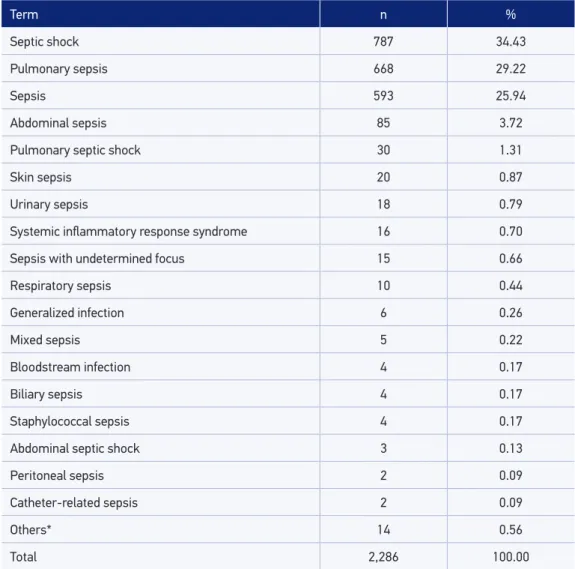
“unknown,” and “unspeciied,” 32 categories were considered (Table 1). In cases where there were terms that qualiied location, the etiologic agent, or diferent clinical classiica-tion, there was no aggregation. The most common terms were “septic shock” (34.4%) and “pulmonary sepsis” (29.2%) (Table 1).
A total of 708 deaths (30.9%) were considered as mention of pulmonary sepsis, classiied in the “pulmonary sepsis,” “pulmonary septic shock,” and “respiratory sepsis” categories (Table 1). In this group, more than half (57.2%) occurred in the age group of 80 years or more, and only 3.9% in the group under 50 years. About 78% of deaths were in the range
Term n %
Septic shock 787 34.43
Pulmonary sepsis 668 29.22
Sepsis 593 25.94
Abdominal sepsis 85 3.72
Pulmonary septic shock 30 1.31
Skin sepsis 20 0.87
Urinary sepsis 18 0.79
Systemic inlammatory response syndrome 16 0.70
Sepsis with undetermined focus 15 0.66
Respiratory sepsis 10 0.44
Generalized infection 6 0.26
Mixed sepsis 5 0.22
Bloodstream infection 4 0.17
Biliary sepsis 4 0.17
Staphylococcal sepsis 4 0.17
Abdominal septic shock 3 0.13
Peritoneal sepsis 2 0.09
Catheter-related sepsis 2 0.09
Others* 14 0.56
Total 2,286 100.00
of 70 or more. The DCs with mention of pulmonary sepsis were reported by 354 physi-cians (1–16 DCs per doctor). Only eight deaths occurred outside health facilities, and the rest were spread over 30 hospitals. The report of pneumonia was found in 345 DCs (48.7%).
The groups with and without mention of pneumonia in the DC difered sharply regarding the UC according to the chapters of the ICD. In the group with mention of pulmonary sepsis and mention of pneumonia, RDs predominated (50.1%), following the pattern of deaths from sepsis in general and pulmonary sepsis. In this group, the per-centage of IPDs was very low (1.4%). In the group with mention of pulmonary sepsis, but without mention of pneumonia, the IPDs predominated (35.8%) and the percentage of RDs was small (6.9%) (Figure 2). The most frequent ICD categories reported as UC were “other septicemia” (A41), with 122 deaths (33.6%) in the group without mention of pneumonia, and “pneumonia, unspeciied” ( J18), with 129 deaths (36.5 %) in the group with the mention of pneumonia.
In the third stage, the analysis of 186 medical records of deaths with mention of pulmo-nary sepsis and without mention of pneumonia (51.5% of selected deaths) of 16 hospitals (57.1% of hospitals with the occurrence of selected deaths) was conducted. The frequency of medical records analyzed was due to the authorization and timely provision by hospi-tals for the study.
Among the medical records evaluated, there was a higher frequency of low education, especially in the category of 1 – 3 years of study (20.4%) compared to the total number of selected deaths (16.1%). There were no important diferences in the characteristics of age, sex, race/color and UC, and the IPDs, cancers and cardiovascular diseases accounted for
0.0 10.0 20.0 30.0 40.0 50.0 60.0
With Pneumonia
Without Pneumonia 6.9 24.8 35.8 13.5 2.5 6.1 4.1 1.1 1.6 2.2
50.1 13.3 1.4 14.8 8.7 1.7 2.0 3.5 2.0 0.9
X II I IX VI IV XIV V XX XI
about 75% of deaths. In only 32 (17.2%) of the 186 records analyzed, there was no record of pneumonia during hospitalization, and in 45 records (24.2%), pneumonia was reported as a reason for hospitalization.
The median age of death in the analyzed medical records was 79 years (ranging from 12 to 99 years), and the age distribution of deaths with and without pneumonia was simi-lar. Females prevailed both in the total (54.8%) and in the group of records with report of pneumonia (57.1%), whereas in the group without the report of pneumonia, males were most frequent (56.3%).
The median hospitalization time was 16 days (ranging from 1 to 606 days), with no important diferences between deaths with and without report of pneumonia. The record of sepsis diagnosis was present in 137 (73.9%) of the 186 records. The use of mechani-cal ventilation was reported in 144 records (77.4%) and the time of use ranged from 1 to 64 days, with an average of 7.5, eight in the group with pneumonia and two in the group without pneumonia.
A total of 354 doctors who issued the 708 DCs with mention of pulmonary sepsis were identiied, and 75 (21.2%) of those responded to the questionnaire. The 708 DCs came from 30 health units. The respondent doctors issued 129 (18.2%) of these DCs from 24 units (80.0%). The time of professional exercise varied widely between 2 and 38 years. Doctors who graduated between 2001 and 2010 formed the largest group, with 51 professionals (68.0%). Twenty-four specialties were reported, predominantly general practitioners (28%). As for the relationship between pulmonary sepsis and pneumonia, 82.7% reported the option of “81 – 100%,” 10.7% reported “61 – 80%,” and 4.0% reported “41 – 60%.” The options “21 – 40%” and “0 – 20%” had only one response.
In the fifth stage, the DCs of PA 2.1 residents, recorded in Rio de Janeiro, in 2011, which contained the mention of pulmonary sepsis were recoded, adding the code J18.9. After the new encoding, the reselection and evaluation of the new causes was performed. Of the total 5,651 DCs, there was a change of the UC in 138 cases (2.4% of all deaths and 7.8% of all deaths with mention of sepsis). In 119 cases (86.3%), the new UC was classified in a different ICD chapter than the original cause. There were 13 changes of the cause to other categories within the same chapter and to other codes in the same category, there were six cases. The chapters of ICD-10 in which there was the greatest number of changes were Chapters I and X. In Chapter I (IPD), there was a reduction of 102 deaths, 30.3% of the deaths in the chapter. In Chapter X (RD), there was an increase of 11.7% — 98 deaths (Figure 3). There was a change in the total deaths in nine chapters of ICD-10, of which six chapters (I, IV, VI, IX, X, and XIV) showed a statistically significant difference between the proportion of deaths before and after the simulation (p < 0.05).
of the code for pneumonia in the DC brings a stronger impact. Deaths from IPD, previously the ifth most common chapter (5.7%), moved to the ninth position (3.1%) (Figure 4). In this group, 130 deaths had sepsis as the declared UC and, of these, 74 (56.9%) had mention of pulmonary sepsis. The proportion of deaths before and after the simulation in the age group of 80 years or more showed statistically signiicant diferences for the same chapters of the ICD than total deaths.
-150 -100 50 0 50 100 150
II IV V VI IX X XIV XX
-102
-7 -6 -2
2.47 2.59
0.15 30.27
6 3.03 3
2 8 0.55 11.75
98
3.00 0.61
% N
Note: I. Some infectious and parasitic diseases; II. Cancers; IV. Nutritional and metabolic endocrine disorders; V. Mental and behavioral disorders; VI. Nervous system disorders; IX. Cardiovascular diseases; X. Respiratory diseases; XI. Digestive diseases; XIV. Diseases of the genitourinary system; XX. External causes of morbidity and mortality. Figure 3. Total and proportion of basic causes modiied with the introduction of the code J18.9 (unspeciied pneumonia) by ICD chapter, Planning Area 2.1, Rio de Janeiro, RJ, Brazil, in 2011.
Before 27.7 16.6 18.7 5.7 4.6 4.7 3.9 6.4 3.1 4.4
Ater 28.0 16.7 21.2 3.1 4.5 4.4 3.9 6.5 3.1 4.2
IX II X I XX IV XI VI XVIII XIV
0 5 10 15 20 25 30
DISCUSSION
The analysis of DCs revealed a concentration of deaths with mention of sepsis in older age groups. This characteristic is even more striking when the DCs with mention of pul-monary sepsis are assessed. Of these, 57.2% were aged 80 years or more. Chapter X (RD) is the most frequent among deaths with mention of sepsis and pulmonary sepsis. The data reinforce the relevance of the study on sepsis and RDs in the process of sickness and death, especially in the elderly population, as pointed out by Lima-Costa, Peixoto, and Giatti (2004)9.
We identiied 32 diferent groups of terms for which the sepsis-related codes were assigned. However, this diversity is not expressed in the SIM database, as they receive the same code. The A41 category (other septicemia) was used in 95% of cases. The use of a single category of ICD for such a wide variety of terminology might mean loss of rele-vant information for the more accurate identiication of the UC.
DCs with mention of pulmonary sepsis, classified in groups with and without men-tion of pneumonia, were very similar regarding the demographic and educamen-tional characteristics. The two groups differed on the UC. In the group without mention of pneumonia, “other septicemia” (A41) was the most frequent UC, with 33.6% of deaths. In the group with mention of pneumonia, “other septicemia” (A41) cannot be the UC, as the “Rules and guidelines for mortality and morbidity coding” of ICD-10 establish that sepsis should be considered a direct result of pneumonia, and the latter, when present in the DC, should be selected as the UC according to the Selection Rule
3 (SR3)10. This huge variation, therefore, cannot be due to a real difference between
UCs, as there is the mention of “pulmonary” sepsis in both groups. The death certi-fication process, which inevitably have a subjective component, as well as the coding and UC selection rules of ICD-10 may have contributed to the magnitude of the dif-ference. Laurenti et al. (2009)11 point out the effectiveness of the selection rules when
the UC is present in the DC, but there are few studies that assess other implications of the UC selection rules.
The results in this study that support the hypothesis of association between pulmonary sepsis and pneumonia were the high frequency of diagnosis of pneumonia (82.8%) in the records evaluated and the responses of doctors on the frequency of pneumonia preceding pulmonary sepsis. The low response rate (21.2% of doctors), the type of question that did not allow reference to other possible precedent for sepsis, diferent from pneumonia, and not including the control group (DCs with report of pneumonia) in the investigation of the records are, however, limitations to this study. It should be noted that the decision to consider only the explicit reports of pneumonia, not clinical criteria, decreased sensitiv-ity and increased the speciicsensitiv-ity of the inclusion criteria.
preceding infection. The change in the UC declared as sepsis was expected due to what was exposed on the SR3 and is consistent with indings from other studies that investi-gated medical records12-13.
The analysis of the mortality data of the PA 2.1 population, with the assumption that pneumonia is the preceding infection to pulmonary sepsis, showed that the coding sim-ulation modifies the total deaths in nine chapters of the ICD. Chapter X (RD) receives the highest number of deaths with modified causes; however, because it already has a high percentage of deaths, it remains the third most common chapter. Pneumonias are
overestimated as the UC, being an incomplete diagnosis14 in some cases, and it is certain
that the simulation conducted further adds to the number of deaths due to pneumonia as the UC. In some cases, they are probably intermediate causes, which could not be
considered an important gain. Some authors12, however, do not consider pneumonia
as an incomplete diagnosis for children under 1 year and adults over 60 years of age. There is, however, undeniable gain. Of the total deaths in the PA 2.1 population with sepsis as the UC (194), 52.6% were due to pulmonary sepsis. Of these, 24.5% migrated to well-defined causes from Chapters V, VI, IX, XX, and categories other than pneu-monia from Chapter X. What determines the quality gain on the UC in the simulation proposed is, in large part, the application of the SR3. Sepsis is considered by the SR3 a direct result of pneumonia, but is not considered a direct result of other conditions such as cerebrovascular disease or dementia, as pneumonia is. If we consider the fre-quency of association between unspecified sepsis and pneumonia, be it on SIM or on what the data on the literature point out to15-16, perhaps the relationship of these
diag-noses, among themselves and with others, with respect to SR3, deserve be discussed as
suggested in the “Annual Meeting of the WHO-FIC Network”, in 200917.
The impact of the coding simulation for pulmonary sepsis is higher in the population aged 80 years or more. In this group, the deaths with UCs in Chapter I have signiicantly decreased, losing more than 45% of the total. The great contribution to Chapter I, of all deaths with the UC declared as sepsis, may induce a distortion of the real magnitude of mortality from IPD, since sepsis should not be the UC.
CONCLUSION
1. Mello Jorge MH, Laurenti R; Lima-Costa MF; Gotlieb SL; Chiavegatto Filho AD. A mortalidade de idosos no Brasil: a questão das causas mal deinidas. Epidemiol Serv Saúde 2008; 17(4): 271-81. DOI: 10.5123/ S1679-49742008000400004.
2. Ministério da Saúde. Departamento de Informática do SUS – DATASUS [homepage na internet]. Sistema de Informações de Mortalidade. Brasília, 1995 [acesso em 17 abr 2012]. Disponível em: http://tabnet.datasus. gov.br/cgi/tabcgi.exe?sim/cnv/obt09br.def.
3. Ministério da Saúde. Departamento de Informática do SUS – DATASUS [homepage na internet]. Sistema de Informações sobre Mortalidade. Brasília, 2010 [acesso em 26 jan 2013]. Disponível em: http://tabnet.datasus. gov.br/cgi/deftohtm.exe?sim/cnv/obt10br.def.
4. Instituto Municipal de Urbanismo Pereira Passos [homepage na internet]. Armazém de dados. Estatísticas, População, Censo 2010. Rio de Janeiro, 2010 [acesso em 19 abr 2012]. Disponível em: http:// www.armazemdedados.rio.rj.gov.br.
5. Instituto Municipal de Urbanismo Pereira Passos [homepage na internet]. Armazém de dados. Estatísticas, Indicadores, Desenvolvimento social 2004. Rio de Janeiro 2010 [acesso em 19 abr 2012]. Disponível em: http:// www.armazemdedados.rio.rj.gov.br.
6. Sevransky JE, Martin GS, Mendez-Tellez P, Shanholtz C, Brower R, Pronovost PJ, et al. Pulmonary vs nonpulmonary sepsis and mortality in acute lung injury. Chest 2008; 134(3): 534-8. DOI: 10.1378/chest.08-0309.
7. Bouch C, Williams G. Recently published papers: pulmonary care, pandemics, and eugenics in surviving sepsis? Crit Care 2006; 10(1): 116. DOI: 10.1186/cc4820.
8. Davis KA, Santaniello JM, He LK, Muthu K, Sen S, Jones SB, et al. Burn injury and pulmonary sepsis: development of a clinically relevant model. J Trauma 2004; 56(2): 272-8.
9. Lima-Costa MF, Peixoto SV, Giatti L. Tendências da mortalidade entre idosos brasileiros (1980 – 2000). Epidemiol Serv Saúde 2004; 13(4): 217-28.
10. Organização Mundial da Saúde. Classif icação Estatística Internacional de Doenças e Problemas Relacionados à Saúde – 10ª Revisão. São Paulo: CBCD/EDUSP; 1995.
11. Laurenti R, Mello Jorge MH, Gotlieb SL. Informação em mortalidade: o uso das regras internacionais para a seleção da causa básica. Rev Bras Epidemiol 2009; 12(2): 195-203.
12. Mello Jorge MH, Gotlieb SL, Laurenti R. O sistema de informações sobre mortalidade: problemas e propostas para o seu enfrentamento I – Mortes por causas naturais. Rev Bras Epidemiol 2002; 5(2): 197-211.
13. Oliveira e Cruz DM. Mortalidade por septicemias e pneumonias em Niterói, ERJ: revisão de dados clínicos para aprimoramento da causa de morte. Rio de Janeiro. Dissertação [Mestrado em Saúde Coletiva] – Instituto de Estudos em Saúde Coletiva, UFRJ, 2012.
14. Laurenti R. Doenças Respiratórias como causa de morte no município de São Paulo, SP (Brasil). Rev Saúde Pública 1981; 15(4): 353-63.
15. Zanon F, Caovilla JJ, Michel RS, Cabeda EV, Ceretta DF, Luckemeyer GD, et al. Sepse na Unidade de Terapia Intensiva: etiologias, fatores prognósticos e mortalidade. Rev Bras Ter Intensiva 2008; 20(2): 128-34.
16. Sales Junior JA, David CM, Hatum R, Souza PC, Japiassú A, Pinheiro CT, et al. Sepse Brasil: Estudo epidemiológico da sepse em Unidades de Terapia Intensiva brasileiras. Rev Bras Ter Intensiva 2006; 18(1): 9-17.
17. Weber S, Weber S. Sepsis on the death certiicate – Is a change to rule 3 necessary? Annual Meeting of WHO-FIC Network; 2009. Proceedings. Seul, Coreia do Sul, 2009. Disponível em: http://www.who.int/ classiications/network/D030_MRG.pdf.
Received on: 08/04/2015
Final version presented on: 01/09/2016 Accepted on: 03/24/2016