AR
TICLE
1 Centro de Graduação em Enfermagem, Universidade Federal do Triângulo Mineiro. Pç. Manoel Terra 330, Centro. 38015-050 Uberaba MG Brasil. darlene.tavares@ uftm.edu.br
2 Escola de Enfermagem de Ribeirão Preto, Universidade de São Paulo. Ribeirão Preto SP Brasil.
Overweight in rural elderly:
association with health conditions and quality of life
Abstract This study aimed to verify the associ-ation of overweight with functional disability, self-reported morbidities and quality of life (QoL) among rural elderly dwellers. This is a domestic and cross-sectional survey conducted in the ru-ral region of a municipality of Southeast Brazil. Three hundred seventy non-overweight elderly people and 192 overweight elderly people were evaluated with the following tools: semi-struc-tured; Katz and Lawton and scales; World Health Organization Quality of Life – BREF and World Health Organization Quality of Life Assessment for Older Adults. Overweight was associated with morbidities arthritis/osteoarthritis (p = 0.002), systemic arterial hypertension (p < 0.001), vari-cose veins (p = 0.009), heart problems (p = 0.028), diabetes mellitus (p = 0.001), cerebrovascular ac-cident (p = 0.044) and urinary incontinence (p = 0.032). Overweight elderly had lower scores in the physical realm (p = 0.005) and higher scores in social relationships (p = 0.033) compared to those without this condition. Results point to the impor-tance of monitoring the nutritional status of rural elderly to prevent comorbidities and improve the quality of life.
Key words Quality of life, Elderly, Overweight, Rural population’s health
Darlene Mara dos Santos Tavares 1
Alisson Fernandes Bolina 2
Flavia Aparecida Dias 1
Pollyana Cristina dos Santos Ferreira 1
T
av
ar
es DMS
Introduction
Some bodily physiological and functional chang-es during the human ageing procchang-ess may
predis-pose the accumulation of fat1. Statistics from the
VIGITEL database – Surveillance of risk factors and protection for chronic diseases by Telephone Inquiry indicated increased overweight (42.8% to 48.5%) and obesity (11.4% to 15, 8%) rates in the Brazilian adult and elderly population from
2006 to 20112. Specifically among the Brazilian
elderly, a study found a significant prevalence of
overweight (32.7%) and obesity (12.4%)3, which
denotes the importance of discussing aspects re-lated to this condition, with a view to focusing strategies to monitor and follow-up the health status of this population.
While the ageing process corroborates with the occurrence of overweight, some authors have identified that the proportion of elderly people in this condition decreases with increased age
group3,4. This may be due to the greater risk of
mortality among overweight elderly individuals
before reaching older ages1. Another possible
ex-planation is related to changes in anthropometric measures, which may lead to an underestimated diagnosis of overweight in older people over the
years1.
Overweight in the elderly can lead to unfa-vorable health conditions. Surveys performed with this population have shown an association of overweight/obesity with systemic arterial
hy-pertension, diabetes mellitus5,6, urinary
incon-tinence7, osteoarticular diseases8 and increased
odds of functional disability9,10; however, most of
the investigations5,7-9 were developed in the
ur-ban area. While literature has suggested the im-pact of overweight on the quality of life (QoL) of
the elderly1,11,12, no studies have been identified so
far to evaluate this association through a specific tool for this age group.
It should be emphasized that transportation limitations, distance from social and health re-sources and unfavorable income may hinder
access of rural elderly to health services13. It is
inferred that this aspect may contribute to more hardships in the care geared to the prevention of excess body weight. Corroborating with these findings, an investigation with elderly rural res-idents in the same municipality of this study, with the purpose of identifying the prevalence of adapting to healthy food found an improper dietary pattern in relation to the intake of vegeta-bles, fruits and greens and consumption of milk
and lean meats14. In addition, authors identified a
high prevalence of overweight in this population
(34.4%)14.
Considering the significant occurrence of
overweight among rural elderly14, as well as
pos-sible health care constraints of this population13,
the interest in this research emerged. Knowing the association of overweight with health condi-tions and quality of life of elderly people in rural areas allows us to assess the problem in this con-text and, therefore, to reinforce the importance of health actions that take into account the pecu-liarities of the rural population.
This study aimed to verify the association of overweight with functional disability, self-report-ed morbidities and QoL of elderly people living in rural areas.
Methods
This is a quantitative, cross-sectional and ana-lytical study carried out by the Collective Health Research Group of the Federal University of the Triângulo Mineiro (UFTM), in the rural area of the city of Uberaba-MG. This population was retrieved from a list obtained in June 2010 con-taining the name, address and number of elderly registered in the Family Health Teams (ESFs) that have 100% coverage in the rural area in this mu-nicipality.
This study included elderly aged 60 years or more, without cognitive decline, who lived in the rural area, were registered in the ESFs, who ac-cepted to participate in the study and who could be submitted to anthropometric tests.
Of a population of 1,297 elderly, 735 were ex-cluded because they could not be submitted to weight and/or height measurements, restricting the calculation of body mass index (BMI) (288), change of address (117), cognitive decline (105), refusal (75), not found after three attempts of the interviewer (57), death (11), hospitalization (3) and other reasons such as not residing in the city (79). Thus, 562 elderly people were interviewed, of which 192 were overweight and 370 were not.
Interviews were carried out by 14 interview-ers from June 2010 to March 2011. The Com-munity Health Workers collaborated to locate the residence of the elderly and we obtained the authorization from the Municipal Health Secre-tariat to carry out of the research.
A cognitive evaluation was performed before starting the interview through the Mini Mental
State Exam, a version validated in Brazil15.
Ques-aúd
e C
ole
tiv
a,
23(3):913-922,
2018
tionnaire for Multidimensional Functional
As-sessment (BOMFAQ)16 was applied for the
col-lection of socioeconomic and health data. Ques-tions were inserted regarding anthropometric measures (weight and height) to calculate BMI. Weight was measured with a portable Bioland digital, platform-type scale with 150kg capacity and 100g precision, with the elderly barefoot and wearing light clothes. Height was measured using flexible and inelastic tape measure, fixed to the wall in a flat and regular surface, without skirt-ing; the elderly remained barefoot in an ortho-static position, with their feet joined, their back to the marker and their gaze towards the horizon. The BMI was calculated using the formula BMI = Weight (Kg) / [Height]² (m), from weight and height values. The classification of nutritional status was performed using BMI, using recom-mendations for the classification of excess weight specific to the elderly population (BMI> 27kg /
m2)17.
The Katz Index, validated in Brazil18 was used
to evaluate functional capacity in the Basic Ac-tivities of Daily Living (BADL), such as bathing, dressing, hygiene, mobility, control over urina-tion and defecaurina-tion and self-feeding. The perfor-mance of Instrumental Activities of Daily Living (IADL) was measured by the Brazilian adapted
version of the Lawton and Brody Scale19, which
evaluates the following activities: using the tele-phone, shopping, going to distant places, prepar-ing own meals, doprepar-ing household chores, wash-ing and ironwash-ing, takwash-ing medicines properly and taking care of finances. In both scales, functional incapacity was considered when the elderly per-son reported not being able to perform a certain activity.
QoL was measured with the World Health
Or-ganization Quality of Life (WHOQOL-BREF)20
and the World Health Organization Quality of Life Assessment for Older Adults
(WHO-QOL-OLD)21 tools, both validated in Brazil.
The generic tool WHOQOL-BREF consists of four realms: physical (pain and discomfort; energy and fatigue; sleep and rest; activities of daily living; dependence on medication or treatments and working capacity); psychologi-cal (positive feelings; thinking; learning; mem-ory and concentration; self-esteem; body image and appearances; negative feelings; spirituality; religiosity and personal beliefs); social relation-ships (personal relationrelation-ships; social support and sexual activity); environment (physical security and protection; home environment; financial resources; health and social care; availability and
quality; opportunity to acquire new information and skills; participation and recreation/leisure opportunity; physical environment: pollution,
noise, traffic, climate and transport)20.
WHOQOL-OLD, specific for the elderly and complementary to the WHOQOL-BREF, has six facets: sensory functioning (assesses sensory functioning and impact of loss of sensory skills in QoL); autonomy (refers to independence in old age, describes the extent to which one is able to live autonomously and make one’s own decisions); past, present, and future activities (describes satisfaction over achievements in life and longings); social participation (participation in daily activities, especially in the communi-ty), death and dying (worries, worries and fears about death and dying); and intimacy (evaluates the ability to have personal and intimate
rela-tionships)21.
Variables evaluated were gender; age group; marital status; housing scheme; schooling; monthly individual income; functional capacity in BADL and IADL; morbidities; and QoL.
Interviews were reviewed by field supervisors and corrections were made in the case of incon-sistent or incomplete questions.
The data were entered twice by two people in an Excel spreadsheet; consistency between the two databases was analyzed. Data were trans-ferred to the Software for the Social Sciences (SPSS), version 17.0, for processing and analysis.
A descriptive analysis was performed using chi-square and Mann-Whitney tests (p < 0.05) using absolute and percentage frequencies. Lo-gistic and multiple linear regression analyses (p < 0.05) were used for the adjustment of the gender and age variables.
The UFTM Human Research Ethics Com-mittee approved the project. The elderly were informed about the research objectives and pro-vided with pertinent information. The interview was conducted after signing the Informed Con-sent Form.
Results
T
av
ar
es DMS
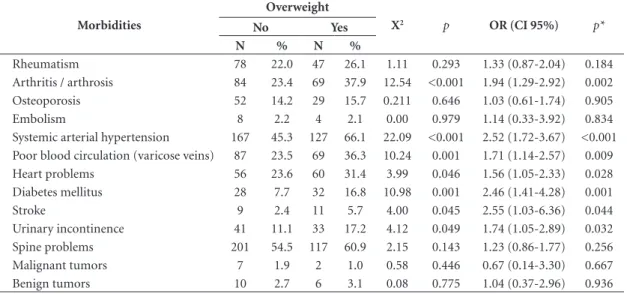
Overweight was associated with morbidities: arthritis/arthrosis (p = 0.002), systemic arterial hypertension (p < 0.001), poor blood circulation (p = 0.009), heart problems (p = 0.028), diabetes mellitus (p = 0.001), stroke (p = 0.044) and uri-nary incontinence (p = 0.032); even after adjust-ment (Table 2).
Regarding the relationship of functional dis-ability in BADL, it was not possible to verify its association with overweight, since only seven elderly (1.2%) had this condition. On the oth-er hand, with regard to functional disability in IADL, it was verified that, among the non-over-weight elderly, 12.2% reported at least one dis-ability – this figure was 10.9% among those
over-weight; however, without significant difference between groups (p = 0.729).
It was observed that the majority of the elder-ly considered that their QoL was good, among the non-overweight (59.7%) and (60.9%) among the overweight. Both groups reported being satisfied with their health – non-overweight (62.2%) and overweight (59.4%). Regarding QoL’s realms and facets, it was observed that the non-overweight and overweight elderly had higher scores in the social relationships realm and in the intimacy facet, and lower scores in the environment realm and in the social participation facet (Table 3).
Regarding the comparison of QoL, the group of overweight elderly had lower scores in the
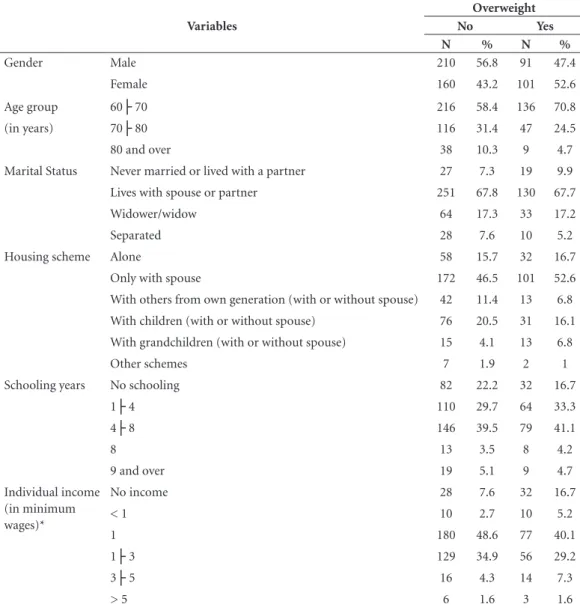
Table 1. Distribution of the sociodemographic, economic and health variables of non-overweight and overweight elderly, living in the rural area. Uberaba, Minas Gerais, Brazil, 2011.
Variables
Overweight
No Yes
N % N %
Gender Male 210 56.8 91 47.4
Female 160 43.2 101 52.6
Age group 60├ 70 216 58.4 136 70.8
(in years) 70├ 80 116 31.4 47 24.5
80 and over 38 10.3 9 4.7
Marital Status Never married or lived with a partner 27 7.3 19 9.9
Lives with spouse or partner 251 67.8 130 67.7
Widower/widow 64 17.3 33 17.2
Separated 28 7.6 10 5.2
Housing scheme Alone 58 15.7 32 16.7
Only with spouse 172 46.5 101 52.6
With others from own generation (with or without spouse) 42 11.4 13 6.8 With children (with or without spouse) 76 20.5 31 16.1
With grandchildren (with or without spouse) 15 4.1 13 6.8
Other schemes 7 1.9 2 1
Schooling years No schooling 82 22.2 32 16.7
1├ 4 110 29.7 64 33.3
4├ 8 146 39.5 79 41.1
8 13 3.5 8 4.2
9 and over 19 5.1 9 4.7
Individual income (in minimum wages)*
No income 28 7.6 32 16.7
< 1 10 2.7 10 5.2
1 180 48.6 77 40.1
1├ 3 129 34.9 56 29.2
3├ 5 16 4.3 14 7.3
> 5 6 1.6 3 1.6
aúd
e C
ole
tiv
a,
23(3):913-922,
2018
physical realm compared to those without this condition, remaining associated after adjustment (p = 0.005) (Table 3). On the other hand, in the social relationships realm, the overweight elderly had higher scores than the others, even after ad-justment (p = 0.033) (Table 3).
Discussion
The prevalence of overweight among the wom-en obtained in this study was similar to that of
urban and rural areas surveyed in Minas Gerais
(54.5%)8, in Santa Catarina (56.6%) and in
Ba-hia (54.7%)23. However, a divergent result was
obtained in a study with adults and the elderly in the United States, in which obesity was higher for
men in rural areas24.
Consistent with this research, studies con-ducted in Brazil and in the world have found a decreased share of overweight elderly individuals
with increased age group3,4,8, which corroborates
the hypothesis that overweight individuals
evi-dence lower longevity1.
Table 2. Distribution of non-overweight and overweight elderly in the rural area, by self-reported morbidities. Uberaba, Minas Gerais, Brazil, 2011.
Morbidities
Overweight
X2 p OR (CI 95%) p*
No Yes
N % N %
Rheumatism 78 22.0 47 26.1 1.11 0.293 1.33 (0.87-2.04) 0.184
Arthritis / arthrosis 84 23.4 69 37.9 12.54 <0.001 1.94 (1.29-2.92) 0.002 Osteoporosis 52 14.2 29 15.7 0.211 0.646 1.03 (0.61-1.74) 0.905
Embolism 8 2.2 4 2.1 0.00 0.979 1.14 (0.33-3.92) 0.834
Systemic arterial hypertension 167 45.3 127 66.1 22.09 <0.001 2.52 (1.72-3.67) <0.001 Poor blood circulation (varicose veins) 87 23.5 69 36.3 10.24 0.001 1.71 (1.14-2.57) 0.009 Heart problems 56 23.6 60 31.4 3.99 0.046 1.56 (1.05-2.33) 0.028 Diabetes mellitus 28 7.7 32 16.8 10.98 0.001 2.46 (1.41-4.28) 0.001
Stroke 9 2.4 11 5.7 4.00 0.045 2.55 (1.03-6.36) 0.044
Urinary incontinence 41 11.1 33 17.2 4.12 0.049 1.74 (1.05-2.89) 0.032 Spine problems 201 54.5 117 60.9 2.15 0.143 1.23 (0.86-1.77) 0.256
Malignant tumors 7 1.9 2 1.0 0.58 0.446 0.67 (0.14-3.30) 0.667
Benign tumors 10 2.7 6 3.1 0.08 0.775 1.04 (0.37-2.96) 0.936
* Adjusted for gender and age.
Table 3. Distribution of mean QoL, WHOQOL-BREF and WHOQOL-OLD scores of rural non-overweight and overweight elderly. Uberaba, Minas Gerais, Brazil, 2011.
Overweight
Z p β p*
Yes No
WHOQOL-BREF
Physical 70.63 67.00 -2.43 0.015 -0.12 0.005
Psychological 70.99 71.03 -0.55 0.580 0.02 0.565
Social relationships 72.75 75.04 -2.11 0.035 0.09 0.033
Environment 64.15 64.04 -0.11 0.909 0.00 0.963
WHOQOL-OLD
Sensory functioning 72.89 72.46 -0.15 0.883 -0.01 0.808
Autonomy 68.97 69.21 -0.13 0.898 0.02 0.654
Past, present and future activities 70.32 70.54 -0.08 0.940 0.02 0.601
Social participation 67.33 68.88 -1.04 0.301 0.06 0.132
Death and dying 71.64 71.98 -0.58 0.565 0.04 0.356
Intimacy 73.88 74.61 -1.78 0.075 0.06 0.162
T
av
ar
es DMS
Regarding the marital status and housing scheme, it is important to mention that the lack of family support may favor nutritional
prob-lems23. However, the national8,23 and
internation-al literature have not investigated this issue24-26.
The identification of marital status and housing scheme is relevant, since, in rural areas, given the distance between locations and scarce social ser-vices, households eventually become the main
source of resource and support13. In this study,
most were married and lived together with some-one, a fact that allows professionals to stimulate households toward nutritional care.
Another aspect that deserves attention is the relationship of schooling with overweight in the elderly. It is inferred that greater schooling pos-sibly favors the process of understanding the nu-tritional status, contributing to reduce overweight
conditions. Previous studies conducted in Brazil8
and in the world25,26 corroborate with this
hypoth-esis by identifying that schooling was an indicator of risk for obesity in the elderly. However, while this aspect was not the focus of research, this study showed similar percentages between the groups.
Consistent income results were obtained in Canada among rural adults and elderly people,
with equivalent proportions26. Unlike these
find-ings, Minas Gerais evidenced a higher share of overweight among the elderly with monthly
in-dividual income above a minimum wage8.
How-ever, another study with rural adults and elderly people in India found that those with medium and high socioeconomic status were more likely
to be obese25. The divergence of the relationship
between income and the occurrence of obesity in the elderly indicates the need to further analyze this situation through studies.
Regarding the association between over-weight and morbidities, a survey of elderly peo-ple from the urban and rural areas of a city of Santa Catarina also found an association between
overweight and arthritis/arthrosis (p = 0.002)23.
These data were similar to findings of the scien-tific literature in which obesity can cause elevated
joint loads, favoring the onset of the disease27.
Other complications of overweight in the
el-derly are the adverse metabolic effects1,27. Studies
in Brazil and in the world conducted in the urban area with adults and elderly found an association between overweight/obesity and systemic arterial
hypertension5,6,28, diabetes5,6,8,28, cardiac problems
and stroke6, confirming results of this
investiga-tion.
The relationship of overweight to poor blood circulation (varicose veins) may be associated
with greater compression of abdominal veins due to increased abdomen circumference. Another possible explanation is related to the sedentary lifestyle of overweight people, which can lead to an inefficient calf muscle pump and contribute to the development of varicose veins, especially
in the lower limbs29.
Regarding the association between over-weight and urinary incontinence, previous studies performed with elderly people in
Bra-zil7,30 and in China6 also evidenced this
relation-ship7,30. Overweight may lead to an increased
in-tra-abdominal pressure due to the weight of the waist-hip affecting the pelvic floor musculature. Consequently, a change in the effective closure mechanism occurs, leading to involuntary loss of
urine7.
It can be considered that inadequate eating habits may contribute to the onset of chronic
diseases31. From this perspective, this situation
may be happening with the elderly investigat-ed. During data collection, it was observed that, while they often cultivated gardens and orchards, they were not habitually consuming them, and eventually, such items were planted for sale. A study carried out with the same population of this research found that the elderly living in the rural area did not adequately follow several of the ten steps for healthy eating proposed by the Min-istry of Health for elderly people, such as con-sumption of vegetables, fruits, greens, milk and
lean meats14. Therefore, adequate nutrition must
be the subject of discussion between the health team and the elderly residents in these areas.
The fact that most of the elderly are inde-pendent for the BADL differs from a study con-ducted in rural communities in Rio Grande do Sul, where 52.9% needed help for up to three
BADLs32. However, a survey conducted in Mexico
with elderly rural residents found that the more complex activities performed by them over a longer period of time in the performance of their occupational functions have positive effects on their postural balance and maintenance of mus-cle strength, leading them to maintain indepen-dence for longer period of time, which explains the result found in this study.
The lack of a relationship of overweight with IADL in this study differs from a research con-ducted with elderly people in a Brazilian
North-eastern municipality (p = 0.025)9, but performed
aúd
e C
ole
tiv
a,
23(3):913-922,
2018
to the cities, contributing to group homogeniza-tion in this regard. Thus, although this research has not found a relationship between overweight and functional disability, it is relevant that health professionals consider the monitoring of nutri-tional status during the funcnutri-tional evaluation of rural elderly.
The impact of overweight on QoL and health self-assessment was suggested in a review of the literature that identified that the elderly with ide-al weight, reflected by a good nutritionide-al status had a positively influenced QoL, as well as being overweight is relevant to increased
morbimor-tality of these individuals33. From this
assump-tion, we can infer that the positive evaluation of QoL and health satisfaction for both groups may denote a false low interference of overweight in the daily life of these elderly. Health profession-als must pay attention to this aspect, identifying possible changes early and avoid compromised health of this population.
The relationship of overweight with lower QoL scores in the physical realm may be a con-sequence of the high number of morbidities as-sociated in this study, considering that this realm evaluates the capacity for work, dependence on
medication and health treatment20. A study
con-ducted in New Zealand with community elders found that obese individuals were 41% more likely of being at risk of using four or more med-ications and 30% more likely of being at risk of experiencing pain or discomfort, which
nega-tively affected QoL34. Another study conducted
in Korea concluded that the presence of comor-bidities in overweight elderly patients negatively
changed QoL35.
The association between overweight and higher QoL scores in the social relationships realm diverges from the assumption that obesity
can affect social, family and work relationships36,
aspects evaluated in this realm20. However, this
interference seems to be more related to the stig-ma surrounding the disease as regards the
nor-mality pattern36, which affects mainly women at
younger ages.
In general, it is important to rethink health care geared to overweight rural elders. Care for this population should be guided by the needs aimed at improving QoL, albeit in the presence of morbidities and physical disabilities.
Conclusion
From the findings of this study, it was possible to identify that overweight was associated with morbidities arthritis/arthrosis, systemic arterial hypertension, varicose veins, heart problems, di-abetes mellitus, stroke and urinary incontinence. Functional disability for IADLs did not show a difference between the groups. While com-paring QoL between the groups, it was verified that overweight elderly had lower scores in the physical realm and higher scores in the social relationships in relation to those who were not overweight.
The relationship between overweight and morbidities suggests the need to monitor the health status in order to avoid complications arising from this event in the quality of life. Con-sidering that the entire population of this study is covered by the Family Health Team, health professionals can use home visits to monitor the nutritional status of rural elderly and, as a result, propose a care plan according to the context of housing. Other key strategies are public educa-tion campaigns that can corroborate with the sensitization of these individuals regarding self-care in overweight control.
T
av
ar
es DMS
Collaborations
aúd e C ole tiv a, 23(3):913-922, 2018 References
1. Mathus-Vliegen EM. Obesity and the elderly. J Clin Gastroenterol 2012; 46(7):533-544.
2. Brasil. Ministério da Saúde (MS). Vigitel Brasil 2006-2009. [acessado 2015 Jan 1]. Disponível em: http://tab-net.datasus.gov.br/cgi/vigitel/vigteldescr.htm
3. Silva VS, Souza I, Petroski EL, Silva DAS. Prevalência e fatores associados ao excesso de peso em idosos bra-sileiros. Atividade Física & Saúde 2011; 16(4):289-294. 4. Silveira EA, Kac G, Barbosa LS. Prevalência e fatores
as-sociados à obesidade em idosos residentes em Pelotas, Rio Grande do Sul, Brasil: classificação da obesidade segundo dois pontos de corte do índice de massa cor-poral. Cad Saude Publica 2009; 25(7):1569-1577. 5. Kim IH, Chun H, Kwon JW. Gender differences in the
effect of obesity on chronic diseases among the elderly Koreans. J Korean Med Sci 2011; 26(2):250-257. 6. Cai L, He J, Song Y, Zhao K, Cui W. Association of
obesity with socio-economic factors and obesity-re-lated chronic diseases in rural southwest China. Public Health 2013; 127(3):247-251.
7. Silva JC, Prado MC, Romão JFF, Cestári CE. Grau de força muscular do assoalho pélvico em mulheres in-continentes obesas e não obesas. Ciência & saúde 2011; 4(2):37-44.
8. Nascimento CM, Ribeiro AQ, Cotta RMM, Acurcio FA, Peixoto SV, Priore SE, Franceschini SCC. Estado nutri-cional e fatores associados em idosos do município de Viçosa, Minas Gerais, Brasil. Cad Saude Publica 2011; 27(12):2409-2418.
9. Freitas RS, Fernandes MH, Coqueiro RS, Reis Júnior WM, Rocha SV, Brito TA.Capacidade funcional e fa-tores associados em idosos: estudo populacional. Acta paulista de enfermagem 2012; 25(6):933-939. 10. Manrique-Espinoza B, Moreno-Tamayo K, Téllez-Rojo
Solís MM, De la Cruz-Góngora VV, Gutiérrez-Robledo LM, Salinas-Rodríguez A. Short-term effect of physical activity and obesity on disability in a sample of rural elderly in Mexico. Salud Publica Mex 2014; 56(1):4-10. 11. Han TS, Tajar A, Lean ME. Obesity and weight man-agement in the elderly. Br Med Bull 2011; 97:169-196. 12. Johannsen DL, Ravussin E. Obesity in the elderly:
is faulty metabolism to blame? Aging health 2010; 6(2):159-167.
13. Bertuzzi D, Paskulin LGM, Morais EP. Arranjos e rede de apoio familiar de idosos que vivem em uma área ru-ral. Texto & contexto enfermagem 2012; 21(1):158-166. 14. Heitor SFD, Rodrigues LR, Tavares DMS. Prevalência
à adequação à alimentação saudável de idosos residen-tes em zona rural. Texto & contexto enfermagem 2013; 22(1):79-88.
15. Bertolucci PHF, Brucki SMD, Campacci SR, Juliano Y. O mini-exame do estado mental em uma popula-ção geral: impacto da escolaridade. Arq Neuropsiquiatr 1994; 52(1):1-7.
16. Ramos LR, Toniolo NJ, Cendoroglo MS, Garcia JT, Najas MS, Perracini M, Paola CR, Santos FC, Bilton T, Ebel SJ, Macedo MBM, Almada FCM, Nasri F, Miranda FD, Gonçalves M, Santos ALP, Fraietta R, Vivacqua NI, Alves MLM, Tudisco ES. Two-year follow-up study of elderly residents in S. Paulo, Brazil: methodology and preliminary results. Rev Saude Publica 1998; 32(5):397-407.
17. Lipschitz DA. Screening for nutritional status in the el-derly. Primary Care 1994; 21(1):55-67.
18. Lino VTS, Pereira SRM, Camacho LAB, Ribeiro Filho ST, Buksman S. Adaptação transcultural da Escala de Independência em Atividades de Vida Diária (Escala de Katz). Cad Saude Publica 2008; 24(1):103-112. 19. Freitas EV, Miranda RD. Parâmetros clínicos do
enve-lhecimento e Avaliação Geriátrica Ampla. In: Freitas EV, Py L, Cançado FAX, Gorzoni ML, Doll J, organiza-dores. Tratado de Geriatria e Gerontologia. Rio de Janei-ro: Guanabara-Koogan; 2006. p. 900-909.
20. Fleck MPA, Louzada S, Xavier M, Chachamovich E, Vieira G, Santos L, Pinzon V. Aplicação da versão em português do instrumento abreviado de avaliação da qualidade de vida “WHOQOL-bref ”. Rev Saude Publica 2000; 34(2):178-183.
21. Fleck MP, Chamovich E, Trentini C. Development and validation of the Portuguese version of the WHOQOL-OLD module. Rev Saude Publica 2006; 40(5):785-791.
22. Departamento Intersindical de Estatística e Estudos Socioeconômicos (DIEESE). Cesta Básica Nacional. Sa-lário mínimo nominal e necessário [serial on the Inter-net] 2015 [cited 2015 Maio 11]. Available from: http:// www.dieese.org.br/analisecestabasica/salarioMinimo. html.
23. Fares D, Barbosa AR, Borgatto AF, Coqueiro RS, Fer-nandes MH. Fatores associados ao estado nutricional de idosos de duas regiões do Brasil. Rev Assoc Med Bras 2012; 58(4):434-441.
24. Trivedi T, Liu J, Probst J, Merchant A, Jhones S, Martin AB. Obesity and obesity related behaviors among ru-ral and urban adults in the USA. Ruru-ral Remote Health 2015; 15(4):3267.
25. Siddiquee T, Bhowmik B, Da Vale Moreira NC, Mu-jumder A, Mahtab H, Khan AK, Hussain A. Prevalence of obesity in a rural Asian Indian (Bangladeshi) popu-lation and its determinants. BMC Public Health 2015; 15:860.
26. Chen Y, Rennie DC, Karunanayake CP, Janzen B, Hagel L, Pickett W, Dyck R, Lawson J, Dosman JA, Pahwa P; Saskatchewan Rural Health Study Group. Income ad-equacy and education associated with the prevalence of obesity in rural Saskatchewan, Canada. BMC Public Health 2015; 15:700.
27. Michalakis k, Goulis DG, Vazaiou A, Mintziori G, Po-lymeris A, Abrahamian-Michalakis A. Obesity in the ageing man. Metabolism 2013; 62(10):1341-1349. 28. Han TS, Tajar A, Lean MEJ. Obesity and weight
man-agement in the elderly. Br Med Bull 2011; 97:169-196. 29. Lins EM, Barros JW, Appolônio F, Lima EC, Barbosa
Júnior M, Anacleto E. Perfil epidemiológico de pa-cientes submetidos a tratamento cirúrgico de varizes de membros inferiores. Jornal vascular brasileiro 2012; 11(4):301-304.
30. Bolina AF, Dias FA, Santos NMF, Tavares DMS. Incon-tinência urinária autorreferida em idosos e seus fatores associados. Rev RENE. 2013; 14(2):354-363.
T
av
ar
es DMS
32. Rigo II, Paskulin LMG, Morais EP. Capacidade funcio-nal de idosos de uma comunidade rural do Rio Grande do Sul. Rev Gaucha Enferm 2010; 31(2):254-261. 33. Fazzio DMG. Envelhecimento e qualidade de vida:
uma abordagem nutricional e alimentar. Revisa 2012; 1(1):76-88.
34. Mitchell RJ, Lord SR, Harvey LA, Close JCT. Associ-ations between obesity and overweight and fall risk, health status and quality of life in older people. Aust N Z J Public Health 2014; 38(1):13-18.
35. So ES. Waist circumference and health-related quality of life by sex in the Korean elderly. J Aging Health 2014; 26(6):887-899.
36. Pinto MS, Bosi MLM. Muito mais do que pe(n)sam: percepções e experiências acerca da obesidade entre usuárias da rede pública de saúde de um município do Nordeste do Brasil. Physis 2010; 20(2):443-457.
Article submitted 08/07/2015 Approved 25/05/2016
Final version submitted 27/05/2016
This is an Open Access article distributed under the terms of the Creative Commons Attribution License
BY