ABSTRACT: Objective:To assess the impact of a child feeding training program for primary care health professionals about breastfeeding and complementary feeding practices. Methods: Cluster-randomized ield trial conducted in the city of Porto Alegre, (RS), Brazil. Twenty primary health care centers (HCC) were randomized into intervention (n = 9) and control (n = 11) groups. The health professionals (n = 200) at the intervention group centers received training about healthy feeding practices. Pregnant women were enrolled at the study. Up to six months of child’s age, home visits were made to obtain variables related to breastfeeding and introduction of foods. Results: 619 children were evaluated: 318 from the intervention group and 301 from the control group. Exclusive breastfeeding prevalence in the irst (72.3 versus 59.4%; RR = 1.21; 95%CI 1.08 – 1.38), second (62.6 versus 48.2%; RR = 1.29; 95%CI 1.10 – 1.53), and third months of life (44.0% versus
34.6%; RR = 1.27; 95%CI 1.04 – 1.56) was higher in the intervention group compared to the control group. The prevalence of children who consumed meat four or ive times per week was higher in the intervention group than in the control group (36.8 versus 22.6%; RR = 1.62; 95%CI 1.32 – 2.03). The prevalence of children who had consumed soft drinks (34.9 versus 52.5%; RR = 0.66; 95%CI 0.54 – 0.80), chocolate (24.5 versus 36.7% RR = 0.66 95%CI 0.53 – 0.83), petit suisse (68.9 versus 79.7; 95%CI 0.75 – 0.98) and cofee (10.4 versus 20.1%; RR = 0.51; 95%CI 0.31 – 0.85) in their six irst months of life was lower in the intervention group. Conclusion: The training of health professionals had a positive impact on infant feeding practices, contributing to the promotion of child health.
Keywords: Child. Breastfeeding. Feeding. Intervention studies. Health services. Primary health care.
Positive impact of child feeding training
program for primary care health professionals:
a cluster randomized ield trial
Atualização sobre alimentação da criança para proissionais de saúde:
estudo de campo randomizado por conglomerados
Márcia Regina VitoloI, Maria Laura da Costa LouzadaII, Fernanda RauberIII ORIGINAL ARTICLE / ARTIGO ORIGINAL
INutrition Department, Universidade Federal de Ciências da Saúde de Porto Alegre – Porto Alegre (RS), Brazil. IIUniversidade de São Paulo – São Paulo (SP), Brazil.
IIIUniversidade Federal de Ciências da Saúde de Porto Alegre– Porto Alegre (RS), Brazil.
Corresponding author: Márcia Regina Vitolo. Rua Sarmento Leite, 245, CEP 90050-170, Porto Alegre, RS, Brasil. E-mail: [email protected]
INTRODUCTION
The importance of breastfeeding and a complementary healthy diet as factors of mother-child health promotion and protection is a consensus in all countries1, but national surveys
have highlighted the magnitude of such problems related to inappropriate infant feeding practices in Brazil2-4. The II Survey of Breastfeeding Prevalence in Brazilian Capitals na in
the Federal District (II Pesquisa de Prevalência de Aleitamento Materno nas Capitais Brasileiras e Distrito Federal)3 showed prevalence of exclusive breastfeeding in 23.3% for 4 months and
9.3% for 6 months of age, data far from the parameters recommended as ideal. It was also found that the early introducing of water, teas and other kinds of milk in the irst month of life and the elevated consumption of cofee, soft drinks and cookies/snacks among children between 9 and 12 months of age.
The transcendency of these problems is emphasized in literature by concrete evidence on the association of early termination of breastfeeding and inadequate nutritional diet to diarrhea, growth retardation, symptoms of respiratory diseases, infections and deiciency
RESUMO: Objetivo: Avaliar o impacto de um programa de atualização em alimentação infantil para proissionais da atenção primaria à saúde nas práticas de aleitamento materno e alimentação complementar. Métodos: Ensaio de campo randomizado por conglomerados realizado em Porto Alegre (RS), Brasil. Vinte unidades de saúde foram randomizadas em grupo intervenção (n = 9) e controle (n = 11). Os proissionais das unidades de saúde do grupo intervenção (n = 200) receberam orientações quanto às diretrizes alimentares para lactentes do Ministério da Saúde. Aos seis meses de idade da criança, realizou-se visita domiciliar às mães participantes para obtenção das variáveis relacionadas a aleitamento materno e introdução de alimentos. Resultados: Avaliaram-se 619 crianças, 318 do grupo intervenção e 301 do controle. A prevalência de aleitamento materno exclusivo no primeiro (72,3 versus 59,4%; RR = 1,21; IC95% 1,08 – 1,38), segundo (62,6 versus 48,2%; RR = 1,29; IC95% 1,10 – 1,53) e terceiro mês de vida (44,0 versus 34,6; RR = 1,27; IC95% 1,04 – 1,56) foi maior no grupo intervenção em relação ao controle. A prevalência de crianças que consumiram carne quatro ou mais vezes na semana foi superior no grupo intervenção em relação ao controle (36,8 versus 22,6%; RR = 1,62; IC95% 1,30 – 2,03). A prevalência de crianças que já haviam consumido refrigerante (34,9 versus 52,5%; RR = 0,66; IC95% 0,54 – 0,80), chocolate (24,5 versus
36,7%; RR = 0,66; IC95% 0,53 – 0,83) e petit suisse (68,9 versus 79,7%; IC95% 0,75 – 0,98) e café (10,4 versus 20,1%; RR = 0,51; IC95% 0,31 – 0,85) nos primeiros seis meses de vida, foi menor no grupo intervenção. Conclusão: A atualização dos proissionais de saúde teve impacto positivo nas práticas alimentares dos lactentes, contribuindo para a promoção da saúde infantil.
diseases5,6. Recent studies also suggest a playing role for child nutrition in the development
of obesity and cardiovascular diseases in adult life7-10.
The efectiveness of educational interventions with mothers on the change of feeding habits in the irst year of life has already been evidenced in previous studies11,12, though, many
times, the implementation of these methods in the routines of health care is limited due to local logistic and inancial diiculties. Intervention programs using public health care which are accessible for the most vulnerable populations may be the most reliable channels for sustainable educational interventions. In this context, the qualiication of health professionals for the implementation of feeding and nutrition policies, programs and actions aimed at promoting an appropriate and healthy diet represent a strategic need for facing the problems resulting from the current Brazilian feeding and nutritional situation13, and the permanent
education in health reveals itself as the mains strategy in order to qualify care practice13.
The objective of this study was to evaluate the impact of updating primary health care professionals in relation to the food guide “Ten Steps for Healthy Feeding from Birth to Two Years of Age”14 in the practices of breastfeeding and in the quality of complementary
diet of breastfed infants assisted by health care centers (HCC) of the city of Porto Alegre. With the intention of preventing the intervention to contaminate health professionals in the control group, in case randomization would be carried out within members of the working teams, the randomization criteria used were the health care centers (HCC).
METHODS
It consists of a cluster randomized ield Trial carried out between April 2008 and September 2009 in Porto Alegre, Rio Grande do Sul, with a estimated population of 1,436,123 inhabitants. The randomization units were the health care centers (HCC) of the municipality and the outcomes were evaluated on mothers and children users of their services. The HCC are distributed throughout eight health districts managements, each of them related to a region of the municipality.
RECRUTING AND CLUSTER RANDOMIZATION
sample, four additional HCC were selected and randomized into the two groups in order to achieve the previously planned sample size. Twenty HCC, 9 from the intervention group and 11 from the control group, took part in the study. All HCC were visited in order to clarify the procedures for the study and to obtain the necessary consents.
The study was approved by the Ethics in Research Committee of the Universidade Federal de Ciências da Saúde de Porto Alegre (UFCSPA) and by the Ethics Committee of the Prefeitura Municipal de Porto Alegre, and the study was registered in ClinicalTrials.gov under the No. NCT00635453.
INTERVENTION
One hundred and sixty eight health professionals (doctors, nurses, nutritionists, auxiliary nurses, nursing technicians, dentists, administrative technicians and interns) of the HCC of the intervention groups participated in the updating session based on the program “Ten Steps for Healthy Feeding from Birth to Two Years of Age”14. This program is a initiative of the
Ministry of Health and aims at supporting health professionals and promoting healthy eating habits for children under two years of age, prioritizing exclusive breastfeed in the six irst months of life and complementary diet in enough quantity and quality in order to provide proper growth and development of the child. The recycling update lasted approximately one hour and it took place in one of the systematic meetings of staf by the researcher responsible for the study.
The teams of HCC health professionals of the intervention group received the technical handbook of the program, developed by the Ministry of Health14, as well as the pocket guide,
developed especially for this study, containing objective information on the dietary practices recommended by national guidelines. Each HCC received educational material to be given to mothers of children under six months of age, in quantities in accordance to the demand for a period of six months. This material contained information on the importance of not ofering other liquids and foods besides breastfeeding, the importance of introducing meat in order to prevent anemia, the adequate consistency of baby food, the importance of not substituting baby food for sandwiches or snacks and examples of food compositions for meals. Two colorful banners, made by durable plastic material, displayed: a) information on the scheme of introduction of complementary food, with number of meals and compositions of salty baby food, including meat; b) colorful and well visible pictures of food that should not be ofered to children under two years of age, including cofee, stufed cookies, jelly, candy, soft drink, petit Suisse cheese.
The HCC of the control group did not participate in the recycling program and did not receive the informative material. The study did not interfere in the strategy or routine of these places.
was that the intervention would (1) increase the consumption of fruit, beans, meat and liver and (2) reduce the consumption of food which are not recommended for breastfed children.
RECRUITMENT OF THE INDIVIDUALS
From April to December 2008, interviewers visited the HCC of both intervention and control group in order to identify the pregnant women indexed in these places and who were in the last trimester of pregnancy, potential mothers for the receiving of the guidance of the health professionals during the irst year of life of their babies. The pregnant women were informed about the procedures of the study and the ones who agreed on taking part in it signed the Informed Consent. In this moment, the pregnant women answered to a survey regarding their age, school education and occupation, family structure and income and probable delivery date. Data such as address and telephone numbers were obtained in order to conduce later household visits. Pregnant women diagnosed as HIV positive were not considered eligible for this study.
To calculate the size of the sample, it was considered the frequency of exclusive breastfeeding until four months of age of 40% in the intervention group15, power of 90%, conidence
level of 95% and cluster correlation coeicient of 1.5, which determined the evaluation of 300 pairs of mother-baby in each group. Considering an anticipated loss of 20%, it was estimated the recruitment of 720 individuals so that the sampling size would be achieved.
EVALUATING THE OUTCOMES
Between November 2008 and September 2009, a household visit to the participant women was conducted, in order to collect data on the children between six and nine months of age. The data of the children were originally planned to be collected when they would reach six months of age. However, due to logistical problems (absence of the mother or child being sick), it was extended to nine months of age. The data on date of birth, gender, birth weight and height were collected in the child’s booklet of vaccines. The dietary data of the child during their irst six months of life were collected through a survey in order to verify the time of breastfeeding, as well as the age the children started consuming other foods — water, tea, other liquids, other kinds of Milk and solid food. Exclusive breastfeeding was deined as the use of maternal milk as the sole food ingested, without the consumption of teas, water, other liquids or solids, with the exception of vitamin and mineral supplementation1.
snacks and processed food (ham, mortadella, salami, hot dog sausage) — at any time during their irst six months of life.
After data collection, the conirmation of those was made by telephone calls in 5% of randomly selected surveys. The interviewers, undergraduate and postgraduate students in Nutrition, were not involved in the randomization process and received theoretical and practical training on data collection, with an average duration of eight hours.
STATISTICAL ANALYSIS
The database was typed twice into the statistical software SPSS, version 11.0 (Statistical Package for Social Science Inc., Chicago, United States) by two trained researchers. The data were validated in the Epi Info software, version 6.4 (Centers for Disease Control and Prevention, Atlanta, United States) and the statistical analysis were carried out in the 16.0 version of the SPSS software. The results were analyzed for treatment purposes.
The variables were described as percentages or average and standard deviations. In order to quantify the intervention, the relative risks (RR) and the respective conidence intervals of 95% (95%CI) were calculated. The results were adjusted for cluster randomization by the Generalized Estimation Equation (GEE) with robust variance and Poisson distribution. Here, p-values < 0.05 were considered signiicant.
RESULTS
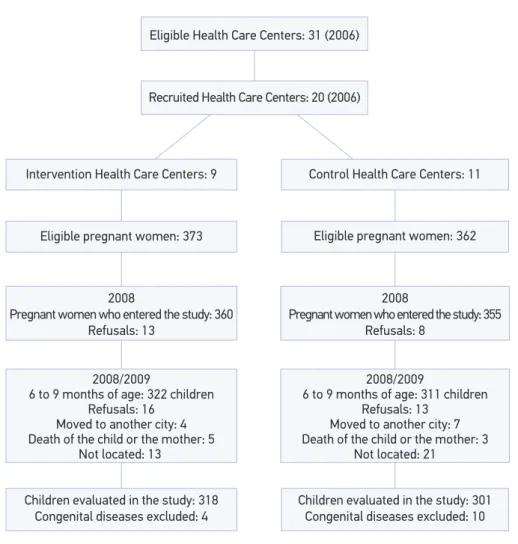
Out of the 736 pregnant women invited to take part in the study, 715 (97.1%) entered the study, 360 of the HCC in the intervention group and 355 in the control group (Figure 1). 633 children between six and nine months of age were evaluated. The main reason for losses during follow-up was due to not locating the families’ homes (Figure 1). Fourteen children with congenital diseases were excluded from the analysis, which resulted in 318 subjects in the intervention group and 301 in the control one.
There was no signiicant diference between the pregnant women lost in the follow-up and those who took part in data collection at six and nine months of age of the child regarding their monthly family income (1066.6 ± 684.8 reais versus 1070.2 ± 732.2 reais, p = 0.96), maternal school education (8.4 ± 2.8 years versus 8.5 ± 2.6 years, p = 0.74) and age of the mother at the time of birth (24.8 ± 6.3 years versus 25.4 ± 6.7 years, p = 0.44).
families. The characteristics of the children were similar for both intervention and control groups, as seen in Table 1.
In the studied population, 33.9% (n = 210) of the children received exclusive breastfeeding for less than one month and 75.9% (n = 470) were exclusively breastfed for less than four months. The breastfeeding rate was 66.1% (n = 409) at six months of age. When comparing the groups, it is observed that the average exclusive breastfeeding period was signiicantly higher in the intervention group (2.34 ± 1.63 months) in relation to the control one (1.92 ± 1.60 months) (diference of averages: 0.41; 95%CI 0.07 – 0.76). The prevalence of children who were fed exclusively with breast milk for less than one month was signiicantly lower in the intervention group (27.7%) when compared to the control one (40.5%) (RR = 0.68; 95%CI 0.53 – 0.86).
Figure 1. Overview of the study.
Eligible Health Care Centers: 31 (2006)
Recruited Health Care Centers: 20 (2006)
Intervention Health Care Centers: 9 Control Health Care Centers: 11
Children evaluated in the study: 318 Congenital diseases excluded: 4
Children evaluated in the study: 301 Congenital diseases excluded: 10 Eligible pregnant women: 373 Eligible pregnant women: 362
2008
Pregnant women who entered the study: 360 Refusals: 13
2008
Pregnant women who entered the study: 355 Refusals: 8
2008/2009
6 to 9 months of age: 322 children Refusals: 16
Moved to another city: 4 Death of the child or the mother: 5
Not located: 13
2008/2009
6 to 9 months of age: 311 children Refusals: 13
Moved to another city: 7 Death of the child or the mother: 3
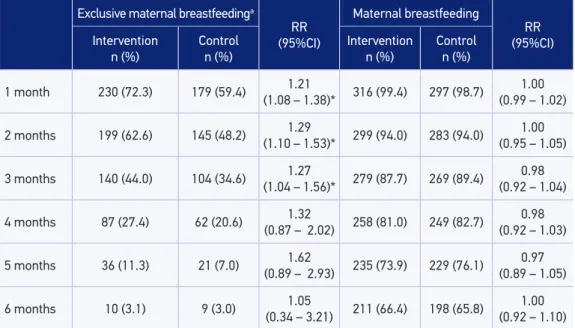
The intervention had a positive impact in the rates of exclusive breastfeeding until the third month of life, though there was a diference between the groups in months four, ive and six (Table 2). The breastfeeding rates were similar between the groups until six months of age (Table 2).
Regarding the quality of the complementary diet, it was observed that the prevalence of children who ate meat four or more times a week was 62% higher than in the intervention group when compared to the control one (36.8 versus 22.6%; 95%CI 1.30 – 2.03) (Table 3). The prevalence of children who ate liver in the week prior to the interview seems to be higher in the intervention group when compared to the control group, although the statistic does not meet critical levels which would allow us to exclude the null hypothesis (10.4 versus 6.0%; 95%CI 1.00 – 2.99).
The prevalence of children who had already ingested soft drinks (34.9 versus 52.5%; RR = 0.66, 95%CI 0.54 – 0.80), chocolate (24.9 versus 36.7%; RR = 0.66; 95%CI 0.53 – 0.63), petit suisse cheese (68.9 versus 79.7%; RR = 0.86; 95%CI 0.75 – 0.98) and cofee (10.4 versus 20.1%; RR = 0.51; 95%CI 0.31 – 0.85) in the irst six months of life was lower in the intervention group in comparison to the control one (Table 4).
DISCUSSION
The present study evaluated the impact of update recycling of health professionals who works in primary health care on child feeding according to the Brazilian feeding guide on the practices of maternal breastfeeding and complementary diet. The irst randomized study to evaluate the efectiveness of the “Ten Steps for Healthy Feeding from Birth to Two Years of Age” guide was conducted with the intervention of university students in visits to the mother for in order to guide those on healthy dietary practices15.
Table 1. Characteristics of children aged 6 to 9 months and their mothers, Porto Alegre, RS, Brazil (n = 619).
*It was not possible to obtain data from eighteen families; SD: standard deviation. Intervention
n (%) / Mean ± SD
Control
n (%) / Mean ± SD
Male 168 (52.8) 157 (52.2)
Only child 140 (44.0) 135 (44.9)
Birth weight in g 3315.4 ± 506.1 3256.4 ± 505.3
Birth height in cm 49.1 ± 2.2 48.9 ± 2.6
Age of mother at the time of birth 26.0 ± 6.8 24.9 ± 6.5
Mother’s school education 8.5 ± 2.5 8.4 ± 2.8
The prevalence of children in exclusive maternal breastfeeding observed in this study revealed that the intervention performed using the health service was efective in signiicantly increasing its practice within the three irst months. The national rates observed in the II Pesquisa de Prevalência de Aleitamento Materno in the Brazilian capitals and in the Federal
Table 2. Impact of the intervention on breastfeeding practices among children aged 6 to 9 months, Porto Alegre, RS, Brazil.
aExclusive breastfeeding was deined as the infant receiving breast milk without any additional food, liquids or water, with the exception of medicine or mineral supplements.
*p < 0.05
Exclusive maternal breastfeedinga
RR
(95%CI)
Maternal breastfeeding
RR
(95%CI)
Intervention
n (%) Controln (%) Interventionn (%) Controln (%)
1 month 230 (72.3) 179 (59.4) (1.08 – 1.38)*1.21 316 (99.4) 297 (98.7) (0.99 – 1.02)1.00
2 months 199 (62.6) 145 (48.2) (1.10 – 1.53)*1.29 299 (94.0) 283 (94.0) (0.95 – 1.05)1.00
3 months 140 (44.0) 104 (34.6) (1.04 – 1.56)*1.27 279 (87.7) 269 (89.4) (0.92 – 1.04)0.98
4 months 87 (27.4) 62 (20.6) (0.87 – 2.02)1.32 258 (81.0) 249 (82.7) (0.92 – 1.03)0.98
5 months 36 (11.3) 21 (7.0) (0.89 – 2.93)1.62 235 (73.9) 229 (76.1) (0.89 – 1.05)0.97
6 months 10 (3.1) 9 (3.0) (0.34 – 3.21)1.05 211 (66.4) 198 (65.8) (0.92 – 1.10)1.00
Table 3. Impact of the intervention on complementary feeding practices among children aged 6 to 9 months, Porto Alegre, RS, Brazil.
Complementary diet Interventionn (%) Controln (%) (95%CI)RR
Fruit ≥ 4 times a week 220 (69.2) 182 (60.5) (0.97 – 1.34)1.14
Bean ≥ 4 times a week 119 (37.4) 104 (34.6) (0.76 – 1.54)1.08
Meat ≥ 4 times a week 16 (36.8) 68 (22.6) (1.30 – 2.03)*1.62
Liver ≥ once a week 33 (10.4) 18 (6.0) (1.00 – 2.99)1.73
District3 for exclusive breastfeeding of children of one, two and three months of age were
60.7, 47.3 and 34.3%, respectively, similar to the rates observed in the control group of this study and lower than the ones observed among children within the intervention group. However, the lack of impact of exclusive breastfeeding rates equal to or higher than four months old may be justiied by some hypothesis. It is possible that, from four months old on, the frequency of pediatric visits decreased, reducing thus the impact of the guidance by health professionals in the quality of this practice. Unfortunately, this hypothesis cannot be conirmed by this study, since the data collection include only the quantity of consultations taken in the irst six months of life, without specifying at what age these visits happened. The second hypothesis is that the health professionals, when observing that the mother was committed into exclusive breastfeeding, would cease reinforcing the importance of continuing with the practice. And as a third hypothesis, it could be considered that the return of the
Foods not recommended Interventionn (%) Controln (%) (95%CI)RR
Added sugar 229 (72.2) 246 (81.7) (0.76 – 1.02)0.88
Candies 123 (38.7) 138 (45.8) (0.58 – 1.21)0.84
Jelly 227 (71.4) 224 (74.4) (0.82 – 1.10)0.95
Sot drinks 111 (34.9) 158 (52.5) (0.54 – 0.80)*0.66
Artiicial juice (powdered) 63 (19.8) 81 (27.0) (0.49 – 1.09)0.73
Cofee 33 (10.4) 60 (20.1) 0.51
(0.31 – 0.85)*
Petit suisse cheese 219 (68.9) 240 (79.7) 0.86
(0.75 – 0.98)*
Stufed cookies 105 (33.1) 130 (43.2) (0.53 – 1.10)0.76
Chocolate 78 (24.5) 110 (36.7) (0.53 – 0.83)*0.66
Chips snacks 57 (17.9) 65 (21.0) (0.50 – 1.37)0.83
Processed meatb 24 (7.5) 29 (9.7) 0.78
(0.40 – 1.51)
Table 4. Impact of the intervention on the intake of non-recommended food a among children aged 6 to 9 months, Porto Alegre, RS, Brazil.
aConsumption of not-recommended food any time during the irst six months of life. bHam, mortadella, salami, hot dog sausage, sausage.
mother to work would keep them from continuing exclusive breastfeeding from four months old on, however, this is considered a poor assumption, once that, in this group, only 33% of the pregnant women reported working outside their homes and that, among those, only 5.5% of them were in maternity leave (data not shown). Besides that, a previous study has shown a great impact by the intervention carried out through household visits in the increase of prevalence of children exclusively breastfed until four months of age and breastfed until six months of age15. Another hypothesis yet would be the high turnover of health professionals in
the USs16, considering that, after a few months, the staf that received the intervention might
not be working in the same places any longer. A study in the countryside of Pernambuco17,
including the services provided by the Iniciativa Hospital Amigo da Criança (IHAC) and the intervention through household visits, in addition to another study on systematic review in order to evaluate efective programs in the promotion of maternal breastfeeding18, got to
the conclusion that combined actions strategies are necessary, involving prenatal, hospital and community care for the efective promotion of maternal breastfeeding.
The highest prevalence of children who ate meat four times a week or more at age six to nine months in the intervention group was a result of the emphasis given to this practice during the recycling of the health professionals and in the material provided to the professionals to the mothers. The reason for this emphasis is the high prevalence of anemia in children from 6 to 24 months of age19 and the importance of providing high bioavailability
iron from the introduction of the complementary diet in order not to deprive the child’s iron reservations, from six months of age on20. It was also shown, from the qualitative study in
Brazil21, which came up with the food guide “Ten Steps for Healthy Feeding from Birth to
Two Years of Age”, that mothers delay meat introduction for considering it a food of hard consistency and of diicult digestion during the irst year of life.
The eighth step of the program “Ten Steps...”14 recommends that mothers avoid ofering
sugar, cofee, canned food, fried food, snacks, soft drinks and candies in the irst two years of life. This guideline was reinforced among health professionals, as national data evidenced the early introduction of these foods to children3. Thus, the intervention was efective in reducing
the prevalence of breastfed children who consumed soft drinks, chocolate, petit suisse cheese and cofee. It is noteworthy, however, that the prevalences of children who consumed these foods, even in the intervention group, remained high. Observing the data regarding hte intake of sugar, candies, jelly and stufed cookies, it is possible to conclude that preventing this food habit in an early age is, yet, a great challenge. It is known that dietary preferences are determined within the irst two or three years of life22 and that the early exposure to high
energy density and sweet foods inluence their consumption later on23-25. Besides that, the
intake of foods which are not recommended in the irst year of life is associated to risk of severe cavities in preschool children26. Thus, it is suggested that the strategies of intervention
level of impact observed. However, the proposal was made according to the real administrative conditions of the HCC and of the demands for the routine of the Service. The priority was that the intervention would take place within all categories of HCC professional in the intervention group, as opposed to only those ones who would deal directly with the children in their irst years of life. Another aspect which may be considered is the lack of control of children who received the guidance from the health professionals. The registering of the children was made with the mother in their last trimester of pregnancy, and not after each pediatric consultation. This way, the impact of the orientations may have been diluted because of mother who did not take their children to the HCC for the follow-up. Due to the multiplicity of the outcomes evaluated in this study, another potential limitation is the chance that some results may have occured by chance. However, due to the fact that the hypothesis were deined a priori, that the results are biologically plausible and that the impact on the breastfeeding practice is consisting with previous indings15, we believe this is a remote possibility.
It has been shonw that there is a need of qualifying health professionals, considering that the lack of information by the professionals27 and the diiculties in communication
between professional and patient28 are among the main reasons related to weaning and to
the early introduction of foods. Another randomized study has also shown that the training of professionals in health units was efective in the improvement of outcomes related to nutrition in the irst years of life29. There are also evidences that dietary couseling to mothers
improve the dietary habits of children under two years of age11,15,30-32, that pediatricians
recognize the need for trainings in order to improve communication with parents33 and that
more eforts from health policies are needed for the trainnings in the service34. Besides that,
the intervention model tested in the study meets the National Policy for Food and Nutrition published by the Ministry of Health13, which reinforces the importance of investments in
instruments and strategies of communication and health education that support health professionals in their role of socializing knowledge and information on food and nutrition and in the support of individuals in the decision, by promoting health practices.
Thus, the results of the present study allow us to conlude that the intervention promoted in the HCC was efective in order to increase the prevalence of children being exclusively breastfed in their three irst months of life, increasing the prevalence of children who ate meat in the beginning of the complementary diet and reducing the intake of foods not recommended between 6 and 9 months of life. More studies are necessary in order to determine the impact of the intervention in the US which took part in the Family Health Strategy, where there is the presence of community health agents, who carry out household visits in the area of their units and bring information capable of dimensioning the main health problem of their given community.
ACKNOWLEDGEMENTS
1. World Health Organization. Complementary feeding of young children in developing countries: a review of current scientiic knowledge. Geneva; 2008. 2. Castro TG, Baraldi LG, Muniz PT, Cardoso MA.
Dietary practices and nutritional status of 0-24-month-old children from Brazilian Amazonia. Public Health Nutr 2009; 12(12): 2335-42.
3. Ministério da Saúde. II Pesquisa de Prevalência de Aleitamento Materno nas Capitais Brasileiras e Distrito Federal. Brasília: Ministério da Saúde; 2009. 4. Caetano MC, Ortiz TT, Silva SG, Souza FI, Sarni RO.
Complementary feeding: inappropriate practices in infants. J Pediatr (Rio J) 2010; 86(3): 196-201. 5. Plenge-Bönig A, Soto-Ramírez N, Karmaus W, Petersen
G, Davis S, Forster J. Breastfeeding protects against acute gastroenteritis due to rotavirus in infants. Eur J Pediatr 2010; 169(12): 1471-6.
6. Evelein AM, Geerts CC, Visseren FL, Bots ML, van der Ent CK, Grobbee DE, et al. The association between breastfeeding and the cardiovascular system in early childhood. Am J Clin Nutr 2011; 93(4): 712-8. 7. Plagemann A, Harder T. Breast feeding and the risk
of obesity and related metabolic diseases in the child. Metab Syndr Relat Disord 2005; 3(3): 222-32. 8. Horta B, Bahl R, Martinez J, Victora CG. Evidence
on the long-term efects of breastfeeding: systematic review and meta-analyses. Genebra: World Health Organization; 2007.
9. Lanigan J, Singhal A. Early nutrition and long-term health: a practical approach. Proc Nutr Soc 2009; 68(4): 422-9.
10. Fall CH, Borja JB, Osmond C, Richter L, Bhargava SK, Martorell R, et al. Infant-feeding patterns and cardiovascular risk factors in young adulthood: data from ive cohorts in low- and middle-income countries. Int J Epidemiol 2001; 40(1): 47-62.
11. Shi L, Zhang J, Wang Y, Caulfield LE, Guyer B. Effectiveness of an educational intervention on complementary feeding practices and growth in rural China: a cluster randomised controlled trial. In Public Health Nutr 2010; 13(4): 556-65.
12. Imdad A, Yakoob MY, Bhutta ZA. Impact of maternal education about complementary feeding and provision of complementary foods on child growth in developing countries. BMC Public Health 2011; 11 Suppl 3: S25.
13. Ministério da Saúde. Política Nacional de Alimentação e Nutrição. Versão preliminar. Série B. Textos Básicos de Saúde. Brasília, DF: Ministério da Saúde; 2012.
14. Ministério da Saúde. Dez passos para uma alimentação saudável: guia alimentar para menores de dois anos. Brasília, DF: Ministério da Saúde; 2002.
15. Vitolo MR, Bortolini GA, Feldens CA, Drachler ML. Impactos da implementação dos dez passos da alimentação saudável para crianças: ensaio de campo randomizado. Cad Saúde Pública 2005; 21(5): 1448-57. 16. Medeiros CRG, Junqueira AGQ, Schwingel G, Carreno I, Jungles LAP, Saldanha OMFL. A rotatividade de enfermeiros e médicos: um impasse na implementação da Estratégia de Saúde da Família. Ciênc Saúde Coletiva 2010; 15(Suppl.1): 1521-31.
17. Coutinho SB, de Lira PIC, Lima M de C, Ashworth A. Comparison of the efect of two systems for the promotion of exclusive breastfeeding. Lancet 2005; 366(9491): 1094-100.
18. Chung M, Raman G, Trikalinos T, Lau J, Ip S. Inter ventions in primar y care to promote breastfeeding: an evidence review for the US Preventive Services Task Force. Annals of Internal Medicine 2008; 149(8): 565-82.
19. Bortolini GA, Vitolo MR. Impacto de orientação dietética sistemática no primeiro ano de vida nas prevalências de anemia e deiciência de ferro aos 12-16 meses. J Pediatr 2012; 88(1): 33-9.
20. Institute of Medicine. Dietary Reference Intakes for Vitamin A, Vitamin K, Arsenic, Boron, Chromium, Copper, Iodine, Iron, Manganese, Molybdenum, Nickel, Silicon, Vanadium, and Zinc. National Academic Press. Food and Nutrition Board. Washington, DC; 2001. 21. Ministério da Saúde. Organização Pan Americana da
Saúde. Guia alimentar para crianças menores de dois anos. Série A. Normas e Manuais Técnicos, n. 107. Brasília, DF: Ministério da Saúde; 2002.
22. Skinner JD, Carruth BR, Wendy B, Ziegler PJ. Children’s food preferences: a longitudinal analysis. J Am Diet Assoc 2002; 102(11): 1638-47.
23. Birch L. Development of food acceptance patterns in the irst years of life. Proceedings of the Nutrition Society 1998; 57(4): 617-24.
24. Sullivan SA, Birch LL. Pass the sugar, pass the salt: experience dictates preference. Developmental Psychology 1990; 26(4): 546-51.
25. Beauchamp GK, Moran M. Acceptance of sweet and salty tastes in 2-year-old children. Appetite 1994; 5(4): 291-305.
26. Feldens CA, Giugliani ER, Vigo Á, Vítolo MR. feeding practices and severe early childhood caries in four-year-old children from southern Brazil: a birth cohort study. Caries Res 2010; 44(5): 445-52.
27. Wijndaele K, Lakshman R, Landsbaugh JR, Ong KK, Ogilvie D. Determinants of early weaning and use of unmodified cow’s milk in infants: a systematic review. J Am Diet Assoc 2009; 109(12): 2017-28.
28. Olson BH, Horodynski MA, Brophy-Herb H, Iwanski KC. Health professionals’ perspectives on the infant feeding practices of low income mothers. Matern Child Health J 2010 14(1): 75-85.
29. Santos I, Victora CG, Martines J, Gonçalves H, Gigante DP, Valle NJ, Pelto G. Nutrition counseling increases weight gain among Brazilian children. J Nutr 2001; 131(11): 2866-73.
30. Penny ME, Creed-Kanashiro HM, Robert RC, Narro MR, Caulfield LE, Black RE. Effectiveness of an educational intervention delivered through the health services to improve nutrition in young children : a cluster-randomised controlled trial. Lancet 2005; 365(9474): 1863-72.
31. de Oliveira LD, Giugliani ER, Santo LC, Nunes LM. Impact of a strategy to prevent the introduction of non-breast milk and complementary foods during the irst 6months of life: A randomized clinical trial with adolescent mothers and grandmothers. Early Hum Dev 2011; 88(6): 357-61. 32. Aboud FE, Moore AC, Akhter S. Efectiveness of a
community-based responsive feeding programme in rural Bangladesh: a cluster randomized ield trial. Matern Chil Nutr 2008; 4(4): 275-86.
33. Turner T, Cull WL, Bayldon B, Klass P, Sanders LM, Frintner MP, et al. Pediatricians and health literacy: descriptive results from a national survey. Pediatrics 2009; 124(Suppl 3): S299-305.
34. Cattaneo A, Buzzetti R. Quality improvement report: Efect on rates of breast feeding of training for the Baby Friendly Hospital Initiative. BMJ 2001; 323(7325): 1358-62. Received on: 01/10/2013