Original Article
Rev. Latino-Am. Enfermagem2014 Nov.-Dec.;22(6):994-1000
DOI: 10.1590/0104-1169.3534.2508 www.eerp.usp.br/rlae
Copyright © 2014 Revista Latino-Americana de Enfermagem This is an Open Access article distributed under the terms of the Creative Commons Attribution Non-Commercial License (CC BY-NC).
This license lets others distribute, remix, tweak, and build upon your work non-commercially, and although their new works must also acknowledge you and be non-commercial, they don’t have to license their derivative
Objectives: to assess the quality of life of people living with HIV/AIDS and verify its association
with clinical characteristics and treatment adherence. Method: cross-sectional study conducted
in a hospital in the state of Paraíba, Brazil. A questionnaire was used to collect socio-demographic
and clinical data. The quality of life scale proposed by the World Health Organization and a
questionnaire to measure treatment adherence were used. Results: of the 314 interviewees,
190 (60.5%) were male, aged 43 years on average, 121 (38.5%) had attended up to five years
of schooling, 108 (34.4%) received up to two times the minimum wage, and 112 (35.7%) were
on sick leave. In regard to clinical variables, individuals with an undetectable viral load scored
higher in all the domains concerning quality of life, with statistically significant differences in
three domains. Regarding treatment adherence, 235 (73.8%) presented poor adherence and
those who strictly adhered to treatment obtained better scores in quality of life. The results show
that quality of life is better among individuals adherent to ART. Supporting people to adhere to
the antiretroviral treatment should be a persistent task of healthcare workers and other people
participating in the treatment, such as family members and friends.
Descriptors: VHI; Acquired Immunodeficiency Syndrome; Quality of Life; Medication Adherence.
Corresponding Author: Ana Cristina de Oliveira e Silva
Rua Adalgiza Luna de Menezes, 681, Bloco D, Apto. 302 Bairro: Bancários
CEP: 58051-840, João Pessoa, PB, Brasil
1 Paper extracted from doctoral dissertation “Quality of life of people living with HIV/AIDS and its association with clinic, psicho emotional
characteristics and adhesion to the treatment”, presented to Escola de Enfermagem de Ribeirão Preto, Universidade de São Paulo, WHO Collaborating Centre for Nursing Research Development, Ribeirão Preto, SP, Brazil.
2 PhD, Adjunct Professor, Departamento de Enfermagem Clinica, Universidade Federal da Paraíba, Paraíba, PB, Brazil.
3 PhD, Professor, Escola de Enfermagem de Ribeirão Preto, Universidade de São Paulo, WHO Collaborating Centre for Nursing Research
Development, Ribeirão Preto, SP, Brazil.
4 PhD, Full Professor, Escola de Enfermagem de Ribeirão Preto, Universidade de São Paulo, WHO Collaborating Centre for Nursing Research
Development, Ribeirão Preto, SP, Brazil.
Quality of life, clinical characteristics and treatment adherence of
people living with HIV/AIDS
1Ana Cristina de Oliveira e Silva
2Renata Karina Reis
3Introduction
The impact of the antiretroviral therapy (ART)
on people with HIV/AIDS contributed to a decrease in
mortality or HIV/AIDS-related illnesses among infected
people(1). The number of AIDS-related deaths among
adults and children decreased 29% since 2005. A
decrease of 37% of AIDS-related deaths was observed
in the last decade in Latin America(2). This decrease in
deaths is certainly a result of therapeutic support, which
in addition to prolonging survival, also improves quality
of life(3).
Treatment adherence, psychological changes and
clinical characteristics are factors directly associated
with the quality of life (QoL) of people living with HIV/
AIDS. Consequently, there is a search not only for
preventive and control methods, but also for strategies
that facilitate and improve the quality of life of HIV/AIDS
patients. Coping with HIV/AIDS means facing situations
that can decrease or limit quality of life(1).
Health conditions, housing, safety and social
relationships are factors that affect the quality of life of
people living with HIV/AIDS in different respects. Quality
of life is one of the terms with the highest multifactor expression, which justiies its many deinitions. In this study, we opted for the deinition of quality of life (QoL) proposed by the World Health Organization (WHO):
“individuals’ perceptions of their position in life in the
context of the culture and value systems in which
they live and in relation to their goals, expectations,
standards and concerns”(3-4).
In this context, the quality of life of people living
with HIV/AIDS and its relationship with ART became an
object of study. Many studies assess the QoL of these
people, however, those addressing the relationship of
QoL and ART are rare. Hence, this study’s objective
was to assess the quality of life of people living with
HIV/AIDS and its association with clinical factors and
adherence to antiretroviral therapy.
Method
This analytical, cross-sectional study was conducted
in a referral hospital for infectious diseases located in
João Pessoa, Paraíba, Brazil.
This study included a convenience sample
composed of 314 people living with HIV/AIDS. The
participants were selected using the feasibility criterion
on days care was provided in the referral hospital.
The selection criteria included: living with HIV/AIDS,
receiving ART for at least three months, and residing
in the state of Paraíba, since many of this hospital’s
patients are from other states. Data were collected
over a period of four months (December 2012 to
March 2013) by properly-trained research assistants.
The study was approved by the Institutional Review
Board at the Federal University of Paraíba (Protocol
No. 0405/12) and all the participants signed free and
informed consent forms.
A semi-structured questionnaire was used to
collect socio-demographic and clinical information.
The WHOQOL-HIV Bref(5) was used to assess Quality
of Life. This instrument was composed of 31 items,
divided into six domains: physical, psychological, social
relationships, environments, level of independence, and
religiosity(4).
The CEAT-VIH instrument (Cuestionario
para la Evaluación de la Adhesión al Tratamiento
Antirretroviral en Personas con Infección por VIH y
Sida
)
was used to collect data related to adherenceto ART. This instrument is composed of 20 items
divided into two dimensions: treatment adherence and factors inluencing treatment adherence(6). The
minimum score is 17 and the maximum score is 89.
In this study, the minimum score was 52 and the
maximum was 88. In accordance with the analysis
proposed by Remor(6), the following percentages
(PC) were established for the questionnaire global score obtained by the sample: PC ≥ 85 indicates strict adherence (good); 50 ≤ PC < 85 indicates poor adherence (dificulty complying with the treatment); PC ≤ 49 indicate no adherence. The scale’s classiication was used to compute the scores of each item of the WHOQOL HIV Bref. The internal
consistency for the instrument domains was computed according to Cronbach’s coeficient of reliability.
Results
A total of 314 people living with HIV/AIDS
participated in the study: 190 (60.5%) men and 124
(39.5%) women, aged 43 years old on average; ages
ranged from 21 to 70 years old. Most participants
(110/ 35.0%) were aged between 30 and 39 years
old. In regard to education, 193 (61.4%) participants
(60.5%), reported being Catholic; 190 (60.5%)
individuals reported sick leave or retirement; and 226
(72%) individuals reported income of up to two times
the minimum wage (Table 1).
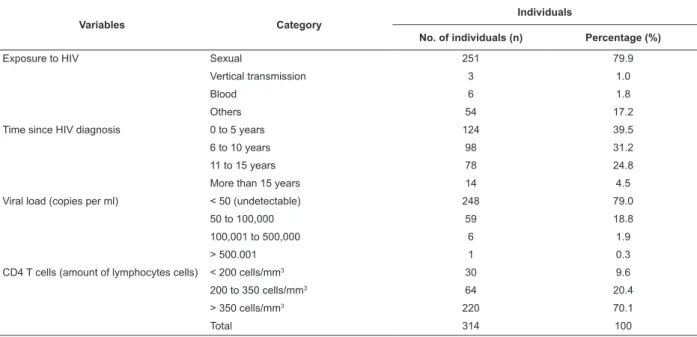
In regard to the distribution of individuals living with
HIV/AIDS according to clinical variables (Table 2), sexual
intercourse was the main route of exposure to the virus
(251/79.9%). In regard to time since diagnosis, 124 (39.5%) individuals reported less than ive years since diagnosis. In terms of clinical characteristics for the CD4
T cells count, most participants (220/70.1%) had more
than 350 cells/mm3. The viral load was undetectable for
248 (79%) participants; from 50 to 100,000 copies per
ml were observed for 59 (18.8%) individuals, and seven
(2.2%) individuals presented more than 100,000 copies
per ml (Table 2).
In regard to time since diagnosis, Table 3 shows
that all the individuals presented higher scores in the
psychological and spiritual domains among those
domains concerning quality of life, according to the
WHOQOL HIV bref.
No signiicant differences were found in the WHOQOL HIV Bref regarding the counting of CD4 T lymphocytes. This study found signiicant differences in the association between viral load and the psychological,
level of independence, and environment domains. Higher scores in all the QoL domains were identiied among individuals with a viral load below 50 copies per ml.
As for the presence of diseases or comorbidities in association with QoL domains, no signiicant differences were found, though signiicant association was found in regard to the psychological domain and previous
diseases. The clinical variable “use of antiretroviral” did not present signiicant difference in the QoL domains, according to the WHOQOL HIV Bref.
When the average scores of QoL were analyzed in regard to therapeutic adherence (Table 4), we veriied that the individuals classiied as “non-adherent” presented the worst scores in all the QoL domains. Table 4 presented statistically signiicant results for the domains: physical, psychological, social relationships,
religion, and the assessment using the CEAT.
Table 1 – Distribution of people living with HIV/AIDS according to socio-demographic variables, João Pessoa-PB,
Brazil, 2012 and 2013
Variables Category
Individuals
No. of individuals (n) Percentage (%)
Sex Male 190 60.5
Female 124 39.5
Age (years) 20 to 29 25 8.0
30 to 39 110 35.0
40 to 49 92 29.3
50 to 59 64 20.4
60 to 70 23 7.3
Race Mixed 114 36.3
Not mixed 200 63.7
Education (years of schooling)
None 27 8.6
1 to 5 years 121 38.5
6 to10 years 72 22.9
11 to 15 years 74 23.6
More than 15 years 20 6.4
Religion Catholic 190 60.5
Non-Catholic 102 32.5
No religion 22 7.0
Income (minimum wage-MW)* Less than 1 times the MW 118 37.6
From 1 to 2 times the MW 108 34.4
More than 2 times the MW 88 28.0
Occupation Employed 74 23.6
Retired 78 24.8
Sick leave 112 35.7
Unemployed 50 15.9
Total 314 100
Table 2 – Distribution of people living with HIV/AIDS according to clinical variables, João Pessoa-PB, Brazil, 2012and
2013
Variables Category
Individuals
No. of individuals (n) Percentage (%)
Exposure to HIV Sexual 251 79.9
Vertical transmission 3 1.0
Blood 6 1.8
Others 54 17.2
Time since HIV diagnosis 0 to 5 years 124 39.5
6 to 10 years 98 31.2
11 to 15 years 78 24.8
More than 15 years 14 4.5
Viral load (copies per ml) < 50 (undetectable) 248 79.0
50 to 100,000 59 18.8
100,001 to 500,000 6 1.9
> 500.001 1 0.3
CD4 T cells (amount of lymphocytes cells) < 200 cells/mm3 30 9.6
200 to 350 cells/mm3 64 20.4
> 350 cells/mm3 220 70.1
Total 314 100
Table 3 – Distribution of scores of the WHOQOL- HIV Bref domains according to clinical variables of people living with
HIV/AIDS, João Pessoa-PB, Brazil, 2012 and 2013
Clinical variables
WHOQOL HIV Bref domains
Physical Psychological Level of independence
Social
relationships Environment
Spirituality /Religion Time since diagnosis 3 months to 5
years
67.7 (18.9) 70.2 (13.1) 60.6 (15.0) 65.8 (17.5) 61.7 (15.1) 73.5 (21.2)
6 to 10 years 67.9 (20.8) 69.1 (16.7) 60.7 (17.2) 66.2 (20.4) 60.6 (15.3) 69.6 (23.2)
11 years or more 65.8 (20.9) 70.3 (16.6) 63.6 (14.8) 66.6 (18.9) 64.2 (14.7) 73.8 (21.5)
P value 0.804 0.858 0.259 0.855 0.327 0.376
CD4 T (cell/mm3)*
< 200 69.8 (21.7) 67.0 (18.0) 56.5 (16.5) 66.3 (23.0) 57.8 (17.2) 76.0 (21.1)
200 - 350 68.1 (20.0) 70.9 (15.2) 62.9 (17.6) 66.4 (17.9) 63.5 (13.0) 71.5 (23.2)
> 350 66.6 (19.9) 70.0 (15.0) 61.8 (14.9) 66.1 (18.5) 62.3 (15.3) 72.2 (21.7)
Valor de p 0.660 0.772 0.242 0.868 0.158 0.625
Viral load (copies per mL)†
<50 copies per ml 68.0 (20.1) 71.2 (15.0) 62.4 (15.5) 67.0 (18.4) 63.3 (15.3) 73.3 (21.5)
≥50 copies per ml 64.4 (19.8) 64.9 (15.7) 58.0 (16.0) 62.8 (19.9) 57.7 (13.5) 68.9 (23.3) P value 0.114 0.004‡
0.033‡ 0.113 0.009‡ 0.163 Presence of another
disease †
No 67.2 (20.1) 70.0 (15.4) 61.5 (15.8) 66.1 (18.8) 62.0 (15.2) 72.4 (22.2)
Yes 68.8 (19.8) 63.6 (10.3) 61.6 (9.8) 67.0 (19.0) 65.2 (10.4) 72.3 (9.4)
P value 0.953 0.133 0.947 0.988 0.538 0.702
Previous diseases† no 67.8 (19.9) 70.7 (14.8) 61.8 (15.7) 66.8 (18.8) 62.0 (15.3) 72.6 (22.2)
yes 61.5 (21.4) 62.5 (18.2) 59.0 (14.8) 60.2 (18.0) 62.9 (13.6) 70.2 (19.7)
P value 0.138 0.019§ 0.236 0.097 0.896 0.405 Use of antiretroviral
(months)†
Up to 60 68.3 (18.3) 71.0 (12.9) 60.4 (14.4) 66.6 (17.8) 61.5 (15.2) 72.9 (21.2)
61 to 120 67.7 (22.9) 69.2 (17.7) 61.7 (17.3) 65.1 (19.9) 62.2 (15.7 ) 71.5 (24.6)
> 120 65.1 (19.6) 68.8 (16.1) 63.1 (15.6) 66.5 (19.2) 63.0 (14.4) 72.6 (20.3)
P value 0.493 0.699 0.346 0.901 0.766 0.984
Discussion
The socio-demographic characterization found
among this study’s participants is in agreement with the proile of the HIV/AIDS epidemic in Brazil: men above older than 30 years old, with a low level of education
and income, who were infected with HIV/AIDS through
sexual transmission(2).
Changes in the proile of people infected with HIV have drawn attention. The ratio of cases between
men and women decreased in all age groups(7). Even
though the highest incidence of the disease is still
observed among male individuals, recent studies show
predominance among female individuals. Women are
predominant in studies conducted in the South of India(8)
and in the United States (9).
Regarding clinical variables observed in this
study, for time since diagnosis, the highest number
of individuals (124/39.5%) was among those who
became aware of their HIV-positive status less than ive years ago. Most participants presented good clinical parameters concerning viral load, i.e., undetectable and
with a high number of CD4 T cells. The individuals in
this study with undetectable viral load scored higher in
all the QoL domains. Increased viral load aggravates the
individual’s clinical condition, worsening symptoms and
increasing the likelihood of hospitalization, consequently
decreasing QoL(10). Early diagnosis is one of the aspects
linked to a favorable prognosis for HIV/AIDS. Being aware
of one’s serological status early on enables appropriate
interventions and favors adherence to ART (11).
The results show that all the individuals scored
well in the QoL domains according to clinical variables,
especially in the psychological and spirituality domains,
while the lowest scores were obtained in the level
of independence and environment domains. The
environment domain presented the lowest score
in comparison to the other QoL domains in studies
conducted in Brazil: Rondônia(12), Santa Catarina(13), in
São Paulo(14) and in Porto Alegre(5).
One study developed in India reports that the
scores obtained in QoL domains were higher in regard
to the environment domain and lower in the domain
concerning spirituality(8). The inverse was observed in
this study. Spirituality was the domain with the highest
score. Religion, spirituality, and beliefs represent a
search for meaning in life, a search for responses to
why and for what purpose individuals face stressful and dificult situations, which are considered valid aspects for improved QoL(15).
Spirituality provides support in times of distress,
when there is social isolation and distance from the Table 4 – Distribution of scores obtained in the WHOQOL- HIV Bref domains according to adherence measured by the
CEAT of people living with HIV/AIDS. João Pessoa - PB. Brazil. 2012 and 2013
WHOQOL domains CEAT +
(adherence) N valid
Average
(scores) Average rank χ
2 statistics P value
Physical* Strict adherence 44 70.5 172.1†
Poor adherence 235 68.2 161.6† 10.522
0.005§ No adherence 35 56.4 111.9‡
Psychological* Strict adherence 44 73.5 183.8†
Poor adherence 235 71.3 164.0† 30.085
0.000§ No adherence 35 55.7 81.0‡
Level of independence Strict adherence 44 61.2 156.7
Poor adherence 235 62.6 162.4 5.065 0.079
No adherence 35 54.5 125.7
Social relationships* Strict adherence 44 72.6 183.2†
Poor adherence 235 66.2 157.6‡ 8.158
0.017|| No adherence 35 57.5 124.8†
Environment Strict adherence 44 64.1 174.2
Poor adherence 235 62.4 157.0 2.854 0.240
No adherence 35 57.5 139.6
Spirituality/ Religion*
Strict adherence 44 72.3 157.4‡
Poor adherence 235 73.9 163.0‡ 6.799
0.033|| No adherence 35 62.5 120.4†
*Kruskal-Wallis test: signiicant results
†Dunn test (multiple comparisons): represent homogenous subsets ‡Dunn test (multiple comparisons): represent heterogeneous subsets §p-value <0.01
family. Religion is an important aspect providing meaning
and order to life, suffering and distress, a result also
found in another study(8,16). An investigation conducted in
Ribeirão Preto, SP, Brazil with individuals co-infected with
tuberculosis and HIV/AIDS reports that the spirituality
domains scored higher than the other domains(17).
The total score obtained on the CEAT in this study was signiicantly correlated with the physical, psychological, social relationships, and spirituality/
religion domains. Low scores obtained in the physical
domain may be associated with clinical conditions, viral
immunosuppression or lack of ART(17).
Non-adherence to therapy, particularly among
people living with HIV/AIDS, is a problem of greater
magnitude. The consequences of patients’ lack of
adherence affect not only the non-adherent individual
but also lead to a series of problems that may reach
the population in general. Viral suppression, decreased
contamination, minimization of opportunistic infections,
and reduced resistance to antiretroviral agents depend
on therapy adherence(18).
Most of the studied sample present “poor adherence” and those classiied as “non-adherent” obtained the lowest scores in all the QoL domains. The impact of
non-adherence to ART on QoL was observed in this study.
Given the changes in mortality and morbidity, studies
show the positive impact of adherence to ART on QoL(18).
It is known that adherence to ART improves clinical
results, delays the progression of the disease, which in
theory, should improve quality of life(16). One longitudinal
study reports that adherence to ART is associated with
improved quality of life(19). Cross-sectional studies also
identiied associations between QoL and adherence to ART (10,20).
When assessing the quality of life of individuals
with HIV/AIDS and its association with ART, one needs to
identify the individual’s clinical characteristics and which
phase of the infection the individual is experiencing: the
asymptomatic, symptomatic or HIV/AIDS last stage(21).
Adherence to antiretroviral treatment may
cause side effects in the short run (nausea and vomiting)
and in the long run (lipodystrophy and dyslipidemia), impacting quality of life. One study reports no signiicant difference in the domains of QoL in association with the use of antiretroviral agents, but found signiicant difference in the overall assessment of health with the
presence of adverse effects of medications(21).
The relationship between adherence to ART and
quality of life is reciprocal. The quality of life of people living with HIV/AIDS may be inluenced by adherence
to ART. In this context, it is imperative to understand antiretroviral therapy in order to maximize its beneits and minimize its adverse effects (21).
Most of the participants in this study were asymptomatic with undetectable viral load (< 50 copies per ml). It can be inferred that these clinical characteristics inluence adherence to ART and, consequently, inluence the QoL of individuals because the absence of symptoms
combined with the presence of undesirable side effects,
as reported by another study, are factors that hinder
adherence to therapy(22).
One limitation of this study is the cross-sectional
methodological design. Despite this limitation, the results indicate the need to assess the inluence of ART on QoL in this speciic population.
Conclusion
The quality of life of the studied population
according to the WHOQOL HIV Bref was associated with
clinical variables and adherence to antiretroviral therapy.
Regarding the clinical variables, it is important to note
that individuals with viral load below 50 copies per ml
obtained the highest scores in all the QoL domains.
As for adherence to antiretroviral therapy, individuals classiied as “non-adherent” obtained the lowest scores in all the QoL domains.
Adherence to antiretroviral therapy is a positive
factor in quality of life, especially because it improves
immunity, controls viral load and delays the progression of the disease. Despite these beneits, many people living with HIV/AIDS have dificulty adhering to the therapy. Such dificulties are not only related to the clinical repercussions of the treatment but also due to dificulties accessing the service, and consequently, accessing medications.
In this sense, we suggest there is a need to monitor
the ART adherence of people living with HIV/AIDS based
on the understanding that adherence is a continuous
process that mainly involves the family and healthcare
workers. In some situations, non-adherence results
from the family and the healthcare workers themselves
abandoning the patient.
References
1. Brito AM, Szwarcwald CL, Castilho EA. Fatores
associados à interrupção de tratamento antirretroviral em
adultos comAIDS. Rev Assoc Med Bras.
2. UNAIDS. Joint United Nations Programme on HIV/
AIDS. Global Report. AIDS by the numbers. Geneva:
Joint United Nations Programme on HIV/AIDS; 2013.
[acesso 2 set 2014]. Disponível em: http://www.
unaids.org/en/media/unaids/contentassets/documents/
u n a i d s p u b l i c a t i o n / 2 0 1 3 / J C 2 5 7 1 _ A I D S _ b y _ t h e _
numbers_en.pdf
3. UNAIDS. Programa Conjunto das Nações Unidas sobre
HIV/AIDS. AIDS. Epidemic update. Geneva, UNAIDS;
2012. [acesso 5 out 2013]. Disponível em: http://www.
unAids.org/hivdata2009.
4. WHO - World Realth Organization. Contry protocol for
developing the who quality of life (WHOQOL): HIV/Aids
module. Genebra; 1997.
5. Zimpel RR, Fleck MPA. Quality of life in HIV-positive
Brazilians: application and validation of the
WHOQOL-HIV, Brazilian version. AIDS Care. 2007;19(7):223-30.
6. Remor E. Systematic Review of the Psychometric
Properties of the Questionnaire to Evaluate the Adherence
to HIV Therapy (CEAT-VIH). Patient. 2013;6:61-73.
7. Ministério da Saúde (BR). Boletim epidemiológico
AIDS – DST; 2013. [acesso 26 maio 2014]. Disponível
em: http://www.aids.gov.br/sites/default/files/anexos/
publicacao/2013/55559/_p_boletim_2013
8. Chandra PS, Gandhi C, Satishchandra P, Kamat A,
Desai A, Ravi V, et al. Quality of life in HIV subtype
C infection among asymptomatic subjects and its
association with CD4 counts and viral loads – a study
from South India. Qual Life Res. 2006;15:1597-605.
9. Bayliss M, Rendas-Bawm R, White MK, Mariish M,
Byorner J, Tunis SL, et al. Health-related quality of
life (HRQL) for individuals with self-reported chronic
physicaland/or mental health conditions: panel survey
of an adult sample in the United States. Health Qual Life
Outcomes. 2012;10:154.
10. Gaspar J, Reis RK, Pereira FMV, Neves LAS, Castrighini
CC, Gir E. Qualidade de vida de mulheres vivendo com o
HIV/AIDS de um município do interior paulista. Rev Esc
Enferm USP. 2011;45(1):230-6.
11. Vyankandondera J, Mitchell K, Asiimwe-Kateeira
B, Boer K, Mutwa P, Balinda JP, et al. Antiretroviral
therapy drug adherence in Rwanda: Perspectives
from patients and healthcare workers using a
mixed-methods approach. AIDS Care.
2013;25(12):1504-12.
12. Nascimento JS. Qualidade de vida: percepções de
adultos com AIDS no interior de Rondônia. [acesso
20 mar. 2013]. Disponível em: http://repositorio.bce.
unb.br/bitstream/10482/2506/1/2006_Janice%20
Santana%20do%20Nascimento.pdf.
13. Silva J, Bunn K, Bertoni RF, Neves AO, Traebert
J. Quality of life of people living with HIV. AIDS Care.
2013;25(1):71-6.
14. Santos ECM, França I Jr, Lopes F. Qualidade de vida
de pessoas vivendo com HIV/AIDS em São Paulo. Rev
Saúde Pública. 2007; 41(Suppl 2):64-71.
15. Peterson M, Webb D. Religion and spirituality in
quality of life studies. Appl. Res. In Qualityof Life.
2006;1:107-16.
16. Reis AC, Lencastre L, Guerra MP, Remor E. Relação
entre sintomatologia psicopatológica, adesão ao
tratamento e qualidade de vida na infecção HIV/AIDS.
Psicologia: Reflexão Crítica. 2010;23(3):420-9.
17. Neves LAS, Canini SRM, Reis RK, Santos CB, Gir E.
AIDS e tuberculose: a coinfecção vista pela perspectiva
da qualidade de vida dos indivíduos. Rev Esc Enferm
USP. 2012;46(3):704-10.
18. Penedo FJ, Gonzalez JS, Dahn JR, Antoni M,
Malow R, Costa P, et al. Personality, quality of life and
HAART adherence among men and women living with
HIV/AIDS. Journal of Psychosomatic Research. 2003
Mar;54(3):271-8.
19. Mannheimer SB, Matts J, Telzak E, Chesney M, Child
C, Wu AW, et al. Quality of life in HIV-infected individuals
receiving antiretroviral therapy is related to adherence.
AIDS Care. 2005;17(1):10-22.
20. Margalho R, Quakinin S, Canavarro MC. Adesão
à HAART, Qualidade de vida e sintomatologia
psicopatológica em doentes infectados pelo VIH/SIDA.
Acta Med Port. 2011;24(S2):539-48.
21. Souza FG, Külkamp IC, Galato D. Avaliação da
qualidade de vida em um grupo de portadores de HIV.
DST - J Bras Doenças Sex Transm. 2009;21(2):53-5.
22. Goujard C, Bernard N, Sohier N, Sohier N, Peyramond
D, Lançon F, et al. Impact of a patient education program
on adherence to HIV medication: a randomized clinical
trial. J Acquir Immune Defic Syndrn. 2003;34(2):191-4.
Received: Oct. 10th 2013