2011 Nov.-Dec.;19(6):1352-61 www.eerp.usp.br/rlae
Corresponding Author:
Ana Emilia Pace
Universidade de São Paulo. Escola de Enfermagem de Ribeirão Preto Departamento de Enfermagem Geral e Especializada
Av. dos Bandeirantes, 3900 Bairro: Monte Alegre
CEP: 14040-902, Ribeirão Preto, SP, Brasil
Cultural adaptation and validation of the Neuropathy - and Foot Ulcer - Specific
Quality of Life instrument (NeuroQol) for Brazilian Portuguese - Phase 1
1Antonia Tayana da Franca Xavier
2Milton Cesar Foss
3Wilson Marques Junior
4Claudia Benedita dos Santos
5Patricia Toscano Barreto Nogueira Onofre
6Ana Emilia Pace
7This methodological study aimed to adapt the Neuropathy - and Foot Ulcer - Specific Quality of
Life instrument - NeuroQol to Brazilian Portuguese and to analyze its psychometric properties.
Participants were 50 people with peripheral diabetic neuropathy and foot ulcers. The floor
and ceiling effects, the convergent and discriminant validity and the reliability were analyzed.
The Cronbach’s alpha coefficient was used to test the reliability and the Pearson’s correlation
coefficient to estimate the convergent validity, the Student’s t test was used to evaluate the
discriminant validity in the comparison of the NeuroQol scores between participants with and
without ulcers. Floor and ceiling effects were found in some domains of the NeuroQol. The
reliability was satisfactory. The correlations between the domains of the NeuroQol and the
SF-36 were negative, significant and of moderate to strong magnitude. The findings show that the
Brazilian version of the NeuroQol is reliable and valid and may be employed as a useful tool for
improving nursing care for people with DM.
Descriptors: Diabetes Mellitus; Validation Studies; Quality of Life; Diabetic Neuropathies; Diabetic Foot.
1 Paper extracted from Master’s Dissertation “Adaptação cultural e validação do Instrumento ‘Neuropathy and Foot Ulcer - Specific Quality of
Life (NeuroQol)’ para o Brasil - Fase 1” presented to Escola de Enfermagem de Ribeirão Preto, Universidade de São Paulo, WHO Collaborating
Centre for Nursing Research Development, SP, Brazil.
2 RN, M.Sc. in Nursing. E-mail: [email protected].
3 Physician, Ph.D. in Medical Clinic, Full Professor, Faculdade de Medicina de Ribeirão Preto, Universidade de São Paulo, SP, Brazil. E-mail:
4 Physician, Ph.D. in Medicine, Associate Professor, Faculdade de Medicina de Ribeirão Preto, Universidade de São Paulo, SP, Brazil. E-mail:
5 Statistician, Ph.D. in Statistics, Associate Professor, Escola de Enfermagem de Ribeirão Preto, Universidade de São Paulo, WHO Collaborating
Centre for Nursing Research Development, SP, Brazil. E-mail: [email protected].
6 Physician, Hospital das Clínicas, Faculdade de Medicina de Ribeirão Preto, Universidade de São Paulo, SP, Brazil. E-mail: [email protected].
7 RN, Ph.D. in Nursing, Associate Professor, Escola de Enfermagem de Ribeirão Preto, Universidade de São Paulo, WHO Collaborating Centre for
Adaptação cultural e validação do Neuropathy - and Foot Ulcer - Speciic
Quality of Life (NeuroQol) para a língua portuguesa do Brasil - Fase 1
Trata-se de estudo metodológico que teve como objetivos adaptar o Neuropathy - and Foot Ulcer - Speciic Quality of Life - NeuroQol para a língua portuguesa do Brasil, e analisar suas propriedades psicométricas. Participaram 50 pessoas com neuropatia
diabética periférica e úlceras nos pés. Foram analisados os efeitos loor e ceiling, a validade convergente, a discriminante e a coniabilidade. Foi utilizado o coeiciente alfa de Cronbach para testar a coniabilidade e o de correlação de Pearson para estimar
a validade convergente; o teste t-Student foi empregado para avaliar a validade
discriminante, na comparação dos escores do NeuroQol entre os participantes com e
sem úlceras. Constataram-se efeitos loor e ceiling em alguns domínios do NeuroQol. A coniabilidade foi satisfatória. As correlações entre os domínios do NeuroQol e SF-36 foram negativas, signiicativas, de moderada a forte magnitude. Os achados evidenciam que a versão brasileira do NeuroQol é coniável e válida, e que ele poderá ser utilizado
como ferramenta útil para melhoria da assistência de enfermagem para as pessoas
com DM.
Descritores: Diabetes Mellitus; Estudos de Validação; Qualidade de Vida; Neuropatias
Diabéticas; Pé Diabético.
Adaptación cultural y validación del Neuropathy - and Foot Ulcer - Speciic Quality of Life (NeuroQol) para el idioma portugués de Brasil - Fase 1
Estudio metodológico que tuvo como objetivos adaptar el Neuropathy - and Foot Ulcer - Speciic Quality of Life - NeuroQol para el idioma portugués de Brasil y analizar sus propiedades psicométricas. Participaron 50 personas con neuropatía diabética periférica
y úlceras en los pies. Fueron analizados los efectos loor y ceiling, la validez convergente, la discriminante y la coniabilidad. Fue utilizado el coeiciente alfa de Cronbach para comprobar la coniabilidad y la correlación de Pearson para estimar la validez convergente;
el test t-Student fue empleado para evaluar la validez discriminante en la comparación de
los puntajes del NeuroQol entre los participantes con y sin úlceras. Se constataron efectos
loor y ceiling en algunos dominios del NeuroQol. La coniabilidad fue satisfactoria. Las correlaciones entre los dominios del NeuroQol y SF-36 fueron negativas, signiicativas,
de moderada a fuerte magnitud. Los hallazgos evidencian que la versión brasileña del
NeuroQol es coniable y válida y podrá ser utilizado como una herramienta útil para la
mejoría de la asistencia de enfermería para las personas con DM.
Descriptores: Diabetes Mellitus; Estudios de Validación; Calidad de Vida; Neuropatías
Diabéticas; Pie Diabético.
Introduction
nine years, a study conducted in the city of Ribeirão
Preto-SP, using similar methods, indicated a prevalence
of 12.1%(3). A recent study(4), performed in the same city
in 2006, showed a prevalence of 15.02%. Associated
with the increased prevalence of DM there was also
an increase in the number of people with chronic DM Diabetes mellitus (DM) has emerged among
the chronic degenerative diseases due to its growing
prevalence and the increased morbidity and mortality
associated with the disease(1). The prevalence of DM in
the urban population, in the age group 30 to 69 years,
complications and of premature deaths, mainly from
cardiovascular disease(5).
The chronic hyperglycemia of diabetes is
associated with long-term damage, dysfunction and
failure of various organs, especially the eyes, kidneys,
nerves, heart and blood vessels(6). In the context of
the morbidities associated with DM, Diabetic Peripheral
Neuropathy (DPN) is one of the chronic complications
of high prevalence, affecting 60% of people with
Diabetes Mellitus, and is considered the most important
precursor of plantar ulcers and amputations of feet in
this group of people(7-8). The neurological dysfunction
starts in the distal portions of the peripheral nervous
system (usually the feet) and can extend to the upper
limbs(9). The impairment of the motor nerves of the
lower limbs in people with DM determines muscular
hypotrophy, deformities and abnormal pressure points;
the impairment of the sensory nerves manifests as
sensitivity of the extremities and can progress to
anesthesia(10).
The clinical manifestations associated with
DPN, as well as its main consequences (ulcers and
amputations of the lower limb extremities) may
compromise the quality of life (QoL) of people with
DM(11). Therefore, the development of an instrument to
evaluate the Health-Related Quality of Life (HRQoL) of
people with DM and neuropathy evidences, by means
of its domains (pain, loss/reduction of sensitivity,
diffuse sensory-motor symptoms, limitations in daily
activities, interpersonal problems and emotional
distress), the factors that could jeopardize the HRQoL,
speciically of these people(12).
The evaluation of HRQoL directed toward health
problems, such as DPN among people with DM, is
essential to identify the needs and speciic interventions
and, therefore, to promote effective solutions to
minimize injuries and to prevent future ones. However,
studies evaluating HRQoL focused on the effects of
DPN are still incipient(13) and, in the national literature, do not identify speciic instruments for this purpose.
Therefore, when considering DPN as a complication of
severe morbidity, the need becomes clear to provide
a speciic measure of HRQoL for people with DM, DPN
and foot ulcers. Thus, the aim of this study was to
perform the adaptation of the NeuroQol - Neuropathy -
and Foot Ulcer - Speciic Quality of Life instrument for
the Brazilian Portuguese language, as well as to test
the reliability and validity of the Brazilian version when
used on people with DM in the presence of DPN and
foot ulcers.
Methods
This methodological adaptation and validation study
of the instrument NeuroQol(12), considered the irst phase
of the validation process, consists of the initial analysis
of the psychometric properties of the adapted version.
It was developed in two steps, the cultural adaptation
and the veriication of the initial psychometric properties
of the instrument. The NeuroQol is a multidimensional
scale, developed in the UK and the USA, composed
of 35 items. Of these, 27 items evaluate the HRQoL
in relation to six domains of the life of a person: Pain (seven items), loss/reduction of sensitivity (three items), diffuse sensory-motor symptoms (three items), limitations in daily activities (three items), interpersonal problems (four items), and emotional distress (seven items). There is one item at the end of each domain, which evaluates, in general, the effects of the domain
on HRQoL (items A, B, C, D, E and F), totaling six items.
There are also two inal items in the scale that evaluate,
respectively, the impact of foot problems on HRQoL and
the general classiication of the HRQoL.
The NeuroQol allows people to respond with the
frequency of the symptoms or how the foot problems
have affected their HRQoL over the previous four weeks,
marking an X on the scale of one to ive. Depending
on the type of question, the number one represents a
“never or hardly at all”, and the number ive “all of the time or a lot, such as exempliied below. After marking
the response to a particular item, the participants were
asked to also mark how much the contents of that item
represents a discomfort or how important it is, on a scale
of one to three, with a response of 1=not at all, 2=a
little, and 3=a lot(12). To obtain the weighted scores for
each item of the respective domains, the value obtained
on each item (1-5) is multiplied by the value assigned
to the corresponding discomfort/importance (1-3). This
multiplication provides the degree of impact of the items
which compose the instrument. The total values of the
scores in each domain are calculated by the mean of the
weighted items of the respective domains and can vary
from 1 to 15, i.e. the highest value corresponds to a
reference of poor HRQoL.
Step 1: Adaptation of the instrument
For the adaptation study of the instrument,
authorization was requested from the authors(12) of the
original version, following the methodological steps(14)
that comprise the translation into the target language,
Xavier ATF, Foss MC, Marques W Jr, Santos CB, Onofre PTBN, Pace AE.
of Judges for evaluation of the semantic, idiomatic,
conceptual and cultural equivalence, the backtranslation
for the analysis of the authors of the instrument and,
inally, the semantic analysis with 18 people from the
target population who were not part of the sample
studied.
The translation was performed by two Brazilians,
one an English Language teacher and one that works
in the area of translation of health issues, after being
informed about the aims of the study. This step resulted
in two versions in Portuguese: called the translated
Portuguese versions, TPV1 and TPV2. The translated
Portuguese versions were compared by the researchers
in order to select the phrases of best expression and, as
a result of this step, a consensus version was created
in Portuguese called Consensual Portuguese Version
1 (CPV1). The next step was the backtranslation,
performed by two independent translators, luent in
English, to create the American English version. These
translators were not aware of the objectives of the study
and were not familiar with the original version of the
instrument. Each produced an English version, called
the English Version 1 and English Version 2, (EV-1 and
EV-2). After the creation of the versions there was a
meeting with the translators and one of the researchers,
where the aims of the study were presented, the two
versions compared and a Final English Version (FEV) of
the instrument obtained. Following this a copy of the
original instrument was given to each of the translators,
to make comparisons with FEV. At this point, each
part of the instrument (instructions, items and scale
of responses) was read, and the translations made
were evaluated seeking one that was more appropriate
regarding the conceptual and cultural equivalence,
thus resulting in the Consensual Portuguese Version
3 (CPV-3). After completion of these steps, the Final
English Version was sent, via e-mail, to the principle
author of the instrument, to evaluate the retroversion
of the instrument. The author was in agreement and,
therefore, it was possible to continue to the next stages
of the study.
The Brazilian version was submitted to semantic
analysis, evaluated by 18 people with DM. From a
committee of specialists (ive of them working in the
areas of diabetes mellitus, one in the area of diabetic
ulcers, one in the area of measurement instruments and
one in the area of quality of life; a bilingual translator
and a person with DM and higher education) the
evaluation of semantic, idiomatic, cultural and conceptual
equivalence of each item was requested. The judges
made semantic adaptations from English to Brazilian
Portuguese, allowing for the appropriateness of use in
Brazil. Following this evaluation of the revised version,
the instructions of the instrument were modiied, along with other minimal changes related to the placement
of prepositions before each item of the instrument
(by, at). This last version was submitted to semantic
analysis(15), which enabled the detection of dificulty
in understanding the item “Do you have a paid job?”
which was modiied to “Do you receive wages for your
work?” and became comprehensible after reapplication.
Overall, the instrument was easily comprehended by the
participants in the semantic analysis and there were no
other changes suggested.
Step 2: Veriication of the initial psychometric
properties of the instrument
In this step, between October 2009 to May 2010,
50 people(16) in followed up at the Diabetes Outpatient
Clinic of a Teaching Hospital and Teaching Health Center
in São Paulo State, responded to the instrument. People
were included with diabetes mellitus type 1 (DM1) or
diabetes mellitus type 2 (DM2), who had DPN or foot
ulcers, of both sexes, aged over 18 years, with no
other advanced-stage chronic complications and with
the cognitive ability to respond to the questions of the
instrument.
To test the convergent validity, the instrument used
was “Perceived Health Status” (SF-36) (Medical Outcomes
Study 36 - Item Short-Form Health Survey)(17), in its
version adapted to Portuguese(18) and to assess the
validity, two distinct groups were formed: one group
of people with ulcers and the other without ulcers. The
diagnosis of DPN was by electromyography, performed
by the neurology physician. The people with foot ulcers
were identiied through the follow-up appointment
records of their respective units. The participants
responded to the Brazilian versions of the NeuroQol
and the SF-36(18), at the same time, through individual
interviews. Information on the sociodemographic and
clinical characteristics of the people were also collected
through interviews and consultation with the medical
records of the participants. Those excluded were people
with other comorbidities that could contribute to the
development of neuropathy, such as hypothyroidism,
alcoholism, and leprosy, among others; people with
diabetes who presented at least one of the following
conditions: undergoing hemodialysis, blindness,
presence of sequelae of cerebral vascular accident/
lower limb, presence of other disabling complications;
and people with dificulties of comprehension of the
instruments due to cultural factors.
Statistical procedures
For the construct validity convergent and
discriminant analyses were employed. In the convergent
analysis it was chosen to investigate the relationship
between the domains of the NeuroQol and those of
the SF-36, since these instruments evaluate similar
constructs, although with opposite scores, i.e. higher
values obtained in the NeuroQol indicate a greater
impact of the neuropathy and ulcer on the HRQoL, while
higher scores with the application of the SF-36 indicate a
better HRQoL. Therefore, negative correlations between
the domains of these instruments were expected.
The areas evaluated in the SF-36 are: Functional
Capacity - FC (ten items), Physical Aspects - PA (four
items), Pain - P (two items), General Health Status - GHS
(ive items), Vitality - VIT (four items), Social Aspects -
SA (two items), Emotional Aspects - EA (three items),
Mental Health -MH (ive items) and one general question
of comparative evaluation between the current general
health status and that of one year before. The irst four
domains (FC, PA, P and GHS) evaluate the physical health,
and the last four (VIT, SA, EA and MH) the mental health.
This separation into two major components, physical and
mental, allowing the generic analysis of the two aspects
involved, which may present themselves distinctly
in diverse pathologies(18). To obtain the scores, the
questions should be scored according to predetermined
rules. Subsequently, the values of the questions are
transformed into scores of eight domains which range in
the scale from zero to 100, where zero corresponds to the
worst health status and 100 the best(18).
The analysis of the relationship between the domains
of NeuroQol and the Physical and Mental components of
the SF-36 (convergent analysis) was carried out using
Pearson’s linear correlation test, and the results were
analyzed according to the following classiication: 0.00
to 0.19 - absent or very weak correlation; 0.20 to 0.39
- weak correlation; 0.40 to 0.59 - moderate correlation;
0.60 to 0.79 - strong correlation; 0.80 to 1.00 - very
strong correlation(19). For the Discriminant Construct
Validity, initially the normality of distribution of the
sample means of the scores for each domain of the
groups with ulcers and without ulcers was tested using
the Kolmogorov-Smirnov test (KS). After conirmation of
the normality, the Student’s t-test was used to compare
the means of the instrument between the with ulcer and
without ulcer groups. The reliability of the instrument,
with regard to the internal consistency of the items, was
estimated by Cronbach’s coeficient alpha, considering
values between 0.70 and 0.90 to be adequate(20). The presence of loor and ceiling effects were also veriied.
These occur when more than 15% of the respondents
are concentrated in the minimum or maximum value of
the scale(16).
The project was approved by the Research Ethics
Committee of Clinical Hospital and Teaching Health
Center of the School of Medicine of Ribeirão Preto,
University of São Paulo, with permission to access the
medical records archive service. All the subjects who
agreed to participate in the study signed the Terms of
Free Prior Informed Consent, in duplicate.
Results
Due to the inclusion/exclusion criteria established,
the time available for data collection and the need to
conduct an examination to conirm the neuropathy, it
was not possible to increase the sample size. Therefore,
the study sample was composed of 50 people. Among
the 50 participants, 18 (54%) were female. Ages ranged
from 29 to 72 years, with a mean of 55.7 (10.1) years
and a median of 56 years. With regard to the level of
schooling, low levels of schooling were found (70.6%).
When analyzing the duration of DM among participants,
a mean of 16.3 (8.2) years of existing with the disease
was found. With respect to the body mass index (BMI)
of the sample, 78.4% were in the overweight and obese
categories. The participants of this study showed a mean
of fasting plasma glucose of 184 mg/dL, and of glycated
hemoglobin of 9.9%.
In the description of the scores obtained in the
responses to the adapted instrument, for the total
measure a mean score of 7.2 (5.2) was obtained, which
could vary from 1 to 15. The domain that obtained the
highest mean value was Limitations in daily activities,
with 9.9 (4.3), while the lowest was in the domain Pain,
with 5.8 (2.6). Regarding the reliability of the adapted
version of the NeuroQol, evaluated with the Cronbach’s
alpha, the value for the total instrument was 0.94. The
Cronbach’s alpha values in the domains ranged from 0.64
Xavier ATF, Foss MC, Marques W Jr, Santos CB, Onofre PTBN, Pace AE.
Table 1 - Number of items, range obtained, mean, median and Cronbach’s coeficient alpha of the NeuroQol domains
and of the total score for the study sample (n=50). Ribeirão Preto, SP, Brazil, 2010
Domains of the NeuroQol No. of items
Range obtained for the
mean score Median Mean (sd)* Cronbach’s alpha
(Min - Max)
NeuroQol total 35 1–15 6.8 7.2 (5.2) 0.94
Pain 7 1–12 5.5 5.8 (2.6) 0.64
Loss/reduction in sensitivity 3 1–15 7.1 7.3 (4.8) 0.76
Diffuse sensory-motor symptoms 3 1–15 8.6 7.6 (4.4) 0.70
Limitations in daily activities 3 1–15 12.0 9.9 (4.3) 0.89
Interpersonal problems 4 1–14 6.2 6.7 (3.9) 0.86
Emotional distress 7 1–15 8.4 7.9 (4.6) 0.88
*sd: standard deviation
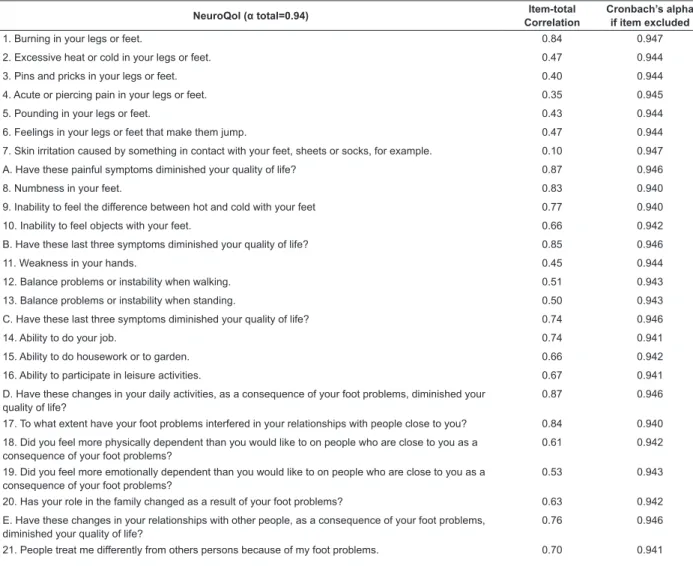
Table 2 - Item-total correlation coeficients and Cronbach’s alpha for the items of the NeuroQol when each of the
items was excluded. Ribeirão Preto, SP, Brazil, 2010 The evaluation of the internal consistency of the
items in each domain of the NeuroQol, through the
Cronbach’s alpha coeficient, obtained values greater
than 0.93. The Pearson’s product moment correlation
test was used to verify the intercorrelations between
each item of the instrument, with the total of the scale,
and the alpha values, when each item was excluded, i.e.
analysis of the extent of the negative or positive impact
of the Cronbach’s Coeficient on the performance of the
scale (Table 2).
NeuroQol (α total=0.94) CorrelationItem-total Cronbach’s alphaif item excluded
1. Burning in your legs or feet. 0.84 0.947
2. Excessive heat or cold in your legs or feet. 0.47 0.944
3. Pins and pricks in your legs or feet. 0.40 0.944
4. Acute or piercing pain in your legs or feet. 0.35 0.945
5. Pounding in your legs or feet. 0.43 0.944
6. Feelings in your legs or feet that make them jump. 0.47 0.944
7. Skin irritation caused by something in contact with your feet, sheets or socks, for example. 0.10 0.947
A. Have these painful symptoms diminished your quality of life? 0.87 0.946
8. Numbness in your feet. 0.83 0.940
9. Inability to feel the difference between hot and cold with your feet 0.77 0.940
10. Inability to feel objects with your feet. 0.66 0.942
B. Have these last three symptoms diminished your quality of life? 0.85 0.946
11. Weakness in your hands. 0.45 0.944
12. Balance problems or instability when walking. 0.51 0.943
13. Balance problems or instability when standing. 0.50 0.943
C. Have these last three symptoms diminished your quality of life? 0.74 0.946
14. Ability to do your job. 0.74 0.941
15. Ability to do housework or to garden. 0.66 0.942
16. Ability to participate in leisure activities. 0.67 0.941
D. Have these changes in your daily activities, as a consequence of your foot problems, diminished your quality of life?
0.87 0.946
17. To what extent have your foot problems interfered in your relationships with people close to you? 0.84 0.940
18. Did you feel more physically dependent than you would like to on people who are close to you as a consequence of your foot problems?
0.61 0.942
19. Did you feel more emotionally dependent than you would like to on people who are close to you as a consequence of your foot problems?
0.53 0.943
20. Has your role in the family changed as a result of your foot problems? 0.63 0.942
E. Have these changes in your relationships with other people, as a consequence of your foot problems, diminished your quality of life?
0.76 0.946
21. People treat me differently from others persons because of my foot problems. 0.70 0.941
Table 3 - Floor and ceiling effects in the responses in the domains of the NeuroQol. Ribeirão Preto, SP, Brazil, 2010
Table 4 - Pearson correlation coeficients between the
domains of the NeuroQol instrument and the components
of the SF-36. Ribeirão Preto, SP, Brazil, 2010
NeuroQol (α total=0.94) CorrelationItem-total Cronbach’s alphaif item excluded
22. I feel older than I really am because of my foot problems. 0.69 0.941
23. My self-confidence is affected because of my foot problems. 0.49 0.944
24. My foot problems turn my life into a struggle. 0.86 0.939
25. I generally feel frustrated because of my foot problems. 0.91 0.938
26. My foot problems make me feel constrained. 0.85 0.939
27. I feel depressed because of my foot problems. 0.84 0.939
F. Have these feelings about yourself, because of your foot problems, diminished your quality of life? 0.73 0.946
28. In general, I would say that my foot problems diminished my quality of life. 0.80 0.946
29. In general, I would rate my quality of life as -0.82 0.950
Table 2 - continuation
The descriptive results of the Brazilian version of the
NeuroQol also allowed the evaluation of the concentration
of the responses between the participants, which veriied the loor and ceiling effects in the sample studied. It
was observed that in the domains Loss/reduction of
sensitivity and Limitations in daily activities, there was a
loor and ceiling effect, respectively (Table 3).
Domains of the NeuroQol Adapted NeuroQol Original NeuroQol
% responses % responses % responses % responses
Pain 2.0 2.0 14.4 0.5
Loss/reduction in sensitivity 16.0 8.0 20.4 19.0
Diffuse sensory-motor symptoms 10.0 8.0 25.5 4.4
Limitations in daily activities 4.0 22.0 28.4 8.3
Interpersonal problems 2.0 4.0 28.4 8.3
Emotional distress 4.0 4.0 20.7 1.0
The evaluation of convergent construct validity
was veriied by the correlation between the NeuroQol scores and the physical and mental components of the
SF-36. While the lower SF-36 instrument values relect
a poorer perception of the general health status, in the
NeuroQol lower values indicate better QoL. The Pearson
correlation coeficients between the measures are presented in Table 3. Negative, statistically signiicant
linear correlations were found of moderate magnitude
between the domains Pain and the Mental component
(r=-0.41; p<0.01); Loss/reduction of sensitivity and the
Physical component (r=-0.45; p<0.01); Interpersonal
problems and the Physical component (r=-0.43;
p<0.01); Interpersonal problems and the Mental
component (r=-0.49; p<0.01); Emotional distress and
the Physical component (r=-0.49; p<0.01), and also
negative correlations of strong magnitude between
the domains Diffuse sensory-motor symptoms and the
Physical component (r=-0.64; p<0.01); Limitations in
daily activities and the Physical component (r=0.60);
Emotional distress and the Mental component (r =-0.71;
p<0.01). The other relationships found between the
domains of the NeuroQol and the components of the
SF-36 were of low magnitude and therefore of little value
for clinical practice (Table 4).
*0.01<p<0.05
†p<0.01
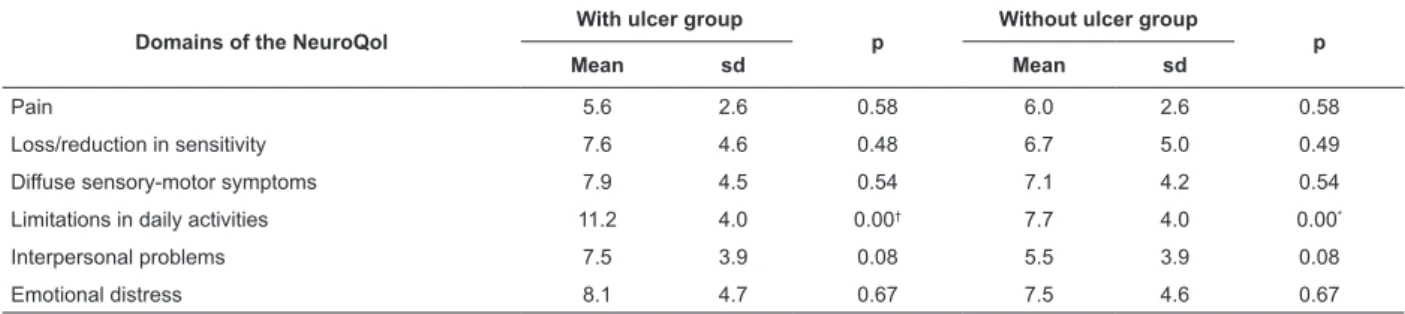
The results of the Student’s t test application,
relative to the discriminant construct validity, are
presented in Table 5.
NeuroQol
SF 36
Physical
component (PHC)
Mental
component (MHC)
Pain -0.31* -0.41†
Loss/reduction in sensitivity -0.45† -0.26
Diffuse sensory-motor symptoms -0.64† -0.19
Limitations in daily activities -0.60† -0.37†
Interpersonal problems -0.43† -0.49†
Xavier ATF, Foss MC, Marques W Jr, Santos CB, Onofre PTBN, Pace AE.
Table 5 - Comparison of the standardized mean values and respective standard deviations for the domains of the
NeuroQol between the with ulcer and without ulcer groups. Ribeirão Preto, SP, Brazil, 2010
Domains of the NeuroQol With ulcer group p Without ulcer group p
Mean sd Mean sd
Pain 5.6 2.6 0.58 6.0 2.6 0.58
Loss/reduction in sensitivity 7.6 4.6 0.48 6.7 5.0 0.49
Diffuse sensory-motor symptoms 7.9 4.5 0.54 7.1 4.2 0.54
Limitations in daily activities 11.2 4.0 0.00† 7.7 4.0 0.00*
Interpersonal problems 7.5 3.9 0.08 5.5 3.9 0.08
Emotional distress 8.1 4.7 0.67 7.5 4.6 0.67
*p<0.01 Student’s t
It was observed that, when comparing the
standardized mean values of the domains of theNeuroQol
between the with ulcers and without ulcers groups there
was a difference between the means in the domain of
Limitations in daily activities, which was expected, since
people with ulcers have a limited capacity to perform
their daily activities, such as doing their work, tasks
in the home or garden, and participating in leisure
activities, which implies a worse QoL
Discussion
The sample was determined at 50 participants,
which, according to the literature(16), permits the initial
evaluation of the psychometric properties of measuring
instruments for psychosocial variables. In relation to the
sociodemographic characterization, the sample consisted
of adults with an mean age of 56 years, low education,
with a greater frequency of females, similar to those
of other studies conducted in the same location(21-22), which can characterize the proile of people seeking
medical care in this unit. However, they differ from the
original construction study of the instrument, developed
with a population from North America and the United
Kingdom, in relation to gender and education. Regarding
the results of the adapted instrument, the highest and
lowest mean scores were for the domains Limitations in
daily activities and Pain, respectively, and in the original
study Loss/reduction of sensitivity and Pain(12).
Studies indicate that foot ulcers impact in the
physical functioning of people with diabetes and can
lead to limitations in daily activities, negatively affecting
the quality of life(23-24).Although Pain is the lower scoring
domain in the studies cited, it is present in approximately
11% of people with DPN, and its presence signiicantly
compromises the QoL of people with DM and DPN(25).
The internal consistency measured by Cronbach’s
coeficient alpha of the instrument was 0.94, a value
that can be considered adequate for the validation of
instruments(16). The domains which obtained the lowest and highest values for this coeficient were Pain (0.64)
and Limitations in daily activities (0.89), respectively.
Knowing that Cronbach’s alpha values smaller than 0.70
can damage the internal consistency(20), it is clariied
that, in this initial phase of the adaptation and validation
of the NeuroQol instrument, the sample presented is
small for the number of items of the instrument, which
justiies the development of a second phase of the
study, with a larger number of participants. In relation
to the loor and ceiling effects, it was observed in the present study, that they occurred in the domains Loss/
reduction in sensitivity (16.0) and Limitations in daily
activities (22.0), respectively. These last psychometric
analyses of the present study indicate favorable results
in relation to the expected proile for the distribution
of responses in a measuring instrument. These effects
can harm the responsiveness property of the instrument
that relates to the ability to detect changes when the
individual improves or worsens(26), that is, the ability of
the instrument to detect clinically important changes
with the passage of time(16).
In the convergent validity, the linear correlations
were negative and statistically signiicant between all
the values of the measurements of the components
of the SF-36 instrument and measurements of the
domains of the NeuroQol, as expected. While the lower
SF-36 instrument values relect a poorer perception of
the general health status, in the NeuroQol lower values
indicate a better QoL. In addition, the results showed
moderate to strong magnitude correlations between the
NeuroQol domains and the SF-36, results similar to the
original study(12). The discriminant validity only showed a statistically signiicant difference between the NeuroQol
scores of the two groups in the Limitations in daily
activities domain. The literature states that the presence
of ulcers can cause greater physical and emotional
consequences for the person with diabetes than the
that the NeuroQol be able to discriminate the greatest
impact of the disease among people with diabetes and
ulcers than among those with DM and neuropathy.
Although, the mean scores of the domains, with the
exception of Pain, were higher among the people with
ulcers, these differences were not statistically signiicant
between the groups studied. For the Pain domain, a
signiicantly higher mean was found among those without
ulcers, which could be explained by the presence of pain
in the initial stage of the diabetic neuropathy(27). The
enlargement of the sample size in subsequent studies
is recommended, in order to expand the analysis of
discriminant validity between the with and without ulcer
groups, as well as the performance of the factor analysis
of the instrument in order to verify the relevance of the
items in the domains of the instrument in the adapted
version.
Final considerations
The results of this irst phase of adaptation and
validation allow it to be considered that the NeuroQoL
has psychometric properties that permit its use as a valid
and reliable instrument. However, a second phase of the
study is needed to extend the psychometric evaluation,
principally with the coverage of different regions of
Brazil, and to consolidate its cultural adaptation and
validation. The evaluation of HRQoL is crucial in order
to establish interventions for the nursing care of people
with DM. However, it is often necessary to recognize
the inluences of a speciic situation of health-illness,
in order to direct actions to prevent, identify early and
intervene in health injuries which can compromise the
biopsychosocial aspects of the person.
References
1. Schmidt MI, Duncan BB, Silva GA, Menezes AM,
Monteiro CA, Barreto SM, Chor D, Menezes PR. Health in
Brazil 4. Chronic non-communicable diseases in Brazil:
burden and current challenges. Lancet. [periodico na
Internet]. 2011;377. [acesso 06 set 2010]. Disponível
em: www.diabetes.org.br/attachments/lancet-collection.
pdf. DOI:10.1016/S0140-6736(11)60135-9.
2. Malerbi DA, Franco LJ. Multicenter study of the
prevalence of diabetes mellitus and impaired glucose
tolerance in the urban Brazilian population aged 30-69
Yr. Diabetes Care. 1992;15(11):1509-16.
3. Torquato MTCG, Montenegro RMJ, Viana LAI, Souza
RAHG, Lanna CMM, Lucas JCB, et al. Prevalence of
diabetes mellitus and impaired glucose tolerance in the
urban population aged 30-69 years in Ribeirão Preto (São
Paulo), Brazil. São Paulo Med J. 2003;121:224-30.
4. Moraes AS, Freitas ICM, Gimeno SGA, Mondini
L. Prevalência de diabetes mellitus e identificação
de fatores associados em adultos residentes em
área urbana de Ribeirão Preto, São Paulo, Brasil,
2006: Projeto OBEDIARP. Cad Saúde Pública.
2010;26(5):929-41.
5. Wild S, Roglic G, Green A, Sicree R, King H. Global
prevalence of diabetes. Estimates for the year 2000
projections for 2030. Diabetes Care. 2004;27(5):1047-53.
6. American Diabetes Association. Diagnosis
and classification of diabetes mellitus. Diabetes
Care.2008;32(suppl.1):S55-S60.
7. Rathur HM, Boulton AJ. The neuropathic diabetic foot.
Nat Clin Pract Endocrinol Metab. 2007;3(1):14-25.
8. Singh N, Armstrong DG, Lipsky BA. Preventing
foot ulcers in patients with diabetes. JAMA.
2005;293(2):217-28.
9. Schmid H, Neumann C, Brugnara L. O diabetes melito
e a desnervação dos membros inferiores: a visão do
diabetólogo. J Vasc Br. 2003;2(1):37-48.
10. Porciúncula MVP, Rolim LCP, Garofolo L, Ferreira SBG.
Análise de fatores associados à ulceração de extremidades
em indivíduos diabéticos com neuropatia periférica. Arq
Bras Endocrinol Metab. 2007;51(7):1134-42.
11. Tentolouris N, Petrikkos G, Vallianou N, Zachos C,
Daikos GL, Tsapogas P, et al. Prevalence of
methicillin-resistant Staphylococcus aureus in infected and
uninfected diabetic foot ulcers. Clin Microbiol Infect.
2006;12(2):186-9.
12. Vileikyte L, Peyrot M, Bundy C, Rubin RR, Leventhal
H, Mora P, et al. The development and validation of
a neuropathy- and foot ulcer-specific quality of life
instrument. Diabetes Care. 2003;26(9):2549-55.
13. Vileikyte L. Psychological aspects of diabetic
peripheral neuropathy. Diabetes Rev. 1999;7:387-94.
14. Ferrer M, Alonso J, Prieto L, Plaza V, Monsó E,
Marrades R, et al. Validity and reliability of the St
George’s Respiratory Questionnaire after adaptation to
a different language and culture: the Spanish example.
Eur Respir J. 1996;9(6):1160-6.
15. Pasquali L. Princípios de elaboração de escalas
psicológicas. Rev Psiquiatr Clín. (São Paulo).
1998;25(5):206-13.
16. Terwee CB, Bot SDM, Boer MR, van der Windt
DAWM, Knol DL, Dekker J, et al. Quality criteria were
proposed for measurement properties of health status
questionnaires. J Clin Epidemiol. 2007;60:34-42
short-Xavier ATF, Foss MC, Marques W Jr, Santos CB, Onofre PTBN, Pace AE.
form health survey (SF-36). I. Conceptual framework
and item selection. Med Care. 1992;30(6):473-83.
18. Ciconelli RM, Ferraz MB, Santos W, Meinão I,
Quaresma MR. Tradução para a língua portuguesa
e validação do questionário genérico de avaliação
de qualidade de vida SF-36 (Brasil SF-36). Rev Bras
Reumatol. 1999;39:143-50.
19. Swinscow TDV. Statistics at square one. [Internet].
9ª ed. London: Br Med J.Group, 1997. [acesso 1 jun
2009]. Disponível em: http://www.bmj.bmjjournals.
com/collections/statsbk/11.dtl
20. Fayers PM, Machin D. Quality of life: assessment,
analysis and interpretation. New York: John Wiley; 2000.
21. Pace AE, Ochoa-Vigo K, Caliri MHL, Fernandes
APM. Oconhecimento sobre diabetes mellitus no
processo deautocuidado. Rev. Latino-Am. Enfermagem.
2006;14(5):728-34.
22. Villas-Boas LCG, Foss MC, Foss-Freitas MC, Torres
HC, Monteiro LZ, Pace AE. Adesão à dieta e ao exercício
físico das pessoas com diabetes mellitus. Texto Contexto
Enferm. 2011;20(2):272-9.
23. Ribu L, Hanestad BR, Moum T, Birkeland K, Rustoen
T. A comparison of the health-related quality of life in
patients with diabetic foot ulcers, with a diabetes group
and a nondiabetes group from the general population.
Qual Life Res. 2007;16(2):179-89.
24. Meijer JWG, Trip J, Jaegers SMHJ, Links TP, Smits
AJ, Groothoff JW, et al. Quality of life in patients with
diabetic foot ulcers. Disabil Rehabil. 2001;33:336-40.
25. Benbow SJ, Wallymahmed ME, MacFarlane IA.
Diabetic peripheral neuropathy and quality of life. Q J
Med. 1998;91(11):733-7.
26. Fayers PM, Machin D. Quality of life. The assessment,
analysis, and interpretation of patient-reported
outcomes. 2.ed. Chichester: England John Wiley; 2007.
27. Boulton AJM, Knight G, Drury J, Ward JD. The
prevalence of symptomatic diabetic neuropathy
in an insulin-treated population. Diabetes Care
1985;8:125–8.
Received: Dec. 6th 2010