www.reumatologia.com.br
REVISTA BRASILEIRA DE
REUMATOLOGIA
Original article
Translation, cultural adaptation and validation into portuguese
(Brazil) in Systemic Sclerosis Questionnaire (SySQ)
Roberta Ismael Lacerda Machado
a, Lais Medeiros Souto
a,
Eutilia Andrade Medeiros Freire
b,c,*
a Universidade Federal da Paraíba (UFPB), João Pessoa, PB, Brazil
b Rheumatology Service, Hospital Universitário Lauro Wanderley, João Pessoa, PB, Brazil
c Department of Internal Medicine, Universidade Federal da Paraíba (UFPB), João Pessoa, PB, Brazil
a r t i c l e i n f o
Article history:
Received 2 February 2013 Accepted 2 September 2013
Keywords:
Systemic sclerosis Quality of life
Validation of questionnaire
a b s t r a c t
Introduction: Systemic sclerosis (SSc) is a multisystem disease, autoimmune disorder char-acterized by a ibroblastic disfunction, with signiicant impact on quality of life (QoL), mea-sured by instruments or questionnaires that usually were formulated in other languages and in different cultural contexts.
Objective: Translate into Brazilian Portuguese, cross cultural adaptation and assess the reli-ability and validity of the Systemic Sclerosis Questionnaire (SySQ).
Methodology: Translation and adaptation: into Portuguese and cross-cultural adaptation was performed in accordance with studies on questionnaire translation methodology into other languages. Reliability: it was analyzed using three interviews with different inter-viewers, two on the same day (interobserver) and the third within 14 days of the irst as-sessment (intraobserver).Validity was assessed by correlating clinical and quality of life parameters with the domain scores of Sysc. Statistical analysis: a descriptive analysis of the study sample. Reproducibility was assessed using an intraclass correlation coeficient (ICC). Internal consistency was assessed using Cronbach’s alpha coeficient. To assess va-lidity we used Spearman correlation coeficient. Five percent was the level of signiicance adopted for all statistical tests.
Results: In the evaluation of the questionnaires, the results were similar to the original questionnaire, the internal consistency ranging between 0.73 and 0.93 for each item. The interobserver reproducibility was very good for all domains (α = 0.786 to 0.983) and
intrao-bserver agreement was considered very good for general symptoms domain (ICC = 0.916), good for musculoskeletal symptoms domain (ICC = 0.897) and cardiopulmonary domain (ICC = 0.842) and reasonable for gastrointestinal symptoms domain (ICC = 0.686).
Conclusion: The Brazilian Portuguese version of SySQ proved to be reproducible and valid for our population, using a recognized methodology for translation and cultural adaptation of questionnaires, as well as to assess the reproducibility and validity.
© 2014 Elsevier Editora Ltda. All rights reserved.
* Corresponding author.
E-mail: [email protected] (E.A.M. Freire).
Tradução, adaptação cultural e validação para a língua portuguesa (Brasil) do Systemic Sclerosis Questionnaire (SySQ)
Palavras-chave:
Esclerose sistêmica Qualidade de vida Validação de questionário
r e s u m o
Introdução: A esclerose sistêmica (ES) é uma doença multissistêmica, autoimune, caracte-rizada por disfunção ibroblástica e vasculopatia, causando grande impacto na qualidade de vida (QV). Esta é mensurada por instrumentos ou questionários, geralmente formulados em outros idiomas e inseridos em contextos culturais distintos.
Objetivo: Traduzir, adaptar culturalmente e validar para a língua portuguesa (Brasil) o ques-tionário do Systemic Sclerosis Questionnaire (SySQ) de QV em ES.
Metodologia: Tradução e adaptação: etapa realizada de acordo com metodologia especíi-ca de tradução de questionários. Coniabilidade: foi analisada através de três entrevistas, realizadas por diferentes entrevistadores, sendo duas no mesmo dia (interobservação) e uma terceira após 14 dias (intraobservação). Validade: avaliada pela correlação clínica e parâmetros de QV com os domínios do Sysc. Análise estatística: realizada análise descri-tiva da amostra. A reprodutibilidade foi avaliada através de um coeiciente de correlação intraclasse (ICC) e a consistência interna pelo coeiciente alfa de Cronbach, já para analisar a validade utilizou o coeiciente de correlação de Spearman.
Resultados: Foram observados 16 pacientes portadores de ES. Os nossos resultados foram semelhantes aos do questionário original, com a consistência interna variando entre 0,73 e 0,93 para cada item. A reprodutibilidade interobservador foi muito boa para todos os do-mínios (α = 0,786 a 0,983), e a intraobservador foi muito boa para o domínio de sintomas
gerais (CCI = 0,916), boa para os domínios de sintomas musculoesqueléticos (CCI = 0,897) e cardiopulmonares (CCI = 0,842) e razoáveis para o de sintomas gastrintestinais (CCI = 0,686).
Conclusão: A versão na língua portuguesa do SySQ mostrou-se reprodutível e válida para nossa população através de metodologia reconhecida para tradução e adaptação cultural de questionários.
© 2014 Elsevier Editora Ltda. Todos os direitos reservados.
Introduction
Systemic sclerosis (SSc) is a multisystemic autoimmune dis-ease characterized by ibroblast dysfunction, along with mi-crovascular involvement, culminating in skin and internal or-gans ibrosis.1 Clinically, the extent of cutaneous and internal
organ involvement by this disease and its severity vary a great deal.2 The disease usually follows a chronic, monophasic and
indolent course, and only in rare cases relapses occur. The course of the disease is slow and indolent without major complications that interfere signiicantly with the quality of life of the affected individual. Nevertheless SSc can exhibit progressive cutaneous and vascular involvement, re-sulting in considerable morbidity with impaired physical and functional appearance, which can lead to a decreased social adequacy. Severe gastrointestinal, renal, and cardiac affections, hypertension and/or interstitial lung disease con-tribute to the mortality rate of the disease, as well as to in-dividual and social performance. Compared with systemic sclerosis, few clinical conditions cause such functional and organic limitations; these issues should be addressed spe-ciically during the evaluation of these patients.
In the last two decades, the results of the assessment focused on the patient's opinion demonstrate a signiicant role in the study of chronic diseases, in addition to the mor-bidity and mortality traditionally measured. In the Ameri-can College of Rheumatology (ACR), the outcome measures
in clinical trials committee, OMERACT (Outcome Measures in Rheumatology Clinical Trials)3 has recognized the
impor-tance of the measurement of function and welfare from the perspective of the patient,as a criteria to determine clinical improvement.
Physiological measures provide essential information to clinicians, but often correlate less with functional capacity and welfare; aspects which patients are familiar and most interested in.
These assessment measures, increasingly used in clinical trials, are instruments or questionnaires that, for the most part, were formulated in English, targeted for it’s use in the English-speaking population and can be generic or speciic for certain conditions. In order for them to be used in other populations, measures should follow pre-established norms published in the literature for its translation in a speciic cul-tural context.4 And for the clinical use in a speciic
popula-tion, their psychometric properties also must to be validated locally, in order to make sure that they are reliable for the as-sessment of what they propose. The properties of a measure are its reliability, validity and responsiveness.5
Ruof et al.6 developed a questionnaire often reported by
The Likert scale (graded 1-4) was used to score the items due to its ease of understanding, referring to the ability to perform an activity (1 means “without dificulty” and 4 means “unable”), intensity of symptoms (0 corresponds to “absent” and 4 to “very intense”) and frequency of symp-toms (1 equals to “never” and 4 to “always”). Without a doubt, the Likert scale is a valid and reproducible measure in this population.
In Brazil, we have no speciic questionnaires to assess SSc patients validated for use in our population. The aim of this study was to translate into Brazilian Portuguese, adapt cultural differences and validate the SySQ questionnaire, so that it can be used in clinical practice and in clinical trials involving SSc patients in Brazil.
Methodology
For our sample composition, 16 SSc patients seen at the Rheu-matology Service of the Federal University of Paraíba, from various locations in the State of Paraíba, were randomly se-lected, fulilling the inclusion criteria of the study: age be-tween 18 and 65 years, diagnosis of systemic sclerosis accord-ing to the criteria of the American College of Rheumatology (ACR), and absence of dementia or cognitive impairment.
Participants were characterized based on a protocol contain-ing sociodemographic and clinical data. They were assessed by the Health Assessment Questionnaire with the visual analogue scale (VAS) for functional status, for systemic sclerosis (sHAQ) and for quality of life by the Medical Outcomes Study 36-Item Short Form Health Survey (SF-36). The questionnaires were ap-plied to patients by interviewers, given the socio-cultural level QUESTIONNAIRE OF QUALITY OF LIFE IN SYSTEMIC
SCLEROSIS
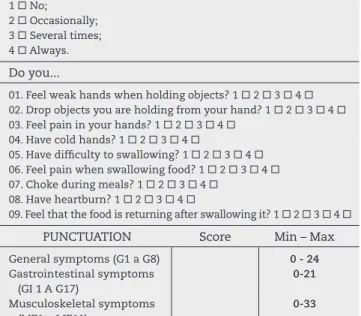
Thank you for completing this questionnaire. It will let us know more about day-to-day problems that affect patients with systemic sclerosis. It will also help us to better understand and maybe permit us to improve the treatment of this disease. For each item, mark only one number that best demonstrates the effect/importance in your life. Please do not ask for help to answer these questions, because you are the best person to know about your illness and how it affects you. There are no right or wrong answers.
Please use this scale to answer the following questions:
1 without dificulty; 2 with little dificulty; 3 with great dificulty; 4 impossible.
Can you ...
01. Cutting meat with a knife? 1 2 3 4 02. Bathing and drying yourself alone? 1 2 3 4 03. Putting on socks? 1 2 3 4
04. Rubbing cream on your body? 1 2 3 4 05. Opening and closing a tap? 1 2 3 4
06. Getting up from a chair that does not have armrests? 1 2 3 4
07. Lie down and get up from bed? 1 2 3 4 08. Walking on a lat street? 1 2 3 4 09. Climbing stairs? 1 2 3 4
10. Eating large pieces of food without cutting them? 1 2 3 4
11. Eating an apple? 1 2 3 4
Please use this scale to answer the following questions:
1 no; 2 light; 3 moderate; 4 strong.
Do you feel...
01. Pain in ingers when touching or holding objects? 1 2 3 4
02. Stiffness in your hands? 1 2 3 4 03. Stiffness in the arms? 1 2 3 4 04. Stiffness in the legs? 1 2 3 4
05. Pain in your hands when it's cold? 1 2 3 4 06. Pain in your feet when it gets cold? 1 2 3 4
07. Shortness of breath when walking on a lat street? 1 2 3 4 08. Shortness of breath when climbing a ladder (2 stairs with about
10 steps) 1 2 3 4
09. Shortness of breath when changing clothes? 1 2 3 4
Do you have ...
10. Cough? 1 2 3 4 11. Chest catarrh? 1 2 3 4
12. Dificulty with deep breathing? 1 2 3 4
Please use this scale to answer the following questions:
1 No;
2 Occasionally; 3 Several times; 4 Always.
Please use this scale to answer the following questions:
1 No;
2 Occasionally; 3 Several times; 4 Always.
Do you...
01. Feel weak hands when holding objects? 1 2 3 4 02. Drop objects you are holding from your hand? 1 2 3 4 03. Feel pain in your hands? 1 2 3 4
04. Have cold hands? 1 2 3 4
05. Have dificulty to swallowing? 1 2 3 4 06. Feel pain when swallowing food? 1 2 3 4 07. Choke during meals? 1 2 3 4
08. Have heartburn? 1 2 3 4
09. Feel that the food is returning after swallowing it? 1 2 3 4
PUNCTUATION Score Min – Max
General symptoms (G1 a G8) 0 - 24
Gastrointestinal symptoms (GI 1 A G17)
0-21
Musculoskeletal symptoms (ME1 a ME11)
0-33
Cardiopulmonary symptoms (CP1 a CP6)
0-18
of the population studied. Data were cataloged in an Excel 2010 worksheet and analyzed using SPSS version 20.
Translation and cultural adaptation
The translation and cultural adaptation followed the meth-odology used by other studies, according to Falcão et al.7 The
instrument was irst translated into Portuguese by a transla-tor luent in German (creating the irst version in Portuguese). The initial translation was reverted to the original language (back translation), and was then compared to the original in-strument. The discrepancies found were reviewed by a rheu-matologist and a general practitioner, together with transla-tors who participated in the previous steps, adapting them to generate a second version in Portuguese.
At this step, the semantic equivalence was analyzed based on vocabulary and grammar correspondence, idiomatic equivalence, translation of idiomatic expressions and also conceptual equivalence, since the terms could have semantic equivalence without conceptual equivalence.
Then, this version was applied to a group of ive patients, being added to each of the questions the "not applicable" op-tion, in order to identify questions that were not understood or that are not regularly used by our population, and thus considered culturally inappropriate.
The questions with more than 25% of responses "not ap-plicable" were analyzed by the committee, and then replaced by others with the same concept. These changes led to new versions of the questionnaire, which were reapplied to these patients until no item was considered "not applicable" by more than 15% of patients, generating the inal Brazilian Por-tuguese version of the questionnaire.
Assessment of psychometric measures of the questionnaire
The reliability of the inal version of the translated question-naire was evaluated through three interviews with each pa-tient, two held on the same day by two different interviewers (interviewer 1 and 2) to evaluate the interobserver reproduc-ibility, and the third interview was done 14 days after the irst assessment by the interviewer 1, to address intraobserver re-producibility. In the irst case, we used the intraclass corre-lation coeficient (ICC); for internal analysis of the questions consistency, Cronbach's alpha was calculated.
Validation
The validity of the questionnaire was assessed by checking the ratio of its scores by domain area with preexisting question-naires of functional assessment (HAQ and sHAQ) and of quality of life (SF-36). The Spearman correlation coeficient was used.
Results
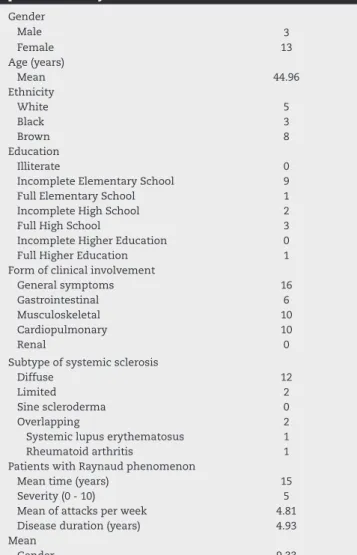
Sixteen SSc patients, 13 females (13/16) and 3 males (3/16), were analyzed. The mean age was 45.5 years, and the sociode-mographic and clinical characterization is described in Table 1. The questionnaire was translated according to the above methodology. In the pre-test, two questions were
consid-ered as “not applicable” by patients. The question “Você consegue levantar-se de uma cadeira sem a ajuda dos braços?” (“Can you get up from a chair without help of your arms?”) was not understood by four of the ive patients who report-ed not understand the meaning of “arm”, if it was their own arm or the arm of the chair. After consideration of the com-mittee, the question was changed to “Você consegue levantar-se de uma cadeira que não tenha apoio para os braços?” (“Can you get up from a chair that does not have armrests?”).
Another question not understood was “Você tem regur-gitação?” (“Do you have regurgitations?”). Again, when four out of ive patients did not understand it, an additional ex-planation was needed: “O alimento volta após as refeições?”
(“Does the food pours back after meals?”). This question was modiied by the committee to “Sente que o alimento volta após engolir?” (“Do you feel that the food returns after swal-lowing it?”). These changes have generated a new version of the questionnaire, which was reapplied to the group of ive patients until no item was considered “not applicable” by more than 15% of patients after the questions were re-formulated.
The scores obtained by patients in each SySQ domain are presented in Table 2.
Table 1 – Socioeconomic and clinical characteristics of 16 patients with systemic sclerosis.
Gender
Male 3
Female 13
Age (years)
Mean 44.96
Ethnicity
White 5
Black 3
Brown 8
Education
Illiterate 0
Incomplete Elementary School 9
Full Elementary School 1
Incomplete High School 2
Full High School 3
Incomplete Higher Education 0
Full Higher Education 1
Form of clinical involvement
General symptoms 16
Gastrointestinal 6
Musculoskeletal 10
Cardiopulmonary 10
Renal 0
Subtype of systemic sclerosis
Diffuse 12
Limited 2
Sine scleroderma 0
Overlapping 2
Systemic lupus erythematosus 1
Rheumatoid arthritis 1
Patients with Raynaud phenomenon
Mean time (years) 15
Severity (0 - 10) 5
Mean of attacks per week 4.81 Disease duration (years) 4.93 Mean
The internal consistency among domains and for each do-main is shown in Table 3, using Cronbach's alpha, as well as the interobserver reproducibility, through the intraclass corre-lation coeficient.
We compared the translated questionnaire with other in-struments already validated in the literature: the generic qual-ity of life questionnaire SF-36, the questionnaire of functional assessment HAQ plus visual analog scale for symptoms of SSc, composing the Scleroderma HAQ (sHAQ).
The SySQ domains were compared to SF-36 domains, as shown in Table 4. The general symptoms domain of SySQ revealed a strong correlation with the social aspects do-main of SF-36, and a moderate correlation with the pain,
general condition and vitality domains of the latter ques-tionnaire.
A strong correlation between the musculoskeletal symp-toms domain and the emotional domain of SF-36 was also found, besides a moderate correlation with functional ca-pacity, pain, and physical and social aspects domains of SF-36. The cardiopulmonary symptoms domain of SySQ had strong correlation with the functional capacity domain of SF-36 and moderate correlation with the domains physical aspects, pain, and general condition. The gastrointestinal symptoms domain of SySQ had no correlation with SF-36.
Table 5 shows the level of correlation between domains of SySQ and HAQ, but there was no relevant statistical
sig-Table 2 – Scores obtained by domain of SySQ questionnaire of 16 patients with systemic sclerosis.
Domains Minimum Maximum Mean Standard Deviation
General symptoms (0-24) 0 21 9.8 6.9
Gastrointestinal symptoms (0-21) 0 21 7.4 4.9
Musculoskeletal symptoms (0-33) 1 24 12.2 7.2
Cardiopulmonary symptoms (0-18) 0 16 5 4.8
Table 3 – Internal consistency and reproducibility of the SySQ questionnaire in 16 patients with systemic sclerosis, using Cronbach’s alpha and intraclass correlation coeficient, respectively.
Domains Interobserver Intraobserver
General symptoms 0.983 0.916
Gastrointestinal symptoms 0.786 0.647
Musculoskeletal symptoms 0.959 0.897
Cardiopulmonary symptoms 0.924 0.842
Internal consistence among domains 0.765
Table 4 – Correlation among SySQ and SF-36 domains.
SySQ SF-36 General symptoms Gastrointestinal symptoms
Musculoskeletal symptoms
Cardiopulmonary symptoms
Functional capacity -0.459 -0.190 -0.656b -0.725a
Physical aspects -0.473 -0.344 -0.633b -0.545b
Pain -0.559b 0.255 -0.662b -0.502a
General state -0.600b 0.164 -0.672b -0.511a
Vitality -0.619b 0.025 -0.352 -0.094
Social aspects -0.707b 0.203 -0.541a -0.288
Emotional aspects -0.390 0.258 -0.782b -0.160
Mental health -0.246 -0.19 -0.457 -0.090
a p < 0.05. b p < 0.01.
Table 5 – Correlation among SySQ domains and of HAQ and sHAQ domains.
SySQ HAQ e sHAQ General symptoms Gastrointestinal symptoms
Musculoskeletal symptoms
Cardiopulmonary symptoms
Dressing up 0.150 0.184 0.061 0.162
Stand up -0.083 0.118 0.188 0.199
Eating 0.253 0.199 0.158 0.929
Walk -0.011 0.091 0.207 0.104
Personal hygiene -0.84 0.172 0.134 0.002
Reaching objects 0.152 0.079 0.134 0.203
Grasping objects 0.272 0.222 0.238 0.230
niicance. In the other hand, Table 6 shows the correlation between the SySQ domains with the domains of visual an-alogue scale (VAS) for SSc of sHAQ. Strong correlation was found between the gastrointestinal symptoms domain of SySQ and pulmonary involvement of sHAQ.
Discussion
Assessment measures focused on the patient’s perception have been increasingly used as tools to determine clinical im-provement in clinical trials and in the clinical practice. For clinical use in a given population, these measures need to have the psychometric properties assessment validated lo-cally in order to make sure they actually measure what they purport to measure.
In Brazil, we lack speciic instruments in Portuguese to evaluate SSc patients; unlike other rheumatic diseases, spe-ciic questionnaires to evaluate patients with this condition are scarce in the literature. The Health Assessment Question-naire (HAQ) Disability Index (a questionQuestion-naire that assesses functional capacity, developed with the cooperation of rheu-matoid arthritis patients) is commonly used in clinical trials involving these patients.
Ruof et al.6 developed a self-administered questionnaire in
German covering speciic (general, gastrointestinal and car-diopulmonary) symptoms and functional limitations caused by SSc. The general symptomatology described was pain, stiffness and skin coolness. The musculoskeletal symptoms analyzed were changes in performance of complex motor functions, hand strength, elevation of extremities and gait. The cardiopulmonary symptoms evaluated were dyspnea and upper airway symptoms (cough, expectoration and limitation of inspiration); the gastrointestinal symptoms were heart-burn, regurgitation and dificulty swallowing and feeding.
A limitation of this questionnaire is that it does not evalu-ate important items such as Raynaud's phenomenon and re-nal involvement which are not covered by SySQ. Nevertheless, this questionnaire captures more appropriately the visceral symptoms of the disease, when compared to other published instruments.
In our study, the translated questionnaire proved to be re-producible, which attests to its reliability, suggesting that it can be used to evaluate SSc patients. In Brazil, this measure is important, because some questions had to be modiied in the process of cultural adaptation. Our results resemble those obtained from the original questionnaire, which showed in-ternal consistency ranging from 0.73 to 0.93 for each item. De-spite the small sample size, justiied by the rarity of the
dis-ease, no major damage was caused to the statistical analysis used, due to the rigor of the methodology adopted.
The interobserver reproducibility was good for all domains (α ranging from 0.786-0.983). The intraobserver reproducibility
was considered very good for the general symptoms domain (ICC = 0.916), good for the musculoskeletal symptoms (ICC = 0.897) and cardiopulmonary (ICC = 0.842) domains, and rea-sonably good for the gastrointestinal symptoms (ICC = 0.686) domain. Therefore, the questionnaire is considered to be re-producible. Similarly, the original instrument obtained α ≥
0.65 for all domains.
To test the validity of the questionnaire, we compared its scores with those obtained by previously validated question-naires in the literature, bearing in mind that they would not be the best tools to compare, since, unlike SySQ, they are not speciic to the disease.
Among all SySQ domains, “musculoskeletal symptoms” was the one that showed the highest number of clinically satisfactory correlations with the SF-36 domains, followed by general and cardiopulmonary symptoms domains, since this is a more comprehensive questionnaire. The gastrointestinal symptoms domain showed correlation only with pulmonary involvement domain of sHAQ.
Cruz-Dominguez et al.8 translated the questionnaire into
Spanish with the collaboration of Mexican patients, with sim-ilar results but with a weak correlation with disease severity index (p = 0.526, p <0.0001). Our service does not have the re-quired exams for the classiication of disease severity; there-fore, this topic was excluded from the assessment of patients. There was no statistically signiicant correlation with the HAQ domains, a functional assessment questionnaire, which can be explained by the fact that SySQ may be a more com-prehensive questionnaire regarding symptoms caused by SSc. Khanna and Merkel9 claim that there was great progress
in the development and validation of assessment measures in SSc, with these measures moving increasingly toward the realm of systems speciically involved with SSc.
One shortcoming of this questionnaire is that it does not assess Raynaud's phenomenon or renal involvement, impor-tant manifestations of the disease, but the author suggests the use of a visual analogue scale for Raynaud's phenomenon and physical (blood pressure determination) and laboratory (serum urea and creatinine) exams for renal involvement.6
The version of SySQ into Brazilian Portuguese proved to be reproducible and valid for use in our population, using recog-nized methodology for translation and doing the needed cul-tural adaptation of the questionnaires, as well as to assess its reproducibility and validity. Studies that assess its response sensitivity to clinical changes over time are needed.
Table 6 – Correlation among SySQ domains and the Visual Analogue Scale for SS (sHAQ) domains.
SySQ EVA General symptoms Gastrointestinal symptoms
Musculoskeletal symptoms
Cardiopulmonary symptoms
Raynaud’s phenomenon 0,133 0,351 0,058 0,400
Gastrointestinal 0,108 0,203 0,340 0,389
Lung involvement -0,215 0,724a -0,003 0,344
Pain 0,189 0,07 -0,003 0,099
Disease severity 0,407 0,024 0,281 0,380
Funding
Conselho Nacional de Desenvolvimento Científico e Tec-nológico - CNPq. Programa de Bolsas de Iniciação Científica da Universidade Federal da Paraíba (PIBIC/UFPB).
Conlicts of interest
The authors declare no conlicts of interest.
R E F E R E N C E S
1. M, Clarke AE. Scleroderma prevalence: Demographic variations in a population-based sample. Arthritis Rheum. 2009;61:400-404.
2. Della Rossa A, Valentini G, Bombardieri S, Bencivelli W, Silman AJ, D’Angelo S, et al. European multicentre study to deine disease activity criteria for systemic sclerosis. I.
Clinical and epidemiological features of 290 patients from 19 centres. Ann Rheum Dis. 2001;60:585-591.
3. Furst DE. Outcome measures in rheumatologic clinical trials and systemic sclerosis. Rheumatol. 2008;47:v29-v30. 4. Ciconelli RM. Medidas de avaliação de qualidade de vida.
Editorial. Rev Bras Reumatol. 2003;43:IX-XIII. 5. Pope JE, Bellamy N. Outcome measurement
in scleroderma clinical trials. Semin Arthrit Rheum.1993;22:22-33.
6. Ruof J, Brühlmann P, Michel BA, Stucki G. Development and validation of a self-administered systemic sclerosis questionnaire (SySQ). Rheumatol. 1999;38:535-42. 7. Falcão DM, Ciconelli RM, Ferraz MB. Translation and
cultural adaptation of quality of life questionnaire: an evaluation of methodology. J Rheumatol. 2003;30:379-85. 8. Cruz-Dominguez MP, Casarrubias-Ramirez M, Martinez
VG, Lastra OLV, Quezada LJJ, Montes-Cortes DH. Self-administered systemic sclerosis questionnaire. Validation of a Spanish version (SYSQ) in Mexicans. [abstract]. Arthrit Rheum. 2011;63:665.