Factors associated with asthma control in a pediatric reference center
Fatores associados ao controle da asma em pacientes pediátricos em centro de referência
Factores asociados al control del asma en pacientes pediátricos en centro de referencia
Vanessa Mika Kinchoku1, Irai Santana Oliveira1, Letícia Abe Watanabe2, Ângela Bueno F. Fomin3, Ana Paula B. M. Castro3, Cristina
Miuki A. Jacob4, Antonio Carlos Pastorino5
Instituição: Departamento de Pediatria da Faculdade de Medicina da Universidade de São Paulo (USP), SP, Brasil
1Aluna de Medicina e bolsista do Programa de Iniciação Científica (PIC) da Faculdade de Medicina da USP, São Paulo, SP, Brasil
2Médica pela Faculdade de Medicina da USP; Colaboradora da Unidade de Alergia e Imunologia do Departamento de Pediatria da Faculdade de Medicina da USP, São Paulo, SP, Brasil
3Doutor em Ciências pela Faculdade de Medicina da USP; Assistente da Unidade de Alergia e Imunologia do Departamento de Pediatria da Facul-dade de Medicina da USP, São Paulo, SP, Brasil
4Livre-Docente pela Faculdade de Medicina da USP; Professor Associado e Chefe da Unidade de Alergia e Imunologia do Departamento de Pediatria da Faculdade de Medicina da USP, São Paulo, SP, Brasil
5Doutor em Ciências pela Faculdade de Medicina da USP; Assistente da Unidade de Alergia e Imunologia do Departamento de Pediatria da Facul-dade de Medicina da USP, São Paulo, SP, Brasil
ABSTRACT
Objective: To describe the epidemiological and clinical data and factors associated with asthma control of asthmatic patients followed at a pediatric reference center.
Methods: Cross-sectional study including asthmatic outpatients receiving prophylactic medications from the institution. For classiication of asthma, steps of treatment and control evaluation, the IV Brazilian Guidelines for the Management of Asthma (2006) were adopted. The pres-ence of other allergies, obesity, immunodeiciency, gastro-esophageal relux and allergic sensitization were evaluated and compared between patients with or without asthma control according to the treatment step, obesity and allergic sensitization.
Results: 300 patients with asthma (1.38M:1F) were included; median age=10.8 years; median age at onset of symptoms=1.0 year. Among parents and/or siblings, 78% re-ported atopy. Personal history showed other allergic diseases in 292 patients (96% rhinitis, 27% atopic dermatitis, 18% allergic conjunctivitis, 6% food allergy). IgA deiciency was diagnosed in seven cases and IgG2 deiciency in four. Obesity was noted in 34/233 patients (15%) and overweight/obesity were associated with asthma poor control (p<0.023). Among 118 patients multisensitizated, the frequency of poor asthma
control was greater (22 (19%) cases; p=0.049, OR 1.9; 95%CI 1.03-3.50). Among the patients, 180 (60%) were treated according steps 3 and 4; 122 children (45%) were considered controlled and 112 (41%) were partially con-trolled.
Conclusions: Allergic rhinitis was the allergic disease more associated with asthma. The prevalence of IgA dei-ciency was 20 times higher than in the general population. Total or partial control of asthma symptoms was obtained in 85% of the cases. Overweight/obesity and multisensitization were associated to poor asthma control.
Key-words: asthma; adolescent; therapeutics; obesity.
RESUMO
Objetivo: Descrever os dados epidemiológicos, clínicos e os fatores associados ao controle da asma em pacientes asmáti-cos seguidos em um ambulatório pediátrico especializado.
Métodos: Estudo transversal de pacientes asmáticos ambulatoriais, para os quais eram fornecidas medicações proiláticas. A classiicação da asma, as etapa de tratamento e a avaliação do controle seguiram a IV Diretrizes Brasilei-ras para o Manejo da Asma, de 2006. Os fatores avaliados foram: outras alergias, obesidade, imunodeiciências, reluxo
Endereço para correspondência Antonio Carlos Pastorino
Rua Dr João Batista Soares de Faria, 113. apto. 141 – Santana CEP 02403-050 – São Paulo/SP
E-mail: [email protected]
Fonte financiadora: PIC da USP (Modalidade Bolsa Santander)
Conflito de interesse: nada a declarar
gastresofágico e sensibilização alérgica, sendo comparados pacientes com asma controlada ou não com relação à etapa do tratamento, à obesidade e à sensibilização alérgica.
Resultados: Foram analisados 300 pacientes com asma (1,38M:1F), com mediana de idade de 10,8 anos, e de início dos sintomas de 1,0 ano. A atopia estava presente em 78% dos pais e/ou irmãos. Antecedentes pessoais de doenças alér-gicas ocorreram em 292 pacientes (96% rinite, 27% dermati-te atópica, 18% conjuntividermati-te alérgica, 6% alergia alimentar). Foram diagnosticados sete casos de deiciência de IgA (DIgA) e quatro de IgG2; obesidade em 37/253 (15%), sendo que sobrepeso e obesidade estiveram associados à falta de controle (p=0,023). Em 118 pacientes com multissensibilização, pre-dominaram casos não controlados (22 (19%) casos; p=0,049; OR 1,9; IC95% 1,03-3,50). Entre os 180 casos (60%) em tratamento nas etapas 3 e 4, 122 (45%) estavam controlados e 112 (41%) parcialmente controlados.
Conclusões: A rinite foi a alergia mais associada à asma e a prevalência de DIgA foi 20 vezes maior do que na po-pulação geral. O controle parcial ou total dos sintomas da asma foi obtido em 85% dos casos. Obesidade/sobrepeso e multissensibilização foram associadas à falta de controle da asma.
Palavras-chave: asma; adolescente; terapêutica; obesidade.
RESUMEN
Objetivo: Describir los datos epidemiológicos, clínicos y los factores asociados al control del asma en pacientes asmá-ticos seguidos en ambulatorio pediátrico especializado.
Métodos: Estudio transversal de pacientes asmáticos ambulatoriales, para los que se suministraban medicaciones proilácticas gratuitamente. La clasiicación del asma, las etapas de tratamiento y la evaluación del control siguieron las IV Directrices Brasileñas para el Manejo del Asma, 2006. Los factores evaluados fueron: otras alergias, obesidad, inmuno-deiciencias, relujo gastroesofágico y sensibilización alérgica, siendo comparados pacientes controlados o no respecto a la etapa del tratamiento, obesidad y la sensibilización alérgica.
Resultados: Se analizaron a 300 pacientes con asma (1,38M:1F); mediana de edad de 10,8 años, mediana del inicio de los síntomas de 1,0 año. La atopía estaba presente en el 77,8% de los padres y/o hermanos. Antecedentes perso-nales de enfermedades alérgicas ocurrieron en 292 pacientes (95,6% rinitis, 27% dermatitis atópica, 18,3% conjuntivitis alérgica, 6% alergia alimentar). Se diagnosticaron 7 casos de
deiciencia de IgA (2,3% de DIgA) y 4 de IgG2; obesidad en 37/253 (14,6%), siendo que el sobrepeso y la obesidad estuvieron asociados a la falta de control (p=0,023). En 118 pacientes con multisensibilización predominaron casos no controlados (18,6% frente a 9,8%) (p=0,049; OR 1,9; IC95% 1,03-3,50). Entre los 180 casos (60,2%) en trata-miento en las etapas 3 y 4, 122 estaban controlados (45,0%) y 112 (41,3%), parcialmente controlados.
Conclusiones: La rinitis fue la alergia más asociada al asma y la prevalencia de DIgA fue 20 veces superior a la población general. El control parcial o total de los síntomas del asma se obtuvo en el 86,3% de los casos. Obesidad/ sobrepeso y multisensibilización fueron asociadas a la falta de control del asma.
Palabras clave: asma; adolescente; terapéutica; obesidad; sensibilización.
Introduction
Asthma remains a public health problem worldwide. According to Brazilian data, it represents the third lead-ing cause of hospitalizations, accountlead-ing for 1.8% of total admissions between 2008 and 2010, and 60% (1.09%) of these patients are younger than 19 years(1).
Asthma is considered a chronic systemic inlammatory process involving the airway, with clinical variations de-pending on the interaction between different genes and the environment where the individual lives(2). Knowledge about the existence of several asthma phenotypes, with dif-ferent underlying inlammatory processes, could provide a more speciic treatment. However, most centers for asthma treatment in Brazil do not detect the inlammatory process involved. Thus, asthma treatment is most frequently based on clinical control(2).
The Allergy and Immunology Unit of Instituto da Criança of the HCFMUSP has developed a line of research on allergic diseases in children and adolescents. The Unit has a specializ-ing outpatient clinic in asthma and rhinitis, where patients are followed up regularly according to the severity and their level of disease control. Patients also receive prophylactic and for the crisis medications on a regular basis e free of payment.
Therefore, the objective of the present article is to describe the proile of the asthmatic patients followed up at a pediatric specializing outpatient clinic in asthma and rhinitis and the factors that may be associated with lack of asthma control. Such knowledge may provide subsidies to new Brazilian studies at Brazilian centers looking for treatment for asthma control and improved quality of life of their patients.
Method
In early 2008, was developed a protocol for a descriptive cross-sectional study on the clinical and laboratory proile of patients treated at the specializing outpatient clinic in asthma of the Allergy and Immunology Unit of Instituto da Criança. Epidemiological data, personal and family history, associated diseases, physical environment, and vaccination schedule were included in the protocol. In addition, infor-mation about the onset of asthma symptoms, clinical and therapeutic characteristics, as well as the analysis of pulmo-nary function tests, laboratory tests, and imaging studies were also part of the protocol. The illing of the protocols was based on the review of medical records containing the data reported by patients and caregivers of all patients with a primary diagnosis of asthma. The present study was ap-proved by the Research Ethics Committee at the HCFMUSP (CAPPesq) as part of the undergraduate research project for medical students at the FMUSP.
We evaluated 313 patients with primary diagnosis of asthma and/or rhinitis who were being followed up at the
outpatient clinic between March and November 2008. Of these, 13 patients were excluded because they were only diagnosed with rhinitis. The inal convenience sample in-cluded 300 patients.
The diagnosis and classiication of asthma severity were established using the Global Strategy for Asthma Man-agement and Prevention, Global Initiative for Asthma (GINA-2006), 2007 updated version, and the 4th Brazilian Guidelines for Asthma Management. Asthma was classiied at admission and during protocol illing as intermittent, mild persistent, moderate, or severe. Level of control was divided into: full control, partial control, or uncontrolled. The stages of treatment were also documented(2,5).Tables 1 and 2 summarize the levels of asthma control and treatment steps. In relation to the steps of treatment, patients receive treatment only for the crisis at stage I, without the need for maintenance medications. At stages II, III, IV and V, maintenance medications are added gradually. The drugs of choice were inhaled corticosteroids at increasing doses, combined or not with long-acting bronchodilators, anti-leukotrienes and other medications, in order to achieve full control of symptoms(2,5).
Patients’ weight and height were measured during the follow-up visits, and their body mass index (BMI) was cal-culated by dividing the weight by squared height. BMI was classiied into percentiles according to age, based on data from the World Health Organization(6). Considering their BMI, patients were classiied as malnourished (BMI below 5%), overweight (BMI above 85%), obese (BMI above 95%), and normal (BMI between 5-85%).
Anemia was deined based on the recommendation of the World Health Organization, which established the hemoglobin level below 11.5g/dL for children between 5 and 12 years old(7). Presence of eosinophilia was established when the absolute count of eosinophils was higher than 500 cells/µL and increased immunoglobulin E (IgE) were
PARAMETER Controlled Partlly Controlled
(At least 1 in any week) Uncontrolled
Daytime symptoms None or minimal 2 or more / week
3 or more parameters present in any week
Night awakenings None at least 1
Need for rescue medications None 2 or more per week
Limitation of activities None Present at any time
PEF or FEV1 Normal or near normal <80% predicted or personal best, if known.
Exacerbation None 1 or more per year 1 in any week
Table 1 - Levels of control of asthmatic patients(2,5)
considered when their levels were higher than 200IU/mL. The diagnosis of immunodeiciencies, particularly of IgA deiciency and IgG2 subclasses, was according to the criteria proposed by the Pan American Group for Im-munodeiciency (PAGID) and the European Society for Immunodeiciencies (ESID)(8,9).
The immediate hypersensitivity skin test (prick test) was performed in 237 patients. Allergenic extracts, positive control (histamine), and negative control were placed on the volar forearm. A disposable plastic pricker was used to pressure the skin surface. The results were determined by measuring the diameter of the wheal formed twenty minutes later. The test was positive if the wheal was equal to or larger than 3mm in diameter(10). Those patients who were positive to at least three allergens were considered to have multiple allergen sensitization.
For the statistical analysis, the tables included percentage, means and medians, showing standard deviation and 95% conidence interval. The computer program Instat 5.0 was used to calculate the odds ratio (OR) between BMI, IgE values, allergic sensitization, and steps of treatment regard-ing the control of asthma.
Results
We analyzed 300 medical records of patients diagnosed with asthma (174 males, M: F=1.38). Mean age at protocol illing was 11 years old (median: 10.8 years, ranging from 2.1 years to 20.2 years).
The mean age at the onset of asthma symptoms was 1.7 years (median=1 year, ranging from 0.5 months to 11 years). The mean follow-up period at the outpatient clinic was 3.6 years (median=2.7 years, ranging from 1-20 years).
Regarding the personal history, 17.2% (39/226) received a previous diagnosis of bronchiolitis and 78.5% (205/261) reported at least one episode of pneumonia before the start of follow-up. In terms of birth conditions and neonatal period, 8.8% (20/226) required oxygen therapy, and 14% (32/230) were premature.
A family history of atopy (parents or siblings) was reported by 77.8% (200/257). The prevalence of parent and/or mother with asthma was 35.4% (91/257) and, among siblings, there were 76 cases of asthma (29.5%).
With regard to the conditions of the physical environ-ment at home, smoking (passive or active) was reported in 43.8% of cases (99/226), presence of animals at home in 49.4% (116/235), dust in 60.7% (88/145), and moist in 37.8% (68/180).
We were able to classify the initial severity of asthma in 270 patients. Of these, 15.9% were classiied as intermit-tent, 23.3% as mild persisintermit-tent, 40.4% as moderate per-sistent, and 20.4% as severe persistent. Patients were also classiied according to the initial and current stage of treat-ment and the results are shown in Figure 1. With regard to symptom control, 271 patients were evaluated at the conclusion of the protocol, with 45% of them controlled, 41.3% and 13.7% partially controlled and uncontrolled, respectively. The association of asthma with allergic rhinitis
STAPS OF TREATMENT
STEP 1 STEP 2 STEP 3 STEP 4 STEP 5
ASTHMA EDUCATION ENVIRONMENTAL CONTROL Short-acting beta 2*
Y/N
Short-acting beta 2* Y/N
Short-acting beta 2* Y/N
Short-acting beta 2* Y/N
Short-acting beta 2* Y/N
Option Select one of the
options below
Select one of the options below
Add 1 or more relative to step 3
Add 1 or more relative to step 4
Preferential Option Low-dose IC
Low-dose IC + LABA
Moderate or high dose of IC + LABA
Low-dose oral corticosteroids Children <6 years IC
moderate dose
Other Options Leukotriene inhibitors or Chromones
Moderate dose IC Leukotriene Inhibitors
Anti-IgE Low-dose IC +
anti-leukotriene
Theophylline Low-dose IC +
theophylline
Table 2 - Stages of asthma treatment for children older than 5 years according to severity(2,5)
Figure 1 - Initial and current classiication of patients regarding the stage of treatment according to the 4th Brazilian Guidelines for Asthma Management, 2006
47
105
86
17
7 47
72
1 54
126
0 20 40 60 80 100 120 140
I II III IV V
Stage of Treatment
N
o of cases
Initial Current
was found in 95.6% of the 300 patients, atopic dermatitis in 27%, allergic conjunctivitis in 18.3%, and food allergy in 6%. The coexistence of gastroesophageal relux was only investigated in 70 patients, being diagnosed in 40 of them (57.1%). There were 11 patients with immunodeiciency, seven of them with IgA deiciency (IgAD) and four with IgG2 deiciency.
The analysis of BMI performed in 253 patients showed that 166 (65.6%) were within the normal range, 30 were overweight (11.9%), 37 were obese (14.6%), and 20 were considered malnourished (7.9%). After analyz-ing the control of asthma in relation to BMI in 231 pa-tients, we found that 11.1% (2/18) of the malnourished patients, 21.4% (6/28) of the overweight, and 21.2% (7/33) of the obese had uncontrolled asthma symptoms. In those patients with a BMI within the normal range, 9.2% (14/152) had uncontrolled symptoms (Table 3). The statistical analysis comparing overweight and obese patients with the remaining patients in relation to the control of asthma symptoms showed a signiicant differ-ence (p=0.023), with a 2.6 times greater risk (OR=2.6, 95%CI 1.17-5.80) for uncontrolled asthma in patients with overweight and/or obesity.
Laboratory tests detected anemia in only 6.5% of cases (18/275). With regard to the absolute number of eosino-phils, 48% had eosinophilia and 52% of 300 patients had normal values.
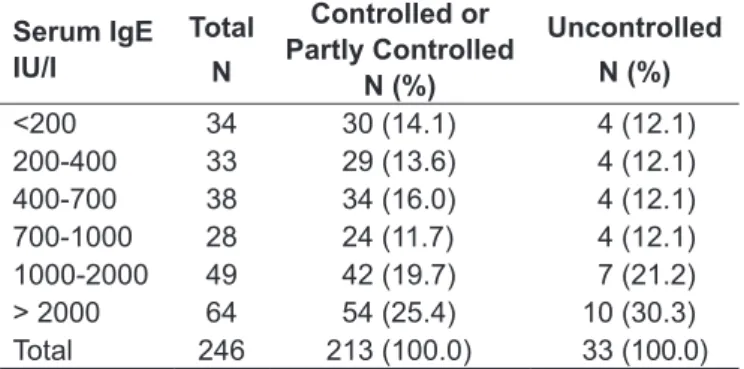
Serum IgE level was analyzed in 266 patients, showing that 84.2% of them had increased values (>200IU/mL), and the percentage of patients with serum IgE>1000IU/mL was 45.1%. There was no difference in terms of the
control of asthma symptoms in relation to serum IgE levels (Table 4).
As for the immediate hypersensitivity skin test (prick test), the most frequent positive allergens were Dermatophagoides
pteronyssinus (Dpt) with 71.8% (161/224), Dermatophagoides
farinae (Df) with 67.9% (150/221), and Blomia tropicalis (Bt) with 64.9% (146/225). There was less than 20% positivity to other home environment allergens, including cockroaches, dog and cat dander, and fungi. Among the 118 patients who had multiple allergen sensitization (>3 positive prick test),
there was a signiicantly larger number of uncontrolled cases of asthma (18.6% versus 9.8%), p=0.049, OR 1.9, 95%CI 1.03-3.50), as shown in Table 5.
Table 3 - Distribution of 231 patients with asthma regarding control of asthma symptoms and their BMI
% BMI Controlled or Partly controlled N (%)
Uncontrolled
N (%)
<5 16 (7.9) 2 (6.9)
5-85 138 (68.3) 14 (48.3)
85 to 95 22 (10.9) 6 (20.7)*
>95 26 (12.9) 7 (24.1)*
TOTAL 202 (100.0) 29 (100.0)
*p=0.023; OR=2.6; 95%CI 1.17 to 5.80
Table 4 - Distribution of patients according to IgE serum levels and control of symptoms in 246 patients with asthma
Serum IgE IU/l
Total
N
Controlled or Partly Controlled
N (%)
Uncontrolled
N (%)
<200 34 30 (14.1) 4 (12.1)
200-400 33 29 (13.6) 4 (12.1)
400-700 38 34 (16.0) 4 (12.1)
700-1000 28 24 (11.7) 4 (12.1)
1000-2000 49 42 (19.7) 7 (21.2)
> 2000 64 54 (25.4) 10 (30.3)
Total 246 213 (100.0) 33 (100.0)
p=1; OR = 1.2; 95%CI 0.39 to 3.62
Table 5 - Distribution of 271 patients with asthma regarding multiple allergen sensitization and asthma control
Prick Test Uncontrolled Asthma N (%)
Controlled
Asthma N (%) Total > 3 positive 22 (59.5)* 96 (41.0) 118 (43.5)
≤ 3 positive 15 (40.5) 138 (59.0) 153 (56.5)
Total 37 (100.0) 234 (100.0) 271 (100.0)
Discussion
Asthma is a highly prevalent disease worldwide, show-ing a tendency to increase in developshow-ing countries(2,3). In a multicenter study using a standardized questionnaire (the International Study of Asthma and Allergies in Childhood - ISAAC), the prevalence of asthma symptoms, rhinitis and eczema in children aged 6-7 years and 13-14 years from dif-ferent countries could be assessed and compared(11,12). In Bra-zil, the rates are high, around 20% for both age groups(13).
In children under 5 years old, the diagnosis of asthma is complex because it is based primarily on clinical aspects and history data, since it is dificult to perform objective tests in this age group(2,3). Distinguishing the phenotypes present in this phase, such as recurrent transient wheezing and persistent wheezing(14), is important, but often only the continued observation of these children will determine whether the wheezing is transient and will disappear between 3 and 6 years old. Some risk factors are considered important for this differentiation, including: personal or family history of atopy, eosinophilia and evidence of sensitivity to airborne allergens and/or food(15,16).
In the irst years of life, wheezing is most often related to viral infections of the respiratory tract. Respiratory syncytial virus is the most important agent, affecting up to 70% of children in the irst year of life(17).Some studies have shown that hospitalizations for bronchiolitis are an independent risk factor for developing asthma(18,19), while other studies have suggested a clear epidemiological link between viral infection and the origin of asthma(20,21). In the present study, 17.2% of patients reported prior history of bronchiolitis and the symptoms began at the mean age of 20 months, which may relect immaturity of the immune system and also more frequent contact with viral agents.
Among the patients analyzed in the present study, there was a slight prevalence of males. Other studies have also shown higher prevalence of asthma in males in the pediatric age group(16,22,23). After reviewing several articles, Postma found a higher prevalence of males until puberty, with a reversal of this trend occurring in adulthood and prevalence of women with cases of severe asthma(22).
In 2003, Kuruulaaratchy et al presented the results of a 10-year follow-up of 1,456 newborns. Of these, 40.3% (n=417) had wheezing ever in life. Among those patients who had symptoms before 4 years old, 63% were consid-ered to have transient wheezing and 37% had persistent wheezing. Risk factors associated with persistent wheezing
were family history of asthma, recurrent chest infections at 2 years, and positive prick test at age 4(24). These data reinforce the importance of having a positive family history as part of a clinical diagnosis of asthma, which occurred in 77.8% of the cases in our sample. Several studies have shown that family history of atopy is an independent risk factor for developing asthma(15,16,23).
Several studies have suggested a strong associa-tion between asthma and smoking in the home environment(15,16,23). Both maternal smoking during pregnancy and passive smoking in the home environment determine high risk for developing asthma(15,16,25). This condition of passive smoking was present in 43.8% of our cases, and the families were counseled to reduce exposure to secondhand smoke at home.
Asthma is a disease that may be related to other atopic disorders. Allergic rhinitis is the disease most often associ-ated with asthma. Some authors consider the two diseases as a single inlammatory process of the airway, sharing the same pathophysiology, triggering factors, and environmental risk factors(26,27). In the present study, rhinitis was associated with asthma in 95.6% of patients. The control of symptoms of rhinitis in asthmatic patients is essential, as this combina-tion may lead to an increased need for medicacombina-tion to control asthma, worsening the quality of life of patients and increas-ing costs and demand for health care services(27,28).
Deiciency of IgA and IgG subclasses have been related to atopic diseases such as asthma(29,30). In the present study, we only performed the immunological evaluation of patients with severe asthma or those with recurrent infections. We found 11 patients with humoral immunodeiciency, seven of them suffering from IgA deiciency with a prevalence of 2.3%, which is quite higher than the rate among Brazil-ian blood donors and healthy pregnant women, who have a prevalence of 0.1% (1 in 965 donors)(31).Such datum is easily explained by the fact that immunodeiciencies pre-dispose to allergic diseases, which can often be the clinical expression of the immunodeiciencies. In 2000, the analysis of the immunological proile of 45 asthmatic patients with recurrent nasopharyngitis found 12 (26%) patients with IgA deiciency, two of them below 7 mg/dl and 10 patients with partial deiciency(32).
although there was no difference in severity and treatment. In 2007, Carrol et al(34) conducted a retrospective study comparing obese and non-obese children with asthma at an emergency department. These authors found no difference between the severity of symptoms or the therapy received, but the obese children were more likely to require hospitalization and intensive care during exacerbations. With regard to the interference of overweight and obesity in asthma control, our results were in agreement with the literature, suggest-ing worsensuggest-ing of the lung function and symptom control in patients with high BMI.
Type I hypersensitivity reactions are involved in the proc-ess of respiratory allergies and the main antibody related to this process is IgE. Thus, increase in total and speciic IgE has been correlated with the presence of asthma and other atopic diseases(16,35,36). In 2000, an analysis of 1,219 patients conducted by Beeh et al showed that increased serum IgE is a risk factor for asthma regardless of atopy(36). Some authors believe that speciic IgE is a better marker for atopy than total IgE(15,16).Sensitization to certain aeroallergens has been described as more related to atopy and allergic diseases such as asthma. Arshad et al, in a 4-year prospective study of 981 infants, showed that tests using the four most common allergens (Dermatophagoides pteronyssinus, pollen, cat and A
alternata) were suficient to detect 94% of atopic children.
The authors found that the risk of atopy increased as the number of positive prick tests increased. This same study found that sensitization to Dermatophagoides pteronyssinus
was a risk factor for asthma(37). This coincides with the
data presented in the present study showing that 71.8% of patients were positive for this aeroallergen. Other allergens associated with asthma, such as D. farinae, P. American and
Canis familiaris, were less prevalent in our study. Multiple
sensitization may be more often associated with asthma and/ or rhinitis, as previously described and conirmed in a study involving adolescents in two urban areas in Brazil(38).
Several factors may be involved in asthma control. Adher-ence to treatment, identiication and treatment of comorbidi-ties and triggering factors, availability of medications, and education of patients and their families may play a funda-mental role in this goal(2,3).Frequent assessments, with the possibility of continuing discussions about the disease and its comorbidities, inspection of environmental control, and the possibility of receiving medications after each medical visit may have been responsible for the high percentage of patients with controlled and/or partly controlled symptoms in the present study.
The retrospective analysis of medical records of asthmatic patients followed up at a reference center is a limitation for the generalization of the data presented in this article. However, it allowed us to understand the factors that had a positive inluence on the control of asthma symptoms and other factors that should be modiied so that such control is attained. Such knowledge may be useful in other health care facilities with similar characteristics. Further prospective studies including a systematic analysis of patients with asthma may provide more concrete data on the presence of isolated or combined factors that contribute to asthma control.
References
1. Brasil - Ministério da Saúde. DATASUS [homepage on the Internet]. Sistema de Informações Hospitalares do SUS (SIH/SUS) 2008 [cited 2011 May 20]. Available from: http://www.datasus.gov.br/datasus
2. Global Initiative for Asthma (GINA) [homepage on the Internet]. 2006 Revision: GINA Report, Global Strategy for Asthma Management and Prevention. Bethesda: NHLBI/WHO; 2006 [cited 2006 Sep 27]. Available from: http://www. ginasthma.org/guidelines-archived-2006-revision.html
3. National Heart, Lung, and Blood Institute; National Asthma Education and Prevention Program [homepage on the Internet]. Expert panel report 3: guidelines for the diagnosis and management of asthma. Bethesda: NIH/ NHLBI; 2007 [2011 Oct 7]. Available from: http://www.nhlbi.nih.gov/guidelines/ asthma/asthgdln.pdf
4. Neffen H, Fritscher C, Schacht FC, Levy G, Chiarella P, Soriano JB et al. Asthma control in Latin America: the asthma insights and reality in Latin America (AIRLA) survey. Rev Panam Salud Publica 2005;17:191-7. 5. Autoria não referida. IV Diretrizes Brasileiras para o Manejo da Asma. J Bras
Pneumol 2006;32 (Suppl 7):S447-74.
6. WHO Multicentre Growth Reference Study Group. WHO Child Growth Standards: length/height-for-age, weight-for-age, weight-for-length, weight-for-height and body mass index-for-age: Methods and development. Geneva: WHO; 2006.
7. World Health Organization. WHO Global Database on Anaemia. Geneva: WHO; 2008.
8. Conley ME, Notarangelo LD, Etzioni A. Diagnostic criteria for primary immunodeficiencies. Representing PAGID (Pan-American Group for
Immunodeiciency) and ESID (European Society for Immunodeiciencies).
Clin Immunol 1999;93:190-7.
9. European Society for Immunodeiciencies (ESID) [homepage on the Internet].
Diagnostic criteria for PID [cited 2011 May 20]. Available from: http://www.esid. org/workingparty.php?party=3&sub=2&id=73#Q8
10. Pepys J. Skin testing. Br J Hosp Med 1975;14:412.
11. Autoria não referida. Worldwide variations in the prevalence of asthma symptoms: the International Study of Asthma and Allergies in Childhood (ISAAC). Eur Respir J 1998;12:315-35.
12. Pearce N, Aït-Khaled N, Beasley R, Mallol J, Keil U, Mitchell E et al. Worldwide trends in the prevalence of asthma symptoms: phase III of the International Study of Asthma and Allergies in Childhood (ISAAC). Thorax 2007;62:758-66.
13. Solé D, Wandalsen GF, Camelo-Nunes IC, Naspitz CK; ISAAC - Brazilian Group. Prevalence of symptoms of asthma, rhinitis, and atopic eczema
of Asthma and Allergies in Childhood (ISAAC) - Phase 3. J Pediatr (Rio J) 2006;82:341-6.
14. Frey U, von Mutius E. The challenge of managing wheezing in infants. N Engl J Med 2009;360:2130-3.
15. Arruda LK, Solé D, Baena-Cagnani CE, Naspitz CK. Risk factors for asthma and atopy.Curr Opin Allergy Clin Immunol 2005;5:153-9.
16. Litonjua AA, Weiss ST [homepage on the Internet]. Risk factors for asthma. UpToDate; 2010 [cited 2011 May 20]. Available from: http://www.uptodate. com/contents/risk-factors-for-asthma
17. Singh AM, Moore PE, Gern JE, Lemanske RF Jr, Hartert TV. Bronchiolitis to asthma: a review and call for studies of gene-virus interactions in asthma causation. Am J Respir Crit Care Med 2007;175:108-19.
18. Henderson J, Hilliard TN, Sherriff A, Stalker D, Al Shammari N, Thomas HM. Hospitalization for RSV bronchiolitis before 12 months of age and subsequent asthma, atopy and wheeze: a longitudinal birth cohort study. Pediatr Allergy Immunol2005;16:386-92.
19. Fjærli HO, Farstad T, Rød G, Ufert GK, Gulbrandsen P, Nakstad B. Acute bronchiolitis in infancy as risk factor for wheezing and reduced pulmonary function by seven years in Akershus County, Norway. BMC Pediatr 2005;5:31.
20. Thomsen SF, van der Sluis S, Stensballe LG, Posthuma D, Skytthe A, Kyvik
KO et al. Exploring the association between severe respiratory syncytial virus
infection and asthma: a registry-based twin study. Am J Respir Crit Care Med 2009;179:1091-7.
21. Kuehni CE, Spycher BD, Silverman M. Causal links between RSV infection and asthma: no clear answers to an old question. Am J Respir Crit Care Med 2009;179:1079-80.
22. Postma DS. Gender differences in asthma development and progression. Gend Med 2007;4 (Suppl B):S133-46.
23. Bener A, Janahi IA, Sabbah A. Genetics and environmental risk factors associated with asthma in schoolchildren. Eur Ann Allergy Clin Immunol 2005;37:163-8.
24. Kurukulaaratchy RJ, Matthews S, Holgate ST, Arshad SH. Predicting persistent disease among children who wheeze during early life. Eur Respir J 2003;22:767-71.
25. von Mutius E. Environmental factors influencing the development and progression of pediatric asthma. J Allergy Clin Immunol 2002;109 (Suppl 6):S525-32.
26. Camargos PA, Rodrigues ME, Solé D, Scheinmann P. Asthma and allergic rhinitis as symptoms of the same disease: a paradigm under construction. J Pediatr (Rio J) 2002;78 (Suppl 2):S123-8.
27. Bousquet J, Khaltaev N, Cruz AA, Denburg J, Fokkens WJ, Togias A et al. Allergic Rhinitis and its Impact on Asthma (ARIA) 2008 update (in collaboration with the World Health Organization, GA(2)LEN and AllerGen). Allergy 2008;63 (Suppl 86):8-160.
28. Thomas M, Kocevar VS, Zhang Q, Yin DD, Price D. Asthma-related health care resource use among asthmatic children with and without concomitant allergic rhinitis. Pediatrics 2005;115:129-34.
29. Pilette C, Durham SR, Vaerman JP, Sibille Y. Mucosal immunity in asthma and chronic obstructive pulmonary disease: a role for immunoglobulin A? Proc Am Thorac Soc 2004;1:125-35.
30. de Moraes Lui C, Oliveira LC, Diogo CL, Kirschfink M, Grumach AS. Immunoglobulin G subclass concentrations and infections in children and adolescents with severe asthma. Pediatr Allergy Immunol 2002;13:195-202. 31. Carneiro-Sampaio MM, Carbonare SB, Rozentraub RB, de Araújo MN,
Riberiro MA, Porto MH. Frequency of selective IgA deiciency among Brazilian blood donors and healthy pregnant women. Allergol Immunopathol (Madr) 1989;17:213-6.
32. Rodríguez Medina R, Gasca Bauza MR. Humoral immunodeficiencies in asthmatic children with recurrence rhinopharyngitis. Rev Alerg Mex 2000;47:204-6. Article in Spanish.
33. Hom J, Morley EJ, Sasso P, Sinert R. Body mass index and pediatric asthma outcomes. Pediatr Emerg Care 2009;25:569-71.
34. Carroll CL, Stoltz P, Raykov N, Smith SR, Zucker AR. Childhood overweight increases hospital admission rates for asthma. Pediatrics 2007;120;734-40. 35. Satwani H, Rehman A, Ashraf S, Hassan A. Is serum total IgE levels a good
predictor of allergies in children? J Pak Med Assoc 2009;59:698-702. 36. Beeh KM, Ksoll M, Buhl R. Elevation of total serum immunoglobulin E is associated
with asthma in nonallergic individuals. Eur Respir J 2000;16:609-14.
37. Arshad SH, Tariq SM, Matthews S, Hakim E. Sensitization to common allergens and its association with allergic disorders at age 4 years: a whole population birth cohort study. Pediatrics 2001;108:E33.
38. Pastorino AC, Kuschnir FC, Arruda LK, Casagrande RR, de Souza RG, Dias
GA et al. Sensitisation to aeroallergens in Brazilian adolescents living at the