Postoperative Outcome of Patients with Prosthetic Valve Leak
Roney Orismar Sampaio
1, Francisco Costa da Silva Jr.
1, Iraí Santana de Oliveira
1, Celso Madeira Padovesi
2, Joyce
Aparecida Soares
2, William Manoel da Silva
2, Luciana de Paula Samorano
1, Flávio Tarasoutchi
1,
Guilherme Sobreira Spina
1, Max Grinberg
1Instituto do Coração do Hospital das Clínicas da Universidade de São Paulo – InCor1, São Paulo; Faculdade de Medicina de Marília – FAMEMA2, Marília, SP, Brasil
Summary
Background: Prosthetic valve leak is a possible complication of surgical valve replacement. Although uncommon, its consequences may be serious. Few studies correlate the degree of prosthetic valve leak with clinical events.
Objective: To compare the postoperative outcome of patients with mild/moderate (Mi/Mo) or severe (Sev) prosthetic valve leak
Methods: A total of 185 patients with prosthetic valve leak were selected among 1350 patients undergoing heart valve surgery between 1999 and 2001. Of these, a sample of 58 patients (37 men) with prosthetic valve leak (36 with Mi/Mo versus 22 with Sev leak) in the pre and/or postoperative period of heart valve replacement had complete medical record data, so their clinical, laboratory and echocardiographic data could be retrospectively assessed.
Results: The incidence of reoperation was 11.1% in the Mi/Mo group, versus 22.7% in the Sev group (odds ratio = 2.35 [95% CI 0.56-9.94]). Endocarditis was the cause of reoperation in 75% of the patients of the Mi/Mo group and in 60% of the Sev group. Aortic bioprostheses were those most frequently related to leak (55.8% in the Mi/Mo group and 57.7% in the Sev group). Forty percent of the patients with previous Mi/Mo leak did not present prosthetic valveleak on postoperative day 2 versus 21.4% of the patients with Sev prosthetic valve leak. No significant differences were found regarding laboratory variables.
Conclusions: (1) Patients with severe leak are more likely to undergo reoperation. (2) Endocarditis was the most frequent cause of reoperation for any leak degree. (3) Severe prosthetic valve leak is more difficult to fully resolve after surgical treatment.
Key Words: Heart valve prosthesis; cardiac surgical procedures; endocarditis.
Mailing Address: Roney Orismar Sampaio •
Rua Comandante Garcia d`Avila, 412, Morumbi, 05.654040, São Paulo, SP, Brasil.
E-mail: [email protected], [email protected],val_roney@ incor.usp.br
Manuscript received March 17, 2008; revised manuscript received Sep-tember 08, 2008; accepted October 27, 2008.
Introduction
Prosthetic valve leak is a relatively rare complication in patients undergoing heart valve replacement, whether for biological or mechanical prostheses. The leak may be central, paravalvular or both. Mild leak, with a low risk for pathologic consequences, may be found in a large proportion of heart valve prostheses. Provided no hemodynamic changes occur, mild leaks are not clinically significant.
Genoni et al1 found a 12.% prevalence of leak among 598 patients, and the symptoms most commonly related to this condition were fatigue (67%), vertigo (55%), and functional class III/IV dyspnea (38%)1.
Jindani et al’s study2, in turn, found a 2.5% prevalence of prosthetic valve leak among a total of 1,175 prostheses
(735 of which were mechanical and 440 biological), and this complication corresponded to 35% of all causes of prosthesis failure. Past medical history of mitral regurgitation, infective endocarditis, acute myocardial infarction, heavily calcified aortic annulus, and Marfan syndrome were the risk factors associated with a higher prevalence of leak2.
Given the importance of prosthetic valve leak among the complications of heart valve surgeries, it is hypothesized that this is a significant predictor of reoperation. The degree of leak seems to be implicated in early reoperation. However, no studies correlating the degree of prosthetic valve leak with possible postoperative events such as reoperation, infection or death are available.
Objective
Methods
In this retrospective study we analyzed the medical records from the database of the Clinical Unit of Heart Valve Disease of our institution, and other clinical data available in its electronic system. The following data were not available in these sources, and were therefore not analyzed: a) surgeries or clinical outcome of patients treated outside the institution; b) test results not available in the paper medical record that were being processed for inclusion in the electronic system by the time of data collection.
Inclusion criteria
• Patients undergoing heart valve surgery between 1999
and 2001 (called “Surgery 1”) who presented at least mild prosthetic valve leak (central and/or paravalvular), whether in biological or mechanical prosthesis;
• Surgery 1 was not necessarily the first heart valve surgery
the patients had undergone in their lives;
• Leak may have occurred in the postoperative period of
Surgery 1 or this surgery may have been performed precisely to correct a preexisting prosthetic valve leak.
Therefore, three possible situations could have occurred for each patient, as shown in Figure 1.
Exclusion criteria
Patients, who, despite meeting the inclusion criteria, had medical records with missing data that would affect the characterization of their clinical outcome or data analysis, were excluded from the study.
The leak degree was determined by pulsed and color Doppler according to the usual recommendations of the American Society of Echocardiography.
Patient groups
Patients who met the inclusion criteria and had medical records with complete data were distributed into two groups, according to the degree of prosthetic valve leak:
• Mi/Mo GROUP: patients presenting mild or moderate
prosthetic valve leak.
• Sev GROUP: patients presenting severe prosthetic valve leak.
For group distribution purposes, the highest leak degree throughout the patient’s clinical / echocardiographic history was considered.
Patient selection
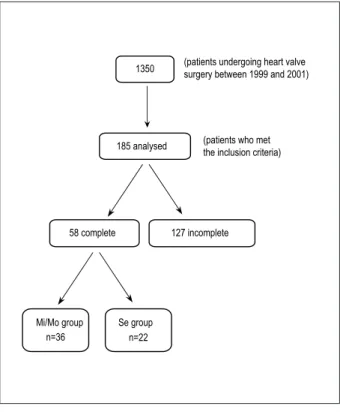
The patient selection process is summarized in Figure 2. A total of 1,350 medical records from patients undergoing heart valve surgery in our institution in the period between 1999 and 2001 were selected. Data from 185 patients who met the inclusion criteria of the protocol were evaluated. In accordance with the exclusion criteria, a total of 58 patients were enrolled in the study, 36 of whom in the Mi/Mo group and 22 in the Sev group.
Variables analyzed
Demographic, clinical, laboratory and echocardiographic variables were analyzed in both groups, namely:
• Demographic variables: age, gender, weight, and date
of death, when applicable;
• Variables related to the type of heart valve disease in
the preoperative period of Surgery 1;
• Clinical variables: preoperative diagnosis of Surgery 1,
date of Surgery 1, date of hospital discharge; date of occasional reoperations, number of heart valve surgeries performed throughout life, comorbidities;
• Laboratory variables: serum levels of hemoglobin,
hematocrit, creatinine, BUN, and glucose;
• Echocardiographic variables: diagnosis related to the
valve(s) affected and its classification as “mild”, “moderate” or “severe”.
Statistical analysis
Descriptive analysis of the data obtained included mean and standard deviation or percentage, depending on the type of variable analyzed. Data collected for the groups were compared using the non-paired Student’s t test, Fischer test and chi square test with Yates continuity correction (for 2x2 tables, 1 degree of freedom), all two-tailed. P values were calculated for each variable analyzed, and so were the odds ratio (OR) for the Sev group inrelation to the Mi/Mo group, and the 95% confidence interval (95%CI) for the data to which they could be applied. P values < 0.05 or OR > 1.5 were considered statistically significant. Calculations were made using the Microsoft Excel 2000 (Microsoft Corp.), Odds Ratio Generator 1.0 (Devilly, G.J.; 2005) and FastStatistics 2.0 (FateSoft) software programs.
Results
Of the 1,350 patients undergoing heart valve surgery in our institution between 1999 and 2001, 185 (13.7%) presented with prosthetic valve leak, which was graded from mild to severe. Most of the cases (86%) were paravalvular leaks. Considering the patients effectively selected for the study (n=58), the follow-up time was 4.49±2.98 years in the Mi/Mo group and 3.76±4.74 years in the Sev group (p=0.5167).
Mi/Mo and Sev group demographics are shown in Table 1. No statistically significant difference was found between the groups regarding age, gender, weight, or follow-up time in the study. In the preoperative period of Surgery 1, 31 patients from the Mi/Mo group had native valves, and five had prosthetic valves, whether with or without leak. In the Sev group, five patients had native valves and 17 had prosthetic valves, whether with or without leak (p<0.001, OR: 21.08 [95%CI 5.4 – 81.12] and RR: 5.56 [2.69 – 11.2]). This goes to show that the performance of surgical prosthetic valve replacement in patients already implanted with prosthesis increases by 5.56 times the risk of significant prosthetic valve leak in the postoperative period.
Surgery 1 Without prosthetic valve leak With prosthetic valve leak
Surgery 1 With prosthetic valve leak With prosthetic valve leak
Surgery 1 With prosthetic valve leak Without prosthetic valve leak
Fig. 1 - Diagram illustrating the three possible situations in which the patients
selected for the study could it.
1350
185 analysed
58 complete 127 incomplete
Mi/Mo group n=36
Se group n=22
(patients undergoing heart valve surgery between 1999 and 2001)
(patients who met the inclusion criteria)
Fig. 2– Patient selection for the study
Mi/Mo group (n=36) Sev group (n=22) p
Male gender 22 (61.1%) 15 (68.2%)
0.7932
Female gender 14 (38.9%) 7 (31.8%)
Age (years) by the time of Surgery 1 51.25±19.84 48.90±15.74 0.6204
Weight (kg) 75.7±20.4 68.2±15.2 0.267
Follow-up time (years) after Surgery 1 4.49±2.98 3.76±4.74 0.5167
Native valve pre Surgery 1 31 5 0.001*
Heart valve prosthesis pre Surgery 1 5 17 0.001*
* In relation to the presence of heart valve prosthesis pre Surgery 1 (OR: 21.08 [5.4-81.12] and RR: 5.56 [2.69 – 11.2]). Table 1 – Proile of the patients selected
probability of reoperation than those with mild/moderate leak. However, the time for reoperation was surprisingly shorter (25.25±22.43 days) for the patients of the Mi/Mo group than for those of the Sev group (79.80±42.09 days) (p<0.001). In both groups, endocarditis was the major cause of reoperation, and biological aortic prostheses were those which more frequently presented leak, followed by biological mitral prostheses. Sixteen patients (72.7%) of the Sev group already presented prosthetic valve leak in the preoperative period of Surgery 1, in comparison with five patients (13.9%) of the Mi/Mo group. Therefore, we can observe that although the causes for the performance of Surgery 1 had been different, all patients who presented some prosthetic valve dysfunction in the Mi/Mo group also presented associated prosthetic valve leak, and most (16/17; 94.1%) of the patients of the Sev group withsome prosthetic valve dysfunction also presented associated prosthetic valve leak. One patient in the Sev group did not present paravalvular or central prosthetic valve leak, despite undergoing surgical heart valve prosthesis replacement.
Table 2 also shows the mean number of heart valve surgeries performed in patients of the Mi/Mo and Sev groups (1.36±0.68 vs. 1.91±1.19 surgeries in the Mi/Mo and Sev groups, respectively; p=0.0551). We found no differences between the groups in relation to the number of heart valve surgeries performed throughout life (p=0.551), although a tendency to a greater number of surgeries among patients in the Sev group had been observed. When we classified the patients in relation to the performance of more than one heart valve surgery in life, we observed that nine patients (25%) of the Mi/Mo group had undergone more than one heart valve surgery in life, in comparison with 11 patients (50%) of the Sev group. A total of 34.5% of the patients in our study underwent more than one heart valve surgery.
Mi/Mo group (n=36) Sev group (n=22) Statistical analysis
Deaths of any cause after Surgery 1 3 (8.3%) 1 (4.5%) OR=0.5238 (0.05-5.38)
Leak in the preoperative period of
Surgery 1 5 (13.9%) 16 (72.7%) OR=16.5333 (4.37-62.60)
Reoperation after Surgery 1 4 (11.1%) 5 (22.7%) OR=2.3529 (0.56-9.94)
Time (days) from Surgery 1 to reoperation 25.25±22.43 79.80±42.09 p<0.001
Cause of reoperation**
Endocarditis 3 (75%) 3 (60%)
Bioprosthesis dysfunction and CHF* 1 (25%) 1 (20%)
Hemolysis** - 1 (20%)
Total of heart valve surgeries pre and/or post-Surgery 1 1.36±0.68 1.91±1.19 p=0.0551
Prosthesis with leak* 24 AoBioP (55.8%)
17 MiBioP (39.5%) 1 AoMecP (2.3%) 1 TriBioP (2.3%)
15 AoBioP (57.7%) 9 MiBioP (34.6%) 1 AoMecP (3.8%) 1 MiMecP (3.8%)
Table 2 – Clinical and echocardiographic data of the patients selected
* Abbreviations: CHF = congestive heart failure; BioP = bioprosthesis; MecP = mechanical prosthesis; Ao = aortic; Mi = mitral; Tri = tricuspid.
** Values expressed as the number of patients with the clinical condition and percentage in relation to the total number of patients undergoing reoperation in each group.
For example: of the four patients undergoing reoperation in the Mi/Mo group, three (75%) presented endocarditis; of the ive patients undergoing reoperation in the Sev group, three (60%) presented endocarditis.
*** As diagnosed by increased lactic dehydrogenase and bilirubin levels and persistent hemoglobin reduction.
present in the postoperative period of Surgery 1. However, the p value was not statistically significant (p=0.380).
In relation to the laboratory variables analyzed, no statistically significant difference was observed between the groups (Table 3).
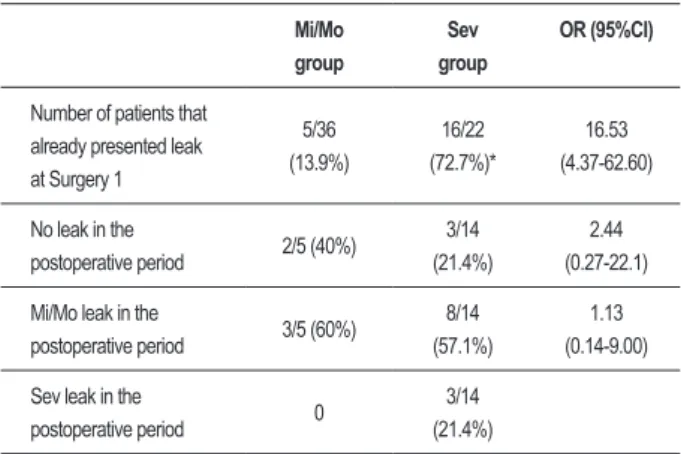
Comparison of the effectiveness of surgical prosthetic valve leak correction in the two groups is shown in Table 4. Effectiveness (that is, how effective surgery was to fully resolve the leak) was calculated at 40% (2/5) in the Mi/ Mo group. In the Sev group, effectiveness was 21.4% (3/14, already excluding the two patients who presented leak in Surgery 1, but whose postoperative data were not available). This corresponds to an OR = 2.44 (95% CI = 0.27-22.1), which leads us to conclude that there is an approximately 2.44-time increase in the chance of the surgical correction of prosthetic valve leak to be effective among patients with mild or moderate leak in relation to patients with severe leak.
No Mi/Mo group patients with mild or moderate leak in Surgery 1 presented severe leak in the postoperative period (three patients among the five who presented leak in Surgery 1 remained with leak, albeit mild or moderate, in the postoperative period). Among the 11 patients of the Sev group who had severe leak at Surgery 1 and progressed with some degree of leak in the postoperative period, the following prevalences of prosthetic valve leak wereobserved, according to its severity: three with mild degree (27.3%), five with moderate degree (45.4%); three with severe degree (27.3%).
Discussion
The present study evaluated the profile of patients who presented severe prosthetic valve leak in relation to patients with mild or moderate leak in the postoperative period of heart valve surgery.
An OR = 16.5 (95% CI = 4.37-62.60) for the presence of leak as a preoperative diagnosis of Surgery 1 in the Sev group in relation to the Mi/Mo group confirmed that surgical prosthetic valve replacement is more frequent among patients with severe leak than among those with mild or moderate leak. Most of the patients (86.1%) with mild or moderate leak did not undergo Surgery 1 due to leak, but developed leak after this surgery, whether or not undergoing surgery later in time. Leak was the most frequent (72.7%) cause of Surgery 1 among patients with severe leak. Additionally, patients with severe leak have a greater change of undergoing reoperation after surgical valve replacement, regardless of the reason for surgery (OR = 2.35; 95%CI = 0.56-9.94).
Table 3 – Laboratory data of Mi/Mo and Sev groups
Mi/Mo group Sev group P
Hemoglobin (g/dL) 12.30±2.35 13.27±2.07 0.1063
Hematocrit (%) 36.86±6.33 39.45±5.29 0.1017
Creatinine (mg/dL) 1.1±0.42 1.25±1.21 0.5809
BUN (mg/dL) 50.09±23.34 53.89±45.17 0.7170
Glucose (mg/dL) 102.30±20.63 112.16±30.77 0.1968 In both groups, more than 50% of the cases of prosthetic
valve leak occurred in biological aortic prostheses, followed by biological mitral prostheses, in disagreement with Akins et al3 findings of a higher frequency of mitral leak (68%) in a series of 136 heart valve replacements. Also interesting is the fact that most of the cases that progressed with significant leak in the postoperative period of Surgery 1 presented prosthesis dysfunction, whether regurgitation alone or associated with stenosis (Table 1).
The comparison of the time elapsed between Surgery 1 and the diagnosis of prosthetic valve leak among patients who did not present leak at the first surgery showed a tendency to a shorter time for the diagnosis of severe leak in relation to less severe degrees of prosthetic valve leak (p=0.552), which is understandable in light of the greater severity and symptoms associated with severe prosthetic valve leak. Genoni et al1 demonstrated that among 598 patients, 22% of the cases of paravalvular leak were diagnosed in the first postoperative week, and 74% up to the first postoperative year. In our study, we verified that the mean time for the diagnosis of prosthetic valve leak in both groups was shorter than one year after surgery (353±624 days in the Mi/Mo group and 230±433 days in the Sev group).
Akin et al3 verified that 50% of the patients undergoing surgical correction of prosthetic valve leak had already undergone at least one cardiac surgery. In our study, we found 34.5% of the patients undergoing at least two heart valve surgeries in life. However, we should point out that our calculation is different from that of Akins et al3 for considering every surgery performed throughout the patients’ lives (and not only those performed before the surgical leak correction) and for being restricted to heart valve surgeries.
Complete resolution of leak after surgical heart valve replacement was less frequent among patients with severe leak (21.4%) than among patients with mild or moderate leak (40%) (OR = 0.5357, 95%CI = 0.07-4.2). However, there was a significant leak reduction by 72.7% in the cases with severe preoperative leak which progressed with some leak in the postoperative period of Surgery 1, naturally resulting in clinical improvement4. Thus, as expected, the effectiveness of the surgical correction of prosthetic valve leak is higher in mild or moderate cases. Despite this fact, the percentage of patients progressing without prosthetic valve leak after Surgery 1 (40% in the Mi/Mo group and 21.4% in the Sev group; Table 4) was considerably lower than the values found by Akins et al3. In this study, only 16% of the patients presented leak recurrence up to 10 years after surgical correction of the primary leak3. Nevertheless, we should consider that the study did not include the cases of leak caused by endocarditis; also, it had a longer follow-up period (15 years)3.
No consensus regarding the best way to treat prosthetic valve leak is available yet, especially in mild/moderate cases. Genoni et al study1 found mortality rates of 26% among patients who received conservative medical treatment and of 12% among those undergoing surgery. Akins et al3 concluded that the morbidity and mortality rates resulting from the surgical correction of prosthetic valve leak are acceptable. Some studies discuss the use of minimally invasive surgical techniques for heart valve replacement3,5 or improvements
in the techniques using the open surgical approach in leak correction, especially for valve annulus reinforcement6.
In addition to leak, other complications related to prosthetic valves contribute to the morbidity and mortality of patients undergoing surgical heart valve replacement. Of these, the most common are thromboembolism, hemorrhage, hemolysis, infectious endocarditis, heart valve failure and reoperation 7-10. Ten years after heart valve replacement, up to 50% of the patients require reoperation or die of complications related to the prosthetic heart valves. There is usually no difference between mechanical and biological prostheses, but the frequency and nature of the complications related to the prostheses vary according to type, model, and valve position, as well as to each patient’s characteristics4,11-15.
By quantifying the comparative odds ratios between patients who presented varying degrees of prosthetic valve leak, the present study contributes to a better knowledge of its clinical outcome and provides information to guide therapies and establish prognoses. Although Genoni et al1 concluded that the surgical treatment of prosthetic valve leak seems to be better than medical treatment, the present study shows that the risk of reoperation and the effectiveness of surgical correction of heart valve replacement vary according to the leak degree. Furthermore, our study also contributed with the observation of the presence of an expressive number of cases of endocarditis as the cause of reoperation associated Table 4 – Effectiveness of surgical correction of prosthetic valve leak
Mi/Mo group
Sev
group
OR (95%CI)
Number of patients that already presented leak at Surgery 1
5/36 (13.9%)
16/22 (72.7%)*
16.53 (4.37-62.60)
No leak in the
postoperative period 2/5 (40%)
3/14 (21.4%)
2.44 (0.27-22.1)
Mi/Mo leak in the
postoperative period 3/5 (60%)
8/14 (57.1%)
1.13 (0.14-9.00)
Sev leak in the
postoperative period 0
3/14 (21.4%)
References
1. Genoni M, Franzen D, Vogt P, Seifert B, Jenni R, Künzli A, et al. Paravalvular leakage after mitral valve replacement: improved long-term survival with aggressive surgery? Eur J Cardiothorac Surg. 2000; 17 (1): 14-9.
2. Jindani A, Neville EM, Venn G, Williams BT. Paraprosthetic leak: a complication of cardiac valve replacement. J Cardiovasc Surg. 1991; 32 (1): 503-8.
3. Akins CW, Bitondo JM, Hilgenberg AD, Vlahakes GJ, Madsen JC, MacGillivray TE. Early and late results of the surgical correction of cardiac prosthetic paravalvular leaks. J Heart Valve Dis. 2005; 14 (6): 799-800.
4. Bottio T, Rizzoli G, Thiene G, Nesseris G, Casarotto D, Gerosa G. Hemodynamic and clinical outcomes with the Biocor valve in the aortic position: an 8-year experience. J Thorac Cardiovasc Surg. 2004; 127 (6): 1616-23.
5. Boudjemline Y, Pineau E, Borenstein N, Behr L, Bonhoeffer P. New insights in minimally invasive valve replacement: description of a cooperative approach for the off-pump replacement of mitral valves. Eur Heart J. 2005; 26 (19): 2013-7.
6. Linden BC, Schumacher CW, MacIver RH, Mrachek JP, Bianco RW. Paravalvular leaks around prosthetic valves implanted in the mitral position: technical refinements of the ovine model. J Heart Valve Dis. 2003; 12 (3): 400-5.
7. Butany JW, Naseemuddin A, Nair V, Borger MA, Daniel L. Infective endocarditis in a Hancock bioprosthetic heart valve. J Card Surg. 2005; 20 (4): 389-92.
8. Goldsmith I, Lip GYH, Patel RL. Evaluation of the Sorin bicarbon bileaflet valve in 488 patients (519 prostheses). Am J Cardiol. 1999; 83 (7): 1069-74.
9. Mansuroglu D, Ömeroglu SN, Izgi A, Ercan F, Yaymaci B, Basaran Y, et al. LDH levels and left atrial ultrastructural chances in patients with mitral paraprosthetic regurgitation. J Card Surg. 2005; 20 (3): 229-33.
10. Nashef SAM, Sethia B, Turner MA, Davidson KG, Lewis S, Bain WH. Bjork-Shiley and Carpentier-Edwards valves: a comparative analysis. J Thorac Cardiovasc Surg. 1987; 93: 394-404.
11. Davila-Roman VG, Waggoner AD, Kennard ED, Holubkoc R, Jamieson WR, Englberger L, et al. Artificial valve endocarditis reduction trial echocardiography study: prevalence and severity of paravalvular regurgitation in the Artificial Valve Endocarditis Reduction Trial (AVERT) echocardiography study. J Am Coll Cardiol. 2004; 44 (7): 1467-72.
12. Englberger L, Schaff HV, Jamieson WR, Kennard ED, Im KA, Holubkov R, et al. AVERT Investigators. Importance of implant technique on risk of major paravalvular leak (PVL) after St. Jude mechanical heart valve replacement: a report from the Artificial Valve Endocarditis Reduction Trial (AVERT). Eur J Cardiothorac Surg. 2005; 28 (6): 838-43.
13. Kuwaki K, Tsukamoto M, Komatsu K, Morishita K, Sakata J, Abe T. Simultaneous aortic and mitral valve replacement: predictors of adverse outcome. J Heart valve Dis. 2003; 12 (2); 169-76.
14. Rizzoli G, Bottio T, Vida V, Nesseris G, Caprili L, Thiene G, et al. Intermediate results of isolated mitral valve replacement with a Biocor porcine valve. J Thorac Cardiovasc Surg. 2005; 129 (2): 322-9.
15. Ruel M, Kulik A, Rubens FD, Bedard P, Masters RG, Pipe AL, et al. Late incidence and determinants of reoperation in patients with prosthetic heart valves. Eur J Cardiothorac Surg. 2004; 25 (3): 364-70.
16. Sadeghi H. Dysfunctions of heart valve prostheses and their surgical treatment. Schweiz Med Wochenschr. 1987; 117 (43): 1665-70.
both with the mild/moderate leak group (75%) and with the severe leak group (60%). Therefore, we point out that it is fundamental to consider the possibility of endocarditis in patients with postoperative prosthetic valve leak16.
Our study was limited by the number of patients enrolled in each of the groups (n=36 and 22 in the Mi/Mo and Sev groups, respectively), so that statistically significant p values or odds ratios (OR) could not be obtained for some of the variables analyzed. This was due to the fact that prosthetic valve leak is relatively uncommon in our institution. However, with the values found we can point to tendencies and suggest further studies on this important topic. Additionally, it is important to recognize that a longer follow-up period may be necessary3 to compare the morbidity and mortality between the groups, since we analyzed approximately 4.49±2.98 years of the Mi/Mo group and 3.76±4.74 years of the Sev group. Other studies demonstrated a mean survival of only 30% 10 years after surgical correction of prosthetic valve leak3.
Conclusions
(1) Surgical correction of prosthetic valve leak is more frequent in patients with severe leak than in those with mild or moderate leak. The presence of prosthesis dysfunction is a predisposing factor for the development of severe postoperative leak.
(2) Patients who already had or who will develop severe prosthetic valve leak have a higher chance of undergoing reoperation after surgical heart valve replacement, regardless of the reason for surgery.
(3) Severe prosthetic valve leak is more difficult to resolve completely after surgical treatment.
(4) Endocarditis was the most common cause of reoperation, regardless of the degree of prosthetic valve leak.
(5) A higher incidence of prosthetic valve leak was observed in aortic bioprostheses in the series of surgeries performed in our institution.
Potential Conflict of Interest
No potential conflict of interest relevant to this article was reported.
Sources of Funding
There were no external funding sources for this study.
Study Association