v. 47 – no.3 – jul./set. 2010 Arq Gastroenterol
238
AR
TIGO ORIGINAL / ORIGINAL AR
TICLE
ARQGA/1495
SHOULD ACTIVE INJECTING DRUG USERS
RECEIVE TREATMENT FOR
CHRONIC HEPATITIS C?
Vasileios
PAPADOPOULOS
, Aikaterini
GOGOU
, Theodora
MYLOPOULOU
and
Konstantinos
MIMIDIS
ABSTRACT – Context - Accumulating data propose that active injecting drug users might not differ from the general population in terms
of sustained virological response when adherent to therapy for chronic hepatitis C. However, current guidelines contain restrictive recommendations for therapy in this group of patients. Objective - Therefore, we evaluated a cohort of chronic hepatitis C patients regarding the potent inluence of active drug using on initial informed consent, compliance and sustained virological response to treatment. Method - For that purpose, 162 consecutive patients (of which 62 active injecting drug users), who had been evaluated during the last 6 years in our center for chronic hepatitis C and proposed to receive treatment with pegylated interferon alpha and ribavirin, were enrolled. Initial informed consent, compliance, and sustained virological response as well as data regarding age, gender, body mass index, genotype, viral load, coinfection with HBV/HDV/HIV, administered interferon alpha (2a or 2b), liver function tests, liver histology, urban residence, ethnicity, and concomitant use of alcohol were collected and analyzed in respect with injecting drug using. Results - Injecting drug using was positively correlated with male gender (P<0.001), young age (P<0.001), native origin (P = 0.043), and concomitant use of alcohol (P<0.001). Comparable initial informed consent (P = 0.836), compliance (P = 0.879), and sustained virological response (P = 0.132) were observed between injecting drug users and non- injecting drug users. The results were conirmed using a multiple regression model. Conclusion - Our data further support that active injecting drug users do not constitute a distinct chronic hepatitis C patient group in terms of initial informed consent, compliance, or sustained virological response. Therefore, injecting drug using should not be a major determinant inluencing the decision for treatment of chronic hepatitis C in eligible patients. HEADINGS – Hepatitis C, chronic. Interferon Alfa-2. Ribavirin. Drug users.
INTRODUCTION
Hepatitis C virus (HCV) transmission is mainly attributed to intravenous drug abuse in developed countries, where 80%-90% of intravenous drug users are estimated to be positive for anti-HCV antibodies. Thus, there is much urge to identify and treat drug addicts with chronic hepatitis C (CHC). However, in this group of patients, coinfection with hepatitis B virus (HBV), hepatitis D virus (HDV), and human immunodeiciency virus (HIV), along with alcohol abuse, and psychiatric illnesses (sometimes aggravated by interferon), may impact negatively on the evolution of HCV infection, and the complience to therapy, necessitating a rather multidisciplinary setting(3, 5, 8, 12, 13)
As indicated in recent studies, the treatment of CHC with peginterferon plus ribavirin in opiate addicts under methadone and/or buprenorphine
maintenance therapy is well tolerated and offers a fairly good success rate, provided that close cooperation with specialists in drug addiction and psychiatrists is provided(3, 7).
Despite the above mentioned results, among patients with CHC eligible for treatment, active injecting drug users, not receiving substitution therapy, still constitute a distinct group. Current European guidelines, with the exception of France, contain restrictive recommendations for therapy in patients actively injecting drugs(10).
Furthermore, these patients are usually excluded from clinical studies as they are believed to manifest high-risk behavior(2, 4, 9). Thus, the therapeutic algorithm of CHC
still remains controversial in this group of patients. In the present study, we evaluated a cohort of CHC patients regarding the potent inluence of active drug using on initial informed consent, compliance and sustained viral response (SVR) to treatment.
First Department of Internal Medicine, Democritus University of Thrace, Alexandroupolis, GR-68100, Greece. Financial support: None received
Papadopoulos V, Gogou A, Mylopoulou T, Mimidis K. Should active injecting drug users receive treatment for chronic hepatitis C?
Arq Gastroenterol 239
v. 47 – no.3 – jul./set. 2010
METHODS
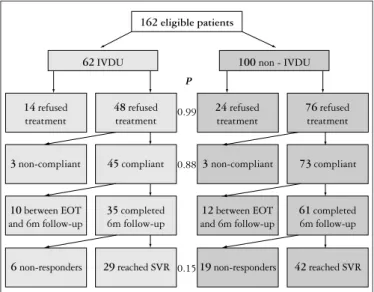
One hundred and sixty-two consecutive patients, who had been evaluated during the last 6 years in our center for CHC and proposed to receive treatment with pegylated interferon alpha-2a or alpha-2b and ribavirin, were enrolled (Figure 1).
Independent correlations were detected using appropriate multiple regression models. All mean values were accompanied by their standard errors. All P values <0.05 were considered statistically signiicant. Statistical tests were performed with the statistical software package Statistica 6.0 and the on-line statistical tool freely available at www.statpages.org.
RESULTS
The cohort consisted of 62 (38%) active injecting drug users (IDU) and 100 (62%) non-injecting drug users (non-IDU) (Figure 1).
IDUs were younger than non-IDUs (37.7 ± 1.2 vs 46.6 ± 1.3 years, P<0.001). Moreover, the IDU group was characterized by a larger male/female ratio than the non-IDU group (54 males/8 females vs 57 males/43 females, P<0.001). However, BMI was comparable between the two groups (24.3 ± 0.5 vs 25.2 ± 0.4 kg/m2, P = 0.152). Coinfection with HIV was not
observed, while coinfection with HBV (positive HBV-DNA) was observed only in the IDU group (1/62 IDU patients,
P = 0.203). Moreover, both the viral load (log10: 5.5 ± 0.1 vs 5.7 ± 0.1, P = 0.293) and the administered scheme (pegylated interferon alpha 2a/2b: 19/43 vs 30/70, P = 0.931) were comparable between the two groups (IDU and non-IDU, consequently).
Injecting drug using was also positively correlated with native origin (44/62 vs 55/100, P = 0.043), and concomitant use of alcohol (32/62 vs 19/100, P<0.001). No difference was noticed between urban and rural residence (42/58 vs 74/96, P = 0.515).
As far as HCV genotypes were concerned, their distribution between IDUs and non-IDUs was similar (Table 1).
162 eligible patients
62IVDU 100 non - IVDU
14refused treatment 48refused treatment 24refused treatment 76refused treatment
3non-compliant 45compliant
10between EOT and 6m follow-up
35completed 6m follow-up
3 non-compliant 73compliant
12between EOT and 6m follow-up
61completed 6m follow-up
6 non-responders 29reached SVR 19non-responders 42reached SVR
P
0.99
0.88
0.15
FIGURE 1. Study algorithm
Initial informed consent was asked by all patients enrolled. The study was approved by the Institutional Ethics Committee. In patients who provided informed consent, therapy with either pegylated interferon alpha 2a (180 μg/week) or alpha 2b (1.5 μg/kg/week) was administered subcutaneously along with ribavirin (twice daily, 800-1200 mg/day) per os for 24-48 weeks according to standard recommendations(11). In case of
relapse alternative treatment was offered. Compliance and SVR, considered as a negative HCV-RNA 24 weeks after the completion of treatment, were recorded for every patient. All patients were under close psychiatric observation througout the duration of the study.
Data regarding age, gender, BMI, HCV genotype, coinfection with HBV, HDV, and HIV, administered pegylated interferon alpha (2a or 2b), urban residence, native (greek) origin, use of alcohol, and injecting drug using were collected. HCV-RNA was determined using COBAS Amplicor HCV test, v.2.0 assay (Roche Molecular Systems, Branchburg, NJ, USA), a qualitative method with sensitivity of 60 copies/mL. HCV genotype was determined using INNO-LiPA HCV II kit (Bayer Diagnostics, Emeryville, CA, USA). Molecular diagnosis of HBV, HDV, and HIV was performed using similar techniques.
Evaluation was performed using chi-square along with Yates’ correction where appropriate (absolute expected values <5) regarding discrete parameters and Student’s t-test regarding continuous variables. However, in cases of non-normality or non-uniformity of distributions, as exhibited by Kolmogorov-Smirnov and Lilliefors tests, respectively, the non-parametric Mann–Whitney U test was alternatively used.
TABLE 1. HCV genotypes: comparison between IDU and non-IDU groups
IDU (n=62) Non-IDU (n=100) P-value
Genotype 1 25/56 39/83 0.786
Genotype 2 6/56 14/83 0.311
Genotype 3 24/56 24/83 0.090
Genotype 4 1/56 6/83 0.297
Comparable informed consent (P = 0.836), compliance (P = 0.879), and SVR (P = 0.132) were observed between IDUs and non-IDUs (Table 2).
TABLE 2. Comparison between IDU and non-IDU groups
IDU (n=62) Non-IDU (n=100) P-value
Age (years) 37.7±1.2 46.6±1.3 <0.001
Gender (M: males, F: females) 54M/8F 57M/43F <0.001
BMI (kg/m2) 24.3±0.5 25.2±0.4 0.152
Urban residence 42/58 74/96 0.515
Native origin 44/62 55/100 0.043
Concomitant use of alcohol 32/62 19/100 <0.001
Initial informed consent 48/62 (77.4%) 76/100 (76.0%) 0.836
Compliance 45/48 (93.8%) 73/76 (96.1%) 0.879
Papadopoulos V, Gogou A, Mylopoulou T, Mimidis K. Should active injecting drug users receive treatment for chronic hepatitis C?
Arq Gastroenterol
240 v. 47 – no.3 – jul./set. 2010
Papadopoulos V, Gogou A, Mylopoulou T, Mimidis K. Usuários ativos de drogas injetáveis devem receber tratamento para hepatite crônica tipo C? Arq Gastroenterol. 2010;47(3):238-41.
RESUMO – Contexto - Dados acumulados demonstram que usuários ativos de drogas injetáveis podem não diferir da população em geral em termos de
resposta virológica sustentada quando aderentes à terapia para a hepatite crônica C. No entanto, as atuais orientações publicadas contêm recomendações restritivas para a terapia nesse grupo de pacientes. Objetivo - Com este propósito, avaliou-se uma coorte de pacientes com hepatite crônica C após consentimento informado inicial, no que diz respeito à inluência da droga ativa na adesão e na resposta virológica sustentada ao tratamento. Métodos – Para o efeito, foram convidados 162 pacientes (dos quais 62 ativos usuários de drogas injetáveis), que foram avaliados durante os últimos 6 anos em um centro de referência para a hepatite crônica C e se propuseram a receber tratamento com interferon alfa peguilado e ribavirina. O consentimento inicial, a adesão ao tratamento e a resposta virológica sustentada, bem como dados sobre idade, sexo, índice de massa corporal, genótipo, carga viral, com coinfecção HBV/HDV/HIV, tipo de interferon alfa administrado (2a ou 2b), testes de função hepática, histologia hepática, residência urbana, etnia e uso concomitante de álcool foram coletados e analisados em relação com o uso de drogas injetáveis. Resultados - O uso de drogas injetáveis teve correlação positiva com o sexo masculino (P<0,001), idade (P<0,001), de origem nativa (P = 0,043) e uso concomitante de álcool (P<0,001). Foram observados entre usuários de drogas injetáveis e usuários de drogas não-injetáveis dados comparáveis em relação ao consentimento informado inicial (P = 0,836), adesão (P = 0,879) e resposta virológica sustentada (P = 0,132). Os resultados foram conirmados através de um modelo de regressão múltipla. Conclusão - Os dados conirmam ainda que usuários ativos de drogas injetáveis não constituem um grupo distinto de paciente com hepatite crônica C em termos de consentimento inicial, adesão, ou a resposta virológica sustentada. Assim, o uso de drogas injetáveis não deve ser um dos principais determinantes que inluenciam a decisão para o tratamento da hepatite C crônica em pacientes elegíveis.
DESCRITORES – Hepatite C crônica. Interferon alfa 2a. Ribavirina. Usuário de drogas. As the two groups were different at a statistically signiicant
extent concerning age, gender ratio, native origin, and use of alcohol, a multiple regression model was used to distinguish primary, causative correlations from secondary, non-causative ones. In that model, injecting drug using, age, gender, BMI, genotype, urban residence, ethnicity, and concomitant use of alcohol, were considered as independent variables, while informed consent, compliance and SVR as dependent ones. None of the independent variables reveal any correlation with informed consent (P = 0.700), and compliance (P
= 0.545). However, genotype 2/3 and younger age were independently correlated with better SVR, irrespectively of all other considered parameters (P = 0.002).
DISCUSSION
The present study demonstrates that active intravenous drug users constitute a group that might well be eligible for CHC treatment as they exhibit similar initial informed consent, compliance and SVR as non-users. This result is independent of any potent confounding factor, as a multiple regression method was used over data pre-estimated regarding comparability (groups of similar gender ratio, BMI, viral load, coinfection rates, and interferon used). Thus, what the study contributes to the perception of the CHC treatment algorithm in drug users, is that active drug using is not
necessarily a barrier for the administration of the indicated therapeutic scheme (interferon alpha and ribavirin).
A previous study, carried out retrospectively in 500 patients, has also demonstrated that neither active intravenous drug using, nor substitution therapy reduces SVR rates in adherent CHC patients(4). However, data
concerning initial behavior regarding informed consent and enrollment to therapy, in relation with active drug using, was not reported.
The transmission of HCV is mainly attributed to the initial phase of drug using, where the awareness for viral disease transmission by reused syringes is limited(1, 6). The exact percentage of active intravenous drug users
who, despite the achievement of SVR after treatment for CHC, will be reinfected by HCV, remains a question to be answered. Most possibly, the follow-up of our series of patients can provide some data on this subject, in the light of an excellent response to therapy with interferon/ ribavirin of acute hepatitis C (90%)(9).
In conclusion, our data support that active IDU do not constitute a distinct CHC patient group in terms of informed consent, compliance, or SVR. Moreover, in our patients, HCV genotypes were uniformly distributed among IDU and non-IDU. Therefore, injecting drug using should not be a major determinant inluencing the decision for treatment of CHC in eligible patients.
REFERENCES
1. Backmund M, Reimer J, Meyer K, Gerlach JT, Zachoval R. Hepatitis C virus infection and injection drug users: prevention, risk factors, and treatment. Clin Infect Dis. 2005;40(Suppl 5):s330-5.
2. Beliori B, Chiodera A, Ciliegi P, Tosti A, Baldelli F, Stagni G, Francisci D. Treatment for hepatitis C virus in injection drug users on opioid replacement therapy: a prospective multicenter study. Eur J Gastroenterol Hepatol. 2007;19: 731-2.
3. Beliori B, Ciliegi P, Chiodera A, Bacosi D, Tosti A, Baldelli F, Francisci D. Peginterferon plus Ribavirin for chronic hepatitis C in opiate addicts on methadone/ buprenorphine maintenance therapy. Dig Liver Dis. 2009;41:303-7.
4. Bruggmann P, Falcato L, Dober S, Helbling B, Keiser O, Negro F, Meili D; Swiss Hepatitis Cohort Study. Active intravenous drug use during chronic hepatitis C therapy does not reduce sustained virological response rates in adherent patients. J Viral Hepat. 2008;15:747-52.
Papadopoulos V, Gogou A, Mylopoulou T, Mimidis K. Should active injecting drug users receive treatment for chronic hepatitis C?
Arq Gastroenterol 241
v. 47 – no.3 – jul./set. 2010
6. Jauffret-Roustide M, Le Strat Y, Couturier E, Thierry D, Rondy M, Quaglia M, Razafandratsima N, Emmanuelli J, Guibart G, Barin F, Desenclos LC. A national cross-sectional study among drug-users in France: epidemiology of HCV and highlight on practical and statistical aspects of the design. BMC Infect Dis. 2009;9:113. 7. Mauss S, Berger F, Goelz J, Jacob B, Schmutz G. A prospective controlled study
of interferon-based therapy of chronic hepatitis C in patients on methadone maintenance. Hepatology. 2004;40:120-4.
8. Reimer J, Schulte B, Castells X, Schafer I, Polywka S, Hedrich D, Wiessing L, Haasen C, Backmund M, Krausz M. Guidelines for the treatment of hepatitis C virus infection in injection drug users: status quo in the European Union countries. Clin Infect Dis. 2005;40(Suppl 5):s373-8.
9. Reimer J, Haasen C. Need-adapted HCV-treatment setting for injection drug users. Lancet. 2009;373:2090-1.
10. Santantonio T, Wiegand J, Gerlach JT. Acute hepatitis C: current status and remaining challenges. J Hepatol. 2008;49:625-33.
11. Yu ML, Chuang WL. Treatment of chronic hepatitis C in Asia: when East meets West. J Gastroenterol Hepatol. 2009;24:336-45.
12. Zanini B, Lanzini A. Antiviral treatment for chronic hepatitis C in illicit drug users: a systematic review. Antivir Ther. 2009;14:467-79.
13. Zule WA, Costenbader EC, Coomes CM, Wechsberg WM. Effects of a hepatitis C virus educational intervention or a motivational intervention on alcohol use, injection drug use, and sexual risk behaviors among injection drug users. Am J Public Health. 2009;99(Suppl 1):s180-6.