AR
TIGO ORIGINAL / ORIGINAL AR
TICLE
ASSESSMENT OF QUALITY OF LIFE OF
PATIENTS WITH INFLAMMATORY BOWEL
DISEASE RESIDING IN SOUTHERN BRAZIL
Danielle
COHEN
1, Ceres Maltz
BIN
2and Ana Paula Trussardi
FAYH
2ABSTRACT – Context - Chronic diseases have an impact on the quality of life of the individuals. Objective - To evaluate the quality of life of adults with inlammatory bowel disease by the inlammatory bowel disease questionnaire certiied for Portuguese language. Methods – We interviewed 50 individuals from both genders aged from 18 to 60 years old, with Crohn’s disease and ulcerative colitis, regardless of disease activity. Results - The average age of the sample was 42.2 ± 13.6 years old, the disease length was 98.8 ± 74.3 months, and 72% of patients had Crohn’s disease and 14% presented disease activity. There was no signiicant difference in questionnaire scores of patients with different inlammatory bowel disease when they are in the remission phase (172.0 ± 42.4 and 173.6 ± 28.2 for ulcerative colitis and Crohn’s disease, respectively, P = 0.886). When compared to scores of patients who were in
crisis, it was found that they have a lower quality of life that patients in remission (123.8 ± 44.5 and 173.3 ± 31.5 for patients in crisis and remission, respectively, P = 0.001). Conclusion - It was noticed that the quality of life of patients with inlammatory bowel disease did not differ among patients with Crohn’s disease or ulcerative colitis, when patients are in remission. The main aspect which determines the loss of quality of life would be being at the stage of disease activity.
HEADINGS – Inlammatory bowel diseases. Crohn disease. Proctocolitis. Quality of life.
1 Methodist University Center; 2 Hospital de Clínicas de Porto Alegre, Porto Alegre, RS, Brasil.
Correspondence: Ana Paula Trussardi Fayh,RD – Rua Coronel Joaquim Pedro Salgado, 80 – Rio Branco – 90690-200 - Porto Alegre, RS, Brazil. E-mail: [email protected]. INTRODUCTION
The inlammatory bowel diseases (IBD), which include Crohn’s disease (CD) and ulcerative colitis (UC), are chronic disorders of multifactorial causes(15).
UC is a condition with inlammatory response and morphological alterations restricted to the colon. The inlammation is restricted to the mucosa and is of variable severity, showing ulcerations, edema, and hemorrhage along the whole colon, while in CD, the inlammation may involve any part of the gastrointestinal tract, from the oropharynx down to the perianal area. The inlammation is transmural, that is, the lesion trespasses the colon wall(11).
The major symptoms are diarrhea, abdominal pain, gastrointestinal bleeding, weight loss, malnutrition and fatigue, and the diseases may have signiicant psychosocial implications and cause limitations in the life style of IBD patients, and consequently impact their quality of life(6).
IBD mechanisms and treatment have not been completely elucidated yet, and the individual response of each patient to the treatment varies. Since no effective treatment has been found yet, there is a need to decrease
the number of the disease’s recurrences, prolong remission duration and improve quality of life(13)..
The Crohn’s disease activity index is a standard classiication system that allows clinical evaluation by interpretation of the patients’ symptoms. It is currently used in most clinical screenings to evaluate different effects on the symptoms of Crohn’s disease activity(5).
The ulcerative colitis activity index has been proposed by several studies to help choosing the treatment and follow-up the long-term development, furthermore, it allows comparing patients in multicenter studies. The activity index of the diseases and their reach in the colon is the best way of objectively assessing which therapeutic measures will be required(3).
However, it is necessary to deine a tool tailored to evaluate aspects speciic of each individual’s reality, including questions about any dificulties faced in their daily routine. The questionnaire on quality of life for patients with inlammatory bowel disease (IBDQ) was proposed in 1988 in the United States by Mitchell et al.(14) and adapted by Guyatt
et al.(8), reducing the original 150 questions to the
and to the Brazilian culture. This translated and validated version can be used to assess the quality of life of Brazilian patients with IBD(18).
In view of these considerations, one can understand how signiicantly IBD may affect the daily routine of individuals with this disease. Its is crucial to assess the impact on quality of life to understand the social and psychological issues involved during the course of this disease so as to provide a more comprehensive treatment to the patients. The present study had the purpose of assessing the quality of life of patients with IBD living in the city of Porto Alegre, RS in Southern Brazil.
METHODS
Sample
Patients with IBD living in the city of Porto Alegre, aged between 18 and 60 years, were invited to take part in the study. The study was announced by electronic means and at hospitals and clinics of the city. The inclusion criterion was that all participants should have been diagnosed with CD or UC for at least 6 months, regardless of the current activity of the disease. All volunteers signed a free and informed term of consent in two counterparts, previously approved by the Research Ethics Committee of the South Methodist Educational Network, Porto Alegre (090/2008).
Additionally, for analysis of quality of life, individuals were classiied according to the activity of their disease. The diseases’ activity rate and its length in the colon is the best way to objectively evaluate the necessary treatment decisions(3), and it is based on clinical, biochemical and
pharmacological criteria(2). According to these criteria,
patients are classiied in disease activity or in remission when the symptoms are milder.
Data collection procedures
The volunteers illed out the questionnaire on quality of life validated for IBDQ. The Portuguese version is already a valid and reproducible tool and may be used for evaluating the quality of life of Brazilian patients with IBD(18). Patients
who declared being illiterate had the questionnaire read to them and illed out by the researcher.
The questionnaire consists of 32 questions divided into four themes: intestinal symptoms (10 questions), systemic symptoms (5 questions), emotional status (12 questions), and social functioning (5 questions). The score scale for each question ranges from 1 to 7, 1 meaning that the problem is severe and 7 that the problem did not occur in the last 2 weeks.
In addition to the IBDQ questionnaire, the participants informed other data for characterizing the sample, such as weight, height, duration, and current activity status of the disease.
Statistical procedures
The data were structured and analyzed with the Statistical Package for Social Sciences version 13.0 for Windows, and the results were expressed as mean ± S.E.M. Distribution of all continuous variables for verifying the assumption
of normality (Shapiro-Wilks test) and homocedasticity of variances (Levene test) were assessed. After the study protocol had been applied, results of the IBDQ scores in the IBD types were compared through an independent t test. Accepted level
of signiicance was P<0.05.
RESULTS
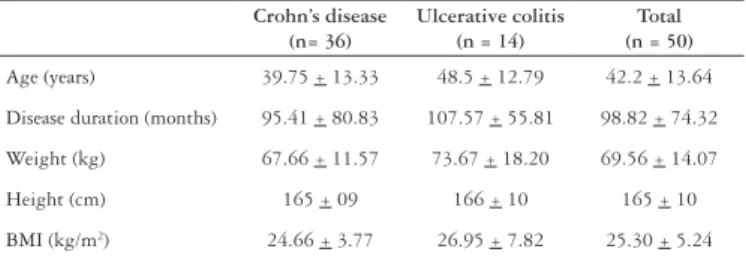
Results point to a mature adult population, in which CD is 72% more prevalent than UC. There was a predominance of women, i.e., 62% of the total sample. Based on the nutritional classiication by body mass index (BMI) (FAO/WHO, 1995), patients with CD were classiied as eutrophic, and patients with UC were overweight. Table 1 contains data on sample description, where patients were classiied by disease, but not by the disease’s activity.
TABLE 1. Sample description
Crohn’s disease (n= 36)
Ulcerative colitis (n = 14)
Total (n = 50)
Age (years) 39.75 + 13.33 48.5 + 12.79 42.2 + 13.64
Disease duration (months) 95.41 + 80.83 107.57 + 55.81 98.82 + 74.32
Weight (kg) 67.66 + 11.57 73.67 + 18.20 69.56 + 14.07
Height (cm) 165 + 09 166 + 10 165 + 10
BMI (kg/m2) 24.66 + 3.77 26.95 + 7.82 25.30 + 5.24
TABLE 2. IBDQ partial and total scores
Crohn’s disease (n = 36)
Ulcerative colitis
Total
(n = 50) P*
Intestinal 55.72 + 10.35 53.14 + 11.85 55 + 10.73 0.917
Systemic 24.38 + 5.33 22 + 6.57 23.72 + 5.73 0.560
Social 29.25 + 6.55 26.64 + 8.23 28.52 + 7.07 0.811
Emotional 61.69 + 14.28 54.21 + 22.30 59.6 + 17 0.950
Total 170.38 +
33.78 156 + 44.97 166.36 + 37.33 0.886
*P value obtained by independent t test
For a preliminary evaluation of the quality of life, the questionnaire’s scores were added, but not separated by the disease’s activity. Table 2 presents the scores on quality of life obtained in the IBDQ questionnaire and shows that there is no difference in the quality of life of patients with the different forms of the disease. Patients had a lower relative score (according to the validated questionnaire scores) in systemic and emotional symptoms, with the social symptoms having a lesser impairment to quality of life.
TABLE 3. IBDQ scores of patients in active disease and in remission
Patients in remission (n = 43)
Patients in active disease (n = 7)
P*
Intestinal 56.72 + 9.54 44.42 + 12.34 0.004
Systemic 24.65 + 5.18 18.00 + 6.05 0.003
Social 29.53 + 6.44 22.28 + 8.07 0.01
Emotional 62.37 + 15.31 42.57 + 18.05 0.003
Total 173.3 + 31.5 123.8 + 44.5 0.001
*P value obtained by independent t test
It is important to compare the quality of life of our sample with data obtained by other studies reported in the literature. Table 4 shows a summary of the comparison of the scores obtained with IBDQ questionnaire in different studies in the medical literature. In this comparison, one can notice similar scores in two studies; however, they are far higher than the other study done in Amsterdam, with larger sample sizes.
TABLE 4. Comparison with other studies found in the literature
Our data (n = 50)
Pallis et al.(16) (n = 135)
Han et al.(10) (n = 30)
de Boer et al.(4) (n = 271)
Intestinal 55 + 10.73 58.9 + 10.7 54.9 + 10.4 37.3 + 7.7
Systemic 23.72 + 5.73 27.7 + 6.9 25.3 + 5.9 17.0 + 4.4
Social 28.52 + 7.07 29.1 + 7.5 29.4 + 8.1 20.0 + 4.7
Emotional 59.6 + 17 62.4 + 15.6 64.1 + 13.7 44.9 + 9.1
Total 166.36 + 37.33 178.1 + 36.9 173.7 + 33.1 119.1 + 22.0
DISCUSSION
The results of this study showed a mature adult sample, aged average 39.8 ± 13.4 years old for CD patients, while in patients with UC, we found an average age higher, reaching to 48.5 ± 12.7 years old. Aghdassi et al.(1), evaluating 74 patients
with CD, had an average age very close to our indings (35.7 ± 1.4 years), as Ren et al.(19), who found an average age of
40.9 ± 15.3 among the 92 patients studied. On the other hand, Pallis et al.(16), in their study describes a sample aged
16 to 84 years old, and average age very similar to this study. These data indicate a strong concern in evaluating mature adults. The aging process coupled with chronic enhances the chances of mature adults to have losses in their quality of life. The average monthly length of CD and UC in this study was 98.2 ± 82.4 and 107.6 ± 55.8 months. Very similar results were shown by Aghdassi et al.(1), with a 120-month
disease’s length for people with DC, as well as to Pallis et al.(16), who found a length average of 78 months for DC and
100 months for ulcerative colitis.
The nutritional condition of individuals with CD in this study was similar to those of patients evaluated by Aghdassi et al.(1), which notice an average of 23.05 + 0, 45 kg/m2 of BMI
from 74 Canadian patients, representing eutrophia. Importantly, the data to determine the nutritional status of individuals in this study were reported, but the literature indicates a high
correlation between igures measured and reported by patients who underwent nutritional assessment(17). Patients with IBD
are more susceptible to protein-energy malnutrition caused mainly by the reduction in food intake, poor absorption, increased gastrointestinal losses and increased nutritional needs(9). However, the fact that the vast majority of patients
were in the remission of the disease may have contributed to the nutritional status assessed by anthropometric parameters is within normal limits.
Regarding the questionnaire score of quality of life, it is noticed that the issues with lower scores were related to emotional and systemic aspects. These indings coincide with those observed by Han et al.(10) who evaluated 30 individuals in
the United Kingdom; however, they differ from the ones from Pallis et al.(16), who assessed 135 individuals in Greece. Due
to the chronicity of the disease, it is justiiable that patients mention a worse quality of life regarding emotional aspects(16),
as the impact of the disease is stronger in the psychological and social aspects. Often patients are unaware of the disease itself, letting the feelings of stigma hinder your social life(14).
Guthrie et al.(7) describe the importance of identifying and
alleviating psychological distress, because they contribute to health-related quality of life loss, regardless of disease severity. Psychological factors like a depressed mood associated with anxiety and health-related quality of life, may have a negative inluence on the course of IBD(15).
Individuals with IBD are more likely to have loss in their quality of life in the period of disease activity(21). Ren et
al.(19) in their study found a prevalence of 40.2% of patients
in crisis, which scored an average of 150 points. This score exceeds the results of this study, which showed an average score of 124 points for patients with active disease. Pallis et al.(16), found a similar average to our study, when a group
with active disease was analyzed (116 points). According to Guthrie et al.(7), psychological symptoms and severity of
the disease contribute to health-related quality of life loss. According to the same author, when disease severity is taken into account and it is statistically isolated (regression analysis), there were no signiicant differences between CD and UC on quality of life of patients. Also in a Greek population, it is observed that the activity of the disease was the main factor on the perception of quality of life(16).
In an attempt to compare the results of this study to similar ones available in the literature Pallis et al.(16) evaluating 135
individuals in Greece, and Han et al.(10) evaluating 30 patients
in the United Kingdom did not differ much in scores of the dimensions and in the total questionnaire score. However, de Boer et al.(4) evaluating 271 individuals in Amsterdam
Cohen D, Bin CM, Fayh APT. Avaliação da qualidade de vida de pacientes com doença inlamatória intestinal residentes no sul do Brasil. Arq Gatroenterol. 2010;47(3):285-9.
RESUMO – Contexto - As doenças inlamatórias intestinais são doenças crônicas e, com isso, podem exercer impacto sobre a qualidade de vida do indivíduo. Objetivo - Avaliar a qualidade de vida de adultos com doenças inlamatórias intestinais, através do Inlammatory Bowel Disease Questionnaire – validado para a língua portuguesa, e comparar esta resposta entre pacientes com a doença em atividade ou não. Métodos - Foram entrevistados 50 indivíduos de ambos os sexos, com idade entre 18 e 60 anos. Resultados - A média de idade da amostra foi de 42,2 + 13,6 anos, o tempo da doença foi de 98,8 + 74,3 meses e 72% destes indivíduos tinham doença de Crohn. Sete indivíduos relataram estar no momento da atividade da doença, mas não houve diferença signiicativa entre o tempo de doença e o estado nutricional quando comparados os pacientes com atividade e em remissão da doença. Não foi veriicada diferença signiicativa na pontuação do questionário dos pacientes com as diferentes doenças inlamatórias intestinais quando estes estão na fase remissiva (172 + 42,4 e 173,6 + 28,2 para retocolite ulcerativa e doença de Crohn, respectivamente, P = 0,886). Quando
comparada a pontuação dos pacientes que estavam em crise, veriicou-se que esses apresentam menor qualidade de vida do que os pacientes em remissão (123,8 + 44,5 e 173,3 + 31,5 para os pacientes em crise e em remissão, respectivamente, P = 0,001). Conclusão - Foi possível veriicar que a qualidade de vida dos pacientes com doenças inlamatórias intestinais não difere quando diagnosticadas nas suas duas classiicações, quando os pacientes estão na remissão. O aspecto principal para determinação de um prejuízo na qualidade de vida seria estar na fase da atividade da doença.
DESCRITORES – Enteropatias inlamatórias. Doença de Crohn. Proctocolite. Qualidade de vida. However, this is not the only questionnaire developed to
evaluate the quality of life. Depending on the questionnaire used, different classiications in quality of life can be reported in the same population. Shepanski et al.(20) evaluated the
health-related quality of lifeof 71 children and adolescents with IBD using the IMPACT-35 instrument, which consists of 35 questions divided into six domains (symptoms of inlammatory bowel disease, systemic symptoms, emotional functioning, social functioning, body image, treatment and interventions). On the other hand, Loonen et al.(12) measured
the quality of life in children and adolescents with IBD using a generic instrument the TNO-AZL Children’s Quality of Life questionnaitre(TACQOL), and concluded that they have
impaired their quality of life, with damage in motor function and autonomy of these patients. Zahn et al.(22) indicated
a strong relation between clinical activity and endoscopic activity rates in all domains of Health-Related Quality of Life (HRQoL), questionnaire of quality of life proposed by the WHO for patients with UC.
This is the irst study that evaluates the quality of life of patients with IBD residents in southern Brazil after the
publication of the validation results of the questionnaire for the Portuguese language spoken in this country. Being a clinical study, it is important to note that this also has limitations. Because this sample was selected for convenience, the external validity of this study is imaired. Another aspect worth mentioning is that there is no epidemiological information of the disease in southern Brazil, so it is unknown if the analyzed sample represents the population. However, having been contributing with data on the quality of life of patients living in Brazil this study makes explicit the relevance of it and the need for further studies to supplement this information.
In this study we observed that the quality of life of patients with IBD, both with CD and with UC is not different when patients are in the remitting phase. The main aspect which determines the loss of quality of life is being at the stage of disease activity where the characteristic symptoms are exacerbated. It is important that health professionals are alert to patients’ own perceptions about their health-related quality of life since this issue may relect on the patients’ care and treatment.
REFERENCES
1. Aghdassi E, Wendland BE, Stapleton M, Raman M, Allard JP. Adequacy of nutritional intake in a Canadian population of patients with Crohn’s disease. J Am Diet Assoc. 2007;107:1575-80.
2. Bin C, Francesconi C, Álvares-da-Silva M. Comparação entre método funcional com avaliação subjetiva global, antropometria, inquérito alimentar e análise bioquímica na estimativa do estado nutricional de pacientes com doença de Crohn. [Dissertation]. Porto Alegre: Universidade Federal do Rio Grande do Sul – UFRGS; 2007.
3. Carter MJ, Lobo AJ, Travis SP. Guidelines for the management of inlammatory bowel disease in adults. Gut. 2004;53(Suppl):1-16.
4. de Boer AG, Wijker W, Bartelsman JF, de Haes HC. Inlammatory bowel disease questionnaire: cross-cultural adaptation and further validation. Eur J Gastroenterol Hepatol. 1995;7:1043-50.
5 Freeman HJ. Use of the Crohn’s disease activity index in clinical trials of biological agents. World J Gastroenterol. 2008;14:4127-30, 2008.
6. Ghosh S, Mitchell R. Impact of inlammatory bowel disease on quality of life: results of the European Federation of Crohn’s and Ulcerative Colitis Associations (EFCCA) patient survey. J Crohn’s Colitis. 2007;1:10-20.
7. Guthrie E, Jackson J, Shaffer J, Thompson D, Tomenson B, Creed F. Psychological disorder and severity of inlammatory bowel disease predict health-related quality of life in ulcerative colitis and Crohn’s disease. Am J Gastroenterol. 2002;97:1994-9.
8. Guyatt G, Mitchell A, Irvine EJ, Singer J, Williams N, Goodacre R, Tompkins C. A new measure of health status for clinical trials in inlammatory bowel disease. Gastroenterol. 1989;96:804-10.
9. Han PD, Burke A, Baldassano RN, Rombeau JL, Lichtenstein GR. Nutrition and inlammatory bowel disease. Gastroenterol Clin North Am. 1999;28:423-43. 10. Han SW, McColl E, Steen N, Barton JR, Welfare MR. The inlammatory bowel disease questionnaire: a valid and reliable measure in ulcerative colitis patients in the northeast of England. Scand J Gastroenterol. 1998;33:961-6.
12. Loonen HJ, Grootenhuis MA, Last BF, Koopman HM, Derkx HH. Quality of life in pediatric inlammatory bowel disease measured by a generic and a disease speciic questionnaire. Acta Paediatr. 2002;91:348-54.
13. Mikocka-Walus AA, Turnbull DA, Moulding NT, Wilson IG, Andrews JM, Holtmann GJ. Antidepressants and inlammatory bowel disease: a systematic review. Clin Pract Epidemiol Ment Health. 2006;2:24-33.
14. Mitchell A, Guyatt G, Singer J, Irvine EJ, Goodacre R, Tompkins C, Williams N, Wagner F. Quality of life in patients with inlammatory bowel disease. J Clin Gastroenterol. 1988;10:306-10.
15. Mittermaier C, Dejaco C, Waldhoer T, Oefferlbauer-Ernst A, Miehsler W, Beier M, Tillinger W, Gangl A, Moser G. Impact of depressive mood on relapse in patients with inlammatory bowel disease: a prospective 18--month follow-up study. Psychosom Med. 2004;66:79–84.
16. Pallis AG, Vlachonikolis IG, Mouzas IA. Assessing health-related quality of life in patients with inlammatory bowel disease, in Crete, Greece. BMC Gastroenterol. 2002;2:1.
17. Peixoto MR, Benício MH, Jardim PC. Validade do peso e da altura auto-referidos: o estudo de Goiânia. Rev Saúde Pública. 2006;40:1065-72.
18. Pontes RM, Miszputen SJ, Ferreira-Filho OF, Miranda C, Ferraz MB. Qualidade de vida em pacientes portadores de doença inlamatória intestinal: tradução
para o português e validação do questionário “Inlammatory Bowel Disease Questionnaire”. Arq Gastroenterol. 2004;41:137-43
19. Ren WH, Lai M, Chen Y, Irvine EJ, Zhou YX. Validation of the mainland Chinese version of the inlammatory bowel disease questionnaire (IBDQ) for ulcerative colitis and Crohn’s disease. Inlamm Bowel Dis. 2007;13:903-10.
20. Shepanski MA, Hurd LB, Culton K, Markowitz JE, Mamula P, Baldassano RN. Health related quality of life improves in children and adolescent with inlammatory bowel disease after attending a camp sponsored by the Crohn’s and Colitis Foundation of America. Inlam Bowel Dis. 2005;11:164-170. 21. Wolfe BJ, Sirois FM. Beyond standard quality of life measures: the subjective
experiences of living with inlammatory bowel disease. Qual Life Res. 2008;17:877–86.
22. Zahn A, Hinz U, Karner M, Ehehalt R, Stremmel W. Health-related quality of life correlates with clinical and endoscopic activity indexes but not with demographic features in patients with ulcerative colitis. Inlamm Bowel Dis. 2006;12:1058-67.