45
J Vasc Bras. 2013 Mar; 12(1):45-48
Prophylactic and temporary inferior vena cava filter
implantation in trauma
Implante profilático e temporário de filtro de veia cava inferior no trauma
Fábio Augusto Cypreste Oliveira1, Carlos Eduardo de Sousa Amorelli1, Fábio Lemos Campedelli1,
Juliana Caetano Barreto2, Mariana Caetano Barreto3, Philippe Moreira da Silva4, Fernanda Lauar Sampaio Meirelles5
Abstract
Pulmonary embolism is a major cause of death after traumas and, in the majority of trauma cases, the anticoagulation drugs usually employed for prevention and treatment of pulmonary embolisms are contraindicated. We report on a case in which a prophylactic and temporary inferior vena cava filter (VCF) was implanted in a multiple trauma patient at high risk of pulmonary embolism.
Keywords: vena cava inferior; wounds and injuries; pulmonary embolism.
Resumo
O tromboembolismo pulmonar (TEP) é importante causa de óbito no trauma e esse, na maioria das vezes, contraindica a principal farmacoterapia na prevenção e no tratamento do TEP: a anticoagulação. Relatamos um caso de paciente politraumatizado, com risco elevado de embolia pulmonar, submetido ao implante preventivo e temporário de filtro de veia cava inferior (FVC).
Palavras-chave: veia cava inferior; ferimentos e lesões; embolia pulmonar.
C A S E
R E P O R T
1 Sociedade Brasileira de Angiologia e Cirurgia Vascular (SBACV), Colégio Brasileiro de Radiologia (CBR), Associação Médica Brasileira (AMB), Goiânia, GO, Brazil. 2 Serviço de Angiologia, Cirurgia Vascular, Endovascular e Laserterapia (Angiogyn), Goiânia, GO, Brazil.
3 Hospital de Urgências de Goiânia, Goiânia, GO, Brazil. 4 Angiogyn, Goiânia, GO, Brazil.
5 Pontifícia Universidade Católica de Goiás - PUC-Goiás, Goiânia, GO, Brazil.
Financial support: None.
Conflict of interest: No conflicts of interest declared concerning the publication of this article. Submitted on: 03.09.11. Accepted on: 26.06.2012
Prophylatic vena cava filter in trauma
46 J Vasc Bras. 2013 Mar; 12(1):45-48
INTRODUCTION
Venous thromboembolisms are responsible for elevated mortality and morbidity in multiple trauma patients and can occur in more than 50% of cases1-3.
Pneumatic compression and administration of low doses of heparin are indicated in these patients, but
questions have been asked about their overall eficacy
for prevention of pulmonary embolisms (PE) after multiple traumas4,5 and their use may need to be
suspended in such cases, even if only temporarily. The incidence rates of PE and their complications
are higher in the irst days after trauma. During this period, the vena cava should be interrupted and itting an infrarenal vena cava ilter is the main defense
against pulmonary embolism6.
CASE REPORT
T.L, a 66-year-old male with hypertension, obesity (body mass index of 33) and a long-term smoking habit, suffered multiple traumas in a tractor accident and was admitted to our department with hypovolemic shock. The patient was initially treated in accordance with protocols that are established worldwide and transferred to intensive care (IC) after volemic resuscitation.
Secondary examinations revealed the following: mild traumatic brain injury, closed fracture of the left femoral diaphysis, fracture with luxation of pelvis and thorax – left side instable due to multiple rib fractures and hemopneumothorax with low output via a chest drain with water seal. The left leg was put in orthopedic traction and 12 hours
after the patient was irst seen, when he was already
stable hemodynamically and on intermittent pneumatic compression, an ELLA® (Ella – CS)
retrievable infrarenal vena cava ilter was implanted
via the right jugular and a double-lumen catheter was
itted via the same route.
The patient enjoyed satisfactory progress; hemodynamic stability was maintained, thoracic drainage output reduced progressively and his
ventilation proile improved. Deinitive surgical
correction of the femoral fracture was conducted on the eighth day in hospital and the patient was discharged from the IC breathing spontaneously via a tracheostomy after the thoracic drain had been removed.
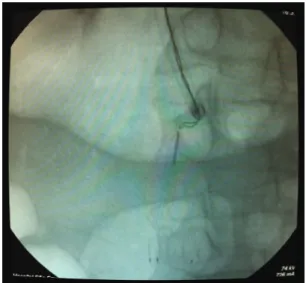
On the twelfth day in hospital, the vena cava
ilter was removed via the right jugular using a
Multi-snare® loop (PFM Medical) and a 12F long
introducer sheath (Figures 1 and 2). Thrombi were
found adhered to the ilter (Figure 3).
The patient was discharged from hospital after 15 days with no signs of deep venous thrombosis or pulmonary embolism and intermittent pneumatic compression and subcutaneous low-dose, low molecular weight heparin were kept at outpatients levels until he was able to walk again. Outpatients follow-up at our clinic 30 days after the trauma revealed no vascular complications.
DISCUSSION
Multiple trauma patients are at high risk of developing PE, particularly in cases in which anticoagulant drugs cannot be used7,8. Some studies
have advocated preventative (in the absence of proven deep venous thrombosis or pulmonary
Figure 1. Using the Multi-snare® loop to catch the filter.
Fábio Augusto Cypreste Oliveira, Carlos Eduardo de Sousa Amorelli et al.
47
J Vasc Bras. 2013 Mar; 12(1):45-48 embolism) implantation of a vena cava ilter after
a trauma, on the basis that it reduces the incidence of severe thromboembolic events in these cases and because it involves temporary interruption of the vena cava9-12. The majority of ilters are itted with
the aid of luoroscopy, using iodine-based contrasts in speciic sectors, but for patients at high risk from transportation, they can be itted at the bedside with the aid of vascular Doppler ultrasound13.
The rate of removal of retrievable ilters is still
low, which can be attributed to the clinical conditions of multiple trauma patients and to failures by the
services that implant ilters to follow-up their patients
afterwards14.
Permanent vena cava ilters offer high eficacy
for prevention of PE, but are not themselves free
from complications and there is a signiicant rate
of thrombosis, which in turn can lead to severe post-thrombotic complications15,16. In view of this,
temporary interruption of the vena cava with a ilter
appears to be the best option for preventing PE, particularly in cases in which full anticoagulation is contraindicated17. Mechanical compression
techniques (elastic stockings and intermittent pneumatic compression) should be used routinely whenever possible.
We have reported on a case of a multiple trauma patient at high risk of PE for whom anticoagulation was contraindicated, requiring temporary implantation of a infrarenal vena cava
ilter which successfully prevented PE for 30 days
after the trauma without complications.
ACKNOWLEDGEMENTS
We are grateful to Dr. Vasco Lauria da Fonseca
Filho, head of the vascular and endovascular surgery department at the Hospital da Lagoa (RJ), for always having something new to teach us and for providing
speciic material for our literature review.
REFERENCES
1. Dries DJ. Activation of the clotting system and complement after trauma. New Horiz. 1996;4:276-89.
2. Weinmann EE, Salzman EW. Deep-vein thrombosis. N Engl J Med. 1994;331:1630-41.
3. Geerts WH, Jay RM, Code KJ, et al. A comparison of low-dose heparin with low-molecular-weight heparin as prophylaxis against venous thromboembolism after major trauma. N Engl J Med. 1996;335:701-7. PMid:8703169.
4. Winchell RJ, Hoyt DB, Walsh JC, Simons RK, Eastman AB. Risk factors associated wit pulmonary embolism despite routine prophylaxis: implications for improved protection. J Trauma. 1994;37(4):600-6. PMid:7932891.
5. Knudson MM, Collins JA, Goodman SB, McCrory DW. T h r o m b o e m b o l i s m f o l l o w i n g m u l t i p l e t r a u m a . J Trauma. 1992;32(1):2-11. PMid:1732568.
6. Carlin AM, Tyburski JG, Wilson RF, Stefes C. Prophylactic and therapeutic inferior vena cava ilters to prevent pulmonary emboli in trauma patients. Arch Surg. 2002;137:521-7. PMid:11982463
7. Stawicki SP, Grossman MD, Cipolla J, et al. Deep venous thrombosis and pulmonary embolism in trauma patients: an overstatement of the problem? Am Surg. 2005;71:387-91. PMid:15986967.
8. Sevitt S, Gallagher N. Venous thrombosis and pulmonary embolism. A clinic-pathological study in injured and burned patients. Br J Surg. 1961;48:475-89.
9. Webb LX, Rush PT, Fuller SB, Meredith JW. Greenfield filter prophylaxis of pulmonary embolism in patients undergoing surgery for acetabular fracture. J Orthop Trauma. 1992;6:139-54. PMid:1602332.
10. Rosenthal D, McKinsey JF, Levy AM, Lamis PA, Clark MD. Use of Greenield ilter in patients with major trauma. Cardiovasc Surg. 1994;2:52-5.
11. Matous SK, Puyana JC, Castle JM. he use of the inferior vena cava filter in trauma patients. In: Proceedings of the 24th Annual Scientiic Meeting of the Western Trauma Association; March 3, 1994; Crested Butte, Colo. Crested Butte; 1994.
12. Rodriguez JL, Lopez JM, Proctor MC, et al. Early placement of prophylactic vena caval ilters in injured patients at high risk for pulmonary embolism. J Trauma. 1996;40(5):797-804. PMid:8614083.
13. Neser RA, Capasso Filho M, Homa CMO. Implante de filtro de veia cava guiado por ultra-som: relato de dois casos. J Vasc Bras. 2006;5(1):71-3. http://dx.doi.org/10.1590/ S1677-54492006000100014
14. Coimbra R, Constantini T. Ritrievable inferior vena cava ilter use in trauma: has the fever broken? J Vasc Bras. 2009;8(3):204-6. http://dx.doi.org/10.1590/S1677-54492009000300003
Prophylatic vena cava filter in trauma
48 J Vasc Bras. 2013 Mar; 12(1):45-48
15. Geerts WH, Code KI, Jay RM, Chen E, Szalai JP. A prospective study of venous thromboembolism after major trauma. N Engl J Med 1994;331:1601-6. PMid:7969340.
16. Blebea J, Wilson R, Waybill P, et al. Deep venous thrombosis af ter p ercut an e o u s ins er ti o n o f v ena c av al f ilters . J Vasc Surg. 1999;30(5):821-8. http://dx.doi.org/10.1016/ S0741-5214(99)70006-6
17. Fonseca Filho VL, Oliveira FAC. Filtro de veia cava-tipos, indicações, técnica e resultados. In: Brito CJ, editor. Cirurgia vascular cirurgia endovascular angiologia. 2. ed. Revinter; 2008. p.1727-38.
Correspondence
Fabio Augusto Cypreste Oliveira Avenida Alphaville Flamboyant, 3900, casa 283, CEP 74884-527 – Goiânia, GO, Brazil E-mail: [email protected]
Author information
FACO, CESA, FLC specialist in Vascular Surgery (Angioradiology and Endovascular Surgery), Sociedade Brasileira de Angiologia e de Cirurgia Vascular (SBACV), Colégio Brasileiro de Radiologia (CBR), and Associação Médica Brasileira (AMB). JCB general practitioner, Angiogyn, Goiânia, Brazil. MCB general surgeon, Hospital de Urgências de Goiânia, Brazil. PLS scrub nurse technician, Angiogyn, Goiânia, Brazil. FLSM medical student (6th year), Pontifícia Universidade Católica de
Goiás (PUC Goiás).
Authors contributions