Efficacy of Pelvisoft® Biomesh for cystocele repair:
assessment of long-term results
_______________________________________________
Erwann Le Long
1, John David Rebibo
1, Romain Caremel
1, Philippe Grise
11Rouen University Hospital, Ch. Nicolle, 76031 Rouen, France
ABSTRACT
ARTICLE
INFO
______________________________________________________________ ______________________
Introduction and Hypothesis: To our knowledge a study regarding the efficacy of Pelvisoft Biomesh for cystocele repair has not previously been reported in the literature. The aim of our study was to assess the long-term efficacy, subjective outcomes and complications in the use of a non-synthetic porcine skin mesh graft (Pelvisoft Biomesh) associated with transvaginal anterior colporrhaphy in the tre-atment of cystocele prolapse.
Materials and Methods: A retrospective study was performed at a single centre. Thirty--three women aged 35-77 years underwent cystocele repair using Pelvisoft® graft be-tween December 2005 and June 2009. Twenty-nine women who underwent transvagi-nal cystocele repair with Pelvisoft Biomesh for over a 2 years period were assessed. Four patients were lost to follow-up. Cystocele repair was performed via the vaginal route using PelvisoftBiomesh implant by inserting it in the anterior vaginal wall. Results: The median follow-up time was 54.0 months. The rate of recurrence was 17.3%. A total of 6.9% of patients presented early mesh exposure treated by conser-vative treatment. The mean PFDI-20 score was 72.2. Among sexually active women, the mean PISQ 12 was 33.9 but 56.2% had dyspareunia. After surgery, 6 patients had de novo intercourse.
Conclusions: Our results show that the use of Pelvisoft biomaterial associated with anterior colporrhaphy for cystocele repair appears to be safe with acceptable failure and complication rates at long term. Nevertheless, an adverse impact on sexual func-tion was reported by the majority of patients.
Key words:
Cystocele; Biocompatible Mate-rials; Prolapse
Int Braz J Urol. 2014; 40: 828-34
_____________________
Submitted for publication: January 13, 2014
_____________________
Accepted after revision: May 03, 2014
INTRODUCTION
Pelvic organ prolapse is characterized by a descent of the pelvic organs into the vaginal wall. The most frequent occurrence is anterior vaginal wall prolapse or cystocele (1). It is a major health--care problem that affects about 40% of women over 50 (1). According to Olsen et al. approximate-ly 11% of women will undergo reparative surgery for prolapse or stress urinary incontinence (SUI) and a second operation is estimate to be required
repair POP during the past decade. Polypropylene monofilament and macroporous tissue is the most widely used. This material assures good anato-mical repair, at short and median term, although there is a high rate of adverse events i.e. vagi-nal erosion, dyspareunia or pelvic pain. The use of biological biomaterials appears to have a lower complication rate, however few evaluations have been reported and most of them with short term follow-up. The aim of our study was to assess the long-term efficacy, subjective outcomes and com-plications in the use of a non synthetic porcine skin mesh graft (Pelvisoft Biomesh) associated
with transvaginal anterior colporrhaphy in the treatment of cystocele prolapse.
MATERIALS AND METHODS
Study population
Thirty-three women who underwent trans-vaginal cystocele repair with implantation of Pelvisoft, from December 2005 to June 2009,
were included in a retrospective study. Two ex-perienced surgeons performed the repair surgery. Pre-operative urogynaecological examination was carried out with patients in the dorsal lithotomy position. Tests included a speculum valve exami-nation, a cough test and Valsalva manoeuvre. The degree of prolapse was defined according to the POP-Q classification (7). All patients had a cysto-cele stage >1 with or without associated apical or posterior vaginal wall prolapse. Urodynamics, in-cluding flow rate measurement, urethrocystometry and profilometry were performed prior to cystocele repair if there were concurrent voiding abnormali-ties. All patients had a follow-up consultation at 2 months after surgery. Then, two years or more af-ter surgery, all patients were examined by an inde-pendent blinded urologist and prolapse recurrence was defined as vaginal descent of the anterior wall POP-Q stage >1.
At each patient consultation, a questionnaire regarding subjective satisfaction to assess sexuali-ty was completed. The French validated translation of the Pelvic Organ Prolapse/Urinary Incontinence Sexual Questionnaire (PISQ-12) was used to assess the effects on sexual function (8) with a score range from 0 to 48, the higher score indicating better
sexu-al function. The study was not submitted for Ethics Committee approval because this is standard clinical practice study with no randomization. The French validated translation of Pelvic Floor Distress Inven-tory (PFDI-20) evaluated pelvic floor disorders (9). It consists of 3 subscales: the pelvic organ prolapsed distress inventory (POPDI-6), the urinary distress inventory (UDI-6), and the colo-rectal-anal distress inventory (CRADI-8) The response of each item was rated from 0 to 4. The mean value of all of the an-swered items within the corresponding scale was then multiplied by 25. Each subscale ranges from 0 to 100, with a maximum summary score of 300.
Surgical technique
Pelvisoft Biomesh (C.R. Bard, Cranston,
R.I.,) is a macroporous mesh material used for cys-tocele repair. It is a porcine dermal acellular matrix collagen biomesh consisting of fibrous, acellular collagen and elastin fibres. A 4 X 7cm size was used for the study. All women had negative urine culture before surgery and received prophylactic antibiotics (i.e. cefazoline) during surgery.
Initially an anterior colpotomy was perfor-med with a dissection of the bladder from the va-gina, opening the pelvis fascia on each side. The implant was inserted transversally over the bladder and attached with 3-0 monofilament polyglactin absorbable sutures on the median line proximal to the periurethral tissue and distal to the cervical ring. On each side, the implant was attached (Figu-re-1) with a 0 monofilament polypropylene tran-sobturator non-absorbable suture, using a Hemet
Figure 1 – Lateral mesh fixation.
needle back and forth. The colpotomy was sutured with a non interrupted 0 monofilament polyglac-tin. A vaginal pack and a Foley catheter were left indwelling for 24h.
An associated apical or posterior prolapse was treated respectively either by sacrospinous sus-pension or a posterior colporrhaphy. When preo-perative SUI was associated, a transobturator tape (TOT) polypropylene sling procedure was perfor-med. A hysterectomy was performed if associated with ≥2 uterus prolapse.
Statistical analysis
Values were reported at the mean plus or minus standard deviation (SD) or at the median and interquartile range (IQRs). Quantitative varia-bles were analyzed using the Mann-Whitney test. For qualitative variables, Fisher’s exact test was used. A p<0.05 was considered to be statistically significant. Statistical analyses were performed with GraphPad Prism (version 5.01 for Windows).
RESULTS
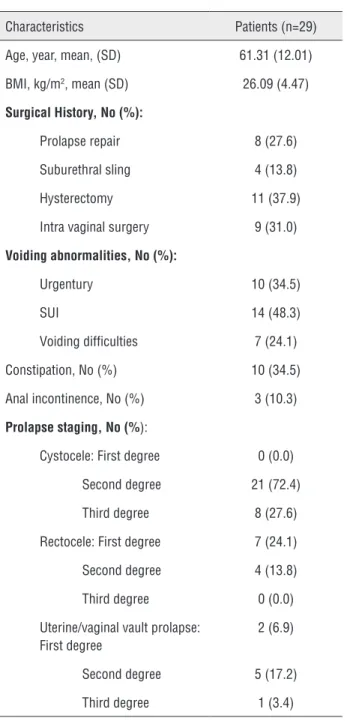
Of the 33 patients who underwent cysto-cele repair, four patients were lost to follow-up. Patient’s characteristics and prolapse staging are shown in Table-1.
Characteristics of surgery and early com-plications are listed in Table-2. The median dura-tion of surgery was 58.0 min (IQR: 45.0-90.0), in-cluding all operative procedures. No per-operative complication was observed, except for a post-voi-ding residual in three patients (>150mL). Resolu-tion occurred in all cases after intermittent self--catheterization. One patient presented a vaginal haematoma treated surgically. Two patients had early mesh exposure due to surgical dehiscence in the anterior wall which resolved conservative-ly and no recurrence occurred. These cases were associated with a vaginal hysterectomy. Urinary tract infection was treated by antibiotics. Mean hospital stay was 3.7 days (SD: 1.0).
Median follow-up period was 54.0 months (IQR: 37.0-57.0, range: 27.0-65.0). Pre and post--operative anatomical findings are shown in Ta-ble-3. Of the 29 patients, five of them had a
cysto-cele recurrence. At follow-up, among patients with recurrent prolapse, two had an early recurrence and had previously undergone laparoscopic sacral fixa-tion. The recurrence rate was not statistically diffe-rent in patients with or without an apical defect or rectocele repair (p=0.6). Median time to recurrence was 33.0 months (IQR: 10.5-49.0. range: 10.0-58.0).
Table 1 – Patients characteristics.
Characteristics Patients (n=29)
Age, year, mean, (SD) 61.31 (12.01)
BMI, kg/m2, mean (SD) 26.09 (4.47)
Surgical History, No (%):
Prolapse repair 8 (27.6)
Suburethral sling 4 (13.8)
Hysterectomy 11 (37.9)
Intra vaginal surgery 9 (31.0)
Voiding abnormalities, No (%):
Urgentury 10 (34.5)
SUI 14 (48.3)
Voiding difficulties 7 (24.1)
Constipation, No (%) 10 (34.5)
Anal incontinence, No (%) 3 (10.3)
Prolapse staging, No (%):
Cystocele: First degree 0 (0.0)
Second degree 21 (72.4)
Third degree 8 (27.6)
Rectocele: First degree 7 (24.1)
Second degree 4 (13.8)
Third degree 0 (0.0)
Uterine/vaginal vault prolapse: First degree
2 (6.9)
Second degree 5 (17.2)
Third degree 1 (3.4)
BMI = body mass index.
Table 2 – Characteristics of the surgery.
Characteristics Patients, No. (%)
Concomitant procedure
Vaginal hysterectomy 6 (20.7)
Posterior colporrhaphy 9 (31)
Suburethral sling 11 (37.9)
Uterine/Vaginal vault suspension 5 (17.2)
Post-operative complication
Acute urine retention 3 (10.3)
Haematoma 1 (3.4)
Urinary tract infection 1 (3.4)
Mesh exposures 2 (6.9)
Table 3 – Anatomical outcomes.
Pre-operative stage of cystocele, No. (%)
Post-operative stage of cystocele, No. (%)
Grade 0 0 (0) 15 (51.7)
Grade I 0 (0) 10 (34.4)
Grade II 21 (72.0) 3 (10.3)
Grade III 8 (28.0) 1 (3.4)
Grade IV 0 (0) 0 (0)
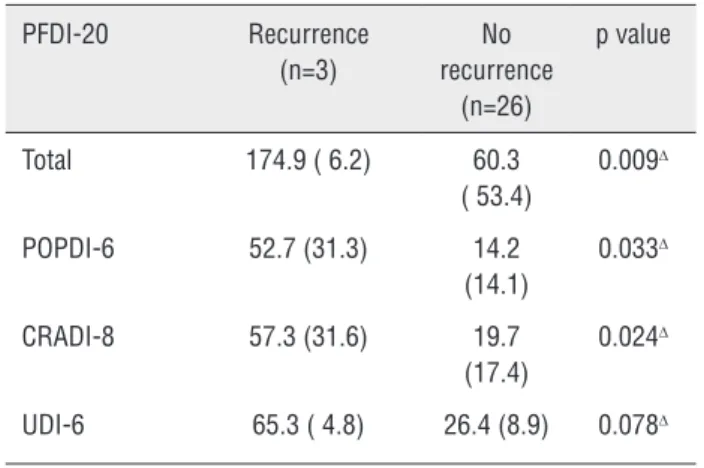
Table 4 – PFDI-20 Scores (recurrence vs no recurrence).
PFDI-20 Recurrence (n=3)
No recurrence
(n=26)
p value
Total 174.9 ( 6.2) 60.3
( 53.4)
0.009∆
POPDI-6 52.7 (31.3) 14.2 (14.1)
0.033∆
CRADI-8 57.3 (31.6) 19.7 (17.4)
0.024∆
UDI-6 65.3 ( 4.8) 26.4 (8.9) 0.078∆
Mann and Whitney Test: ∆
A de novo SUI occurred in 24.1% and de novo ur-gency in 13.7%. Urur-gency was resolved in 50.0%.
Our retrospective study regarding sexuality showed that 10 women still experienced sexual in-tercourse before surgery, with dyspareunia in 40.0 % of cases. After surgery, 16 patients had a sexual life showing an improvement in sexuality with 6 patients who had de novo sexual intercourse. The mean 12 score was 33.9 (SD: 8.7). The PISQ-12 showed that among women who had intercourse (16 patients), nine had pain during sexual activity. The mean PFDI-20 score was 72.2 (±61.7) (Table-4). It was significantly higher in patients with recur-rence (p<0.05). Recurrecur-rence was associated with an adverse impact in quality of life, prolapse distress, colo-rectal and anal distress (p<0.05).
DISCUSSION
To our knowledge, our study is the first to evaluate outcomes of Pelvisoft non synthetic
bio-materials in cystocele treatment.
In the treatment of POP, the search for the “ideal graft” remains problematic. Currently, the most widely used material is macroporous low weight polypropylene. Synthetic meshes provide satisfactory anatomical results but side-effects and tolerance still remain a major concern. Therefore, studies regarding non-synthetic biomaterials are limited. Non-synthetic biomaterials have been re-ported to have a better biocompatibility and fewer side effects. As previously mentioned, Pelvisoft
biomesh, used in our study, is an acellular collagen matrix for tissue repair. Using a rat model, Kons-tantinovic et al. showed that there was no shrinka-ge of Pelvisoft after a 90 day period although
an increase in size of 17% has been observed (10). Macropores present in the material facilitate the integration of the implant into the surrounding tissue and provide a better resistance (11). In fact, in contrast with Pelvicol, another porcine dermal
collagen implant (not macroperforated), the pores in Pelvisoft permit new vessel generation as well
as a better tensile strength (12). The tensile strength of Pelvisoft is also similar to that of
pores, it can form a mesh encapsulation due to fi-brotic tissue and allow dead space formation be-tween native tissue and the graft. To date, only one clinical study has been reported in the literature assessing the properties of Pelvisoft for rectocele
repair. In a series of 35 patients, Dell et al. have shown that the use of these materials led to good anatomical results with sexual activity preservation (13). These authors observed that no graft exposure occurred due to fenestration.
In our study using Pelvisoft, the
recurren-ce rate was 17.2% and is less than the 40% repor-ted with native-tissue colporrhaphy repair without mesh (4-6). However, this rate is higher than that reported with the use of polypropylene mesh. In recent prospective studies using synthetic meshes, the recurrence rate varies from 9.0% to 10.2% with a median follow-up of 12 months (14, 15). The incidence of cystocele recurrence increased over time with the follow-up. A 24.0% recurrence rate with 79 months follow-up was reported by Letou-zey et al. (16). Two recent randomized trials have reported better results with a failure rate of 5.7% and 13% respectively for a follow-up of 24 to 60 months (5, 17). However, in these two studies the major concern was a mesh exposure rate of 11.1% and 19%. Vaginal mesh extrusions appear to be the most common complication observed with the use of a synthetic mesh graft and its management is often surgical. In the literature, with a follow-up higher or equal to 1 year, reported mesh-exposure was 4.0 to 14.4% (14-16). Two different processes may be involved. Early exposure could be caused by a healing defect resulting of the procedure. A late exposure may be a rejection phenomenon due to chronic tissue erosion depending on the material used (18). In our study, two patients presented early mesh exposure in the 15 days following surgery which was related to procedure (dehiscence of he-aling). They underwent concomitant hysterectomy which is a reported risk factor of exposure (19). However, we did not observe any late exposure. The hypothesis that may explain this result is that Pelvisoft is composed of acellular collagen matrix
which had minimal immunologic and inflamma-tory reaction compared to synthetic materials. The risk of mesh exposure could also result due to the friction during intercourse (18). Our rate of women
sexually active was low which may explain our good results on late exposure. Furthermore, among the women who had sexual intercourse, dyspa-reunia might have been a protective factor since pain can lead patients to avoid sexual intercourse. In fact, in our population 56.2% had dyspareunia. Moreover, the use of a synthetic mesh may lead to its shrinkage and consequently responsible for vaginal shortening and tightening. This may ex-plain the better impact of surgery on quality of life and sexuality with Pelvicol (biological graft) than
with Gynemesh PS (non absorbable mesh)
obser-ved in Natale et al. study (20). In our study, during follow-up, elasticity of the vagina was normal, with no shortening.
Some studies using other porcine dermis mesh have reported a low recurrence rates. Mes-chia et al. in a series of 201 women observed the lowest recurrence rate in the treatment of cystocele with Pelvicol (7%) at 1 year follow-up, in
compa-rison to patients treated with colporrhaphy (20 %) (21). Gomelsky et al. studied 70 patients over a 24 months period treated with Pelvicol for POP and
reported a 12.9% recurrence rate (22). In a retros-pective study of 119 patients, Handel et al. com-pared anterior colporrhaphy, polypropylene meshes and porcine dermis meshes in cystocele repair with a 13.5 months mean follow-up (23). With the use of the porcine dermis graft, recurrence and erosion rates were 36% and 21% respectively, and this was significantly higher than in the two other groups. Two additional studies using Pelvicol showed a
high rate of recurrence: Dahlgren et al. reported a 58% recurrence at 3 years follow-up, while Natale et al. reported a 43.6% recurrence rate at 24 mon-ths follow-up (20, 24). These high recurrence ra-tes can be explained due to the non-macroporous cross-linked structure of Pelvicol which decreases
strength and durability of tissue support owing to the limitation of neovascularization and encap-sulation of the graft (20). Our lower failure rate may have been due to macroperforations in the Pelvisoft graft which allows a better
incorpora-tion of native tissue in grafts than the non macro-perforated meshes.
life. Most women avoid sexual activity because of the presence of vaginal bulging (45.3-52.6%) (25). Surgery is an alternative which may improve se-xuality; however, some vaginal functions might be altered. Also, the effect of surgery on sexual func-tion remains contradictory. In our study, the impact on sexuality was not evaluated prospectively befo-re surgery but based on a befo-retrospective interview and compared to sexual activity after surgery at the follow-up visit. Our mean PISQ 12 score was 33.9, which was similar to that reported in the literature, i.e. 34.1 to 35.5 (25, 26). Our rate of inactive sexual patients after surgery was 44.8%. Two prospective studies with validated questionnaires showed an improvement of sexual function even if pain had been reported during intercourse after surgery for POP (27, 28), however the mean age of population was relatively young (36 and 51 years respective-ly). In other studies, sexual function was unchan-ged regardless of surgical procedure, with or wi-thout meshes or via the abdominal route (26, 29). A negative impact of the vaginal route on sexual function was described by Hellstrom and Nilsson, caused by a decreased elasticity of the vaginal wall and disturbance of the female erectile reflex (30). In our study, we observed a high rate of dyspareunia (56.2%) in comparison to other studies, (25, 26, 29), but the responsibility of Pelvisoft seems to be less,
since 40% of sexually active patients had already dyspareunia before the surgery. Further, we could not establish a de novo dyspareunia rate due to the absence of pre-operative evaluation. As regards, overall sexual satisfaction is difficult to evaluate due to a wide range of factors, i.e. age of two par-tners, widowhood, erectile dysfunction, however surgery seems to have only a limited impact.
CONCLUSIONS
This retrospective study on the use of Pelvisoft in vaginal cystocele repair reassures
this mesh as an interesting option. Our median 54 months follow-up showed positive functional ou-tcomes with non recurrence of cystocele in 82% of patients. However, a long follow-up with a larger patient population is necessary, as well as future randomised controlled trials comparing non syn-thetic and synsyn-thetic meshes.
ABBREVIATIONS
SUI = Stress urinary incontinence
POP = Pelvic organ prolapsed
PISQ-12 = Pelvic Organ Prolapse/Urinary Inconti-nence Sexual Questionnaire
SD = Standard deviation
IQRs = Median and interquartile range
TOT = Transobturator tape
ACKNOWLEDGEMENT
The authors are grateful to Richard Medei-ros, Medical Editor, Medical Editing International for editing the manuscript.
CONFLICT OF INTEREST
None declared.
REFERENCES
1. Hendrix SL, Clark A, Nygaard I, Aragaki A, Barnabei V, McTiernan A. Pelvic organ prolapse in the Women’s Health Initiative: gravity and gravidity. Am J Obstet Gynecol. 2002; 186: 1160-6.
2. Olsen AL, Smith VJ, Bergstrom JO, Colling JC, Clark AL. Epidemiology of surgically managed pelvic organ prolapse and urinary incontinence. Obstet Gynecol. 1997; 89: 501-6. 3. Denman MA, Gregory WT, Boyles SH, Smith V, Edwards SR,
Clark AL. Reoperation 10 years after surgically managed pelvic organ prolapse and urinary incontinence. Am J Obstet Gynecol. 2008; 198: 555.e1-5.
4. Sand PK, Koduri S, Lobel RW, Winkler HA, Tomezsko J, Culligan PJ, et al. Prospective randomized trial of polyglactin 910 mesh to prevent recurrence of cystoceles and rectoceles. Am J Obstet Gynecol. 2001; 184: 1357-62; discussion 1362-4.
5. Nieminen K, Hiltunen R, Takala T, Heiskanen E, Merikari M, Niemi K, et al. Outcomes after anterior vaginal wall repair with mesh: a randomized, controlled trial with a 3 year follow-up. Am J Obstet Gynecol. 2010; 203: 235.e1-8. 6. Altman D, Väyrynen T, Engh ME, Axelsen S, Falconer C;
Nordic Transvaginal Mesh Group. Anterior colporrhaphy versus transvaginal mesh for pelvic-organ prolapse. N Engl J Med. 2011;364:1826-36.
8. Rogers RG, Coates KW, Kammerer-Doak D, Khalsa S, Qualls C. A short form of the Pelvic Organ Prolapse/ Urinary Incontinence Sexual Questionnaire (PISQ-12). Int Urogynecol J Pelvic Floor Dysfunct. 2003; 14: 164-8; discussion 168. Erratum in: Int Urogynecol J Pelvic Floor Dysfunct. 2004;15:219.
9. de Tayrac R, Deval B, Fernandez H, Marès P; Mapi Research Institute: Development of a linguistically validated French version of two short-form, condition-specific quality of life questionnaires for women with pelvic floor disorders (PFDI-20 and PFIQ-7). J Gynecol Obstet Biol Reprod (Paris). 2007;36:738-48.
10. Konstantinovic ML, Ozog Y, Spelzini F, Pottier C, De Ridder D, Deprest J. Biomechanical findings in rats undergoing fascial reconstruction with graft materials suggested as an alternative to polypropylene. Neurourol Urodyn. 2010;29:488-93.
11. Bellón JM, Contreras LA, Buján J, Palomares D, Carrera-San Martín A. Tissue response to polypropylene meshes used in the repair of abdominal wall defects. Biomaterials. 1998; 19: 669-75.
12. Zheng F, Verbeken E, de Ridder D, Deprest J. Improved surgical outcome by modification of porcine dermal collagen implant in abdominal wall reconstruction in rats. Neurourol Urodyn. 2005; 24: 362-8.
13. Dell JR, O’Kelley KR. PelviSoft BioMesh augmentation of rectocele repair: the initial clinical experience in 35 patients. Int Urogynecol J Pelvic Floor Dysfunct. 2005; 16: 44-7; discussion 47.
14. Vollebregt A, Fischer K, Gietelink D, van der Vaart CH. Primary surgical repair of anterior vaginal prolapse: a randomised trial comparing anatomical and functional outcome between anterior colporrhaphy and trocar-guided transobturator anterior mesh. BJOG. 2011; 118: 1518-27.
15. Simon M, Debodinance P. Vaginal prolapse repair using the Prolift kit: a registry of 100 successive cases. Eur J Obstet Gynecol Reprod Biol. 2011; 158: 104-9.
16. Letouzey V, Deffieux X, Gervaise A, Mercier G, Fernandez H, de Tayrac R. Trans-vaginal cystocele repair using a tension-free polypropylene mesh: more than 5 years of follow-up. Eur J Obstet Gynecol Reprod Biol. 2010; 151: 101-5. 17. Rane A, Iyer J, Kannan K, Corstiaans A. Prospective study of
the Perigee™ system for treatment of cystocele - our five-year experience. Aust N Z J Obstet Gynaecol. 2012; 52: 28-33. 18. Mistrangelo E, Mancuso S, Nadalini C, Lijoi D, Costantini
S. Rising use of synthetic mesh in transvaginal pelvic reconstructive surgery: a review of the risk of vaginal erosion. J Minim Invasive Gynecol. 2007; 14: 564-9. 19. Belot F, Collinet P, Debodinance P, Ha Duc E, Lucot JP,
Cosson M. Risk factors for prosthesis exposure in treatment of genital prolapse via the vaginal approach. Gynecol Obstet Fertil. 2005; 33: 970-4.
20. Natale F, La Penna C, Padoa A, Agostini M, De Simone E, Cervigni M. A prospective, randomized, controlled study comparing Gynemesh, a synthetic mesh, and Pelvicol, a biologic graft, in the surgical treatment of recurrent cystocele. Int Urogynecol J Pelvic Floor Dysfunct. 2009; 20: 75-81.
21. Meschia M, Pifarotti P, Bernasconi F, Magatti F, Riva D, Kocjancic E. Porcine skin collagen implants to prevent anterior vaginal wall prolapse recurrence: a multicenter, randomized study. J Urol. 2007; 177: 192-5.
22. Gomelsky A, Rudy DC, Dmochowski RR. Porcine dermis interposition graft for repair of high grade anterior compartment defects with or without concomitant pelvic organ prolapse procedures.J Urol. 2004; 171: 1581-4. 23. Handel LN, Frenkl TL, Kim YH. Results of cystocele
repair: a comparison of traditional anterior colporrhaphy, polypropylene mesh and porcine dermis. J Urol. 2007; 178: 153-6; discussion 156.
24. Dahlgren E, Kjølhede P: RPOP-PELVICOL Study Group. Long-term outcome of porcine skin graft in surgical treatment of recurrent pelvic organ prolapse. An open randomized controlled multicenter study. Acta Obstet Gynecol Scand. 2011; 90: 1393-401.
25. Handa VL, Zyczynski HM, Brubaker L, Nygaard I, Janz NK, Richter HE, et al. Sexual function before and after sacrocolpopexy for pelvic organ prolapse. Am J Obstet Gynecol. 2007; 197: 629.e1-6.
26. Sentilhes L, Berthier A, Sergent F, Verspyck E, Descamps P, Marpeau L. Sexual function in women before and after transvaginal mesh repair for pelvic organ prolapse. Int Urogynecol J Pelvic Floor Dysfunct. 2008; 19: 763-72. 27. Azar M, Noohi S, Radfar S, Radfar MH. Sexual function
in women after surgery for pelvic organ prolapse. Int Urogynecol J Pelvic Floor Dysfunct. 2008; 19: 53-7.
28. Hoda MR, Wagner S, Greco F, Heynemann H, Fornara P. Prospective follow-up of female sexual function after vaginal surgery for pelvic organ prolapse using transobturator mesh implants. J Sex Med. 2011; 8: 914-22.
29. Weber AM, Walters MD, Piedmonte MR. Sexual function and vaginal anatomy in women before and after surgery for pelvic organ prolapse and urinary incontinence. Am J Obstet Gynecol. 2000; 182: 1610-5.
30. Helström L, Nilsson B. Impact of vaginal surgery on sexuality and quality of life in women with urinary incontinence or genital descensus. Acta Obstet Gynecol Scand. 2005; 84: 79-84.