AR
TICLE
1 Departamento de Odontologia, Universidade Federal do Rio Grande do Norte. R. Joaquim Gregório s/n, Penedo. 59300-000 Caicó RN Brasil. [email protected]
Inequality in the characteristics of the institutionalized elderly
in the city of Natal, Brazil
Abstract The aim of this study was to describe the differences in the profile of elderly residents in non-profit and for-profit Long-Term Residential Institutions for the Elderly (ILPI). We visited 12 ILPIs in the city of Natal, Rio Grande do Norte. Six of them were non-profits housing 260 elderly, and six were for-profit institutions, housing 127 elderly. The unequal characteristics of the elder-ly in these facilities are based on socioeconomic data and the reason for institutionalization. The data was submitted to Chi-squared or Student’s t, with a significance level of 5%. Illiterate, single, black or brown, individuals with no retirement/ pension or healthcare plan, no children and no visitors who purchase something outside the insti-tution with their own money are associated with non-profit ILPIs. When analyzing the reasons for institutionalization, family conflict, abandon-ment and being homeless were associated with the elderly institutionalized in non-profit ILPIs. The main reason for the elderly institutionalized in for-profit ILPIs was “being ill”. The conditions of the elderly in non-profit ILPIs were poorer, reflect-ing the social inequality these subjects experienced throughout their lifetime.
Key words Elderly, Long-Term care facilities for
the elderly, Socioeconomic factors
Natália Cristina Garcia Pinheiro 1
Vinicius Carlos Duarte Holanda 1
Laércio Almeida de Melo 1
Annie Karoline Bezerra de Medeiros 1
Pinhe
ir
o NCG
Introduction
Population aging is one of the largest challenges facing contemporary Public Health. Developing nations are experiencing inverted age pyramids, corroborating the existence of a significant pro-portion of elderly people in their populations1.
The increase in number of elderly people and lon-ger life-expectancy have led to a proportionately larger number of homeless elderly and increased demand for care facilities for those over 602.
As a result, more Long-Term Residential In-stitutions for the Elderly (ILPI) are being created. This is a special type of socio-health institution that may be non-profit or for-profit. Commit-ting the elderly to this type of facility is associ-ated with the services they offer, in addition to the economic and psychosocial problems that families face in caring for their elderly, especially in view of their vulnerability and reduced func-tional capability at this stage in life3.
Professionals working at the ILPIs must there-fore know how to directly handle the elderly with reduced functional skills, attempting to preserve their quality of life. This requires identifying the differences in the characteristics of the elderly populating residing in non-profit and for-profit ILPIs to help implement care programs for this population, which increasingly needs care due to longer life-spans, loss of independence and au-tonomy and increase in chronic diseases4.
Thus it is fair to state that institutions for the elderly are hybrid in nature: social and health-care, and therefore demand policies that address both these spheres. This requires developing spe-cific policies to regulate their operation5.
On October 2008 ILPI regulation was signed, defining the legal, infrastructure, operational, hy-giene-sanitary and occupational health require-ments for the proper operation of long-term residential care facilities for the elderly in Natal. According to this legislation, the quality of life of the elderly must be safeguarded when they live in this type of shelter6.
It is understood that institutions should of-fer favorable living conditions to the elderly in all aspects, however due to economic problems this doesn’t always happen. In general. these elderly individuals suffer from a situation of inequality lasting their entire lives. Because of this, the goal of this study was to check the differences in the characteristics of the elderly population living in ILPIs in the city of Natal, RN - both non-profit and for-profit.
Methods
This is a cross-sectional study of elderly subjects living and non-profit and for-profit ILPIs as the unit of observation and analysis. This study was submitted to the Federal University of Rio Grande do Norte Research Ethics Committee (REC), and approved.
The sample was made up of elderly men and women aged 60 or over residing in ILPIs in the city of Natal, RN, registered as such with the city health surveillance agency (VISA). We vis-ited twelve long-term care facilities, six of them non-profits housing 260 elderly, and the other six for-profit, housing 127 elderly. This study was performed between June 2012 and November 2013.
Data was collected using a questionnaire based on SABE, the Health, Well-Being and Aging project7 and on the Héredia et al.8 study
conduct-ed in Caxias do Sul in 2004. The questionnaire was answered by the elderly themselves, so long as they had sufficient cognitive function to do so. Otherwise, the questions were answered by the care-giver or supplemented with data provided by the institution. Interviews to gather data were conducted by interviewers trained and calibrated for this purpose.
To identify inequalities, elderly residents were characterized by age, gender, color/race, marital status, children (yes or no), origin, religion, rea-son for institutionalization, years of schooling, if they purchased anything outside the institution with their own money, if they have retirement/ pension benefits or health insurance or the like, and if they receive visitors.
The questionnaire answers were analyzed us-ing the Statistical Package for the Social Sciences (SPSS) 20.0 program. Furthermore, we used Chi-squared/Fisher’s Exact tests or Student’s t for in-dependent samples to check for any association between the variables used to characterize the elderly and the type of residential facility, with a 95% confidence level.
Results
aúd e C ole tiv a, 21(11):3399-3405, 2016
have no health insurance of the equivalent, are retired/have a pension and do not manage their own money.
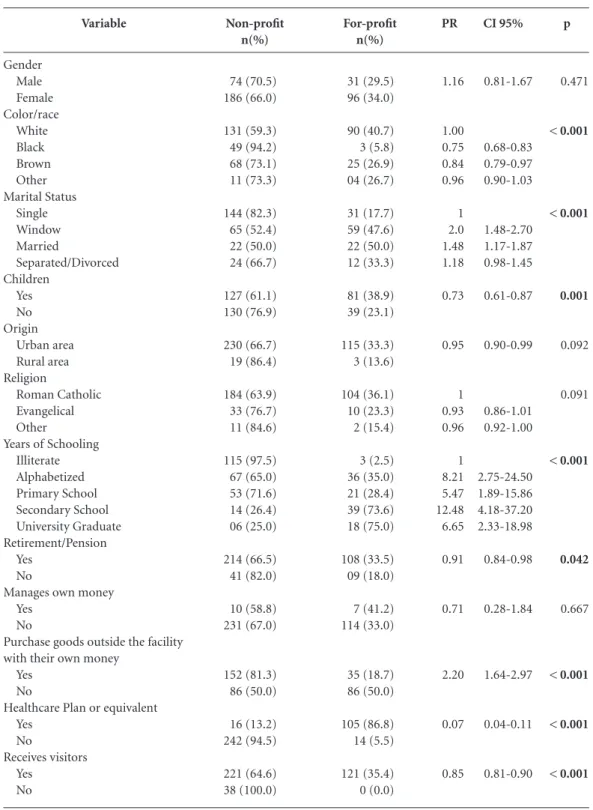
Table 1 shows the breakdown of the elderly in this study by type of residential facility, and
clearly shows significant differences. Data analy-sis shows that, as a rule, the elderly in non-profit organizations are in the lower end of socioeco-nomic strata. This was determined based on the fact that the illiterate, single,
non-retired/pen-Variable Gender Male Female Color/race White Black Brown Other Marital Status Single Window Married Separated/Divorced Children Yes No Origin Urban area Rural area Religion Roman Catholic Evangelical Other
Years of Schooling Illiterate Alphabetized Primary School Secondary School University Graduate Retirement/Pension Yes No
Manages own money Yes
No
Purchase goods outside the facility with their own money
Yes No
Healthcare Plan or equivalent Yes
No
Receives visitors Yes
No
Table 1. Absolute and percentage distribution of the independent variables related to living in non-profit and for-profit ILPIs. Natal-RN, Brazil, 2013.
Pinhe
ir
o NCG
sioned elderly with no children, no health insur-ance, and receiving no visitors were associated with non-profit ILPIs.
For black and brown subjects, there was a pos-itive association between the variable color/race and the type of facility they are living in. There are 25% fewer whites than blacks at non-profit ILPIs, and 16% fewer white than brown elderly. 27% more of the elderly in non-profit ILPIs re-ported no children.
Regarding the variable “purchases something outside the institution with his/her own money”, although the socioeconomic situation of the el-derly living in non-profit ILPIs tends to be poor-er, they have more independence to buy what they want outside the institution.
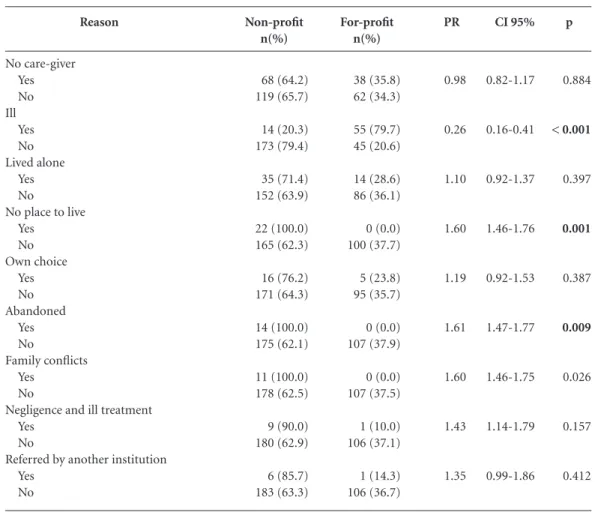
When analyzing why these individuals were sent to care facilities, the lack of a caregiver was the main reason in both non-profit and for-prof-it instfor-prof-itutions. When analyzing the reasons for
institutionalization, family conflict, abandon-ment and being homeless were associated with the elderly institutionalized in non-profit ILPIs. Among those the elderly institutionalized in for-profit ILPIs was “being ill” was the main rea-son given and had a positive association (Table 2).
Discussion
The aim of this study was to describe the dif-ferences in the profile of elderly residents in non-profit and for-profit Long-Term Residential Institutions for the Elderly (ILPI). In both types of facilities women outnumber men, corrobo-rating the findings in most of the literature re-viewed9-12. This reflects the fact that all over the
world and in Brazil women outnumber men due to increased cardiovascular protection from hor-mones, less use of alcohol and tobacco, and more
Reason No care-giver Yes No Ill Yes No Lived alone Yes No
No place to live Yes No Own choice Yes No Abandoned Yes No Family conflicts Yes No
Negligence and ill treatment Yes
No
Referred by another institution Yes
No
Table 2. Breakdown of the elderly by reason for institutionalization and whether they are in a non-profit or for-profit ILPI. Natal-RN, Brazil, 2013.
aúd
e C
ole
tiv
a,
21(11):3399-3405,
2016
frequent visits to the doctor13. In addition,
wom-en are more likely to be widowed and experiwom-ence economic difficulties, making it more likely that they will be placed in a care facility12,14.
Being elderly, with few friends, and little or no schooling are often described as risk factors for institutionalization4. When it comes to
chil-dren however, our results disagree with previous studies as some of the single elderly subjects had children4. This reflects family vulnerability in
terms of caring for their elderly, as even with chil-dren who potentially could have cared for their relatives, these subjects were institutionalized.
Abandonment was not among the main caus-es for the elderly living in care faciliticaus-es. However, vulnerabilities are found in family awareness of how to care for the elderly. Given the diminished functional capabilities and independence of this segment, the family transfers responsibility to caregivers, which possibly explains the predom-inance of “no caregiver” as the main reason for institutionalization.
Regarding color/race and religion, the results reflect the overall characteristics of the Brazilian population, where most people declare them-selves to be white and Roman catholic1. The fact
that most of the elderly living in care come from urban areas suggests that those in rural areas have more trouble getting into an ILPI in the state capital, suggesting the need to discuss the supply of this type of service in the interior of the state.
Single elderly and those who have lost their spouse and have no children or close fami-ly member socialfami-ly obligated to provide care are often sent by their more distant relatives to non-profit long-term care facilities for the elder-ly. In addition, the fact that most of the black or brown elderly live in non-profit ILPIs shows that those who report themselves as such are more likely to have fewer years of schooling and lower socioeconomic status15.
We found that almost all of the illiterate el-derly in the sample live in non-profit facilities, whereas the majority of those with a universi-ty degree live in for-profit ILPIs. This reflects a strong association in this country between socio-economic conditions and completing secondary school, which in turn enables access to higher ed-ucation. Most individuals completing secondary
school belong to the middle or upper classes16.
This being the case, the elderly able to cover the costs of a for-profit ILPI had more opportuni-ty to access higher education at the appropriate time in their lives.
Given the poorer socioeconomic conditions of the elderly residing in non-profit ILPIS, it is clear that those residing in this type of facility are more susceptible to the chronic stresses of greater socioeconomic privation, with a direct or indi-rect impact on their health17. However, the
elder-ly in these facilities have more freedom to go out and purchase something, which may improve their self-esteem and diminish the symptoms of depression18,19.
In this study all of the elderly receiving no visitors resided in non-profit ILPIs, confirming their unfavorable situation as the absence of vis-itors is related to abandonment, and may imply in a decline in the individual’s physical or mental health, and is also associated with symptoms of depression20.
Finally, the more unfavorable conditions were found among the elderly living in non-profit IL-PIs. When we look at the reason for institution-alization, the only variable not consistent with this scenario was “being ill”, which was found more often among the elderly in for-profit IL-PIs. This leads us to believe that although these families are in a better socioeconomic situation, they would rather institutionalize their elderly because of the services these facilities provide. Looking at the reasons for institutionalizing the elderly in non-profit ILPIs, we found that family members feel no responsibility for caring for the elderly in worse social conditions, as “abandoned by the family”, “no place to live” and “family con-flicts” are associated with this type of facility.
Conclusion
Pinhe
ir
o NCG
Collaborations
NCG Pinheiro gathered and interpreted the data and helped with study design and the final draft of the manuscript. VCD Holanda worked on data
aúd
e C
ole
tiv
a,
21(11):3399-3405,
2016
Silva ME, Cristianismo RS, Dutra LR, Dutra IR. Perfil epidemiológico, sociodemográfico e clínico de idosos institucionalizados. Rev Enferm Cent-Oeste Min 2013; 3(1):569-576.
Rocha CH, Oliveira APS, Ferreira C, Faggiani FT, Schroeter G, Souza ACA, DeCarli GA, Morrone FB, Werlang MC. Adesão à prescrição médica em idosos de Porto Alegre, RS. Cien Saude Colet 2008; 13(Supl.):703-710.
Pavan FJ, Meneghel SN, Junges JR. Mulheres idosas en-frentando institucionalização. Cad Saude Publica 2008; 24(9):2187-2189.
Bastos JF, Peres MA, Peres KG, Dumith SC, Gigante DP. Diferenças socioeconômicas entre autoclassificação e heteroclassificação de cor/raça. Rev Saude Publica 2008; 42(2):324-334.
Osorio RG. Classe, raça e acesso ao ensino superior no Brasil. Cad Pesquisa 2009; 39(138):867-880.
Ferreira MAF, Latorre MRDO. Desigualdade social e os estudos epidemiológicos: uma reflexão. Cien Saude
Colet 2012; 17(9):2523-2531.
Marin MJS, Miranda FA, Fabbri D, Tinelli LP, Stor-niolo LV. Compreendendo a história de vida de idosos institucionalizados. Rev Bras Geriatr Gerontol 2012; 15(1):147-154.
Tier CG. Depressão em idosos residentes em uma Insti-tuição de Longa Permanência (ILP): identificação e ações
de enfermagem e saúde. Rio Grande do Sul [dissertação].
Rio Grande: Fundação Universidade Federal do Rio Grande; 2006.
Danilow MZ, Moreira ACS, Villela CG, Barra BB, No-vaes MRCG, Oliveira MPF. Perfil epidemiológico, so-ciodemográfico e psicossocial de idosos institucionali-zados do Distrito Federal. Comum Ciênc Saúde 2007; 18(1):9-16.
Article submitted 13/08/2015 Approved 02/10/2015
Final version submitted 04/10/2015 12.
13.
14.
15.
16. 17.
18.
19.
20. References
Instituto Brasileiro de Geografia e Estatística (IBGE).
Censo Demográfico 2010. Rio de Janeiro: IBGE; 2010.
Reis SCGB, Higino MASP, Melo HMDM, Freire MCM. Condição de saúde bucal de idosos institucionaliza-dos em Goiânia-GO, 2003. Rev Bras Epidemiol 2005; 8(1):67-73.
Oliveira MPF, Novaes MRCG. Perfil socioeconômico, epidemiológico e farmacoterapêutico de idosos institu-cionalizados de Brasília, Brasil. Cien Saude Colet 2013; 18(4):1069-1078.
Alencar MA, Bruck NNS, Pereira BC, Câmara TMM, Almeida RDS. Perfil dos idosos residentes em uma ins-tituição de longa permanência. Rev Bras Geriatr Geron-tol 2012; 15(4):786-796.
Pinto SPLC, Simson ORMV. Instituições de Longa Per-manência para Idosos no Brasil: Sumário da Legislação.
Rev Bras Geriatr Gerontol 2012; 15(1):169-174.
Natal. Prefeitura Municipal de Natal. Decreto nº 8.553, de 2 de outubro de 2008. Regulamentação do funcio-namento de Instituições de Longa permanência desti-nadas a idosos no Município de Natal. Diário Oficial do
Município 2008; 8 out.
Lebrao ML, Laurenti R. Saúde, bem-estar e envelheci-mento: o estudo SABE no Município de São Paulo. Rev
Bras Epidemiol 2005; 8(2):127-141.
Herédia VBM, Cortelletti IA, Casara MB. Instituciona-lização do idoso: identidade e realidade. In: Cortelletti IA, Casara MB, Herédia VBM. Idoso asilado, um estudo
gerontológico. Caxias do Sul: Educs, Edipucrs; 2004. p.
13-60.
Costa EHM, Saintrain MVL, Vieira APGF. Autopercep-ção da condiAutopercep-ção de saúde bucal em idosos institucio-nalizados e não institucioinstitucio-nalizados. Cien Saude Colet
2010; 15(6):2925-2930.
Silva DD, Held RB, Torres SVS, Sousa MLR, Neri AL, Antunes JLF. Autopercepção da saúde bucal em idosos e fatores associados em Campinas. Rev Saude Publica
2011; 45(6):1145-1153.
Goncalves LHT, Silva AH, Mazo GZ, Benedetti TRB, Santos SMA, Marques S, Rodrigues RAP, Portella MR, Scortegagna HM, Santos SSC, Pelzer MT, Souza AS, Meira EC, Sena ELS, Creutzberg M, Rezende TL. O idoso institucionalizado: avaliação da capacidade funcional e aptidão física. Cad Saude Publica 2010; 26(9):1738-1746.
1. 2.
3.
4.
5.
6.
7.
8.
9.
10.