409
AR
TIGO
AR
TICLE
The impact of suicide on morbidity
and mortality in the population of Itabira
O impacto do suicídio sobre a morbimortalidade
na população de Itabira
1 Centro Latino Americano de Estudos de Violência e Saúde Jorge Careli, Departamento de Epidemiologia e Métodos Quantitativos em Saúde, ENSP, Fiocruz. Av. Brasil 4036, sala 700, Manguinhos, 21040-361, Rio de Janeiro RJ. [email protected] 2 Claves, Escola Nacional de Saúde Pública, Fiocruz. 3 Instituto Fernandes Figueira, Fiocruz.
Edinilsa Ramos de Souza 1
Maria Cecília de Souza Minayo 2
Fátima Gonçalves Cavalcante 3
Abstract The suicide rates in Itabira, a city with 100,000 inhabitants, are higher than those of the Brazilian population. To understand the phenom-enon we investigated morbidity and mortality through a descriptive epidemiological study, with emphasis to external causes and specific subgroups. Suicide was studied according to the characteristics of victims and events. The period studied was 1990-2001. Mortality data were collected from the Mortality Information System and morbidity data for the year 2000 from the Hospital Admission Au-thorization System. An active data search on sui-cide over the period 1996-2001 based on sex, age and occupation of the victim, month of occurrence and method used in completed and attempted sui-cides was conducted at the local notary’s office and at the state police headquarters. Based on these da-ta we calculated proportions, rates and mean val-ues. The populations used for calculating the rates were extracted from the DATASUS base. Results indicated an increasing tendency to suicide among men, coinciding with the economical crisis caused by the reorganization of the iron production process in this mono-industrial city. Suicide at-tempts were more frequent among housewives, housekeepers and students. The mostly used meth-ods were hanging and firearms. Relevant means used in suicide attempts were nonmedicinal sub-stances, drugs and medicaments.
Key words Morbidity and mortality, External causes, Suicide, Attempted suicide
Resumo As taxas de suicídio em Itabira, mu-nicípio com cerca de 100.000 habitantes, são mais elevadas do que as da população brasileira. Para entender esse fenômeno, investigou-se a mor-bimortalidade da população por meio de estudo epidemiológico descritivo, com ênfase nas causas externas e subgrupos específicos, destacando-se o suicídio, segundo características das vítimas e dos eventos, entre 1990 e 2001 com base no Sistema de Informações sobre Mortalidade; e internações, por meio das Autorizações de Internações Hospi-talares para 2000. Fez-se busca ativa das infor-mações sobre suicídios no cartório e no batalhão de polícia militar locais, entre 1996 e 2001, se-gundo sexo, idade e ocupação da vítima, mês de ocorrência e meio usado no suicídio consumado e nas tentativas. Calcularam-se proporções, taxas e médias referentes a esses dados. As populações us-adas no cálculo das taxas foram extraídas do site do DATASUS. Os resultados apontam para tendência de aumento de suicídios entre homens, coincidindo com a reestruturação produtiva que ocorreu nesta cidade monocultora da mineração de ferro. As tentativas são crescentes para donas de casa, domésticas e estudantes. Os suicídios se dão principalmente por enforcamento e armas de fogo. Nas tentativas são relevantes substâncias não-medicinais, drogas e medicamentos.
Souza,
E.
R.
et
a
l.
Introduction
The present epidemiological study focusing suicide in the city of Itabira was part of a broad-er and deepbroad-er investigation into this problem, today mobilizing the inhabitants of the city. A good part of the local population is concerned with the extraordinary growth of this phenom-enon over the last 12 years, period coinciding with a radical reorganization of the iron-min-ing industry, from which more than 90% of residents earn their living. The investigation that originated this paper covered different perspectives: 1) a socioanthropological study into the population of workers and residents directed to the changes in the iron mining; 2) a psychosocial autopsy and epidemiological study of the life histories of persons who committed or attempted suicide. A number of papers on the different perspectives approached by this study have already been published. Among them, studies on the context, the population and
work relations1; a sociocultural approach and a
study on the psychology of suicide2; an
expla-nation of the complex methodological
ap-proach3to the phenomenon suicide; and a
syn-thetic analysis with the title:The eloquence of
the final gesture4. Specifically in the sociological survey, we sought to deal with the subject sui-cide in the overall context of general mortality, morbidity and external causes. This broader approach allowed at the same time relativizing the impact of self-inflicted events in the text of other health problems and in the con-text of the morbidity and mortality profile. Al-though other causes of violent death such as homicide or accidents, like drowning or traffic disasters, showed to be much more significant
in terms of magnitude5, 6, the data here
de-scribed and analyzed show the increasing num-ber of suicides and attempted suicides to be a fact as well. The reorganization of the produc-tion process resulting in unemployment, un-deremployment and exclusion from the formal labor market mobilized the sociological
imagi-nation to a high degree. According to classical7
and recent studies8, the suicide rates, generally
more or less constant, use to increase during historical moments of destabilization and so-cial transition.
Material and method
About mortality
The mortality data refer to the period 1990-2001 and were collected from the Mortality Information System (MIS) of the Ministry of
Health9, 10, 11, whose primary source is the
Death Certificate (DC). For the mortality data regarding the period 1990-1995, we used revi-sion 9 of the International Classification of Diseases (ICD-9), and for the period 1996-2001, revision 10 of the same classification.
Information about general mortality, mor-tality due to external causes and from suicide in Itabira was collected. For a comparative analy-sis we considered data from Belo Horizonte, Minas Gerais and Brazil. Proportions and rates for general mortality and mortality due to ex-ternal causes for the studied areas and periods were calculated according to sex and age. All mortality rates were calculated based on the population of residents provided by
DATA-SUS12.
The mortality rates due to external causes were analyzed in general terms and according to specific subgroups (traffic accidents, homi-cide, suihomi-cide, falls and others). With regard to suicide we detailed sex, age, level of education, civil status and origin of the victims as well as types of suicide. Ages were grouped into 0 to 14; 15 to 24; 25 to 39; 40 to 59 and 60 years or more. Professions were classified according to the Brazilian Code of Occupation (BCO). Sex, level of education and civil status were deter-mined according to the CD-ROM containing the Death Certificate data of the DATASUS base. To get acquainted with the underestimation
pointed out by different authors13, 14and for
C
iência & Saúde C
oleti
va,
11(2):409-418,
2006
411
All deaths from causes other than suicide were excluded. Also not included were deaths not officially declared as suicide by either of the investigated sources and those classified as possible suicides but where the basic cause of death was difficult to establish, like in the case of death from suffocation. Even cases where verbal information characterizing them as self-inflicted death or suicide attempt was available were not considered in this study.
About morbidity
Information about morbidity due to injuries and poisonings was collected from the database Reduced Files 2001 of the Hospital Admission Authorization System (HAA) contained in the CD-ROM of the Ministry of Health. We consid-ered the primary diagnoses (the injury that led to hospitalization) and secondary diagnoses (the external cause of the injury and resulting hospitalization) of cases from Itabira, Belo Horizonte, Minas Gerais and Brazil in 2001.
The analysis identified the five main causes of hospitalizations and specified the group In-juries and Poisonings, above all in relation to attempted suicide. The data were analyzed as to sex, age and occupation of the victim, peri-od of the year and lethality. The universe of suicide attempts extracted from the HAA was also compared with the data collected from the state police in Itabira.
For complementing the information on sui-cide attempts in the city, we conducted an ac-tive search using as source the data of the local state police for the period 1996-2001. All cases declared as attempted suicide in the OB of the referred police force were considered. The same source was used for information on vari-ables such as sex, age, occupation, means used, and month in which the attempt took place.
Results
Analysis of general mortality
The total number of deaths from all causes in Itabira for the period 1990-2001 was 6,372 (56.1% men and 43.9% women), a mean of 531 deaths per year. The general death rate dropped 26.7%, from 659.29 deaths in 1990 to 520.19 deaths per 100,000 inhabitants in 2001. Approximately half of the deaths from all caus-es in Itabira were concentrated in the group of old-aged people, the group with 60 years or more (48.1% in 1990 and 54.3% in 2001).
In table 1 we observe that, in the years 1990 and 2001, diseases of the circulatory system, neoplasias, diseases of the respiratory tract, ex-ternal causes and endocrine, nutritional and metabolic diseases appear as the five main causes of death in the population of Itabira (excluding deaths from not well defined signals and symptoms and affections originated in the perinatal period). Together, these five main causes represent almost 70% of all deaths in the city over the period under study.
Forty-two residents of the city were fatal victims of external causes, 81% of them men. The young population (0 to 24 years of age) participated with 28.6% (n=12) in the deaths from external causes, followed by 26.2% (n=11) deaths from accidents and violent deaths of young adults (25-39 years). Summed together, these two age groups were responsible for more than half (54.8%) of deaths from these causes in the city. Differently from the causes of death occurring in the elder population, this group of events affected principally young people.
Table 1
Main causes of mortality in Itabira according to major groups of causes – 1990 and 2001.
Great groups of causes 1990 2001
n % n %
Diseases of the circulatory system 185 33.3 1st 154 29.7 1st
Neoplasias 59 10.6 2nd 71 13.7 2nd
Diseases of the respiratory tract 57 10.3 3rd 63 12.1 3rd
External causes 53 9.5 4th 42 8.1 4th
Endocrin, nutritional and metabolic diseases 37 6.7 5th 30 5.8 5th
Souza,
E.
R.
et
a
l.
Analysis of mortality from external causes
Between 1990 and 2001, a total of 600 per-sons were victims of accidents and violence in Itabira. From these, 79.8% were men, a ratio of 4 men per woman, representing 9.4% of all deaths in the city. As can be observed in graph 1, over the period under study there was a de-crease in the mortality rates from these causes, not only in the general population but also with respect to each of the sexes, the great os-cillations notwithstanding. In the general pop-ulation, the rate passed from 63 to 42.1 per 100,000 inhabitants, a decrease of nearly 50% over the period. The rate decreased 56.7% among men and 3.9% among women.
In 1990, the greater part of victims belonged to the age groups from 15 to 24 years (30.6%) and from 25 to 39 years (38.8%). This picture changed in the year 2001, when most victims came from the elder population, the groups ranging from 25 to 39 years (26.2%) and from 40 to 59 years (29.6).
In the analysis of external causes according to specific subgroups shown in table 2, traffic accidents were responsible for most deaths in Itabira between 1990 and 2001 (153 victims).
The yearly mean of deaths from this cause dur-ing these 12 years was 12.7, includdur-ing mainly young individuals (15 to 24 years – 28.10%) and adults (25 to 39 years –28.75%), of mascu-line sex (76.5%).
The most relevant subgroup following traf-fic accidents was homicide. Over the period, 126 homicides were committed in Itabira, a mean of 10.5/year. The victims were mainly men (69.8%), young individuals in the group from 15 to 24 years (20.6%) and young adults in the group from 25 to 39 years (35.7%).
It is important to emphasize the high num-ber of drownings (82), constituting the third major external cause of death. The victims of this kind of accident were mainly men (80.5%) belonging to the age group between 25 and 39 years (23.17%).
Suicides contributed with 64 deaths to the group of external causes, oscillating between 4 and 8 deaths per year, a mean of 5.3 deaths/year. They included mainly individuals of masculine sex (6.6%) from the age groups 15 to 24 years (29.7%) and 25 to 39 years (34.4%).
All other external causes together totalized 175 deaths, representing 29.2% and a mean of 14.6 deaths per year.
Graph 1
Mortality rates* due to external causes in Itabira according to sex. 1990-2001.
0 20 40 60 80 100 120 140
Total Feminine Masculine
2001 2000 1999 1998 1997 1996 1995 1994 1993 1992 1991 1990
Ci
ência & Sa
ú
de C
oleti
va,
11(2):409-418,
2006
413
Analysis of mortality from suicide
The total number of deaths from suicide in Itabira over the period 1990-2001 was 64, from which 54 men and 10 women, a mean of 5.3 cases per year. Analyzing graph 2, we observe that the highest mortality rate due to this cause occurred in 1997, with 8.18 cases per 100,000 inhabitants, while 1992 shows the lowest rate (3.43/100,000). In the same year of 1997, Belo Horizonte and Minas Gerais also presented the highest rates, however with lower numbers than those observed in Itabira (5.74 and 3.79 respectively). Brazil, on the other hand, had its highest rate in 2001 (4.46). In that year oc-curred 5 deaths from suicide in Itabira, 110 in Belo Horizonte, 795 in Minas Gerais and 7,682 in Brazil. Data from the local notary’s office in-dicate a slight increase in the frequency of sui-cides in Itabira during the winter months (n=18 or 31.1%) and a decrease during autumn (n=12 or 20.4%).
Considering the mean of three years’ peri-ods in order to avoid the yearly oscillations, we observe a gradual increase of mortality from suicide in the city, with medium rates of 4.30 for the first three years’ period; 5.97 for the sec-ond; 6.17 for the third; and 6.30 for the fourth
period. This corresponds to an increase of 46.5% between the first and last analyzed periods. This behavior is mainly due to the increasing death rates among men, passing from 7.24 to 9.98, 10.50 and 11.66 respectively, until the end of the period. Among women, on the other hand, the rates were increasing until the third of the three years’ period and decreased in the last one. The rates for women were 1.53, 2.13, 3.0 e 1.3 during the respective periods. Although the above behavior could be observed even more intensely when considering the registries
Graph 2
Mortality rates* from suicide in Itabira according to sex. 1990-2001.
0 2 4 6 8 10 12 14 16
Total Feminine Masculine
2001 2000 1999 1998 1997 1996 1995 1994 1993 1992 1991 1990
* Rate per 100,000 inhabitants. Source: MS/DATASUS.
Table 2
Distribution of mortality from external causes in Itabira according to number of deaths, proportion and mean per year – 1990-2001.
External causes n % Mean/Year
Traffic accidents 153 25.50 12.7
Homicides 126 21.00 10.0
Suffocation 82 13.67 6.8
Suicides 64 10.67 5.3
Other external causes 175 29.17 14.6
Total 600 100.00 50.0
Souza,
E.
R.
et
a
l.
of the local notary’s office, this was not true for the data collected from the state police, whose medium rates for the fourth three years’ period were slightly lower than those for the third pe-riod under study.
Increasing suicide rates in the young popu-lation of Brazilian cities were observed by Souza
et al.15, and Santana et al.16also found a small but statistically significant increase in the rates of the Brazilian population over the period 1980-1999. These authors found a rate of 3.27 per 100,000 inhabitants for 1980 and of 3.98 for 1999.
The information collected for the period 1996-2001 from the local notary’s office and from the state police showed a higher number of deaths from suicide than the data of the MIS. This is noteworthy, considering that the primary source of information of both the MIS and the notary’s office is exactly the same, the Death Certificate. How to explain that on tran-scribing the data from the Death Certificate to the data base such information gets lost, creat-ing an underestimation that in 1996 reached 117%? There is a considerable discrepancy be-tween the data available at the MIS and those of the Death Certificate in the notary’s office, which registers 2.2 more suicides than the MIS. The same failure is repeated over all years here compared, confirming the great underestima-tion of suicides in the country pointed out by several authors.
The analysis of suicides according to age and sex indicates that in 1990 the cases were mainly concentrated in the group with 25 to 39 years (75%), but also in the group from 15 to 24 years of age (25%). In that year occurred 3 deaths from suicide (75%) of men in comparison to 1 (25%) of a woman. In 2001 however, 80% of deaths were of individuals between 25 and 39 and 40 and 59 years, all of them (n=5) men.
The data referring Belo Horizonte, Minas Gerais and Brazil, analyzed by sex, are similar to those found in Itabira. The greater part of victims in 1990 (75.3%, 75.5%, 74.7%, respec-tively) as well as in 2001 (80%, 79.1% e 79.8%) were men. The same applies to the analysis ac-cording to age. The age groups of 25 to 39 and 40 to 59 years constitute the greater part of sui-cides in the different studied places.
According to the information from the lo-cal notary’s office, 11 suicides were committed in 1996, 10 of them (90%) by men; and 7 in 2001, 7 of them also by men. According to this source, the greater part of suicides was
com-mitted by young people and adults in the age group between 15 and 39 years. The records of the local notary’s office showed to be the most reliable source of information. The data of the state police showed undernotification, only 7 suicides were identified in 1996, and 7 in 2001. In 1990, half of the individuals who com-mitted suicide was married, the other half un-married. In 2001, the group was composed by married (40%), unmarried (20%) and widowed (20%) individuals. The rest lived under other conjugal conditions. The highest number of married suicides was concentrated in the group of elder persons, a fact found in all three sources. The high number of suicides among married people found in Itabira is uncommon, seeing that the comparison with the other sociogeo-graphic spaces as well as international statistics reveal the greater part of victims of self-inflict-ed death to be unmarriself-inflict-ed individuals
The analysis of the educational level of the victims was hampered by the lack of informa-tion about this variable. Anyhow, it can be ob-served that in the year 1990 half of the individ-uals who committed suicide had elementary school level, for the other half no information could be made available. In 2001 the level of education could not be clarified in 100% of cases, a proof for the worsening in data quality. Thus, not only in Itabira but also in the other studied areas, the main victims of suicide were persons with only primary school education, a fact that makes one think about restricted op-portunities in the economical-financial and professional life contributing to the idea, at-tempt and completion of self-inflicted death.
Among the 58 suicide cases registered in the notary’s office in Itabira, hanging was the main cause of death, corresponding to 55.2% of cases over the period 1996-2001. Other methods used in self-destruction were firearms (13.8%), self-poisoning (13.8%), drowning (6.9%), cut-ting objects (3.4%), jumps from high struc-tures (0.02%) and being struck by moving ob-jects (0.02%).
Analysis of morbidity from all causes
Ci
ência & Sa
ú
de C
oleti
va,
11(2):409-418,
2006
415
ly two cases were admitted to hospital due to attempted suicide in the year 2000. In both cas-es the victims were men in the age group be-tween 15 and 24 years, and both needed inpa-tient treatment due to injury. These two admis-sions represented only 2.0% of the total on 100 hospital admissions due to external causes in that year.
An analysis of the data of the state police reveals 539 suicide attempts over the period 1996-2001, 124 of which in the year 2000. This discrepancy may suggest that only more severe cases lead to hospital admission. A good part of individuals who had attempted suicide were treated in hospital emergency centers and thus their cases were not recorded in the admission forms that generate the HAA data.
Comparing hospital admissions due to at-tempted suicide in Itabira with the general da-ta for Brazil, one observes that there were 9,465 hospitalizations due to this cause in the coun-try, 1.5% of cases due to external causes. The greater part of individuals hospitalized due to attempted suicide were men (61.1% of cases). This information contradicts the belief that principally women provoke self-inflicted in-juries, but it may also be masking the serious notification problems repeatedly mentioned in this paper. It could still indicate that only the more serious attempts, generally committed by men who employ more noxious dosages and means, reach the health services. These hospi-talizations were concentrated in the age group of 15 to 39 years (representing 57.9% of all ages). The methods used in these suicide at-tempts were mainly ingestion of nonmedicinal substances (39.4%), injury (30.4%) and intoxi-cation from drugs and medicaments (22.2%).
A similar profile was found in Minas Ge-rais, where 53.6 of the 22,281 hospital admis-sions were of men. Hospital admisadmis-sions due to attempted suicide however corresponded to 3.1% of external causes, a percentage higher than that found in Itabira and in Brazil. Most of the hospitalizations also corresponded to the age group of 15 to 24 years and were main-ly due to ingestion of nonmedicinal substances (41.8%), drugs and medicaments (32,5%) and injury (18%).
The hospital admissions due to attempted suicide in Belo Horizonte corresponded to 4.0% of the total of external causes, similar to the percentage found in Minas Gerais. Differently from the other studied areas, hospital admis-sions of women in this capital were higher, rep-diseases of the respiratory tract (12.4%);
dis-eases of the circulatory system (10.8%); uro-genital disorders (8.8%); and diseases of the di-gestive tract (8.1%).
External causes, responsible for 2.9% of all hospitalizations in Itabira, ranked in the 11th position when considering the primary diag-nosis of injuries and poisonings, and in the 9th position according to the secondary diagnosis. However, one must be attentive to the mistake being made in filling in the admittance form. Considering the primary diagnosis, 238 admis-sions should have been classified as injuries and poisonings, but only 26 admissions were classified as such, and 212 were notified as ex-ternal causes, in this case representing secondary diagnosis, erroneously classified as primary di-agnosis. The same inversion in the classifica-tions appears when giving emphasis to the sec-ondary diagnosis. In that case, only 32 admis-sions due to external causes and 176 due to in-juries and poisonings were notified, totalizing 208 hospital admissions. This shows that the health information personnel need to be trained for the activity of classifying/categorizing.
The high number of hospital admissions of women was due to problems involving preg-nancy and childbirth. On the other hand, dis-eases of the bone-muscle system, of the con-junctive tissue and external causes were the main problems leading to hospital admission of men. The age group mainly occupying hospital beds is the group with 25 to 39 years (29.4%).
Analysis of hospital admissions due to external causes
Data of SIH-SUS based on secondary diag-nosis show that external causes represented 1.6% of the total of 6,126 hospitalizations. The main reason for hospital admission was injury (80%). Accidental falls (40.4%) and traffic ac-cidents (37.1%) were the main responsible for the category external causes. Most of the vic-tims were men (77.7%).
Distribution by age shows more frequent admissions in the groups with 15 to 24 years (37.3%) and 40 to 59 years (18.1%). In these age groups, injury (95.2% and 94.6% respec-tively) was the main reason for hospitalization.
Analysis of attempted suicides
on-Souza,
E.
R.
et
a
l.
resenting 60.1% of a total of 476 cases. Also differently from the data of Minas Gerais and Brazil, the total number of individuals who at-tempted suicide was more strongly concentrat-ed in the age group between 15 and 39 years (74.6%). The methods used for attempting sui-cide in this capital were mainly ingestion of drugs and medicaments (51.5%) and intoxica-tion by nonmedicinal substances (32.2%). In-jury only corresponded to 8.2% of cases. This shows a different profile from that of the coun-try, where nonmedicinal substances rank in the first place and, as stated in the hospital admis-sion records, injury represents the most com-mon means in the attempt to take one’s own life. Due to the fact that in Itabira the data about suicide available at the state police were more consistent, we chose this source for our analysis. Five hundred and thirty nine attempts were registered over the period 1996-2001, a rise of 37.4% in the triennial mean of occur-rences. There were 75.7 attempts in the trienni-um 1996-1998 and 104 over the period 1999-2001, showing not only an increase in the rate of suicide attempts but also of deaths.
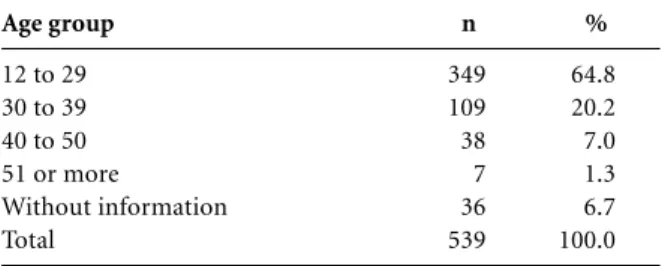
Table 3 shows the distribution of suicide at-tempts according to age over the period 1996-2001. Nearly 65% of cases occurred in the young population with less than 30 years of age.
Approximately 68.1% (n=367) of attempt-ed suicides were committattempt-ed by women. This is in accordance with the literature, showing sui-cide to be more often attempted by women but more often completed by men.
The occupational analysis of the individu-als who attempted suicide in Itabira shows that the greater part were housekeepers (18.9%), housewives (18.9%) and students (18.4%). To-gether these occupations constituted a total of 56.2%, which is in accordance with the fact that the major part of suicide attempts is commit-ted by women.
Conclusions
This study, part of a more complex investiga-tion, established the rank suicide occupies in the magnitude of general mortality and mor-tality from external causes in Itabira. Focusing only the category external causes, it could be observed that over these 12 years suicide pied the fourth place. The first places are occu-pied by death from traffic accidents, homicide and drowning. However, it is the suicides that
disquiet the sociological imagination in the first place, provoking apprehension in the pop-ulation
With respect to suicide specifically, the main subject approached by this investigation, in terms of magnitude this problem showed not to be the most relevant. This evidence allowed relativizing and simultaneously articulating in-formation, considerations and local proposals, first of all for the health sector. It also provided the opportunity to analyze the qualitative sig-nificance of self-inflicted death and morbidity as phenomena that deeply mobilize the social energy.
On the other hand, it became evident that although suicide is occupying the fourth place in the death rates due to accidents and violence in the general context of external causes, the rates of both attempted and completed suicide tend to increase. It could also be shown that the profile of individuals who complete suicide is different from those who attempt suicide. As to mortality, the greater part of suicide victims were men between 25 and 39 and 40 and 59 years of age, married, and used mainly hanging and firearms as methods to take their own life. More women than men attempted suicide, mainly housekeepers, housewives and students (although this was evidenced in the data of the state police, not in those of the MIS). More than 50% of them used nonmedicinal sub-stances, drugs and medicaments to this intent.
The synthesis study4showed
disenchant-ment with the present and future perspectives of life, alcoholism of the individual or of mem-bers of his family and mental diseases to have strong impact upon suicide. As refers to suicide attempts, patriarchalism, a life mostly spent isolated at home and without the support of social networks, domestic violence, physical and psychological abuse, sexual negligence and
Table 3
Distribution of attempted suicide in Itabira, 1996 to 2001.
Age group n %
12 to 29 349 64.8
30 to 39 109 20.2
40 to 50 38 7.0
51 or more 7 1.3
Without information 36 6.7
Total 539 100.0
Ci
ência & Sa
ú
de C
oleti
va,
11(2):409-418,
2006
417
violence, many times occurring all together, are relevant factors, especially in the case of women. With respect to the available data, there is an evident undernotification by the databases of the health sector. The best sources of infor-mation for analyzing the deaths are the reg-istries of the local notary’s office; and for the attempts, the archives of the state police. The MIS shows underregistration of deaths, and the HAA present classification problems as refers to primary and secondary diagnoses. These problems point to the need of a better training of professionals for diagnosing, noti-fying and codinoti-fying the basic cause of death from violence and accidents in general and in special with regard to suicidal events. A num-ber of mistakes are being committed when fill-ing in the medical/hospital records. There is a lack of data regarding emergency attendance pointing to the need of establishing notifica-tion norms and routines, if not for all accidents and cases of violence, at least for those repre-senting a public health problem in the city.
In the end of the investigation that gave origin to this paper and others mentioned in the introduction, we had the opportunity to discuss all data referring health problems with the city authorities, with emphasis to the
im-pact of violence and accidents. The imim-pact of these events was consolidated under different aspects: the socioeconomic context, the impact of the ongoing productive reorganization upon the life of the workers and their families, the cultural traditions strongly marked by patriar-chalism, magnitudes, relations and subjectivi-ties; and, above all, the role of the local institu-tions, mainly those of the health sector. In this last case, besides discussing the aspect promo-tion, we emphasized the need to improve the attendance services for the victims of violent events and produce well-notified and reliable information.
We also emphasized the need to start dis-cussing treatment and prevention programs for the groups more vulnerable to suicide, which could be detected and followed up by Family Health Programs but also need specialized pro-fessional care.
Finally, we attempted to prove here that it is possible to conduct a deep analysis of specif-ic situations but applspecif-icable to general situa-tions with basis on one case and one specific question. Understanding these situations, we can improve our knowledge and contribute to a better quality of life and, above all, to a better health management.
Collaborations
ER Souza participated in the theoretical conception and in the writing of the final text. MCS Minayo participated in the writing of the final text. FG Cavalcante coordinat-ed the process of data’s collection and collaboratcoordinat-ed to the writing of the final text.
Acknowledgements
Souza,
E.
R.
et
a
l.
References
1. Minayo MCS. De ferro e flexíveis: marcas do estado empresário e da privatização na subjetividade ope-rária. Rio de Janeiro: Garamond; 2004.
2. Cavalcante FG, Minayo MCS. Organizadores psíqui-cos e suicídio: retratos de uma autópsia psipsíqui-cossocial. In: Prado MCA, coordenadora. O mosaico da violên-cia: a perversão na vida cotidiana. São Paulo: Vetor; 2004. p. 371-431
3. Minayo MCS, Cavalcante FG, Souza ER. Proposta metodológica para abordagem de suicídio como fe-nômeno complexo. Cad Saúde Pública. [No prelo 2006].
4. Minayo MCS, Cavalcante FG, Souza, ER. A eloqüên-cia do gesto final: suicídio em Itabira. Rio de Janeiro: Claves/Fiocruz; 2004. Relatório de pesquisa. 5. Mello-Jorge MHP, Gotlieb SLD. As condições de
saúde no Brasil. Rio de Janeiro: Ed. Fiocruz; 2000. 6. Souza ER. Homicídio: o grande vilão da saúde
públi-ca na dépúbli-cada de 80. Cad Saúde Públipúbli-ca 1994; 10 (Supl. 1):135-45.
7. Durkheim E. O suicídio. São Paulo: Abril; 1980. (Co-leção Os Pensadores).
8. Ostamo A, Lahelma E, Lönnqvist J. Tansitions of em-ployement status among suicide attempters during a severe economic recession. Soc Sci Med 2001; 52 (11):1741-50.
9. Brasil. Ministério da Saúde. Banco de dados do Sis-tema de Informação sobre Mortalidade: 1979 a 1998 – dados de Declaração de Óbito [CD-ROM]. Brasília: MS; 2000.
10. Brasil. Ministério da Saúde. Banco de dados do Sis-tema de Informação sobre Mortalidade: 1996 a 2000 [CD-ROM]. Brasília: MS; 2002
11. Brasil. Ministério da Saúde. Banco de dados do Sis-tema de Informação sobre Mortalidade: 2001 [CD-ROM]. Brasília: Ministério da Saúde; 2003. 12. Brasil. Ministério da Saúde. Banco de dados do
Sis-tema Único de Saúde. 2006 Maio [acessado 2006 maio 10]. Disponível em: http://www.datasus.gov.br 13. Souza ER. Violência velada e revelada: estudo
epide-miológico da mortalidade por causas externas em Duque de Caxias [dissertação]. Rio de Janeiro: Esco-la Nacional de Saúde Pública, Fundação Oswaldo Cruz; 1991.
14. Mello-Jorge MHP. Investigação sobre a mortalidade por acidentes e violências na infância [tese]. São Paulo: Faculdade de Saúde Pública; 1988.
15. Souza ER, Minayo MCS, Malaquias JV. Suicide among young people in selected Brazilian State Capitals. Cad Saúde Pública 2002; 18(3):673-83.
16. Santana FS, Souza ER, Minayo MCS, Malaquias JV, Reis AC. Evolução temporal da mortalidade por suicídio no Brasil, 1980 a 1999. Boletim Claves/Ce-nepi [periódico na Internet] 2002 dez. Disponível em: http://www.claves.fiocruz.br/boletim%206.pdf
Article presented in 25/02/2006 Approved in 9/03/2006