Original Article
Artigo Original
Aline Rodrigues Pinto1 Roberta Gonçalves da Silva2 Luciana Pinato2
Keywords
Renal Failure Speech-Language and Hearing Swallowing Disorders
Descritores
Insuiciência Renal Fonoaudiologia Transtornos de Deglutição
Correspondence address:
Luciana Pinato
Departamento de Fonoaudiologia, Universidade Estadual Paulista Avenida Higyno Muzzi Filho, 737, Marília (SP), Brasil, CEP: 17515-901. E-mail: [email protected]
Received: 03/11/2015
Accepted: 06/16/2015
Study carried out at Santa Casa de Misericórdia de Marília – Marília (SP), Brazil. (1) Santa Casa de Misericórdia de Marília – Marília (SP), Brazil.
(2) Graduate Program of Speech-Language Pathology and Audiology, Universidade Estadual Paulista “Júlio de Mesquita Filho” – UNESP – Marília, (SP), Brazil.
Conlict of interests: nothing to declare.
Oropharyngeal swallowing in chronic renal failure
Deglutição orofaríngea na insuiciência renal crônica
ABSTRACT
Objective: To characterize the oropharyngeal swallowing proile of patients with chronic renal failure.
Methods: A cross-sectional clinical study involving 20 adults diagnosed with chronic renal failure in hospital stay was conducted. The evaluation of swallowing was performed by videoluoroscopy, and characterization of indings was based on effectiveness and safety parameters. Functional Oral Intake Scale (FOIS) was also applied. Results: On videoluoroscopy, 16 patients presented changes in oral and pharyngeal patterns, three individuals presented impairment at the pharyngeal phase, and only one individual presented changes only at the oral phase of swallowing. Furthermore, videoluoroscopy showed penetration and tracheal aspiration in 30% of the sample. Before the videoluoroscopy, four individuals (20%) were at level 5 of FOIS scale, whereas 16 individuals (80%) were at level 7. After adjustments of the oral diet consistency because of safety and swallowing effectiveness, FOIS classiication was six individuals at level 1, seven at level 4, four at level 5, and three at level 6. Conclusion: The characterization of oropharyngeal swallowing proile in chronic renal patients showed abnormalities at oral and pharyngeal phase, including penetration and tracheal aspiration, which requires oral intake changes.
RESUMO
Objetivo: Caracterizar o peril de deglutição orofaríngea em indivíduos com insuiciência renal crônica (IRC). Métodos: Estudo clínico transversal do qual participaram 20 indivíduos adultos com diagnóstico médico de IRC, durante o período de internação hospitalar. A avaliação objetiva da deglutição foi realizada por videoluoroscopia de deglutição (VFD), sendo a caracterização e classiicação dos achados baseada em parâmetros de eicácia e segurança. Além disso, foi aplicada a Functional Oral Intake Scale (FOIS).
INTRODUCTION
Although the mechanisms involved in chronic renal failure (CRF) are not clear yet, patients with CRF may present, in addition to the inlammatory process, changes in regulation of the hypotha-lamic pituitary gland, the immune system, sleep patterns, mood, and swallowing, and the occurrence of symptoms depend on the disease, dietary habits, and the level of reduction in renal function(1-4).
Because swallowing is a complex act that requires the integrity of various neuronal systems involved in the integra-tion of stimuli, central nervous system and motor response(5), any conditions affecting this integration can lead to dysphagia. Because CRF is a condition that leads to levels of consciousness change and xerostomia(4), the investigation of the hypothesis that patients may present oropharyngeal dysphagia is justiied.
Despite the clinical observation of abnormalities in oropha-ryngeal swallowing of patients with CRF during hospital stay, this phenomenon has not yet been scientiically investigated. Only one study, using a structured questionnaire addressed oral symptoms in CRF, pointing xerostomia(4) as main complaint and on clinical evaluation, which is relevant, as this is a predictive factor for oropharyngeal dysphagia(6).
The research on the biomechanics of swallowing is cases of CRF aims to contribute to the understanding of causes and con-sequences of various clinical symptoms known to be related to dysphagia, besides raising the possible need and targeting of early intervention with regard to safety and effectiveness of swallowing in this population. The objective of this study was to describe the oropharyngeal swallowing proile of patients with CRF.
METHODS
This is a cross-sectional clinical trial complying with study pro-tocol approved by the institution number 0667/2013. All individuals and/or legal representatives were aware and signed the Informed Consent form, according to recommendations of Resolution 196/96 of the National Health Council on Guidelines and Norms Regulating research involving human beings.
Twenty individuals with medical diagnosis of CRF in hospital stay for hemodialysis participated in this study, ex-cluding those who were using psychoactive drugs, presenting neurological changes or invasive medical intervention such as intubation. Seven of these were males and 13 were females, all of them of the age from 29 to 79 years (mean 54.9 ± 3.3 years).
Before the procedures of swallowing assessment, we con-ducted an informal clinical interview with all the patients from the CRF group about potential oropharyngeal complaints, and the only complaint reported by 100% of CRF patients was the feeling of xerostomia, under the name of “dry mouth.”
At this point, the neurological Glasgow Coma Scale was applied to identify patients’ level of consciousness, which was found to score 14:15.
Videoluoroscopic evaluation of swallowing
The videoluoroscopic evaluation of swallowing (VFS) was held at a philanthropic hospital where patients with CRF were hospitalized. In all cases, VFS was performed on the irst
day of hospitalization before the irst hemodialysis session. An speech language pathologist, a radiology technician, and a nursing technician participated in the exam. Evaluation of swallowing involved addition of radiological contrast barium sulfate (Bariogel@) in food consistencies that obey the standards of the American Dietetic Association(7).
Each individual with CRF was evaluated during swallowing of liquid consistencies, nectar and honey(7), offered in a spoon with 5, 10, and 15 mL (totaling three tablespoons for each food consistency). Liquids were initially provided in a 5-mL spoon, and then by freely swallowing (in a glass).
To prepare consistencies and volumes, we used a dispos-able plastic cup, disposdispos-able plastic spoon, 20-mL syringe (for measuring volumes), barium sulfate, instant food thickener with a thickening agent of modiied corn starch and maltodextrin, and diet pear-lavored juice powder (previously diluted in 500 mL of water). The measurer was provided by the food thick-ener manufacturer. Next, VFS was performed with barium sulfate at 50% to 50% food consistency, so it would not go through changes.
To perform the examination, patients were sitting at 90°. The anatomical limits ranged from the oral cavity into the esophagus, anterior limit was set by the lips, posterior limit by the pharyngeal wall, upper limit by the nasopharynx, and the lower limit by cervical esophagus(8).
The equipment used was a C-arm from Siemens, model Cerimobil. The images were transferred to a video monitor attached to the C-arm and recorded by means of “double cap-tion,” where the examination of the images was captured from the monitor using a high-deinition camcorder machine, and subsequently recorded on a DVD.
Characterization of swallowing indings
Characterization and classiication of VFS indings were based on effectiveness and safety parameters proposed in the literature by Clavé(9). Thus, the indings were characterized as described: presence of swallowing biomechanics without losses; abnormalities in oral phase of swallowing (presence of oral incoordination, loss in propulsion, and oral residue); abnor-malities in pharyngeal stage of swallowing (presence of residue, penetration, and tracheal aspiration); and abnormalitiesin oral and pharyngeal phases (presence of oral incoordination, loss in propulsion, oral residue, penetration, and tracheal aspiration).
Functional Oral Intake Scale
To characterize the level of oral intake, Functional Oral Intake Scale (FOIS) was applied, as proposed by Crary(10), before and after the evaluation of swallowing by VFS.
RESULTS
Swallowing proiles deined by analyzing VFS indings of individuals with CRF showed that among 20 patients studied, 16 presented abnormalities in oral and pharyngeal phase (mean age 53.75 ± 3.8 years), 3 presented changes only in the pharyn-geal phase (mean age 65 ± 2.5 years), and 1 of them presented changes in the oral phase of swallowing (43 years). None of the subjects presented unchanged swallowing biomechanics (Figure 1).
With respect to oral intake, FOIS put 4 individuals (20%) with CRF at level 5 and 16 individuals (80%) at level 7, before VFS (Figure 2A). On completion of VFS, there was a change in FOIS levels of six subjects to level 1, seven to Level 4, four to level 5, and three to level 6 (Figure 2B).
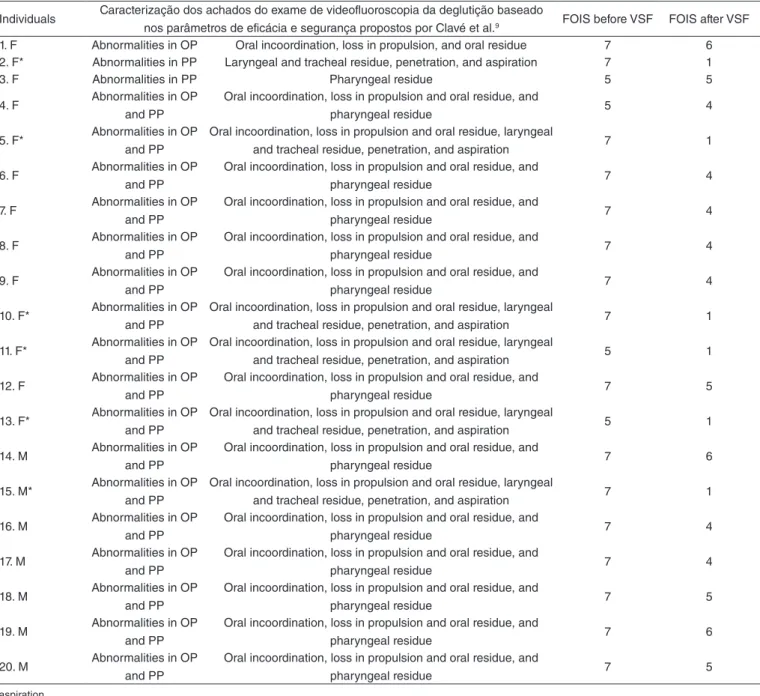
Furthermore, VFS showed penetration and tracheal aspiration in 30% of individuals. Among these, two patients (33.3%) were at FOIS level 5, and four subjects (66.6%) were at FOIS level 7 before VFS (Figure 3A). Individual descriptions of dificulties in swal-lowing, according to parameters by Clave(9), are shown in Table 1. Whenever presence of tracheal aspiration was related to the classiication of VSF indings, presence of tracheal aspiration seen in one individual (16.6%) was rated as change in pharyngeal phase, and in ive individuals (83.3%) were identiied with changes in the oral and pharyngeal phases of swallowing (Figure 3B).
DISCUSSION
The production of knowledge about parameters that indicate disorders in swallowing biomechanics in various diseases is still an evolving procedure in dysphagia research(11). This study was the irst to describe the biomechanics of orophyngeal swallow-ing in patients with CRF.
VFS showed high incidence (80%) of abnormalities in oral and pharyngeal phases in subjects with CRF, a lower percent-age (15%) of cases with abnormalities in the pharyngeal phase only, and one case (5%) of abnormalities in the oral phase of swallowing. Although one cannot compare these epidemiologi-cal data with other studies in the same population, as this was the irst study to perform such investigation, data show a high incidence of oropharyngeal dysphagia in CRF patients when compared with the same method in populations known to be at risk for this dysfunction, such as individuals with neurologi-cal impairments after a stroke(12-14). These data, coupled with the fact that none of the CRF patients presented unchanged swallowing biomechanics, position CRF at the same level of diseases that cause clinical pictures of oropharyngeal dyspha-gia, which points to the need for research and early speech therapy intervention.
The main point of this evaluation of CRF was the presence of tracheal aspiration in 30% of the sample. This inding, if not diagnosed or properly treated, may favor nutritional and immunity loss, leading to the acquisition of other diseases and even to death(15).
At this point, it should be noted that this disease has an instable clinical picture. The clinical manifestations of CRF can be divided into symptoms that improve, persist, or arise because of dialysis, which is indicated when, despite treat-ment with hypoproteic diet, diuretics, and antihypertensives, neurological and gastrointestinal symptoms remain(16). Dialysis could be responsible for a case also known as “dialysis demen-tia” that may include speech and language disorders or even swallowing disorders (during or after dialysis); months later, these features become persistent, associated with myoclonus,
Figure 2. Number of patients in the renal failure group at all intake phases (1–7) according to the Functional Oral Intake Scale, before (A) and after (B) videofluoroscopy (n=20)
Caption: FOIS = Functional Oral Intake Scale
Number of individuals
FOIS levels 20
1 2 3 4 5 6 7 15
10
5
0
Number of individuals
20
15
10
5
0
FOIS levels
1 2 3 4 5 6 7
A
B
Caption: CRF = chronic renal failure
Figure 1. Swallowing findings in chronic renal failure obtained by videofluoroscopy (n=20)
Number of individuals
Abnormalities in oral phase Abnormalities in pharyngeal phase Abnormalities in oral and pharyngeal phases 20
15
10
5
seizures, balance, and cognitive disorders, affecting mainly the memory(17).
Considering that this spectrum of symptoms can be changed during hospital stay and with renal replacement therapy, all subjects were analyzed on the irst day of hospitalization and before the irst hemodialysis session.
Among individuals showing presence of aspiration, 33.3% were at FOIS level 5, and 66.6% at level 7 before VFS. These data show that this population had unmanaged oral diet at this point, with consequences to swallowing noted by VFS. Once aspiration was noted, there was a change in eating behavior, with restrictions to food consistency in oral diet or even the use of alternative means of supply.
As FOIS is a tool used for the classiication of the type of diet of an individual, one can say that a given change in FOIS after VFS is related to the need for change in the consistency of the oral diet because of losses in safety and eficiency of swallowing observed in the objective examina-tion of swallowing(11,18,19).
On the whole, these indings suggest that abnormalities in oropharyngeal swallowing can be a part of CRF clinical image and highlight the need to investigate the causes of this phenomenon.
The speech pathologist evaluation in the clinical manifes-tations of CRF can be a determining factor to avoid potential complications arising from the presence of abnormalities in the biomechanics of oropharyngeal swallowing.
Based on these indings, the need for the clinical examina-tion of swallowing in this populaexamina-tion must be emphasized by
request of the medical staff, a routine procedure in the institu-tion where the study was conducted.
As a future perspective, this study raises the need for the deinition of swallowing proile after hospital stay in this popu-lation. Another parameter to be investigated in further studies is the presence of dry mouth sensation described by these pa-tients, as this symptom affects proper formation of bolus and contributes to changes in the oral phase of swallowing, thus interfering with the quality and safety of feeding(4,6).
Other possible factors as causes of oropharyngeal dysphagia in CRF would be complications and/or co-morbidities that impact the neuromotor system, such as neuropathy and uremic encephalopathy, changes in levels of consciousness, attention and associated alert or sleep-ing disorders, neuronal damage induced by uremic toxins, ischemic brain injury, oxidative stress, chronic inflamma-tion, endothelial dysfuncinflamma-tion, and anemia(4,20-24), which also need to be investigated.
In addition to dementia, uremic neuropathy, and uremic encephalopathy, the literature also describes frequent comorbid conditions in CRF such as anemia, calcium and phosphorus metabolism alterations, metabolic acidosis, malnutrition, car-diovascular disease, peripheral vascular disease, retinopathy, and diabetic neuropathy. When it comes to anemia, most com-mon symptoms are tiredness and exhaustion, breathlessness and arrhythmia, and the possibility of headache, ringing in the ears, dysgeusia, and dysphagia(20).
In addition, data point to the need for further research on relation between biomechanics of swallowing and clinical
Figure 3. Number of individuals with CRF presenting aspiration at videofluoroscopy in all FOIS levels before assessment (A) and in all phases: changes in oral phase, changes in pharyngeal phase, and changes in oral and pharyngeal phases, according to swallowing profile found in VFS (B) (n=20) Caption: FOIS = Functional Oral Intake Scale; C-OP = changes in oral phase; C-PP = changes in pharyngeal phase; C-OPP = changes in oral and pharyngeal phases
A
FOIS 20
15
10
5
0
1 2 3 4 5 6 7
Number of individuals
Aspiration
B
Characterization of swallowing 20
15
10
5
0
CO-P C-PP C-OPP
Number of individuals
manifestations and possible complications of CRF, which can help to build knowledge and to contribute to the mul-tidisciplinary treatment of this population.
CONCLUSION
The characterization of oropharyngeal swallowing profile in patients with CRF showed abnormalities in oral and pharyngeal phases, including penetration and tracheal aspiration, and requiring management in the oral intake.
ACKNOWLEDGMENT
We would like to thank Fundação de Amparo à Pesquisa do Estado de São Paulo (FAPESP) for the support (process 2011/51495-4),
and National Council for Scientiic and Technological Development (CNPq), universal edital (480208/2013-1).
*ARP participated in study conception and design, data analysis, and writing; RGS participated in study conception and design, data analysis and writing; LP participated in study conception and design, data analysis and writing.
REFERÊNCIAS
1. Cachofeiro V, Goicochea M, De Vinuesa SG, Oubina P, Lahera V, Luño J. Oxidative stress and inlammation, a link between chronic kidney disease and cardiovascular disease. Kidney Int Suppl. 2008; (111):S4-9. 2. Filiopoulos V, Vlassopoulos D. Inlammatory syndrome in chronic kidney
disease: pathogenesis and inluence on outcomes. Inlamm Allergy Drug Targets. 2009;8:369-82.
Individuals Caracterização dos achados do exame de videofluoroscopia da deglutição baseado
nos parâmetros de eficácia e segurança propostos por Clavé et al.9 FOIS before VSF FOIS after VSF
1. F Abnormalities in OP Oral incoordination, loss in propulsion, and oral residue 7 6 2. F* Abnormalities in PP Laryngeal and tracheal residue, penetration, and aspiration 7 1
3. F Abnormalities in PP Pharyngeal residue 5 5
4. F Abnormalities in OP and PP
Oral incoordination, loss in propulsion and oral residue, and
pharyngeal residue 5 4
5. F* Abnormalities in OP and PP
Oral incoordination, loss in propulsion and oral residue, laryngeal
and tracheal residue, penetration, and aspiration 7 1
6. F Abnormalities in OP and PP
Oral incoordination, loss in propulsion and oral residue, and
pharyngeal residue 7 4
7. F Abnormalities in OP and PP
Oral incoordination, loss in propulsion and oral residue, and
pharyngeal residue 7 4
8. F Abnormalities in OP and PP
Oral incoordination, loss in propulsion and oral residue, and
pharyngeal residue 7 4
9. F Abnormalities in OP and PP
Oral incoordination, loss in propulsion and oral residue, and
pharyngeal residue 7 4
10. F* Abnormalities in OP and PP
Oral incoordination, loss in propulsion and oral residue, laryngeal
and tracheal residue, penetration, and aspiration 7 1
11. F* Abnormalities in OP and PP
Oral incoordination, loss in propulsion and oral residue, laryngeal
and tracheal residue, penetration, and aspiration 5 1
12. F Abnormalities in OP and PP
Oral incoordination, loss in propulsion and oral residue, and
pharyngeal residue 7 5
13. F* Abnormalities in OP and PP
Oral incoordination, loss in propulsion and oral residue, laryngeal
and tracheal residue, penetration, and aspiration 5 1
14. M Abnormalities in OP and PP
Oral incoordination, loss in propulsion and oral residue, and
pharyngeal residue 7 6
15. M* Abnormalities in OP and PP
Oral incoordination, loss in propulsion and oral residue, laryngeal
and tracheal residue, penetration, and aspiration 7 1
16. M Abnormalities in OP and PP
Oral incoordination, loss in propulsion and oral residue, and
pharyngeal residue 7 4
17. M Abnormalities in OP and PP
Oral incoordination, loss in propulsion and oral residue, and
pharyngeal residue 7 4
18. M Abnormalities in OP and PP
Oral incoordination, loss in propulsion and oral residue, and
pharyngeal residue 7 5
19. M Abnormalities in OP and PP
Oral incoordination, loss in propulsion and oral residue, and
pharyngeal residue 7 6
20. M Abnormalities in OP and PP
Oral incoordination, loss in propulsion and oral residue, and
pharyngeal residue 7 5
Caption: F = female; M = male; FOIS = FunctionalOralIntakeScale; VFS = videofluoroscopy of swallowing; OP = oral phase; PP = pharyngeal phase;
Table 1. Videofluoroscopic findings in chronic renal failure
3. Cheung WW, Paik KH, Mak RH. Inlammation and cachexia in chronic kidney disease. Pediatr Nephrol. 2010;25:711-24.
4. Vesterinen M, Ruokonen H, Furuholm J, Honkanen E, Meurman JH. Clinical questionnaire study of oral health care and symptoms in diabetic vs. non- diabetic predialysis chronic kidney disease patients. Clin Oral Investig. 2012;16(2):559-63.
5. Furkim AM, Mattana A. Fisiologia da Deglutição Orofaríngea. In: Ferreira LP, Beli-Lopes DM, Limonge SCO, organizadores. Tratado de Fonoaudiologia. São Paulo: Roca; 2004. Cap. 18. p. 212-8.
6. Bassi D, Furkim AM, Silva CA, Coelho MSPH, Rolim MRP, Alencar MLA, et al. Identiicação de grupos de risco para disfagia orofaríngea em pacientes internados em um hospital universitário. CoDAS. 2014;26(1):17-27. 7. American Dietetic Association (ADA). Food and nutrition
misinformation: position of ADA. J Am Diet Assoc. 2002;102260-266. 8. Chee C, Arshad S, Singh S, Mistry S, Hamdy S. The inluence of
chemical gustatory stimuli and oral anesthesia on healthy human pharyngeal swallowing. Chem Senses. 2005;30(5):393-400.
9. Clavé P, Arreola V, Romea M, Medina L, Palomera E, Serra-Prat M. Accuracy of the volume-viscosity swallow test for clinical screening of oropharyngeal dysphagia and aspiration. Clin Nutr. 2008;27:806-15.
10. Crary MA, Mann GD, Groher ME. Initial psychometric assessment of a functional oral intake scale for dysphagia in stroke patients. Arch Phys Med Rehab. 2005;86(8):1516-20.
11. Silva RG, Jorge AG, Peres FM, Cola PC, Gatto AR, Spadotto AA. Protocolo para Controle de Eicácia Terapêutica em Disfagia Orofaríngea Neurogênica (Procedon). Rev CEFAC. 2010;12:75-81.
12. S c h e l p AO , C o l a P C , G a t t o A R , S i l va R D , C a r va l h o L D . Incidência de disfagia orofaríngea após acidente vascular encefálico em hospital público de referência. Arq Neuropsiquiatr. 2004;62(2-B):503-6.
13. Chai J, Chu FCS, Chow TW, Shum NC. Prevalence of malnutrition and its risk factors in stroke patients residing in an inirmary. Singap Med J. 2008;49(4):290-6.
14. Martino R, Martin RE, Black S. Dysphagia after stroke and its management. CMAJ. 2012;184(10):1127-8.
15. Teramoto S. Novel preventive and therapuetic strategy for post-stroke pneumonia. Expert Rev Neurother. 2009;9(8):1187-200.
16. Draibe SA. Insuiciência renal crônica. In: Ajzen H, Schor N, editor. Guias de medicina ambulatorial e hospitalar. Nefrologia. São Paulo: Manole; 2002. p. 179-194
17. Rakowski DA, Caillard S, Agodoa LY, Abbott KC. Dementia as a Predictor of Mortality in Dialysis Patients. Clin J Am Soc Nephrol. 2006;1:10005.
18. Carnaby-mann GD, Crary MA. McNeill dysphagia therapy program: a case-control study. Arch Phys Med Rehabil 2010;91(5):743-9. 19. Rofes L, Vilardell N, Clavé P. Post-stroke dysphagia: progress at last.
Neurogastroenterol Motil. 2013;25(4):278-82.
20. Bastos MG, Carmo WB, Abrita RR, Almeida EC, Mafra D, Costa DMN, et al. Doença Renal Crônica: Problemas e Soluções. J Bras Nefrol. 2004; 26(4):202-15.
21. Yoon CH, Seok JI, Lee DK, An GS. Bilateral basal ganglia and unilateral cortical involvement in a diabetic uremic patient. Clin Neurol Neurosurg. 2009;111(5):477-9.
22. Da Matta SM, Moreira JM, Melo e Kummer A, Barbosa IG, Teixeira AL, Simões e Silva AC. Alterações cognitivas na doença renal crônica: uma atualização. J Bras Nefrol. 2014;36(2):241-5.
23. Bugnicourt JM, Godefroy O, Chillon JM, Choukroun G, Massy ZA. Cognitive disorders and dementia in CKD: the neglected kidney-brain axis. J Am Soc Nephrol. 2013;24:353-63.