EUROPEAN ORGANIZATION FOR NUCLEAR RESEARCH (CERN)
CERN-EP/2016-236 2017/03/28
CMS-HIN-16-009
Observation of charge-dependent azimuthal correlations in
pPb collisions and its implication for the search for the
chiral magnetic effect
The CMS Collaboration
∗Abstract
Charge-dependent azimuthal particle correlations with respect to the second-order event plane in pPb and PbPb collisions at a nucleon-nucleon center-of-mass energy of 5.02 TeV have been studied with the CMS experiment at the LHC. The measurement is performed with a three-particle correlation technique, using two particles with the same or opposite charge within the pseudorapidity range|η| < 2.4, and a third
par-ticle measured in the hadron forward calorimeters (4.4 < |η| < 5). The observed
differences between the same and opposite sign correlations, as functions of multi-plicity and η gap between the two charged particles, are of similar magnitude in pPb and PbPb collisions at the same multiplicities. These results pose a challenge for the interpretation of charge-dependent azimuthal correlations in heavy ion collisions in terms of the chiral magnetic effect.
Published in Physical Review Letters as doi:10.1103/PhysRevLett.118.122301.
c
2017 CERN for the benefit of the CMS Collaboration. CC-BY-3.0 license ∗See Appendix A for the list of collaboration members
1
In relativistic heavy ion collisions, metastable domains of gluon fields may form with non-trivial topological configurations [1–4]. The interaction of quarks with these gluon fields will lead to an imbalance in left- and right-handed quarks, which violates local parity (P) symme-try [3, 4]. In the presence of a strong magnetic field in a noncentral nucleus-nucleus (AA) col-lision, this chirality imbalance leads to an electric current perpendicular to the reaction plane, resulting in a final-state charge separation phenomenon, known as the chiral magnetic effect (CME) [5]. Attempts to measure this charge separation in heavy ion collisions were made by the STAR experiment at RHIC [6–10] and the ALICE experiment at the LHC [11]. In these mea-surements, a charge dependence of azimuthal correlations with respect to the reaction plane was observed, which is qualitatively consistent with the expectation of a charge separation from the CME.
The charge separation can be characterized by the P-odd sine term (a1) in a Fourier
decompo-sition of the particle azimuthal distribution [12]: dN
dφ ∝ 1+2
∑
n(vncos[n(φ−ΨRP)] +ansin[n(φ−ΨRP)]), (1) where φ−ΨRPrepresents the particle azimuthal angle with respect to the reaction plane angle ΨRP(determined by the impact parameter and beam axis), vnand andenote the coefficients ofP-even and P-odd Fourier terms, respectively. Although the reaction plane is not an experimen-tal observable, it can be approximated by the second-order event plane,ΨEP, determined by the
direction of the beam and the maximal particle density in the elliptic azimuthal anisotropy. An azimuthal correlator proposed to explore the first coefficient, a1, of the P-odd Fourier terms
characterizing the charge separation [12] is: cos(φα+φβ−2ΨEP)
=cos(φα−ΨEP)cos(φβ−ΨEP)
−sin(φα−ΨEP)sin(φβ−ΨEP) . (2)
Here, α and β denote particles with the same or opposite charge sign and the brackets reflect an averaging over particles and events. Assuming particles α, β are uncorrelated except for their individual correlations with respect to the event plane, the first term on the right hand side of Eq. (2) becomesv1,αv1,β , which is generally small and independent of charge [7], while the
second term is sensitive to charge separation and can be expressed asa1,αa1,β , which can be
measured.
The observation of the CME in heavy ion collisions remains inconclusive because of several identified sources of background correlations that can account for part or all of the observed charge-dependent azimuthal correlations [13–15]. For example, the effect of local charge con-servation, coupled with the anisotropic emission of particles (v2), can generate an effect
re-sembling charge separation with respect to the reaction plane [15]. The charge-dependent az-imuthal correlation signals observed in the data can be qualitatively described by models that do not include CME, such as the AMPT [16] andEPOS LHC[17] models. A significant amount of recent experimental and theoretical effort is directed toward quantifying possible mechanisms, including the CME, that can lead to charge-dependent azimuthal correlations [18].
This Letter presents the first application of charge-dependent azimuthal correlation analysis with respect to the event plane in proton-nucleus collisions, using pPb data collected with the CMS detector at the LHC at √sNN = 5.02 TeV. High-multiplicity pp and pPb collisions have been shown to generate large final-state azimuthal anisotropies, comparable to those in AA collisions [19–32]. However, the CME contribution to any charge-dependent signal is expected to be small in a high-multiplicity pPb collision, as the proton likely intersects the Pb nucleus
at a small impact parameter. Consequently, the magnetic field in the proton-nucleus overlap region is expected to be smaller than in peripheral PbPb collisions at similar multiplicities. Furthermore, based on Monte Carlo (MC) Glauber calculations [33], the angle between the magnetic field direction and the event plane of elliptic anisotropy is randomly distributed in pPb collisions, contrary to the situation for PbPb collisions. With a reduced magnetic field strength and a random field orientation, the CME contribution to any charge-dependent signal is expected to be small. The high-multiplicity events in pPb collisions exhibit collective effects and bulk properties similar to those found in AA collisions [29, 31, 34] but possess very different strengths and configurations of the initial magnetic field. Thus, they can provide a new way to explore the possible CME and local strong parity violation. With the implementation of a high-multiplicity trigger, the pPb data sample gives access to multiplicities comparable to those in peripheral PbPb collisions (e.g.,∼55% centrality, where centrality is defined as the fraction of the total inelastic cross section, with 0% denoting the most central collisions), allowing for a direct comparison of the two systems with very different CME contributions in the overlap zone. The measurement is presented in different charge combinations as functions of event multiplicity and pseudorapidity (η) difference of correlated particles. In pPb collisions, the particle correlations with respect to the event planes that are obtained using particles with 4.4< |η| <5 from the p- and Pb-going beam direction, are also explored.
The central feature of the CMS apparatus is a superconducting solenoid of 6 m internal diam-eter, providing a magnetic field of 3.8 T. Within the solenoid volume, there are four primary subdetectors including a silicon pixel and strip tracker detector, a lead tungstate crystal elec-tromagnetic calorimeter (ECAL), and a brass and scintillator hadron calorimeter (HCAL), each composed of a barrel and two endcap sections. Muons are measured in gas-ionization detec-tors embedded in the steel flux-return yoke outside the solenoid. The silicon tracker measures charged particles within the range |η| < 2.5. For charged particles with transverse
momen-tum 1 < pT < 10 GeV and |η| < 1.4, the track resolutions are typically 1.5% in pT and 25–
90 (45–150) µm in the transverse (longitudinal) impact parameter [35]. Iron and quartz-fiber Cherenkov hadron forward (HF) calorimeters cover the range 2.9 < |η| < 5.2. A detailed
de-scription of the CMS detector, together with a definition of the coordinate system used and the relevant kinematic variables, can be found in Ref. [36].
The pPb data at√sNN = 5.02 TeV, collected in 2013 at the LHC, correspond to an integrated luminosity of 35 nb−1. The beam energies are 4 TeV for the protons and 1.58 TeV per nucleon for the lead nuclei. A subset of peripheral PbPb data at√sNN =5.02 TeV collected in 2015 (30– 80% centrality) is also used. The PbPb data were reprocessed using the same reconstruction algorithm as the pPb data, in order to directly compare the two systems at similar multiplicities. The event reconstruction, event selections, and the triggers, including the dedicated triggers to collect a large sample of high-multiplicity pPb events, are identical to those used in previous CMS particle correlation measurements [19, 29]. In the offline analysis of pPb (PbPb) collisions, hadronic events are selected by requiring the presence of at least one (three) energy deposit(s) greater than 3 GeV in each of the two HF calorimeters. Events are also required to contain a primary vertex within 15 cm of the nominal interaction point along the beam axis and 0.15 cm in the transverse direction. In the pPb data sample, there is a 3% probability to have at least one additional interaction in the same bunch crossing (pileup). The procedure used to reject pileup events in pPb collisions yields a purity of 99.8% for single pPb collision events and is described in Ref. [29]. The pileup in PbPb data is negligible.
Primary tracks, i.e., tracks that originate at the primary vertex and satisfy the high-purity cri-teria of Ref. [35], are used to define the event charged-particle multiplicity (Ntrkoffline) and to perform correlation measurements. In addition, the impact parameter significance of the track
3
with respect to the primary vertex in the direction along the beam axis, dz/σ(dz)is required to
be less than 3, as is the corresponding impact parameter significance in the transverse plane, dT/σ(dT). The relative uncertainty in pT, σ(pT)/pT, must be less than 10%. Each track is also
required to leave at least one hit in one of the three layers of the pixel tracker. To ensure high tracking efficiency, only tracks with|η| <2.4 and pT >0.3 GeV are used in this analysis.
The pPb and PbPb data are compared in classes of Ntrkoffline, where primary tracks with|η| <2.4
and pT > 0.4 GeV are counted. To compare with results from other experiments, the PbPb
data are also analyzed based on centrality classes for the 30–80% centrality range. The average values of multiplicity, before and after correcting for detector and algorithm inefficiencies, in each multiplicity class of pPb and PbPb data, can be found in Ref. [29].
Without directly reconstructing the event plane, the expression shown in Eq. (2) can be al-ternatively evaluated using a three-particle correlator with respect to a third particle [6, 7], cos(φα+φβ−2φc) /v2,c, where v2,c corresponds to the elliptic flow of the particle c. The
three-particle correlator is measured via the scalar product method of Q vectors [7, 37]. The particles α and β are taken from the tracker with|η| <2.4 and 0.3< pT <3 GeV, and are
cor-rected for tracking efficiency to account for reconstruction effects. The particle c is measured by using the tower energies in the HF calorimeters with 4.4< |η| <5.0. This choice of η range for
HF towers imposes an η gap of at least 2 units with respect to particles α and β from the tracker, to minimize possible short-range correlations. To account for any occupancy effect of the HF detectors resulting from the large granularities in η and φ, each tower is weighted by its ET
value when calculating the Q vector. The v2,cis obtained following the standard scalar-product
method [6, 7], by correlating the Q vectors from the tracker region at midrapidity and the two HF detectors at forward rapidity. The three-particle correlator is evaluated for particles α and β carrying same sign (SS) and opposite sign (OS), as a function of pseudorapidity difference|∆η|
(≡ |ηα−ηβ|). The SS combinations, (+,+) and (−,−), give consistent results within statistical
uncertainty and are therefore combined. For pPb collisions, the three-particle correlator is also measured with particle c from HF+and HF−, corresponding to the p- and Pb-going direction, respectively. For symmetric PbPb collisions, the results from HF+ and HF−are consistent with each other within statistical uncertainty and are therefore averaged. The effect of the nonuni-form detector acceptance is found to be negligible by evaluating the cumulants of Q-vector products [38].
The absolute systematic uncertainty of the three-particle correlator has been studied. Varying the dz/σ(dz)and dT/σ(dT)from less than 3 (default) to less than 2 and 5, and the σ(pT)/pT <
10% (default) to σ(pT)/pT < 5%, together yield a systematic uncertainty of±1.0×10⁻⁵. The
longitudinal primary vertex position (Vz) has been varied, using ranges|Vz| < 3 cm and 3 <
|Vz| <15 cm, where the difference with respect to the default range|Vz| <15 cm is±1.0×10⁻⁵,
taken as the systematic uncertainty. In pPb collisions only, using the lower-threshold of the high-multiplicity trigger yields a systematic uncertainty of±3.0×10⁻⁵, which accounts for the possible trigger bias from the inefficiency of the default trigger around the threshold. A final test of the analysis procedures is done by comparing “known” charge-dependent signals based on the EPOS event generator to those found after events are passed through a GEANT4 [39]
simulation of the CMS detector response. Based on this test, a systematic uncertainty of±2.5×
10−5 is assigned. The tracking efficiency and acceptance of positively and negatively charged particles have been evaluated separately, and the difference has been found to be negligible. All sources of systematic uncertainty are uncorrelated and added in quadrature to obtain the total absolute systematic uncertainty. No dependence of the systematic uncertainties on the sign combination, multiplicity, or ∆η is found. The systematic uncertainties in our results as function of|∆η|and multiplicity are point-to-point correlated. In pPb collisions, the systematic
uncertainty is also observed to be independent of particle c pointing to the Pb- or p-going direction, and thus is quoted to be the same for these two situations.
|
η
∆
|
0 1 2 3 4 2,c/v
〉
)
cφ
-2
βφ
+
αφ
cos(
〈
1 − 0.5 − 0 0.5 1 3 − 10 × = 5.02 TeV NN s pPb (Pb-going) c φ (p-going) c φ SS OS < 220 trk offline N ≤ 185 (a)|
η
∆
|
0 1 2 3 4 2,c/v
〉
)
cφ
-2
βφ
+
αφ
cos(
〈
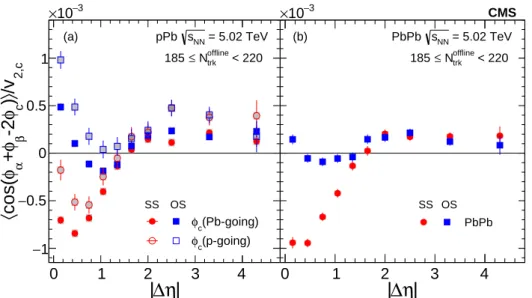
1 − 0.5 − 0 0.5 1 3 − 10 × < 220 trk offline N ≤ 185 (b) PbPb sNN = 5.02 TeV CMS SS OS PbPbFigure 1: The same (SS) and opposite sign (OS) three-particle correlator as a function of|∆η| ≡ |ηα−ηβ|for 185 ≤ Ntrkoffline < 220 in (a) pPb and (b) PbPb collisions at
√
sNN = 5.02 TeV. The pPb results obtained with particle c in Pb-going (solid markers) and p-going (open markers) sides are shown separately. Statistical and systematic uncertainties are indicated by the error bars and shaded regions, respectively.
Measurements of the charge-dependent three-particle correlator are shown in Fig. 1 as a func-tion of the|∆η|between charged particles α and β with the same and opposite signs, in the multiplicity range 185 ≤ Noffline
trk < 220 for pPb and PbPb collisions at
√
sNN = 5.02 TeV. The pPb data are obtained with particle c in the Pb- and p-going sides separately. In both pPb and PbPb systems, a charge dependence of the three-particle correlator is observed for |∆η|up to about 1.6. In this range, the SS correlators show significant negative values as|∆η|decreases, while the OS correlators become positive towards|∆η| ≈ 0. For |∆η| > 1.6, the SS and OS correlators converge to a common positive value, which is weakly dependent on |∆η| up to about 4.8 units. Similar |∆η|dependence of the three-particle correlator has been reported at
√
sNN = 0.2 TeV [6] and 2.76 TeV [11], measured up to |∆η| ≈ 1.6. In pPb collisions, three-particle correlators obtained with three-particle c from the p-going side are shifted toward more positive values than those from the Pb-going side by approximately the same amount for both the SS and OS pairs. The Pb-going side results for the pPb collisions are of similar magnitude as the results for PbPb collisions. The common shift of SS and OS correlators between the p- and Pb-going side reference (c) particle, may be related to sources of correlations that are charge-independent, such as directed flow and the momentum conservation effect, the latter being sensitive to the difference in multiplicity between p- and Pb-going directions.
To explore the multiplicity or centrality dependence of the three-particle correlator, an average of the results in Fig. 1 over|∆η| < 1.6 (charge-dependent region) is taken, where the average is weighted by the number of particle pairs in each |∆η|range. The resulting |∆η|-averaged three-particle correlators are shown in Fig. 2 as a function of Ntrkofflinefor pPb (particle c from the Pb-going side) and PbPb collisions at√sNN =5.02 TeV. Up to Ntrkoffline =300, the pPb and PbPb results are measured in the same Ntrkofflineranges. The centrality scale on the top of Fig. 2 relates to the PbPb experimental results. Within uncertainties, the SS and OS correlators in pPb and
5 trk offline N 2,c /v 〉 ) c φ -2 β φ + α φ cos( 〈−0.5 0 0.5 3 − 10 × 2 10 103 pPb, φc(Pb-going) PbPb = 5.02 TeV NN s SS OS PbPb centrality(%) 55 45 35 65 CMS
Figure 2: The same sign (SS) and opposite sign (OS) three-particle correlator averaged over
|ηα−ηβ| < 1.6 as a function of Ntrkoffline in pPb and PbPb collisions at
√
sNN = 5.02 TeV are shown. Statistical and systematic uncertainties are indicated by the error bars and shaded regions, respectively.
PbPb collisions exhibit the same magnitude and trend as a function of event multiplicity. The OS correlator reaches a value close to zero for Noffline
trk > 200, while the SS correlator remains
negative, but the magnitude gradually decreases as Noffline
trk increases. Part of the observed
multiplicity (or centrality) dependence is understood as a dilution effect that falls with the inverse of event multiplicity [7]. The notably similar magnitude and multiplicity dependence of the three-particle correlator observed in pPb collisions relative to that in PbPb collisions again indicates that the dominant contribution of the signal is not related to the CME. The results of SS and OS three-particle correlators as functions of centrality in PbPb collisions at√sNN =5.02 TeV are also found to be consistent with the results from lower energy AA collisions [7, 11].
To eliminate sources of correlations that are charge independent (e.g., directed flow, v1) and
to explore a possible charge separation effect generated by the CME, the difference of three-particle correlators between OS and SS is shown as a function of|∆η|in the multiplicity range 185≤ Ntrkoffline<220 (Fig. 3 (a)) and as a function of Ntrkofflineaveraged over|∆η| <1.6 (Fig. 3 (b),) for pPb and PbPb collisions at√sNN =5.02 TeV. After taking the difference, the pPb data with particle c from both the p- and Pb-going sides, and PbPb data, show nearly identical values. The charge-dependent difference is largest at|∆η| ≈ 0 and drops to zero for |∆η| > 1.6, and also decreases as a function of Ntrkoffline. The striking similarity in the observed charge-dependent azimuthal correlations strongly suggests a common physical origin. In PbPb collisions, it was suggested that the charge dependence of the three-particle correlator as well as its |∆η| de-pendence are indications of the charge separation effect with respect to the event plane due to the CME [7, 11]. However, as argued earlier, a strong charge separation signal from the CME is not expected in a very high-multiplicity pPb collision. The similarity seen between high-multiplicity pPb and peripheral PbPb collisions challenges the attribution of the observed charge-dependent correlations to the CME. Note that there is a hint of a slight difference be-tween pPb and PbPb in the slopes of the Ntrkofflinedependence in Fig. 3 (b), where the systematic uncertainties are point-to-point correlated. This difference is worth further investigation. In summary, charge-dependent azimuthal correlations of same and opposite sign particles with respect to the second-order event plane have been measured in pPb and PbPb collisions at
| η ∆ | 0 1 2 3 4 SS)− (OS 2,c /v〉) c φ -2 β φ+ α φ cos(〈 0 0.5 1 1.5×10⁻³ (a) < 220 trk offline N ≤ 185 CMS = 5.02 TeV NN s (Pb-going) c φ pPb, (p-going) c φ pPb, PbPb trk offline N SS)− (OS 2,c /v〉) c φ -2 β φ+ α φ cos(〈 0 0.5 1 3 − 10 × 2 10 103 (Pb-going) c φ pPb, (p-going) c φ pPb, PbPb = 5.02 TeV NN s CMS PbPb centrality(%) (b) 55 45 35 65
Figure 3: The difference of the opposite sign (OS) and same sign (SS) three-particle correlators (a) as a function of |ηα−ηβ| for 185 ≤ Ntrkoffline < 220 and (b) as a function of Ntrkoffline,
aver-aged over |ηα−ηβ| < 1.6, in pPb and PbPb collisions at
√
sNN = 5.02 TeV. The pPb results are obtained with particle c from Pb- and p-going sides separately. Statistical and systematic uncertainties are indicated by the error bars and shaded regions, respectively.
√
sNN = 5.02 TeV by the CMS experiment at the LHC. The correlation is extracted via a three-particle correlator as functions of three-particle|∆η|and charged-particle multiplicity of the event. The difference between opposite and same sign particles as functions of |∆η| and multiplic-ity is found to agree for pPb and PbPb collisions, possibly indicating a common underlying mechanism that generates the observed correlation. These results challenge the CME interpre-tation for the observed charge-dependent azimuthal correlations in nucleus-nucleus collisions at RHIC and the LHC.
Acknowledgments
We congratulate our colleagues in the CERN accelerator departments for the excellent perfor-mance of the LHC and thank the technical and administrative staffs at CERN and at other CMS institutes for their contributions to the success of the CMS effort. In addition, we gratefully acknowledge the computing centers and personnel of the Worldwide LHC Computing Grid for delivering so effectively the computing infrastructure essential to our analyses. Finally, we acknowledge the enduring support for the construction and operation of the LHC and the CMS detector provided by the following funding agencies: BMWFW and FWF (Austria); FNRS and FWO (Belgium); CNPq, CAPES, FAPERJ, and FAPESP (Brazil); MES (Bulgaria); CERN; CAS, MoST, and NSFC (China); COLCIENCIAS (Colombia); MSES and CSF (Croatia); RPF (Cyprus); SENESCYT (Ecuador); MoER, ERC IUT and ERDF (Estonia); Academy of Finland, MEC, and HIP (Finland); CEA and CNRS/IN2P3 (France); BMBF, DFG, and HGF (Germany); GSRT (Greece); OTKA and NIH (Hungary); DAE and DST (India); IPM (Iran); SFI (Ireland); INFN (Italy); MSIP and NRF (Republic of Korea); LAS (Lithuania); MOE and UM (Malaysia); BUAP, CINVESTAV, CONACYT, LNS, SEP, and UASLP-FAI (Mexico); MBIE (New Zealand); PAEC (Pakistan); MSHE and NSC (Poland); FCT (Portugal); JINR (Dubna); MON, RosAtom, RAS and RFBR (Russia); MESTD (Serbia); SEIDI and CPAN (Spain); Swiss Funding Agencies (Switzerland); MST (Taipei); ThEPCenter, IPST, STAR and NSTDA (Thailand); TUBITAK and
References 7
TAEK (Turkey); NASU and SFFR (Ukraine); STFC (United Kingdom); DOE and NSF (USA).
References
[1] T. D. Lee, “A Theory of Spontaneous T Violation”, Phys. Rev. D 8 (1973) 1226, doi:10.1103/PhysRevD.8.1226.
[2] T. D. Lee and G. C. Wick, “Vacuum stability and vacuum excitation in a spin-0 field theory”, Phys. Rev. D 9 (1974) 2291, doi:10.1103/PhysRevD.9.2291.
[3] P. D. Morley and I. A. Schmidt, “Strong P, CP, T violations in heavy-ion collisions”, Z. Phys. C 26 (1985) 627, doi:10.1007/BF01551807.
[4] D. Kharzeev, R. D. Pisarski, and M. H. G. Tytgat, “Possibility of Spontaneous Parity Violation in Hot QCD”, Phys. Rev. Lett. 81 (1998) 512,
doi:10.1103/PhysRevLett.81.512, arXiv:hep-ph/9804221.
[5] D. Kharzeev, “Parity violation in hot QCD: Why it can happen, and how to look for it”, Phys. Lett. B 633 (2006) 260, doi:10.1016/j.physletb.2005.11.075,
arXiv:hep-ph/0406125.
[6] STAR Collaboration, “Azimuthal Charged-Particle Correlations and Possible Local Strong Parity Violation”, Phys. Rev. Lett. 103 (2009) 251601,
doi:10.1103/PhysRevLett.103.251601, arXiv:0909.1739.
[7] STAR Collaboration, “Observation of charge-dependent azimuthal correlations and possible local strong parity violation in heavy-ion collisions”, Phys. Rev. C 81 (2010) 054908, doi:10.1103/PhysRevC.81.054908, arXiv:0909.1717.
[8] STAR Collaboration, “Measurement of charge multiplicity asymmetry correlations in high-energy nucleus-nucleus collisions at√sNN= 200 GeV”, Phys. Rev. C 89 (2014) 044908, doi:10.1103/PhysRevC.89.044908, arXiv:1303.0901.
[9] STAR Collaboration, “Beam-Energy Dependence of Charge Separation along the Magnetic Field in Au+Au Collisions at RHIC”, Phys. Rev. Lett. 113 (2014) 052302, doi:10.1103/PhysRevLett.113.052302, arXiv:1404.1433.
[10] STAR Collaboration, “Fluctuations of charge separation perpendicular to the event plane and local parity violation in√sNN = 200 GeV Au+Au collisions at the BNL Relativistic Heavy Ion Collider”, Phys. Rev. C 88 (2013) 064911,
doi:10.1103/PhysRevC.88.064911, arXiv:1302.3802.
[11] ALICE Collaboration, “Charge separation relative to the reaction plane in Pb-Pb collisions at√sNN = 2.76 TeV”, Phys. Rev. Lett. 110 (2013) 012301,
doi:10.1103/PhysRevLett.110.012301, arXiv:1207.0900.
[12] S. A. Voloshin, “Parity violation in hot QCD: How to detect it”, Phys. Rev. C 70 (2004) 057901, doi:10.1103/PhysRevC.70.057901, arXiv:hep-ph/0406311.
[13] F. Wang, “Effects of cluster particle correlations on local parity violation observables”, Phys. Rev. C 81 (2010) 064902, doi:10.1103/PhysRevC.81.064902,
[14] A. Bzdak, V. Koch, and J. Liao, “Azimuthal correlations from transverse momentum conservation and possible local parity violation”, Phys. Rev. C 83 (2011) 014905, doi:10.1103/PhysRevC.83.014905, arXiv:1008.4919.
[15] S. Schlichting and S. Pratt, “Charge conservation at energies available at the BNL Relativistic Heavy Ion Collider and contributions to local parity violation observables”, Phys. Rev. C 83 (2011) 014913, doi:10.1103/PhysRevC.83.014913,
arXiv:1009.4283.
[16] G.-L. Ma and B. Zhang, “Effects of final state interactions on charge separation in relativistic heavy ion collisions”, Phys. Lett. B 700 (2011) 39,
doi:10.1016/j.physletb.2011.04.057, arXiv:1101.1701.
[17] T. Pierog et al., “EPOS LHC: Test of collective hadronization with data measured at the CERN Large Hadron Collider”, Phys. Rev. C 92 (2015) 034906,
doi:10.1103/PhysRevC.92.034906.
[18] D. E. Kharzeev, J. Liao, S. A. Voloshin, and G. Wang, “Chiral magnetic and vortical effects in high-energy nuclear collisions—A status report”, Prog. Part. Nucl. Phys. 88 (2016) 1, doi:10.1016/j.ppnp.2016.01.001, arXiv:1511.04050.
[19] CMS Collaboration, “Observation of long-range, near-side angular correlations in proton-proton collisions at the LHC”, JHEP 09 (2010) 091,
doi:10.1007/JHEP09(2010)091, arXiv:1009.4122.
[20] ATLAS Collaboration, “Observation of Long-Range Elliptic Azimuthal Anisotropies in√ s =13 and 2.76 TeV pp Collisions with the ATLAS Detector”, Phys. Rev. Lett. 116 (2016) 172301, doi:10.1103/PhysRevLett.116.172301, arXiv:1509.04776. [21] CMS Collaboration, “Measurement of Long-Range Near-Side Two-Particle Angular
Correlations in pp collisions at√s=13 TeV”, Phys. Rev. Lett. 116 (2016) 172302, doi:10.1103/PhysRevLett.116.172302, arXiv:1510.03068.
[22] CMS Collaboration, “Evidence for collectivity in pp collisions at the LHC”, Phys. Lett. B
765(2017) 193, doi:10.1016/j.physletb.2016.12.009, arXiv:1606.06198. [23] CMS Collaboration, “Observation of long-range, near-side angular correlations in pPb
collisions at the LHC”, Phys. Lett. B 718 (2013) 795,
doi:10.1016/j.physletb.2012.11.025, arXiv:1210.5482.
[24] ALICE Collaboration, “Long-range angular correlations on the near and away side in p-PB collisions at√sNN =5.02 TeV”, Phys. Lett. B 719 (2013) 29,
doi:10.1016/j.physletb.2013.01.012, arXiv:1212.2001.
[25] ATLAS Collaboration, “Observation of Associated Near-Side and Away-Side
Long-Range Correlations in√sNN =5.02 TeV Proton-Lead Collisions with the ATLAS Detector”, Phys. Rev. Lett. 110 (2013) 182302,
doi:10.1103/PhysRevLett.110.182302, arXiv:1212.5198.
[26] LHCb Collaboration, “Measurements of long-range near-side angular correlations in√ sNN =5 TeV proton-lead collisions in the forward region”, Phys. Lett. B 762 (2016) 473, doi:10.1016/j.physletb.2016.09.064, arXiv:1512.00439.
References 9
[27] CMS Collaboration, “Long-range two-particle correlations of strange hadrons with charged particles in pPb and PbPb collisions at LHC energies”, Phys. Lett. B 742 (2015) 200, doi:10.1016/j.physletb.2015.01.034, arXiv:1409.3392.
[28] ALICE Collaboration, “Long-range angular correlations of pi, K and p in p–Pb collisions at√sNN = 5.02 TeV”, Phys. Lett. B 726 (2013) 164,
doi:10.1016/j.physletb.2013.08.024, arXiv:1307.3237.
[29] CMS Collaboration, “Multiplicity and transverse momentum dependence of two- and four-particle correlations in pPb and PbPb collisions”, Phys. Lett. B 724 (2013) 213, doi:10.1016/j.physletb.2013.06.028, arXiv:1305.0609.
[30] ATLAS Collaboration, “Measurement of long-range pseudorapidity correlations and azimuthal harmonics in√sNN= 5.02 TeV proton-lead collisions with the ATLAS detector”, Phys. Rev. C 90 (2014) 044906, doi:10.1103/PhysRevC.90.044906, arXiv:1409.1792.
[31] CMS Collaboration, “Evidence for Collective Multiparticle Correlations in p-Pb Collisions”, Phys. Rev. Lett. 115 (2015) 012301,
doi:10.1103/PhysRevLett.115.012301, arXiv:1502.05382.
[32] K. Dusling, W. Li, and B. Schenke, “Novel collective phenomena in high-energy proton-proton and proton-nucleus collisions”, Int. J. Mod. Phys. E 25 (2016) 1630002, doi:10.1142/S0218301316300022, arXiv:1509.07939.
[33] B. Alver, M. Baker, C. Loizides, and P. Steinberg, “The PHOBOS Glauber Monte Carlo”, (2008). arXiv:0805.4411.
[34] CMS Collaboration, “Multiplicity and rapidity dependence of strange hadron production in pp, pPb, and PbPb collisions at the LHC”, Phys. Lett. B 768 (2017) 103,
doi:10.1016/j.physletb.2017.01.075, arXiv:1605.06699.
[35] CMS Collaboration, “Description and performance of track and primary-vertex reconstruction with the CMS tracker”, JINST 9 (2014) P10009,
doi:10.1088/1748-0221/9/10/P10009, arXiv:1405.6569.
[36] CMS Collaboration, “The CMS experiment at the CERN LHC”, JINST 3 (2008) S08004, doi:10.1088/1748-0221/3/08/S08004.
[37] A. Bilandzic et al., “Generic framework for anisotropic flow analyses with multiparticle azimuthal correlations”, Phys. Rev. C 89 (2014), no. 6, 064904,
doi:10.1103/PhysRevC.89.064904, arXiv:1312.3572.
[38] I. Selyuzhenkov and S. Voloshin, “Effects of nonuniform acceptance in anisotropic flow measurement”, Phys. Rev. C 77 (2008) 034904, doi:10.1103/PhysRevC.77.034904, arXiv:0707.4672.
[39] GEANT4 Collaboration, “GEANT4—a simulation toolkit”, Nucl. Instrum. Meth. A 506 (2003) 250, doi:10.1016/S0168-9002(03)01368-8.
11
A
The CMS Collaboration
Yerevan Physics Institute, Yerevan, Armenia
V. Khachatryan, A.M. Sirunyan, A. Tumasyan
Institut f ¨ur Hochenergiephysik, Wien, Austria
W. Adam, E. Asilar, T. Bergauer, J. Brandstetter, E. Brondolin, M. Dragicevic, J. Er ¨o, M. Flechl, M. Friedl, R. Fr ¨uhwirth1, V.M. Ghete, C. Hartl, N. H ¨ormann, J. Hrubec, M. Jeitler1, A. K ¨onig, I. Kr¨atschmer, D. Liko, T. Matsushita, I. Mikulec, D. Rabady, N. Rad, B. Rahbaran, H. Rohringer, J. Schieck1, J. Strauss, W. Waltenberger, C.-E. Wulz1
Institute for Nuclear Problems, Minsk, Belarus
O. Dvornikov, V. Makarenko, V. Zykunov
National Centre for Particle and High Energy Physics, Minsk, Belarus
V. Mossolov, N. Shumeiko, J. Suarez Gonzalez
Universiteit Antwerpen, Antwerpen, Belgium
S. Alderweireldt, E.A. De Wolf, X. Janssen, J. Lauwers, M. Van De Klundert, H. Van Haevermaet, P. Van Mechelen, N. Van Remortel, A. Van Spilbeeck
Vrije Universiteit Brussel, Brussel, Belgium
S. Abu Zeid, F. Blekman, J. D’Hondt, N. Daci, I. De Bruyn, K. Deroover, S. Lowette, S. Moortgat, L. Moreels, A. Olbrechts, Q. Python, S. Tavernier, W. Van Doninck, P. Van Mulders, I. Van Parijs
Universit´e Libre de Bruxelles, Bruxelles, Belgium
H. Brun, B. Clerbaux, G. De Lentdecker, H. Delannoy, G. Fasanella, L. Favart, R. Goldouzian, A. Grebenyuk, G. Karapostoli, T. Lenzi, A. L´eonard, J. Luetic, T. Maerschalk, A. Marinov, A. Randle-conde, T. Seva, C. Vander Velde, P. Vanlaer, D. Vannerom, R. Yonamine, F. Zenoni, F. Zhang2
Ghent University, Ghent, Belgium
A. Cimmino, T. Cornelis, D. Dobur, A. Fagot, G. Garcia, M. Gul, I. Khvastunov, D. Poyraz, S. Salva, R. Sch ¨ofbeck, A. Sharma, M. Tytgat, W. Van Driessche, E. Yazgan, N. Zaganidis
Universit´e Catholique de Louvain, Louvain-la-Neuve, Belgium
H. Bakhshiansohi, C. Beluffi3, O. Bondu, S. Brochet, G. Bruno, A. Caudron, S. De Visscher, C. Delaere, M. Delcourt, B. Francois, A. Giammanco, A. Jafari, P. Jez, M. Komm, G. Krintiras, V. Lemaitre, A. Magitteri, A. Mertens, M. Musich, C. Nuttens, K. Piotrzkowski, L. Quertenmont, M. Selvaggi, M. Vidal Marono, S. Wertz
Universit´e de Mons, Mons, Belgium
N. Beliy
Centro Brasileiro de Pesquisas Fisicas, Rio de Janeiro, Brazil
W.L. Ald´a J ´unior, F.L. Alves, G.A. Alves, L. Brito, C. Hensel, A. Moraes, M.E. Pol, P. Rebello Teles
Universidade do Estado do Rio de Janeiro, Rio de Janeiro, Brazil
E. Belchior Batista Das Chagas, W. Carvalho, J. Chinellato4, A. Cust ´odio, E.M. Da Costa, G.G. Da Silveira5, D. De Jesus Damiao, C. De Oliveira Martins, S. Fonseca De Souza, L.M. Huertas Guativa, H. Malbouisson, D. Matos Figueiredo, C. Mora Herrera, L. Mundim, H. Nogima, W.L. Prado Da Silva, A. Santoro, A. Sznajder, E.J. Tonelli Manganote4, A. Vilela Pereira
Universidade Estadual Paulistaa, Universidade Federal do ABCb, S˜ao Paulo, Brazil
S. Ahujaa, C.A. Bernardesb, S. Dograa, T.R. Fernandez Perez Tomeia, E.M. Gregoresb, P.G. Mercadanteb, C.S. Moona, S.F. Novaesa, Sandra S. Padulaa, D. Romero Abadb, J.C. Ruiz Vargas
Institute for Nuclear Research and Nuclear Energy, Sofia, Bulgaria
A. Aleksandrov, R. Hadjiiska, P. Iaydjiev, M. Rodozov, S. Stoykova, G. Sultanov, M. Vutova
University of Sofia, Sofia, Bulgaria
A. Dimitrov, I. Glushkov, L. Litov, B. Pavlov, P. Petkov
Beihang University, Beijing, China
W. Fang6
Institute of High Energy Physics, Beijing, China
M. Ahmad, J.G. Bian, G.M. Chen, H.S. Chen, M. Chen, Y. Chen7, T. Cheng, C.H. Jiang, D. Leggat, Z. Liu, F. Romeo, S.M. Shaheen, A. Spiezia, J. Tao, C. Wang, Z. Wang, H. Zhang, J. Zhao
State Key Laboratory of Nuclear Physics and Technology, Peking University, Beijing, China
Y. Ban, G. Chen, Q. Li, S. Liu, Y. Mao, S.J. Qian, D. Wang, Z. Xu
Universidad de Los Andes, Bogota, Colombia
C. Avila, A. Cabrera, L.F. Chaparro Sierra, C. Florez, J.P. Gomez, C.F. Gonz´alez Hern´andez, J.D. Ruiz Alvarez, J.C. Sanabria
University of Split, Faculty of Electrical Engineering, Mechanical Engineering and Naval Architecture, Split, Croatia
N. Godinovic, D. Lelas, I. Puljak, P.M. Ribeiro Cipriano, T. Sculac
University of Split, Faculty of Science, Split, Croatia
Z. Antunovic, M. Kovac
Institute Rudjer Boskovic, Zagreb, Croatia
V. Brigljevic, D. Ferencek, K. Kadija, B. Mesic, S. Micanovic, L. Sudic, T. Susa
University of Cyprus, Nicosia, Cyprus
A. Attikis, G. Mavromanolakis, J. Mousa, C. Nicolaou, F. Ptochos, P.A. Razis, H. Rykaczewski, D. Tsiakkouri
Charles University, Prague, Czech Republic
M. Finger8, M. Finger Jr.8
Universidad San Francisco de Quito, Quito, Ecuador
E. Carrera Jarrin
Academy of Scientific Research and Technology of the Arab Republic of Egypt, Egyptian Network of High Energy Physics, Cairo, Egypt
A.A. Abdelalim9,10, Y. Mohammed11, E. Salama12,13
National Institute of Chemical Physics and Biophysics, Tallinn, Estonia
M. Kadastik, L. Perrini, M. Raidal, A. Tiko, C. Veelken
Department of Physics, University of Helsinki, Helsinki, Finland
13
Helsinki Institute of Physics, Helsinki, Finland
J. H¨ark ¨onen, T. J¨arvinen, V. Karim¨aki, R. Kinnunen, T. Lamp´en, K. Lassila-Perini, S. Lehti, T. Lind´en, P. Luukka, J. Tuominiemi, E. Tuovinen, L. Wendland
Lappeenranta University of Technology, Lappeenranta, Finland
J. Talvitie, T. Tuuva
IRFU, CEA, Universit´e Paris-Saclay, Gif-sur-Yvette, France
M. Besancon, F. Couderc, M. Dejardin, D. Denegri, B. Fabbro, J.L. Faure, C. Favaro, F. Ferri, S. Ganjour, S. Ghosh, A. Givernaud, P. Gras, G. Hamel de Monchenault, P. Jarry, I. Kucher, E. Locci, M. Machet, J. Malcles, J. Rander, A. Rosowsky, M. Titov, A. Zghiche
Laboratoire Leprince-Ringuet, Ecole Polytechnique, IN2P3-CNRS, Palaiseau, France
A. Abdulsalam, I. Antropov, S. Baffioni, F. Beaudette, P. Busson, L. Cadamuro, E. Chapon, C. Charlot, O. Davignon, R. Granier de Cassagnac, M. Jo, S. Lisniak, P. Min´e, M. Nguyen, C. Ochando, G. Ortona, P. Paganini, P. Pigard, S. Regnard, R. Salerno, Y. Sirois, T. Strebler, Y. Yilmaz, A. Zabi
Institut Pluridisciplinaire Hubert Curien, Universit´e de Strasbourg, Universit´e de Haute Alsace Mulhouse, CNRS/IN2P3, Strasbourg, France
J.-L. Agram14, J. Andrea, A. Aubin, D. Bloch, J.-M. Brom, M. Buttignol, E.C. Chabert, N. Chanon, C. Collard, E. Conte14, X. Coubez, J.-C. Fontaine14, D. Gel´e, U. Goerlach, A.-C. Le Bihan, K. Skovpen, P. Van Hove
Centre de Calcul de l’Institut National de Physique Nucleaire et de Physique des Particules, CNRS/IN2P3, Villeurbanne, France
S. Gadrat
Universit´e de Lyon, Universit´e Claude Bernard Lyon 1, CNRS-IN2P3, Institut de Physique Nucl´eaire de Lyon, Villeurbanne, France
S. Beauceron, C. Bernet, G. Boudoul, E. Bouvier, C.A. Carrillo Montoya, R. Chierici, D. Contardo, B. Courbon, P. Depasse, H. El Mamouni, J. Fan, J. Fay, S. Gascon, M. Gouzevitch, G. Grenier, B. Ille, F. Lagarde, I.B. Laktineh, M. Lethuillier, L. Mirabito, A.L. Pequegnot, S. Perries, A. Popov15, D. Sabes, V. Sordini, M. Vander Donckt, P. Verdier, S. Viret
Georgian Technical University, Tbilisi, Georgia
T. Toriashvili16
Tbilisi State University, Tbilisi, Georgia
Z. Tsamalaidze8
RWTH Aachen University, I. Physikalisches Institut, Aachen, Germany
C. Autermann, S. Beranek, L. Feld, A. Heister, M.K. Kiesel, K. Klein, M. Lipinski, A. Ostapchuk, M. Preuten, F. Raupach, S. Schael, C. Schomakers, J. Schulz, T. Verlage, H. Weber, V. Zhukov15
RWTH Aachen University, III. Physikalisches Institut A, Aachen, Germany
A. Albert, M. Brodski, E. Dietz-Laursonn, D. Duchardt, M. Endres, M. Erdmann, S. Erdweg, T. Esch, R. Fischer, A. G ¨uth, M. Hamer, T. Hebbeker, C. Heidemann, K. Hoepfner, S. Knutzen, M. Merschmeyer, A. Meyer, P. Millet, S. Mukherjee, M. Olschewski, K. Padeken, T. Pook, M. Radziej, H. Reithler, M. Rieger, F. Scheuch, L. Sonnenschein, D. Teyssier, S. Th ¨uer
RWTH Aachen University, III. Physikalisches Institut B, Aachen, Germany
V. Cherepanov, G. Fl ¨ugge, B. Kargoll, T. Kress, A. K ¨unsken, J. Lingemann, T. M ¨uller, A. Nehrkorn, A. Nowack, C. Pistone, O. Pooth, A. Stahl17
Deutsches Elektronen-Synchrotron, Hamburg, Germany
M. Aldaya Martin, T. Arndt, C. Asawatangtrakuldee, K. Beernaert, O. Behnke, U. Behrens, A.A. Bin Anuar, K. Borras18, A. Campbell, P. Connor, C. Contreras-Campana, F. Costanza, C. Diez Pardos, G. Dolinska, G. Eckerlin, D. Eckstein, T. Eichhorn, E. Eren, E. Gallo19,
J. Garay Garcia, A. Geiser, A. Gizhko, J.M. Grados Luyando, P. Gunnellini, A. Harb, J. Hauk, M. Hempel20, H. Jung, A. Kalogeropoulos, O. Karacheban20, M. Kasemann, J. Keaveney, C. Kleinwort, I. Korol, D. Kr ¨ucker, W. Lange, A. Lelek, J. Leonard, K. Lipka, A. Lobanov, W. Lohmann20, R. Mankel, I.-A. Melzer-Pellmann, A.B. Meyer, G. Mittag, J. Mnich, A. Mussgiller, E. Ntomari, D. Pitzl, R. Placakyte, A. Raspereza, B. Roland, M. ¨O. Sahin, P. Saxena, T. Schoerner-Sadenius, C. Seitz, S. Spannagel, N. Stefaniuk, G.P. Van Onsem, R. Walsh, C. Wissing
University of Hamburg, Hamburg, Germany
V. Blobel, M. Centis Vignali, A.R. Draeger, T. Dreyer, E. Garutti, D. Gonzalez, J. Haller, M. Hoffmann, A. Junkes, R. Klanner, R. Kogler, N. Kovalchuk, T. Lapsien, T. Lenz, I. Marchesini, D. Marconi, M. Meyer, M. Niedziela, D. Nowatschin, F. Pantaleo17, T. Peiffer, A. Perieanu, J. Poehlsen, C. Sander, C. Scharf, P. Schleper, A. Schmidt, S. Schumann, J. Schwandt, H. Stadie, G. Steinbr ¨uck, F.M. Stober, M. St ¨over, H. Tholen, D. Troendle, E. Usai, L. Vanelderen, A. Vanhoefer, B. Vormwald
Institut f ¨ur Experimentelle Kernphysik, Karlsruhe, Germany
M. Akbiyik, C. Barth, S. Baur, C. Baus, J. Berger, E. Butz, R. Caspart, T. Chwalek, F. Colombo, W. De Boer, A. Dierlamm, S. Fink, B. Freund, R. Friese, M. Giffels, A. Gilbert, P. Goldenzweig, D. Haitz, F. Hartmann17, S.M. Heindl, U. Husemann, I. Katkov15, S. Kudella, P. Lobelle Pardo, H. Mildner, M.U. Mozer, Th. M ¨uller, M. Plagge, G. Quast, K. Rabbertz, S. R ¨ocker, F. Roscher, M. Schr ¨oder, I. Shvetsov, G. Sieber, H.J. Simonis, R. Ulrich, J. Wagner-Kuhr, S. Wayand, M. Weber, T. Weiler, S. Williamson, C. W ¨ohrmann, R. Wolf
Institute of Nuclear and Particle Physics (INPP), NCSR Demokritos, Aghia Paraskevi, Greece
G. Anagnostou, G. Daskalakis, T. Geralis, V.A. Giakoumopoulou, A. Kyriakis, D. Loukas, I. Topsis-Giotis
National and Kapodistrian University of Athens, Athens, Greece
S. Kesisoglou, A. Panagiotou, N. Saoulidou, E. Tziaferi
University of Io´annina, Io´annina, Greece
I. Evangelou, G. Flouris, C. Foudas, P. Kokkas, N. Loukas, N. Manthos, I. Papadopoulos, E. Paradas
MTA-ELTE Lend ¨ulet CMS Particle and Nuclear Physics Group, E ¨otv ¨os Lor´and University, Budapest, Hungary
N. Filipovic
Wigner Research Centre for Physics, Budapest, Hungary
G. Bencze, C. Hajdu, D. Horvath21, F. Sikler, V. Veszpremi, G. Vesztergombi22, A.J. Zsigmond
Institute of Nuclear Research ATOMKI, Debrecen, Hungary
N. Beni, S. Czellar, J. Karancsi23, A. Makovec, J. Molnar, Z. Szillasi
University of Debrecen, Debrecen, Hungary
15
National Institute of Science Education and Research, Bhubaneswar, India
S. Bahinipati, S. Choudhury24, P. Mal, K. Mandal, A. Nayak25, D.K. Sahoo, N. Sahoo, S.K. Swain
Panjab University, Chandigarh, India
S. Bansal, S.B. Beri, V. Bhatnagar, R. Chawla, U.Bhawandeep, A.K. Kalsi, A. Kaur, M. Kaur, R. Kumar, P. Kumari, A. Mehta, M. Mittal, J.B. Singh, G. Walia
University of Delhi, Delhi, India
Ashok Kumar, A. Bhardwaj, B.C. Choudhary, R.B. Garg, S. Keshri, S. Malhotra, M. Naimuddin, N. Nishu, K. Ranjan, R. Sharma, V. Sharma
Saha Institute of Nuclear Physics, Kolkata, India
R. Bhattacharya, S. Bhattacharya, K. Chatterjee, S. Dey, S. Dutt, S. Dutta, S. Ghosh, N. Majumdar, A. Modak, K. Mondal, S. Mukhopadhyay, S. Nandan, A. Purohit, A. Roy, D. Roy, S. Roy Chowdhury, S. Sarkar, M. Sharan, S. Thakur
Indian Institute of Technology Madras, Madras, India
P.K. Behera
Bhabha Atomic Research Centre, Mumbai, India
R. Chudasama, D. Dutta, V. Jha, V. Kumar, A.K. Mohanty17, P.K. Netrakanti, L.M. Pant, P. Shukla, A. Topkar
Tata Institute of Fundamental Research-A, Mumbai, India
T. Aziz, S. Dugad, G. Kole, B. Mahakud, S. Mitra, G.B. Mohanty, B. Parida, N. Sur, B. Sutar
Tata Institute of Fundamental Research-B, Mumbai, India
S. Banerjee, S. Bhowmik26, R.K. Dewanjee, S. Ganguly, M. Guchait, Sa. Jain, S. Kumar, M. Maity26, G. Majumder, K. Mazumdar, T. Sarkar26, N. Wickramage27
Indian Institute of Science Education and Research (IISER), Pune, India
S. Chauhan, S. Dube, V. Hegde, A. Kapoor, K. Kothekar, S. Pandey, A. Rane, S. Sharma
Institute for Research in Fundamental Sciences (IPM), Tehran, Iran
H. Behnamian, S. Chenarani28, E. Eskandari Tadavani, S.M. Etesami28, A. Fahim29, M. Khakzad, M. Mohammadi Najafabadi, M. Naseri, S. Paktinat Mehdiabadi30, F. Rezaei Hosseinabadi, B. Safarzadeh31, M. Zeinali
University College Dublin, Dublin, Ireland
M. Felcini, M. Grunewald
INFN Sezione di Baria, Universit`a di Barib, Politecnico di Baric, Bari, Italy
M. Abbresciaa,b, C. Calabriaa,b, C. Caputoa,b, A. Colaleoa, D. Creanzaa,c, L. Cristellaa,b, N. De Filippisa,c, M. De Palmaa,b, L. Fiorea, G. Iasellia,c, G. Maggia,c, M. Maggia, G. Minielloa,b, S. Mya,b, S. Nuzzoa,b, A. Pompilia,b, G. Pugliesea,c, R. Radognaa,b, A. Ranieria, G. Selvaggia,b, L. Silvestrisa,17, R. Vendittia,b, P. Verwilligena
INFN Sezione di Bolognaa, Universit`a di Bolognab, Bologna, Italy
G. Abbiendia, C. Battilana, D. Bonacorsia,b, S. Braibant-Giacomellia,b, L. Brigliadoria,b, R. Campaninia,b, P. Capiluppia,b, A. Castroa,b, F.R. Cavalloa, S.S. Chhibraa,b, G. Codispotia,b,
M. Cuffiania,b, G.M. Dallavallea, F. Fabbria, A. Fanfania,b, D. Fasanellaa,b, P. Giacomellia, C. Grandia, L. Guiduccia,b, S. Marcellinia, G. Masettia, A. Montanaria, F.L. Navarriaa,b, A. Perrottaa, A.M. Rossia,b, T. Rovellia,b, G.P. Sirolia,b, N. Tosia,b,17
INFN Sezione di Cataniaa, Universit`a di Cataniab, Catania, Italy
INFN Sezione di Firenzea, Universit`a di Firenzeb, Firenze, Italy
G. Barbaglia, V. Ciullia,b, C. Civininia, R. D’Alessandroa,b, E. Focardia,b, P. Lenzia,b, M. Meschinia, S. Paolettia, G. Sguazzonia, L. Viliania,b,17
INFN Laboratori Nazionali di Frascati, Frascati, Italy
L. Benussi, S. Bianco, F. Fabbri, D. Piccolo, F. Primavera17
INFN Sezione di Genovaa, Universit`a di Genovab, Genova, Italy
V. Calvellia,b, F. Ferroa, M. Lo Veterea,b, M.R. Mongea,b, E. Robuttia, S. Tosia,b
INFN Sezione di Milano-Bicoccaa, Universit`a di Milano-Bicoccab, Milano, Italy
L. Brianza17, M.E. Dinardoa,b, S. Fiorendia,b,17, S. Gennaia, A. Ghezzia,b, P. Govonia,b,
M. Malberti, S. Malvezzia, R.A. Manzonia,b, D. Menascea, L. Moronia, M. Paganonia,b, D. Pedrinia, S. Pigazzini, S. Ragazzia,b, T. Tabarelli de Fatisa,b
INFN Sezione di Napolia, Universit`a di Napoli ’Federico II’b, Napoli, Italy, Universit`a della Basilicatac, Potenza, Italy, Universit`a G. Marconid, Roma, Italy
S. Buontempoa, N. Cavalloa,c, G. De Nardo, S. Di Guidaa,d,17, M. Espositoa,b, F. Fabozzia,c, F. Fiengaa,b, A.O.M. Iorioa,b, G. Lanzaa, L. Listaa, S. Meolaa,d,17, P. Paoluccia,17, C. Sciaccaa,b, F. Thyssen
INFN Sezione di Padova a, Universit`a di Padova b, Padova, Italy, Universit`a di Trento c, Trento, Italy
P. Azzia,17, N. Bacchettaa, L. Benatoa,b, D. Biselloa,b, A. Bolettia,b, R. Carlina,b, A. Carvalho Antunes De Oliveiraa,b, P. Checchiaa, M. Dall’Ossoa,b, P. De Castro Manzanoa, T. Dorigoa, U. Dossellia, F. Gasparinia,b, U. Gasparinia,b, A. Gozzelinoa, S. Lacapraraa, M. Margonia,b, A.T. Meneguzzoa,b, J. Pazzinia,b, N. Pozzobona,b, P. Ronchesea,b, F. Simonettoa,b, E. Torassaa,
M. Zanetti, P. Zottoa,b, G. Zumerlea,b
INFN Sezione di Paviaa, Universit`a di Paviab, Pavia, Italy
A. Braghieria, A. Magnania,b, P. Montagnaa,b, S.P. Rattia,b, V. Rea, C. Riccardia,b, P. Salvinia, I. Vaia,b, P. Vituloa,b
INFN Sezione di Perugiaa, Universit`a di Perugiab, Perugia, Italy
L. Alunni Solestizia,b, G.M. Bileia, D. Ciangottinia,b, L. Fan `oa,b, P. Laricciaa,b, R. Leonardia,b,
G. Mantovania,b, M. Menichellia, A. Sahaa, A. Santocchiaa,b
INFN Sezione di Pisaa, Universit`a di Pisab, Scuola Normale Superiore di Pisac, Pisa, Italy
K. Androsova,32, P. Azzurria,17, G. Bagliesia, J. Bernardinia, T. Boccalia, R. Castaldia, M.A. Cioccia,32, R. Dell’Orsoa, S. Donatoa,c, G. Fedi, A. Giassia, M.T. Grippoa,32, F. Ligabuea,c, T. Lomtadzea, L. Martinia,b, A. Messineoa,b, F. Pallaa, A. Rizzia,b, A. Savoy-Navarroa,33, P. Spagnoloa, R. Tenchinia, G. Tonellia,b, A. Venturia, P.G. Verdinia
INFN Sezione di Romaa, Universit`a di Romab, Roma, Italy
L. Baronea,b, F. Cavallaria, M. Cipriania,b, D. Del Rea,b,17, M. Diemoza, S. Gellia,b, E. Longoa,b, F. Margarolia,b, B. Marzocchia,b, P. Meridiania, G. Organtinia,b, R. Paramattia, F. Preiatoa,b, S. Rahatloua,b, C. Rovellia, F. Santanastasioa,b
INFN Sezione di Torino a, Universit`a di Torino b, Torino, Italy, Universit`a del Piemonte Orientalec, Novara, Italy
N. Amapanea,b, R. Arcidiaconoa,c,17, S. Argiroa,b, M. Arneodoa,c, N. Bartosika, R. Bellana,b,
C. Biinoa, N. Cartigliaa, F. Cennaa,b, M. Costaa,b, R. Covarellia,b, A. Deganoa,b, N. Demariaa, L. Fincoa,b, B. Kiania,b, C. Mariottia, S. Masellia, E. Migliorea,b, V. Monacoa,b, E. Monteila,b, M. Montenoa, M.M. Obertinoa,b, L. Pachera,b, N. Pastronea, M. Pelliccionia, G.L. Pinna
17
Angionia,b, F. Raveraa,b, A. Romeroa,b, M. Ruspaa,c, R. Sacchia,b, K. Shchelinaa,b, V. Solaa, A. Solanoa,b, A. Staianoa, P. Traczyka,b
INFN Sezione di Triestea, Universit`a di Triesteb, Trieste, Italy
S. Belfortea, M. Casarsaa, F. Cossuttia, G. Della Riccaa,b, A. Zanettia
Kyungpook National University, Daegu, Korea
D.H. Kim, G.N. Kim, M.S. Kim, S. Lee, S.W. Lee, Y.D. Oh, S. Sekmen, D.C. Son, Y.C. Yang
Chonbuk National University, Jeonju, Korea
A. Lee
Chonnam National University, Institute for Universe and Elementary Particles, Kwangju, Korea
H. Kim
Hanyang University, Seoul, Korea
J.A. Brochero Cifuentes, T.J. Kim
Korea University, Seoul, Korea
S. Cho, S. Choi, Y. Go, D. Gyun, S. Ha, B. Hong, Y. Jo, Y. Kim, B. Lee, K. Lee, K.S. Lee, S. Lee, J. Lim, S.K. Park, Y. Roh
Seoul National University, Seoul, Korea
J. Almond, J. Kim, H. Lee, S.B. Oh, B.C. Radburn-Smith, S.h. Seo, U.K. Yang, H.D. Yoo, G.B. Yu
University of Seoul, Seoul, Korea
M. Choi, H. Kim, J.H. Kim, J.S.H. Lee, I.C. Park, G. Ryu, M.S. Ryu
Sungkyunkwan University, Suwon, Korea
Y. Choi, J. Goh, C. Hwang, J. Lee, I. Yu
Vilnius University, Vilnius, Lithuania
V. Dudenas, A. Juodagalvis, J. Vaitkus
National Centre for Particle Physics, Universiti Malaya, Kuala Lumpur, Malaysia
I. Ahmed, Z.A. Ibrahim, J.R. Komaragiri, M.A.B. Md Ali34, F. Mohamad Idris35, W.A.T. Wan Abdullah, M.N. Yusli, Z. Zolkapli
Centro de Investigacion y de Estudios Avanzados del IPN, Mexico City, Mexico
H. Castilla-Valdez, E. De La Cruz-Burelo, I. Heredia-De La Cruz36, A. Hernandez-Almada,
R. Lopez-Fernandez, R. Maga ˜na Villalba, J. Mejia Guisao, A. Sanchez-Hernandez
Universidad Iberoamericana, Mexico City, Mexico
S. Carrillo Moreno, C. Oropeza Barrera, F. Vazquez Valencia
Benemerita Universidad Autonoma de Puebla, Puebla, Mexico
S. Carpinteyro, I. Pedraza, H.A. Salazar Ibarguen, C. Uribe Estrada
Universidad Aut ´onoma de San Luis Potos´ı, San Luis Potos´ı, Mexico
A. Morelos Pineda
University of Auckland, Auckland, New Zealand
D. Krofcheck
University of Canterbury, Christchurch, New Zealand
National Centre for Physics, Quaid-I-Azam University, Islamabad, Pakistan
A. Ahmad, M. Ahmad, Q. Hassan, H.R. Hoorani, W.A. Khan, A. Saddique, M.A. Shah, M. Shoaib, M. Waqas
National Centre for Nuclear Research, Swierk, Poland
H. Bialkowska, M. Bluj, B. Boimska, T. Frueboes, M. G ´orski, M. Kazana, K. Nawrocki, K. Romanowska-Rybinska, M. Szleper, P. Zalewski
Institute of Experimental Physics, Faculty of Physics, University of Warsaw, Warsaw, Poland
K. Bunkowski, A. Byszuk37, K. Doroba, A. Kalinowski, M. Konecki, J. Krolikowski, M. Misiura, M. Olszewski, M. Walczak
Laborat ´orio de Instrumenta¸c˜ao e F´ısica Experimental de Part´ıculas, Lisboa, Portugal
P. Bargassa, C. Beir˜ao Da Cruz E Silva, B. Calpas, A. Di Francesco, P. Faccioli, P.G. Ferreira Parracho, M. Gallinaro, J. Hollar, N. Leonardo, L. Lloret Iglesias, M.V. Nemallapudi, J. Rodrigues Antunes, J. Seixas, O. Toldaiev, D. Vadruccio, J. Varela, P. Vischia
Joint Institute for Nuclear Research, Dubna, Russia
S. Afanasiev, P. Bunin, M. Gavrilenko, I. Golutvin, I. Gorbunov, A. Kamenev, V. Karjavin, A. Lanev, A. Malakhov, V. Matveev38,39, V. Palichik, V. Perelygin, S. Shmatov, S. Shulha,
N. Skatchkov, V. Smirnov, N. Voytishin, A. Zarubin
Petersburg Nuclear Physics Institute, Gatchina (St. Petersburg), Russia
L. Chtchipounov, V. Golovtsov, Y. Ivanov, V. Kim40, E. Kuznetsova41, V. Murzin, V. Oreshkin, V. Sulimov, A. Vorobyev
Institute for Nuclear Research, Moscow, Russia
Yu. Andreev, A. Dermenev, S. Gninenko, N. Golubev, A. Karneyeu, M. Kirsanov, N. Krasnikov, A. Pashenkov, D. Tlisov, A. Toropin
Institute for Theoretical and Experimental Physics, Moscow, Russia
V. Epshteyn, V. Gavrilov, N. Lychkovskaya, V. Popov, I. Pozdnyakov, G. Safronov, A. Spiridonov, M. Toms, E. Vlasov, A. Zhokin
Moscow Institute of Physics and Technology
A. Bylinkin39
National Research Nuclear University ’Moscow Engineering Physics Institute’ (MEPhI), Moscow, Russia
O. Markin, E. Tarkovskii
P.N. Lebedev Physical Institute, Moscow, Russia
V. Andreev, M. Azarkin39, I. Dremin39, M. Kirakosyan, A. Leonidov39, A. Terkulov
Skobeltsyn Institute of Nuclear Physics, Lomonosov Moscow State University, Moscow, Russia
A. Baskakov, A. Belyaev, E. Boos, A. Ershov, A. Gribushin, A. Kaminskiy42, O. Kodolova, V. Korotkikh, I. Lokhtin, I. Miagkov, S. Obraztsov, S. Petrushanko, V. Savrin, A. Snigirev, I. Vardanyan
Novosibirsk State University (NSU), Novosibirsk, Russia
19
State Research Center of Russian Federation, Institute for High Energy Physics, Protvino, Russia
I. Azhgirey, I. Bayshev, S. Bitioukov, D. Elumakhov, V. Kachanov, A. Kalinin, D. Konstantinov, V. Krychkine, V. Petrov, R. Ryutin, A. Sobol, S. Troshin, N. Tyurin, A. Uzunian, A. Volkov
University of Belgrade, Faculty of Physics and Vinca Institute of Nuclear Sciences, Belgrade, Serbia
P. Adzic44, P. Cirkovic, D. Devetak, M. Dordevic, J. Milosevic, V. Rekovic
Centro de Investigaciones Energ´eticas Medioambientales y Tecnol ´ogicas (CIEMAT), Madrid, Spain
J. Alcaraz Maestre, M. Barrio Luna, E. Calvo, M. Cerrada, M. Chamizo Llatas, N. Colino, B. De La Cruz, A. Delgado Peris, A. Escalante Del Valle, C. Fernandez Bedoya, J.P. Fern´andez Ramos, J. Flix, M.C. Fouz, P. Garcia-Abia, O. Gonzalez Lopez, S. Goy Lopez, J.M. Hernandez, M.I. Josa, E. Navarro De Martino, A. P´erez-Calero Yzquierdo, J. Puerta Pelayo, A. Quintario Olmeda, I. Redondo, L. Romero, M.S. Soares
Universidad Aut ´onoma de Madrid, Madrid, Spain
J.F. de Troc ´oniz, M. Missiroli, D. Moran
Universidad de Oviedo, Oviedo, Spain
J. Cuevas, J. Fernandez Menendez, I. Gonzalez Caballero, J.R. Gonz´alez Fern´andez, E. Palencia Cortezon, S. Sanchez Cruz, I. Su´arez Andr´es, J.M. Vizan Garcia
Instituto de F´ısica de Cantabria (IFCA), CSIC-Universidad de Cantabria, Santander, Spain
I.J. Cabrillo, A. Calderon, J.R. Casti ˜neiras De Saa, E. Curras, M. Fernandez, J. Garcia-Ferrero, G. Gomez, A. Lopez Virto, J. Marco, C. Martinez Rivero, F. Matorras, J. Piedra Gomez, T. Rodrigo, A. Ruiz-Jimeno, L. Scodellaro, N. Trevisani, I. Vila, R. Vilar Cortabitarte
CERN, European Organization for Nuclear Research, Geneva, Switzerland
D. Abbaneo, E. Auffray, G. Auzinger, M. Bachtis, P. Baillon, A.H. Ball, D. Barney, P. Bloch, A. Bocci, A. Bonato, C. Botta, T. Camporesi, R. Castello, M. Cepeda, G. Cerminara, M. D’Alfonso, D. d’Enterria, A. Dabrowski, V. Daponte, A. David, M. De Gruttola, A. De Roeck, E. Di Marco45, M. Dobson, B. Dorney, T. du Pree, D. Duggan, M. D ¨unser, N. Dupont, A. Elliott-Peisert, S. Fartoukh, G. Franzoni, J. Fulcher, W. Funk, D. Gigi, K. Gill, M. Girone, F. Glege, D. Gulhan, S. Gundacker, M. Guthoff, J. Hammer, P. Harris, J. Hegeman, V. Innocente, P. Janot, J. Kieseler, H. Kirschenmann, V. Kn ¨unz, A. Kornmayer17, M.J. Kortelainen, K. Kousouris, M. Krammer1, C. Lange, P. Lecoq, C. Lourenc¸o, M.T. Lucchini, L. Malgeri, M. Mannelli, A. Martelli, F. Meijers, J.A. Merlin, S. Mersi, E. Meschi, P. Milenovic46, F. Moortgat, S. Morovic, M. Mulders, H. Neugebauer, S. Orfanelli, L. Orsini, L. Pape, E. Perez, M. Peruzzi, A. Petrilli, G. Petrucciani, A. Pfeiffer, M. Pierini, A. Racz, T. Reis, G. Rolandi47, M. Rovere, M. Ruan, H. Sakulin, J.B. Sauvan, C. Sch¨afer, C. Schwick, M. Seidel, A. Sharma, P. Silva, P. Sphicas48, J. Steggemann, M. Stoye, Y. Takahashi, M. Tosi, D. Treille, A. Triossi, A. Tsirou, V. Veckalns49,
G.I. Veres22, M. Verweij, N. Wardle, H.K. W ¨ohri, A. Zagozdzinska37, W.D. Zeuner
Paul Scherrer Institut, Villigen, Switzerland
W. Bertl, K. Deiters, W. Erdmann, R. Horisberger, Q. Ingram, H.C. Kaestli, D. Kotlinski, U. Langenegger, T. Rohe
Institute for Particle Physics, ETH Zurich, Zurich, Switzerland
F. Bachmair, L. B¨ani, L. Bianchini, B. Casal, G. Dissertori, M. Dittmar, M. Doneg`a, C. Grab, C. Heidegger, D. Hits, J. Hoss, G. Kasieczka, P. Lecomte†, W. Lustermann, B. Mangano, M. Marionneau, P. Martinez Ruiz del Arbol, M. Masciovecchio, M.T. Meinhard, D. Meister,
F. Micheli, P. Musella, F. Nessi-Tedaldi, F. Pandolfi, J. Pata, F. Pauss, G. Perrin, L. Perrozzi, M. Quittnat, M. Rossini, M. Sch ¨onenberger, A. Starodumov50, V.R. Tavolaro, K. Theofilatos, R. Wallny
Universit¨at Z ¨urich, Zurich, Switzerland
T.K. Aarrestad, C. Amsler51, L. Caminada, M.F. Canelli, A. De Cosa, C. Galloni, A. Hinzmann, T. Hreus, B. Kilminster, J. Ngadiuba, D. Pinna, G. Rauco, P. Robmann, D. Salerno, Y. Yang, A. Zucchetta
National Central University, Chung-Li, Taiwan
V. Candelise, T.H. Doan, Sh. Jain, R. Khurana, M. Konyushikhin, C.M. Kuo, W. Lin, Y.J. Lu, A. Pozdnyakov, S.S. Yu
National Taiwan University (NTU), Taipei, Taiwan
Arun Kumar, P. Chang, Y.H. Chang, Y.W. Chang, Y. Chao, K.F. Chen, P.H. Chen, C. Dietz, F. Fiori, W.-S. Hou, Y. Hsiung, Y.F. Liu, R.-S. Lu, M. Mi ˜nano Moya, E. Paganis, A. Psallidas, J.f. Tsai, Y.M. Tzeng
Chulalongkorn University, Faculty of Science, Department of Physics, Bangkok, Thailand
B. Asavapibhop, G. Singh, N. Srimanobhas, N. Suwonjandee
Cukurova University, Adana, Turkey
A. Adiguzel, S. Cerci52, S. Damarseckin, Z.S. Demiroglu, C. Dozen, I. Dumanoglu, S. Girgis, G. Gokbulut, Y. Guler, I. Hos53, E.E. Kangal54, O. Kara, A. Kayis Topaksu, U. Kiminsu, M. Oglakci, G. Onengut55, K. Ozdemir56, D. Sunar Cerci52, B. Tali52, S. Turkcapar, I.S. Zorbakir, C. Zorbilmez
Middle East Technical University, Physics Department, Ankara, Turkey
B. Bilin, S. Bilmis, B. Isildak57, G. Karapinar58, M. Yalvac, M. Zeyrek
Bogazici University, Istanbul, Turkey
E. G ¨ulmez, M. Kaya59, O. Kaya60, E.A. Yetkin61, T. Yetkin62
Istanbul Technical University, Istanbul, Turkey
A. Cakir, K. Cankocak, S. Sen63
Institute for Scintillation Materials of National Academy of Science of Ukraine, Kharkov, Ukraine
B. Grynyov
National Scientific Center, Kharkov Institute of Physics and Technology, Kharkov, Ukraine
L. Levchuk, P. Sorokin
University of Bristol, Bristol, United Kingdom
R. Aggleton, F. Ball, L. Beck, J.J. Brooke, D. Burns, E. Clement, D. Cussans, H. Flacher, J. Goldstein, M. Grimes, G.P. Heath, H.F. Heath, J. Jacob, L. Kreczko, C. Lucas, D.M. Newbold64, S. Paramesvaran, A. Poll, T. Sakuma, S. Seif El Nasr-storey, D. Smith, V.J. Smith
Rutherford Appleton Laboratory, Didcot, United Kingdom
A. Belyaev65, C. Brew, R.M. Brown, L. Calligaris, D. Cieri, D.J.A. Cockerill, J.A. Coughlan,
K. Harder, S. Harper, E. Olaiya, D. Petyt, C.H. Shepherd-Themistocleous, A. Thea, I.R. Tomalin, T. Williams
Imperial College, London, United Kingdom
M. Baber, R. Bainbridge, O. Buchmuller, A. Bundock, D. Burton, S. Casasso, M. Citron, D. Colling, L. Corpe, P. Dauncey, G. Davies, A. De Wit, M. Della Negra, R. Di Maria, P. Dunne,
21
A. Elwood, D. Futyan, Y. Haddad, G. Hall, G. Iles, T. James, R. Lane, C. Laner, R. Lucas64, L. Lyons, A.-M. Magnan, S. Malik, L. Mastrolorenzo, J. Nash, A. Nikitenko50, J. Pela, B. Penning, M. Pesaresi, D.M. Raymond, A. Richards, A. Rose, C. Seez, S. Summers, A. Tapper, K. Uchida, M. Vazquez Acosta66, T. Virdee17, J. Wright, S.C. Zenz
Brunel University, Uxbridge, United Kingdom
J.E. Cole, P.R. Hobson, A. Khan, P. Kyberd, D. Leslie, I.D. Reid, P. Symonds, L. Teodorescu, M. Turner
Baylor University, Waco, USA
A. Borzou, K. Call, J. Dittmann, K. Hatakeyama, H. Liu, N. Pastika
The University of Alabama, Tuscaloosa, USA
S.I. Cooper, C. Henderson, P. Rumerio, C. West
Boston University, Boston, USA
D. Arcaro, A. Avetisyan, T. Bose, D. Gastler, D. Rankin, C. Richardson, J. Rohlf, L. Sulak, D. Zou
Brown University, Providence, USA
G. Benelli, E. Berry, D. Cutts, A. Garabedian, J. Hakala, U. Heintz, J.M. Hogan, O. Jesus, K.H.M. Kwok, E. Laird, G. Landsberg, Z. Mao, M. Narain, S. Piperov, S. Sagir, E. Spencer, R. Syarif
University of California, Davis, Davis, USA
R. Breedon, G. Breto, D. Burns, M. Calderon De La Barca Sanchez, S. Chauhan, M. Chertok, J. Conway, R. Conway, P.T. Cox, R. Erbacher, C. Flores, G. Funk, M. Gardner, W. Ko, R. Lander, C. Mclean, M. Mulhearn, D. Pellett, J. Pilot, S. Shalhout, J. Smith, M. Squires, D. Stolp, M. Tripathi
University of California, Los Angeles, USA
C. Bravo, R. Cousins, A. Dasgupta, P. Everaerts, A. Florent, J. Hauser, M. Ignatenko, N. Mccoll, D. Saltzberg, C. Schnaible, E. Takasugi, V. Valuev, M. Weber
University of California, Riverside, Riverside, USA
K. Burt, R. Clare, J. Ellison, J.W. Gary, S.M.A. Ghiasi Shirazi, G. Hanson, J. Heilman, P. Jandir, E. Kennedy, F. Lacroix, O.R. Long, M. Olmedo Negrete, M.I. Paneva, A. Shrinivas, W. Si, H. Wei, S. Wimpenny, B. R. Yates
University of California, San Diego, La Jolla, USA
J.G. Branson, G.B. Cerati, S. Cittolin, M. Derdzinski, A. Holzner, D. Klein, V. Krutelyov, J. Letts, I. Macneill, D. Olivito, S. Padhi, M. Pieri, M. Sani, V. Sharma, S. Simon, M. Tadel, A. Vartak, S. Wasserbaech67, C. Welke, J. Wood, F. W ¨urthwein, A. Yagil, G. Zevi Della Porta
University of California, Santa Barbara - Department of Physics, Santa Barbara, USA
N. Amin, R. Bhandari, J. Bradmiller-Feld, C. Campagnari, A. Dishaw, V. Dutta, M. Franco Sevilla, C. George, F. Golf, L. Gouskos, J. Gran, R. Heller, J. Incandela, S.D. Mullin, A. Ovcharova, H. Qu, J. Richman, D. Stuart, I. Suarez, J. Yoo
California Institute of Technology, Pasadena, USA
D. Anderson, A. Apresyan, J. Bendavid, A. Bornheim, J. Bunn, Y. Chen, J. Duarte, J.M. Lawhorn, A. Mott, H.B. Newman, C. Pena, M. Spiropulu, J.R. Vlimant, S. Xie, R.Y. Zhu
Carnegie Mellon University, Pittsburgh, USA
M.B. Andrews, V. Azzolini, T. Ferguson, M. Paulini, J. Russ, M. Sun, H. Vogel, I. Vorobiev, M. Weinberg
University of Colorado Boulder, Boulder, USA
J.P. Cumalat, W.T. Ford, F. Jensen, A. Johnson, M. Krohn, T. Mulholland, K. Stenson, S.R. Wagner
Cornell University, Ithaca, USA
J. Alexander, J. Chaves, J. Chu, S. Dittmer, K. Mcdermott, N. Mirman, G. Nicolas Kaufman, J.R. Patterson, A. Rinkevicius, A. Ryd, L. Skinnari, L. Soffi, S.M. Tan, Z. Tao, J. Thom, J. Tucker, P. Wittich, M. Zientek
Fairfield University, Fairfield, USA
D. Winn
Fermi National Accelerator Laboratory, Batavia, USA
S. Abdullin, M. Albrow, G. Apollinari, S. Banerjee, L.A.T. Bauerdick, A. Beretvas, J. Berryhill, P.C. Bhat, G. Bolla, K. Burkett, J.N. Butler, H.W.K. Cheung, F. Chlebana, S. Cihangir†, M. Cremonesi, V.D. Elvira, I. Fisk, J. Freeman, E. Gottschalk, L. Gray, D. Green, S. Gr ¨unendahl, O. Gutsche, D. Hare, R.M. Harris, S. Hasegawa, J. Hirschauer, Z. Hu, B. Jayatilaka, S. Jindariani, M. Johnson, U. Joshi, B. Klima, B. Kreis, S. Lammel, J. Linacre, D. Lincoln, R. Lipton, T. Liu, R. Lopes De S´a, J. Lykken, K. Maeshima, N. Magini, J.M. Marraffino, S. Maruyama, D. Mason, P. McBride, P. Merkel, S. Mrenna, S. Nahn, C. Newman-Holmes†, V. O’Dell, K. Pedro, O. Prokofyev, G. Rakness, L. Ristori, E. Sexton-Kennedy, A. Soha, W.J. Spalding, L. Spiegel, S. Stoynev, N. Strobbe, L. Taylor, S. Tkaczyk, N.V. Tran, L. Uplegger, E.W. Vaandering, C. Vernieri, M. Verzocchi, R. Vidal, M. Wang, H.A. Weber, A. Whitbeck, Y. Wu
University of Florida, Gainesville, USA
D. Acosta, P. Avery, P. Bortignon, D. Bourilkov, A. Brinkerhoff, A. Carnes, M. Carver, D. Curry, S. Das, R.D. Field, I.K. Furic, J. Konigsberg, A. Korytov, J.F. Low, P. Ma, K. Matchev, H. Mei, G. Mitselmakher, D. Rank, L. Shchutska, D. Sperka, L. Thomas, J. Wang, S. Wang, J. Yelton
Florida International University, Miami, USA
S. Linn, P. Markowitz, G. Martinez, J.L. Rodriguez
Florida State University, Tallahassee, USA
A. Ackert, J.R. Adams, T. Adams, A. Askew, S. Bein, B. Diamond, S. Hagopian, V. Hagopian, K.F. Johnson, A. Khatiwada, H. Prosper, A. Santra, R. Yohay
Florida Institute of Technology, Melbourne, USA
M.M. Baarmand, V. Bhopatkar, S. Colafranceschi, M. Hohlmann, D. Noonan, T. Roy, F. Yumiceva
University of Illinois at Chicago (UIC), Chicago, USA
M.R. Adams, L. Apanasevich, D. Berry, R.R. Betts, I. Bucinskaite, R. Cavanaugh, O. Evdokimov, L. Gauthier, C.E. Gerber, D.J. Hofman, K. Jung, P. Kurt, C. O’Brien, I.D. Sandoval Gonzalez, P. Turner, N. Varelas, H. Wang, Z. Wu, M. Zakaria, J. Zhang
The University of Iowa, Iowa City, USA
B. Bilki68, W. Clarida, K. Dilsiz, S. Durgut, R.P. Gandrajula, M. Haytmyradov, V. Khristenko, J.-P. Merlo, H. Mermerkaya69, A. Mestvirishvili, A. Moeller, J. Nachtman, H. Ogul, Y. Onel, F. Ozok70, A. Penzo, C. Snyder, E. Tiras, J. Wetzel, K. Yi
Johns Hopkins University, Baltimore, USA
I. Anderson, B. Blumenfeld, A. Cocoros, N. Eminizer, D. Fehling, L. Feng, A.V. Gritsan, P. Maksimovic, C. Martin, M. Osherson, J. Roskes, U. Sarica, M. Swartz, M. Xiao, Y. Xin, C. You
23
The University of Kansas, Lawrence, USA
A. Al-bataineh, P. Baringer, A. Bean, S. Boren, J. Bowen, C. Bruner, J. Castle, L. Forthomme, R.P. Kenny III, S. Khalil, A. Kropivnitskaya, D. Majumder, W. Mcbrayer, M. Murray, S. Sanders, R. Stringer, J.D. Tapia Takaki, Q. Wang
Kansas State University, Manhattan, USA
A. Ivanov, K. Kaadze, Y. Maravin, A. Mohammadi, L.K. Saini, N. Skhirtladze, S. Toda
Lawrence Livermore National Laboratory, Livermore, USA
F. Rebassoo, D. Wright
University of Maryland, College Park, USA
C. Anelli, A. Baden, O. Baron, A. Belloni, B. Calvert, S.C. Eno, C. Ferraioli, J.A. Gomez, N.J. Hadley, S. Jabeen, R.G. Kellogg, T. Kolberg, J. Kunkle, Y. Lu, A.C. Mignerey, F. Ricci-Tam, Y.H. Shin, A. Skuja, M.B. Tonjes, S.C. Tonwar
Massachusetts Institute of Technology, Cambridge, USA
D. Abercrombie, B. Allen, A. Apyan, R. Barbieri, A. Baty, R. Bi, K. Bierwagen, S. Brandt, W. Busza, I.A. Cali, Z. Demiragli, L. Di Matteo, G. Gomez Ceballos, M. Goncharov, D. Hsu, Y. Iiyama, G.M. Innocenti, M. Klute, D. Kovalskyi, K. Krajczar, Y.S. Lai, Y.-J. Lee, A. Levin, P.D. Luckey, B. Maier, A.C. Marini, C. Mcginn, C. Mironov, S. Narayanan, X. Niu, C. Paus, C. Roland, G. Roland, J. Salfeld-Nebgen, G.S.F. Stephans, K. Sumorok, K. Tatar, M. Varma, D. Velicanu, J. Veverka, J. Wang, T.W. Wang, B. Wyslouch, M. Yang, V. Zhukova
University of Minnesota, Minneapolis, USA
A.C. Benvenuti, R.M. Chatterjee, A. Evans, A. Finkel, A. Gude, P. Hansen, S. Kalafut, S.C. Kao, Y. Kubota, Z. Lesko, J. Mans, S. Nourbakhsh, N. Ruckstuhl, R. Rusack, N. Tambe, J. Turkewitz
University of Mississippi, Oxford, USA
J.G. Acosta, S. Oliveros
University of Nebraska-Lincoln, Lincoln, USA
E. Avdeeva, R. Bartek71, K. Bloom, D.R. Claes, A. Dominguez71, C. Fangmeier, R. Gonzalez Suarez, R. Kamalieddin, I. Kravchenko, A. Malta Rodrigues, F. Meier, J. Monroy, J.E. Siado, G.R. Snow, B. Stieger
State University of New York at Buffalo, Buffalo, USA
M. Alyari, J. Dolen, J. George, A. Godshalk, C. Harrington, I. Iashvili, J. Kaisen, A. Kharchilava, A. Kumar, A. Parker, S. Rappoccio, B. Roozbahani
Northeastern University, Boston, USA
G. Alverson, E. Barberis, A. Hortiangtham, A. Massironi, D.M. Morse, D. Nash, T. Orimoto, R. Teixeira De Lima, D. Trocino, R.-J. Wang, D. Wood
Northwestern University, Evanston, USA
S. Bhattacharya, O. Charaf, K.A. Hahn, A. Kubik, A. Kumar, N. Mucia, N. Odell, B. Pollack, M.H. Schmitt, K. Sung, M. Trovato, M. Velasco
University of Notre Dame, Notre Dame, USA
N. Dev, M. Hildreth, K. Hurtado Anampa, C. Jessop, D.J. Karmgard, N. Kellams, K. Lannon, N. Marinelli, F. Meng, C. Mueller, Y. Musienko38, M. Planer, A. Reinsvold, R. Ruchti, G. Smith, S. Taroni, M. Wayne, M. Wolf, A. Woodard