Arquipelago - Life and Marine Sciences ISSN: 0873-4704
57
Scoping the potential for outdoor microalgae production
in the Azores
E
MANUELD.
X
AVIER,
A.I.
N
ETO,
A.
R
EIS&
J.M.N.
A
ZEVEDOXavier, E.D., A.I. Neto, A. Reis & J.M.N. Azevedo 2016. Scoping the potencial for outdoor microalgae production in the Azores. Arquipelago. Life and Marine Sciences 33: 57-70.
Microalgae cultivation has received much attention due to some desirable characteristics such as fast growth rates, high photosynthetic efficiencies and the production of valuable biochemicals. Mass cultivation of microalgae for commercial purposes is already a reality in some locations being an activity with approximately 45 years. The Azores archipelago, located in the North Atlantic Ocean off the coast of Portugal, features a temperate climate. To evaluate the feasibility of local outdoor microalgae production, certain fundamental factors must be analysed. In this study water, light, temperature, carbon sources, nutrients, international outlook and regional context were analyzed from the perspective of a local outdoor commercial microalgae production. A SWOT analysis was applied to the analysed factors to evaluate the strengths, weaknesses, opportunities and threats. The results nominate the Azores as a promising location to implement an outdoor production of value-added products from microalgae.
Key words: Microalgae, Azores archipelago, outdoor commercial production, SWOT analysis
Emanuel D. Xavier(email: [email protected]), Ana I. Neto & José M.N. Azevedo, cE3c-Centre for Ecology, Evolution and Environmental Changes/Azorean Biodiversity Group, University of the Azores, Department of Biology, 9501-801 Ponta Delgada, Portugal; Alberto Reis, The National Laboratory of Energy and Geology (LNEG) I.P., Bioenergy Unit. , PT-2610 Amadora, Portugal.
INTRODUCTION
Microalgae are photosynthetic micro-organisms, living in saltwater, brackish or freshwater environments that convert sunlight, water, nutrient and carbon dioxide to biomass (Ozkurt 2009). They exist as individual cells, colonies or chains of cells but do not form differentiated, multicellular organisms, as do macroalgae (Bahadar & Khan 2013). Their rapid growth, high biomass yields, metabolite diversity, and ease of harvest from open ponds or closed photobioreactor systems give them excellent commercial potential as sustainable environ-mentally-friendly resources (Gao et al. 2012).
Microalgal use by indigenous populations has occurred for a long time. Indeed, edible blue-green algae (Cyanobacteria) including Nostoc, Arthrospira (Spirulina) and Aphanizomenon species have been used as food for thousands of years (Jensen et al. 2001). In a short period of about 40 years, the microalgal biotechnology industry has grown and diversified significantly (Spolaore et al. 2006). Nowadays, the microalgal biomass market produces about 5,000 t of dry matter/year and generates a turnover of approximately US$ 1.25×10⁹/year. These rates
relate only to biomass as a commercial product. Thus the total global production of microalgal biomass, including processed products, would be
Xavier et al.
58
rated between 8,000 and 10,000 t (Pulz & Gross 2004; Posten & Walter 2012; Vigani et al. 2015). The most important parameters regulating algal growth are quantity and quality of nutrients, light, temperature, pH, turbulence and salinity. The various parameters may be interdependent and differently tolerated by each species (Barsanti & Gualtieri 2014).
The Azores archipelago is formed by nine volcanic islands located in the North Atlantic Ocean where the American, Eurasian, and African plates meet at a triple junction (Searle 1980). The climate is mainly classified as temperate with no dry season and a mild summer; however, Santa Maria and Graciosa islands are better classified as temperate with dry and warm summers. The average annual temperature range is low and there are numerous local microclimates, derived from the mountainous nature of the islands (Cropper 2013). There is a considerable amount of fresh water bodies but the microalgae species that inhabit them have been subject of few ecological studies (e.g. Barrois 1886; Bourrelly & Manguin 1946; Gonçalves 2008).
The present study describes the international and regional context for outdoor microalgae production and uses a SWOT analysis to analyse the potential of the Azores in this area.
NATURAL FACTORS
WATER
Given that microalgae cultivation is carried out in liquid medium, water is a primary factor of the process. Water consumption has been postulated to be a resource barrier for large-scale production of microalgae (Batan et al. 2013). The amount of water needed for the production of 1 Kg of microalgae biomass in closed systems can be estimated from final biomass concentration values. Using the final concentrations given by Yang et al. 2012 of 0.5 g/L to 7.56 g/L, and assuming no water loss, the production of 1 Kg of biomass consumes between 2,000 and 132 L of water. To these values must be added the water
needed for the remainder of the process. Borowitzka & Moheimani (2013) reported that due to evaporation rates in regions of high solar irradiation, it is highly unlikely that open pond culture of freshwater microalgae can be used to produce biofuels and the focus for this purpose must be on species able to grow in saltwater, preferably over an extended salinity range. By using seawater or wastewater, the freshwater usage can be reduced by as much as 90%. Nevertheless, a significant amount of freshwater must still be used for culture no matter whether sea/wastewater serves as the culture medium or how much harvested water is recycled (Yang et al. 2010). However, if algae are grown in an enclosed system such as a photobioreactor, the use of freshwater is feasible as the water lost by evaporation can be recovered and recycled (Borowitzka & Moheimani 2013).
The oceanic position of the Azores gives it virtually unlimited access to saltwater. The Azorean climate is further characterized by regular and abundant rainfall, thermal mildness, and high air humidity. The annual average rainfall ranges from 749 mm in Santa Maria to 1,512 mm in Flores, with an annual average of 1,033 mm for the region. According to Cropper (2013), rainfall varies significantly throughout the year being December the rainiest month and July the driest (Table 1). The high volume of water derived from rainwater could be used as feedstock for the production of microalgae. On the other hand, the existence of days on which rainfall exceeds 100 mm could cause problems in open pond systems. According to SRAM (2012), the Azores have an annual water need for human activities of 195.2 x 10⁶ m3 (Table 2). The balance between
availability and demand is 2,089.5 x 106 m3. In all
islands the supply greatly exceeds the demand, with emphasis to Pico which presents a supply 449 times greater than the demand. São Miguel presents the highest water demand (165.4 x 10⁶
m3) due to higher population and activities, yet
only 34.26% of the available water is consumed annually (SRAM 2012). In terms of superficial and subterranean water availability of either fresh or saltwater, all islands are therefore compatible with the commercial production of microalgae.
Microalgae production in the Azores
59 Table 1. Average monthly and annual precipitation (mm) from five islands of the Azores: Santa Maria (SMA),
São Miguel (SMG), Terceira (TER), Flores (FLR) and Faial (FAI) (Cropper 2013).
Jan Feb Mar Apr May Jun Jul Aug Sep Oct Nov Dec Annual
Vila do Porto, SMA 75 76 65 57 45 50 22 34 59 71 88 106 749 Ponta Delgada, SMG 79 76 82 69 53 32 23 42 79 87 99 109 829 Lajes, TER 116 136 116 75 61 51 49 57 97 128 139 159 1,184 Santa Cruz, FLR 170 146 134 99 97 88 49 72 118 159 168 211 1,512
Horta, FAI 87 91 82 58 64 53 30 50 78 96 100 102 891
Average 105 105 96 72 64 55 35 51 86 108 119 137 1,033
Table 2. Total water requirements, water availability and water balance for the islands of the Azores (hm3)
(SRAM 2012).
S. Maria S. Miguel Terceira Faial Graciosa Pico Jorge São Flores Corvo Total
Total water requirements 0.5 165.4 8.8 1.9 0.5 1.7 1.2 15.1 0.1 195.2
Water availability Super-ficial 19.3 261.1 146.6 55.2 6.2 181 103.5 71.5 10.5 854.8 Sub-terranean 15.1 221.8 193.1 74.1 15 582 219 101.4 8.3 1,429.8 Total 34.4 482.9 339.7 129.3 21.2 763 322.5 172.9 18.8 2,284.6 Balance 33.9 317.5 330.9 127.4 20.7 761.3 321.3 157.8 18.7 2,089.5 LIGHT
Light is the driving force of photosynthesis, as well as a major issue in cell photo-acclimatization. Both photoperiod and light intensity have a significant effect on microalgal growth. Khoeyi et al. (2012) showed that at different light intensities, an increase in light duration was associated with increased specific growth rates in C. vulgaris. Of the various intensities and photoperiods tested, the maximum biomass (2.05 ± 0.1 g L-1) was recorded at an
intensity of 62.5 μmol photons m-2 s-1 and 16:8 h. A study of Tetraselmis chui (Chlorophyta) by
Meseck et al. (2005) suggested that in photoperiods less than 12 h, cell quota, nutrient-uptake and division rate are energy limited, regardless of light intensity.
The number of daylight hours in the Azores varies from 9.3 in December to 14.7 in June. According to Azevedo (2015), three months have more than 14 daylight hours (Fig. 1). Algal growth is compromised when the number of hours of light falls below 12 (Meseck et al. 2005). This means that a reduction in production of outdoor cultivation is expected in the Azores between October and February.
Xavier et al.
60
Fig. 1. Diurnal period throughout the year in the Azores (after Azevedo 2015).
However, above a certain threshold, light intensity becomes an inhibiting factor. This photoinhibition phenomenon will generally cause reversible damage to the photosynthetic process (Rubio et al. 2003). Since outdoor microalgal cultures are exposed to environmental conditions, limiting and even inhibiting values for photosynthesis are likely to be recorded on clear days (Carvalho et al. 2011). According to Vonshak et al. (1989), e.g., Spirulina platensis (Cyanobacteria) becomes “light saturated” well below one quarter of full sunlight and maximum growth rate measured was only at about 20 μmol photons m-2 s-1.
Defining the optimal light intensity for the growth of microalgae is complex since it depends on several factors, e.g. species, cultivation system and culture density. Khoeyi et al. (2012) recorded the maximum biomass at a light intensity of 62.5 μmol photons m-2 s-1 for a 16:8 h light/dark photoperiod duration in Chlorella vulgaris (Chlorophyta). The results of Kitaya et al. (2005) demonstrated that the highest multiplication rate of the microalga Euglena gracilis (Euglenophyta) was at a light flux of about 100 μ mol m-2 s-1 with
continuous lighting. Chen et al (2011), observed a reduction in productivity with light intensity above 260 μmol photons m-2 s-1 in Chlorella sp.
Mata et al. (2012) reported the highest biomass production in Tetradesmus obliquus (formerly Scenedesmus obliquus) (Chorophyta) at the light intensity of 165 μmol photons m-2 s-1.
The amount of energy from solar radiation in the Azores is around 42 MJ m-2 day-1 at Summer
solstice, decreasing to 15 MJ m-2 day-1 at Winter solstice. However, given the radiation attenuation along its path through the atmosphere, in particular due to the typical cloudiness of the region, these values are significantly higher than those observed on the surface of the islands. The highest annual average values of surface radiation energy are observed in Santa Maria (14.4 MJ m-2
day-1) and Flores (12.8 MJ m-2 day-1) (Azevedo
2015, Table 3). The variation through the year is nevertheless high: December has an average radiation of 6 MJ m-2 day-1, whereas in July this
value reaches 21 MJ m-2 day-1.
The conversion of Einstein, a unit defined as the energy in one mole (6.022×10²³) of photons to
J is not an easy task because energy is inversely proportional to wavelength, and therefore the unit is frequency dependent. In order to do so, several assumptions should be introduced. In terms of energy, sunlight at Earth's surface is around 52 to 55% infrared (above 700 nm), 42 to 43% visible 9.6 10.5 11.7 13 14.1 14.7 14.4 13.5 12.2 11 9.9 9.3 0 2 4 6 8 10 12 14 16
Jan Feb Mar Apr May Jun Jul Aug Sep Oct Nov Dec
D iur na l pe riod (h )
Microalgae production in the Azores
61 (400 to 700 nm), and 3 to 5% ultraviolet (below
380 nm).
The photosynthetically active radiation (PAR) corresponding to photon wavelength range from 380 nm and 700 nm is assumed to contain 42.5% of the total solar energy impinging the earth surface. It is assumed that average visible photons
(550 nm) have an energy content of 217.503 kJ/mol.
Thus, 1 E of visible light (PAR) is assumed to correspond to 217.5 KJ of PAR energy and 511.8 KJ of total radiation. This means that 1 μmol photon m-2s-1 can be considered equivalent to 0.0187 MJ m-2 d-1.
Table 3. Average monthly and annual global solar radiation on the surface (MJ m-2 day-1), for five islands of the
Azores: Santa Maria (SMA), São Miguel (SMG), Terceira (TER), Flores (FLR) and Faial (FAI) (Azevedo 2015). Jan Feb Mar Apr May Jun Jul Aug Sep Oct Nov Dec ANN
Horta, FAI 6.7 8.7 12.1 16.1 19 19.2 21.6 20.5 15.4 11.2 7.5 5.9 13.7 Santa Cruz, FLR 6.1 7.9 11.6 15 18.2 18.6 20.3 19.3 14.3 9.9 6.6 5.3 12.8 Vila do Porto, SMA 7.1 9.2 12.9 16.4 20.9 20.3 22.4 21 16.1 11.7 8 6.7 14.4 Lajes, TER 7 9.1 12.7 16.3 19.7 19.7 21.5 20.4 16.2 11.4 7.6 6 14.0 Ponta Delgada, SMG 7 9.1 12.2 15.6 18.7 18.7 20.5 19.4 15.4 11.3 7.8 6.4 13.5
AVG 6.8 8.8 12.3 15.9 19.3 19.3 21.3 20.1 15.5 11.1 7.5 6.1
TEMPERATURE
Temperature is a crucial factor for outdoor production of microalgae. The effect of elevated temperatures is often described as more deleterious than low temperatures (Ras et al. 2013). Although the optimum temperature is species and strains-specific, most microalgae are capable of carrying out photosynthesis and cellular division over a range of temperatures between 15 and 30 °C, with optimal conditions between 20 and 25 °C (Li 1980). Kim et al. (2012) demonstrated that optimum temperature conditions for growth of Chlorella and Dunaliella (Chlorophyta) strains were 25 and 27 °C, respectively. According to Converti et al. (2009), C. vulgaris growth appeared to be negatively affected at temperatures above 30 °C. At 35 °C this microalga exhibited in fact a 17% decrease in its growth rate when compared to 30 °C. Further
increase in temperature (38 °C) led to an abrupt interruption of microalgal growth, and eventually to cell death. Microalgae are also sensitive to temperature changes, thus maintaining constant temperature is important for stable long-term cultivation (Kim et al. 2012).
The Azores have a low annual thermal range: the annual mean temperature varies from 17.3 °C in Ponta Delgada to 17.9 °C in Vila do Porto and Horta (Cropper 2013). The monthly mean temperature varies from 14 °C in February and 23 °C in August (Table 4).
The mean temperature decreases steadily at a rate of 0.9 °C per 100 m in altitude, until the dew point temperature is reached, at a height on average close to 400 m. From there, the temperature decreases less abruptly, at the rate of 0.6 °C per 100 m (SRAM 2012). This effect must be taken into consideration when planning the location of a microalgae plant.
Xavier et al.
62
Table 4. Average monthly and annual mean temperature (°C) from five islands of the Azores: Santa Maria (SMA), São Miguel (SMG), Terceira (TER), Flores (FLR) and Faial (FAI) (Cropper 2013).
Jan Feb Mar Apr May Jun Jul Aug Sep Oct Nov Dec ANN
Santa Maria, SMA 15 14 15 16 17 19 22 23 22 20 17 16 18
Ponta Delgada, SMG 14 14 14 15 16 19 21 22 21 19 17 15 17
Lajes, TER 14 14 14 15 17 19 21 22 21 19 17 15 17
Santa Cruz, FLR 15 14 15 16 17 19 22 23 22 19 17 15 18
Horta, FAI 15 15 15 16 17 19 22 23 22 20 17 16 18
Average 15 14 15 15 17 19 21 23 22 19 17 16
The low thermal amplitudes of the Azores are a positive factor for outdoor cultivation of microalgae, given their sensitivity to temperature fluctuations. The absence of natural temperature extremes, coupled with the greenhouse effect in photobioreactors means that a culture temperature within the 15 to 30 °C range, considered adequate for most species (Ras et al. 2013), can be maintained throughout the year in the Azores without the need for heating or cooling the culture.
The ability for microalgae to grow under high temperatures is species dependent. The existence of thermophilic species explains optimal growth temperatures above 40 °C (Ras et al. 2013), whereas thermophilic cyanobacteria (formerly blue-green alga) are reported to have optimal growth temperatures covering the entire range from 30 °C to over 65 °C (Castenholz 1981). Some studies have investigated the use of high temperature-tolerant species for carbon dioxide sequestration (Ono & Cuello 2006), metal bioremoval (Radway et al. 2001), and bioactive compound production (Fish & Codd 1994) among others. The use of geothermal waters for temperature control in commercial microalgae cultivation has previously been studied with positive results (Bedell 1985; Fournadzhieva et al. 2002). Geothermal energy proved to be a significant factor for economic efficiency of microalgal cultivation given the opportunity to heat the cultures in the cooler seasons.
The present-day volcanic activity in the Azores is due to the interaction between the complex tectonic setting and the presence of a mantle
melting anomaly. It is characterized not only by seismic activity, but also by several secondary manifestations of volcanism such as high temperature fumaroles (95-100 °C), steaming ground, thermal springs, cold CO2 rich springs
and soil diffuse degassing areas (Viveiros et al. 2012). Currently on the island of São Miguel there are two geothermal energy plants, responsible for the production of 40% of the electricity consumption on the island, and a third plant is projected for Terceira (EDA 2014). Hot water is a by-product of geothermal activity and could be used for the production of thermophilic microalgae. In addition, natural fumarolic fields such as those of Furnas and Ribeira Grande, where water temperatures up to 100 °C are recorded, may also enable this type of production. CARBON SOURCES
Carbon is an essential factor for microalgal growth (Borowitzka & Moheimani 2013). Microalgal biomass contains approximately 50% carbon by dry weight (Mirón et al. 2003), all of which is typically derived from carbon dioxide. Producing 100 t of algal biomass fixes roughly 183 t of carbon dioxide (Chisti 2007). Microalgae can fix CO2 from different sources: the
atmosphere, industrial flue gases, and soluble carbonates (NaHCO3/Na2CO3) (Elumalai et al.
2014). Generally, atmosphere CO2 is the carbon
source for open pond culturing of microalgae. As the carbon dioxide content in atmospheric air is relatively low (approximately 400 ppm, Blunden & Arndt 2014), cell growth is limited and can be slow (Borowitzka & Moheimani 2013).However,
Microalgae production in the Azores
63 several studies have shown tolerance of
microalgae to elevated CO2 concentrations
(Negoro et al. 1991; Maeda et al. 1995; Chiu et al. 2011). Westerhoff et al. (2010) reported that Scenedesmus sp. and Chlorella sp. (Chlorophyta) grew well and tolerated exposure to a gas mixture containing up to 20% CO2 applied continuously
in batch reactors. This property has led to the use of microalgae to sequester industrial carbon dioxide while producing valuable biomaterials. Exhaust gases from thermal power stations typically contain 10-20% CO2, corresponding to
an increment of 250–500 times relatively to atmospheric air. In the Azores the industry responsible for the majority of CO2 emissions is
Electricidade dos Açores, S.A. (EDA), through thermo-electric production. In 2013, EDA was responsible for emitting 398,976 tons of CO2
(Table 5). This CO2 source could be used for the
production of microalgae, reducing production costs and simultaneously minimizing environmental impacts. In São Miguel there are also two geothermal power plants in operation. Although geothermal energy is generally considered a benign energy source to the environment, it releases a considerable amount of CO2 to the atmosphere (Suryata et al. 2010).
These authors demonstrated that geothermal flue gas can be efficiently used as a feedstock for microalgae cultivation, a concept that could be used for microalgal production in the Azores.
Table 5. Total energy production (MWh) and CO2
emissions (t) for the Azores in 2013 (EDA 2014).
Energy production CO2 emissions
Santa Maria 21,074 23,307 São Miguel 412,183 128,706 Terceira 208,854 121,281 Graciosa 13,552 17,213 São Jorge 29,254 33,789 Pico 45,608 27,953 Faial 49,047 31,572 Flores 11,452 13,129 Corvo 1,442 2,025 Total 792,466 398,975
CO2 is also produced by soil emissions.
Present-day volcanic activity in the Azores is marked by highly active fumarolic fields, hot springs and diffuse soil degassing phenomena (Ferreira et al. 2005). These authors identified degassing areas associated with hydrothermal systems of active central volcanoes in São Miguel, Terceira and Graciosa islands. Less significant degassing fields exist in Faial, Pico, São Jorge and Flores islands while there are no reported gas emanations in Santa Maria or Corvo islands (Ferreira 1994; Viveiros 2003). In certain areas of Furnas village soil temperatures can be as high as 100 °C and soil gas concentrations of CO2 reaches between
50 and 100%. Data from the last 15 years demonstrate the stability of these soil CO2
emissions. A rough estimation for the CO2
naturally emitted from an area of approximately 6.2 km2 is 1,100 t d–1 (Viveiros 2010). The idea of
associating the production of microalgae to this natural phenomenon of CO2 release and
temperature would be an innovative use. NUTRIENTS
Various culture media have been developed and used for isolation and cultivation of freshwater algae and are useful for growing a wide variety of algae (e.g. Guillard 1975; Becker 1994). The growth medium for microalgae production must provide the inorganic elements that constitute the algal cell. Main elements include nitrogen, phosphorus, iron and in some cases silicon. Nutrients such as phosphorus must be supplied in significant excess because of its reduced bioavailability (Chisti 2007). In commercial cultivation of microalgae, the culture medium represents a significant cost (Mata et al. 2010). In order to reduce production costs and increase commercial viability, many studies have proposed the use of costless nutrients with environmental advantages.
Many species of microalgae, for instance, are able to effectively grow in wastewater utilizing its abundant organic carbon and inorganic N and P (Pittman et al. 2011). Urban effluents tertiary treatment involves the removal of nitrogen and phosphorus prior to discharge into the
Xavier et al.
64
environment. Usually, the removal of phosphorus is done chemically, which adds to the cost of treatment. The capacity of microalgae to simultaneously consume nitrogen and phosphorous could play an important role in the tertiary treatment of municipal wastewaters. The generated biomass could then be used for biofuels, feed/food proteins and chemicals (Rawat et al. 2011; Arbib et al. 2013). Park et al. (2011) suggested the use of high rate algal ponds (HRAPs) for wastewater treatment, establishing that they produce a much smaller environmental footprint compared to commercial algal production which consumes freshwater and fertilizers. In the Azores, there are municipal wastewater treatment plants in the islands of São Miguel, Santa Maria, Terceira, Graciosa, and Corvo but only one of them performs tertiary treatment. Producing microalgae using this facility would be an environmental friendly activity.
Other important source of nutrients is agricultural wastewater, which is often derived from manure, and can be very high in N and P content (Borowitzka & Moheimani 2013). Agriculture is an important sector of the economic structure of the Azores in which livestock production, in particular the dairy industry, play a major role. In 2013 there were a total of 44,500 cows for milk production while the meat sector slaughtered 125,834 animals and exported live 17,866 (Table 6).
Table 6. Total animals slaughtered locally and exported in 2013 in the Azores (SRRN 2013).
Nº Animals Weight (t) Slaughtered locally Cattle 60,479 13,152 Swine 65,355 4,906 Poultry - 4,724 Exported Cattle 17,866 4,525 Total 143,700 27,307
Other interesting nutrient source is the whey effluent from the cheese industry, which represents about 85% of the total milk used in the process (Parmjit & Kennedy 2012). In 2013 (SRRN 2014), 565 million L of milk were delivered to local factories in the Azores, resulting in the production of 28 thousand tons of cheese. Millions of liters of whey have no current application and impose an economic and environmental burden. Recent studies have demonstrated the feasibility of using whey as culture media for microalgae production (Girard et al. 2014; Espinosa-Gonzalez et al. 2014). All the above mentioned sources could be used for microalgae production in the Azores, as demonstrated by An et al. (2003), who grew Botryococcus braunii (Chlorophyta) using piggery wastewater and Johnson & Wen (2010) who utilized dairy manure for the production of Chlorella sp. However, this would only be possible in areas of intensive farming such as cattle (Wang et al. 2010), swine (Godos et al. 2010) and poultry (Singh et al. 2011) or close to cheese factories.
SOCIAL AND ECONOMIC FACTORS INTERNATIONAL OUTLOOK
Although many major technical challenges remain before microalgal biofuels become a commercial reality (Greenwell et al. 2009), nowadays microalgae are used as a source for several products of commercial interest, namely intracellular molecules such as proteins, including essential amino acids, high molecular weight polysaccharides, pigments, lipids, polyunsaturated fatty acids (PUFAs), biological active molecules and the biomass itself (Posten & Walter 2012). The global production of microalgal biomass is rated between 8,000 and 10,000 tones, generating a turnover of approximately US$ 1.25×10⁹/year (Pulz & Gross
2004).
According to Borowitzka (2013) several high-value microalgae products are already well established, and there are clear opportunities for additional new products. With the presently greatly increased efforts to commercialize
Microalgae production in the Azores
65 microalgae, new products are likely to be
developed and marketed in the next decade. Currently only a few species of microalgae producing high value products (e.g. Spirulina spp. - Cyanobacteria, Dunaliella salina, Chlorella spp. - Chlorophyta) are grown commercially in open ponds in Australia, China, India, Israel, Japan, Thailand, and the USA (Boruff et al. 2015). Western Australia hosts the largest commercial microalgae cultivation plant in the world, the Dunaliella salina (Chlorophyta) plant producing the valuable beta-carotene. The plant is located in Hutt Lagoon, on the central coast of Western Australia, and comprises a total pond area of over 740 ha (Borowitzka 2013).
According to the previously described, microalgae production is a growing business with potential opportunities. The global interest in the biotechnology of microalgae has been followed in Europe. Microalgae have been widely recognized as a key value chain for the bioeconomy. The European SET-PLAN (strategic energy technological plan) recognizes microalgae of strategic importance for biomaterials production (Gouveia et al. 2015). In addition, past and current European R&D projects also evidence the importance of microalgae biotechnology.
REGIONAL CONTEXT
The Azores have the human capital and the political will to take advantage of opportunities in the field of microalgae production. The University of the Azores (UAc) is a higher education institution with centers on three islands. The education offer covers a range of courses related to biotechnology such as biology, engineering, or pharmaceutical sciences. Research areas of the UAc include biochemistry, aquaculture and algal biology. A pilot project of microalgae cultivation in partnership with a startup company (ALGICEL) gave positive results which are now being consolidated. One of the general conclusions was that it is possible and promising to produce H. pluvialis (Chlorophyta) in the Azores (Xavier 2011).
The Azores Government promotes a number of investment incentives that aim to promote the
sustainable development of the regional economy, including research-based innovation. In fact, biotechnology and aquaculture are among the strategic priorities set out in the research and innovation strategy for smart specialisation of the region (SPI AÇORES 2014).
DISCUSSION AND CONCLUSIONS
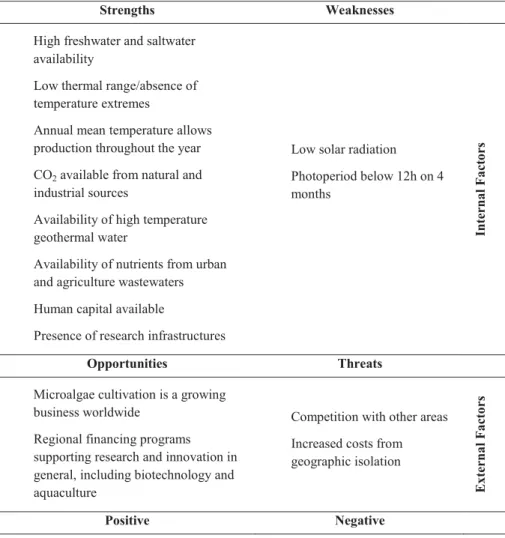
A SWOT analysis of the main factors required for microalgae cultivation in the Azores was performed and shows a set of strengths that favour intensive outdoor culture in the Azores (Table 7).
Some of the local natural conditions favour the development of commercial microalgae production, given that they surpass many of the basic requirements of this activity. Apart from the natural conditions, the activities already present in the region may also be considered strengths. The major limitation identified in the present study is related to the relatively unfavourable local characteristics regarding solar light intensity. Nevertheless, this does not preclude the production of microalgae, and can be overcome by working at lower culture densities, or using photobioreactors with smaller diameters, to increase light penetration (Richmond 2004). The threats identified, commercial competition coupled with increased costs from geographic isolation, may be surpassed by the listed opportunities. In fact, the Strategy for Research and Innovation for Intelligent Specialisation of the Azores (SPI AÇORES 2014) places a strategic priority on biotechnology for the period 2014-2020. The EU structural funds could therefore leverage the opportunities for companies interested in investing in this area. To focus on high-value compounds would increase the commercial viability of a local microalgae production by reducing the percentage of the cost of taking the products to the market. Some of the local characteristics mentioned, such as precipitation and annual average sunshine, suggest that closed production systems (photobio-reactores) are more suitable. The availability of technology, infrastructures, academic and
Xavier et al.
66
professional skills were also identified as strengths.
All the above suggests that the Azores have conditions to implement outdoor production of value-added products from microalgae, providing end-users relevant benefits from an alternative economic resource. However, in order to facilitate
future investment in the region, identifying the most suitable locations for microalgae cultivation is imperative. The present work gives several indications in this direction but further social and economic concerns should be addressed, such as the availability of land and the affordability of property.
Table 7. SWOT analysis of the factors that potentiate microalgae cultivation in the Azores.
Strengths Weaknesses
High freshwater and saltwater availability
Low thermal range/absence of temperature extremes
Annual mean temperature allows production throughout the year CO2 available from natural and
industrial sources
Availability of high temperature geothermal water
Availability of nutrients from urban and agriculture wastewaters Human capital available
Presence of research infrastructures
Low solar radiation Photoperiod below 12h on 4 months Inter na l Fa ct or s Opportunities Threats
Microalgae cultivation is a growing business worldwide
Regional financing programs supporting research and innovation in general, including biotechnology and aquaculture
Competition with other areas Increased costs from geographic isolation Externa l F ac to rs Positive Negative ACKNOWLEDGEMENTS
This research was partially supported by the European Regional Development Fund (ERDF) through the COMPETE – Operational Competitiveness Programme and national funds
through FCT – Foundation for Science and Technology, under the projects PEst-C/MAR/LA0015/2013; and cE3c funding (Ref.UID/BIA/00329/2013). Emanuel Xavier was supported by a PhD Grant (ref. M3.1.2/F/027/2011) awarded by Fundo Regional
Microalgae production in the Azores
67 da Ciência e Tecnologia, Região Autónoma dos
Açores. Logistic support was also provided by IRN/UAc (Centre of Natural Resources of University of the Azores).
REFERENCES
Qasmi, M., N.R. Member, IAENG, S. Talebi, S. Al-Rajhi & T. Al-Barwani 2012. A Review of Effect of Light on Microalgae Growth. Pp. 4-6 in: Proceedings of the World Congress on Engineering, London, July 2012.
An, J.Y., S.J. Sim, J.S. Lee & B.W. Kim 2003. Hydrocarbon production from secondarily treated piggery wastewater by the green alga Botryococcus braunii. Journal of Applied Phycology 15: 185-191.
Arbib, Z., J. Ruiz, P. Álvarez-Díaz, C. Garrido-Pérez, J. Barragana & J.A. Perales 2013. Long term outdoor operation of a tubular airlift pilot photobioreactor and a high rate algal pond as tertiary treatment of urban wastewater. Ecological Engineering 52: 143-153.
Azevedo, E.M.V. 2015. O Clima dos Açores - Radiação Solar numa Superfície Horizontal. University of the Azores. Technical Report 17 pp. Bahadar, A. & M.B. Khan 2013. Progress in energy
from microalgae: A review. Renewable and Sustainable Energy Reviews 27: 128-148.
Barrois, T. 1886. Matériaux pour servir a l'étude de la faune des eaux douces des Açores. Société des Sciences de Lille. 172 pp.
Barsanti, L. & P. Gualtieri 2014. Algae: Anatomy, Biochemistry, and Biotechnology (2ND edition). CRC Press. 361 pp.
Batan, L., J.C. Quinn & T.H. Bradley 2013. Analysis of water footprint of a photobioreactor microalgae biofuel production system from blue, green and lifecycle perspectives. Algal Research 2: 196-203. Becker, E.W. 1994. Microalgae. Biotechnology and
Microbiology. Cambridge University Press. 304 pp. Bedell, G.W. 1985. Stimulation of Commercial Algal Biomass Production by the Use of Geothermal Water for Temperature Control. Biotechnology and Bioengineering 28: 1063-1066.
Blunden, J. & D.S. Arndt 2014. State of the Climate in 2013. Bulletin of the American Meteorological Society 95: 1-279.
Borowitzka, M.A. & N.R. Moheimani 2013. Sustainable biofuels from algae. Mitigation and Adaptation Strategies for Global Change 18:13-25. Borowitzka, M.A. 2013. High-value products from
microalgae—their development and
commercialization. Journal of Applied Phycology 25: 743-756.
Borowitzka, M.A. 2013. Handbook of Microalgal Culture: Applied Phycology and Biotechnology (2nd edition). Wiley & Sons, Ltd. 719 pp.
Boruff, B.J., N.R. Moheimani & M.A. Borowitzka 2015. Identifying locations for large-scale microalgae cultivation in Western Australia: A GIS approach. Applied Energy 149: 379–391.
Bourrelly, P. & E. Manguin 1946. Contribution a la flore algale d'eau douce des Açores. Société de Biogéographie Mémoires 8: 447-500.
Carvalho, A.P., S.O. Silva, J.M. Baptista & F.X. Malcata 2011. Light requirements in microalgal photobioreactors: an overview of biophotonic aspects. Applied Microbiology and Biotechnology 89: 1275-1288.
Castenholz, R.W. 1981. Isolation and Cultivation of Thermophilic Cyanobacteria. The Prokaryotes 1981: 236-246.
Chen, X., Q.Y. Goh, W. Tan, I. Hossain, W.N. Chen & R. Lau 2011. Lumostatic strategy for microalgae cultivation utilizing image analysis and chlorophyll a content as design parameters. Bioresource Technology 102: 6005-6012.
Chisti, Y. 2007. Biodiesel from microalgae. Biotechnology Advances 25: 294-306.
Chiu, S.Y., C.Y. Kao, T.T. Huang, C.J. Lin, S.C. Ong, C.D. Chen, J.S. Chang & C.S. Lin 2011. Microalgal biomass production and on-site bioremediation of carbon dioxide, nitrogen oxide and sulfur dioxide from flue gas using Chlorella sp. cultures. Bioresource Technology 102: 9135-9142. Converti, A., A.A. Casazza, E.Y. Ortiz, P. Perego & M.
Borghi 2009. Effect of temperature and nitrogen concentration on the growth and lipid content of Nannochloropsis oculata and Chlorella vulgaris for biodiesel production. Chemical Engineering and Processing 48: 1146-1151.
Cropper, T. 2013. The weather and climate of Macaronesia: past, present and future. Weather 68: 300-307.
Electricidade dos Açores (EDA) 2014. Procura e Oferta de Energia Elétrica. Technical Report 34 pp.
Elumalai, S., G. Jegan & G.K. Saravanan 2014. Studies on Growth and Biochemical Analysis of Three Microalgal Strains on Different Molar Concentration of Sodium Bicarbonate. Indian Journal of Applied Research 4: 60-62.
Espinosa-Gonzalez, I., A. Parashar & D.C. Bressler 2014. Heterotrophic growth and lipid accumulation of Chlorella protothecoides in whey permeate, a dairy by-product stream, for biofuel production. Bioresource Technology 155: 170-176.
Xavier et al.
68
Ferreira, T. 1994. Contribuição para o estudo das emanações gasosas associadas a processos de vulcanismo no Arquipélago dos Açores. PhD Thesis, University of the Azores. 183 pp.
Ferreira, T., J.L. Gaspar, F. Viveiros, M. Marcos, C. Faria & F. Sousa 2005. Monitoring of fumarole discharge and CO2 soil degassing in the Azores:
contribution to volcanic surveillance and public health risk assessment. Annals of Geophysics 48: 787-796.
Fish, S.A. & G.A. Codd 1994. Bioactive compound production by thermophilic and thermotolerant cyanobacteria (blue-green algae). World Journal of Microbiology & Biotechnology 10: 338-341. Fournadzhieva, S., P. Pilarsky, A. Arvanitis, M. Fytikas
& E. Koultsiakis 2002. Use of geothermal fluids for cultivation of the microalga Spirulina in Nigrita-Serres. Pp. 97-104 in: Proceedings of the 7th National Conferences on Renewable Energy Sources, Patras, November 2002.
Gao, Y., C. Gregor, Y. Liang, D. Tang & C. Tweed 2012. Algae biodiesel-a feasibility report. Chemistry Central Journal 6: 1-16.
Girard, J.M., M.L. Roy, M.B. Hafsa, J. Gagnon, N. Faucheux, M. Heitz, R. Tremblay & J.S. Deschênes 2014. Mixotrophic cultivation of green microalgae Scenedesmus obliquus on cheese whey permeate for biodiesel production. Algal Research 5: 241-248.
Godos, I., V.A. Vargas, S. Blanco, M.C.G. González, R. Soto, P.A. García-Encina, E. Becares & R. Muñoz 2010. A comparative evaluation of microalgae for the degradation of piggery wastewater under photosynthetic oxygenation. Bioresource Technology 101: 5150-5158.
Gonçalves, V. 2008. Contribuição do estudo das microalgas para a avaliação da qualidade ecológica das lagoas dos Açores: fitoplâncton e diatomáceas bentónicas. PhD Thesis, University of the Azores. 343 pp.
Gouveia, L., A. Reis, P. Moura, C. Oliveira & F. Gírio 2015. Microalgae for biofuels: the Portuguese experience. Watch Letter 32: 10 p.
Greenwell, H.G., L.M.L. Laurens, R.J. Shields, R.W. Lovitt & K.J. Flynn 2009. Placing microalgae on the biofuels priority list: a review of the technological challenges. Journal of the Royal Society Interface doi:10.1098/rsif.2009.0322. Guillard, R.R.L. 1975. Culture of phytoplankton for
feeding marine invertebrates. Pp. 29-60 in: Smith, W.L. & M.H. Chanley. Culture of Marine Invertebrate Animals. Plenum Publishers, New York. 318 pp.
Jensen, G.S., D.I. Ginsberg & M.S. Drapeau 2001. Bluegreen algae as an immuno-enhancer and
biomodulator. Journal of the American Nutraceutical Association 3: 24-30.
Johnson, M.B. & Z.Y. Wen 2010. Development of an attached microalgal growth system for biofuel production. Applied Microbiology and Biotechnology 85: 525-534.
Khoeyi, Z.A., J. Seyfabadi & Z. Ramezanpour 2012. Effect of light intensity and photoperiod on biomass and fatty acid composition of the microalgae, Chlorella vulgaris. Aquaculture International 20: 41-49.
Kim, W., J.M. Park, G.H. Gim, S. Jeong, C.M. Kang, D. Kim & S.W. Kim 2012. Optimization of culture conditions and comparison of biomass productivity of three green algae. Bioprocess and Biosystems Engineering 35: 19-27.
Kitaya, Y., H. Azuma & M. Kiyota 2005. Effects of temperature, CO2/O2 concentrations and light
intensity on cellular multiplication of microalgae, Euglena gracilis. Advances in Space Research 35: 1584-1588.
Li, W.K.W. 1980. Temperature Adaptation in Phytoplankton: Cellular and Photosynthetic Characteristics. Environmental Science Research 19: 259-279.
Maeda, K., M. Owadai, N. Kimura, K. Omata & I. Karubd 1995. CO2 fixation from the flue gas on
coal-fired thermal power plant by microalgae. Energy Conversion and Management 36: 717-720. Mata, T.M., A.A. Martins & N.S. Caetano 2010.
Microalgae for biodiesel production and other applications: A review. Renewable and Sustainable Energy Reviews 14: 217-232.
Mata, T.M., A.C. Melo, M. Simões & N.S. Caetano 2012. Parametric study of a brewery effluent treatment by microalgae Scenedesmus obliquus. Bioresource Technology 107: 151-158.
Meseck, S.L., J.H. Alix & G.H. Wikfors 2005. Photoperiod and light intensity effects on growth and utilization of nutrients by the aquaculture feed microalga, Tetraselmis chui (PLY429). Aquaculture 246: 393-404.
Mirón, A.S., M.C.C. García, A.C. Gómez, F.G. Camacho, E.M. Grima & Y. Chisti 2003. Shear stress tolerance and biochemical characterization of Phaeodactylum tricornutum in quasi steady-state continuous culture in outdoor photobioreactors. Biochemical Engineering Journal 16: 287-97. Negoro, M., N. Shioji, K. Miyamoto & Y. Miura 1991.
Growth of Microalgae in High CO2 Gas and
Effects of SOx and NOx. Applied Biochemistry and Biotechnology 28: 877-886.
Ono, E. & J.L. Cuello 2006. Feasibility Assessment of Microalgal Carbon Dioxide Sequestration Technology with Photobioreactor and Solar
Microalgae production in the Azores
69 Collector. Biosystems Engineering 95: 597-606.
Ozkurt, I. 2009. Qualifying of safflower and algae for energy. Energy, Education, Science and Technology 23: 145-51.
Park, J.B.K., R.J. Craggs & A.N. Shilton 2011. Wastewater treatment high rate algal ponds for biofuel production. Bioresource Technology 102: 35-42.
Parmjit, S.P. & J.F. Kennedy 2012. Biotechnological approaches for the value addition of whey. Critical Reviews in Biotechnology 32: 327-348.
Pittman, J.K., A.P. Dean & O. Osundeko 2011. The potential of sustainable algal biofuel production using wastewater resources. Bioresource Technology 102: 17-25.
Posten, C. & C. Walter 2012. Microalgal Biotechnology: Integration and Economy. De Gruyter. 319 pp.
Pulz, O. & W. Gross 2004. Valuable products from biotechnology of microalgae. Applied Microbiology and Biotechnology 65: 635-648. Radway, J.A.C., E.W. Wilde, M.J. Whitaker & J.C.
Weissman 2001. Screening of algal strains for metal removal capabilities. Journal of Applied Phycology 13: 451-455.
Ras, M., J.P. Steyer & O. Bernard 2013. Temperature effect on microalgae: a crucial factor for outdoor production. Reviews in Environmental Science and Biotechnology 12: 153-164.
Rawat, I., R.R. Kumar, T. Mutanda & F. Bux 2011. Dual role of microalgae: Phycoremediation of domestic wastewater and biomass production for sustainable biofuels production. Applied Energy 88: 3411-3424.
Richmond, A. 2004. Principles for attaining maximal microalgal productivity in photobioreactors: an overview. Developments in Hydrobiology 173: 33-37.
SPI AÇORES 2014. Estratégia de Investigação e Inovação para a Especialização Inteligente da Região Autónoma dos Açores, RIS3 AÇORES, xiii+137 pp.
Rubio, F.C., F.G. Camacho, J.M.F. Sevilla, Y. Chisti & E. Molina Grima 2003. A Mechanistic Model of Photosynthesis in Microalgae. Biotechnology and Bioengineering 81: 459-473.
Santos, C., M. Lima, R. Montiel, N. Angles, L. Pires, A. Abade & M.P. Aluja 2003. Genetic Structure and Origin of Peopling in The Azores Islands (Portugal): The View from mtDNA. Annals of Human Genetics 67: 433-456.
Searle, R.C. 1980. Tectonic pattern of the Azores spreading center and triple junction. Earth and Planetary Science Letters 51: 415-434.
Singh, M., D.L. Reynolds & K.C. Das 2011.
Microalgal system for treatment of effluent from poultry litter anaerobic digestion. Bioresource Technology 102: 10-16.
Spolaore, P., C. Joannis-Cassan, E. Duran & A. Isambert 2006. Commercial applications of microalgae. Journal of Bioscience and Bioengineering 101: 87-96.
SRAM-Secretaria Regional do Ambiente e do Mar 2012. Plano de gestão da região hidrográfica dos Açores. Governo Regional Região Autónoma dos Açores. Technical Report 296 pp.
SRRN-Secretaria Regional dos Recursos Naturais 2014. PRORURAL Relatório de execução do ano 2013. Governo Regional Região Autónoma dos Açores. Technical Report 282 pp.
Suryata, I., H.G. Svavarsson, S. Einarsson, Á. Brynjólfsdóttir, & G. Maliga 2010. Geothermal CO2 bio-mitigation techniques by utilizing
microalgae at the Blue Lagoon, Iceland. Pp 8 in: Proceedings of the Thirty-Fourth Workshop on Geothermal Reservoir Engineering, Stanford, February 2010.
Vigani, M., C. Parisi, E. Rodríguez-Cerezo, M. Barbosa, L. Sijtsma, M. Ploeg & C. Enzing 2015. Food and feed products from microalgae: Market opportunities and challenges for the EU. Trends in Food Science & Technology 42: 81-92.
Viveiros, F. 2003. Contribuição para o estudo dos processos de desgaseificação difusa nos Açores no âmbito da monitorização sismovulcânica e da avaliação do risco: discriminação de factores que influenciam a variação do fluxo de CO2. PhD
Thesis, University of the Azores. 140 pp.
Viveiros, F., C. Cardellini, T. Ferreira, S. Caliro, G. Chiodini & C. Silva 2010. Soil CO2 emissions at
Furnas volcano, São Miguel Island, Azores archipelago: Volcano monitoring perspectives, geomorphologic studies, and land use planning application. Journal of Geophysical Research 115: B12208.
Viveiros, F., C. Cardellini, T. Ferreira & C. Silva 2012. Contribution of CO2 emitted to the atmosphere by
diffuse degassing from volcanoes: The Furnas Volcano case study. International Journal of Global Warming 4: 287-304.
Vonshak, A., M.N. Sivak & D.A. Walker 1989. Use of a solid support in the study of photosynthetic activity of Spirulina platensis. Journal of Applied Phycology 1: 131-136.
Wang, L., Y. Li, P. Chen, M. Min, Y. Chen, J. Zhu & R.R. Ruan 2010. Anaerobic digested dairy manure as a nutrient supplement for cultivation of oil-rich green microalgae Chlorella sp. Bioresource Technology 101: 2623-2628.
Xavier et al.
70
2010. Growth parameters of microalgae tolerant to high levels of carbon dioxide in batch and continuousǦflow photobioreactors. Environmental Technology 31: 523-532.
Xavier, E., 2011. Outdoor production and astaxanthin accumulation of Haematococcus pluvialis Flotow. Master Thesis, University of the Azores. 64 pp.
Yang, X., P. Liu, Z. Hao, J. Shi & S. Zhang 2012. Characterization and identification of freshwater microalgal strains toward biofuel production. BioResourses 7: 686-695.
Received 26 Jun 2016. Accepted 20 Sep 2016. Published online 10 Oct 2016.