ScienceDirect
Available online at www.sciencedirect.com
Procedia Manufacturing 51 (2020) 1423–1430
2351-9789 © 2020 The Authors. Published by Elsevier Ltd.
This is an open access article under the CC BY-NC-ND license (https://creativecommons.org/licenses/by-nc-nd/4.0/) Peer-review under responsibility of the scientific committee of the FAIM 2021.
10.1016/j.promfg.2020.10.198
10.1016/j.promfg.2020.10.198 2351-9789
© 2020 The Authors. Published by Elsevier Ltd.
This is an open access article under the CC BY-NC-ND license (https://creativecommons.org/licenses/by-nc-nd/4.0/) Peer-review under responsibility of the scientific committee of the FAIM 2021.
ScienceDirect
Procedia Manufacturing 00 (2020) 000–000
www.elsevier.com/locate/procedia
2351-9789 © 2020 The Authors. Published by Elsevier Ltd.
This is an open access article under the CC BY-NC-ND license https://creativecommons.org/licenses/by-nc-nd/4.0/) Peer-review under responsibility of the scientific committee of the FAIM 2020.
30th International Conference on Flexible Automation and Intelligent Manufacturing (FAIM2020)
15-18 June 2020, Athens, Greece.
TPM implementation and maintenance strategic plan – a case study
G. Pinto
a, F. J. G. Silva
a,*, A. Baptista
a, Nuno O. Fernandes
b, R. Casais
a, C. Carvalho
aa
ISEP - School of Engineering, Polytechnic of Porto, Rua Dr. António Bernardino de Almeida, 431, 4200-072 Porto, Portugal
bInstituto Politécnico de Castelo Branco, Avenida do Empresário, Castetelo Branco 6000-767, Portugal
* Corresponding author. Tel.: +351 228340500; fax: +351 228321159. E-mail address: [email protected]
Abstract
Maintenance has assumed an increasing importance in the reorganization of the industrial sector. However, there are several companies where a maintenance strategic plan needs to be implemented. This work was developed in an industrial context, in a company of Clutches and Hydraulic Controls. The focus was the implementation of a strategic plan for maintenance. The methodology chosen was Total Productive Maintenance (TPM) and the cells chosen for implementation were CNC Lathes and CNC Machining Centers. The TPM uses some maintenance activities, whose come from preventive maintenance (PM), and focuses on eliminating efficiency losses. The main problems of the cell equipment were analyzed and eliminated. Through the analysis of maintenance manuals and internal know-how, autonomous maintenance (AM) procedures and preventive maintenance plans have been created to be executed following a given timeframe. At the end of the study, the results were clearly positive due to the corrective and preventive maintenance. There was a decrease in breakdowns due to failure by 23% for CNC lathes and by 38% for CNC machining centers, which resulted in an evident increase in machine availability and OEE (Overall Equipment Effectiveness) improved by 5%.
© 2020 The Authors. Published by Elsevier Ltd.
This is an open access article under the CC BY-NC-ND license https://creativecommons.org/licenses/by-nc-nd/4.0/) Peer-review under responsibility of the scientific committee of the FAIM 2020.
Keywords: Industrial Management, Maintenance, Continuous Improvement, Process Optimization, TPM, Planning, Failure Analysis, 5S, MTBF, MTTR, OEE.
1. Introduction
The current context of the world economy presents a challenge for industries that lead to profound changes. Focusing on customer needs, as well as customer loyalty with higher value, is critical to success. All sectors of the economy are increasingly competitive and the metalworking industry is no exception. In order to foster business competitiveness, constant improvement actions are need to make companies increasingly profitable and with less waste associated with the process [1-3]. Therefore, it is necessary to eliminate the causes associated with equipment failures.
Total Productive Maintenance (TPM) aims to eliminate losses, reduce downtime and reduce costs. This methodology uses recourse to well-defined maintenance plans. For this reason, it is widely used in the industry in recent decades and has presented excellent results [4,5]. The company of this study is no
exception, as it aims to improve machines’ availability, reducing downtime due to equipment failure. In addition to improving productivity, it is also important to create a culture of commitment to the proper handling and use of equipment in order to increase the life of machines and improve the quality of manufactured products. This work intends to present a preventive maintenance (PM) plan to be implemented in a company of Clutches and Hydraulic Controls, based on the TPM methodology. These implementations aim to improve the Mean Time To Repair (MTTR), Mean Time Between Failure (MTBF), Availability and Overall Equipment Effectiveness (OEE) indicators. The maintenance of the equipment aims to be seen as a global strategy of the company, to be carried out not only by the maintenance technicians, but also in a transversal way by all workers using the TPM tools.
The remainder of this paper is organized as follows. Section 2 provides the background for the work developed. Section 3
ScienceDirect
Procedia Manufacturing 00 (2020) 000–000
www.elsevier.com/locate/procedia
2351-9789 © 2020 The Authors. Published by Elsevier Ltd.
This is an open access article under the CC BY-NC-ND license https://creativecommons.org/licenses/by-nc-nd/4.0/) Peer-review under responsibility of the scientific committee of the FAIM 2020.
30th International Conference on Flexible Automation and Intelligent Manufacturing (FAIM2020)
15-18 June 2020, Athens, Greece.
TPM implementation and maintenance strategic plan – a case study
G. Pinto
a, F. J. G. Silva
a,*, A. Baptista
a, Nuno O. Fernandes
b, R. Casais
a, C. Carvalho
aa
ISEP - School of Engineering, Polytechnic of Porto, Rua Dr. António Bernardino de Almeida, 431, 4200-072 Porto, Portugal
bInstituto Politécnico de Castelo Branco, Avenida do Empresário, Castetelo Branco 6000-767, Portugal
* Corresponding author. Tel.: +351 228340500; fax: +351 228321159. E-mail address: [email protected]
Abstract
Maintenance has assumed an increasing importance in the reorganization of the industrial sector. However, there are several companies where a maintenance strategic plan needs to be implemented. This work was developed in an industrial context, in a company of Clutches and Hydraulic Controls. The focus was the implementation of a strategic plan for maintenance. The methodology chosen was Total Productive Maintenance (TPM) and the cells chosen for implementation were CNC Lathes and CNC Machining Centers. The TPM uses some maintenance activities, whose come from preventive maintenance (PM), and focuses on eliminating efficiency losses. The main problems of the cell equipment were analyzed and eliminated. Through the analysis of maintenance manuals and internal know-how, autonomous maintenance (AM) procedures and preventive maintenance plans have been created to be executed following a given timeframe. At the end of the study, the results were clearly positive due to the corrective and preventive maintenance. There was a decrease in breakdowns due to failure by 23% for CNC lathes and by 38% for CNC machining centers, which resulted in an evident increase in machine availability and OEE (Overall Equipment Effectiveness) improved by 5%.
© 2020 The Authors. Published by Elsevier Ltd.
This is an open access article under the CC BY-NC-ND license https://creativecommons.org/licenses/by-nc-nd/4.0/) Peer-review under responsibility of the scientific committee of the FAIM 2020.
Keywords: Industrial Management, Maintenance, Continuous Improvement, Process Optimization, TPM, Planning, Failure Analysis, 5S, MTBF, MTTR, OEE.
1. Introduction
The current context of the world economy presents a challenge for industries that lead to profound changes. Focusing on customer needs, as well as customer loyalty with higher value, is critical to success. All sectors of the economy are increasingly competitive and the metalworking industry is no exception. In order to foster business competitiveness, constant improvement actions are need to make companies increasingly profitable and with less waste associated with the process [1-3]. Therefore, it is necessary to eliminate the causes associated with equipment failures.
Total Productive Maintenance (TPM) aims to eliminate losses, reduce downtime and reduce costs. This methodology uses recourse to well-defined maintenance plans. For this reason, it is widely used in the industry in recent decades and has presented excellent results [4,5]. The company of this study is no
exception, as it aims to improve machines’ availability, reducing downtime due to equipment failure. In addition to improving productivity, it is also important to create a culture of commitment to the proper handling and use of equipment in order to increase the life of machines and improve the quality of manufactured products. This work intends to present a preventive maintenance (PM) plan to be implemented in a company of Clutches and Hydraulic Controls, based on the TPM methodology. These implementations aim to improve the Mean Time To Repair (MTTR), Mean Time Between Failure (MTBF), Availability and Overall Equipment Effectiveness (OEE) indicators. The maintenance of the equipment aims to be seen as a global strategy of the company, to be carried out not only by the maintenance technicians, but also in a transversal way by all workers using the TPM tools.
The remainder of this paper is organized as follows. Section 2 provides the background for the work developed. Section 3
describes the methodology applied in this work and Section 4 describes the results achieved. Finally Section 5 draws the main conclusions, highlighting the results obtained and drawing guidelines for future work.
2. Literature review
With the globalization of markets, competition has become more aggressive, demanding higher quality products at more competitive prices [6]. Business profits can be increased by increasing sales, reducing costs or both. One way to do this is by the elimination of all types of waste associated with the production processes [7]. One common type of waste at manufacturing companies refers to breakdowns due to machine failures [6,8] and the best way to minimize this type of waste is the adoption of strategic maintenance management policies [9,10]. Maintenance is an essential activity in the equipment life cycle to achieve high machine availability at low costs. Maintenance is defined as the set of operations necessary to reestablish an equipment to accomplish the tasks it was planned to do [11]. Monchy [12] establishes two important milestones, birth and death, namely, entry into service and death. Between these two milestones, he points out three distinct phases. Child, where there is a decrease in typical diseases of this age; adolescent and adult, where diseases are randomly revealed; geriatric age, where there is a tendency for the disease to increase. Another decisive factor for the evolution of maintenance was the technological evolution, namely informatics technology. Thus, it allows to easily gather a large amount of information in an easy and organized way and to provide information on the overall performance of equipment [1].
The market is also increasingly demanding on quality requirements. As a result, equipment becomes increasingly complex and maintenance is affected. Because of this high degree of requirement, tools have emerged in maintenance strategy, for example, Total Productive Maintenance (TPM), Reliability-Centered Maintenance (RCM), RBI - Risk-Based Inspection, TQMain - Total Quality Maintenance [13]. The common denominator of these maintenance strategies is the use of computer media for information management. Among these strategies, RCM and TPM are widely used in today's industries. RCM is a methodology based on equipment failure modes and the severity of their consequences. TPM is a methodology that involves managers and operators and aims to maximize overall efficiency by eliminating waste [1,9].
For a company to function, all its constituent departments must function in harmony with the company's overall objectives, and maintenance is no exception. Maintenance objectives cannot be dissociated from the main goals established for a certain company, believing in Coetzee's opinion [14]. Maintenance, like other auxiliary activities of a company, directly affects the cost, quality and delivery reliability of products.
TPM proposes that maintenance should involve the whole structure of the company, from the leadership to all the workers, although with differentiated roles. TPM maximizes equipment productivity by creating an environment in which efforts to improve reliability, quality, cost savings and creativity are encouraged through the participation of all [15]. In this
environment, the activities became well defined, consolidating the idea that the service should be self-controlled and “everyone takes care of their own equipment”. In other words, the proposal of “autonomous maintenance” emerges, as one of the TPM characteristics [16]. This methodology incorporates the concept of PM and autonomous maintenance, which includes: a set of planned inspections, cleanings, replacements and repairs to avoid compromising failures and to control machine deterioration [17].
The fact that continuous improvement is also one of the bases of TPM, is a sign that the individuals, teams and the company itself are continually learning and sharing the development, transfer and use of knowledge and skills. Indeed, when thinking about reducing waste, the use of Lean tools is practically inevitable. The reduction of waste usually leads to an increase in OEE, which directly depends on quality, performance and equipment availability [1,6,18]. While sectors such as Production and Logistics are primarily concerned with product quality and delivery performance, Maintenance must ensure the highest possible equipment availability. However, for this to take place, it is common to make use of Lean tools, such as the 5S or the SMED methodology [19,20]. The 5S refer to five Japanese words, Seiri (Organize), Seiton (Fix), Seiso (Clean), Seiketsu (Normalize), Shitsuke (Discipline) [21]. Recently, Pinto et al. [1] carried out a research work in a company that manufactures rubber articles for the automotive industry, which was induced by the need for that company to comply with the IATF 16949: 2016 standard [22], which implied having updated records of indicators such as the MTBF, MTTR and OEE. As the work evolved, mainly through the calculation of the OEE indicator, waste was detected in the press setup processes, which forced the application of the SMED methodology. In order to improve maintenance services and reduce equipment downtime, the 5S tool was also used. This resulted in a savings in setup time of 11% and an increase in the OEE to values of 90.22%, which is clearly above the world benchmark of 85%. In the graphic printing sector, Moreira et al. [6] mitigated the causes that affected the lack of quality of the final product and the unavailability of the machines, having achieved a minimum OEE increment of 2%, analyzing equipment to equipment, also reducing costs with non-conformities by 32.9%.
Pombal et al. [23] applied 5S and Visual Management in the storage of cabinets material for maintenance, having achieved time reductions in operations by around 70%. In addition, it also remodeled the material stock management, through improvements in the application of Kanban, having achieved savings of around 30% in the time needed for repair. The use of a milk-run supply system for that same material warehouse was also studied, which was expected to bring added benefits to the operation of the Maintenance Department of the company under study.
In this work, it was proposed cv a maintenance model that is intended: (1) to reduce the number of curative interventions on two CNC machining cells; (2) to reduce machine breakdown time due to failures, and (3) to reduce the time spent in maintenance interventions.
3. Methods
3.1. TPM – Defining pillars to be used
TPM is the methodology approached and implemented in this work. There are several ways to organize and implement TPM. The TPM pillars considered are the following (even if the literature there are variations in the number and name of each one): (a) Elimination of the main problems; (b) Autonomous maintenance; (c) Planned maintenance; and (d) Formation and training.
• Elimination of the main problems - Consists of promoting analysis and identification of the main problems and their causes. These problems must be eliminated or reduced; • Autonomous maintenance (AM) - Places responsibility for
routine maintenance in the hands the workers;
• Planned maintenance - Consists of the planning and systematic performance of maintenance activities by qualified technicians or by the worker himself, to keep the equipment in the ideal operating conditions and avoid unexpected stops;
• Formation and training - Consists of providing knowledge to workers and operational heads of theoretical and practical information about the machines to avoid losses. The benefits of training may not be immediately.
Based on the brand maintenance manuals, internal documents were made, whose must contain the maintenance tasks and the respective periodicity. Maintenance plans were carried out by type of machine, and divided according to the periodicity, containing both autonomous and planned tasks.
3.2. Diagnosis - conditions before TPM application
The conditions found before applying TPM were as follows: • Previously, maintenance was not structured. Maintenance
tasks were not well distributed and followed over time; • Maintenance was based on a weekly cleaning operation,
just in one machine for each productive cell; • The 5S methodology was not implemented;
• There is no history of malfunctions or interventions. There was no history of maintenance costs or breakdowns; • Company had not maintenance control software available; • No damage analysis had ever been carried out and no
studies had been carried out regarding the causes, seasonality and their prevention;
• There was no stock management or history of consumption of spare parts.
Due to all the previous assumptions, it would not make sense to use and implement the eight pillars of standard TPM, but rather to define documentation that is practical and that allows a quick and effective implementation.
3.2.1. Collection of machine failure data during 3 months
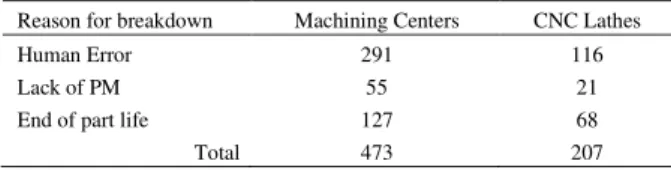
During the first 3 months of this work, all downtimes that occurred at CNC Lathes and machining centers were collected. The reasons for breakdowns are identified in the Table 1 and categorized as follows:
• Human error;
• Lack of preventive maintenance (PM);
• End of life of the part.
Table 1 – Number of breakdowns at Machining Centers and CNC Lathes. Reason for breakdown Machining Centers CNC Lathes
Human Error 291 116
Lack of PM 55 21
End of part life 127 68
Total 473 207
As already discussed, the company presents problems in terms of organization and cleanliness. These were reflected in the way the work was performed and how the equipment was handled. It was possible to verify from the beginning that to implement TPM, and more specifically AM, it would be necessary to have a 5S base behind it. Thus, and in order to improve the state of the company's internal organization, the planning and production team started a 5S implementation program. In order to maximize the chances of success of the 5S implementation, a series of documents were produced, such as, 5S implementation schedule, 5S audit sheet, audit planning, list of measures to be implemented, layout to identify before and after. It is important to note that after training, the Planning and Production Department will take an active role in controlling the process. Internal audits will be carried out weekly to identify problems and comply with the measures implemented.
3.3. TPM implementation
Table 2 describes the steps used to implement the TPM.
Table 2 - Work method.
Tasks Description
Survey and analysis of machine maintenance manuals
Initial document related to the maintenance activities to be carried out. Current information: task to be performed and its frequency.
Crossing information from manuals and know-how of maintenance workers
Creation of the final document version with planned and autonomous maintenance activities and respective checklist. Collection of machine failure
data.Period: 3 months.
Data collected: Type of failure, downtime, reason for stopping and machine serviced. Implementation of the TPM 4
pillars. As described in 3.1 Collection of machine failure
data.
Period: 3 months after TPM implementation.
Comparison with the data collected before the TPM implementation.
Conclusions
Check for improvements after preventive and corrective actions applied with the TPM implementation.
3.3.1. 1st Pillar - Main problems elimination
The 1st pillar consists of the continuous analysis of problems and the definition of corrective and preventive actions, with the intent of continuous improvement. This pillar supports a proactive attitude to define all the necessary actions to significantly reduce the downtime associated with a problem, or even eliminate that problem. The steps of this pillar are as follows:
• Determine losses and main problems; • Analyze the causes;
• Define and implement corrective actions; • Create and normalize standards.
3.3.1.1. Step 1 - Determine losses and main problems
When searching for failure history, it was found that there was no record of failures, machine stops or repairs. The following problems became evident: The operators had many difficulties in identifying malfunctions, a situation that demonstrates, the workers’ lack of knowledge about the equipment, as well as lack of communication between workers. In order to overcome this situation, maintenance control software needs to be purchased and implemented to record all the data collected. After collecting as much information as possible about failures and after recording failures and problems associated to the machines, it was possible to identify problems associated to the equipment, which could be solved by implementing corrective measures, such as:
• Problems related to filling the coolant tank;
• Problem related to sliding the machine security door.
3.3.1.2. Step 2 – Causes analysis
With the help of maintenance workers, administrators and production workers, it was possible to find causes and define actions for the problems identified in order to eliminate them. To find the problem source, the “5 whys” tool was used. The structure of the questions is as follows.
• Problems with filling the coolant tank (Fig. 1) - The fact that the coolant leaves the circuit through the swarf extractor, together with the swarf, makes the need for refilling frequently. During the tank filling, the operators let the liquid overflow, contaminating the floor.
Fig. 1. “5 Why” - Problems with filling the coolant tank.
It was thought to sensitize operators to be more careful, but this method would hardly bring long-term benefits. It was necessary to work on another solution that will be detailed in the next chapter.
• Safety door sliding problem (Fig. 2) - The machines have a safety system that only allows the machining operation to be carried out with the door closed. Sometimes the sliding of the machine occurs poorly or even stalls, causing production to stop.
Fig. 2. “5 Why” - Problems with safety door sliding.
Failure to perform simple machine cleaning tasks brings inconveniences at the productive level, Fig 2. There is no routine for cleaning the door sliding rails, and some workers only perform it as a last alternative (Fig 3a).
3.3.1.3. Step 3 – Define and implement corrective actions
Regarding the problems with the coolant tank, it was found out that coolant filling system is ineffective, so it was decided to install a self-filling and coolant filtration system on the machines. Initially, the control of the cooling tank filling was performed entirely by the worker, who opened the filling valve and closed it as soon as he considered the tank at the correct level. Worker lack of attention often caused the liquid to overflow. After installing the tank self-filling system, it is possible to control the opening and closing of the valve through a control float. In addition to using the tank self-filling, a coolant filtration system was installed that will allow the same coolant to be used for a longer period, which will enable the company to reduce the costs of purchasing the oil. With filtering and oil self-filling, the need to replace it will change from monthly to annual. In order to be able to use the same coolant for so long, it is necessary to carry out weekly control of the liquid concentration, since the water present tends to evaporate, leaving the liquid increasingly concentrated.
Regarding the problem related to the sliding security door, the problem is quite common and causes shortstops in production very often, Fig 3b. As cleaning procedures are not implemented, there is a bad habit of cleaning only some areas of the machines as a last alternative.
Fig. 3. Filing in the door guidance (a), door guidance without filing (b).
In order to eliminate this problem, a daily cleaning procedure was created, and this area of the machine was added as an area to pay special attention. The cleaning procedure was reflected in the form of a shift ticket. The workers, at the end of each shift, must carry out the operations described and sign the sheet as a form of confirmation.
3.3.1.4. Step 4 - Create and normalize
Standardization is essential to control a process, allowing to quickly identify deviations in the processes and obtain useful indicators. Thus, in order for the measures implemented to be effective, it was decided to:
For problems with filling the coolant tank: • Install a float that controls the tank coolant level; • Install a coolant filtration system;
• Insert a refrigerant concentration control activity into the weekly AM procedure;
• Include in the planned maintenance procedure, an annual activity of total replacement of the coolant.
For problem with sliding security door:
• Creation of cleaning procedures for machines and workstations and make this task mandatory;
• Periodic control of cleaning and signing the Turn ticket.
3.3.2. 2nd Pillar - Autonomous Maintenance
As previously discussed, AM is performed by workers. The steps to implement maintenance with maximum efficiency are:
• Perform basic inspection of machinery and equipment; • Normalize maintenance activities, including cleaning and
inspection;
• Perform maintenance activities independently; • Continuously improve equipment and process quality. These steps will be used to implement AM in this work.
3.3.2.1. Step 1 - Perform basic inspection of machinery and equipment
The objective of this step is to inspect the machines and equipment to improve or create access for maintenance, to prevent dirt and leakage and to correct anomalies. The machines studied in this work are MAZAK machines, which were developed and designed to facilitate access to lubrication and cleaning, making no sense to do changes to the equipment. In this sense, the first stage of this process was not considered.
3.3.2.2. Step 2 - Normalize maintenance activities including cleaning and inspections
In order to ensure and assist the AM performance, it is essential to normalize these activities. This step consists of creating AM and cleaning procedures according to the needs of the machines. In order to guarantee these habits, AM procedures were created. The frequency is Daily, Weekly and Monthly. To define the maintenance activities that should be included in the AM procedures, it must be considered:
• The maintenance manuals of the machines were analyzed. The recommended activities and their frequency were checked;
• Problems and anomalies that workers face daily were discussed, as well as the maintenance activities and the frequency with which they should be carried out to eliminate/prevent these problems;
• It was discussed with maintenance workers with deep knowledge about the equipment, activities and periodicity that would be important for the proper machine functioning.
After analyzing the machines manuals, it was found that it would be possible to normalize maintenance activities per cell, i.e., there would only be a need to carry out a maintenance plan for the Lathes and another for the Machining Centers. Although machines with different operational characteristics exist within each manufacturing cell, the maintenance characteristics are similar. In order to enforce the daily AM, the shift ticket was created, i.e., each operator must guarantee, at the time of the shift change, the cleaning of the various parameters described in the shift ticket checklist. The AM plans are divided into three periods: daily, weekly and monthly.
3.3.2.3. Step 3 - Perform maintenance activities independently and improve standards
In order to allow workers to carry out AM activities autonomously and correctly, a meeting was held with workers and explained what was intended and how to achieve it. Theoretical and practical training was given on AM, where activities were explained, their importance and all doubts that arose were clarified. It was pointed out to the operators that the involvement, cooperation and communication between maintenance and production would be essential to keep the machine in a state that allows for long durability and good quality of the manufactured products. In addition to the shift change forms, which reflect a commitment to carrying out daily activities, weekly and monthly checklists were also implemented.
3.3.2.4. Step 4 - Continuous improvement of equipment and quality of processes
Continuous improvement is the main target after AM procedures have been created. The standard activities and the documentation of these activities are intended to discipline workers for their realization, but always emphasizing the role that workers need suggest improvements and implement good practices. To instruct workers on these good practices, a document was created, made available to them, one per machine, which allows them to suggest changes to the standard and the creation of good practices. With regard to equipment, what is intended is the proper functioning of each one.
3.3.3. 3rd Pillar - Planned maintenance
In the company, the planned maintenance was already implemented in the production cells covered by this work, however, there are several points to be changed in order to make the most of the planned maintenance:
• The activities contained in the planned maintenance plans and the respective periodicity do not correspond to what is recommended by the brand and they are not adapted to the machine's needs;
• It was not clearly defined who and when should perform each of the activities defined in the planned maintenance plans;
• The timings for planned maintenance did not apply. Too often they were "run over" by the needs of production;
• There was no maintenance information management system, jeopardizing its control and realization.
According to the 1st pillar, all maintenance actions that require skills and technical knowledge will be included in the PM plans.
3.3.3.1. Implementation of preventive maintenance plans
As in AM case, the machines manuals and the experience of the maintenance technicians were crucial to carry out a plan that could take advantage of the company's experience and of the recommendations of the brand.
3.3.3.2. Requests for curative maintenance intervention
The curative intervention requests result from a malfunction or anomaly of the equipment. Any worker of the company is responsible for reporting such situations in the system. This type of order must be filled out, first, by the worker who detected the failure and, subsequently, the person in charge of maintenance will receive an anomaly notification. After the intervention, the maintenance team must fill in some information in the system, such as number of hours spent, spare parts used, description of the problem and respective description of the intervention.
4. Results
In this section, results of the work performed will be presented, namely: the reduction in downtime achieved through the maintenance carried out by the Production workers, the implemented actions effectiveness, the indicators evolution and all the non-measurable results achieved through this work.
4.1. Main problems elimination
The tank coolant filling problem cannot be seen as a malfunction, but it is clearly a problem that causes unnecessary waste of time and excessive expenses. Before the supply and filtering system have been installed, the total coolant change was carried out approximately every three months. This exchange is currently carried out annually. This means that the coolant exchange activity has a four-fold impact on the planned downtime, compared to what happened previously. The average downtime was 3 hours in this operation. If this operation was previously performed four times a year and, at the moment, it is only one, this means a gain of nine hours per year. The monetary impact of this improvement is also significant. Another improvement achieved was the fact that operators did not have to worry about filling the tank. Previously, coolant was supplied from the machine weekly (it was not a rule) and this manual supply often caused coolant waste and unnecessary loss of time. It is difficult to count the number of stops and the downtime caused by the sliding security door problem during the period under study, but this problem caused micro stops in production, corresponding to the time needed by the worker to clean the area affected in the machine. This activity was inserted in the shift change form.
Thus, as it was difficult to count downtime before the implementation of the shift ticket, it is also difficult to account for the impact it caused in combating the problem, however, improvements in the cleaning of the machines are evident, so there was an improvement brought by this implemented action.
4.2. Maintenance performed
AM: the implementation of the shift change form was viewed positively by most of the group. Initially, all workers fulfilled their assigned tasks, but after 2/3 weeks of implementation, results have been declining. A new call was made to workers to practice this activity, which has brought positive results. The performance of the monthly AM was carried out in the timings imposed in the maintenance schedule sheet. One machine was serviced per week in each of the sections. As there are eight Lathes and eight Machining Centers, maintenance was carried out with the same frequency. The results can be considered positive, since previously this maintenance was not carried out on a scheduled basis.
4.3. Evolution of indicators
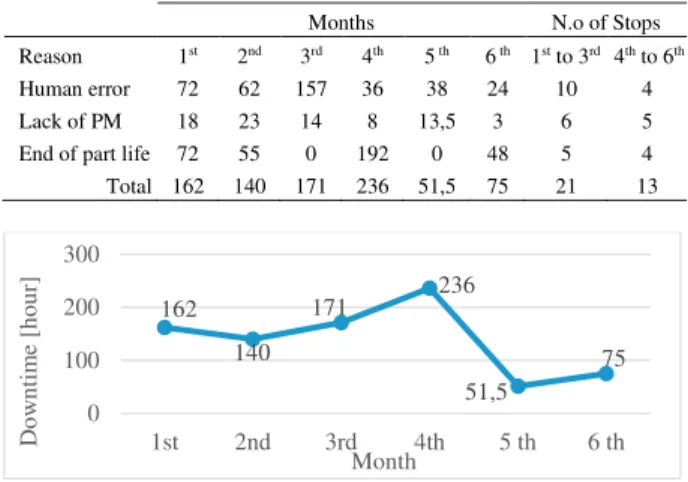
Thanks to all the corrective, preventive and improvement actions carried out, the AM activities and investment in spare parts and consumables, there is an effective reduction in the equipment downtime which translates into an increase in the machines availability. In the case of Machining Centers, the downtime has been decreasing over the months, there were two major stops that occurred in the months under study, which were caused, one by human error and the other by the end of life of a bearing. As can be seen in Table 3 and Fig 4, downtimes were always more than 100 hours per month and are currently less. The reduction in downtime was 23.4% and the number of interventions reduced by 38.1%.
Table 3 - Time, in hours, and the reason for stopping at CNC Machining Centers.
Months N.o of Stops Reason 1st 2nd 3rd 4th 5 th 6 th 1st to 3rd 4th to 6th Human error 72 62 157 36 38 24 10 4 Lack of PM 18 23 14 8 13,5 3 6 5 End of part life 72 55 0 192 0 48 5 4 Total. 162 140 171 236 51,5 75 21 13
Fig. 4. Downtime at CNC machining centers. Table 4 - Time, in hours, and reason for stopping at CNC Lathes.
Months N.o Stops
Reason 1st 2nd 3rd 4th 5 th 6 th 1st to 3rd 4th to 6th Human error 61 25 30 48 22 12 9 8 Lack of PM 11 0 10 4,5 4 2,5 5 4 End of part life 8 48 12 0 24,5 11 4 3 Total. 80 73 52 52,5 50,5 25,5 18 15
The same happened for CNC Lathes. There was a reduction in machine downtime by 37.3%, and the number of interventions reduced by 16.7%. Table 4 and Fig 5.
162 140 171 236 51,5 75 0 100 200 300 1st 2nd 3rd 4th 5 th 6 th D ow nt im e [hour ] Month
Author 1 et al. / Procedia Manufacturing 00 (2020) 000–000 7
Fig. 5. Stopping time on CNC Lathes.
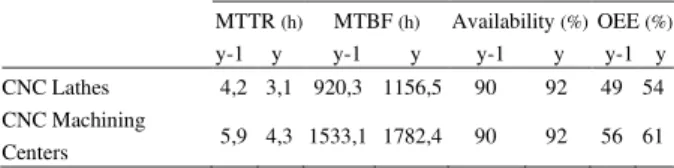
The data presented in an audit to the ISO 9001 management system, demonstrate a more favorable evolution. The data presented refer to the OEE, MTTR and MTBF within the period under study and show positive evolution compared to the previous three months. Data regarding the MTTR values can be seen in Table 5. For the two studied cells, the stopping hours for curative maintenance and the number of failures were analyzed. In short, the “theoretical time available - time spent on interventions”/”number of interventions” was used. Table 5 also shows the MTBF values obtained. For the two cells under study, the stopping hours for curative maintenance and the “number of occurrences”/”failures” were analyzed. In short, the time spent on “interventions”/”number” of interventions were used. Table 5 also shows the Availability and OEE values calculated. The OEE equation corresponds to the multiplication between Availability, Performance and Quality.
Table 5. MTTR (h), MTBF (h), Availability and OEE (%) values in the previous year (y-1) and in the year under study (y).
MTTR (h) MTBF (h) Availability (%) OEE (%)
y-1 y y-1 y y-1 y y-1 y CNC Lathes 4,2 3,1 920,3 1156,5 90 92 49 54 CNC Machining
Centers 5,9 4,3 1533,1 1782,4 90 92 56 61
To calculate availability, the real available time was divided by the theoretically available time. Regarding the performance, it was used (available real-time - time to change parts - setup time) / available real-time. Regarding quality, the (number of pieces produced - number of non-conforming pieces) / number of pieces produced was used.
4.4. 5S Results
The implementation of 5S brought clear advantages in the work organization and the production process. After the first phase of 5S training and awareness of the teams, the 5Ss were applied on the factory floor. At this stage, employees were an essential part of the process, their opinions were considered and implemented, as can be seen in Fig. 6 and Fig. 7. Currently, monthly audits by zones throughout the factory are being performed to ensure that the methodology remains successfully applied, pointing out opportunities for improvement.
Fig. 6. Before the implementation of the 5S (a) after (b).
Fig. 7. Before the implementation of the 5S (a) after (b).
After each audit, an evaluation is carried out, Figs 8 and 9, in all areas, to verify compliance with the 5S, and later exposed on the factory floor.
Fig. 8. Result of the 5S assessment to one of the areas.
Fig. 9. 5S evaluation exposed on the factory floor. 4.5. Non-measurable results
Throughout all this improvement process, other non-measurable results were obtained, namely (a) the involvement and cooperation between everyone involved in the TPM; (b) the development of the autonomy and technical capabilities of equipment operators; (c) improved communication between operators and maintenance technicians; and (d) development of operators' responsibility in relation to the equipment in which they operate.
5. Conclusions and future work
5.1. Conclusions
This work aimed to implement a maintenance management system in a metalworking company. A well-implemented Maintenance Management System has a major influence on an organization's success. Understanding maintenance in a global way may allow greater efficiency in aspects related to maintenance, being able to contribute to the repair of a malfunction more quickly, trying to avoid the repetition of the problem and trying to eliminate the cause, which may provide the reduction of costs, increased equipment availability and increased equipment life.
The first objective of this work focused on reducing the number of curative interventions by 20%. At the machining
80 73 52 52,5 50,5 25,5 0 20 40 60 80 100 1st 2nd 3rd 4th 5 th 6 th D ow nt im e [hour ] Month
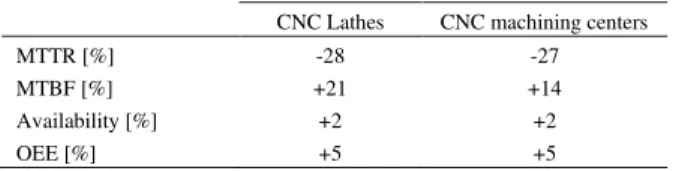
center it was achieved, reaching a reduction of 38%. In CNC lathes, this value was almost reached, reaching 17%. Through the creation of AM plans, PM and management of consumable/spare parts stocks, it was possible to successfully achieve the second objective of reducing the number of hours the machines were stopped. There was a decrease in breaks due to failures by 23% and 38% for CNC lathes and CNC machining centers, respectively. The last goal was not achieved. The time required to perform monthly maintenance has not been significantly reduced. The operation continues to be carried out in a full shift. At the end of this period, an evaluation of the indicators OEE, MTTR and MTBF carried out by the Quality Manager together with the Maintenance Department and the Planning and Production Department, showed an evolution of the cells under study. As a consequence of the changes made to achieve the proposed objectives, the MTTR, MTBF, Availability and OEE indicators were improved, as can be seen in table 6. The results shown in table 6 were calculated according to [6].
Table 6. Evolution of indicators.
CNC Lathes CNC machining centers
MTTR [%] -28 -27
MTBF [%] +21 +14
Availability [%] +2 +2
OEE [%] +5 +5
The main limitations of this work are the following: a) workers' resistance; b) the time it takes to adapt to the new routines; c) implement and maintain the new routines.
As important as what has been done, is to guarantee the continuity of the work done. In this sense, all responsibilities were distributed and once standards were defined and standards were worked on, the information and working methods are properly organized, which facilitates the continuity process.
5.2. Proposal for future work
A fully functioning maintenance management system must have an effective auxiliary computer system behind it, where the creation of alerts is foreseen, the historic about interventions can be created, and the spare parts stock management can be performed. Training on TPM and Lean should be provided to employees to ensure the correct execution of these tools. There should also be a commitment to constant and conscious training of workers in all TPM. Communication between maintenance and production workers must be improved. If the problem and the resolution are not fully registered and described in the computer system, the information and the possibility of analysis are lost. Once AM has been implemented, it is possible to free maintenance workers for more demanding preventive and predictive maintenance tasks.
References
[1] Pinto GFL, Silva FJG, Campilho RDSG, Casais RB, Fernandes AJ, Baptista A. Continuous improvement in maintenance: a case study in the automotive industry involving Lean tools. Procedia Manuf 2019;38;1582-91. doi: 10.1016/j.promfg.2020.01.127.
[2] Santos T, Silva FJG, Ramos SF, Campilho RDSG, Ferreira, LP. Asset priority setting for maintenance management in the food industry. Procedia Manuf 2019;38;1623-33. doi: 10.1016/j.promfg.2020.01.122.
[3] Neves P, Silva FJG, Ferreira LP, Pereira T, Gouveia RM, Pimentel C. Implementing lean tools in the manufacturing process of trimming products. Procedia Manuf 2018;17:696-704. doi: 10.1016/j.promfg.2018.10.119. [4] Reis MDO, Godina R, Pimentel C, Silva FJG, Matias JCO. A TPM strategy
implementation in an automotive production line through loss reduction. Procedia Manuf 2019;38:908-15. doi: 10.1016/j.promfg.2020.01.173. [5] Ribeiro IM, Godina R, Pimentel C, Silva FJG, Matias JCO. Implementing
TPM supported by 5S to improve the availability of an aautomotive production line. Procedia Manuf 2019;38:1574-81. doi: 10.1016/j.promfg.2020.01.128.
[6] Moreira A, Silva FJG, Correia AI, Pereira T, Ferreira LP, de Almeida F. Cost reduction and quality improvement in the printing industry. Procedia Manuf 2018;17:623-30. doi: 10.1016/j.promfg.2018.10.107.
[7] Rosa C, Silva FJG, Ferreira LP. Improving the quality and productivity of steel wire-rope assembly lines for the automotive industry. Procedia Manuf 2017;11:1135-42. doi: 10.1016/j.promfg.2017.07.214.
[8] Santos RFL, Silva FJG, Gouveia RM, Campilho RDSG, Pereira MT, Ferreira LP. The improvement of an APEX machine involved in the tire manufacturing process. Procedia Manuf 2018;17:571-8. doi: 10.1016/j.promfg.2018.10.098.
[9] Ferreira S, Silva FJG, Casais RB, Pereira MT, Ferreira LP. KPI development and obsolescence management in industrial maintenance. Procedia Manuf 2019;38;1427-35. doi: 10.1016/j.promfg.2020.01.145.
[10] Morimoto A, Sato Y, Takata S. Continuous Improvement of Criteria for Condition-based Maintenance by Means of Effects Evaluation of Treatments. Procedia CIRP 2017;61:293–8. doi:10.1016/ j.procir.2016.11.266. [11] BS EN 13306:2010 - Maintenance - Maintenance terminology. British
Standard Institution, London, UK, 2010.
[12] Monchy, F. La fonction maintenance : Formation à la gestion de la maintenance industrielle. Elsevier Masson, Paris, pp. 15-77, 1996. ISBN 2-225-85518-8.
[13] Lundgren C, Skoogh A, Bokrantz J. Quantifying the effects of maintenance: a literature review of maintenance models. Procedia CIRP 2018;72:1305-10. doi: 10.1016/j.procir.2018.03.175.
[14] Coetzee, J. A holistic approach to the maintenance “problem”. Journal of Quality in Maintenance Engineering 1999;5(3):276-81. doi: 10.1108/13552519910282737.
[15] Courtois A, Pillet M, Martin-Bonnefous C. Gestão da Produção (in Portuguese), Lidel - Edições Técnicas, Lda., Lisboa, Portugal, 2006. ISBN: 9789727574698.
[16] Guariente P, Antoniolli I, Ferreira LP, Pereira T, Silva FJG. Implementing autonumous maintenance in au automotive components manufacturer. Procedia Manuf 2017;13:1128-34. doi: 10.1016/j.promfg.2017.09.174. [17] Cooke FL. Implementing TPM in plant maintenance: some organizational
barriers. International Journal of Quality & Reliability Management, Vol 17 No. 9, 2000, pp 1003–1016. doi: 10.1108/02656710010378789.
[18] Bakti AH, Rahim ARA, Yusof NM, Ahmad R. Booting Lean production via TPM. Procedia - Social and Behavioral Sciences 2012;65:485–491. doi: 10.1016/j.sbspro.2012.11.153.
[19] Antosz K, Pasko L, Gola A. The Use of Intelligent Systems to Support the Decision-Making Process in Lean Maintenance Management. IFAC-PapersOnLine 2019;52(10):148-153. doi: 10.1016/j.ifacol.2019.10.037. [20] Ribeiro P, Sá JC, Ferreira LP, Silva FJG, Pereira MT, Santos G. The Impact
of the Application of Lean Tools for Improvement of Process in a Plastic Company: a case study. Procedia Manuf 2018;38:765-75.
[21] Costa C, Ferreira LP, Sá JC, Silva FJG. Implementation of 5S methodology in a metalworking company. DAAAM International Scientific Book 2018, pp 001-012. doi: 10.2507/daaam.scibook.2018.01.
[22] IATF 16949:2016 - Quality management system requirements for automotive production and relevant service parts organization, IATF – International Automotive Task Force, 2016.
[23] Pombal T, Ferreira, LP, Sá JC, Pereira MT, Silva FJG. Implementation of Lean methodologies in the management of consumable materials in the maintenance workshop of an industrial company. Procedia Manuf 2019;38:975-82. doi: 10.1016/j.promfg.2020.01.18.