EUROPEAN ORGANIZATION FOR NUCLEAR RESEARCH (CERN)
CERN-PH-EP/2013-219 2014/04/28
CMS-HIN-13-003
Event activity dependence of
Υ(nS) production in
√
s
NN=
5.02 TeV pPb and
√
s
=
2.76 TeV pp collisions
The CMS Collaboration
∗Abstract
The production of Υ(1S), Υ(2S), and Υ(3S) is investigated in pPb and pp colli-sions at centre-of-mass energies per nucleon pair of 5.02 TeV and 2.76 TeV, respec-tively. The datasets correspond to integrated luminosities of about 31 nb−1 (pPb) and 5.4 pb−1 (pp), collected in 2013 by the CMS experiment at the LHC. Upsilons that decay into muons are reconstructed within the rapidity interval |yCM| < 1.93 in the nucleon-nucleon centre-of-mass frame. Their production is studied as a func-tion of two measures of event activity, namely the charged-particle multiplicity mea-sured in the pseudorapidity interval |η| < 2.4, and the sum of transverse energy
deposited at forward pseudorapidity, 4.0 < |η| < 5.2. The Υ cross sections
nor-malized by their event activity integrated values, Υ(nS)/hΥ(nS)i, are found to rise with both measures of the event activity in pp and pPb. In both collision systems, the ratios of the excited to the ground state cross sections, Υ(nS)/Υ(1S), are found to decrease with the charged-particle multiplicity, while as a function of the trans-verse energy the variation is less pronounced. The event activity integrated dou-ble ratios, [Υ(nS)/Υ(1S)]pPb/[Υ(nS)/Υ(1S)]pp, are also measured and found to be 0.83±0.05 (stat.)±0.05 (syst.) and 0.71±0.08 (stat.)±0.09 (syst.) forΥ(2S) and Υ(3S), respectively.
Published in the Journal of High Energy Physics as doi:10.1007/JHEP04(2014)103.
c
2014 CERN for the benefit of the CMS Collaboration. CC-BY-3.0 license
∗See Appendix B for the list of collaboration members
1
1
Introduction
The suppression of theΥ(1S), Υ(2S), and Υ(3S) (collectively referred to as Υ(nS) in what follows) yields produced in heavy-ion collisions relative to proton-proton (pp) collisions was first mea-sured by the Compact Muon Solenoid (CMS) experiment, at the Large Hadron Collider (LHC), in PbPb collisions at a centre-of-mass energy per nucleon pair of √sNN = 2.76 TeV [1, 2]. The tightest bound state,Υ(1S), was observed to be less suppressed than the more loosely bound ex-cited states,Υ(2S) and Υ(3S). Such ordering is theoretically predicted to occur in the presence of a deconfined medium in which the colour fields modify the spectral properties of the bb quark pair, and prevent the formation of a bound state [3–6]. However, other phenomena, dis-cussed below, can affect the bottomonium yields at stages that precede or follow the formation of the bb pair and of the bound state, independently of the presence of a deconfined partonic medium. Some of these phenomena could lead to a suppression sequence that depends on the binding energy. In this context, measurements in reference systems are essential: proton-lead (pPb) collisions can probe nuclear effects, while pp collisions are essential for understanding the elementary bottomonium production mechanisms.
In heavy-ion collisions (AA), effects that precede the formation of the bb pair (called here initial-state effects), such as the modification of the nuclear parton distribution functions (nPDFs) in the incoming nuclei [7], parton energy loss, and the Cronin effect [8, 9], are expected to affect the members of theΥ family in the same way, given their small mass difference and identical quantum numbers JCP = 1−−. Consequently, any difference among the states is likely due to phenomena occurring after the bb production, during or after the Υ formation. Examples of final-state effects that might play a role include interactions with spectator nucleons that break up the state (nuclear absorption) [10, 11], and collisions with comoving hadrons [12, 13] or surrounding partons [6, 8, 14–16] that can dissociate the bound states or change their kinemat-ics. Any of these final-state processes can affect theΥ(nS) yields differently, depending on the binding energy and size of each state, and be at play in AA and/or pA collisions, possibly with different strengths and weights, depending on the properties of the environment created in each case. A measurement of theΥ(1S) and Υ(2S+3S) production cross sections in pA collisions at√sNN ≈ 39 GeV using several targets, relative to proton-deuterium collisions [17], showed no difference, within uncertainties, between the ground state and the combined excited states, although a suppression was observed for both.
Understanding the production of bottomonia in elementary pp collisions is equally important for interpreting any additional effects in collisions involving heavy ions. At present, there are different proposed mechanisms to describe the evolution of a heavy-quark pair into a bound quarkonium state (a review can be found in e.g. Ref. [18]), but little is known of the underlying event associated with each state. For instance, the fragmentation of the soft gluons involved in some mechanisms [19, 20], or the feed-down processes [4] (decays of the higher-mass states to one of lower mass) could generate different numbers of particles associated with each of the quarkonium states. Therefore, the average contribution from each state to the global event characteristics (multiplicity, transverse energy, etc) can be different. In addition, the recent observation in pp collisions at√s= 7 TeV [21] that the J/ψ yield increases with associated track multiplicity suggests that other phenomena need to be considered for a full understanding of the quarkonium production mechanism in elementary collisions.
This paper reports measurements of three observables characterizing theΥ mesons produced in pp and pPb collisions within the interval|yCM| <1.93, where yCMis the meson rapidity in the centre-of-mass of the nucleon-nucleon collision. First, double ratios of the yields of the excited states, Υ(2S) and Υ(3S), to that of the ground state, Υ(1S), are reported in pPb with respect
2 2 Experimental setup and event selection
to pp collisions, [Υ(2S)/Υ(1S)]pPb/[Υ(2S)/Υ(1S)]pp, and similarly for the Υ(3S). Then, single yield ratios of the excited states to the ground state, Υ(nS)/Υ(1S), are corrected for detector acceptance and reconstruction inefficiencies, and studied as a function of two event activity variables, measured in different rapidity ranges: a) the sum of the transverse energy deposited at a large rapidity gap with respect to the Υ, in the forward region (4.0 < |η| < 5.2), and b)
the number of charged particles reconstructed in the central region (|η| <2.4) that includes the
rapidity range in which theΥ is measured. Lastly, Υ(nS) cross sections are studied as a function of the same event activity variables, with both cross sections and event activities divided by their values in all measured events. These values (denoted ”activity-integrated values”) are found by including all events with no selection on transverse energy or particle multiplicity.
2
Experimental setup and event selection
The results presented in this paper use pp data corresponding to an integrated luminosity of 5.4 pb−1, and pPb collision data corresponding to an integrated luminosity of 31 nb−1. The pp data were collected at a centre-of-mass energy √s = 2.76 TeV. In pPb collisions the beam energies were 4 TeV for protons, and 1.58 TeV per nucleon for lead nuclei, resulting in a centre-of-mass energy per nucleon pair of√sNN =5.02 TeV. The direction of the higher-energy proton beam was initially set up to be clockwise, and was reversed after an integrated luminosity of 18 nb−1of data was recorded. As a result of the energy difference of the colliding beams, the nucleon-nucleon centre-of-mass in the pPb collisions is not at rest with respect to the laboratory frame. Massless particles emitted at|ηCM|= 0 in the nucleon-nucleon centre-of-mass frame are detected at η = −0.465 (clockwise proton beam) or+0.465 (counterclockwise proton beam) in the laboratory frame.
A detailed description of the CMS detector can be found in Ref. [22]. Its main feature is a su-perconducting solenoid of 6 m internal diameter, providing a magnetic field of 3.8 T. Within the field volume are the silicon pixel and strip tracker, the crystal electromagnetic calorime-ter, and the brass/scintillator hadron calorimeter. The silicon pixel and strip tracker measures charged-particle trajectories in the range |η| < 2.5. It consists of 66 M pixel and 10 M strip
channels. Muons are detected in the range |η| < 2.4, with detection planes based on three
technologies: drift tubes, cathode strip chambers, and resistive-plate chambers. Because of the strong magnetic field and the fine granularity of the tracker, the muon pT measurement based on information from the tracker alone has a resolution between 1% and 2% for a typical muon in this analysis. The CMS apparatus also has extensive forward calorimetry, including two steel/quartz-fibre Cherenkov hadron forward (HF) calorimeters, which cover the range 2.9 < |η| < 5.2. These forward calorimeters are used for online event selection and provide a
measure of the forward event activity.
Similar selection criteria as the ones developed in Ref. [23] are applied to the pPb sample to re-move electromagnetic, beam-gas, and multiple collisions (pileup). The longitudinal and trans-verse distance between the leading vertex (the vertex with the highest number of associated tracks) and the second vertex in an event are used as criteria for identifying and removing pileup events. These criteria are tightened when applied to the pp sample, which has a higher number of simultaneous collisions per beam crossing; at maximum, at the beginning of an LHC fill, 23% of the pp events had more than one collision, compared to 3% in pPb. After the se-lection, the remaining integrated luminosity in the pp sample is equivalent to 4.1 pb−1, with a residual pileup lower than 3%. Since pileup only biases the event activity variables, this selec-tion is applied to the event activity dependent part of the analysis, but not for the pp integrated results.
3 ) 2 (GeV/c -µ + µ m 7 8 9 10 11 12 13 14 ) 2 Events / ( 0.05 GeV/c 0 200 400 600 800 1000 1200 1400 CMS pPb sNN = 5.02 TeV -1 L = 31 nb data total fit background | < 1.93 CM µ η | > 4 GeV/c µ T p ) 2 (GeV/c -µ + µ m 7 8 9 10 11 12 13 14 ) 2 Events / ( 0.05 GeV/c 0 100 200 300 400 500 600 700 800 = 2.76 TeV s CMS pp -1 L = 5.4 pb data total fit background | < 1.93 µ CM η | > 4 GeV/c µ T p
Figure 1: Invariant mass spectrum in pPb (left) and pp collisions (right) of µ+µ− pairs with
single muons with pµ
T > 4 GeV/c and|η
µ
CM| < 1.93. The data (black circles) are overlaid with the fit (solid blue line). The background component of the fit is represented by the dashed blue line.
Monte Carlo (MC) events are used to evaluate efficiencies and acceptances. SignalΥ(nS) events are generated, for 2.76 TeV and 5.02 TeV (boosted to have the correct rapidity distribution in the detector frame), using PYTHIA 6.424 [24]. In all samples, the Υ(nS) decay is simulated
using EVTGEN [25], assuming unpolarized production [26]. No systematic uncertainties are
assigned for this assumption, any possible modification due to polarization being considered as part of the physics that is studied [27]. The final-state bremsstrahlung is implemented using
PHOTOS[28]. The CMS detector response is simulated with GEANT4 [29].
3
Signal extraction
TheΥ states are identified through their dimuon decay. The events were selected online with a hardware-based trigger requiring two muon candidates in the muon detectors with no explicit momentum or rapidity thresholds. Offline, only reconstructed muons with pseudorapidity
|ηCMµ | < 1.93 and transverse momentum pµT > 4 GeV/c, passing the quality requirements
de-scribed in Ref. [30], are selected. The pµT selection is identical to the one used in the PbPb analyses [1, 2], but the individual muon|ηCMµ |is restricted to be smaller than 1.93, in order to
keep a symmetric range in the pPb centre-of-mass frame. The same selections are used when analyzing the pPb and pp data. The pTrange of the selected dimuon candidates extends down to zero. The dimuon rapidity is limited to|yCM| <1.93. The resulting opposite-charge dimuon invariant-mass distributions are shown in Fig. 1 for the pPb (left) and pp (right) datasets, in the 7–14 GeV/c2range.
The Υ(nS)/Υ(1S) yield ratios are extracted from an unbinned maximum likelihood fit to the invariant dimuon mass spectra, following the method described in Ref. [2]. The reconstructed mass lineshape of eachΥ(nS) state is modeled by a Crystal Ball (CB) function [31], i.e. a Gaus-sian function with the low-side tail replaced by a power law function describing final-state radiation. The mass resolution, described by the width of the Gaussian component of the CB, is constrained to scale with the ratios of the resonance masses. The resolution of theΥ(1S) mass is a free parameter in the activity-integrated fits, and fixed to the value obtained in the
inte-4 4 Event activity integrated results
grated fits when fitting in bins of event activity. Reasonable variations with multiplicity are considered in the systematic uncertainties. The CB tail parameters are fixed to values obtained from MC simulations. TheΥ(nS) mass ratios are fixed to their world average values [32], with the Υ(1S) mass left free and found to be consistent with its world average value. The back-ground shape is modeled by an exponential function multiplied by an error function and all its parameters are left free in the fit, as in Ref. [2].
The systematic uncertainties from the signal extraction are evaluated by allowing different line-shape variations. The signal line-shape is varied by fixing all CB parameters to their MC expecta-tions, fixing only one CB parameter to the expectation, and leaving all CB parameters floating free. The background model is varied by using different shapes, and by constraining its pa-rameters from a fit to the same-sign dimuon spectrum. The maximum observed variations are taken as a conservative estimate of the corresponding systematic uncertainties.
The pp reference data are taken at a different nucleon-nucleon centre-of-mass energy than the pPb data. In order to assess the√s dependence of the single ratio in pp collisions, the single ratios measured at√s = 7 TeV [33] and√s = 1.8 TeV [34, 35], tabulated in Table 1, are com-pared to the √s = 2.76 TeV ratios of the present analysis. No significant difference is found within the systematic and statistical uncertainties in all samples. The 2.76 TeV pp sample is used to compute the double ratios since it was recorded with the same trigger requirements and reconstructed with the same algorithms as the pPb data, and hence the related efficiencies cancel in the double ratio, down to a level which is negligible (<0.1%) with respect to other systematic and statistical uncertainties. It is further checked, for each sample, that the trig-ger, reconstruction, and selection efficiencies agree well, to better than 2%, between data and simulations (following the same procedure as in Ref. [36]).
4
Event activity integrated results
4.1 Double ratios:
[
Υ(
nS)
/Υ(
1S)]
pPb/[
Υ(
nS)
/Υ(
1S)]
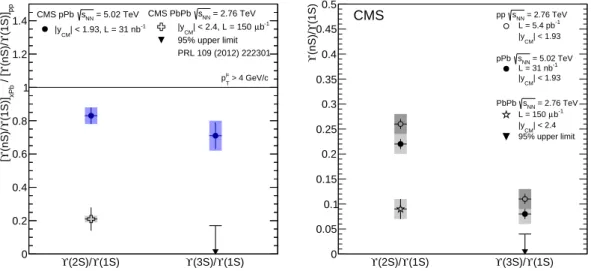
ppUsing the raw yield ratios found by fitting separately the pPb and pp event activity integrated data samples, the double ratios are
Υ(2S)/Υ(1S)|pPb
Υ(2S)/Υ(1S)|pp =0.83±0.05 (stat.)±0.05 (syst.)
Υ(3S)/Υ(1S)|pPb
Υ(3S)/Υ(1S)|pp =0.71±0.08 (stat.)±0.09 (syst.).
The systematic uncertainties include uncertainties from the signal extraction procedure de-scribed above (6% and 13% for the Υ(2S) and Υ(3S), respectively), and from a potentially im-perfect cancelation of the acceptances for individual states between the two centre-of-mass energies (2% and 1%, respectively, estimated from MC).
The above double ratios, in which the initial-state effects are likely to cancel, suggest the pres-ence of final-state effects in the pPb collisions compared to pp collisions, that affect more strongly the excited states (Υ(2S) and Υ(3S)) compared to the ground state (Υ(1S)).
In Fig. 2 (left), the pPb double ratios are compared with the measurement in PbPb at√sNN =
2.76 TeV [2]. The pPb ratios are larger than the corresponding PbPb ones. This observation may help in understanding the final-state mechanisms of suppression of excitedΥ states in the absence of a deconfined medium, and their extrapolation to the PbPb system. It is noted here
4.2 Single cross section ratios:Υ(nS)/Υ(1S) 5 (1S) ϒ (2S)/ ϒ ϒ(3S)/ϒ(1S) pp (1S)] ϒ (nS)/ ϒ / [ xPb (1S)] ϒ (nS)/ ϒ [ 0 0.2 0.4 0.6 0.8 1 1.2 1.4 > 4 GeV/c µ T p = 5.02 TeV NN s CMS pPb -1 | < 1.93, L = 31 nb CM |y = 2.76 TeV NN s CMS PbPb -1 b µ | < 2.4, L = 150 CM |y 95% upper limit PRL 109 (2012) 222301 (1S) ϒ (2S)/ ϒ ϒ(3S)/ϒ(1S) (1S) ϒ (nS)/ ϒ 0 0.05 0.1 0.15 0.2 0.25 0.3 0.35 0.4 0.45 0.5 CMS pp sNN = 2.76 TeV -1 L = 5.4 pb | < 1.93 CM |y = 5.02 TeV NN s pPb -1 L = 31 nb | < 1.93 CM |y = 2.76 TeV NN s PbPb -1 b µ L = 150 | < 2.4 CM |y 95% upper limit
Figure 2: Left: event activity integrated double ratios of the excited states, Υ(2S) and Υ(3S), to the ground state,Υ(1S), in pPb collisions at √sNN = 5.02 TeV with respect to pp collisions at √s = 2.76 TeV (circles), compared to the corresponding ratios for PbPb (cross) collisions at √sNN = 2.76 TeV from Ref. [2], which used a different dataset for the pp normalization. Right: event activity integrated single cross section ratios of the excitedΥ(2S) and Υ(3S) to the groundΥ(1S) state, as measured in pp (open circles), pPb (full circles), and PbPb (open star) collisions at 2.76, 5.02, and 2.76 TeV, respectively. In both figures, the error bars indicate the statistical uncertainties, and the boxes represent the systematic uncertainties. The single ratios are available in tabulated form in Table 2.
that the PbPb double ratios reported in Ref. [2] were normalized to the smaller pp dataset col-lected by CMS in 2011. Once all the corrections are applied, the ratio of the 2011 to the 2013 pp single cross section ratios is 1.6±0.4 (stat.), making them consistent within 1.5 standard deviations. Normalizing by the 2013 reference data would bring the PbPb double ratio up by the same factor 1.6 and reduce the statistical uncertainties, at the price of enhancing the sys-tematic uncertainties since the trigger and reconstruction algorithm are different. Also, though single ratios in pp collisions do not depend significantly on √s [33, 34] and on rapidity [33], one should take into account when comparing or extrapolating the results in Fig. 2 that the pPb and PbPb single ratios differ in these aspects.
4.2 Single cross section ratios: Υ
(
nS)
/Υ(
1S)
The single ratios used as numerator and denominator in the pPb double ratios in Fig. 2 (left) are further corrected for detector acceptance (to a single muon transverse momentum cover-age of pµT > 0 GeV/c and Upsilon|yCM| < 1.93), reconstruction and trigger inefficiencies, and are given in Fig. 2 (right). The global uncertainties (not related to the signal extraction) are added in quadrature to the systematic uncertainties, and are estimated by following the same methods as in the previous analyses [2, 36]: by considering the effect of variations in the sim-ulated kinematic distributions on the acceptance (7–8%) and efficiency (1–2%) corrections, and from differences in the efficiency estimations from data and MC simulation (<1%). The PbPb values are derived from Ref. [2] but, unlike the ones quoted in Eq. (1) in that reference, they are corrected for acceptance and efficiency, following the same procedures as used for the 2013 samples.
6 5 Event activity binned results
state effects acting on the excited states compared to the ground state from pp to pPb to PbPb collisions. For both types of ratios, a quantitative extrapolation of these effects in pPb to the corresponding PbPb requires theoretical modeling, which is beyond the scope of this paper.
5
Event activity binned results
5.1 Excited-to-ground state cross section ratios: Υ
(
nS)
/Υ(
1S)
The pp and pPb data are further analyzed separately as a function of event activity variables measured in two different rapidity regions. Specifically, the single ratios, Υ(2S)/Υ(1S) and Υ(3S)/Υ(1S), are measured in bins of: (1) E|η|>4
T , the raw transverse energy deposited in the most forward part of the HF calorimeters at 4.0 < |η| < 5.2, and (2) Ntracks|η|<2.4, the number of
charged particles, not including the two muons, with pT > 400 MeV/c reconstructed in the tracker at|η| <2.4 and originating from the same vertex as theΥ.
The binning is chosen using a minimum bias event sample, triggered by requiring at least one track with pT > 400 MeV/c to be found in the pixel tracker for a bunch crossing. The bin upper boundaries, presented in Table 3, are chosen for each variable so that they are half or round multiples of the uncorrected mean value in the minimum bias events,hNtracks, raw|η|<2.4 i =10 and 41, hET, raw|η|>4i = 3.5 and 14.7 GeV for pp and pPb, respectively. Table 3 also lists, for each bin, the mean values of both variables, as computed from the dimuon sample used in the analysis, and the fraction of minimum bias events in the bin. For Ntracks|η|<2.4, the mean is extracted after weighting each reconstructed track in one bin by a correction factor that accounts for the detector acceptance, the efficiency of the track reconstruction algorithm, and the fraction of misreconstructed tracks as described in Ref. [23]. Based on studies in Refs. [37, 38], the uncertainty in the total single-track correction is estimated to be 3.9% for the 2013 pp and pPb data, and 10% for the PbPb data.
The binned single ratios Υ(2S)/Υ(1S) and Υ(3S)/Υ(1S) are corrected for acceptance, and for trigger and reconstruction efficiencies. The bin-to-bin systematic uncertainties, represented by coloured boxes in Figs. 3 and 4, come from the fitting procedure and are in the ranges 3–8% (Υ(2S)/Υ(1S)) and 4–30% (Υ(3S)/Υ(1S)) for pp, and 3–8% (Υ(2S)/Υ(1S)) and 7–17% (Υ(3S)/Υ(1S)) for pPb. The uncertainty common to all points in a given dataset, quoted in the captions, is es-timated following the same procedure as for the activity-integrated results.
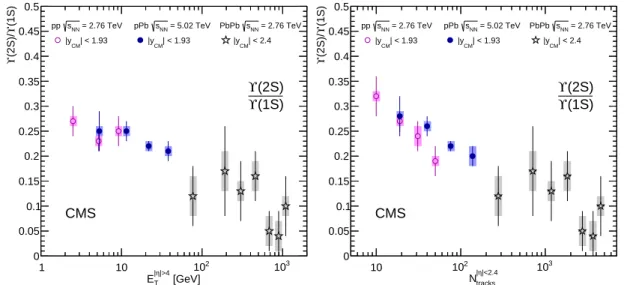
In Fig. 3, for both pp and pPb, the results are shown as a function of forward transverse energy
(E|Tη|>4, left panel), and as a function of midrapidity track multiplicity (Ntracks|η|<2.4, right panel).
In all bins, the abscissae are given by the bin-average value listed in Table 3. The ratios vary weakly as a function of ET|η|>4, while they exhibit a significant decrease with increasing Ntracks|η|<2.4. The difference observed between theΥ states when binning in Ntracks|η|<2.4can arise in two oppo-site ways. If, on the one hand, theΥ(1S) is systematically produced with more particles than the excited states, it would affect the underlying distribution of charged particles and create an artificial dependence when sliced in small multiplicity bins. This dependence should be sensi-tive to the underlying multiplicity distribution, and would result in a larger correlation if one reduces the size of the multiplicity bins. If, on the other hand, theΥ are interacting with the surrounding environment, theΥ(1S) is expected, as the most tightly bound state and the one of smallest size, to be less affected thanΥ(2S) and Υ(3S), leading to a decrease of the Υ(nS)/Υ(1S) ratios with increasing multiplicity. In either case, the ratios will continuously decrease from the
5.1 Excited-to-ground state cross section ratios:Υ(nS)/Υ(1S) 7 [GeV] |>4 η | T E 0 5 10 15 20 25 30 35 40 (1S) ϒ (nS)/ ϒ 0 0.05 0.1 0.15 0.2 0.25 0.3 0.35 0.4 0.45 0.5 | < 1.93 CM |y = 5.02 TeV NN s CMS pPb (1S) ϒ (2S)/ ϒ (1S) ϒ (3S)/ ϒ = 2.76 TeV s CMS pp (1S) ϒ (2S)/ ϒ (1S) ϒ (3S)/ ϒ |<2.4 η | tracks N 0 20 40 60 80 100 120 140 (1S) ϒ (nS)/ ϒ 0 0.05 0.1 0.15 0.2 0.25 0.3 0.35 0.4 0.45 0.5 |< 1.93 CM |y = 5.02 TeV NN s CMS pPb (1S) ϒ (2S)/ ϒ (1S) ϒ (3S)/ ϒ = 2.76 TeV s CMS pp (1S) ϒ (2S)/ ϒ (1S) ϒ (3S)/ ϒ
Figure 3: Single cross section ratiosΥ(2S)/Υ(1S) and Υ(3S)/Υ(1S) for|yCM| <1.93 versus trans-verse energy measured in 4.0 < |η| < 5.2 (left) and number of charged tracks measured
in |η| < 2.4 (right), for pp collisions at
√
s = 2.76 TeV (open symbols) and pPb collisions at
√
sNN = 5.02 TeV (closed symbols). In both figures, the error bars indicate the statistical tainties, and the boxes represent the point-to-point systematic uncertainties. The global uncer-tainties on the pp results are 7% and 8% forΥ(2S)/Υ(1S) and Υ(3S)/Υ(1S), respectively, while in the pPb results they amount to 8% and 9%, respectively. The results are available in tabulated form in Table 4, with binning information provided in Table 3.
pp to pPb to PbPb systems, as a function of event multiplicity.
The impact of additional underlying particles on the decreasing trend of theΥ(2S)/Υ(1S) and Υ(3S)/Υ(1S) versus N|η|<2.4
tracks in pp and pPb collisions is studied in more detail. The pp sample contains on average two extra charged tracks in theΥ(1S) events when compared to the Υ(2S) andΥ(3S) events, consistent with the pPb sample, though the average number of charged par-ticles rises from 13 (pp) to 50 (pPb). The trend shown in the right panel of Fig. 3 is found to weaken (or even reverse) if one artificially lowers the number of charged particles in theΥ(1S) sample by two or three tracks for every event. In contrast, the number of extra charged particles does not vary when lowering the pTthreshold down to 200 MeV/c in the Ntracks|η|<2.4computation, or when removing particles located in a cone of radius ∆R = √(∆φ)2+ (∆η)2 = 0.3 or 0.5 around the Υ momentum direction. Extra charged particles are indeed expected in the Υ(1S) sample because of feed-down from higher-mass states, such asΥ(2S)→Υ(1S)π+
π−, but decay
kinematics [24], with typically assumed feed-down fractions [4], do not lead to a significant rise of the number of charged particles with pT>400 MeV/c. While most feed-down contributions should come from the decays of P-wave states, such as χb→Υ(1S)γ, the probability for a pho-ton to convert in the detector material and produce at least one electron with pT >400 MeV/c, that is further reconstructed and selected, is very low (<0.2%). This makes the number of re-constructed electrons not sufficient to produce the measured trend. Therefore, it is concluded that feed-down contributions cannot solely account for the observed features in the measured ratios. It is noted also that if the three Υ states are produced from the same initial partons, the mass difference between the Υ(1S) and the Υ(2S) (>500 MeV), or theΥ(1S) and the Υ(3S) (>800 MeV), could be found not only in the momentum of theΥ(1S), but also in extra particles created together with theΥ(1S).
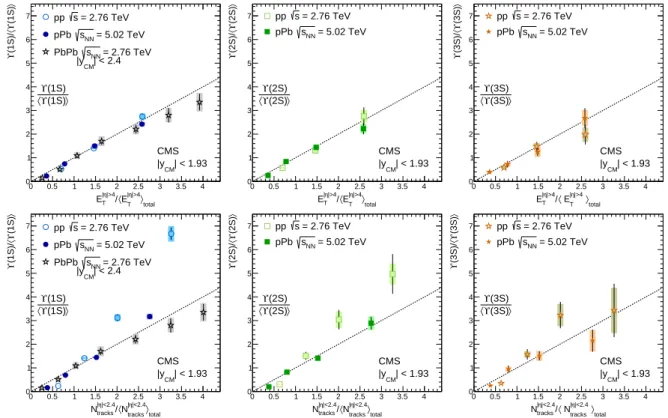
8 5 Event activity binned results [GeV] |>4 η | T E 1 10 102 3 10 (1S) ϒ (2S)/ ϒ 0 0.05 0.1 0.15 0.2 0.25 0.3 0.35 0.4 0.45 0.5 CMS = 2.76 TeV NN s pp | < 1.93 CM |y = 5.02 TeV NN s pPb | < 1.93 CM |y = 2.76 TeV NN s PbPb | < 2.4 CM |y (1S) ϒ (2S) ϒ |<2.4 η | tracks N 10 102 3 10 (1S) ϒ (2S)/ ϒ 0 0.05 0.1 0.15 0.2 0.25 0.3 0.35 0.4 0.45 0.5 CMS = 2.76 TeV NN s pp | < 1.93 CM |y = 5.02 TeV NN s pPb | < 1.93 CM |y = 2.76 TeV NN s PbPb | < 2.4 CM |y (1S) ϒ (2S) ϒ
Figure 4: Single cross section ratiosΥ(2S)/Υ(1S) for|yCM| <1.93 versus (left) transverse energy measured at 4.0 < |η| < 5.2 and (right) charged-particle multiplicity measured in|η| < 2.4,
for pp collisions at√s = 2.76 TeV (open circles) and pPb collisions at√sNN =5.02 TeV (closed circles). Both figures also include the Υ(2S)/Υ(1S) ratios for |yCM| < 2.4 measured in PbPb collisions at√sNN = 2.76 TeV (open stars). The error bars in the figures indicate the statistical uncertainties, and the boxes represent the point-to-point systematic uncertainties. The global uncertainties of the results are 7%, 8%, and 8% for the pp, pPb, and PbPb, respectively. The results are available in tabulated form in Tables 4 and 6, with binning information provided in Tables 3 and 6.
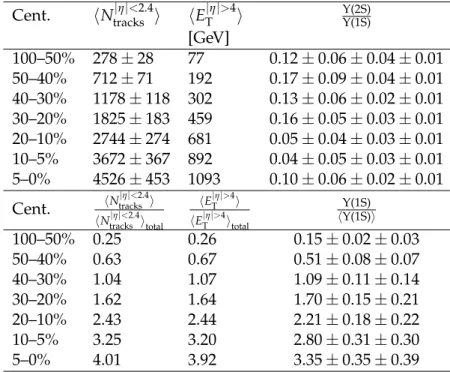
For comparison, similarly corrected PbPb ratios, Υ(2S)/Υ(1S), are computed from the double ratios presented in Ref. [2] versus percentiles of transverse energy deposited in the HF in the 2.9 < |η| < 5.2 range, which define the centrality of the PbPb event. The point-to-point
sys-tematic uncertainties are obtained as described in Ref. [2] and are in the range 13–85% across all bins, while the 8% global uncertainty is calculated as for the activity-integrated results de-scribed above. The statistical uncertainty ranges from 24% to 139%. Because there is a relatively strong correlation between the charged-particle multiplicity and the transverse energy in PbPb collisions, the results reported here are not obtained by repeating the analysis as a function of Ntracks|η|<2.4, but by estimating, in the dimuon sample, the corresponding Ntracks|η|<2.4value for each of the HF energy-binned results [2]. The estimation is done using a low-multiplicity PbPb sample reconstructed with the same reconstruction algorithm as the pp and pPb data, and the pub-lished PbPb pT charged-track distribution [38] to account for the change in pT shape between different PbPb event activity categories. Although the full HF acceptance is used for the cen-trality selection in PbPb, the plotted transverse energy is scaled to the same pseudorapidity coverage as the pp and pPb datasets (4.0< |η| <5.2) using the results in Ref. [39].
In Fig. 4, theΥ(2S)/Υ(1S) ratios from the three collision systems are plotted versus ET|η|>4in the left panel, and versus Ntracks|η|<2.4in the right panel. A logarithmic x-axis scale is chosen to allow displaying the three systems together. The relatively wide most peripheral (50–100%) PbPb bin has little overlap with the highest-multiplicity pPb bin, preventing a direct comparison of the two systems at the same event activity. It should be noted that, within (large) uncertainties, the PbPb centrality dependence is not pronounced [2] and that all pp and pPb ratios are far above the PbPb activity-integrated ratio, shown in the right panel of Fig. 2.
5.2 Self-normalized cross sections:Υ(nS)/hΥ(nS)i 9
5.2 Self-normalized cross sections: Υ(nS)/
h
Υ(nS)i
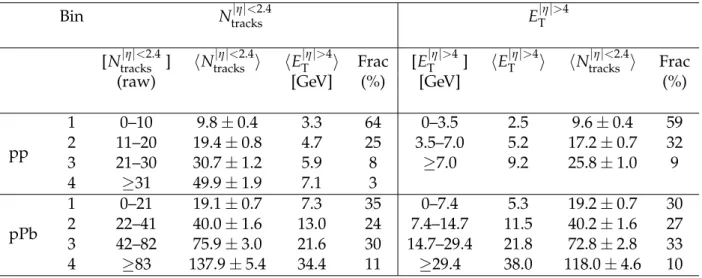
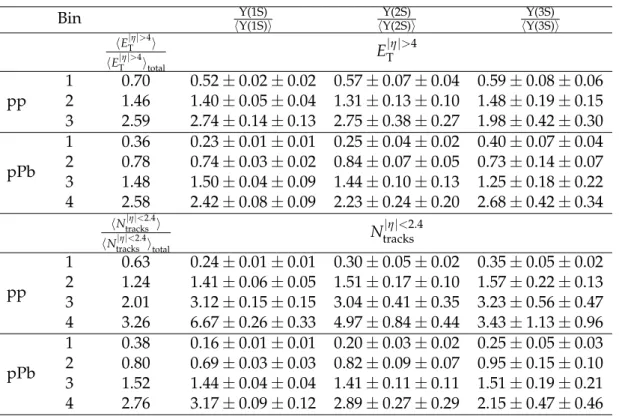
All the ratios presented so far address the relative differences between the excited states and the ground state. In addition, the individual Υ(nS) yields, self-normalized to their activity-integrated values, are computed. The results are shown in Fig. 5 in bins of ET|η|>4/hET|η|>4itotal
(top) and Ntracks|η|<2.4/hNtracks|η|<2.4i
total(bottom), for pp and pPb collisions, where the denominator is averaged over all events. These ratios are constructed from the yields extracted from the same fit as the single ratios and are corrected for the residual activity-dependent efficiency that does not cancel in the ratio. The systematic uncertainties are determined following the same pro-cedure as for the other results reported in this paper. The bin-to-bin systematic uncertainties, represented by the coloured boxes in Fig. 5, come from the fitting procedure and are in the ranges 3–7% (Υ(1S)), 5–14% (Υ(2S)) and 6–20% (Υ(3S)), depending on the bin. Figure 5 (left) also shows the corresponding ratios for the Υ(1S) state in PbPb collisions, which are derived from Ref. [2] by dividing the nuclear modification factors (RAA) binned in centrality by the centrality-integrated RAAvalue. TheΥ(2S) results from Ref. [2] are not included here because of their low precision.
All the self-normalized cross section ratios increase with increasing forward transverse energy and midrapidity particle multiplicity in the event. In the cases where Pb ions are involved, the increase observed in both variables can arise from the increase in the number of nucleon-nucleon collisions. The pp results are reminiscent of a similar J/ψ measurement made in pp collisions at 7 TeV [21]. A possible interpretation of the positive correlation between theΥ pro-duction yield and the underlying activity of the pp event is the occurrence of multiple parton-parton interactions in a single pp collision [40].
To compare the trends between collision systems, linear fits (not shown) are performed sepa-rately for the pp, pPb, and PbPb results. In the case of the forward transverse energy binning, the self-normalized ratios in all three collision systems are found to have a slope consistent with unity. Hence, no significant difference between pp, pPb, and PbPb results or between individ-ual states is observed when correlatingΥ production yields with forward event activity. The similarity of the three systems has to be tempered by the fact that very different mean values are used for normalizing the forward transverse energy, 3.5, 14.7, and 765 GeV, respectively, as well as by the absence of sensitivity of theΥ(nS)/hΥ(nS)iobservable to a modification that is independent of event activity. In contrast, the case of Ntracks|η|<2.4 binning shows differences be-tween the three states, an observation which is related to the single-ratio variations observed in Fig. 3 (right). TheΥ(1S), in particular, exhibits the fastest rise in pp collisions.
6
Summary
The relative production of the three Υ states has been investigated in pPb and pp collisions collected in 2013 by the CMS experiment, in the |yCM| < 1.93 centre-of-mass rapidity range. The self-normalized cross section ratios,Υ(1S)/hΥ(1S)i,Υ(2S)/hΥ(2S)i,Υ(3S)/hΥ(3S)i, increase with event activity. The excited-to-ground-states cross section ratios, Υ(nS)/Υ(1S), are found to decrease with increasing charged-particle multiplicity as measured in the|η| < 2.4
pseu-dorapidity interval that contains the region in which the Υ are measured. This unexpected dependence suggests novel phenomena in quarkonium production that could arise from a larger number of charged particles being systematically produced with the ground state, or from a stronger impact of the growing number of nearby particles on the more weakly bound states. This dependence is less pronounced when the event activity is inferred from transverse energy deposited in the forward 4.0 < |η| < 5.2 region. When integrated over event activity,
10 6 Summary total 〉 |>4 η | T E 〈 / |>4 η | T E 0 0.5 1 1.5 2 2.5 3 3.5 4 〉 (1S) ϒ〈 (1S)/ ϒ 0 1 2 3 4 5 6 7 CMS | < 1.93 CM |y 〉 (1S) ϒ 〈ϒ(1S) | < 2.4 CM |y = 2.76 TeV s pp = 5.02 TeV NN s pPb = 2.76 TeV NN s PbPb total 〉 |>4 η | T E 〈 / |>4 η | T E 0 0.5 1 1.5 2 2.5 3 3.5 4 〉 (2S) ϒ〈 (2S)/ ϒ 0 1 2 3 4 5 6 7 CMS | < 1.93 CM |y 〉 (2S) ϒ 〈ϒ(2S) = 2.76 TeV s pp = 5.02 TeV NN s pPb total 〉 |>4 η | T E 〈 / |>4 η | T E 0 0.5 1 1.5 2 2.5 3 3.5 4 〉 (3S) ϒ〈 (3S)/ ϒ 0 1 2 3 4 5 6 7 CMS | < 1.93 CM |y 〉 (3S) ϒ 〈ϒ(3S) = 2.76 TeV s pp = 5.02 TeV NN s pPb total 〉 |<2.4 η | tracks N 〈 / |<2.4 η | tracks N 0 0.5 1 1.5 2 2.5 3 3.5 4 〉 (1S) ϒ〈 (1S)/ ϒ 0 1 2 3 4 5 6 7 CMS | < 1.93 CM |y 〉 (1S) ϒ 〈ϒ(1S) | < 2.4 CM |y = 2.76 TeV s pp = 5.02 TeV NN s pPb = 2.76 TeV NN s PbPb total 〉 |<2.4 η | tracks N 〈 / |<2.4 η | tracks N 0 0.5 1 1.5 2 2.5 3 3.5 4 〉 (2S) ϒ〈 (2S)/ ϒ 0 1 2 3 4 5 6 7 CMS | < 1.93 CM |y 〉 (2S) ϒ 〈ϒ(2S) = 2.76 TeV s pp = 5.02 TeV NN s pPb total 〉 |<2.4 η | tracks N 〈 / |<2.4 η | tracks N 0 0.5 1 1.5 2 2.5 3 3.5 4 〉 (3S) ϒ〈 (3S)/ ϒ 0 1 2 3 4 5 6 7 CMS | < 1.93 CM |y 〉 (3S) ϒ 〈ϒ(3S) = 2.76 TeV s pp = 5.02 TeV NN s pPb
Figure 5: The Υ(nS) cross section versus transverse energy measured at 4 < |η| < 5.2 (top
row) and versus charged-track multiplicity measured in|η| < 2.4 (bottom row), measured in
|yCM| < 1.93 in pp collisions at
√
s = 2.76 TeV and pPb collisions at √sNN = 5.02 TeV. For Υ(1S), the PbPb data at √sNN = 2.76 TeV (open stars) are overlaid. Cross sections and x-axis variables are normalized by their corresponding activity-integrated values. For all points, the abscissae are at the mean value in each bin. The dotted line is a linear function with a slope equal to unity. The error bars indicate the statistical uncertainties, and the boxes represent the point-to-point systematic uncertainties. The results are available in tabulated form in Table 5.
References 11
the double ratios[Υ(nS)/Υ(1S)]pPb/[Υ(nS)/Υ(1S)]ppare found to be equal to 0.83±0.05 (stat.)±
0.05 (syst.) and 0.71±0.08 (stat.)±0.09 (syst.) forΥ(2S) and Υ(3S), respectively, which are larger than the corresponding double ratios measured for PbPb collisions. This suggests the presence of final-state suppression effects in the pPb collisions compared to pp collisions which affect more strongly the excited states (Υ(2S) and Υ(3S)) compared to the ground state (Υ(1S)). A global understanding of the effects at play in pp, pPb, and PbPb calls for more activity-related studies of the Υ yields in pp collisions, as well as for additional PbPb data allowing a more detailed investigation of the most peripheral events.
We congratulate our colleagues in the CERN accelerator departments for the excellent perfor-mance of the LHC machine. We thank the technical and administrative staff at CERN and other CMS institutes, and acknowledge support from: BMWF and FWF (Austria); FNRS and FWO (Belgium); CNPq, CAPES, FAPERJ, and FAPESP (Brazil); MES (Bulgaria); CERN; CAS, MoST, and NSFC (China); COLCIENCIAS (Colombia); MSES (Croatia); RPF (Cyprus); MEYS (Czech Republic); MoER, SF0690030s09 and ERDF (Estonia); Academy of Finland, MEC, and HIP (Fin-land); CEA and CNRS/IN2P3 (France); BMBF, DFG, and HGF (Germany); GSRT (Greece); OTKA and NKTH (Hungary); DAE and DST (India); IPM (Iran); SFI (Ireland); INFN (Italy); NRF and WCU (Korea); LAS (Lithuania); CINVESTAV, CONACYT, SEP, and UASLP-FAI (Mex-ico); MSI (New Zealand); PAEC (Pakistan); MSHE and NSC (Poland); FCT (Portugal); JINR (Armenia, Belarus, Georgia, Ukraine, Uzbekistan); MON, RosAtom, RAS and RFBR (Russia); MSTD (Serbia); SEIDI and CPAN (Spain); Swiss Funding Agencies (Switzerland); NSC (Taipei); TUBITAK and TAEK (Turkey); NASU (Ukraine); STFC (United Kingdom); DOE and NSF (USA). Individuals have received support from the Marie-Curie programme and the European Research Council and EPLANET (European Union); the Leventis Foundation; the A. P. Sloan Foundation; the Alexander von Humboldt Foundation; the Belgian Federal Science Policy Of-fice; the Fonds pour la Formation `a la Recherche dans l’Industrie et dans l’Agriculture (FRIA-Belgium); the Agentschap voor Innovatie door Wetenschap en Technologie (IWT-(FRIA-Belgium); the Ministry of Education, Youth and Sports (MEYS) of Czech Republic; the Council of Science and Industrial Research, India; the Compagnia di San Paolo (Torino); the HOMING PLUS pro-gramme of Foundation for Polish Science, cofinanced by EU, Regional Development Fund; and the Thalis and Aristeia programmes cofinanced by EU-ESF and the Greek NSRF.
References
[1] CMS Collaboration, “Indications of suppression of excitedΥ states in PbPb collisions at
√
sNN= 2.76 TeV”, Phys. Rev. Lett. 107 (2011) 052302,
doi:10.1103/PhysRevLett.107.052302, arXiv:1105.4894.
[2] CMS Collaboration, “Observation of sequential Upsilon suppression in PbPb collisions”, Phys. Rev. Lett. 109 (2012) 222301, doi:10.1103/PhysRevLett.109.222301,
arXiv:1208.2826.
[3] T. Matsui and H. Satz, “J/ψ suppression by quark-gluon plasma formation”, Phys. Lett. B
178(1986) 416, doi:10.1016/0370-2693(86)91404-8.
[4] S. Digal, P. Petreczky, and H. Satz, “Quarkonium feed down and sequential
suppression”, Phys. Rev. C 64 (2001) 094015, doi:10.1103/PhysRevD.64.094015, arXiv:hep-ph/0106017.
[5] ´A. M ´ocsy and P. Petreczky, “Color screening melts quarkonium”, Phys. Rev. Lett. 99 (2007) 211602, doi:10.1103/PhysRevLett.99.211602, arXiv:0706.2183.
12 References
[6] M. Laine, O. Philipsen, P. Romatschke, and M. Tassler, “Real-time static potential in hot QCD”, JHEP 03 (2007) 054, doi:10.1088/1126-6708/2007/03/054,
arXiv:hep-ph/0611300.
[7] R. Vogt, “Cold nuclear matter effects on J/ψ andΥ production at energies available at the CERN Large Hadron Collider (LHC)”, Phys. Rev. C 81 (2010) 044903,
doi:10.1103/PhysRevC.81.044903, arXiv:1003.3497.
[8] R. Sharma and I. Vitev, “High transverse momentum quarkonium production and dissociation in heavy ion collisions”, Phys. Rev. C 87 (2013) 044905,
doi:10.1103/PhysRevC.87.044905, arXiv:1203.0329.
[9] F. Arleo and S. Peigne, “Heavy-quarkonium suppression in pA collisions from parton energy loss in cold QCD matter”, JHEP 03 (2013) 122,
doi:10.1007/JHEP03(2013)122, arXiv:1212.0434.
[10] C. Gerschel and J. Hufner, “A contribution to the suppression of the J/ψ meson produced in high-energy nucleus nucleus collisions”, Phys. Lett. B 207 (1988) 253,
doi:10.1016/0370-2693(88)90570-9.
[11] C. Lourenco, R. Vogt, and H. K. Woehri, “Energy dependence of J/ψ absorption in proton-nucleus collisions”, JHEP 02 (2009) 014,
doi:10.1088/1126-6708/2009/02/014, arXiv:0901.3054.
[12] S. Gavin and R. Vogt, “J/ψ suppression from hadron-nucleus to nucleus-nucleus collisions”, Nucl. Phys. B 345 (1990) 104, doi:10.1016/0550-3213(90)90610-P. [13] A. Capella et al., “Charmonium dissociation and recombination at RHIC and LHC”, Eur.
Phys. J. C 58 (2008) 437, doi:10.1140/epjc/s10052-008-0772-6, arXiv:0712.4331.
[14] S. J. Brodsky and A. H. Mueller, “Using nuclei to probe hadronization in QCD”, Phys. Lett. B 206 (1988) 685, doi:10.1016/0370-2693(88)90719-8.
[15] M. Strickland and D. Bazow, “Thermal bottomonium suppression at RHIC and LHC”, Nucl. Phys. A 879 (2012) 25, doi:10.1016/j.nuclphysa.2012.02.003,
arXiv:1112.2761.
[16] A. Emerick, X. Zhao, and R. Rapp, “Bottomonia in the quark-gluon plasma and their production at RHIC and LHC”, Eur. Phys. J. A 48 (2012) 72,
doi:10.1140/epja/i2012-12072-y, arXiv:1111.6537.
[17] D. M. Alde et al., “Nuclear dependence of the production of Upsilon resonances at 800-GeV”, Phys. Rev. Lett. 66 (1991) 2285, doi:10.1103/PhysRevLett.66.2285. [18] N. Brambilla et al., “Heavy quarkonium: progress, puzzles, and opportunities”, Eur.
Phys. J. C 71 (2011) 1534, doi:10.1140/epjc/s10052-010-1534-9, arXiv:1010.5827.
[19] M. Beneke and I. Z. Rothstein, “Hadroproduction of quarkonia in fixed target experiments”, Phys. Rev. D 54 (1996) 2005, doi:10.1103/PhysRevD.54.2005, arXiv:hep-ph/9603400. Erratum available at doi:10.1103/PhysRevD.54.7082. [20] R. Vogt, “Are the J/ψ and χcA dependencies the same?”, Nucl. Phys. A 700 (2002) 539,
References 13
[21] ALICE Collaboration, “J/ψ production as a function of charged particle multiplicity in pp collisions at√s =7 TeV”, Phys. Lett. B 712 (2012) 165,
doi:10.1016/j.physletb.2012.04.052, arXiv:1202.2816.
[22] CMS Collaboration, “The CMS experiment at the CERN LHC”, JINST 3 (2008) S08004, doi:10.1088/1748-0221/3/08/S08004.
[23] CMS Collaboration, “Multiplicity and transverse momentum dependence of two- and four-particle correlations in pPb and PbPb collisions”, Phys. Lett. B 724 (2013) 213, doi:10.1016/j.physletb.2013.06.028, arXiv:1305.0609.
[24] T. Sj ¨ostrand, S. Mrenna, and P. Skands, “PYTHIA 6.4 physics and manual”, JHEP 05 (2006) 026, doi:10.1088/1126-6708/2006/05/026, arXiv:hep-ph/0603175. [25] D. J. Lange, “The EvtGen particle decay simulation package”, Nucl. Instrum. Meth. A 462
(2001) 152, doi:10.1016/S0168-9002(01)00089-4.
[26] CMS Collaboration, “Measurement of theΥ(1S), Υ(2S) and Υ(3S) polarizations in pp collisions at√s=7 TeV”, Phys. Rev. Lett. 110 (2013) 081802,
doi:10.1103/PhysRevLett.110.081802, arXiv:1209.2922.
[27] P. Faccioli and J. Seixas, “Observation of χcand χbnuclear suppression via dilepton polarization measurements”, (2012). arXiv:1203.2033.
[28] E. Barberio and Z. Was, “PHOTOS — A universal Monte Carlo for QED radiative corrections: version 2.0”, Comput. Phys. Commun. 79 (1994) 291,
doi:10.1016/0010-4655(94)90074-4.
[29] GEANT Collaboration, “GEANT4 — A simulation toolkit”, Nucl. Instrum. Meth. A 506 (2003) 250, doi:10.1016/S0168-9002(03)01368-8.
[30] CMS Collaboration, “Υ production cross section in pp collisions at√s = 7 TeV”, Phys. Rev. D 83 (2011) 112004, doi:10.1103/PhysRevD.83.112004, arXiv:1012.5545. [31] T. Skwarnicki, “A study of the radiative CASCADE transitions between the
Upsilon-Prime and Upsilon resonances”, Technical Report DESY-F31-86-02, 1986. [32] Particle Data Group Collaboration, “Review of Particle Physics”, Phys. Rev. D 86 (2012)
010001, doi:10.1103/PhysRevD.86.010001.
[33] CMS Collaboration, “Measurement of the Y(1S), Y(2S), and Y(3S) cross sections in pp collisions at√s = 7 TeV”, Phys. Lett. B 77 (2013) 101,
doi:10.1016/j.physletb.2013.10.033, arXiv:1303.5900.
[34] CDF Collaboration, “Υ production in pp collisions at√s = 1.8 TeV”, Phys. Rev. Lett. 75 (1995) 4358, doi:10.1103/PhysRevLett.75.4358.
[35] CDF Collaboration, “Υ production and polarization in pp collisions at√s = 1.8 TeV”, Phys. Rev. Lett. 88 (2002) 161802, doi:10.1103/PhysRevLett.88.161802. [36] CMS Collaboration, “Suppression of non-prompt J/ψ, prompt J/ψ, andΥ(1S) in PbPb
collisions at√sNN = 2.76 TeV”, JHEP 05 (2012) 063, doi:10.1007/JHEP05(2012)063, arXiv:1201.5069.
[37] CMS Collaboration, “Measurement of tracking efficiency”, CMS Physics Analysis Summary CMS-PAS-TRK-10-002, 2010.
14 A Results in tabulated format
[38] CMS Collaboration, “Measurement of the elliptic anisotropy of charged particles
produced in PbPb collisions at nucleon-nucleon center-of-mass energy = 2.76 TeV”, Phys. Rev. C 87 (2013) 014902, doi:10.1103/PhysRevC.87.014902, arXiv:1204.1409. [39] CMS Collaboration, “Measurement of the pseudorapidity and centrality dependence of
the transverse energy density in PbPb collisions at√sNN =2.76 TeV”, Phys. Rev. Lett.
109(2012) 152303, doi:10.1103/PhysRevLett.109.152303, arXiv:1205.2488. [40] H. Abramowicz et al., “Summary of the workshop on multi-parton interactions
(MPI@LHC 2012)”, (2013). arXiv:1306.5413.
A
Results in tabulated format
Table 1: The √s dependence of the excited-to-ground-state cross section ratios, Υ(nS)Υ(1S), in pp and pp collisions. The total quoted uncertainties represent the quadratic sum of the statistical, systematic, and global uncertainties. Listed also are theΥ rapidity and transverse momentum ranges for which each measurement is reported.
Data pT [GeV/c] Rapidity ΥΥ((2S1S))total
Υ(3S) Υ(1S) total CMS pp√s=2.76 TeV 0–40 |y| <1.93 0.26±0.02 0.11±0.02 CMS pp√s=7 TeV [33] 0–38 |y| <2.4 0.26±0.03 0.13±0.02 CDF pp√s =1.9 TeV [34] 1–10 |y| <0.4 0.28±0.05 0.16±0.03
Table 2: The excited-to-ground-state cross section ratios, Υ(nS)Υ(1S), for Upsilons with pT <40 GeV/c, in pp, pPb, and PbPb collisions at nucleon-nucleon center of mass collision energy of 2.76, 5.02, and 2.76 TeV, respectively. Listed uncertainties are statistical first, systematic second, and global third.
Data Rapidity ΥΥ((1S2S)) ΥΥ((3S1S))
pp√s=2.76 TeV |yCM| <1.93 0.26±0.01±0.01±0.02 0.11±0.01±0.01±0.01 pPb√sNN =5.02 TeV |yCM| <1.93 0.22±0.01±0.01±0.02 0.08±0.01±0.01±0.01 PbPb√sNN =2.76 TeV |yCM| <2.4 0.09±0.02±0.02±0.01 <0.04 (at 95% confidence level)
15
Table 3: Event activity bins in Ntracks|η|<2.4 (left) and E|Tη|>4 (right), comprising the bin edges, the mean within the bin and the corresponding mean of the other variable calculated in the dimuon sample, and the fraction of recorded minimum bias triggered events falling within the bin. The bin upper boundaries are chosen for each variable so that they are half or round multiples of the uncorrected mean value in the minimum bias events,hNtracks, raw|η|<2.4 i =10 and 41,hET, raw|η|>4i = 3.5 and 14.7 GeV for pp and pPb, respectively. The quotedhNtracks|η|<2.4ivalues are efficiency corrected.
Bin Ntracks|η|<2.4 E|Tη|>4
[Ntracks|η|<2.4] hNtracks|η|<2.4i hE|Tη|>4i Frac [E|Tη|>4] hET|η|>4i hNtracks|η|<2.4i Frac
(raw) [GeV] (%) [GeV] (%)
pp 1 0–10 9.8±0.4 3.3 64 0–3.5 2.5 9.6±0.4 59 2 11–20 19.4±0.8 4.7 25 3.5–7.0 5.2 17.2±0.7 32 3 21–30 30.7±1.2 5.9 8 ≥7.0 9.2 25.8±1.0 9 4 ≥31 49.9±1.9 7.1 3 pPb 1 0–21 19.1±0.7 7.3 35 0–7.4 5.3 19.2±0.7 30 2 22–41 40.0±1.6 13.0 24 7.4–14.7 11.5 40.2±1.6 27 3 42–82 75.9±3.0 21.6 30 14.7–29.4 21.8 72.8±2.8 33 4 ≥83 137.9±5.4 34.4 11 ≥29.4 38.0 118.0±4.6 10
Table 4: Excited-to-ground state cross section ratios, in event activity bins. Listed uncertainties are statistical first, systematic second, and global scale third.
Bin Υ(2S)Υ(1S) Υ(3S)Υ(1S) E|Tη|>4 pp 1 0.27±0.03±0.01±0.02 0.12±0.02±0.01±0.01 2 0.23±0.02±0.01±0.02 0.12±0.01±0.01±0.01 3 0.25±0.03±0.01±0.02 0.08±0.02±0.01±0.01 pPb 1 0.25±0.04±0.01±0.02 0.13±0.03±0.01±0.01 2 0.25±0.02±0.01±0.02 0.07±0.01±0.01±0.01 3 0.22±0.01±0.01±0.02 0.06±0.01±0.01±0.01 4 0.21±0.02±0.01±0.02 0.09±0.01±0.01±0.01 Ntracks|η|<2.4 pp 1 0.32±0.04±0.01±0.02 0.16±0.02±0.01±0.01 2 0.27±0.02±0.01±0.02 0.12±0.01±0.01±0.01 3 0.24±0.03±0.02±0.02 0.11±0.02±0.01±0.01 4 0.19±0.03±0.01±0.01 0.06±0.02±0.02±0.00 pPb 1 0.28±0.04±0.01±0.02 0.12±0.03±0.01±0.01 2 0.26±0.02±0.01±0.02 0.10±0.02±0.01±0.01 3 0.22±0.01±0.01±0.02 0.08±0.01±0.01±0.01 4 0.20±0.02±0.02±0.02 0.05±0.01±0.01±0.00
16 A Results in tabulated format
Table 5: Self-normalized cross section ratios, in event activity bins. In the first column for each bin, the numerator is averaged over the bin and the denominator is averaged over all events. Listed uncertainties are statistical first and systematic second.
Bin hΥ(1S)Υ(1S)i hΥ(2S)Υ(2S)i hΥ(3S)Υ(3S)i hE|η|>4 T i hE|η|>4 T itotal ET|η|>4 pp 1 0.70 0.52±0.02±0.02 0.57±0.07±0.04 0.59±0.08±0.06 2 1.46 1.40±0.05±0.04 1.31±0.13±0.10 1.48±0.19±0.15 3 2.59 2.74±0.14±0.13 2.75±0.38±0.27 1.98±0.42±0.30 pPb 1 0.36 0.23±0.01±0.01 0.25±0.04±0.02 0.40±0.07±0.04 2 0.78 0.74±0.03±0.02 0.84±0.07±0.05 0.73±0.14±0.07 3 1.48 1.50±0.04±0.09 1.44±0.10±0.13 1.25±0.18±0.22 4 2.58 2.42±0.08±0.09 2.23±0.24±0.20 2.68±0.42±0.34 hN|η|<2.4 tracks i hN|η|<2.4 tracks itotal Ntracks|η|<2.4 pp 1 0.63 0.24±0.01±0.01 0.30±0.05±0.02 0.35±0.05±0.02 2 1.24 1.41±0.06±0.05 1.51±0.17±0.10 1.57±0.22±0.13 3 2.01 3.12±0.15±0.15 3.04±0.41±0.35 3.23±0.56±0.47 4 3.26 6.67±0.26±0.33 4.97±0.84±0.44 3.43±1.13±0.96 pPb 1 0.38 0.16±0.01±0.01 0.20±0.03±0.02 0.25±0.05±0.03 2 0.80 0.69±0.03±0.03 0.82±0.09±0.07 0.95±0.15±0.10 3 1.52 1.44±0.04±0.04 1.41±0.11±0.11 1.51±0.19±0.21 4 2.76 3.17±0.09±0.12 2.89±0.27±0.29 2.15±0.47±0.46
17
Table 6: Single cross section ratios,Υ(2S)/Υ(1S) and Υ(1S)/hΥ(1S)i, measured in bins of central-ity (Cent.) in PbPb collisions at√sNN = 2.76 TeV, derived from Ref. [2]. The quotedhN|η|<2.4
tracks i values are efficiency corrected. In the second section, the denominator in the fractions is av-eraged over all events. Listed uncertainties are statistical first, systematic second, and global scale third. Cent. hNtracks|η|<2.4i hET|η|>4i Υ(2S)Υ(1S) [GeV] 100–50% 278±28 77 0.12±0.06±0.04±0.01 50–40% 712±71 192 0.17±0.09±0.04±0.01 40–30% 1178±118 302 0.13±0.06±0.02±0.01 30–20% 1825±183 459 0.16±0.05±0.03±0.01 20–10% 2744±274 681 0.05±0.04±0.03±0.01 10–5% 3672±367 892 0.04±0.05±0.03±0.01 5–0% 4526±453 1093 0.10±0.06±0.02±0.01 Cent. hN |η|<2.4 tracks i hN|η|<2.4 tracks itotal hE|Tη|>4i hE|η|>4 T itotal Υ(1S) hΥ(1S)i 100–50% 0.25 0.26 0.15±0.02±0.03 50–40% 0.63 0.67 0.51±0.08±0.07 40–30% 1.04 1.07 1.09±0.11±0.14 30–20% 1.62 1.64 1.70±0.15±0.21 20–10% 2.43 2.44 2.21±0.18±0.22 10–5% 3.25 3.20 2.80±0.31±0.30 5–0% 4.01 3.92 3.35±0.35±0.39
19
B
The CMS Collaboration
Yerevan Physics Institute, Yerevan, Armenia
S. Chatrchyan, V. Khachatryan, A.M. Sirunyan, A. Tumasyan
Institut f ¨ur Hochenergiephysik der OeAW, Wien, Austria
W. Adam, T. Bergauer, M. Dragicevic, J. Er ¨o, C. Fabjan1, M. Friedl, R. Fr ¨uhwirth1, V.M. Ghete, C. Hartl, N. H ¨ormann, J. Hrubec, M. Jeitler1, W. Kiesenhofer, V. Kn ¨unz, M. Krammer1, I. Kr¨atschmer, D. Liko, I. Mikulec, D. Rabady2, B. Rahbaran, H. Rohringer, R. Sch ¨ofbeck, J. Strauss, A. Taurok, W. Treberer-Treberspurg, W. Waltenberger, C.-E. Wulz1
National Centre for Particle and High Energy Physics, Minsk, Belarus
V. Mossolov, N. Shumeiko, J. Suarez Gonzalez
Universiteit Antwerpen, Antwerpen, Belgium
S. Alderweireldt, M. Bansal, S. Bansal, T. Cornelis, E.A. De Wolf, X. Janssen, A. Knutsson, S. Luyckx, L. Mucibello, S. Ochesanu, B. Roland, R. Rougny, H. Van Haevermaet, P. Van Mechelen, N. Van Remortel, A. Van Spilbeeck
Vrije Universiteit Brussel, Brussel, Belgium
F. Blekman, S. Blyweert, J. D’Hondt, N. Heracleous, A. Kalogeropoulos, J. Keaveney, T.J. Kim, S. Lowette, M. Maes, A. Olbrechts, D. Strom, S. Tavernier, W. Van Doninck, P. Van Mulders, G.P. Van Onsem, I. Villella
Universit´e Libre de Bruxelles, Bruxelles, Belgium
C. Caillol, B. Clerbaux, G. De Lentdecker, L. Favart, A.P.R. Gay, T. Hreus, A. L´eonard, P.E. Marage, A. Mohammadi, L. Perni`e, T. Reis, T. Seva, L. Thomas, C. Vander Velde, P. Vanlaer, J. Wang
Ghent University, Ghent, Belgium
V. Adler, K. Beernaert, L. Benucci, A. Cimmino, S. Costantini, S. Dildick, G. Garcia, B. Klein, J. Lellouch, J. Mccartin, A.A. Ocampo Rios, D. Ryckbosch, M. Sigamani, N. Strobbe, F. Thyssen, M. Tytgat, S. Walsh, E. Yazgan, N. Zaganidis
Universit´e Catholique de Louvain, Louvain-la-Neuve, Belgium
S. Basegmez, C. Beluffi3, G. Bruno, R. Castello, A. Caudron, L. Ceard, G.G. Da Silveira, C. Delaere, T. du Pree, D. Favart, L. Forthomme, A. Giammanco4, J. Hollar, P. Jez, M. Komm, V. Lemaitre, J. Liao, O. Militaru, C. Nuttens, D. Pagano, A. Pin, K. Piotrzkowski, A. Popov5, L. Quertenmont, M. Selvaggi, M. Vidal Marono, J.M. Vizan Garcia
Universit´e de Mons, Mons, Belgium
N. Beliy, T. Caebergs, E. Daubie, G.H. Hammad
Centro Brasileiro de Pesquisas Fisicas, Rio de Janeiro, Brazil
G.A. Alves, M. Correa Martins Junior, T. Martins, M.E. Pol, M.H.G. Souza
Universidade do Estado do Rio de Janeiro, Rio de Janeiro, Brazil
W.L. Ald´a J ´unior, W. Carvalho, J. Chinellato6, A. Cust ´odio, E.M. Da Costa, D. De Jesus Damiao, C. De Oliveira Martins, S. Fonseca De Souza, H. Malbouisson, M. Malek, D. Matos Figueiredo, L. Mundim, H. Nogima, W.L. Prado Da Silva, J. Santaolalla, A. Santoro, A. Sznajder, E.J. Tonelli Manganote6, A. Vilela Pereira
Universidade Estadual Paulistaa, Universidade Federal do ABCb, S˜ao Paulo, Brazil
C.A. Bernardesb, F.A. Diasa,7, T.R. Fernandez Perez Tomeia, E.M. Gregoresb, C. Laganaa, P.G. Mercadanteb, S.F. Novaesa, Sandra S. Padulaa
20 B The CMS Collaboration
Institute for Nuclear Research and Nuclear Energy, Sofia, Bulgaria
V. Genchev2, P. Iaydjiev2, A. Marinov, S. Piperov, M. Rodozov, G. Sultanov, M. Vutova
University of Sofia, Sofia, Bulgaria
A. Dimitrov, I. Glushkov, R. Hadjiiska, V. Kozhuharov, L. Litov, B. Pavlov, P. Petkov
Institute of High Energy Physics, Beijing, China
J.G. Bian, G.M. Chen, H.S. Chen, M. Chen, R. Du, C.H. Jiang, D. Liang, S. Liang, X. Meng, R. Plestina8, J. Tao, X. Wang, Z. Wang
State Key Laboratory of Nuclear Physics and Technology, Peking University, Beijing, China
C. Asawatangtrakuldee, Y. Ban, Y. Guo, W. Li, S. Liu, Y. Mao, S.J. Qian, H. Teng, D. Wang, L. Zhang, W. Zou
Universidad de Los Andes, Bogota, Colombia
C. Avila, C.A. Carrillo Montoya, L.F. Chaparro Sierra, C. Florez, J.P. Gomez, B. Gomez Moreno, J.C. Sanabria
Technical University of Split, Split, Croatia
N. Godinovic, D. Lelas, D. Polic, I. Puljak
University of Split, Split, Croatia
Z. Antunovic, M. Kovac
Institute Rudjer Boskovic, Zagreb, Croatia
V. Brigljevic, K. Kadija, J. Luetic, D. Mekterovic, S. Morovic, L. Tikvica
University of Cyprus, Nicosia, Cyprus
A. Attikis, G. Mavromanolakis, J. Mousa, C. Nicolaou, F. Ptochos, P.A. Razis
Charles University, Prague, Czech Republic
M. Finger, M. Finger Jr.
Academy of Scientific Research and Technology of the Arab Republic of Egypt, Egyptian Network of High Energy Physics, Cairo, Egypt
A.A. Abdelalim9, Y. Assran10, S. Elgammal9, A. Ellithi Kamel11, M.A. Mahmoud12, A. Radi13,14
National Institute of Chemical Physics and Biophysics, Tallinn, Estonia
M. Kadastik, M. M ¨untel, M. Murumaa, M. Raidal, L. Rebane, A. Tiko
Department of Physics, University of Helsinki, Helsinki, Finland
P. Eerola, G. Fedi, M. Voutilainen
Helsinki Institute of Physics, Helsinki, Finland
J. H¨ark ¨onen, V. Karim¨aki, R. Kinnunen, M.J. Kortelainen, T. Lamp´en, K. Lassila-Perini, S. Lehti, T. Lind´en, P. Luukka, T. M¨aenp¨a¨a, T. Peltola, E. Tuominen, J. Tuominiemi, E. Tuovinen, L. Wendland
Lappeenranta University of Technology, Lappeenranta, Finland
T. Tuuva
DSM/IRFU, CEA/Saclay, Gif-sur-Yvette, France
M. Besancon, F. Couderc, M. Dejardin, D. Denegri, B. Fabbro, J.L. Faure, F. Ferri, S. Ganjour, A. Givernaud, P. Gras, G. Hamel de Monchenault, P. Jarry, E. Locci, J. Malcles, A. Nayak, J. Rander, A. Rosowsky, M. Titov
21
Laboratoire Leprince-Ringuet, Ecole Polytechnique, IN2P3-CNRS, Palaiseau, France
S. Baffioni, F. Beaudette, P. Busson, C. Charlot, N. Daci, T. Dahms, M. Dalchenko, L. Dobrzynski, N. Filipovic, A. Florent, R. Granier de Cassagnac, M. Haguenauer, P. Min´e, C. Mironov, I.N. Naranjo, M. Nguyen, C. Ochando, P. Paganini, D. Sabes, R. Salerno, Y. Sirois, C. Veelken, Y. Yilmaz, A. Zabi
Institut Pluridisciplinaire Hubert Curien, Universit´e de Strasbourg, Universit´e de Haute Alsace Mulhouse, CNRS/IN2P3, Strasbourg, France
J.-L. Agram15, J. Andrea, D. Bloch, J.-M. Brom, E.C. Chabert, C. Collard, E. Conte15, F. Drouhin15, J.-C. Fontaine15, D. Gel´e, U. Goerlach, C. Goetzmann, P. Juillot, A.-C. Le Bihan, P. Van Hove
Centre de Calcul de l’Institut National de Physique Nucleaire et de Physique des Particules, CNRS/IN2P3, Villeurbanne, France
S. Gadrat
Universit´e de Lyon, Universit´e Claude Bernard Lyon 1, CNRS-IN2P3, Institut de Physique Nucl´eaire de Lyon, Villeurbanne, France
S. Beauceron, N. Beaupere, G. Boudoul, S. Brochet, J. Chasserat, R. Chierici, D. Contardo, P. Depasse, H. El Mamouni, J. Fan, J. Fay, S. Gascon, M. Gouzevitch, B. Ille, T. Kurca, M. Lethuillier, L. Mirabito, S. Perries, J.D. Ruiz Alvarez, L. Sgandurra, V. Sordini, M. Vander Donckt, P. Verdier, S. Viret, H. Xiao
Institute of High Energy Physics and Informatization, Tbilisi State University, Tbilisi, Georgia
Z. Tsamalaidze16
RWTH Aachen University, I. Physikalisches Institut, Aachen, Germany
C. Autermann, S. Beranek, M. Bontenackels, B. Calpas, M. Edelhoff, L. Feld, O. Hindrichs, K. Klein, A. Ostapchuk, A. Perieanu, F. Raupach, J. Sammet, S. Schael, D. Sprenger, H. Weber, B. Wittmer, V. Zhukov5
RWTH Aachen University, III. Physikalisches Institut A, Aachen, Germany
M. Ata, J. Caudron, E. Dietz-Laursonn, D. Duchardt, M. Erdmann, R. Fischer, A. G ¨uth, T. Hebbeker, C. Heidemann, K. Hoepfner, D. Klingebiel, S. Knutzen, P. Kreuzer, M. Merschmeyer, A. Meyer, M. Olschewski, K. Padeken, P. Papacz, H. Pieta, H. Reithler, S.A. Schmitz, L. Sonnenschein, D. Teyssier, S. Th ¨uer, M. Weber
RWTH Aachen University, III. Physikalisches Institut B, Aachen, Germany
V. Cherepanov, Y. Erdogan, G. Fl ¨ugge, H. Geenen, M. Geisler, W. Haj Ahmad, F. Hoehle, B. Kargoll, T. Kress, Y. Kuessel, J. Lingemann2, A. Nowack, I.M. Nugent, L. Perchalla, O. Pooth, A. Stahl
Deutsches Elektronen-Synchrotron, Hamburg, Germany
I. Asin, N. Bartosik, J. Behr, W. Behrenhoff, U. Behrens, A.J. Bell, M. Bergholz17, A. Bethani, K. Borras, A. Burgmeier, A. Cakir, L. Calligaris, A. Campbell, S. Choudhury, F. Costanza, C. Diez Pardos, S. Dooling, T. Dorland, G. Eckerlin, D. Eckstein, T. Eichhorn, G. Flucke, A. Geiser, A. Grebenyuk, P. Gunnellini, S. Habib, J. Hauk, G. Hellwig, M. Hempel, D. Horton, H. Jung, M. Kasemann, P. Katsas, C. Kleinwort, H. Kluge, M. Kr¨amer, D. Kr ¨ucker, W. Lange, J. Leonard, K. Lipka, W. Lohmann17, B. Lutz, R. Mankel, I. Marfin, I.-A. Melzer-Pellmann, A.B. Meyer, J. Mnich, A. Mussgiller, S. Naumann-Emme, O. Novgorodova, F. Nowak, J. Olzem, H. Perrey, A. Petrukhin, D. Pitzl, R. Placakyte, A. Raspereza, P.M. Ribeiro Cipriano, C. Riedl,
22 B The CMS Collaboration
E. Ron, M. ¨O. Sahin, J. Salfeld-Nebgen, R. Schmidt17, T. Schoerner-Sadenius, M. Schr ¨oder, N. Sen, M. Stein, A.D.R. Vargas Trevino, R. Walsh, C. Wissing
University of Hamburg, Hamburg, Germany
M. Aldaya Martin, V. Blobel, H. Enderle, J. Erfle, E. Garutti, M. G ¨orner, M. Gosselink, J. Haller, K. Heine, R.S. H ¨oing, H. Kirschenmann, R. Klanner, R. Kogler, J. Lange, I. Marchesini, J. Ott, T. Peiffer, N. Pietsch, D. Rathjens, C. Sander, H. Schettler, P. Schleper, E. Schlieckau, A. Schmidt, T. Schum, M. Seidel, J. Sibille18, V. Sola, H. Stadie, G. Steinbr ¨uck, D. Troendle, E. Usai, L. Vanelderen
Institut f ¨ur Experimentelle Kernphysik, Karlsruhe, Germany
C. Barth, C. Baus, J. Berger, C. B ¨oser, E. Butz, T. Chwalek, W. De Boer, A. Descroix, A. Dierlamm, M. Feindt, M. Guthoff2, F. Hartmann2, T. Hauth2, H. Held, K.H. Hoffmann, U. Husemann, I. Katkov5, A. Kornmayer2, E. Kuznetsova, P. Lobelle Pardo, D. Martschei, M.U. Mozer, Th. M ¨uller, M. Niegel, A. N ¨urnberg, O. Oberst, G. Quast, K. Rabbertz, F. Ratnikov, S. R ¨ocker, F.-P. Schilling, G. Schott, H.J. Simonis, F.M. Stober, R. Ulrich, J. Wagner-Kuhr, S. Wayand, T. Weiler, R. Wolf, M. Zeise
Institute of Nuclear and Particle Physics (INPP), NCSR Demokritos, Aghia Paraskevi, Greece
G. Anagnostou, G. Daskalakis, T. Geralis, S. Kesisoglou, A. Kyriakis, D. Loukas, A. Markou, C. Markou, E. Ntomari, I. Topsis-giotis
University of Athens, Athens, Greece
L. Gouskos, A. Panagiotou, N. Saoulidou, E. Stiliaris
University of Io´annina, Io´annina, Greece
X. Aslanoglou, I. Evangelou, G. Flouris, C. Foudas, P. Kokkas, N. Manthos, I. Papadopoulos, E. Paradas
Wigner Research Centre for Physics, Budapest, Hungary
G. Bencze, C. Hajdu, P. Hidas, D. Horvath19, F. Sikler, V. Veszpremi, G. Vesztergombi20, A.J. Zsigmond
Institute of Nuclear Research ATOMKI, Debrecen, Hungary
N. Beni, S. Czellar, J. Molnar, J. Palinkas, Z. Szillasi
University of Debrecen, Debrecen, Hungary
J. Karancsi, P. Raics, Z.L. Trocsanyi, B. Ujvari
National Institute of Science Education and Research, Bhubaneswar, India
S.K. Swain21
Panjab University, Chandigarh, India
S.B. Beri, V. Bhatnagar, N. Dhingra, R. Gupta, M. Kaur, M.Z. Mehta, M. Mittal, N. Nishu, A. Sharma, J.B. Singh
University of Delhi, Delhi, India
Ashok Kumar, Arun Kumar, S. Ahuja, A. Bhardwaj, B.C. Choudhary, A. Kumar, S. Malhotra, M. Naimuddin, K. Ranjan, P. Saxena, V. Sharma, R.K. Shivpuri
Saha Institute of Nuclear Physics, Kolkata, India
S. Banerjee, S. Bhattacharya, K. Chatterjee, S. Dutta, B. Gomber, Sa. Jain, Sh. Jain, R. Khurana, A. Modak, S. Mukherjee, D. Roy, S. Sarkar, M. Sharan, A.P. Singh
23
Bhabha Atomic Research Centre, Mumbai, India
A. Abdulsalam, D. Dutta, S. Kailas, V. Kumar, A.K. Mohanty2, L.M. Pant, P. Shukla, A. Topkar
Tata Institute of Fundamental Research - EHEP, Mumbai, India
T. Aziz, R.M. Chatterjee, S. Ganguly, S. Ghosh, M. Guchait22, A. Gurtu23, G. Kole, S. Kumar, M. Maity24, G. Majumder, K. Mazumdar, G.B. Mohanty, B. Parida, K. Sudhakar, N. Wickramage25
Tata Institute of Fundamental Research - HECR, Mumbai, India
S. Banerjee, S. Dugad
Institute for Research in Fundamental Sciences (IPM), Tehran, Iran
H. Arfaei, H. Bakhshiansohi, H. Behnamian, S.M. Etesami26, A. Fahim27, A. Jafari, M. Khakzad, M. Mohammadi Najafabadi, M. Naseri, S. Paktinat Mehdiabadi, B. Safarzadeh28, M. Zeinali
University College Dublin, Dublin, Ireland
M. Grunewald
INFN Sezione di Baria, Universit`a di Barib, Politecnico di Baric, Bari, Italy
M. Abbresciaa,b, L. Barbonea,b, C. Calabriaa,b, S.S. Chhibraa,b, A. Colaleoa, D. Creanzaa,c, N. De Filippisa,c, M. De Palmaa,b, L. Fiorea, G. Iasellia,c, G. Maggia,c, M. Maggia, B. Marangellia,b, S. Mya,c, S. Nuzzoa,b, N. Pacificoa, A. Pompilia,b, G. Pugliesea,c, R. Radognaa,b, G. Selvaggia,b, L. Silvestrisa, G. Singha,b, R. Vendittia,b, P. Verwilligena, G. Zitoa
INFN Sezione di Bolognaa, Universit`a di Bolognab, Bologna, Italy
G. Abbiendia, A.C. Benvenutia, D. Bonacorsia,b, S. Braibant-Giacomellia,b, L. Brigliadoria,b, R. Campaninia,b, P. Capiluppia,b, A. Castroa,b, F.R. Cavalloa, G. Codispotia,b, M. Cuffiania,b, G.M. Dallavallea, F. Fabbria, A. Fanfania,b, D. Fasanellaa,b, P. Giacomellia, C. Grandia, L. Guiduccia,b, S. Marcellinia, G. Masettia, M. Meneghellia,b, A. Montanaria, F.L. Navarriaa,b, F. Odoricia, A. Perrottaa, F. Primaveraa,b, A.M. Rossia,b, T. Rovellia,b, G.P. Sirolia,b, N. Tosia,b, R. Travaglinia,b
INFN Sezione di Cataniaa, Universit`a di Cataniab, CSFNSMc, Catania, Italy
S. Albergoa,b, G. Cappelloa, M. Chiorbolia,b, S. Costaa,b, F. Giordanoa,2, R. Potenzaa,b, A. Tricomia,b, C. Tuvea,b
INFN Sezione di Firenzea, Universit`a di Firenzeb, Firenze, Italy
G. Barbaglia, V. Ciullia,b, C. Civininia, R. D’Alessandroa,b, E. Focardia,b, E. Galloa, S. Gonzia,b, V. Goria,b, P. Lenzia,b, M. Meschinia, S. Paolettia, G. Sguazzonia, A. Tropianoa,b
INFN Laboratori Nazionali di Frascati, Frascati, Italy
L. Benussi, S. Bianco, F. Fabbri, D. Piccolo
INFN Sezione di Genovaa, Universit`a di Genovab, Genova, Italy
P. Fabbricatorea, R. Ferrettia,b, F. Ferroa, M. Lo Veterea,b, R. Musenicha, E. Robuttia, S. Tosia,b
INFN Sezione di Milano-Bicoccaa, Universit`a di Milano-Bicoccab, Milano, Italy
A. Benagliaa, M.E. Dinardoa,b, S. Fiorendia,b,2, S. Gennaia, A. Ghezzia,b, P. Govonia,b, M.T. Lucchinia,b,2, S. Malvezzia, R.A. Manzonia,b,2, A. Martellia,b,2, D. Menascea, L. Moronia, M. Paganonia,b, D. Pedrinia, S. Ragazzia,b, N. Redaellia, T. Tabarelli de Fatisa,b
INFN Sezione di Napoli a, Universit`a di Napoli ’Federico II’ b, Universit`a della
Basilicata (Potenza)c, Universit`a G. Marconi (Roma)d, Napoli, Italy
S. Buontempoa, N. Cavalloa,c, F. Fabozzia,c, A.O.M. Iorioa,b, L. Listaa, S. Meolaa,d,2, M. Merolaa, P. Paoluccia,2
24 B The CMS Collaboration
INFN Sezione di Padovaa, Universit`a di Padovab, Universit`a di Trento (Trento)c, Padova, Italy
P. Azzia, N. Bacchettaa, M. Bellatoa, M. Biasottoa,29, D. Biselloa,b, A. Brancaa,b, R. Carlina,b, P. Checchiaa, T. Dorigoa, F. Fanzagoa, M. Galantia,b,2, F. Gasparinia,b, U. Gasparinia,b, P. Giubilatoa,b, A. Gozzelinoa, K. Kanishcheva,c, S. Lacapraraa, I. Lazzizzeraa,c, M. Margonia,b, A.T. Meneguzzoa,b, J. Pazzinia,b, N. Pozzobona,b, P. Ronchesea,b, F. Simonettoa,b, E. Torassaa, M. Tosia,b, A. Triossia, P. Zottoa,b, A. Zucchettaa,b, G. Zumerlea,b
INFN Sezione di Paviaa, Universit`a di Paviab, Pavia, Italy
M. Gabusia,b, S.P. Rattia,b, C. Riccardia,b, P. Vituloa,b
INFN Sezione di Perugiaa, Universit`a di Perugiab, Perugia, Italy
M. Biasinia,b, G.M. Bileia, L. Fan `oa,b, P. Laricciaa,b, G. Mantovania,b, M. Menichellia, A. Nappia,b†, F. Romeoa,b, A. Sahaa, A. Santocchiaa,b, A. Spieziaa,b
INFN Sezione di Pisaa, Universit`a di Pisab, Scuola Normale Superiore di Pisac, Pisa, Italy
K. Androsova,30, P. Azzurria, G. Bagliesia, J. Bernardinia, T. Boccalia, G. Broccoloa,c, R. Castaldia, M.A. Cioccia,30, R. Dell’Orsoa, F. Fioria,c, L. Fo`aa,c, A. Giassia, M.T. Grippoa,30, A. Kraana, F. Ligabuea,c, T. Lomtadzea, L. Martinia,b, A. Messineoa,b, C.S. Moona,31, F. Pallaa, A. Rizzia,b, A. Savoy-Navarroa,32, A.T. Serbana, P. Spagnoloa, P. Squillaciotia,30, R. Tenchinia, G. Tonellia,b, A. Venturia, P.G. Verdinia, C. Vernieria,c
INFN Sezione di Romaa, Universit`a di Romab, Roma, Italy
L. Baronea,b, F. Cavallaria, D. Del Rea,b, M. Diemoza, M. Grassia,b, C. Jordaa, E. Longoa,b, F. Margarolia,b, P. Meridiania, F. Michelia,b, S. Nourbakhsha,b, G. Organtinia,b, R. Paramattia, S. Rahatloua,b, C. Rovellia, L. Soffia,b, P. Traczyka,b
INFN Sezione di Torino a, Universit`a di Torino b, Universit`a del Piemonte Orientale (No-vara)c, Torino, Italy
N. Amapanea,b, R. Arcidiaconoa,c, S. Argiroa,b, M. Arneodoa,c, R. Bellana,b, C. Biinoa, N. Cartigliaa, S. Casassoa,b, M. Costaa,b, A. Deganoa,b, N. Demariaa, C. Mariottia, S. Masellia, E. Migliorea,b, V. Monacoa,b, M. Musicha, M.M. Obertinoa,c, G. Ortonaa,b, L. Pachera,b, N. Pastronea, M. Pelliccionia,2, A. Potenzaa,b, A. Romeroa,b, M. Ruspaa,c, R. Sacchia,b, A. Solanoa,b, A. Staianoa, U. Tamponia
INFN Sezione di Triestea, Universit`a di Triesteb, Trieste, Italy
S. Belfortea, V. Candelisea,b, M. Casarsaa, F. Cossuttia,2, G. Della Riccaa,b, B. Gobboa, C. La Licataa,b, M. Maronea,b, D. Montaninoa,b, A. Penzoa, A. Schizzia,b, T. Umera,b, A. Zanettia
Kangwon National University, Chunchon, Korea
S. Chang, T.Y. Kim, S.K. Nam
Kyungpook National University, Daegu, Korea
D.H. Kim, G.N. Kim, J.E. Kim, D.J. Kong, S. Lee, Y.D. Oh, H. Park, D.C. Son
Chonnam National University, Institute for Universe and Elementary Particles, Kwangju, Korea
J.Y. Kim, Zero J. Kim, S. Song
Korea University, Seoul, Korea
S. Choi, D. Gyun, B. Hong, M. Jo, H. Kim, Y. Kim, K.S. Lee, S.K. Park, Y. Roh
University of Seoul, Seoul, Korea