University of Aveiro 2009
Department of Communication and Art
Sérgio Rodrigues
de Almeida
Mudança Comportamental através de Multimédia:
Um Estudo de Caso em Cessação Tabágica
Changing Behavior Through Multimedia: A Case
Study on Smoking Cessation
University of Aveiro 2009
Department of Communication and Art
Sérgio Rodrigues
de Almeida
Changing Behavior Through Multimedia: A Case
Study on Smoking Cessation
Dissertation thesis presented to the University of Aveiro as a fulfillment of the necessary requirements to the obtainment of the Master’s Degree in Multimedia Communication, accomplished under the scientific supervision of Professor Dr. Ana Isabel Veloso, Assistant professor of the Department of Communication and Arts of the University of Aveiro and Professor Dr. Vassiliki Zisi, Lecturer at the Department of Physical Education and Sports Science of the University of Thessaly
the jury
president Prof. Óscar Emanuel Chaves Mealha
Associate professor of the Department of Communication and Arts of the University of Aveiro
Prof. Maria Fernanda da Silva Martins
Assistant Professor of the Faculty of Letters of the University of Porto
Prof. Ana Isabel Barreto Furtado Franco de Albuquerque Veloso
Assistant Professor of the Department of Communication and Arts of the University of Aveiro
Prof. Vassiliki Zisi
acknowledgments Vânia Carvalho Simão Oliveira Rodolfo Costa Simo Parni Sandra Zipprich Janneke Hermans Markus Suuronen Inga Kupsyte Prof. Ana Veloso Prof. Vassiliki Zisi Prof. Mary Hassandra Prof. Francislê Souza Stamatia Gratsani Georgia Kofou Despina
keywords Educational Applications, Behavior Change, Interactive Multimedia
abstract This project consists on the development of a multimedia application, which will function as a tool to provide therapeutical treatment for individuals who want to change their addictive behaviors, through the articulation between real and virtual sessions. The application will be used as a support tool for smoke cessation intervention programs. This multimedia application was developed according with therapeutical practical experiences and printed materials. Therefore, knowledge of learning and behavior theories is fundamental, such as Behaviorism, Cognitivism, Constructivism, Transtheoretical Model and Theory of Planned Behavior. A profound study on these theories and models will help to understand how the subject thinks, thus facilitating the development of an application which can help the users. This project is performed in the field of practical therapeutical uses, applied to the greek reality through a multimedia approach.
The project took place at the University of Thessaly – Department of Physical Education and Sports Sciences, at the city of Trikala, Greece where the conceptual model was elaborated with the influence of User Centred Design concepts from therapists specialized on this technique, originating the development of a prototype for a multimedia application. Its assessment content was done by some experts in the fields of psychology, multimedia, physical education and smoking cessation intervention programs, using their experience and knowledge to evaluate some of its aspects (like design, interaction, navigation system, strategies used, and others). This preliminary evaluation allowed to conclude that multimedia can have an important role on the fight for smoke cessation, since its usage can bring extra motivation for the users, and present information through more interesting strategies.
palavras-chave Aplicações educacionais, Mudança Comportamental, Multimédia Interactivo
resumo Este projecto consiste no desenvolvimento de uma aplicação multimédia, que irá funcionar como uma ferramenta para fornecer tratamento terapêutico a indivíduos que querem alterar os seus comportamentos aditivos, através da articulação entre sessões reais e virtuais. A aplicação irá ser usada como uma ferramenta de suporte para programas de intervenção de cessação tabágica. Esta aplicação multimédia foi desenvolvida de acordo com experiências práticas terapêuticas e materiais impressos.
Assim, conhecimentos de teorias de aprendizagem e comportamento são fundamentais, tais como Behaviorismo, Cognitivismo, Constructivismo, Model Transteórico e Teoria de Comportamento Planeado. Um estudo aprofundado destas teorias e modelos irá ajudar a compreender como o sujeito pensa, facilitando o desenvolvimento de uma aplicação que pode ajudar os utilizadores. Este projecto é desenvolvido na área de utilização de práticas terapêuticas, aplicado à realidade grega através do multimédia.
O projecto teve lugar na Universidade da Tessália – Departamento de Educação Física e Ciências do Desporto, na cidade de Trikala, Grécia, onde o modelo conceptual foi elaborado com a influência de conceitos de Design Centrado no Utilizador de terapeutas especializados nesta técnica, originando o desenvolvimento de um protótipo para uma aplicação multimédia. A sua avaliação de conteúdo foi feita por alguns especialistas nas áreas da psicologia, multimédia, educação física e programas de intervenção da cessação tabágica, usando as suas experiências e conhecimento para avaliarem alguns dos seus aspectos (como design, interacção, sistema de navegação, estratégias utilizadas, entre outros). Esta avaliação preliminar permitiu concluir que o uso de multimédia pode ter um papel importante na luta pela cessação tabágica, já que o seu uso pode trazer motivação adicional para os utilizadores, e apresentar informação através de estratégias interessantes.
Index
Glossary 1
1. Introduction 3
1.1. Research problem 3 1.2. Research Methodology 3 1.3. Aims and objectives 4 1.4. Dissertation thesis structure 5
2. Theoretic framework 7 2.1. Learning theories 7 2.1.1. Behaviorism 7 2.1.2. Cognitivism 9 2.1.3. Constructivism 10 2.2. Behavior theories 13 2.2.1. Transtheoretical model 13
2.2.2. Theory of Planned Behavior 17
2.3. Interactive Multimedia Instruction 19
2.3.1. Characterization of IMI systems 19
2.3.2. Interactivity and user control 20
2.3.3. International contextualization and support theories 22
2.3.4. The evolution of computer-based learning technologies 22
2.4. Multimedia applications examples 24
2.4.1. The N-Squad (2008): 24
2.4.2. ASPIRE – A Smoking Prevention Interactive Experience (2005): 24
2.4.3. Joe Chemo (2001): 25
2.4.4. ANTISMOKE CD-Rom (Greek) 26
2.5. Final comments 27
3. Empirical research context: case study 29
3.1. Study contextualization 29 3.2. Conceptualization of the multimedia model 31
3.3. Prototype development 35 3.4. Prototype evaluation 45
3.4.1. Sample description 45
3.4.2. Data acquiring instruments 46
3.4.3. Setup of presential context 47
3.4.4. Categorization of the data collection process 47
4. Results 49
4.1. Presentation of collected data 49 4.2. Analysis of collected data 62
5. Final Comments 69
5.1. Main objectives and obtained results 69
5.2. Limitations and problems 71
5.3. Future work 72
Bibliography 75 Annexes 85
Annex 1 – Interview guide for Smoke Cessation experts 86
Annex 2 – Interview guide for Multimedia experts 87
Annex 3 – Interview guide for Psychology experts 88
Annex 4 – Interview guide for Physical Education experts 89
Annex 5 – Table of smoking ratings in Europe, for males and females 90
Figure index
Figure 1 – Spiral model of the Stages of Change... 15
Figure 2 – Theory of Planned Behavior ... 18
Figure 3 – Levels of interaction in educational multimedia ... 21
Figure 4 – The N-Squad screenshot ... 24
Figure 5 – ASPIRE screenshot... 25
Figure 6 – Joe Chemo screenshot ... 26
Figure 7 – ANTISMOKE CD-Rom screenshot... 27
Figure 8 – Smoking ratings in males (Europe) ... 30
Figure 9 – Smoking ratings in females (Europe) ... 30
Figure 10 – Application storyboard... 34
Figure 11 – Storyboard transferred to digital ... 36
Figure 12 – Representation of the structure of the prototype ... 38
Figure 13 – Languages screen... 39
Figure 14 – Introduction screen (“Pop the balloons” game) ... 40
Figure 15 – Screen 3 (illustration of the human body and opened help section) .. 41
Figure 16 – Screen 4 (photos of healthy and unhealthy lungs) ... 42
Figure 17 – Screen 7 (Questionnaire) ... 43
Chart Index
Chart 1 – Representation of the distribution of the learning and behavior theories
identified by the Smoke Cessation experts 50
Chart 2 – Representation of the distribution of learning and behavior theories
identified by Psychology experts 52
Chart 3 – Representation of the distribution of the attributes indicated by the
different groups of experts to the general aspects of the prototype 53
Chart 4 – Representation of the distribution of the attributes indicated by the
different groups of experts to the Design category of the prototype 54
Chart 5 – Representation of the distribution of the attributes indicated by the
different groups of experts to the Interaction category of the prototype 55
Chart 6 – Representation of the distribution of the attributes indicated by the
different groups of experts to the Navigation category of the prototype 56
Chart 7 – Representation of the distribution of the attributes indicated by the
different groups of experts to the Strategies category of the prototype 57
Chart 8 – Representation of the distribution of the attributes indicated by the
different groups of experts to the Structure category of the prototype 58
Chart 9 – Representation of the distribution of problems, errors or mistakes by
number of users 59
Chart 10 – Representation of the distribution of the attributes suggested to add by
number of experts divided by groups 60
Chart 11 – Representation of the distribution of the attributes suggested to add by
Glossary
IMI Interactive Multimedia Instruction
TTM Transtheoretical Model
TPB Theory of Planned Behaviour
Cogn Cognitivism Const Constructivism Intro Introduction I/N Immersion/narrative Anim Animations Unif Uniformity Exerc Exercises Quest Questionnaires Instr Instructions Unsp Unspecified
1. Introduction
1.1. Research problem
In a world where young children begin to use the computer each time sooner, the ease of people to use multimedia applications is increasing. Their IT (Information Technology) skills are greater than ever, which allows the design of better and more advanced applications to replace tasks formerly performed by humans. This increases the convenience, security, privacy, and user customization, enhancing their quality of life.
With this research, a multimedia application was developed, focusing on interaction as a way to persuade users to change their behaviors. Interfaces and interaction were built according to learning theories (Behaviorism, Cognitivism and Constructivism) and behavior theories (Transtheoretical Model, Theory of Planned Behavior).
The aspiration is to understand whether multimedia applications are effective and efficient in order to change users’ behaviors. If this is proven to be true, individuals with addictive behaviors will have a new and strong weapon to help them fight their problem.
1.2. Research Methodology
This study focuses on the conversion of printed materials into digital format, applying certain learning and behavior theories. As soon as the objectives of the project are defined, the study becomes more precise.
Initially, the development of this study is exploratory, since a primary research is essential to extend knowledge. Even through the development of the project, research is vital, to find key references as well as projects related or similar to this one. The research core consists of articles about specific learning
and behavior theories and their appliances to multimedia projects related to smoke cessation.
According to the generalization of the study, it is considered a case-study, since it will be based on the development of a multimedia prototype. In this way, it will analyze intensively some particular situations related to smoke cessation. This method allows the collection of complex and diverse data, making its analysis practicable. An empirical overview can be generated and pragmatic conclusions can be attained under limited and controlled circumstances. And since the prototype will be developed and acutely examined individually, this study is considered clinic when analyzed from the viewpoint of the centralization on the object of study.
The collected data that will be obtained from the study of the prototype will be obtained using a qualitative method, since it cannot be quantified and is evaluated according to itself alone, not being judged against to other applications of similar development.
The first steps to take on the practical phase of the study will be the analysis of the methods and tools necessary. The prototype will be evaluated by a reduced number of specialists. These professionals in the fields of psychology, multimedia, physical education and smoke cessation intervention programs will access the application and will then be interviewed, providing the qualitative data necessary to evaluate the success or failure of the study.
1.3. Aims and objectives
Aims: Understand the usefulness and role of technology on the change of harmful behaviors.
Objectives:
Conceptualize and develop a multimedia prototype based on printed materials.
Evaluate different categories (design, navigation, interaction, structure, strategies) from the multimedia application, using groups of experts from different fields of research (Psychology, Smoke Cessation, Multimedia and Physical Education).
1.4. Dissertation thesis structure
This dissertation thesis is divided in 5 chapters, being the first one the introduction which explains of the research problem, objectives and methodology to be applied.
The second chapter consists of the theoretic framework, explicating the theories behind the project and their relevance. Also, the concept of Interactive Multimedia Instruction is described. At the end, some multimedia applications similar to this project are presented.
The third chapter of this dissertation thesis describes the development of the prototype (case-study). This will be contextualized, and then the conceptualization and development will be described, followed by an explanation of the software’s evaluation method.
The fourth chapter presents and elucidates the analysis of the collected data.
Finally, the fifth and last chapter of this dissertation thesis brings the conclusions took from the data, comparing them to the initial objectives. The problems and limitations to the project are also presented, followed by perspectives for future work.
2. Theoretic framework
Flexibility for educational appliances with more reliable deliverance of knowledge is responsible for the development of more and better Interactive Multimedia Instruction (IMI) systems. Evolution of technology combined with interactivity, user control and hypermedia structures allow for the creation of tools that can turn out to be helpful for individuals with addictive behaviors like smoking. The capability of computers to be programmed allows the creation of user-centered applications, focusing on interaction to approach from Computer Mediated Communication to Face to Face Communication (KETTANURAK, 2001).
Since it is essential to understand how users behave and learn in order to develop a prototype which successfully provides recommendations towards smoking cessation, the study of both learning and behavior theories is crucial. The appliance of such theories onto the prototype may be responsible for its success.
The characterization of Interactive Multimedia Instruction systems and the analysis of some examples will help to understand the advantages of the development of the prototype, as well as recognize the best strategies to associate knowledge with interactivity and the theories.
2.1. Learning theories
2.1.1. Behaviorism
The behaviorist theory defines that all actions organisms do are to be considered behaviors. In other words, there is a restrict link between a certain stimulus and the behavior it generates.
According to B. F. Skinner (1953), behaviorism focuses on the interaction between the individual and the environment. Learning implicates a change of behavior, which is wrought by the environment, being influenced by motivation and correctional feedback. On the other hand, A. Bandura states that learning comes
from experiences involving reinforcement, punishment or observation. An individual’s behavior change is justified by psychological aspects, as well as the influence from the surrounding environment (BANDURA, 1976).
Assuming this, the users of an application learn by experiencing it. Therefore, learning is a change in behavior caused by experience and the relation between a stimulus and its response. If this stimulus-response relation is repeated, the learning is reinforced. In order for the individuals to access knowledge with the purpose of changing their behavior, the application must be developed aiming for simplicity and ease of use, though meaningful, with learning tasks ordered through a logical order of a hierarchy. (DEUBEL, 2003) The objective of this project is to develop an application which doesn’t present explicitly a certain model to the user, but help him create his own model, based on certain entities and relations. These must be discovered by the individual, demonstrating that he has mastered the knowledge. (STRUDWICK, 1998) The user will access the knowledge on his own, and make the relations himself, with the help of the application.
However, the behavioral technique by its own is not as effective as it is expected in this kind of applications. In fact, the basic model of presentation screens followed by examples and an exercise doesn’t take into account the fact that the individual might forget the information after some time. Also, his motivation levels might be affected and reduce the user’s success level. Cronje (1995) refers that, when applying the behavioral theory, the learners get poor performances and maintain poor motivation. Learning comes from the individual’s mistakes, connecting meaning with random events and linking different pieces of information to create new knowledge. Furthermore, the behavioral theory cannot explicitly clarify the complex processes of human learning, leading for the development of applications based in low-level skills (KETTANURAK, 2001). This does not mean that the behavior theory is obsolete, but it must be used, in the development of the prototype, in combination with strategies for full efficiency.
Design strategies (according to Skinner (1953, 2005), Bandura (1976), Kettanurak (2001)):
- Increasing difficulty or complexity;
- Positive examples must be followed by negative examples to help the individual understand the conceptual limits;
- Individual may be routed to miss a certain response on a test, being forced to repeat a certain sector of the application;
- Learning process summary;
- Learner control.
2.1.2. Cognitivism
Replacing Behaviorism as the most popular learning theory on the 20th century, Cognitivism states that psychology can be fully understood with experiments and a scientific approach, focusing on the mental processes. According to this theory, the process of learning is centered on what the individual knows and how he obtains that knowledge, diverging from the behaviorist perspective that focuses on what the individual does. Cognitivism has Gestalt psychology roots, which reports that learning is a process that can be organized in perception, learning and problem solving. The knowledge is obtained by the individual who associates different pieces of information to create new and logical knowledge.
Through a multimedia application, the main objective of the cognitivist viewpoint is to deliver knowledge into the individual through an efficient and effective way (KETTANURAK, 2001). The individual’s responsibility is to relate newly acquired information with old one in his long-term memory, producing new knowledge through that association. If the subject receives a stimulus, he processes the information cognitively and then creates a reaction, sponsoring the use of memory and decreasing the predictability of the response (DEUBEL, 2003). Consequently, through a multimedia application, learning is a personal process, since it depends on the learner’s memory.
However, different subjects can interpret the same information in a diverse way, according to their previous experiences and knowledge. The learning
process through the application ends up being collaborative, since it is enhanced by multiple perspectives. Also, the learning processes can occur by an unconscious way, leading into unconscious knowledge which must not be ignored (CRONJE, 1995).
Design strategies (according to Cronje (1995), Deubel (2003), Kettanurak (2001)):
− Questions and clarifications (e.g. hot spots);
− Examples and practice, allowing users to review or repeat sections; − Navigation with the use of buttons and menus (the individual controls the pace and sequence);
− Suggestions, hints, help… (feedback); − Ways to test the acquired knowledge; − Allow the user to discover the knowledge;
− Problem solving.
2.1.3. Constructivism
In Piaget’s perspective of learning, Constructivism, knowledge is acquired from the individual’s experience, influencing the way an individual thinks and providing a personal viewpoint of life. There is a real world to be experienced by the individual, who creates his own meanings. Each experience related to a certain meaning changes it, influenced by the surroundings (STRUDWICK, 1998). Through the constructivist viewpoint, learning is examined as a spontaneous and self-regulated phenomenon. Learning can only occur when the individual reflects, meaning that the process depends on the learner and not on the environment. He admits new information, combines it with previously obtained information and creates his own perspective of the facts.
Therefore, under a constructivist viewpoint, a multimedia application shall not explicitly deliver all the instructions to the learner, but let him generate his own knowledge. All the assistance required by the individual must be provided to him,
so he can successfully create his conclusions through the environment. Since the construction of knowledge is distinct for different individuals, the plan they develop is different as well, but as long as they achieve their goals, the plan is not important. In this way, it is not expected that all the learners achieve the same interpretation.
Therefore, when interacting with the application, the individuals are supposed to learn by themselves instead of asking for help. They are expected to use the application as it was planned to be used, solving the problems given to them. Yet, the learner must be given clues towards complex relations between different information, so he can conclude those relations by himself (STRUDWICK, 1998). However, since the complexity of the application must be progressive, it is understandable that this task might be impossible on the first steps of the prototype.
Using multimedia, it is possible to create an application which adapts to different learning styles of different users, reproducing real problems that learners can solve doing by themselves. On the other hand, Cronje states, “we need to be careful of giving learners too much freedom and too little guidance” (1995: 3), since the individual might take wrong conclusions or disperse his considerations.
Design strategies (Kettanurak (2001), Strudwick (1998)):
− Hypermedia structure;
− Hot spots;
2.2. Behavior theories
2.2.1. Transtheoretical model
2.2.1.1. Model explanation
The Transtheoretical model was presented in 1983 by Prochaska and DiClemente and tries to explain how people change their behaviors by themselves. This theory emphasizes self-change in therapeutical appliances like smoking cessation. It is divided in different stages (Precontemplation, Contemplation, Preparation, Action, Maintenance and Termination) according to the behavior and way of thinking of the individual, who generally goes between stages several times until he reaches a successful performance (PROCHASKA, 1992).
The ability to be self-effective is responsible for resisting to tempting situations, and resist to reversions. The level of self-efficacy rises with the smokers’ progress through the stages, but lowers when he relapses (NAUHEIMER, 2005).
2.2.1.2. Stages of therapeutic change
According to the Transtheoretical Model, the individual’s behavior locates him in a specific stage of therapeutical change, and he will remain in that stage until he modifies his attitudes. The recognition of the user’s current step is essential to understand the strategies that must be used on the application.
Next, the different stages of therapeutic change are presented (PROCHASKA, DICLEMENTE, 1983):
Precontemplation is the first stage. At this point, the individual doesn’t have
any intention to stop smoking at all because he doesn’t believe there is something wrong in his current behavior. Usually, his family and friends are the ones aware of
his condition, and tend to pressure him towards therapy. Therefore, the amount of social pressure is directly related to their intention to quit smoking. An individual is considered to be in the Precontemplation stage if he’s not willing to relinquish in 6 months.
Contemplation is the stage in which the individual understands that he has
a problem, but hasn’t taken any action yet, continuing his addictive behavior. It is normal to observe smokers drag this stage for indefinite time, justifying that they want to stop, but are not ready yet. However, the subjects are willing to try in a 6 months period, since they realize they have a problem with smoking.
Preparation is the stage in which individuals are convinced they will act
sometime in the next month and have tried to take action in the past, though without success. Smokers in this stage are willing to alter their behavior in a near future and often take little actions, making small and progressive reductions in the amount of tobacco they smoke.
Action is the stage in which the individual does something to solve his
problem. And it is with these intentions that he modifies his attitudes, environment or experiences, spending a lot of time and energy. The individual is considered to be in the Action stage if he has altered his addictive behavior for a period between 1 day and 6 months, reaching a certain goal like self-restraint from smoking. This is the stage with the most credit, being the most visible for external persons. It is common to observe individuals proud of their ability to quit smoking, and being congratulated by others.
Maintenance is the stage in which the individual strengthens the gains
achieved throughout the action of smoking cessation, continuing his performance and carrying on his change. An individual is said to be at the Maintenance stage if he is able not to smoke on a time between six months and an undefined period, which can go to the end of his life. His main goal is to maintain his behavior change and avoid a reversion.
The Termination stage was proposed by J.O. Prochaska as the final stage of the Transtheoretical model, in which the individual has completed the change process. Former smokers don’t need to prevent a reversion, since they consider the act of smoking as something wrong and don’t feel tempted to relapse (PROCHASKA, 2001).
Although there are 6 different stages, the subject can’t jump randomly between them. And because relapses are the most common phenomenon for smokers who want to quit their addictive behavior, the progression through the different stages of the model is made in a spiral way. When the individual fails to accomplish a certain stage, he will regress to the previous one. And because they’re motivation is hardly affected, they have a propensity to revert to the Precontemplation stage where they can remain for a long period of time (PROCHASKA, 1992).
Figure 1 – Spiral model of the Stages of Change
Individuals go between changes until they get it successfully and are rarely able to succeed on their first attempt. In the case of smoking cessation, the number of attempts necessary to succeed on the Action stage is from three to four.
The identification of the step on which the user is inserted into is crucial to develop the application. The design of strategies must take into account the psychological status of the individual, and provide him with adequate exercises
according to his needs. Therefore, for different steps of the Transtheoretical Model, different types of exercises must be created.
2.2.1.3. Intervention techniques and main applications
Since the beginning of the use of multimedia on intervention techniques, the Transtheoretical Model has gained great popularity in the promotion of health habits (DUFFETT-LEGER, 2008). More specifically on issues related to smoke cessation, the Transtheoretical Model has been appointed as an effective method of information gathering about smoking cessation (FAVA, 1995). In fact, the model represents an advanced method of individual characterization, allowing for the studies to be focused on particular behaviors.
The main applications of the Transtheoretical Model are related to health promotion and disease prevention, but it is also associated with eating disorders, drug use, drinking abuse or alcoholism and smoking.
2.2.1.4. Model relevance
The Transtheoretical Model has been one of the most cited papers in the
psychology literature1 and allows for a better understanding of the smokers’
behaviors, by locating on which stage they are included. Through this, it is possible to develop different recommendations for individuals located in different stages, and help them have a successful performance, proceeding to the next stage. Focusing on a specific type of user, the application can carry out deeper and more accurate operations to help that user.
However, West (2005) passed judgment on the Transtheoretical Model, presenting a number of flaws which can question it as a trustworthy method:
− The stages’ boundaries are arbitrary; − Individuals don’t generate coherent plans;
− Disregards reward and punishment methods.
West also proposes the creation of a new model, which must analyze the unconscious processes, consider specific circumstances and study the relation between motivation and a particular behavior.
2.2.2. Theory of Planned Behavior
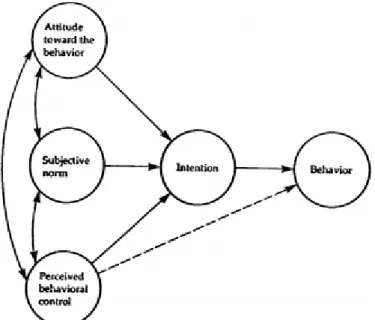
The Theory of Planned Behavior was introduced by Icek Ajzen (1985). It consists of an extension of the Theory of Reasoned Action, which explains how an individual who wants to execute a behavior consider its consequences first.
The individual associates the current social context with his intentions in order to understand whether his behavior will be considered as good or bad. In this way, the individual’s intentions are very affected by the social contexts. So, a subject who smokes will feel the social pressure according to his attitudes. The Theory of Planned Behavior also associates the behavior change of an individual with its intention. However, it focuses on cases where the individual can’t control all the variables of his behaviors. “Successful performance of the intended behavior is contingent on the person’s control over the various factors that may prevent it” (AJZEN, 1985).
The intention of the individual can’t predict its successful execution, since he isn’t able to control exterior factors that can alter is ability to quit smoking. If the intention can predict the individual attempt to carry out the smoking cessation but can’t foresee its achievement, it is probable that some issues beyond the control of the individual have been responsible for preventing his intention. This can determinate that only the intention may not be sufficient for the individual to stop his addictive behavior, since he can’t control external factors (such as opportunity, for example).
1ETTER, Jean-François (2005). Theoretical Tools for the Industrial Era in Smoking Cessation
Figure 2 – Theory of Planned Behavior
Control is associated with a plan that, if followed, could result in the behavioral objective: smoking cessation. If that plan fails to succeed, a backup plan can be executed by the subject. Occasionally the individual doesn’t have a well defined plan to stop smoking. However, the later stages of his plan will become clear while he succeeds the early stages. The success of the behavioral change depends on the plan that the individual has drawn, as well as on the external and personal factors that may influence his control. But the only way an individual can attempt to perform behavior is through his intention: he can only quit smoking if those are his intentions; otherwise, he will surely fail. Both social pressure and a constructive approach directly affect the person’s intention. For example, the individual’s girlfriend can pressure him to quit smoking, changing his intentions.
Through a multimedia application, several recommendations can be given to the user, providing him with informations on how to confront this social pressure. Also, it can provide him with a better look at his own plan of smoke cessation, supplying him with suggestions that can affect his intentions.
The Theory of Planned Behavior states that the individual will try to stop smoking if he believes that the advantages of that behavior are superior to its disadvantages, always taking social pressure into account. If the person has
enough control over both the internal and external factors which influence his accomplishment, he will succeed the smoking cessation. The multimedia application can present reasons, facts and arguments about the advantages of smoke cessation, and can turn out to be a critical factor towards the user’s ending of addictive behavior.
2.3. Interactive Multimedia Instruction
2.3.1. Characterization of IMI systems
Interactive Multimedia Instruction (IMI) was a concept presented by Schwier and Misanchuk (1993), which provided its definition based on its features. So, Interactive Multimedia Instruction is:
Instructional;
Multiply-sourced (i.e., multiple media sources are involved); Segmented;
Intentionally designed;
Coherent.
The final result is an instructional application which bases its contents on multiple content-relevant sources. The user accesses various types of media together, sometimes even providing similar information. The effectiveness of the system may be in the relations between the different types of media, and these relations are thought by the producer, not being random. The systems are often segmented, allowing the user to define what contents they wish to access. The design was developed intentionally for interaction purposes, so the user interacts as it was defined by the producer of the application.
“Interactive Multimedia Instruction (IMI) is an instructional program which includes a variety of integrated sources in the instruction with a computer at the heart of the system. The program is intentionally designed in segments, and viewer responses to structured opportunities (e.g., menus, problems, simulated crises, questions, virtual environments) influence the sequence, size, content, and shape of the program.”
2.3.2. Interactivity and user control
The use of interactivity is crucial on this kind of applications. It has been proved that an application with a certain level of interactivity and a wide-range of choices for the user results in a more embedding experience, rising both motivation and performance in health related applications (KETTANURAK, 2001). With a high-level of interactivity, the learner becomes an important part of the learning process, since he is the one making the decisions. Being in control of his pace and sequence, the individual has the autonomy and liberty to dedicate as much time to a section has he wishes.
Interactivity can have different methods, being reactive (when the user responds to a stimulus), proactive (the learner constructs is own knowledge using different pieces of information and experience) or interactive (being a combination of both reactive and proactive methods, promoting active participation of the user) (KETTANURAK, 2001).
The application must have the ability to let the learners regulate it to their will and potentialities, allowing them to become active participants through interaction, and making important decisions through interactive actions. The user must have power over the application and some variables can be available for him to control (SIMS):
− Pace: Ability to control when the content must be presented and respective speed of presentation;
− Sequence: Ability to control the order of presentation of the different contents. The user must have the power to explore the application at his will;
− Content: Specify which of the existing contents the user wants to learn at the time;
− Context: Identify a particular context on which the user wants to engage the contents;
− Presentation: Choose on which way the learner wants the contents to be presented to him;
− Optional content: Specify if some particular (advanced) contents must be presented or not;
− Locus: Identify who controls most of the application, the user or the instructor (computer).
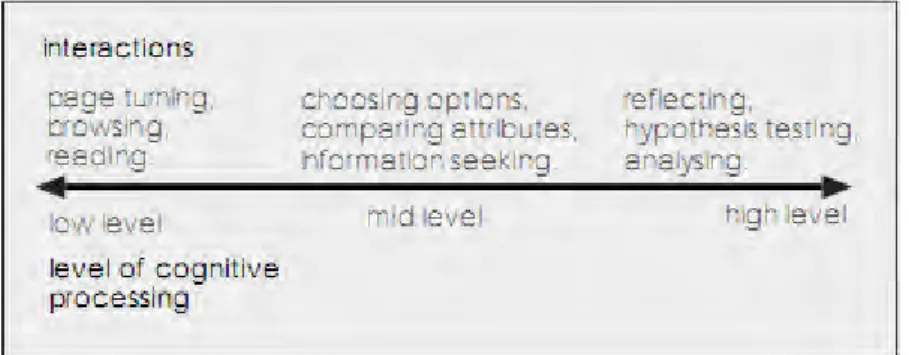
There are also 3 different levels of complexity when it comes to interactivity. The most used are the low- and mid-level strategies which are easier to develop, while having well defined limits. However, the learning process is not clearly observed in such interactions.
Figure 3 – Levels of interaction in educational multimedia
Understanding and defining the control that the user has over the application allows for the design of better prototypes. The learner must be able to focus more on the contents, being provided with an ergonomically developed application.
However, during the conceptualization of the application, it must be taken into account that some users might not be familiar with interactive multimedia, or even with computers. In this way, the interactive strategies must be well designed, allowing the subject to use them with ease.
2.3.3. International contextualization and support theories
In 1992, educational systems in the 90s were researched, in order to understand which would be the most responsible for its evolution. On this article (GALBREATH, 1992), a definition for interactive multimedia applications for educational purposes was researched but not found. The next year, it was presented the concept of Interactive Multimedia Instruction, in an article with that same name (SCHWIER, 1993).
Since then, the concept of Interactive Multimedia Instruction has been widely used for educational purposes. It appears connected to the concept of distance education (MOORE, 2008; WILLIS, 1994), as well as associated with learning strategies (RICHARD, 1994; REEVES, 2003). Also, the concept of Interactive Multimedia Instruction has been used for military and defense applications, mainly by the Department of Defense (DoD) of the United States of America (1996). Also, some private American companies like Delex Systems, Inc. or Westar – Aerospace & Defense Group have specialized in providing systems for these purposes. This military application is justified by the “frequent overseas deployment, strains on resources of both time and personnel, and the availability of sophisticated technological capabilities”. (CHARLOTTE)
As for all these appliances, the support theories behind the development of such projects are the same as used for this project: learning theories such as behaviourism, cognitivism and constructivism. (KETTANURAK, 2001; SCHWIER, 1993)
2.3.4. The evolution of computer-based learning technologies
The responsible for the birth and boom of learning technologies was Microsoft’s PowerPoint. (WILCOX, 2009) This world-famous software is characterized as being linear, with a very low level of interactivity, but allowing the use of different types of media altogether.
The usage of the CD-ROM turned out to be an important technological advance in the 1990’s for education. (TRUETT, 1994) Even if not the CD-ROM itself, the usage of its variants was widely spread for educational contexts. (GALBREATH, 1992) These physical elements allowed for the development of bigger and more complex applications that could be taken everywhere.
The spread of the Internet was fundamental for the technological evolution of learning. Since the contents are now available everywhere, the user can access them from distance, increasing convenience, comfort and privacy, bringing new ways of content sharing. In fact, the use of the internet has been proven more effective than the traditional methods (DUFFET-LEGER, 2008).
The appearance of Computer Assisted Instruction systems, by the means of eLearning software or Interactive Multimedia Instructions, brought new technological tools that allowed for higher interactivity and communication. This aimed for better learning experiences and optimized research environments. However, eLearning proved to be ineffective and not appropriate for some disciplines. (BUTLAND, 2000) Nevertheless, eLearning is a tool still used and sometimes essential for certain services (WILCOX, 2009).
Recently, virtual worlds (mainly Linden Labs’ Second Life) have become an active technology widely used for learning. The usage of virtual worlds is starting to become effective and the tool has been praised worldwide. The possibilities are almost endless, allowing for the access of many resources and the relation with educational applications (BOULOS, 2007). However, Second Life has an age restriction to more than 18 years old, which reduces the target-audience of this tool. Also, the learning process to the system is quite long, so the users need to be familiar with the service before starting to use more complex attributes. The main problem with Second Life and other virtual worlds is the fact that they are not designed to be learning technologies, limiting their features for this purpose. (TRINDER, 2009)
2.4. Multimedia applications examples
2.4.1. The N-Squad (2008):
http://n-squad.rice.edu/ (5/1/2009)
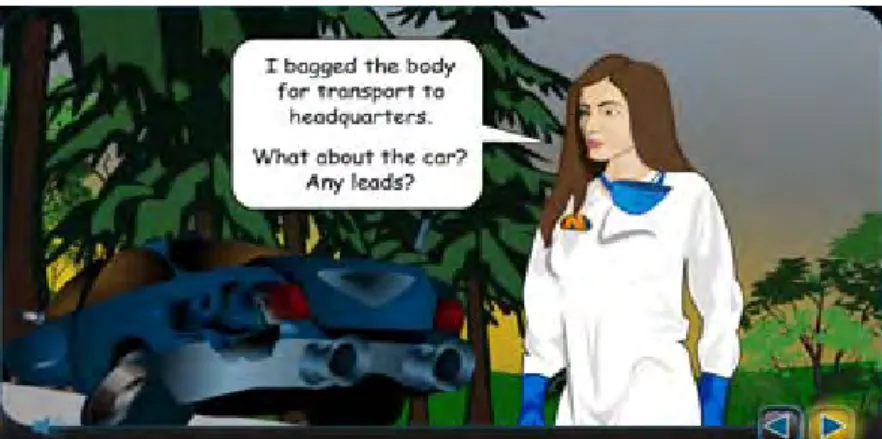
This site consists of a successful web adventure for middle-school students, with the intention of increasing their knowledge about the biological effects of alcohol abuse and alcoholism. The students play the role of a member of a forensics team solving a crime. The application is very creative with some good animations and design. The interaction keeps the user aware and somewhat concentrated. However, the action is quite slow which makes the application a bit dull and unexciting, keeping low motivation. The usage of a narrative can be quite effective with the younger, keeping them glued to the screen as the action happens.
Figure 4 – The N-Squad screenshot
2.4.2. ASPIRE – A Smoking Prevention Interactive Experience (2005):
This web application has a very attractive design and interface, keeping it simple and easy to use. Very interactive, being based mostly in videos and animations, but with some games and activities, provides good and useful information in a friendly informal way, trying to make the user identify himself with the facts related on each section. Its main objective is to give advices to the user, whether he is trying to quit smoking, thinks there is nothing wrong with smoking or doesn’t smoke at all.
The strategy used to identify the type of user is effective and can be a good way to understand his needs. However, if the user doesn’t belong in any of the presented categories, he will have doubts and the strategy might fail completely.
Figure 5 – ASPIRE screenshot
2.4.3. Joe Chemo (2001):
http://www.joechemo.org/ (29/1/2009)
This is a creative application with an appealing design and some interesting features. It supplies useful information that can maintain the user motivated at least for a while. It is quite interactive, testing the user’s knowledge and providing explicit facts about smoking and its consequences.
However, the information is always presented simply by text or by the means of tests and questionnaires. The addition of more and different types of
media (audio, video, animation, etc.) could prove to be very beneficial to this project.
Figure 6 – Joe Chemo screenshot
2.4.4. ANTISMOKE CD-Rom (Greek)
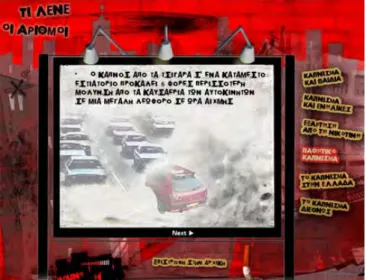
The ANTISMOKE CD-Rom is a Greek application for health education with basis on smoke cessation and health prevention issues, offered merely in greek language. It presents an attractive visual with 3D animations and videos, a hip-hop soundtrack by a popular Greek band and plenty of presentations for educational intentions.
Although presenting the information in a good way, the strategies are limited to visualization by the user, making the motivation levels decrease after some time. The addition of some interaction strategies could turn this application more engaging and immersive.
Figure 7 – ANTISMOKE CD-Rom screenshot
2.5. Final comments
In this chapter were presented the theories behind the project. The understanding and appliance of the learning and behavior theories is vital to the development of the prototype. The relevance of interactivity was elucidated and clarified, as well as the importance of user control. At last, some examples of similar applications were given.
The analysis of the different theories allowed for the determination of certain strategies to be used in the development of the prototype. These strategies are presented in Section 3.2.
3. Empirical research context: case study
3.1. Study contextualization
This study consists on the adaption of some written materials to a multimedia application. These written materials consist of some chapters from a publication by Yannis Theodorakis and Konstandinos Gourgoulianis, both professors at the University of Thessaly. The book, called “Stop Smoking – Time for Exercise”, was based on a guide for smoking cessation – American Cancer Society (2004), Break Away From the Pack – and a relative article – Rabius, V., et
al (2004), Telephone Counseling Increases Cessation Rates Among Young Adult
Smokers. However, the book was not only a translation of the sources but was also enriched and oriented towards exercise issues and adjusted to the Greek language and mentality by its authors.
It was produced in collaboration between the Department of Physical Education and Sports Science and the Department of Medicine, both from the University of Thessaly, Greece. It consists of ten chapters, each of them corresponding to a psychotherapeutical session on the way to smoke cessation. Each step presents informations in general about the dangers of smoking and recommendations to help the user quitting, by means of advices for everyday situations, as well as examples of exercises to improve physical condition and advance towards cessation.
Since the book is directed to subjects who smoke and want therapeutical help to stop their addictive behavior, according to the Transtheoretical Model the individuals are inserted into the Preparation and Action stages. However, the developed prototype is based only on the first step of the book, which focuses on the Preparation Stage only.
This book was created with the support of the Hellenic Ministry of National Education and Religious Affairs and the European Union.
Figure 8 – Smoking ratings in males (Europe)
Figure 9 – Smoking ratings in females (Europe)
The objectives of this study were relating to the development of a multimedia prototype “X-Smoke”, in order to help its users stop smoking, by the means of therapeutical support. The smoking ratings in Greece are one of the highest in Europe, both for men and women.2 So, the idea for this study appeared
2
on the research group. The table of smoking ratings in Europe is presented on Annex 5.
Since the target-audience of this prototype are subjects inserted in the Preparation stage of the Transtheoretical Model, the strategies and informations provided must be developed according to the definition of the stage. The users are convinced that they will do something to quit smoking in a near future, and they are willing to try. It is important to guide them, advising them to take small steps and progressive reductions towards smoke cessation.
For this study, a group of multi-disciplinary elements was formed, having experts in the areas of psychology, smoking cessation therapy and multimedia. This group of specialists discussed the main ideology that should be present behind the prototype, using different theories, both from the psychology and the learning spheres.
The main target-audience of this multimedia application consists of people who wish to stop smoking and seek therapeutical help for that purpose. The application is developed as a support material for therapeutical sessions, undertaken by a smoking cessation program.
After its development, the prototype was tested by different groups of experts in the areas of multimedia/computers, smoking cessation intervention programs, psychologists and physical education. This different types of experts could help to understand if different aspects of the application where developed in a good way and could prove meaningful, according to their knowledge.
3.2. Conceptualization of the multimedia model
The multimedia application presented on this dissertation thesis has the aim of supporting the therapeutical sessions used on smoke cessation intervention programs. A multimedia model was selected, because it brings interactivity into health education, allowing the development of strategies that can reveal more appealing and attractive than regular media, and this fact can be observed on the
applications analyzed on Section 2.4. The usage of various media types and formats can boost the interest and motivation of the users.
Before the development of the prototype, the conceptualization of the model was done, in order to understand in which way the strategies can prove themselves efficient. Since this was an undergoing project, its name was already defined: X-Smoke. Also, for the strategies and main design development, the multi-disciplinary team was necessary, covering all different needs for the brainstorming.
The target-audience was not specific, consisting of all the people who want therapeutical help to stop smoking. There weren’t any other specifications about the target-audience, like literacy, IT skills, age or gender. This fact makes the conceptualization of the multimedia model somewhat difficult, attending to the vague characteristics of the users.
In this way, the application had to be designed in order to be as simple as possible, so that the users with lower information technology skills could interact and navigate without problems. The age of the users was also undefined, so the usage of interactive strategies was limited. The development of interactive games could prove itself very effective for younger users, but unattractive for older users not so used to interact with this kind of software (VORDERER, 2000).
So, the main concern during the conceptualization was to idealize the application to be as simple as possible. The design of the whole application should be extremely simple and clean, in order not to confuse or discourage the users. Also, the strategies had to be used by individuals with different levels of information technology skills. This aspect was relevant as it influenced the interaction levels that could be used. The strategies should be designed to be clear and simple, but maintaining a certain interaction level, so that motivation could be kept and users remain optimistic. Since the interaction is a key component on this type of applications, the conceptualization of strategies turned out being more complicated than expected. Finding strategies that are both simple and motivating for all kinds of users was a hard cognitive effort for all parts involved, and a big amount of time was necessary for solutions to start appearing.
Some strategies were thought to use very simple interaction (such as just clicking or moving the cursor).
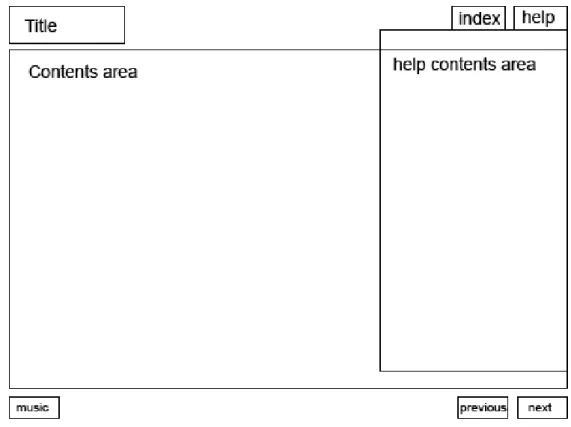
The contents area (Figure 10) was thought as defined but without borders, so that the informations can appear freely, without decentralization issues. The contents appear in a specific region of the application, and their format is irrelevant (video, graphic, text, animation, etc.). Also, the majority of contents were placed on the left side of the contents area, so that the right side could receive the Help system when solicited by the user.
The Help system should have different informations depending on which screen the user is navigating. It should contain both general and specific advices and tips for different steps of the application. As with all the software, the Help system should be as simple as possible, so that even users not so familiar with these systems could interact easily. It shall consist of a single button, which provides a column of helpful informations when clicked.
The navigation system was thought to be fast and easy. According to the learning theories presented on Chapter II, particularly Cognitivism, the navigation must use a linear strategy, allowing the user to access the information he wants, when he wants, but not giving too much freedom. The user is supposed to navigate at own pace, but can only navigate to the previous or next section of the current step. At first the navigation was thought to be executed by the means of arrow buttons, as it can be seen on Annex 6. But since some users might not be familiar with that strategy, it was decided that buttons with the explicit words “previous” and “next” should be used, so that the navigation process happens without effort. The user must finish the current step before advancing to the next one. The user can also go back to the steps index at any time. The information of the current step shall be always visible to allow the user to know where he’s standing.
It was decided to add music to the application, according to the reports from the psychology experts in agreement with the concept of User Centred Design. However, it should be optional, since the software is supposed to be used as a part of an intervention program, which means it will be used under guidance of psychologists at first, and maybe as stand-alone software later.
For the intro, an idea of having coloured balloons flying up appeared, with the purpose of starting the application in a fun, attractive way. The user is supposed to click those balloons, and an introductory message towards smoking cessation shall appear.
After joining all these ideas and concepts, a storyboard for the application in general was created, suffering some changes to eliminate some minor flaws. The final result is presented in figure 10.
Figure 10 – Application storyboard
After having the book translated into English language, its analysis allowed that some ideas for interaction strategies started to appear, with the help of the psychologists and experts in smoke cessation intervention programs. An interactive questionnaire was designed, which should present some minor score or grade at the end, to motivate the user. Also, a knowledge test was designed, so that the user could measure is own awareness to the dangers of smoking. Moreover, an animation was thought to be developed, presenting what happens to
the body when an individual smokes. A thermometer-like “drag-and-drop” interaction strategy was thought to be implemented, but was later abandoned, since it didn’t have much to do with the contents inserted. The idea of presenting photographs of healthy organs next to photographs of unhealthy ones was designed, presenting some sort of interaction strategy for the users.
The creation of videos was agreed by the experts, to present alternative activities for when users want to smoke. However, the production of the videos should be of good quality, so that the user doesn’t get uninterested. The creation of a small narrative is idealized, using different camera angles and camera plans.
Because of the interaction levels required for this application, as well as visual aspects allied to programming needs, the team agreed in using Adobe Flash for the prototype development.
3.3. Prototype development
Having designed some strategies for use on the application, the first step was to develop them, since some implied a lot of programming issues. However, since the main aesthetic aspects of the application were not decided, their visual development was almost non-existent. Some programming problems already started to appear, compromising the time available for other aspects of the application. So, the programming issues where simplified, allowing the focus to turn onto the design of the application in general.
This project was already underway for some time, so a logotype had already been created. Using this logotype, the design could start to be developed, indicating the main colour scheme for use throughout the entire software application. However, some logistic errors and non-categorized data ended up in the loss of the logotype. So, its use was impossible.
Therefore, the design of the main aspects of the application was created from scratch, turning this step of the development harder than expected at start. Also, there was only one person in the team who was familiar with design and visual development for multimedia software, but his knowledge about smoking
cessation and health education issues in general was limited, as well as having very few experience in this field.
The first step was to transfer the storyboard into digital format to Adobe Flash, as seen on the following figure.
Figure 11 – Storyboard transferred to digital
While doing this process, already some minor changes were made: to maximize readability, a non-serif font was chosen (as seen in Annex 6); also, the background was maintained white for that matter; the buttons were created with round edges for smoother appearance; the navigation section was separated from the rest of the contents by a single line. Since the simple white background was visually poor, a background image was temporarily inserted, presenting some stylized flowers on a light grey tone. A different background image was to be designed at the end of the prototype development, but time issues turned this task not possible, so the initial background image stayed in place.
Choosing a white background, readability was already taken as a point with an important role. And with this matter decided, the colour selection for the contents was limited to darker tones. After some experienced tones, some colours were already eliminated for contrasting too much, or not enough, with the background. Never the less, because the target-audience is so subjective, the choice had to fell onto a more neutral colour, which led onto grey. However, to make the application more appealing and attractive, the final choice led to the colour blue (hexadecimal code: #049BCD), with grey applications on the background. All the screens corresponding to the Step 1 have a title, introducing the theme or activity currently active. The study of the colours palette is presented on Annex 6.
The font used on the prototype is Arial. It was selected for its simplicity and uniformity, compared to other fonts. The choice of a non-serif font was due to the fact that it is more legible on screens than a serif font. The typography studies are presented on Annex 6.
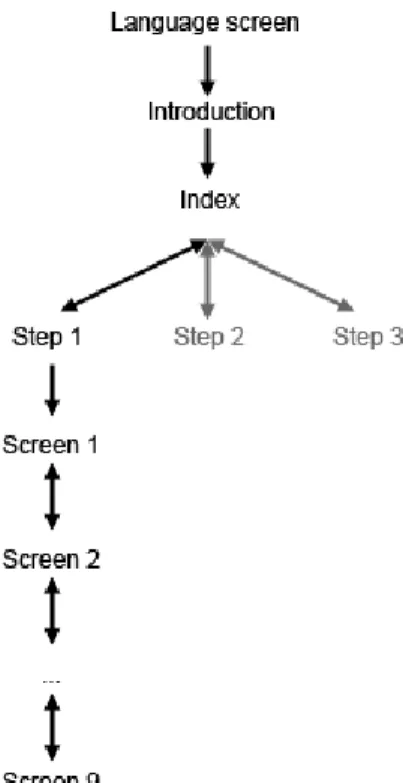
The structure of the prototype had to be thought to allow the users to pass between steps or screens in the simplest way possible. So, the navigation of the application was thought with the simplicity of its structure in mind. However, severe problems in the navigation system appeared, not allowing the user to perform simple navigation tasks at his will. So, the structure of the prototype had to be re-thought. After some structure modifications, a good simplicity-efficacy relation was obtained in the navigation system, which was the main objective for this aspect of the application. However, this and other programming problems took too much time which was supposed to be dedicated to illustration and animation. If the programming issues on the final prototype are very few, this means that the final quality of the illustrations and mainly the animations is below the expected. These animations are specified ahead on this section.
Figure 12 – Representation of the structure of the prototype
The “Index” section, which allows the user to choose which of the steps he is going to work with, also reflects the simplicity of the application. To contrast the application title (“X-Smoke”) with the rest of the text contents, the complementary colour of blue was chosen, so the title and some other few elements are presented in orange colour (hexadecimal code: #FF6600). This section stayed with very few graphic elements, not having the presence of a logotype or application title besides its name written. The lack of available materials and time to create them caused a delay on the development of the features.
The help system was then developed, presenting different tips, navigation help or other questions according to which step the user is working on. To distinguish the help section from the rest of the contents, its background is blue. And to prevent the total concealment of some of the contents when the help system is activated, its section is somewhat transparent. To close the section, a white cross-shaped button was placed on its top right corner.
This project was mainly developed in Greece. However, since not all of the team’s members are Greek, the contents were created using the English
language. Nonetheless, since this application is designed to be used primarily in Greece, the contents are to be developed also in greek language. So, an introductory screen was created, where the user can choose which of the languages he prefers to use, although the Greek contents are not available yet. This initial screen, shown in Figure 12, presents only two round buttons, filled with the colours and formats of both the Greek and the United Kingdom’s flags.
Figure 13 – Languages screen
After selecting the language, a simple screen is presented with the information “Pop the balloons”. Then, the user is confronted with the introduction mini-game, where balloons in different colours start flying up on the screen, and the user has to click them. These balloons appear from the lower part of the screen but they never leave it, hitting the upper part in a negative-gravity effect. When the user clicks a balloon, a message appears on the screen presenting advices that introduce to the main theme of smoke cessation. This strategy and respective advices were idealized by the smoke cessation experts, to engage the user and raise is motivation at the start of the application. Although the introduction was visually completed, a small issue was detected: after clicking the
balloons, depending on the final balloons’ position, the messages may appear overlapped, turning the reading process more difficult. This issue was not fixed due to time concerns.
Figure 14 – Introduction screen (“Pop the balloons” game)
After selecting the first step on the Index screen, the user is presented a small, non-interactive welcome screen, stating that he is currently on Step 1 and that he can use help if he has any difficulties.
The second screen presents an illustration of a person with a cigarette on his hand, and a button stating “Smoke”. When the user clicks the button, a basic animation of the illustration shows the person smoking and in the smoke some general information about smoking and its dangers are presented. These informations were taken from the book used as a base for the prototype. The final result of this animation was not as good as expected at the beginning of the development, for reasons already mentioned.
The third screen (Figure 13) presents an illustration of a profile cut from the human body and some of its organs (some arteries and veins, lungs, brain and
heart). The illustration has a cigarette on its mouth, next to a button stating “Smoke”. When the user clicks the button, some information is presented to the user, explaining the dangers of smoking and the ways it affects the human body. At the same time, the different parts of the body start becoming black, as they are affected by the smoke, until the whole body symbolically turns black. This animation was thought and conceptualized to be much more complex and detailed, but some issues already mentioned turned that task impossible.
Figure 15 – Screen 3 (illustration of the human body and opened help section)
The fourth (figure 14) and fifth screens present to the user faded photographs of healthy and unhealthy lungs and mouth, respectively. When the user passes the cursor over one of the photos, this is progressively focused and increased, becoming clearly visible. At the same time, a small text explaining what the photo exhibits appears below it. When the cursor leaves the photo area, this returns to its initial state and the text disappears.
Figure 16 – Screen 4 (photos of healthy and unhealthy lungs)
The sixth screen (Figure 15) presents a test, allowing the user to measure is own knowledge. A group of Yes/No questions are brought before the user, with the finality of understanding if he was aware of certain facts about smoking or not. At the end of the test, the informations that the user didn’t know (for the questions which he answered “No”) are presented again.
In the seventh screen, the user is presented a questionnaire on which he is brought up to certain facts. He is asked to answer if the fact presented is good for him or not, in a scale from 1 to 10. After the questionnaire, a score is calculated according to the users’ answers, letting him know what is his own opinion about quitting smoking (if he believes it is good for himself or not).
Figure 17 – Screen 7 (Questionnaire)
The eighth screen (Figure 16) consists of a video demonstration, presenting to the user one possible solution of what he can do when he wishes to smoke.
Firstly, the idea was thought about as an alternative for what people can do instead of smoking when they are stressed at work, and a short screenplay was used. The video shall represent a woman working on an office, being tired and having the desire to smoke a cigarette. However, when she looks through the window she decides to put the cigarettes on a drawer and going for a walk.
The location was selected, as well as the actress. The video was produced with a regular handy-cam, using various angles to give the video a more dynamic appearance, being more comfortable and engaging for the user.
The video was assembled and pos-produced using Pinnacle Studio 11. The video was supposed to have sounds and a narration explaining what the viewer could do instead of smoking and its benefits. However, the audio insertion in the video using the software was impossible, due to an error that is still unknown. The
menus for the video were introduced using Adobe Flash, and only allowing the actions of play, pause and control of volume level.
Figure 18 – Screen 8 (Video)
The ninth screen is similar to the first one, presenting only a motivational phrase and the information that the first step is over and the user shall proceed to the index.
To turn the background a bit more dynamic and appealing, a basic animation was introduced, of clouds flying to the left side. This animation was also included in the introduction screen.
The option to listen to music is present on the prototype, by the means of four buttons on the lower left part of the screen. One button stops the music, and the other three buttons correspond to different kinds of ambient music. The music doesn’t start at the same time as the prototype: the user has to click one of the buttons in order for it to start.
The prototype development process turned out to be more complex and time-spending than expected at start, mainly due to problems that appeared along the way. However, even if some of the features were not developed exactly the way they were designed, they are present and functioning at levels from acceptable to perfect. So, the user interaction is possible and the prototype was successfully used during the evaluation process.
3.4. Prototype evaluation
3.4.1. Sample description
To evaluate the prototype and collect the necessary data, four groups of different experts were brought together, divided according to their specialization or field of research: Psychology, Physical Education, Smoking Cessation and Multimedia/Computers. These four groups were selected to evaluate both the application in general and some specific features that are meaningful in their specialization sphere.
The groups of experts were defined, to be subject to interviews. Having a large population, it is neither possible nor useful to analyze each of its members; so, a sample is required. In this case, a non-probability sample was used, since it wasn’t random. In this way, it is possible to obtain trustful information about a large population, questioning only a reduced number of its members (QUIVY, 2005). The sampling process was necessary since it is impossible to interview the whole population. The sample definition was influenced by the experts’ geographic localization and availability.
In the end, a total of twelve individuals was obtained to be interviewed, divided by different groups: three Psychology experts, five Physical Education experts, two Smoke Cessation experts and two Multimedia/Computer experts.