RESUMO: “Estudos farmacognósticos de tubérculos de Momordica tuberosa Cogn., Cucurbitaceae”. Este trababalho teve como objetivo estabelecer um peril farmacognóstico dos tuvérculos da planta Momordica tuberosa Cogn., Cucurbitaceae. A morfoanatomia dos tubérculos da espécie foi realizada para estabelecer um peril completo que possa ajudar na identiicação e evitar problemas na sua taxonomia. Os ensaios foram realizados usando microscópio ótico, procedimentos isico-químicos e itoquímicos estabelecidos pela OMS. Os parâmetros apresentados podem ser usados para apresetar a autenticidade dos tubérculos desta espécie, uma vez que esta parte da droga é utilizada tradicionalmente na Índia e, também, para diferenciá-la de outras espécies de Momordica.
Unitermos: anatomia, seção transversal, isicoquímica, farmacognosia, tubérculos.
ABSTRACT:The study was aimed at establishing pharmacognostical proile for the tubers of plant Momordica tuberosa Cogn., Cucurbitaceae. Morphoanatomy of tubers of this plant were studied in
order to establish its complete proile to aid in its identiication and avoid confusion in its taxanomic species. These were established using light microscopy, WHO recommended physicochemical and phytochemical procedures. The parameters presented here may be used to establish the authenticity of tubers of this plant as this part has been used traditionally in India and also to differentiate between closely related Momordica species.
Keywords: anatomy, transverse section, physicochemical, pharmacognosy, tubers.
Brazilian Journal of Pharmacognosy 20(1): 7-11, Jan./Mar. 2010
A
rt
igo
Received 23 December 2008; Accepted 12 August 2009
Pharmacognostical studies on tubers of
Momordica tuberosa
Cogn.,
Cucurbitaceae
Pramod Kumar,
*,1Devala Rao G.,
2Lakshmayya Bilakanti,
1Ramachandra Setty S
31Department of Pharmacognosy, V.L. College of Pharmacy, Manik Prabhu Temple Road, Raichur, 584103, India 2KVSR Siddhartha College of Pharmaceutical Sciences, Vijayawada, 520010, India
3S.C.S. College of Pharmacy, Harapanahalli, 583131, India.
INTRODUCTION
The plant Momordica tuberosa Cogn.,
Cucurbitaceae, originating in tropical regions of India and South East Asia. M. tuberosa Cogn. is commonly known as karchikai (Kannada) or athalkai (Tamil) and has been traditionally used as abortifacient in India (Kirtikar & Basu, 1991). The plant is a climbing annual or perennial herb with slender, scandent, branched, striate stem. The leaves are orbicular-reniform in outline, deeply cordate at the base, obtusely lobed with ive-seven lobes. Fruits are pyriform or broadly fusiform, leshy dark green and eight-ribbed, sparsely hairy. The roots are woody, tuberous and perennial (Nadakarni, 1976).There are reports suggesting its antihyperglycemic (Kameshwar Rao et al., 2003), anti-implantation and antiovulatory (Koneri et al., 2006), antidiarrhoeal (Vrushabendra Swamy et al., 2008) and anticonvulsant activities (Srinivas Murthy et al., 2007). We have earlier reported (Pramod Kumar et al., 2008) the in vitro and in vivo antioxidant activity of its tubers
property in CCl4 model. Cucurbitacins, bitter substances, have been reported from the fruits of this plant (Bharathi Dhasan et al., 2008). Fruits are reported to contain citric acid, maleic acid and vitamin C (Parvati & Kumar, 2002).
However, there are no reports on the pharmacognostical features of the plant. Hence, the present investigation is an attempt in this direction and includes morphological and anatomical evaluation, determination of physico-chemical constants and preliminary phytochemical screening of different extracts of M. tuberosa.
MATERIAL AND METHODS
Plant material
The tubers of Momordica tuberosa Cogn.,
Pharmacognosy, V.L. College of Pharmacy, Raichur.
Chemicals and instruments
Rotary microtome was used to take sections of the tubers. Compound microscope, glass slides, cover slips, watch glass and other common glassware were used in this experiment. Photographs were taken with using Nikon Labphot 2 Microscopic Unit. Various solvents used mainly ethanol (95%), petroleum ether, chloroform and reagents used for staining different sections like toluidine blue, safranin, fast-green and iodine in KI were procured from S D Fine chemicals, Mumbai, India.
Macroscopic and microscopic analysis
The macroscopic and microscopic features of the tubers were studied according to Easu (1964) and Brain & Turner (1975). For microscopic studies cross section were prepared according to procedure of Johansen (1940). The sections were stained with toluidine blue as per the method published by O’Brien et al. (1964). Where ever necessary sections were also stained with safranin and Fast-green and IKI (for starch). Glycerin mounted temporary preparations were made for macerated/cleared material. Powdered materials of tubers were cleared with NaOH, stained with phloroglucinol and conc. HCl and mounted in glycerin medium. Different cell component were studied and measured.
Photomicrographs
Microscopic descriptions of tissues are supplemented with micrographs wherever necessary. Photographs of different magniications were taken with Nikon Labphot 2 Microscopic Unit. For normal observations bright ield was used. For the study of crystals, starch grains and ligniied cells, polarized light was employed. Magniications of the igures are indicated by the scale-bars. Descriptive terms of the anatomical features are as given in the standard books (Easu, 1964).
Physico-chemical analysis
The ash values of tubers were determined as per the Indian Pharmacopoeia (1996) methods and crude iber content by Dutch process (Wallis, 1989). The behavior of the powdered tubers with different chemical reagents was studied. Size of starch grains determined was according to Kokate (1996) and angle of repose for tuber powder (Funnel method) were also determined. Foaming index was as per WHO guidelines on quality control methods for medicinal plant materials (WHO/PHARM, 1992). For the determination of bulk density Tapping method was followed (Sourabh, 2004).
Preliminary phytochemical screening
This was carried out by using methods of Kokate (1996) and Khandelwal (2005).
RESULTS AND DISCUSSION
Macroscopic characters
The roots are woody, tuberous, and perennial, about 4 to 8 cm in diameter, light brownish yellow in color with characteristic odor and highly bitter taste. Fractured surface is ibrous. Inner tuber is whitish cream colored. The tubers show many rootlets and some black patches here and there.
Microscopic characters
Transverse section of tubers
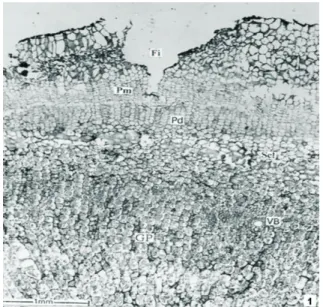
The root tuber is napi form, soft and smooth. It consists of a periderm which is seen in deeper part of cortex. The cortex outer to the periderm has issured forming deep, narrow issures (Figure 1). The periderm consists of wide and distinct phellem and equally developed phelloderm (Figure 1). The phellem is 300 µm wide and has thin walled suberised tabular cells; the phelloderm has radial iles of large, squarish or rectangular thin walled cells (Figure 2). The phelloderm is 500 µm wide. The inner boundary of the phelloderm is marked by a thin layer of branchy sclerids (Figure 1, 2).
The portion inner to the periderm consists of radially aligned parallel rows of parenchyma cells which are densely loaded with starch grains (Figure 1). The starch grains are highly variable in size; but mostly they are circular concentric type with “+” shaped dark band when viewed under polarized light microscope (Figure 3). The middle portion of the tuber has small nests of vascular strands. The strand has one or two wide xylem elements and a cluster of small xylem elements. Phloem occurs in the outer portion of xylem strand (Figure 2).
The central core of the tuber consists of several radial, triangular, larger vascular strands having a few wide xylem elements associated with the xylem ibres. Phloem occurs in the thick block, outer to the xylem. The inner ground tissue is also parenchymatous, with dense load of starch grains.
Powder characters
Figure 1. Transeverse section of tubers (Fi-Fissures; GP -Ground parenchyma; Pd-Phelloderm; Pm-Phellem; VB-vascular bundle).
Figure 2. Transeverse section of tubers; Vascular bundle enlarged (Ca-Cambium; Pa- Parenchyma cells; Ph-Phloem; X-Xylem).
Figure 3. SG-Starch grains in the tubers
Table 2. Ash values of tubers of M.tuberosa
Parameters Values {% (w/w) ± SD}
Total ash 3.86±0.004
Acid insoluble ash 1.26±0.01
Water soluble ash 2.90±0.002
Sulphated ash 1.26±0.014
Table 3. Extractive Values of tubers of M.tuberosa.
Solvents Values {% (w/w) ± SD}
Pet Ether (60 - 80 oC) 0.603±0.08
Chloroform 01.13±0.152
Ethanol (95%) 14.40±0.20
Water 17.86±0.611
Table 4. Behaviour of powdered tubers on treatment with different chemical reagents.
Reagents Colour developed
in day light
Powder as such Cream
1N NaOH (aq) Brown
Picric acid Yellow
Glacial acetic acid Dark yellow
1N HCl Yellow
1N HNO3 Cream
5% Iodine Blue
40% NaOH + few drops of 10% lead
acetate
Brown
Ammonia Yellow
Con H2SO4 Purplish brown
5% Fecl3 Light brown
10% sodium hydroxide +copper
sulphate
Greenish blue
Table 5. Colour and consistency of tuber extracts of M. tuberosa
Extracts Colour Consistency
Petroleum ether (60 - 80oC)
Pale yellowish Waxy
Chloroform Light Brown Sticky
Ethanol (95%) Dark brown Semi solid
Water Dark brown Sticky paste
Preliminary phytochemical screening
The screening for phytochemicals revealed the presence of sterols, saponins, triterpenoids cardiac glycosides, bitters and carbohydrates (Table 1).
Physico-chemical constants
Ash values signify the amount of inorganic impurities, resistant materials like sand, soil and stone particles in crude drugs. The percentages of total ash, acid insoluble ash, water soluble ash and sulphated ash are given in Table 2 and extractive values in different solvents are given in Table 3. Results of behavior of the powder with different chemical reagents in visible light are given in Table 4. The physical properties and nature of different extracts prepared by successive extraction method are given in Table 5. To determine powder characters of 40 mesh size, the angle of repose and bulk density were also calculated. To determine powder characters of 40 mesh size, the angle of repose and bulk density were also calculated. The drug showed an angle of repose of 40°10” and 0.65 g/c.c. bulk density. Size of the starch grain was 9.9 to 33 µ, with average size being 19.07 µ. The foaming index was 265±13.23.
Table 1. Preliminary phytochemical screening of tubers of M. tuberosa.
Tests Pet ether Chloroform Ethanol Water
Alkaloids ---- ---- ----
----Sterols + + ----
----Triterpenes + + +
----Saponins ---- ---- + +
Flavonoids ---- ---- ----
----Tannins ---- ---- ----
----Fixed oils &
Fats ---- ---- ----
----Gums &
Mucilages ---- ---- ----
----Carbohydrates ---- ---- + +
Cardiac
Glycosides ---- ---- + +
Proteins &
Amino acids ---- ---- ----
----+ Indicates respective constituent present
CONCLUSION
The present study of pharmacognostical evaluation of tubers of Momordica tuberosa Cogn.,
Cucurbitaceae will provide most needed information on its identiication. To authenticate and substantiate the tubers, morphological and microscopical studies will be of great help which could even be used to distinguish it from other species of Momordica.
ACKNOWLEDGEMENTS
REFERENCES
Bharathi Dhasan P, Jegadeesan M, Kavimani S 2008. Cucurbitacins isolated from the fruits of Momordica cymbalaria Hook f. Pharmacogn Mag 4: 96-101.
Brain KR, Turner TD. 1975. The Practical Evaluation of Phytopharmaceuticals, Wright-scienctechnica, Bristol,
p 4-9.
Easu K 1964. Plant Anatomy. New York: John Wiley and Sons,
p. 767.
Indian Pharmacopoeia 1996. 4. ed., New Delhi: Controller of publications, p. A53-A54.
Johansen DA 1940. Plant Microtechnique. New York: Mc Graw
Hill Book Co, p. 523.
Kameshwar Rao B, Kesavulu MM, Apparao C 2003. Evaluation of antidiabetic effects of Momordica cymbalaria fruit in
alloxan diabetic rats. Fitoterapia 74: 7-9.
Khandelwal KR 2005. Practical Pharmacognosy. 13. ed. Pune:
Nirali Prakashan, p. 149-160.
Kirtikar KR, Basu BD. 1991. Indian medicinal Plants. 2. ed. New
Delhi: Periodical experts books agency, p. 1129-1131. Kokate CK 1996. Practical Pharmacognosy. 4. ed. Pune: Vallabh
Prakashan, p. 107-109.
Koneri R, Balaraman R, Saraswati CD 2006. Antiovulatory and abortifacient potential of the ethanolic extract of roots of
Momordica cymbalaria fenzl.in rats. Indian J Pharmacol 38: 111-114.
Nadkarni AK 1976. Indian Materia Medica. Bombay: Popular
Prakashan Private Ltd, p 127.
O’Brien TP, Feder N, McCull ME 1964. Polychromatic staining of plant cell walls by toluidine blue-O. Protoplasma 59:
364-373.
Parvati S, Kumar VJ 2002. Studies on chemical composition and utilisation of wild edible vegetable Athalakkai
(Momordica tuberosa). Plant Food Hum Nutr 57:
215-218.
Pramod Kumar, Deval Rao G, Lakshmayya, Ramachandra Setty S 2008. Antioxidant and hepatoprotective activity of tubers of Momordica tuberosa Cogn. against CCl4 induced liver
injury in rats. Indian J Exp Biol 46: 510-513.
Sourabh J, Manish L, Nayak S 2004. Preliminary phytochemical studies on the roots of Cocculus hirsutus Linn. Ancient Sci Life 3: 42-45.
Srinivas Murthy N, Snehalatha N, Anuradha N, Seetharam YN 2007. Anticonvulsant activity of ethanolic extract of
Momordica cymbalaria Fenzl. ex Naud. Focus Altern Complement Ther 12: 45-47.
Vrushabendra Swamy BM, Jayaveera KN, Ravindra Reddy K, Bharathi T 2008. Anti-diarrhoeal activity of fruit extract of Momordica cymbalaria Hook. F. The Internet J Pharmacol 6, Available at http://www.ispub.com/
journal/the_internet_journal_of_pharmacology/archive/ volume_6_number_1_32.html.
Wallis TE 1989. Text Book of Pharmacognosy. New Delhi: CBS
publishers and Distributors, p. 356-549.