Received from ABC Foundation and Medical School at ABC, Brazil.
1. MD; Collaborator, CET at Medical School at ABC (FMABC) 2. MD; Specialization in Anesthesiology, CET-FMABC
3. Assistant Professor, Anesthesiology, FMABC; Coordinator, CET-FMABC
4. Health Sciences Master Degree, FMABC; Assistant Professor, Anesthesiology, FMABC; Professor, Antalgic Therapy, Nursing School at ABC Foundation
5. Anesthesiologist
Submitted on December 29, 2010. Approved on August 3, 2011.
Correspondence to: Thiago Ramos Grigio, MD
Rua Pedro Pomponazzi, 230, apto 151 Vila Mariana
04115000 – São Paulo, SP, Brazil E-mail: [email protected]
CLINICAL INFORMATION
Case Report: Anesthesia in Patients with Asphyxiating
Thoracic Dystrophy: Jeune Syndrome
Deise Saletti
1, Thiago Ramos Grigio
2, Deoclecio Tonelli, TSA
3,
Onésimo Duarte Ribeiro Júnior
4,
Fabríccio Marini
5Summary: Saletti D, Grigio TR, Tonelli D,Ribeiro Júnior OD, Marini F – Case Report: Anesthesia in Patients with Asphyxiating Thoracic Dystro-phy: Jeune Syndrome.
Background and objectives: Jeune Syndrome or Asphyxiating Thoracic Dystrophy is a recessive autosomal disease. This syndrome is cha-racterized by a bone dysplasia with varied abnormalities: thoracic, pancreatic, cardiac, hepatic, renal and retinal. Patients’ age when the clinical condition is experienced correlates with the disease severity. These patients experience polychondrodystrophy with large, short, horizontal ribs and irregular costochondral junctions resulting in a rigid and reduced thoracic cage with varied respiratory injury level.
Case Report: Male patient, 4 months-old, 7 kg, suffering with Asphyxiating Thoracic Dystrophy, intubated and presented with reduced thoracic cage. Echocardiogram: mild pulmonary hypertension. Chest tomography: pulmonary hypoplasia. Patient submitted to bilateral thoracoplasty and thoracotomy with general anesthesia. Anesthesia maintenance: sufentanil e sevoflurane continuous infusion. Ventilation parameters: pressure-cycled mechanical ventilation. Thorax opening provided improvement of the ventilation parameters, but after thoracic prosthesis placement, ventilation was limited. Reduction of the thoracic prosthesis was considered with consequent improvement of ventilation.
Conclusions: Diagnosis of all present abnormalities is essential for the correct anesthetic management. Observation was necessary to adequate pre- and post-thoracotomy/thoracoplasty ventilation and to maintain patient hemodynamically stable. Pressure-cycled mechanical ventilation is the most adequate type of ventilation to overcome the mechanical barrier. In the intraoperative setting, the ideal is to maintain the inspiratory pressure peak as low as possible to minimize the risk of barotrauma, venous return impairment and reduced cardiac output.
Keywords: Anesthesia, General; Genetic Diseases, Inborn/Jeune Syndrome; Respiration, Artificial; Thoracic Surgery.
©2012 Elsevier Editora Ltda. All rights reserved.
INTRODUCTION
Jeune Syndrome (JS) or Asphyxiating Thoracic Dystrophy is a rare recessive autosomal disease located in the chromosome 15q13 1,2. It occurs at a frequency of 1:100,000 to 1:130,000 newborns alive in the United States 1. This syndrome is char-acterized by a bone dysplasia with varied abnormalities - tho-racic, pancreatic, cardiac, hepatic, renal and retinal. The age when the clinical condition is experienced is considered to be correlated with the disease severity 2-7. Showing a great vari-ety in the clinical condition, cases may be leveled as: lethal,
sever, moderate and underlying forms 2,3. Most of the deaths occur during the perinatal period as the short thorax and hyp-oplastic lungs lead to asphyxia 2,6,7.
In the moderate forms, the child experiences repeated pneumonias with progressive respiratory failure in the first year of life 7. Typically, these patients are mechanical ven-tilation dependents 7,8. Some lately diagnosed patients may experience adequate ventilation when resting, and improve respiratory capacity along the years 7.
Pulmonary function ranges from normal and may reach pulmonary hypertension due to pulmonary hypoplasia 1,7. Occasional cardiac involvement results from cardiac failure secondary to an increased pulmonary vascular resistance, a thoracic constriction, an alveolar hypoplasia, and a primary myocardial disease 1. There may be liver impairment with prolonged neonatal jaundice, hepatic polycystic disease, bile duct hyperplasia and congenital hepatic cirrhosis 2-4. Addition-ally, renal failure is caused by diffuse interstitial fibrosis with lymphoblastic infiltration and tubular alterations (intercalated dilatation and atrophy) 1,2,4. Polyuria, polydipsia and hyperten-sion may occur in the second or third year of life, while renal failure develops in childhood and adolescence 1,9. Patients may experience intestine malabsorption, degeneration of the retina, polydactyly and dental and pelvic abnormalities 2.
CASE REPORT: ANESTHESIA IN PATIENTS WITH ASPHYXIATING THORACIC DYSTROPHY: JEUNE SYNDROME
Revista Brasileira de Anestesiologia 425
Vol. 62, No 3, May-June, 2012
cage is extremely reduced and causes pulmonary restric-tion 1,7. All patients experience reduced thorax, though the re-spiratory injury level may vary from insignificant to death 1-3,7. The purpose of this article is to report an anesthesia case in a patient with Jeune Syndrome reported in the University Anesthesiology Service at the Hospital Estadual Mário Covas – Medical School of ABC.
Case Report
Male patient, 4 months-old, 7 kg, ASA III, with Jeune Syn-drome, presenting with pulmonary and bone alterations. Among the pulmonary alterations were observed pulmonary hypoplasia and rigid thoracic cage.
In the physical examination, patient was hydrated, with normal skin color, intubated with volume-cycled mechanical ventilation, with reduced thoracic cage and short limbs. No al-terations in the cardiac or pulmonary auscultation (Figure 1).
Laboratory Tests: Hemoglobin 10.9 mg.dL-1, Hematocrit 30.9%, leukocytes 11,500.mm-3 without deviation, platelets 268,000.mm-3, coagulation which changes, sodium 135 mg.dL-1, potassium 4.4 mg.dL-1, creatinine 0.9 mg.dL-1, total calcium 9.2 mg.dL-1, ionized calcium 1.34 mg.dL-1, mag nesium 1.7 mg.dL-1, gasometry: pH 7.510, PaO
2 218.2 mm Hg, PaCO2 32.8 mm Hg, HCO3 25.6 mmol.L-1, BE 3.1 mmol.L-1, O2 saturation 99.2%.
Echocardiogram: Normal ejection fraction, normal cardiac valves, mild pulmonary hypertension.
Thorax radiography: Reduced thoracic cage (Figure 2).
Chest tomography: Pulmonary hypoplasia, short and rec-tified ribs.
Monitoring: Cardioscopy, pulse oximetry, expiratory cap-nography, invasive blood pressure, bispectral index (BIS), thermal blanket and indwelling catheters. Patient was sub-mitted to bilateral thoracoplasty for subsequent thoraco-tomy with general anesthesia. Previous peripheral venous access established in upper right limb (Jelco® 24). In the
Figure 1 –Thorax/Abdomen Disproportion.
surgical center, after anesthetic induction, central venous access puncture was conducted in right femoral vein and invasive blood pressure in left radial artery with Jelco® 22.
Anesthetic induction: Midazolam 0.7 mg (0.1 mg.kg-1), sufen-tanyl 3.5 µg (0.5 µg.kg-1), atracurium 3.5 mg (0.5 mg.kg-1).
Maintenance: Sufentanyl continuous infusion 0.5 µg to
1 µg.kg-1.h-1and 2% sevoflurane. Hydration was conducted with 25 mL.kg-1 0.9% sodium chloride + 2 g 50% glucose at first hour followed by hydration according to Holliday et al. 11 method (4 mL.kg-1.h-1) + surgery classification (8 mL.kg-1.h-1).
Ventilation parameters: Pressure-cycled mechanical
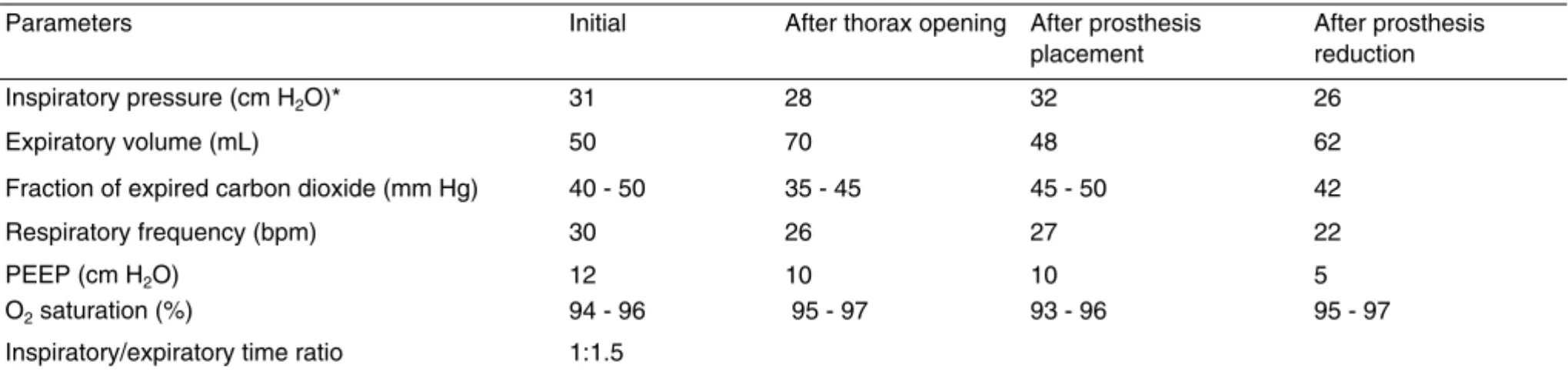
ventilation with inhalation pressure indexes of 31 cm H2O, respiratory frequency 30 incursions per minute, PEEP 12 cm H2O, FiO2 80%, expiratory volume around 50 mL, inspiratory/expiratory time ratio 1:1.5 and minute volume 1.7. Initially, fraction of expired carbon dioxide was main-tained at 40-50 mm Hg and O2 saturation 96%-99%. Tho-rax opening provided improved ventilation parameters, making it possible to reduce the inspiratory pressure with improvement of the expiratory volume. After placement of the thoracic prosthesis, however, limited ventilation was observed with increase in the inspiratory pressure being required. At this point, reduction in the expiratory volume and increase in the fraction of expired carbon dioxide were observed. Reduction of the thoracic prosthesis was per-formed with consequent ventilation improvement (inspira-tory pressure 26 cm H2O, expira(inspira-tory volume 62 mL, PEEP 5 cm H2O, respiratory frequency 22 respiratory incursions per minute, fraction of expired carbon dioxide 42 mm Hg) (Table I). The procedure duration was 7 hours. Patient required blood replacement and received 100 mL packed red cells. Average blood pressure values were ranged from 50-60 mm Hg, blood glucose 79-154 mg.dL-1, hemoglobin 10.8-12.1 mg.dL-1.
Initial gasometry: pH 7.46, PaCO2 32.8 mm Hg, PaO2
168.2 mm Hg, HCO3 23.3 mmol.L-1, BE 0.3 mmol.L-1 and O2 saturation 99.2%.
Final gasometry: pH 7.447, PaCO2 34.7 mm Hg, PaO2
113.3 mm Hg, HCO3 23.4 mmol.L-1, BE 0.0 mmol.L-1, O2 saturation 98,3%. Diuresis was 0.53 mL.kg-1.h-1.
At the end of the surgery epidurial blockade was applied. In left lateral decubitus position, the patient received thoracic antisepsis with alcoholic chlorhexidine, followed by Tuohy 20G needle puncture between T5 and T6. After the epidu-ral space been located using the Dogliotti’s technique of loss of resistance, morphine 200 µg and fentanyl 15 µg were ad-ministered. Patient was transferred to the neonatal ICU with orotracheal intubation and mechanical ventilation, maintaining previous ventilation parameters. Midazolam 2 mg and atracu-rium 1 mg intravenous in bolus infusion was administered for transportation.
CONCLUSIONS
Asphyxiating thoracic dystrophy is a rare recessive autosomal disease showing wide phenotype variability. Therefore, diag-nosis of all present abnormalities is essential for the correct anesthetic management of the patient. In the pre anesthetic visit, pulmonary function is required to be assessed through the clinical condition, chest X-ray, computerized tomography, pulmonary function test and blood tests; in addition, check re-nal, hepatic and pancreatic functions.
During anesthesia, observation was necessary to ad-equate pre- and post-thoracotomy/thoracoplasty ventilation and to maintain patient hemodynamically stable. After tho-racic opening, improvement in patient’s ventilation param-eters was observed. Reduction in the inspiratory pressure and improvement in the expiratory volume were made pos-sible, with reduction of the fraction of expired carbon dioxide. However, after the thoracic prosthesis placement, the wide thoracic opening with the prosthesis was noted to restrict ven-tilation, returning to initial ventilation parameters (increase in the inspiratory pressure and reduction in the expiratory
vol-Table I – Ventilation Parameters
Parameters Initial After thorax opening After prosthesis
placement
After prosthesis reduction
Inspiratory pressure (cm H2O)* 31 28 32 26
Expiratory volume (mL) 50 70 48 62
Fraction of expired carbon dioxide (mm Hg) 40 - 50 35 - 45 45 - 50 42
Respiratory frequency (bpm) 30 26 27 22
PEEP (cm H2O) 12 10 10 5
O2 saturation (%) 94 - 96 95 - 97 93 - 96 95 - 97
CASE REPORT: ANESTHESIA IN PATIENTS WITH ASPHYXIATING THORACIC DYSTROPHY: JEUNE SYNDROME
Revista Brasileira de Anestesiologia 427
Vol. 62, No 3, May-June, 2012
ume). Therefore, prosthesis size readjustment and reduction of the thoracic opening were required to improve the venti-lation parameters with reduction in the inspiratory pressure and increase in the expired volume. During surgery, a PEEP reduction was possible.
Ventilation control is one of the greatest intraoperative challenges. Patients with small thorax and short hypoplastic ribs experience great respiratory restriction with difficult pul-monary expansion. Thus, pressure-cycled mechanical venti-lation is the most adequate type of ventiventi-lation to overcome the mechanical barrier. In the intraoperative setting, the ideal is to maintain the inspiratory pressure peak as low as possible to
minimize the risk of barotraumas, venous return impairment, and reduced cardiac output. In addition, PEEP reduction is advisable to avoid its deleterious effects when reaching high values, such as the pulmonary air escape, reduced venous return, increased peripheral vascular resistance and carbon dioxide retention.
REFERÊNCIAS/REFERENCES
1. Chen H – Asphyxiating thoracic dystrophy (Jeune Syndrome). eMedi-cine, 2009.
2. Morgan NV, Bacchelli C, Gissen C et al. – A lócus for asphyxiating thoracic dystrophy, ATD, maps to chromosome 15q13. J Med Genet, 2003;40:431-435.
3. Sahin N, Kara H, Ertugrul F et al. – Jeune Sendromu ve Anestezi. Turkiye Klinikleri J Anest Reanim, 2007;5:150-153.
4. Borland LM – Anesthesia for chilren with Jeune’s Syndrome (asphyxi-ating thoracic dystrophy). Anesthesiology, 1987;66:86-88.
5. Schinzel A, Savoldelli G, Briner J et al. – Prenatal sonographic diag-nosis of Jeune Syndrome. Radiology, 1985:154:777-778.
6. Davis JT, Ruberg RL, Leppink DM et al. – Lateral thoracic expansion for Jeune’s asphyxiatin dystrophy: a new approach. Ann Thorac Surg, 1995;60:694-696.
7. Davis JT, Heistein JB, Castile RG et al. – Lateral thoracic expansion for Jeune’s syndrome: midterm results. Ann Thorac Surg, 2001;72:872-877.
8. Baum VC, OF’laherty JE – Anesthesia for genetic, metabolic and dys-morphic sydromes of childhook, 2ed, Philadelphia: Lippincott Williams & Wilkins; 2007;191-192.
9. Orfaliais CS, March MFP, Ferreira S et al. – Distrofia torácica asfi-xiante de Jeune: relato de 3 casos. Jornal de Pediatria, 1998;74:333-337.
10. Molinero LR, Mena EJ, Tudelilla JMM et al. – Distrofia torácica asfi-xiante o enfermedad de Jeune. Bol Pediatr, 1990;31:135-139. 11. Holliday MA, Segar, WE – The maintenance need for water in