ORIGINAL RESEARCH
Dentists and undergraduate dental students require
more information relating to child abuse
Ana Rodrigues Moura,IArmanda Amorim,I,IILuı´s Proenca,
I,IIVirgı´nia MilagreI,II IInstituto Superior de Cieˆncias da Saude Egas Moniz (ISCSEM), Campus Universitario, Caparica, PortugalIICentro de Investigac
a˜o Interdisciplinar Egas Moniz,
Campus Universitario, Caparica, Portugal
OBJECTIVE:To evaluate the preparation for, and the appropriate approach of dentists to the diagnosis of patient mistreatment.
METHOD:This investigation was conducted among sixty randomly selected dentistry students: twenty 1styear
students, ten 5th year students at our institution, ten 5th year students at the Faculty of Dentistry, Lisbon University, sixteen dentists at the University Clinic of our institution, and four dentists with private offices. Students and dentists took part voluntarily. The exclusion criteria were (a) prior attendance of another degree, (b) cooperation with social organizations; and, for professionals, less than five years of experience. Data analysis was performed through descriptive and inferential statistics (chi-squared test) for a confidence level of 95%.
RESULTS:Among dentists, 38% do not know which area of the organism is the most affected, 43% know it is proper to officially report the fact; out of these, 48% know that the information may be provided anonymously. There are 47% who state that they received no undergraduate training in this area. However, 60% of the students in the last year declare they did receive training.
CONCLUSIONS:Dentists are not sufficiently familiar with the subject of child abuse. A regular approach to this matter in undergraduate education is important. It will be very useful to create a working tool unifying the criteria for screening, diagnosing, and registering such events.
KEYWORDS: child abuse; dentist knowledge; orofacial manifestations.
MouraAR,AmorimA,ProencaL,MilagreV.Dentistsandundergraduatedentalstudentsrequiremoreinformationrelatingtochildabuse. MedicalExpress (São Paulo, online).2015;2(2):M150203.
Received for publication onFebruary 6 2015;First review completed onFebruary 24 2015;Accepted for publication onMarch 2 2015
E-mail: [email protected]
B INTRODUCTION
The concept of violence as defined in the UN Convention on the Rights of the Child, according its Article 19, includes “all forms of physical or mental violence, damage or abuse, negligence or negligent treatment, mistreatment or exploita-tion, including sexual abuse”. The United Nations Chil-dren’s Fund (UNICEF) estimates that every year 3,500 children die victims of physical violence and negligence in first world countries. This is the main cause of death for children and adolescents, and occurs within all ethnicities
and socioeconomic strata.1 This United Nations organism
places Portugal among the worse rated countries2 in this
regard, averaging four deaths due to physical violence and negligence for every 100,000 children. Data gathered from 2000 to 2009 by the Portuguese Statistical Institute (INE) reveals that there are 1.8 million children in Portugal under the age of 15, of which an average of 66 die each year due to violence and negligence. However, not all cases of violence are reported to the authorities. Thus these values, albeit high,
may underrate reality. The World Health Organization (WHO) estimates that around 53,000 children between the age of 0 and 17 were victims of homicide during 2012. Compared to adults, children are frail, defenseless, depen-dent, and vulnerable. Acts of domestic violence have been
frequent since antiquity.3 Of all the children that have
suffered an initial act of abuse, 35% will continue to be severely hurt and abused if no legal determination exists that will prevent the legal guardian from retaining custody, and
5% of them may actually die.4Child and adolescent abuse
are two of the most prominent causes of death in this age
group.5Diagnosing abuse depends on familiarity with the
signs, both physical and behavioral, that are most common in children that have suffered them. Some abusive situations are still hidden in the painful silence of those who suffer them, but this may be altered by health professionals.6 – 10Of the lesions caused by child abuse, 65% exhibit signs in the
face and head areas11,12, while 25% occur around or inside
the mouth and may be recognized by the Dentist.Because the mouth is often affected, aggression victims often must resort to a dentist, which places him in the frontline, as compared to other health professionals, when it comes to recognizing these situations.13 – 15 A recently published study indicates
DOI:10.5935/MedicalExpress.2015.02.03
Copyrightq2015MEDICALEXPRESS.Thisisanopenaccessarticledistributedunderthetermsofthecreativecommonsattribution
Non-CommercialLicense(http://creativecommons.org/licenses/by-nc/4.0/)whichpermitsunrestrictednon-commercialuse,distribution, andreproductioninanymedium,providedtheoriginalworkisproperlycited.
that dentists who receive training in these matters will be five times more likely to report them than those who do not.9
B MATERIALS AND METHODS
A total of 60 volunteers were randomly included in this study, distributed as follows: 40 students from Integrated Master in Dentistry (MIMD) and 20 dentists. Forty of these were students: twenty in the 1styear, ten in the 5th of our institution, ten in the 5thyear of the Dentistry School of the Lisbon University. The twenty other volunteers are dentists, 16 with their practice in our institution’s University Clinic and four in private practices. Of the included students, 63% were female and 37% were male; among Dentists these values were 40% and 60%, respectively.
The inclusion criteria were as follows: students with no prior frequency in any other course degrees or working in social care institutions, and dentists practicing professionally for five or more years. The exclusion criteria included students that had experience in other courses or had worked with social institutions and dentists with less than 5 years of professional practice. The inquiry was specifically prepared for the study with eight multiple choice questions, allowing for quick responses, easy interpretation and analysis and an adequate participation rate of entrants. The questionnaire used referred the following topics: the importance of clinical history, most injured area, the areas to be covered by the clinical exam, post-suspicion procedures, the level of information as to the anonymity of the informant, the decision to report the situation to the proper authorities and, in case no report was made, the reason for this decision. The final question touched on whether or not this subject had been broached during pre-graduate education. The PASW Statistics v.21 software was used in data analysis, by application of descriptive and inferential statistics methods (chi-squared test) for a confidence level of 95%.
B RESULTS
The answers to the questions described in Methods were as follows.
Question 1: “Can one disregard clinical history and take into account solely observation?” All students and dentists responded “No” to this question.
Question 2: “What kind of examination should be made?” All students and dentists selected the “Intra and extra oral” option, as opposed to the “teeth” alternative. Question 3: “Which area do you think will be most injured in case of abuse?”
Results are displayed in Table 1. A majority of respondents marked the “head and neck” alternative, which is the correct epidemiological alternative; however arms were marked as
the most likely by a high number of participants: 37% of the
1st year students, 50% of 5th year students and 38% of
dentists.
Question 4: “When coming in contact with a child who is a victim of abuse, what should you do?”
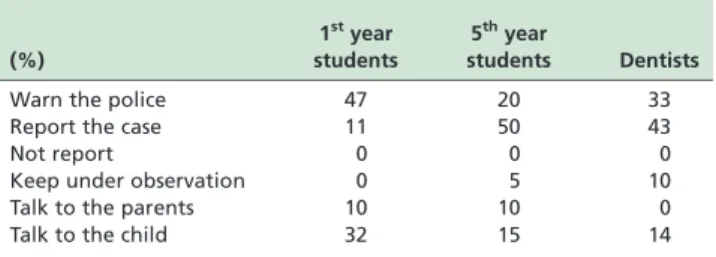
Results are displayed in Table 2. Regarding the procedure to use in case of suspicion of mistreatment, a majority of respondents in all three classes (58% of 1styear students, 70%
of 5thyear students, 76% of dentists) would either warn the
police or report the case. Most other respondents selected either the “talk to parents” or “talk to the child” options.
Some 5thyear students (5%) and dentists (10%) would keep
the child under observation.
Regarding the anonymity in case a report is made, for 84%
of 1styear students, the Police would know the informant’s
identity, 65% of 5th year students know the report is
anonymous and of all the dentists only 48% know about the anonymity (Tables 3 and 4).
Question 5: “In case a report is made to the authorities, would it be anonymous?”
Table 3 shows that a vast majority of students, but only half of the dentists, would prefer to make an anonymous report.
Question 6: “Upon reporting the case to the authorities, who would be privy to the informant’s identity?”
Table 4 shows that most respondents believe that only the police should know the identity of the informant. But roughly one tenth of students and one quarter of dentists believe that the best course would be to make a totally anonymous report.
Question 7: “When confronted with a child that’s a victim of abuse, you would not report it for fear of. . .?”
Only 53% of 1styear students and 65% of 5thyear students
would make the report; the value rises to 67% in the case of dentists. As shown in Table 5, not reporting would mainly be
due to fears of a wrong diagnosis (26% of 1styear students,
30% of 5thyear students and 19% of dentists). A total of 16% of 1st year students and 5% of 5th year students also
Table 1 -Responses to Question 3 – Which area do you think will be most injured in case of abuse? (p¼0.812, chi-squared test, “head and neck” vs. other alternatives)
(%) 1styear students 5thyear students Dentists
Head and neck 52 45 43
Arms 37 50 38
Legs 0 5 0
Buttocks 11 0 19
Table 3 -Responses to Question 5 – “In case a report is made to the authorities, would it be anonymous?” (p¼0.119, chi-squared test)
(%) 1styear students 5thyear students Dentists
Yes 79 65 48
No 21 35 52
Table 2 -Responses to Question 4 – “When coming in contact with a child who is a victim of abuse, what should you do?” (p¼0.453, chi-squared test, “warn the police” and “report case” vs. other alternatives)
(%)
1styear students
5thyear
students Dentists
Warn the police 47 20 33
Report the case 11 50 43
Not report 0 0 0
Keep under observation 0 5 10
Talk to the parents 10 10 0
Talk to the child 32 15 14
Dentists and child abuse
Moura AR et al. MedicalExpress (São Paulo, online)2015;2(2):M150203
mentioned fear of reprisals. A few 1st year students and dentists also referred the fear of wasting time in court as one of the reasons.
Table 6 shows that 60% of 5thyear students stated that the subject was broached during undergraduate education, whereas 48% of dentists said the subject had never been talked about.
B DISCUSSION
Regarding the importance of clinical history, the results
obtained are similar to Josgrilberg et al,16 where 98% of
respondents recognized its importance. As to the most likely injured areas in case of abuse, the results are similar as
well,16where only 21% of respondents correctly identified
the most injured area. Regarding the type of medical exam, all answers indicated that it should be both extra and intraoral, a result that differs greatly from those of
Josgrilberg et al,16 where only 67% of respondents gave
particular importance to the intraoral exam. When con-fronted with an abusive situation, not all of our respondents would know how to deal with it. Even so, the results
obtained were higher than those of Andrade et al,17where
the great majority (68%) wouldn’t know how to follow up on the situation. Regarding this same procedure, 32% of 1styear students, after confirming the occurrence of an abuse, would start by approaching the victim or by talking to the parents/legal guardians (even if they were possible
perpetrators of this abuse). Among the 5th year students,
15% would talk to the victim and 10% would approach the parents/legal guardians. As to the dentists, 14% would
approach the victim, 10% would opt for keeping the child under observation in the follow-up appointments. Results
were similar to other studies: Tornavoi et al18 report that
when confronted with a mistreated child, 45% would report it to the proper authorities and 37% would try to approach
the parents of the abused child. A previously cited study16
found that 29.6% of respondents would also approach the
parents; Gomes et al1also found 29.6% of respondents who
would approach parents/guardians. Carvalho et al19
reported that none of the respondents knew how to properly follow up when confronted with a case of abuse. Regarding anonymity when reporting a case to the authorities, we found that 48% of dentists know that this can be done anonymously, a result similar to a study by the Australian
Dental Association,20 where 45% of dentists were familiar
with the situation. In another study, 52% of dentists from the Australian and New Zealand Society of Paediatric Dentistry recognize this deficiency as well.20
The question, “Who do you believe will know your identity?” was meant to help understand if the groups under study were aware that such reports are indeed anonymous; 85% of 1styear students and 75% of 5thyear students believe the Police would be privy to the informant’s identity and the latter also believe the parents would be informed. As to the reason for not reporting, we found, among other motives, the fear of wrong diagnosis and also a fear of reprisals. Owais et al21report that the fear of a wrong diagnosis is the motive for 73% of dentists not reporting these cases. In this same study,21the fear that the child might suffer further because of
“talking” amounted to 66%. Jessee6 reveals that 85% of
respondents also refer to lack of knowledge and diagnosis uncertainty as reasons for not reporting. In this same study, it was found that 81% of respondents prefer consulting with a colleague before reporting.6Doctor-patient confidentiality is also referred as a reason for not reporting, but diagnosis uncertainty still rates as a larger percentage.20In our study,
60% of 5thyear students say the subject was broached during
their education. As for dentists, 48% say they were never given any information during undergraduate education, which is not unlike the results (66%) reported by Josgrilberg et al.16The higher level of 1styear medical students declaring
the subject was not covered is somewhat irrelevant because these students are still in an early stage of their education.
Ramos-Gomez et al22report similar values with only 28% of
students referring to school information, but 84% of these had already searched for the subject in scientific literature.22
Gomes et al1 concluded that 97% of students consider the
subject as important, but only 34% were given training on it during their studies. In our study all participants considered the subject as important and, of the people contacted, only two refused to answer the questionnaire citing absolute ignorance on the subject.
B CONCLUSION
The most affected area in cases of child abuse is not generally known to the dentists, allowing us to conclude that these have not been sufficiently trained in order to be able to trace these cases. When confronted with an abuse situation, only 43% of practicing dentists would correctly report it. We deem it urgent to contribute to the training and alerting of dentists to this subject due to their prominence in its detection and reporting to the authorities. The data obtained points to a generally unsatisfactory scenario, making it clear
Table 4 -Responses to Question 6 – “Upon reporting the case to the authorities, who would be privy to the informant’s identity?” (p¼0.791, chi-squared test, “nobody” vs. other alternatives)
(%) 1st year students 5th year students Dentists
Nobody 11 10 24
Police 84 75 62
Parents 5 15 14
Table 5 -Answers to Question 7 – “When confronted with a child that’s a victim of abuse, you would not report it for fear of. . .?” (p¼0.238, chi-squared test, “diagnostic
error” vs. other alternatives)
(%) 1styear students 5thyear students Dentists
Being identified 0 0 0
Possible reprisals 16 5 0
Wasting too much time in court
5 0 14
Diagnostic error 26 30 19
Table 6 -Answers to Question 8 – “Was this subject broached during your pre-graduate education?” (p¼0.727, chi-squared test)
(%) 1styear students 5thyear students Dentists
Yes 47 60 52
No 55 40 48
MedicalExpress (São Paulo, online)2015;2(2):M150203 Dentists and child abuse
Moura AR et al.
that information is not effectively transmitted to dentists. Lack of knowledge on the subject in all of its facets, from injury location to the correct procedure when confronted with an abuse situation does not allow the dentist to assume his role in tracking and reporting it. This study concludes that most dentists are not sufficiently trained for diagnosing abuse nor are they reporting it to the authorities.
B DENTISTAS E ESTUDANTES DE ODONTOLOGIA
CARECEM DE MELHOR INFORMACA˜ O SOBRE
ABUSO INFANTIL
B RESUMO
OBJETIVO:avaliar a preparaca˜o dos dentistas para diagno´stico e manejo de pacientes pedia´tricos vı´timas de abuso e maus-tratos.
ME´ TODO:A pesquisa foi realizada entre sessenta dentistas ou estudantes de odontologia selecionados aleatoriamente: vinte alunos do primeiro ano, dez do quinto ano entre alunos de nossa instituica˜o, dez do quinto ano entre alunos da Faculdade de Odontologia da Universidade de Lisboa, dezesseis dentistas da Clı´nica Universita´ria de nossa instituica˜o e quatro dentistas com consulto´rios privados Eles participaram de forma volunta´ria e os crite´rios de exclusa˜o foram: (a) atendimento anterior de um outro curso universita´rio, (b) a cooperaca˜o com organizaco˜es sociais. Para os profissionais, menos de cinco anos de experieˆncia. A ana´lise de dados foi realizada por meio de estatı´stica descritiva e inferencial (teste do qui-quadrado) para um nı´vel de confianca de 95%.
RESULTADOS:Os resultados mostram que, entre os dentistas, 38% na˜o sabem qual e´ a a´rea mais afetada do organismo, 43% sabem que e´ adequado informar oficialmente o fato; destes, 48% sabem que as informaco˜es podem ser fornecidas de forma anoˆnima. Ha´ 47% que afirmam na˜o terem recebido instruca˜o nesta a´rea durante seus cusros de graduaca˜o. No entanto, 60% dos estudantes do u´ltimo ano de declararam ter recebido tal instruca˜o.
CONCLUSO˜ ES:Os dentistas na˜o esta˜o suficientemente familiarizados com o assunto. Uma abordagem regular deste assunto em ensino de graduaca˜o e´ importante. Sera´ muito u´til para criar uma ferramenta de trabalho unificando os crite´rios para o rastreio, diagno´stico, e registrar tais eventos.
UNITERMOS: abuso infantil; conhecimento dos dentistas; manifestaco˜es orofaciais.
B REFERENCES
1. Gomes LS, Pinto TC, Costa EM, Ferreira JM, Cavalcanti SA, Granville-Garcia AF. Percepca˜o de acadeˆmicos de odontologia sobre maus-tratos na infaˆncia. Odontol. Clin-Cient. 2011;10(1):73-8.
2. Pires AL, Miyazaki MC. Maus-tratos contra criancas e adolescentes: revisa˜o da literatura para profissionais de sau´de. Arq. Cieˆnc. Sau´de. 2005;12(1):42-9.
3. Mello FM, Faria AA, Mello AF, Carpenter LL, Tyrka AR, Price LH. Childhood maltreatment and adult psychopathology: pathway to
hypothalamic-pituitary-adrenal axis dysfunction. Rev. Bras. Psiquiatr. 2009;31(Suppl 2):S41-8.
4. Stavrianos C, Metska ME, Petalotis N. Child abuse and neglect: It’s recognition by dentists. Balkan J. Stomatol. 2005;3(9):204-7.
5. Junqueira MF, Deslandes SF. Resilience and child abuse. Cad. Sau´de Pu´blica. 2003;19(1):227-35.
6. Jessee SA. Physical manifestations of child abuse to the head, face and mouth: a hospital survey. ASDC J. Dent. Child. 1995;62(4):245-9. 7. Cairns AM, Mok JY, Welbury RR. The dental practitioner and child
protection in Scotland. Br. Dent. J. 2005;199(8):517-20.
8. Granville-Garcia AF, Menezes VA, Arau´jo JR, Silva PF. Ocorreˆncias de maus-tratos em criancas e adolescentes na cidade de Caruaru-PE. Pesq. Bras. Odontoped. Clin. Integr. 2006;1(6):65-70.
9. Cavalcanti AL, Granville-Garcia AF, Costa EM, Fontes LB, Sa´ LO, Lemos AD. Dentist’s role in recognizing child abuse: a case report. Rev. Odontol. Cieˆnc. 2009;24(4):432-4.
10. Tsang Sweet D. Detecting child abuse and neglect – Are dentists doing enough? J. Can. Dent. Assoc. 1999;7(65):387-91.
11. Crespo M, Andrade D, La-Salete Alves A, Magalha˜es T. O papel do me´dico dentista no diagno´stico e sinalizaca˜o de abuso de criancas. Acta Med. Port. 2011;24(S4):939-48.
12. Fracon ET, Silva RHA, Bregagnolo JC. Evaluation of dentist’s behavior regarding domestic violence against children and adolescent in the city of Cravinhos (Sao Paulo – Brasil). Rev. Sul-Brasileira Odontol. 2011;8(2):153-9.
13. Massoni AC, Ferreira AM, Araga˜o K, Menezes VA, Colares V. Aspectos orofaciais dos maus-tratos infantis e da negligeˆncia odontolo´gica. Cieˆnc. Sau´de Coletiva. 2010;15:403-10.
14. Welbury RR, Hobson RS, Stephenson JJ, Jepson NJ. Evaluation of a computer-assisted learning programme on the oro-facial signs of child physical abuse (non-accidental injury) by general dental practitioners. Br. Den. J. 2011;190(12):668-70.
15. Stavrianos C, Louloudiadis K, Papadopoulos C, Konosidou N, Samara E, Tatsis D. Challenging dentists’ role: Identifying and reporting domestic violence. Res. J. Med. Sci. 2011;5(1):32-7.
16. Josgrilberg EB, Carvalho FG, Guimara˜es MS, Pansani CA. Maus-tratos em criancas: a percepca˜o do aluno de Odontologia. Odontol. Clı´n-Cient. 2008;7(1):35-8.
17. Andrade KL, Colares V, Cabral HM. Avaliaca˜o da consulta dos odontopediatras de Recife com relaca˜o ao abuso infantil. Rev. Odonto Cienc. 2006;49(20):231-5.
18. Tornavoi DC, Galo R, Silva RH. Conhecimento de profissionais de Odontologia sobre violeˆncia dome´stica. Rev. Sul-Brasileira Odontol. 2010;8(1):54-9.
19. Carvalho FM, Arau´jo LN, Azevedo ML, Colares V, Caraciolo G. O conhecimento de estudantes de graduaca˜o em odontologia em relaca˜o ao abuso infantil. Odontol. Clı´n-Cient. 2006;5(3):207-10.
20. John V, Messer LB, Arora R, Fung S, Hatzis E, Nguyen T, et al. Child abuse and dentistry: a study of knowledge and attitudes among dentists in Victoria. Australia. Aust. Dent. J. 1999;44(4):259-67.
21. Owais AI, Qudeimat MA, Qodceih S. Dentists’ involvement in identification and reporting of child physical abuse: Jordan as a case study. Int. J. Paediatr. Dent. 2009;19(4):291-6.
22. Ramos-Gomez F, Rothman D, Blain S. Knowledge and attitudes among California dental care providers regarding child abuse and neglect. J. Am. Dent. Assoc. 1998;129(3):340-8.
Dentists and child abuse
Moura AR et al. MedicalExpress (São Paulo, online)2015;2(2):M150203