6 9 3 6 9 3 6 9 3 6 9 3 6 9 3 Rev Saúde Pública 2003;37(6):693-8
www.fsp.usp.br/rsp
Infant mortality and low birth weight in cities
of Northeastern and Southeastern Brazil
Mortalidade infantil e baixo peso ao nascer
em cidades do Nordeste e Sudeste, Brasil
Antônio Augusto Moura da Silvaa, Heloísa Bettiolb, Marco Antônio Barbierib, Valdinar Sousa Ribeiroc, Vânia Maria de Farias Aragãoc, Luiz Gustavo Oliveira Britoa and Márcio Mendes Pereiraa
aDepartamento de Saúde Pública, Universidade Federal do Maranhão. São Luís, MA, Brasil.
bDepartamento de Puericultura e Pediatria, Faculdade de Medicina de Ribeirão Preto, Universidade
de São Paulo. Ribeirão Preto, SP, Brasil. cDepartamento de Medicina III, Universidade Federal do Maranhão. São Luís, MA, Brasil
Correspondence to:
Antônio Augusto Moura da Silva Departamento de Saúde Pública – UFMA Rua Barão de Itapary, 155 Centro 65070-020 São Luís, MA, Brasil E-mail: [email protected]
Supported by Fundação de Amparo à Pesquisa do Estado de São Paulo (Fapesp – Grant n. 93/0525-0) and Conselho Nacional de Desenvolvimento Científico e Tecnológico (CNPq – Grant ns. 523474/96-2 and 520664/98-1). Received on 19/4/2001. Reviewed on 4/7/2003. Approved on 23/7/2003.
Keywords
Infant, low birth weight. Infant, premature. Infant small for gestational age. Infant mortality. Cohort studies. Information systems. Socioeconomic factors. Family income. Brazil.
Descritores
Recém-nascido de baixo peso. Prematuro. Recém-nascido pequeno para a idade gestacional. Mortalidade infantil. Estudos de coortes. Sistemas de informação. Fatores
socioeconômicos. Renda familiar. Brasil.
Abstract
Objective
To compare estimates of low birth weight (LBW), preterm birth, small for gestational age (SGA), and infant mortality in two birth cohorts in Brazil.
Methods
The two cohorts were performed during the 1990s, in São Luís, located in a less developed area in Northeastern Brazil, and Ribeirão Preto, situated in a more developed region in Southeastern Brazil. Data from one-third of all live births in Ribeirão Preto in 1994 were collected (2,839 single deliveries). In São Luís, systematic sampling of deliveries stratified by maternity hospital was performed from 1997 to 1998 (2,439 single deliveries). The chi-squared (for categories and trends) and Student t tests were used in the statistical analyses.
Results
The LBW rate was lower in São Luís, thus presenting an epidemiological paradox. The preterm birth rates were similar, although expected to be higher in Ribeirão Preto because of the direct relationship between preterm birth and LBW. Dissociation between LBW and infant mortality was observed, since São Luís showed a lower LBW rate and higher infant mortality, while the opposite occurred in Ribeirão Preto.
Conclusions
Higher prevalence of maternal smoking and better access to and quality of perinatal care, thereby leading to earlier medical interventions (cesarean section and induced preterm births) that resulted in more low weight live births than stillbirths in Ribeirão Preto, may explain these paradoxes. The ecological dissociation observed between LBW and infant mortality indicates that the LBW rate should no longer be systematically considered as an indicator of social development.
Resumo
Objetivo
Comparar as estimativas das taxas de baixo peso ao nascer, prematuridade, pequeno para a idade gestacional e mortalidade infantil em duas coortes de nascimento no Brasil.
Métodos
6 9 4 6 9 46 9 4 6 9 4
6 9 4 Rev Saúde Pública 2003;37(6):693-8
www.fsp.usp.br/rsp Infant mortality and low birth weight
Silva AAM da et al
INTRODUCTION
The perinatal health situation in Brazil has been lit-tle investigated and, because of the limitations of the existing information systems, low birth weight (LBW), preterm birth rates and their respective risk factors are mostly unknown. The perinatal mortality rate is also practically unknown in many places, due to the lack of reliable records, especially with respect to fetal death. The “Sistema de Informação Sobre Nascidos Vivos (SISNASC)” (Live Birth Information System) has poor coverage in some towns, thus impairing the calcula-tion of valid estimates. In addicalcula-tion, SINASC data do not provide the birth rate for children that were small for gestational age (SGA), because gestational age is defined in intervals and not in complete weeks, thus preventing the calculation of birth weight percentiles in relation to gestational age.
The existence of reliable statistics is of extreme importance for the general evaluation of population data. The lack of valid information impairs the plan-ning and evaluation of health actions.
Few population-based cohort studies have been carried out in Brazil. Its perinatal health situation has been assessed in some epidemiological studies using representative samples of the birth popula-tion.2,3,6,7,15-17 These studies employed systematic methodology and were representative of the towns where the studies were carried out.
Birth weight is the most important single
determin-região menos desenvolvida, no Nordeste, e em Ribeirão Preto, situada em uma região mais desenvolvida, no Sudeste. Foram coletados dados de um terço dos nascidos vivos de Ribeirão Preto, SP, em 1994 (2.839 partos únicos); em São Luís, MA, foi realizada amostragem sistemática de partos estratificada por maternidade, no período de 1997/98 (2.439 partos únicos). Os testes do qui-quadrado (categórico e para tendências) e t de Student foram usados na análise estatística.
Resultados
A taxa de baixo peso ao nascer foi menor em São Luís, constituindo um paradoxo epidemiológico. As taxas de prematuridade foram semelhantes, quando se esperava percentual mais elevado em Ribeirão Preto, por sua relação direta com o baixo peso ao nascer. Observou-se dissociação entre baixo peso ao nascer e mortalidade infantil, pois São Luís apresentou menor baixo peso ao nascer e maior mortalidade infantil, ocorrendo o inverso em Ribeirão Preto.
Conclusões
Maior prevalência de tabagismo materno e melhor acesso e qualidade da assistência perinatal promovendo intervenções médicas mais precoces (cesárea e prematuridade induzida) que resultam em maior número de nascidos vivos com baixo peso do que natimortos em Ribeirão Preto podem explicar estas discrepâncias. A dissociação ecológica observada entre baixo peso ao nascer e mortalidade infantil sugere que a taxa daquele não deve mais ser considerada sistematicamente como indicador de desenvolvimento social.
ing factor for infant survival, since children with LBW (less than 2,500 g) are at much higher risk of death or illness during the first year of life.14 Various factors can interfere with birth weight, such as the duration of preg-nancy and intrauterine growth. Belizán & Villar5 pointed out that delivery of SGA children is the main factor responsible for LBW in developing countries, while in developed countries this condition is mainly the result of preterm delivery.
In the present study, LBW, preterm birth, SGA and infant mortality estimates were compared in two co-hort studies.
METHODS
Study area
The city of Ribeirão Preto is located in the north-west of the State of São Paulo, with a population of 457,653 inhabitants in 1997. Ribeirão Preto is one of the most developed cities in the country, with 99% of homes receiving piped city water and having sani-tary facilities. It has one of the highest per capita
incomes in the country, of about US$ 5,600 per an-num. Its main economic activity is the sugar cane agricultural industry, in addition to commerce and services. The city is also a regional university center of excellence. In 1994, Ribeirão Preto possessed 10 maternity hospitals.6
6 9 5 6 9 5 6 9 5 6 9 5 6 9 5 Rev Saúde Pública 2003;37(6):693-8
www.fsp.usp.br/rsp
Infant mortality and low birth weight
Silva AAM da et al
coast of the state, with a population of 801,895 in-habitants in 1997. São Luís is located in one of the poorest regions of the country, where only 50% of the homes are connected to a sewer network and only about 75% receive piped water. Its economic activity is associated with the aluminum steel industry and ore exportation from the Serra de Carajás, in addition to commerce and services. São Luís possessed 18 maternity hospitals in 1997.16
Population studies
The population studies were carried out in the 1990s in these two cities from different regions in Brazil. The cohort data from Ribeirão Preto were col-lected during a period of four consecutive months (May to August 1994), during which all live births were registered, giving a total of 3,663 observations. Considering only the live births from single deliver-ies from famildeliver-ies living in the municipality of Ribeirão Preto, the sample consisted of 2,839 births. A period of four months was chosen because of a previous study in which no seasonality of birth distribution or LBW and preterm birth rates was observed.2,6
The cohort data from São Luís were obtained by means of systematic sampling of deliveries stratified by maternity hospital. One in every seven births was systematically selected from the birth lists at each hospital. A total of 2,831 women were interviewed and 2,439 live births from single deliveries from fami-lies living in the municipality of São Luís were con-sidered. Hospital births represented about 96.3% (95% CI: 94.1-98.6%) of all births in 1996, thus assuring the representativeness of the hospital birth sample.16 The study was carried out at 10 maternity units, in-cluding public and private ones, over a one-year pe-riod. Maternity units with less than 100 deliveries in 1996, corresponding to only 2.2% of deliveries in that year, were excluded from the sample. Therefore, the study included 94% of the hospital births that occurred during this period.
Standardized questionnaires were used in the two studies, with small differences between them. The methodology was basically the same and has been described in detail elsewhere.6,16 Cases for which no information was available after the birth were ex-cluded (3.2% in Ribeirão Preto and 5.8% in São Luís).
Anthropometric examination
The newborn was submitted to anthropometric ex-amination soon after birth. Birth weight was deter-mined using a baby-type balance, with 10-g gradua-tions. The child was weighed without clothing and,
when he/she was crying, the weight was obtained af-ter deep inspiration. The scales used in the hospitals were periodically monitored and replaced in the event of defects. The cohorts used the same technique. Birth weight was classified as low birth weight (<2,500 g) or non-low birth weight (≥2,500 g).
Preterm birth
For the Ribeirão Preto cohort, gestational age was calculated based on the date of the last normal men-strual period reported by the mother and, when not remembered, the date was classified as unknown. In São Luís, day 15 was adopted for those cases in which the last day of the normal menstrual period was unknown.
Because of errors in reported dates for the last nor-mal menstrual period, which tend to overestimate the preterm birth rate,13 birth weights incompatible with the dates of the last normal menstrual period that were above the 99th percentile of the English curve1 were reclassified as unknown. The same procedure was employed in cases with an unlikely gestational age (less than 20 or more than 50 weeks). Finally, an im-putation process was followed for all cases with un-known date or with the date reclassified as unun-known, using a regression model that included birth weight, parity, family income and the sex of the newborn.16 Newborns with a gestational age of less than 37 weeks were classified as preterm.
The classification of birth weight according to ges-tational age was based on the curve proposed by Williams et al.18 Children weighing below the 10th percentile were classified as small for gestational age.
Statistical analysis
The chi-squared test (for categories or trends) was used to compare proportions and the Student t test to compare means between the two cities. The Stata 6.0 program was used for statistical analysis.
RESULTS
6 9 6 6 9 66 9 6 6 9 6
6 9 6 Rev Saúde Pública 2003;37(6):693-8
www.fsp.usp.br/rsp Infant mortality and low birth weight
Silva AAM da et al
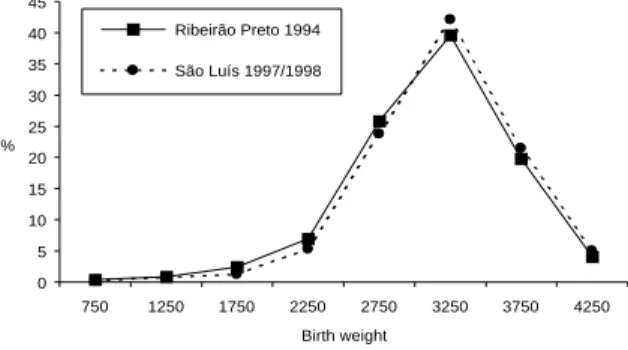
Figure 1 shows the birth weight distribution per 500 g group in the two cities. The distribution of birth weight in Ribeirão Preto was shifted to the left com-pared to São Luís. The mean birth weight was 63 g lower in Ribeirão Preto than in São Luís (3,113 vs
3,176 g, p<0.05), whereas the standard deviation was higher (554 vs 530 g).
As shown in Figure 2, there were small differences in mean birth weight distribution according to gesta-tional age between the two cities (from 37 to 45 weeks). However, among preterm newborns, the mean weight for gestational age was higher in São Luís than in Ribeirão Preto.
Table 2 shows the prevalence of LBW, preterm birth and SGA births according to family income (expressed as the number of minimum salaries) in the two cities. Only Ribeirão Preto showed a marked difference be-tween family income and birth weight. There was no linear trend in the association between family income and preterm birth. The SGA rate was negatively asso-ciated with family income in both cities.
DISCUSSION
The LBW rate was higher in Ribeirão Preto, while infant mortality was higher in São Luís. Preterm and
Table 1 - Birth weight, gestational age, births that were small for gestational age and infant mortality in the cities of Ribeirão Preto and São Luís, Brazil, during the 1990s.
Variables Ribeirão Preto 1994 São Luís 1997/98
f % f %
Birth weight (g)
<1,500 36 1.3 26 1.1
1,500–2,499 267 9.4 160 6.5
≥2,500 2,536 89.3 2,253 92.4
Gestational age (weeks)
≥37 2,480 87.3 2,132 87.4
33–36 307 10.8 250 10.3
≤32 52 1.7 57 2.3
Small for gestational age
Yes 364 12.8 347 14.2
No 2,475 87.2 2,092 85.8
Infant mortality*
Yes 47 16.6 64 26.2
No 2,792 83.4 2,375 73.8
Total 2,839 100.00 2,439 100.00
*Calculated per 1,000 live births.
Table 2 - Prevalence of low birth weight, preterm birth and births that were small for gestational age, according to family income in the two cities of Brazil during the 1990s.
Family Low birth weight Preterm birth Small for gestational age income Ribeirão Preto São Luís Ribeirão Preto São Luís Ribeirão Preto São Luís
N f % N f % N f % N f % N f % N f %
≤1 237 31 13.1 786 67 8.5 237 32 13.5 786 108 13.9 237 42 17.7 786 132 16.8
1.1-3 593 75 12.6 718 43 6.0 593 84 14.2 718 66 9.2 593 86 14.5 718 99 13.8 3.1-6 485 38 7.8 412 34 8.3 485 50 10.3 412 63 15.3 485 71 14.6 412 47 11.4 6.1-10 299 22 7.4 157 11 7.0 299 29 9.7 157 18 11.5 299 29 9.7 157 23 14.7 >10 395 36 9.1 203 12 5.9 395 58 14.7 203 23 11.3 395 36 9.1 203 16 7.9 Unknown 830 101 12.2 163 19 11.7 830 106 12.8 163 28 17.2 830 100 12.1 163 30 18.4
p=0.010 p=0.323 p=0.368 p=0.220 p<0.001 p=0.001
Total 2,839 303 10.7 2,439 186 7.6 2,839 359 12.7 2,439 307 12.6 2,839 364 12.8 2,439 347 14.2 Figure 2 - Mean birth weight according to gestational age in the two cities in Brazil.
Figure 1 - Birth weight distribution in the cities of São Luís and Ribeirão Preto, Brazil.
0 5 10 15 20 25 30 35 40 45
750 1250 1750 2250 2750 3250 3750 4250
Birth weight %
Ribeirão Preto 1994
São Luís 1997/1998
0 500 1000 1500 2000 2500 3000 3500
<31 32 34 36 38 40 42 44
Gestational age (weeks)
Mean weight (g) Ribeirão Preto 1994
6 9 7 6 9 7 6 9 7 6 9 7 6 9 7 Rev Saúde Pública 2003;37(6):693-8
www.fsp.usp.br/rsp
Infant mortality and low birth weight
Silva AAM da et al
SGA birth rates were similar. The prevalence of SGA newborns increased as the family income decreased, while preterm birth did not show any variation and an increase in the LBW rate according to decreasing family income was only observed in Ribeirão Preto.
The present study showed a series of contradictions between perinatal indicators and the socioeconomic conditions of the two cities: why did Ribeirão Preto, although more developed than São Luís, show a higher LBW rate, if LBW is considered to be an indi-cator of social development? Why did Ribeirão Preto, with a higher LBW rate, present lower infant mortal-ity than São Luís, if low birth weight is the factor most strongly associated with infant mortality? De-spite the differences in LBW rates between the two cities, why did they show similar preterm and SGA birth rates? Why was a social difference in LBW only observed in Ribeirão Preto?
It can be seen that there is an epidemiological para-dox between the two cities. Such situations have also been reported in studies from other countries that compared LBW rates between two ethnically differ-ent populations; for example, the epidemiological paradox between Latin women living in the United States and white American women. Latin women showed a lower LBW rate than for white American women, despite their socioeconomic disadvantage.9 A similar paradox was reported by Baruffi et al4 in Hawaii between Samoan and Caucasian women, with a higher LBW rate being observed for children born to Caucasian women of a better socioeconomic level.
Several hypotheses can be raised to explain the higher LBW rate observed in Ribeirão Preto. One explanation is the higher percentage of cesarean sec-tions in Ribeirão Preto in comparison with São Luís (51.1 vs 33.2%). Previous studies15,17 have shown an association between LBW and cesarean section rate in the two cities, with the population-attributable risk of cesarean section, in relation to LBW, being higher in Ribeirão Preto than in São Luís (20 vs 10.9%).
Another plausible hypothesis is the better perina-tal care in Ribeirão Preto, which leads to the survival of fetuses that would otherwise be stillbirths. How-ever, these survivors are live births with LBW. This may have contributed to the lower mean birth weight for each gestational age among preterm births ob-served in this city.
The higher prevalence of maternal smoking in Ribeirão Preto, in comparison with São Luís (21.4 vs
6.3%), is another possible explanation, since this habit represents a risk factor for LBW.12
It is also possible that, in São Luís, a large propor-tion of live births that die within the first hours of life are erroneously considered stillbirths, a fact that tends to underestimate LBW rates in these groups, espe-cially among poorer classes. This fact has been ob-served in other studies, in relation to fetuses weigh-ing less than 500 g, but may also be true for newborn infants with a higher birth weight.11
The preterm birth rate was expected to be higher in Ribeirão Preto than in São Luís due to the higher LBW rate observed in the former. However, similar preterm birth rates were observed for the two cities and preterm newborns showed a higher mean birth weight according to gestational age in São Luís. This finding might be due to bias in the determination of gestational age, which was calculated based on the date of the last normal menstrual period, because er-rors in reported date are more common in populations of low socioeconomic level.8 Kramer et al13 concluded that women of low sociocultural level mistake bleed-ing due to blastocyst implantation for menstrual bleeding. Therefore, the preterm birth rate in São Luís may have been overestimated and some of these erro-neously classified preterm newborns contributed to-wards increasing the mean weight for gestational age among preterm births.
The similarity in SGA rates between the two cities may be explained by an equilibrium between two risk factors: socioeconomic factors were more preva-lent in São Luís,16 while the prevalence of maternal smoking was higher in Ribeirão Preto.15
Despite the higher LBW rate in Ribeirão Preto, in comparison with São Luís, infant mortality was lower in the former, probably due to better medical care and better socioeconomic conditions.
In contrast to São Luís, Ribeirão Preto showed dif-ferences in birth weight distribution according to fam-ily income. This fact may be explained by the hy-pothesis stated above, i.e., under-registration of live births among the poorer classes of São Luís. In addi-tion, a higher rate of cesarean sections was observed for the wealthier classes in São Luís, probably lead-ing to higher preterm birth and LBW rates. Differ-ences in low birth weight according to family income were also reported for Pelotas in 1993.10
6 9 8 6 9 86 9 8 6 9 8
6 9 8 Rev Saúde Pública 2003;37(6):693-8
www.fsp.usp.br/rsp Infant mortality and low birth weight
Silva AAM da et al
15 was adopted, while in Ribeirão Preto the date was classified as unknown. Differences in cultural per-ceptions of fetal viability was another limiting fac-tor, which might have interfered with the birth records, with more live births being considered stillbirths in one city than in the other. The sample had an 80% power to detect differences of 2.5% or more among indicators from the two cities.
To reduce the differences due to errors in gesta-tional age estimation, infants with weights incom-patible with gestational age were excluded from the analysis. One aspect conferring reliability on the
study was the standardization of the weight measure-ment performed under supervision in the two studies.
Regardless of the hypotheses for explaining the paradoxes identified, one conclusion can be derived from the present data. This is that the ecological dissociation observed between LBW and infant mor-tality indicates that the LBW rate should no longer be systematically considered as an indicator of so-cial development. Differences in the access to and quality of perinatal medical care are possibly one of the factors responsible for this apparent epidemio-logical paradox.
REFERENCES
1. Altman DG, Coles EG. Nomograms for precise determination of birthweight for dates. Br J Obstet Gynaecol 1980;87:81-6.
2. Barbieri MA, Gomes UA, Barros Filho AA, Bettiol H, Almeida LEA, Silva AAM. Saúde perinatal em Ribeirão Preto, SP, Brasil: a questão do método. Cad Saúde Pública 1989;5:376-87.
3. Barros FC, Huttly SRA, Victora CG, Kirkwood BR, Vaughan JP. Comparison of the causes and
consequences of prematurity and intrauterine growth retardation: a longitudinal study in southern Brazil. Pediatrics 1992;90:238-44.
4. Baruffi G, Kieffer EC, Alexander GR, Mor JM. Changing pregnancy outcomes of Samoan women in Hawaii. Paediatr Perinat Epidemiol 1999;13:254-68.
5. Belizán JM, Villar J. El crescimiento fetal y su repercusión sobre el desarrollo del niño. In: Cusminsky M, Moreno EM, Suárez-Ojeda, EN, eds. Crescimiento y desarrollo: hechos y tendencias. Washington: Pan American Health Organization; 1988. p. 102-19.
6. Bettiol H, Barbieri MA, Gomes UA, Andrea M, Goldani MZ, Ribeiro ERO. Saúde perinatal em Ribeirão Preto, SP, Brasil, 1994: metodologia e algumas características da população estudada. Rev Saúde Pública 1998;32:18-28.
7. Bettiol H, Rona RJ, Chinn S, Goldani MZ, Barbieri MA. Factors associated with preterm birth in Southeast Brazil: a comparison of two births cohorts born 15 years apart. Paediatr Perinat Epidemiol 2000;14:30-8.
8. Buekens P, Delvoye P, Wollast E, Robyn C. Epidemiology of pregnancies with unknown last menstrual period. J Epidemiol Community Health 1984;38:79-80.
9. Fuentes-Afflick E, Hessol NA, Perez-Stable EJ. Testing the epidemiologic paradox of low birth weight in Latinos. Arch Pediatr Adolesc Med 1999;153:147-53.
10. Horta FL, Barros FC, Halpern R, Victora CG. Baixo peso ao nascer em duas coortes de base populacional no Sul do Brasil. Cad Saúde Pública 1996;(Supl 1):27-31.
11. Joseph KS, Kramer MS. Recent trends in Canadian infant mortality rates: effect of changes in registration of live newborns weighing less than 500 g. Can Med Assoc J 1996;15:1047-52.
12. Kramer MS. Determinants of low birth weight: methodological assessment and meta-analysis. Bull World Health Organ 1987;65:663-737.
13. Kramer MS, Mclean FH, Boyd ME, Usher RH. The validity of gestational age estimation by menstrual dating in term, preterm and postterm gestations. JAMA 1988;260:3306-8.
14. McCormick MC. The contribution of low birthweight to infant mortality and childhood morbidity. N Engl J Med 1985;312:82-90.
15. Silva AAM, Barbieri MA, Gomes UA, Bettiol H. Trends in low birth weight: a comparison of two birth cohorts separated by a 15-year interval in Ribeirão Preto, Brazil. Bull World Health Organ 1998;76:73-84.
16. Silva AAM, Coimbra LC, Silva RA, Alves MTSSB, Lamy-Filho F, Lamy ZC et al. Perinatal health and mother-child health care in the municipality of São Luís. Cad Saúde Pública 2001;17:109-19.
17. Silva AAM, Lamy-Filho F, Alves MTSSB, Coimbra LC, Bettiol H, Barbieri MA. Risk factors for low birth-weight in northeast Brazil: the role for caesarean section. Paediatr Perinat Epidemiol 2001;15:257-64.