Blood pressure levels and body mass index in Brazilian
adults with Down syndrome
Níveis de pressão arterial e índice de massa corporal em adultos brasileiros com
síndrome de Down
Felipe Pucci
I, Guilherme Machado
I, Edcarlo Solera
I, Fernanda Cenovicz
II, Christian Arruda
I, Chiu Braga
III, Renato Nisihara
IIIDepartment of Medicine, Universidade Positivo (UP), Curitiba, PR, Brazil
ABSTRACT
CONTEXT AND OBJECTIVE: Increased life expectancy among people with Down syndrome (DS) has in-troduced new environmental factors that may afect blood pressure (BP) and/or lead to obesity in this po-pulation. The aim here was to investigate BP levels and body mass index (BMI) in adults with DS, correlating these data with the patients’ sex and age.
DESIGN AND SETTING: Analytical cross-sectional observational study conducted in special schools in Curitiba (PR), Brazil.
METHODS: 97 adult patients were included. BP was measured in accordance with the established guide-lines. BMI was calculated by dividing the weight by the height squared (kg/m2).
RESULTS: Sex had no inluence on BMI; nor did systolic BP (SBP) or diastolic BP (DBP). The age range was from 18 to 56 years. No correlation was observed between increasing age and greater BMI or BP. Eighty-six individuals (88.7%) presented normal BP, eleven (11.3%) prehypertension and none hypertension. Twenty patients (20.4%) presented BP lower than 90 × 60 mmHg. BMI ranged from 18 to 48 kg/m2 (mean of 28.8
± 3.92 kg/m2): 21.9% had normal weight; 40.7% were overweight; and 25.3% had obesity class I, 9.9% class
II and 2.2% class III. Higher BMI was associated with signiicantly greater SBP and DBP (P = 0.0175 and P = 0.0015).
CONCLUSION: Sex and age did not inluence SBP, DBP or BMI in Brazilian adults with DS. Higher BMI was associated with greater BP (both systolic and diastolic).
RESUMO
CONTEXTO E OBJETIVO: O aumento da expectativa de vida das pessoas com síndrome de Down (SD) introduziu novos fatores ambientais que podem afetar a pressão sanguínea e/ou levar a obesidade nessa população. O objetivo foi investigar os níveis de pressão arterial (PA) e o índice de massa corporal (IMC) em adultos com SD, correlacionando estes dados com a idade e o gênero dos pacientes.
DESENHO E LOCAL: Estudo observacional, transversal e analítico, realizado em escolas especiais em Curi-tiba (PR), Brasil.
MÉTODOS: Foram incluídos 97 pacientes adultos. A aferição da PA foi feita de acordo com as diretrizes estabelecidas. O IMC foi calculado dividindo-se o peso pela altura ao quadrado (kg/m2).
RESULTADOS: O gênero não inluenciou o IMC, a pressão arterial sistólica (PAS) e diastólica (PAD). A idade variou de 18 a 56 anos. Não foi observada correlação entre aumento da idade e maior IMC ou pressão arterial. 86 indivíduos (88,7%) apresentaram PA normal, 11 (11,3%) pré-hipertensão e nenhum hipertensão. Vinte (20,4%) apresentaram PA inferior a 90 × 60 mmHg. O IMC variou entre 18 e 48 kg/m2 (média de 28,8
±
3,92), 21,9% tinham peso normal, 40,7% sobrepeso, 25,3% obesidade grau I, 9,9 % grau II e 2,2% obesidade grau III. Aumento signiicativo da PAS e PAD foi associado com elevação do IMC (P = 0,0175 e P = 0,0015).
CONCLUSÃO: Veriicou-se que sexo e idade não inluenciaram PAS, PAD e IMC em adultos brasileiros com SD. O aumento signiicativo da PAS e PAD foi associado com o aumento do IMC.
IMD. Attending Physician, Department of Medicine,
Universidade Positivo (UP), Curitiba, PR, Brazil.
IIUndergraduate Student, Department of Medicine,
Universidade Positivo (UP), Curitiba, PR, Brazil.
IIIPhD, Assistant Professor, Department of Medicine,
Universidade Positivo (UP), Curitiba, PR, Brazil.
KEY WORDS: Down syndrome. Blood pressure. Obesity. Body mass index. Adult.
PALAVRAS-CHAVE: Síndrome de Down. Pressão sanguínea. Obesidade.
INTRODUCTION
Over the last ive decades, there has been a trend toward lon-ger survival among individuals with Down syndrome (DS).1-3 In developed countries, recent estimates have indicated that their average age at death is greater than 50 years.2,3 Reduced institu-tionalization with increased mobility and integration into society has also played a role.1,4,5
DS is a multiorgan disorder, afecting the heart and vascu-lar system both structurally and functionally.6 Conditions such as obesity, mobility restrictions, depression, hypothyroidism and Alzheimer’s disease are known to become increasingly prevalent in later life,7 including increased blood pressure (BP) and body mass index (BMI). here are a few studies evaluating blood pres-sure in adults with DS that have reported that their BP is lower than that of the general population and people with other forms of mental handicap. However, some of these studies were con-ducted many years ago.8,9 Today, individuals with DS are exposed to diferent environmental factors such as stress, fast foods, greater social inclusion and new challenges that can afect BP and cause obesity.
Draheim et al.10 investigated 52 DS patients and reported that systolic and diastolic BP were significantly lower in adults with DS than in a matched control group; and that their body mass index (BMI) was 31.0 ± 6, which was signiicantly higher than that of the controls (28.0 ± 7). here are no studies on this topic conducted in Brazil.
OBJECTIVE
In the present study, we investigated the levels of diastolic/sys-tolic BP and BMI among noninstitutionalized adults with DS in Curitiba, Brazil, correlating the indings with the patients’ sex and age.
METHODS
his study had an observational cross-sectional design and was approved by the local research ethics committee (Positivo University, number 297.349/2013). he parents or guardians of all participants signed informed consent forms.
he study population comprised adults with DS over the age of 18 years who were being followed up at two institutions: Associação de Pais e Amigos dos Excepcionais (APAE-PR) and Associação Reviver, both in Curitiba, Paraná. he parents were sent a letter proposing the study. If they agreed, they signed the consent form and the patient was included in the study. In a brief questionnaire, the participants answered questions about the presence of diagnosed hypertension, smoking and alcohol con-sumption. he participants received guidance on healthy habits and were encouraged to practice physical activity. he study was conducted over the period from May 2013 to September 2013.
he researchers invited 97 consecutive adults with DS who were attending the schools that collaborated in the study. All agreed in to participate. hus, a total of 97 DS patients (49 male and 48 female patients) in Curitiba, Paraná, Brazil, were included in the study. None of them were smokers or alcohol consumers or had hypertension diagnosed previously.
BP measurements were made using the auscultatory method with a calibrated mercury sphygmomanometer, performed by an operator trained in the standardized technique. he patients were properly prepared and positioned. hey remained seated quietly for at least ive minutes on a chair, with feet on the loor and arms supported on armrests at heart level. Cafeine and exercise needed to be avoided for at least 30 minutes prior to the measurements, in accordance with the guidelines established by the American Heart Association in the Seventh Report of the Joint National Committee (JNC-7).11 he measurements made by the two researchers agreed well when simultaneous record-ings were made in the right and let arms of the patients, with appropriate cuf sizes used. For all the patients in this study, three BP measurements were made, done on diferent days within one week. he mean from these measurements was used in the analyses.
BMI was calculated by dividing the weight in kilograms by the height in meters squared (kg/m2), in accordance with the World Health Organization (WHO) recommendations.12 To obtain the patients’ body weight and height, we used an elec-tric scale and a tape measure. Patients who presented abnormal BP measurements received a letter from the school, in which their parents were advised to seek the municipal health service for the patients’ BP to be measured. he healthcare professional assigned to the special school was also informed about the ind-ings. All the patients received information about proper nutrition and physical exercise for maintaining their health.
he data distribution was analyzed using the Kolmogorov-Smirnov test. he results were expressed as the mean and stan-dard deviation (SD) for parametric data and as the median and interquartile range (IQR) for nonparametric data. he Fisher exact and chi-square tests were used for association studies on nominal data and the unpaired t test and Mann-Whitney test were used for continuous data. Calculations were done with the aid of the GraphPad Prism sotware, version 4.0, and Medcalc version 12.1.3.0. he signiicance level used was 5%.
RESULTS
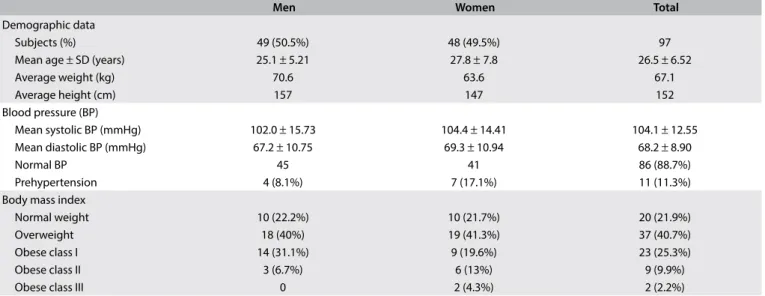
he population age range was from 18 to 56 years, with a mean age of 26.5 ± 6.52 years; 74.2% were less than or equal to 30 years of age (Table 1). he statistical analysis showed that there was no association between increasing age and higher BMI (P = 0.64), or between increasing age and SBP (P = 0.45) or DBP (P = 0.80).
he systemic arterial pressure ratios of the 97 patients evalu-ated in this study ranged from 72/36 mmHg to 132/88 mmHg. Eighty-six of them (88.7%) presented BP below the “optimal” reference value (120/80 mmHg) for individuals with normal BP, as recommended through JNC-7.11 Eleven patients (11.3%) were classiied as presenting prehypertension and no patient pre-sented hypertension (Table 1). hree patients (3.1%) had border-line BP, deined as SBP 130-139 mmHg and another two patients (2.1%) showed DBP between 85 mmHg and 89 mmHg. On the other hand, twenty patients (20.4%) presented BP levels lower than 90 mmHg × 60 mmHg (10 males; mean age of 26.4 years): seven individuals with normal BMI, 10 with obesity class I and three with obesity class II. Four of them had systemic BP of 70 mmHg × 50 mm/Hg.
BMI screening was performed on 91 patients. Six patients did not allow weight and height measurements to be made. he BMI ranged from 18 to 48 kg/m2, with a mean of 28.8 kg/m2± 3.92 kg/m2. Among the patients, 21.9% presented weight within normal limits, while 40.7% were classiied as overweight, 25.3% as obese class I, 9.9% as obese class II and 2.2% as obese class III, in accordance with the World Health Organization classiica-tion system12 (Table 1).
Higher BMI was associated with significant greater SBP and DBP (P = 0.0175 and P = 0.0015, respectively). Figure 1
shows the SBP and DBP values according to BMI variation. No
significant correlation was observed when the patients’ ages were compared with either SBP or DBP. Among the patients with normal weight (21.9%), the median BP was 101 mmHg x 65 mmHg. The overweight patients (40.7%) had median BP of 102 mmHg x 66 mmHg and those with obesity class I (25.3%) had median BP of 105 mmHg x 70 mmHg. BP was significantly greater among the patients with obesity classes II and III (12.1%), who showed median BP of 115 mmHg x 80 mmHg (P = 0.0038), in comparison with the patients with normal weight.
Men Women Total
Demographic data
Subjects (%) 49 (50.5%) 48 (49.5%) 97
Mean age ± SD (years) 25.1 ± 5.21 27.8 ± 7.8 26.5 ± 6.52
Average weight (kg) 70.6 63.6 67.1
Average height (cm) 157 147 152
Blood pressure (BP)
Mean systolic BP (mmHg) 102.0 ± 15.73 104.4 ± 14.41 104.1 ± 12.55 Mean diastolic BP (mmHg) 67.2 ± 10.75 69.3 ± 10.94 68.2 ± 8.90
Normal BP 45 41 86 (88.7%)
Prehypertension 4 (8.1%) 7 (17.1%) 11 (11.3%)
Body mass index
Normal weight 10 (22.2%) 10 (21.7%) 20 (21.9%)
Overweight 18 (40%) 19 (41.3%) 37 (40.7%)
Obese class I 14 (31.1%) 9 (19.6%) 23 (25.3%)
Obese class II 3 (6.7%) 6 (13%) 9 (9.9%)
Obese class III 0 2 (4.3%) 2 (2.2%)
SD = standard deviation.
Table 1. Clinical and demographic data and comparison between sexes in the study group
SBP DBP
Normal
mmHg
200
150
100
50
0
OW Ob-I
Ob-II and III Normal
OW Ob-I
Ob-II and III
Figure 1. Blood pressure levels in patients with Down syndrome, according to body mass index.
DISCUSSION
In this study, we evaluated the BP and the BMI of adults with DS. We showed that the diastolic and systolic BPs were lower among indi-viduals with DS and that high BMI was associated with increased BP. In terms of BP, in our study, the majority (88.7%) of the patients had BP below the recommended levels, which is consis-tent with the indings of other authors.8,10 Among our patients, none presented hypertension; 11 cases (11.3%) were classiied as presenting prehypertension, among which 9 presented obesity class II and III. hese patients will be monitored through peri-odic measurements of their BP and referral for medical care. On the other hand, 20.6% of the patients presented low systemic blood pressure, i.e. below 90 mmHg x 60 mmHg, without any association with sex or age. Some authors have suggested that this low BP may be associated with Alzheimer’s disease and pre-mature aging among individuals with DS.8 On the other hand, the lack of inluence of sex and age on BP and BMI may be due to the small sample size or to survival bias, in the case of age.
A sedentary lifestyle and an unhealthy diet are common among individuals with DS, especially among those living in community settings.13,14 he prevalence of overweight and obe-sity among patients with DS is signiicantly higher than among other patients with intellectual disabilities or in the general popu-lation. he reported prevalence of obesity among adults with DS is between 31% and 47%.15-17 In our study, the prevalence of obe-sity among adults with DS was 37.8%, and 40% of the population was overweight. Only 22.2% presented appropriate weight for age. It is natural to emphasize the importance of consistent exercise, good diet, community involvement and regular health examina-tions for these individuals. In a study on physical inactivity among adults with intellectual disability, Draheim et al.18 reported that less than 46% of the men and women participated in the rec-ommended amount of physical activity and that no adults older than 30 years reported participation in vigorous physical activity. However, Fujiura et al.19 founded that there were no strong links between BMI, diet and exercise among adults with DS. hey dis-covered a signiicant link between friendships or access to rec-reation and BMI, concluding that community interactions had a major efect on health. In our view, healthy behavior should be stimulated. It is to be expected that a speciic approach is needed to get these people interested and motivated to change their life-style. herefore, development of speciic programs for DS patients that may be conducted in schools is necessary.
CONCLUSION
In our study, we found that sex and age did not inluence SBP, DBP or BMI among Brazilian adults with DS. We observed that our DS patients presented high BMI. Furthermore, higher BMI was associated with higher systolic and diastolic BP.
REFERENCES
1. Yang Q, Rasmussen SA, Friedman JM. Mortality associated with Down’s syndrome in the USA from 1983 to 1997: a population-based study. Lancet. 2002;359(9311):1019-25.
2. Bittles AH, Bower C, Hussain R, Glassom EJ. The four ages of Down syndrome. Eur J Public Health. 2007;17(2):221-5.
3. Glasson EJ, Sullivan SG, Hussain R, et al. The changing survival proile of people with Down’s syndrome: implications for genetic counselling. Clin Genet. 2002;62(5):390-3.
4. Day SM, Strauss DJ, Shavelle M, Reynolds RJ. Mortality and causes of death in persons with Down syndrome in California. Dev Med Child Neurol. 2005;47(3):171-6.
5. McCarron M, Gill M, McCallion P, Begley C. Health co-morbidities in ageing persons with Down syndrome and Alzheimer’s dementia. J Intellect Disabil Res. 2005;49(Pt 7):560-6.
6. Vis JC, Dufels MG, Winter MM, et al. Down syndrome: a cardiovascular perspective. J Intellect Disabil Res. 2009;53(5):419-25.
7. Coppus AM, Evenhuis HM, Verberne GJ, et al. Survival in elderly persons with Down syndrome. J Am Ger Society. 2008;56(12):2311-6. 8. Morrison RA, McGrath A, Davidson G, et al. Low blood pressure in
Down’s syndrome, A link with Alzheimer’s disease? Hypertension. 1996;28(4):569-75.
9. Richards BW, Enver F. Blood pressure in Down’s syndrome. J Ment Deic Res. 1979;23(2):123-35.
10. Draheim CC, Geijer JR, Dengel DR. Comparison of intima-media thickness of the carotid artery and cardiovascular disease risk factors in adults with versus without the Down syndrome. Am J Cardiol. 2010;106(10):1512-6.
11. Chobanian AV, Bakris GL, Black HR, et al. Seventh report of the Joint National Committee on Prevention, Detection, Evaluation, and Treatment of High Blood Pressure. Hypertension. 2003;42(6):1206-52. 12. WHO Expert Consultation. Appropriate body-mass index for
Asian populations and its implications for policy and intervention strategies. Lancet. 2004;363(9403):157-63.
13. Beange H, McElduf A, Baker W. Medical disorders of adults with mental retardation: a population study. Am J Mental Retard. 1995;99(6):595-604.
14. van den Akker M, Maaskant MA, van der Meijden RJ. Cardiac diseases in people with intellectual disability. J Intellect Disabil Res. 2006;50(Pt 7):515-22.
15. Melville CA, Cooper SA, McGrother CW, Thorp CF, Collacott R. Obesity in adults with Down syndrome: a case-control study. J Intellect Disabil Res. 2005;49(Pt 2):125-33.
16. Prasher VP. Overweight and obesity amongst Down’s syndrome adults. J Intellect Disabil Res. 1995;39(Pt 5):437-41.
18. Draheim CC, Williams DP, McCubbin JA. Prevalence of physical inactivity and recommended physical activity in community-based adults with mental retardation. Ment Retard. 2002;40(6):436-44. 19. Fujiura GT, Fitzsimons N, Marks B, Chicoine B. Predictors of BMI among
adults with Down syndrome: the social context of health promotion. Res Dev Disabil. 1997;18(4):261-74.
Sources of funding: None
Conlict of interest: None
Date of irst submission: December 1, 2015
Last received: March 14, 2016
Accepted: March 18, 2016
Address for correspondence:
Renato Nisihara Rua João Azolin, 660 Curitiba (PR) — Brasil CEP 82040-015