Effects of two programs of exercise on body composition of adolescents
with Down syndrome
Efeitos de dois programas de exercício na composição corporal de adolescentes com síndrome de Down
Efectos de dos programas de ejercicios en la composición corporal de adolescentes con síndrome de Down
Bruna Barboza Seron1, Renan Alvarenga C. Silva1, Márcia Greguol1
Instituição: Universidade Estadual de Londrina (UEL), Londrina, PR, Brasil
1UEL, Londrina, PR, Brasil
ABSTRACT
Objective: To investigate the effects of a 12 week aerobic and resistance exercise on body composition of adolescents with Down syndrome.
Methods: A quasi-experimental study with 41
adoles-cents with Down syndrome, aged 15.5±2.7 years, divided
into three groups: Aerobic Training Group (ATG; n=16), Resisted Training Group (RTG; n=15) and Control Group (CG; n=10). There were two types of training: aerobic, with intensity of 50-70% of the heart rate reserve 3 times/week, and resisted, with intensity of 12 maximum repetitions 2 times week. Both trainings were applied during a 12-week period. The percentage of fat evaluation was performed using
plethysmography with Bod Pod® equipment. Waist
circum-ference (WC), body weight and height were also measured. Paired t-test was used to compare variables before and after the exercise program.
Results: The percentage of body fat did not change sig-nificantly for both groups that participated in the training intervention. However, CG showed a significant increase in this variable (31.3±7.2 versus 34.0±7.9). On the other hand, body mass index (BMI) and WC were significantly reduced
for ATG (BMI: 27.0±4.4 and 26.5±4.2; WC: 87.3±11.1
and 86.2±9.7), while RTG and GC showed no differences
in these variables.
Conclusions: The aerobic and resisted training programs maintained body fat levels. ATG significantly reduced BMI
and WC measures. Individuals who did not attend the train-ing intervention increased their percentage of fat.
Key-words: Down syndrome; body composition; exercise; adolescent.
RESUMO
Objetivo: Analisar os efeitos do exercício aeróbio e resis-tido por 12 semanas na composição corporal de adolescentes com síndrome de Down.
Métodos: Estudo quase experimental com 41 adolescentes
com síndrome de Down, com idades de 15,7±2,7 anos,
di-vididos em três grupos: Grupo Treinamento Aeróbio (GTA; n=16), Grupo Treinamento Resistido (GTR; n=15) e Grupo Controle (GC; n=10). Realizaram-se dois tipos de treinamento: o aeróbio, com intensidade de 50 a 70% da frequência cardíaca de reserva 3 vezes/semana, e o resistido, com intensidade de 12 repetições máximas 2 vezes/semana. Ambos os treinamentos foram realizados por 12 semanas. A avaliação da porcentagem de gordura foi realizada por pletismografia com o equimento
Bod Pod®. Mensuraram-se ainda as variáveis antropométricas
de circunferência abdominal (CA), massa corporal e estatura.
Aplicou-se o teste t pareado para a comparação das variáveis
analisadas antes e após o treinamento.
Resultados: A porcentagem de gordura corporal não se alterou nos grupos que participaram do treinamento; entre-tanto, o GC apresentou aumento significativo dessa variável
Endereço para correspondência: Bruna Barboza Seron
Rua Benjamin Constant, 1.985, apto. 501 CEP 86020-320 – Londrina/PR
E-mail: [email protected]
Conflito de interesse: nada a declarar
(31,3±7,2 versus 34,0±7,9). Por outro lado, a CA e o índice de massa corpórea (IMC) reduziram-se de forma significante
para o GTA (IMC: 27,0±4,4 e 26,5±4,2; CA: 87,3±11,1 e
86,2±9,7), enquanto que o GTR e o GC não apresentaram
diferenças nessas variáveis.
Conclusões: Os programas de treinamento aeróbio e resistido mantiveram os níveis de gordura corporal e o GTA reduziu de forma significativa as medidas de IMC e de CA. Os indivíduos que não participaram do treinamento tiveram sua porcentagem de gordura aumentada.
Palavras-chave: síndrome de Down; composição corporal; exercício; adolescente.
RESUMEN
Objetivo: Analizar los efectos del ejercicio aeróbico y resistido en la composición corporal de adolescentes con síndrome de Down.
Métodos:Estudio casi experimental con 41 adolescentes
con síndrome de Down, con edades de 15,7±2,7 años,
divi-didos en tres grupos: Grupo Entrenamiento Aeróbico (GEA; n=16), Grupo Entrenamiento Resistido (GER; n=15) y Grupo Control (GC; n=10). Se realizaron dos tipos de entrenamiento: el aeróbico, con intensidad de 50 a 70% de la frecuencia car-diaca de reserva, y el resistido, con intensidad de 12 repeticio-nes máximas. La evaluación del porcentaje de grasa se realizó
por pletismografía con equipo Bod Pod®. Se midieron además
las variables antropométricas de circunferencia abdominal (CA), masa corporal y estatura. Los datos fueron inicialmente
tratados por estadística descriptiva, utilizando la prueba de t
pareada para la comparación de las variables analizadas.
Resultados: El porcentaje de grasa corporal no se alteró en los grupos que participaron del entrenamiento; sin embargo, el GC presentó aumento significativo de esa variable (31,3±7,2 versus
34,0±7,9). Por otra parte, la CA y el índice de masa corporal
(IMC) se redujeron de manera significante para el GEA (IMC:
27,0±4,4 y 26,5±4,2; CA: 87,3±11,1 y 86,2±9,7), mientras
que el GER y el GC no presentaron diferencias en esas variables.
Conclusiones:Los programas de entrenamiento aeróbico y resistido mantuvieron los niveles de grasa corporal y el GEA redujo de modo significativo las medidas de IMC y de CA. Los individuos que no participaron del entrenamiento tuvieron su porcentaje de grasa aumentada.
Palabras clave: síndrome de Down; composición corporal; ejercicio; adolescente.
Introduction
Most of the world’s population does not exercise regu-larly, although there is evidence showing an inverse relation
between mortality and a healthy lifestyle(1). Moreover, the
prevalence of obesity worldwide, especially in young people, has demonstrated a rapid increase in recent decades, making it a true global epidemic(2).
Obesity is characterized by excessive accumulation of body fat associated with health problems such as cardiovas-cular disease, type II diabetes mellitus, and dyslipidemia, as
well as some disorders such as sleep apnea(3). Among people
with disabilities, obesity is also a serious public health problem, especially due to the few opportunities to access
physical exercise programs(4), because young people in this
condition still face major barriers to enter and remain in such programs(5).
In individuals with Down syndrome (DS) that have a tendency to some health related disorders, such as heart problems, muscle hypotonia, and increased predisposition to leukemia, the obesity factor may further compromise
their quality of life(6). Despite the similar life expectancy
of individuals with DS and the general population, DS is associated with a variety of comorbidities in different stages of life(7).
Individuals with DS have higher rates of obesity compared to those without the syndrome. According to Florentino Neto et al(8), obesity is intensiied by a characteristic feature
in the routine of people with DS, the sedentary lifestyle.
According to Harris et al(9), 30–50% of children with DS
are obese, which provides greater risk for obesity in
adult-hood(10), indicating the need for physical exercise programs
aimed at this population.
The negative consequences of obesity and the contribu-tion for its onset due to the characteristics of DS are facts that show the importance and urgency of creating speciic intervention programs for this population. Studies show, in some cases, positive developments in body composition of patients with DS after completion of a training program,
with reduced fat percentage(11,12). On the other hand, other
studies did not show improvement in that regard. Thus, there is insuficient evidence to identify which exercise pro-grams are most effective for improving body composition in people with DS(4,13-15).
Method
The present study is quasi-experimental. We carried out the selection of participants by convenience in institutions assisting people with DS in the municipality of Londrina, state of Paraná. Once informed about the conditions of the research, the parents or guardians of the participants signed an informed consent form. This study was approved by the Research Ethics Committee of Universidade Estadual de Londrina, opinion n. 93680/2012.
The study included 41 adolescents with DS (25 boys and 16 girls) who were authorized for the practice of physical exer-cise by a physician. The following adolescents were excluded: those with respiratory, cardiac, or orthopedic impairments, and/or intellectual disabilities that could interfere with the performance or understanding of tests and/or physical exer-cise sessions. The subjects were divided into three groups by convenience, according to the availability of attending the program, being: Control Group (CG – n=10, with six girls); Aerobic Training Group (ATG – n=16, with ive girls); and Resistance Training Group (RTG – n=15, with ive girls).
The assessment of body composition (percentage of fat mass and lean mass) was made by a plethysmography device
(BOD POD® – Life Measurement Inc., Concord, CA). The
apparatus was calibrated before evaluations with a cylinder with a volume of 50L. After calibration, the volunteers were assessed using a minimum amount of clothes and a cap on their heads. In this equipment, we analyzed the variations between pressure and volume to determine body density. From these data, we calculated body composition based on the equation of Siri(16).
The following anthropometric variables were also meas-ured: waist circumference (WC), weight, and height. Waist circumference was measured in centimeters, using a lexible 2-meter tape measure. Body mass index (BMI) was calculated by dividing body weight measured in kilograms (by digital scale with precision of 100g) by height in square meters (measured with a stadiometer with accuracy of 0.1cm). All evaluations were performed twice, before and after the 12-week program of training, by the same evaluator.
The training program consisted of 12 weeks, with a fre-quency of 3 times per week for the ATG and twice a week for the RTG, following the recommendations proposed by
the American College of Sports Medicine (ACSM)(17). Each
session lasted approximately 50 minutes, consisting of a 5–10 minute warm-up preceding the exercise and 5–10 minute stretching at the end of the session.
The aerobic training was performed on a treadmill/bike, with heart rate intensity corresponding to 50–70% of the heart rate reserve (controlled by a Polar FT2 frequency counter) during 30 minutes. The maximum heart rate was obtained through a maximal exercise test speciic for this population(18),
conducted prior to the start of the training period.
Resistance training was composed of nine exercises and consisted of three sets of 12 maximum repetitions (12 MR) for each exercise, with 1-minute interval between sets and 3 minutes between exercises. We proposed the following series of exercises: bench press machine, leg extension, front pull-down, cable biceps curl, standing hip lexion with ankle weights, cable triceps, calf raise with ankle weights, front raises with dumb-bell weights, and abs. The two initial sessions were adaption sessions with light loads; thereafter, we estimated the load used observing the ability to perform the exercise in 12 maximum repetitions. The progression of the load was spontaneous, being increased as the individual could perform more than 12 repeti-tions of that exercise. Thus, the increased load was given as the individual could perform the 13th repetition.
The data were initially treated by means of descriptive statistics, with mean values and variability. After checking the normality of the data, so that the groups were compared in the two time points, we performed analysis of variance (ANOVA to verify possible differences between the groups. As for the comparison of variables before and after the
exercise program, the paired t test was performed. To test
the correlation between BMI, WC, and fat percentage, the Pearson’s correlation coeficient was used. In all cases, the
signiicance level was established at p≤0.05. The data were
treated in the Statistical Package for the Social Sciences (SPSS), version 17.
Results
The 41 participants were divided into three groups: 16 in the ATG, 15 in the RTG, and 10 in the CG. The groups ATG, RTG, and CG were homogeneous regarding age
(respectively 15.7±2.7; 16±2.8, and 14.4±2.5 years) and
body weight (61.5±10.8; 52.7±10.0 and 54.7±11.8kg).
As for height in centimeters, the CG (140.0±9.1) values
were signiicantly lower in comparison to values for the ATG
(151.0±8.4) and the RTG (150.4±7.0).
high cardiovascular risk, because they were above the 90th percentile according to the reference values(20). Still, 50% of
girls and 44% of boys exhibited values between the 75 and 90th percentiles. As for the fat percentage values, 44% of girls
and 16% of boys were above the 90th percentile(21).
There were strong, positive, and signiicant correlations
(p<0.01) between the variables of weight and BMI (r=0.76;
r=0.86; and r=0.78) and WC (r=0.80; r=0.80; and r=0.93) for three groups (aerobic, resistance, and control), respec-tively. Likewise, the correlations between WC and BMI were
also strong and signiicant (p<0.01) for the three groups
(r=0.91; r=0.77; and r=0.92). On the other hand, when cor-related fat percentage with BMI (r=0.62; r=0.53), moderate correlations were noted for the aerobic and resistance group, and strong correlation for the CG (r=0.73). Regarding the correlation of fat percentage with WC (r=0.68; r=0.61; and r=0.65) it was moderate for the three groups, respectively (aerobic, resistance, and control). All correlations were
sig-niicant (p<0.05). When performed correlations between
weight and body fat percentage, these were weak (r<0.40) and not signiicant (p>0.05) for all groups.
Discussion
The results of this study show high rates of overweight and obesity in adolescents with DS. In this sense, the World
Health Organization(22) points to the alarming rise in the
prevalence of these rates also in young people in general.
Murray and Ryan-Krause(23) highlighted that the prevalence
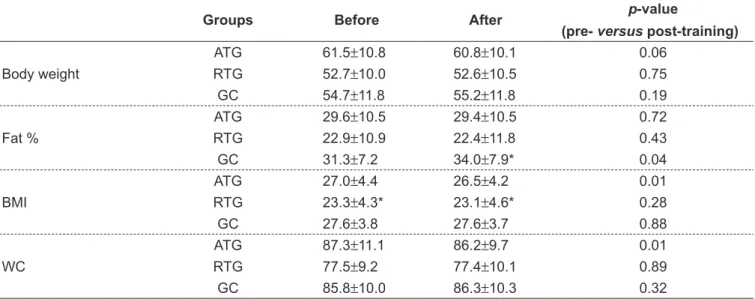
also that the exercise program did not change signiicantly the values of fat percentage in the groups that participated in the training. However, it was observed that the group that did not perform exercise (CG) had a signiicant increase
in this variable (p=0.049). In addition, when the second
evaluation was performed, values of fat percentage for this group were signiicantly higher compared to other groups.
When analyzing BMI, the group that performed aerobic training was able to signiicantly reduce the values of this
variable (p=0.010), while those who performed resistance
training and those who did not exercise presented no differ-ences between the two moments. Similarly, changes in the WC measurement also showed signiicant only to the ATG
(p=0.017). It is noteweorthy that the RTG presented, in the
pre-training, signiicantly lower values for BMI (p=0.022)
and WC (p=0.029), when compared to other groups.
Table 2(19), shows that 65.8% of adolescents were
over-weight or obese. In the analysis by gender, more than 60% of girls and 24% of boys were obese.
Regarding the cardiovascular risk of adolescents according to WC measurements, 25% of girls and 12% of boys presented
Table 1 - Measures of body composition before and after training in the three groups, described as mean±standard deviation
Groups Before After p-value
(pre- versus post-training)
Body weight
ATG 61.5±10.8 60.8±10.1 0.06
RTG 52.7±10.0 52.6±10.5 0.75
GC 54.7±11.8 55.2±11.8 0.19
Fat %
ATG 29.6±10.5 29.4±10.5 0.72
RTG 22.9±10.9 22.4±11.8 0.43
GC 31.3±7.2 34.0±7.9* 0.04
BMI
ATG 27.0±4.4 26.5±4.2 0.01
RTG 23.3±4.3* 23.1±4.6* 0.28
GC 27.6±3.8 27.6±3.7 0.88
WC
ATG 87.3±11.1 86.2±9.7 0.01
RTG 77.5±9.2 77.4±10.1 0.89
GC 85.8±10.0 86.3±10.3 0.32
*p<0.05 – signiicant difference between other groups in a single moment, ANOVA. ATG: Aerobic Training Group; RTG: Resistance Training Group;
CG: Control Group. BMI: body mass index; WC: waist circumference
Table 2 - Frequency of overweight and obesity according to
body mass index
BMI by age Boys Girls Total
Obesity 24.0% 62.5% 39.0%
Overweight 40.0% 6.2% 26.8%
Obesity: ≥95th percentile; overweight: ≥85th percentile (reference values
of obesity in individuals with DS may be higher than in the general population and, as a justiication, the authors describe some physiological and behavioral factors associ-ated with the syndrome that contribute to this fact, such as a reduction of basal metabolism, hypothyroidism, increased leptin, and physical inactivity.
According to Loveday et al(24), the best deinition for
obe-sity is based in adipoobe-sity (body fat percentage), because it is the variable that leads to increased morbidity and mortality. According to Adelekan et al(25), the increase in dyslipidemia
in individuals with DS is associated with changed levels of leptin, which is secreted by adipocytes and, thus, relates to the percentage of fat. Consequently, children and adolescents with DS represent a population at high risk for obesity, dia-betes, and unfavorable lipid proile, which is an additional risk for cardiovascular disease in adult life.
In order to contribute to reducing the deleterious effects of this situation, some studies have been conducted to examine the inluence of exercise on body composition in children and adolescents with DS. However, a recent literature review showed that in the few studies found, the results have been contradic-tory regarding the effects of training on body composition(26).
Varela et al(14) conducted a 16-week study with a rowing
ergometer in adolescents and young adults with DS, with intensity and volume similar to the aerobic training in this study, and found no changes in weight or body fat. Likewise,
González-Agüero et al(27), after 21 weeks of training of
com-bined strength exercises in people with DS, also did not observe decreases in body fat percentage or BMI, using the same weekly frequency as the present study (twice a week).
On the other hand, Ordonez et al(11) assessed 22 overweight
and obese adolescents with DS, having performed an exer-cise program (in water and land) of 3 sessions a week, with progressive duration for 3 months. The authors observed a
signiicant reduction in fat mass (31.8±3.7 to 26.0±2.3%).
It was possible that the speciicity of the exercise (water and land) contributed to reduce these values.
In the present study, Table 1 shows that the subjects of the ATG and the RTG did not obtain a signiicant reduction in fat percentage. However, it is noteworthy that the percent-age of body fat of individuals in the CG increased, i.e., the exercise proved beneicial in providing the maintenance of body fat levels of the subjects with DS who participated in the exercise program.
In some recent studies with adults with DS, in which the inluence of the exercise was veriied, there were no changes
in the values of body composition. Mendonca et al(28), after
aerobic and resistance training, concluded that the exercise program had no signiicant effect on the body composition of participants. Calders et al(29), in turn, analyzed the
inlu-ence of a combined training (aerobic and strength) and observed that the variables BMI, WC, and percentage of fat mass remained stable after the intervention period. Finally,
Rimmer et al(4) conducted a 12-week intervention program
of combined exercise (aerobic and resistance) with 52 adults with DS, with a frequency of 3 times a week, observing body weight reduction in these individuals; however, no changes were found in BMI.
Besides fat percentage, BMI and WC are also important variables to analyze body composition. The present study showed a prevalence of 65.8% of individuals with BMI above the 85th percentile, which puts them at risk,
accord-ing to international criteria(19). As an aggravating factor,
about 40% of these were above the 95th percentile, which indicates the presence of obesity. The use of cutoff points of BMI for young people with DS is questioned. However,
a recent study (30) determined the validity of this parameter
to identify excess fat in young people with DS, using the CDC cutoffs as a basis(19).
Another important measure in the evaluation of the health of children and adolescents is the WC, as this is associated with health problems such as hyperlipidemia, type II diabetes, and cardiovascular risk factors in general. Therefore, early identi-ication of children with high central adiposity is critical(20).
The results of this study indicated that 17% of young people with DS had cardiovascular risk because they pre-sented WC above the 90th percentile. Moreover, almost half of the individuals were between the 75th and 90th percentiles. The average WC found in this study is similar to
that found in children and adolescents with DS in Spain(31).
The high prevalence of risk conditions regarding body
composition in this population is worrying. Rimmer et al(32)
pointed out that excess weight aggravates many secondary health conditions in children and adolescents with DS, includ-ing chronic pain, social isolation, depression, falls, injury, and extreme fatigue. Taking this fact into account Murray and
Ryan-Krause(23) highlighted the need to prioritize prevention
assessment, already showed results of signiicantly lower BMI and WC when compared to other groups. This may have contributed to insigniicant changes in these variables in the post-training, since the smaller the initial values, probably the smaller the possibility of improvement.
The speciicity of training is also an issue to be consid-ered when analyzing the inluence of exercise program. In the present study, attendance to exercise sessions has always been above 85% for both experimental groups, all subjects performed the requested exercises properly, always under the supervision of a responsible teacher who controlled intensity, movement technique, the number of repetitions, and resting time.
Despite having shown signiicant results, some limitations of the study need to be mentioned. One of them refers to the volume of training proposed in the intervention, once the number of weekly sessions and the duration of training may not have been suficient to generate a signiicant impact on body composition. The sample selection by convenience and the fact that we did not perform the calculation of the sample size may have reduced the statistical power to detect signiicant differences in the effects of training. Another pos-sible intervening point is that the diet of the participants was not controlled. Throughout the intervention, some
parents reported that their children, after the start of the training period, began to ingest a larger amount of food, especially those rich in carbohydrates. Nevertheless, the re-sults showed a decrease in BMI and WC values in the group that performed aerobic training. Therefore, if the training were combined with a proper and healthy diet, the results could have been different.
Finally, the results showed that the physical exercise was able to keep the body fat levels of young people with DS, and those who remained sedentary suffered losses in this variable. In addition, aerobic training caused a reduction in measures of BMI and WC, contributing to better health. However, a few points are worth mentioning between the two types of exercise. The aerobic training had a larger volume than the resistance training; moreover, the progression of the load in the resistance training was spontaneous and, therefore, more subjective, once it depended a great deal on the individual’s motivation. The intensity control of the aerobic training was performed with the heart rate.
Therefore, we reinforce the idea that intervention stud-ies are necessary in order to contribute for the prevention and treatment of obesity in young people with DS, to help reducing cardiovascular risk factors and, consequently, to increase life expectancy in this population.
References
1. Guthold R, Ono T, Strong KL, Chatterji S, Morabia A. Worldwide variability in physical inactivity a 51-country survey. Am J Prev Med 2008;34:486-94. 2. Oliveira CL, Fisberg M. Obesidade na infância e adolescência: uma verdadeira
epidemia. Arq Bras Endocrinol Metab 2003;47:107-8.
3. Mancini MC, Aloe F, Tavares S. Apnéia do sono em obesos. Arq Bras Endocrinol Metab 2000;44:81-90.
4. Rimmer JH, Heller T, Wang E, Valerio I. Improvements in physical itness in adults with Down syndrome. Am J Ment Retard 2004;109:165-74.
5. Barr M, Shields N. Identifying the barriers and facilitators to participation in physical activity for children with Down syndrome. J Intellect Disabil Res 2011;55:1020-33.
6. Angulo-Barroso R, Burghardt AR, Lloyd M, Ulrich DA. Physical activity in infants with Down syndrome receiving a treadmill intervention. Infant Behav Dev 2008;31:255-69.
7. Glasson EJ, Sullivan SG, Hussain R, Petterson BA, Montgomery PD, Bittles AH. The changing survival proile of people with Down’s syndrome: implications for genetic counselling. Clin Genet 2002;62:390-3.
8. Florentino Neto J, Pontes LM, Fernandes Filho J. Body composition alterations resulting from weight training in subjects with Down syndrome. Rev Bras Med Esporte 2010;16:9-12.
9. Harris N, Rosenberg A, Jangda S, O’Brien K, Gallagher ML. Prevalence of obesity in International Special Olympic athletes as determined by body mass index. J Am Diet Assoc 2003;103:235-7.
10. Daniels SR. The consequences of childhood overweight and obesity. Future Child 2006;16:47-67.
11. Ordonez FJ, Rosety M, Rosety-Rodriguez M. Inluence of 12-week exercise training on fat mass percentage in adolescents with Down syndrome. Med Sci Monit 2006;12:CR416-9.
12. Savucu Y. Inluence of 12-week training on aerobic capacity and respiratory functions of adolescents with Down syndrome. World Appl Sci J 2010;11:1292-6. 13. Tsimaras V, Glagazoglou P, Fotiadou E, Christoulas K, Angelopoulou N.
Jog-walk training in cardioresperatory itness of adults with down syndrome. Percept Motor Skills 2003;96:1239-51.
14. Varela AM, Sardinha LB, Pitetti KH. Effects of an aerobic rowing training regimen in young adults with Down syndrome. Am J Ment Retard 2001;106:135-44. 15. Millar AL, Fernhall B, Burkett LN. Effects of aerobic training in adolescents
with Down syndrome. Med Sci Sports Exerc 1993;25:270-84.
16. Siri WE. Body composition from luid spaces and density: analysis of methods. In: Brozek J, Henschel A, editors. Techniques for measuring body composition. Washington DC: National Academy of Science; 1961. p. 223-44.
17. Haskell WL, Lee IM, Pate RP, Powell KE, Blair SN, Franklin BA et al. Physical
activity and public health: updated recommendation for adults from the American College of Sports Medicine and the American Heart Association. Circulation 2007;116:1081-93.
18. Fernhall B, Pitetti KH, Rimmer JH, Mccubbin JA, Rintala P, Millar AL et al.
Cardiorespiratory capacity of individuals with mental retardation including Down syndrome. Med Sci Sports Exerc 1996;28:366-71.
20. Fernández JR, Redden DT, Pietrobelli A, Allison DB. Waist circumference percentiles in nationally representative samples of African-American, European-American, and Mexican-American children and adolescents. J Pediatr 2004;145:439-44.
21. Laurson KR, Eisenmann JC, Welk GJ. Body fat percentile curves for U.S. children and adolescents. Am J Prev Med 2011;41 (Suppl 2):S87-92. 22. World Health Organization [homepage on the Internet]. Childhood overweight
and obesity on the rise [cited 2013 Jun 19]. Available from: http://www.who. int/dietphysicalactivity/childhood/en/index.html
23. Murray J, Ryan-Krause P. Obesity in children with Down syndrome: background and recommendations for management. Pediatr Nurs 2010;36:314-9. 24. Loveday SJ, Thompson JM, Mitchell EA. Bioelectrical impedance for measuring
percentage body fat in young persons with Down syndrome: validation with dual-energy absorptiometry. Acta Paediatr 2012;101:e491-5.
25. Adelekan T, Magge S, Shults J, Stallings V, Stettler N. Lipid proiles of children with Down Syndrome compared with their siblings. Pediatrics 2012; 129:e1382-7.
26. González-Agüero A, Vicente-Rodríguez G, Moreno LA, Guerra-Balic M, Ara I, Casajús JA. Health-related physical itness in children and adolescents with Down syndrome and response to training. Scand J Med Sci Sports 2010;20:716-24.
27. González-Agüero A, Vicente-Rodríguez G, Gómez-Cabello A, Ara I, Moreno LA, Casajús JA. A combined training intervention programme increases lean mass in youths with Down syndrome. Res Dev Disabil 2011;32:2383-8.
28. Mendonca GV, Pereira FD, Fernhall B. Effects of combined aerobic and resistance exercise training in adults with and without Down syndrome. Arch Phys Med Rehabil 2011;92:37-45.
29. Calders P, Elmahgoub S, Roman de Mettelinge T, Vandenbroeck C, Dewandele I, Rombaut L et al. Effect of combined exercise training on physical and metabolic itness in adults with intellectual disability: a controlled trial. Clin Rehabil 2011;25:1097-108.
30. Bandini LG, Fleming RK, Scampini R, Gleason J, Must A. Is body mass index a useful measure of excess body fatness in adolescents and young adults with Down syndrome? J Intellect Disabil Res; 2013;57(11):1050-7. 31. González-Agüero A, Ara I, Moreno LA, Vicente-Rodríguez G, Casajús JA. Fat
and lean masses in youths with Down syndrome: gender differences. Res Dev Disabil 2011;32:1685-93.