Analysis of Service-learning activities adopted in
health courses of Federal University of Bahia
Aline Silva Baldoino1, Renata Meira Veras2
Análise das atividades de integração ensino-serviço desenvolvidas nos cursos de saúde da Universidade Federal da Bahia
Análisis de las actividades de integración enseñanza-servicio desarrolladas en los cursos de salud de la Universidade Federal de Bahia
1 Physical therapist. Master’s in Interdisciplinary Studies on University/UFBA. Salvador, BA, Brazil.
2 Adjunct Professor, Instituto of Humanities, Arts and Sciences, Permanent Faculty at the Graduate Program in Interdisciplinary Studies on University/UFBA. Salvador, BA, Brazil.
DOI: http://dx.doi.org/10.1590/S0080-623420160000300003
ABSTRACT
his study aimed to raise and discuss the data about the integration of health courses teaching and service activities ofered at the Federal University of Bahia (UFBA), pre-senting scenarios practices and major diiculties existing in the relationship between the university and the services of health. his was a qualitative study of descriptive explo-ratory character, using a questionnaire as a research tool applied to the coordinators of selected health courses. he selection was by reading the political pedagogical project, the following courses were selected: nursing, physical therapy, speech therapy, medicine, nu-trition, dentistry and public health. he results indicated eight types of teaching-service integration activities, 57 scenarios of practice and the main diiculties. It was concluded that these courses are sticking to changes in academic training in health, in view of the large number of basic health units in the teaching service process. hus, it emphasizes that the UFBA includes activities in health care that enable the integration-education in the higher education process, although there are some diiculties in this relationship indicated by the coordinators.
DESCRIPTORS
University; Health; Health Education.
Correspondence Addressed to: Aline Silva Baldoino
Rua Araguaia, nº 70 - Jardim Atalaia-Stiep CEP 41770-120, Salvador, BA, Brazil [email protected]
Received: 26/03/2015 Approved: 14/11/2015
ORIGINAL ARTICLE
Analysis of Service-learning activities adopted in health courses of Federal University of Bahia
INTRODUCTION
he teaching-learning process established from the tegration between university and service, through the in-tegration of health service faculty, can lead to new ways of organizing health care work, thereby promoting better preparation for the health services. In addition, the kno-wledge exchange relationship formed between students, faculty, clinical professionals and users can contribute to the formation of a new proile of professionals committed to health care quality, which meets the actual needs of the population (1).
Over the past years, aided by the Brazilian health re-form, there have been changes in care practices and trai-ning of health professionals, who sought and contributed to changing this scenario, e.g., the implementation of in-tegrated curricula, teaching-service linkages, the construc-tion of the Naconstruc-tional Curricular Guidelines (NCG), the UNI projects, movements coordinated by the United Ne-twork, and the student movement (2).
hus, according to the Ministry of Health (3), the
chan-ges in care practices also require chanchan-ges in the training of professionals; in order to improve the way to care for, treat and monitor health, it is necessary to change the methods of teaching and learning, and to review educational practi-ces and their efects on the actions and servipracti-ces (4).
he Ministry of Health considers teaching-service in-tegration to be an important strategy for training profes-sionals, which also meets the principles and guidelines of the Uniied Health System (SUS). his integration can be can be understood as a collective work, by making a pact between students/faculty and staf members who comprise the health service teams, which aims toward an individual and collective quality of health care, a quality of vocational training and development and satisfaction of health care staf members(1,5).
It is therefore one of the axes that seeks to solidify the curricular proposal through various actions in the tea-ching-service interface (6). Its regulation has been addressed
by the World Health Organization (WHO), regarding in-novative actions in training human resources for health, in order to promote favorable conditions for the qualiication of current and future health teams (7).
herefore, the following are considered activities pro-moting teaching-service integration: supervised practice internship, Work Educational Program for Health (PET--Health), National Reorientation Program for Professional Training in Health (Pro-Health) and extension programs
(4,8-12). hus, it is necessary to know in which practice
settin-gs these activities are developed by linking the educational institutions and health services, as the pedagogical space goes beyond the classroom, consisting of real work scena-rios where experiences and responsibilities are processed and shared among faculty, students, service professionals, managers and the community (13,14).
In view of the need to change this scenario, and seeking to improve the quality of higher education in Brazil and in Bahia, this article aims to map the combined
teaching-ser-vice integration activities in the higher education process of disciplines at UFBA, by presenting the practice settings and major diiculties in the relationship between the uni-versity and the health services.
METHOD
his was a descriptive, exploratory, qualitative study conducted at the Federal University of Bahia (UFBA) from August to September of 2014, in the Canela neighborhood campus, in the city of Salvador/BA with the nursing, phy-sical therapy, speech therapy, medicine, nutrition, dentistry and public health disciplines.
Initially, a literature review was performed, which sou-ght to identify aspects related to the teaching-service in-tegration and higher education in health. he search for bibliographic materials was performed in databases such as Lilacs, Medline, institutional collections of theses, books, and full-text databases, namely SciELO, CAPES Periodi-cals, Virtual Health Library, among others. he descriptors used were: education, higher; health human resource trai-ning; teaching-health care integration. All of them were available in the Descriptors in Health Sciences (DECS - http://decs.bvs.br).
A total of 675 national scientiic journal articles were identiied: 126 articles were found in education, higher; 463 in health human resource training; and 86 in teaching care integration services. Of these, all duplicates, publi-cations in foreign languages, those without abstracts, and studies with other themes were excluded. hus, 20 articles were selected. Text books and masters’ theses from 1999 to 2014 were also used. he extensive time period was used due to the relevance of data on the theme that were addres-sed by some of the older journal articles.
hereafter, documentary analysis was performed of the educational projects of the 14 health disciplines ofered by UFBA, with seven disciplines selected by comparing them with regard to their aims and the similarity of so-me common guiding eleso-ments of the projects, such as: an integrated curriculum, link between theory/practice, and diversiication of learning settings. his analysis enabled identiication of the curricular change proposals indicated by the disciplines to contribute to the training of future professionals, committed to the political, social, educatio-nal, health and cultural problems, aimed at the health nee-ds of the population.
Later, a ive-question instrument was administered in person to the course coordinators, as an evaluation tool. he analytical categories were based on the responses of the coordinators, and were divided into three axes: tea-ching-service integration activities, practice scenarios, and diiculties related to the implementation of these activities.
After completion of the ield activities, content analy-sis was performed, as proposed by Bardin (15). According
the characteristics resulting from the choice of “commu-nication fragmentation categories” are listed. he elements that make up these categories become objects of the se-cond stage, called inferential, when the logical deductions are performed. Finally, the third step is the interpretation efort for the meaning of the categories/characteristics.
RESULTS AND DISCUSSION
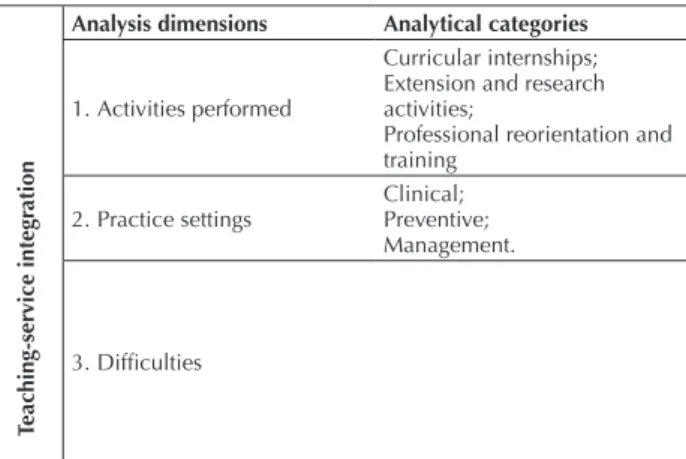
he analysis of the results, along with the theoretical fra-mework and document analysis, evidenced connections that fostered the development of programs, and projects imple-mented to strengthen teaching-service integration in the re-searched disciplines. hus, the analysis categories allowed for the identiication of the constituent elements of teaching--service integration at UFBA, such as activities performed, practice settings, and diiculties, as shown below:
Table 1 – Analysis categories
Teac
hing-ser
vice integr
ation
Analysis dimensions Analytical categories
1. Activities performed
Curricular internships; Extension and research activities;
Professional reorientation and training
2. Practice settings
Clinical; Preventive; Management.
3. Dificulties
Source: Constructed by the authors, February, 2015.
Discussions about the training of human resources for the public health sector have existed in the political sce-nario since the SUS was irst considered. his theme was included in the propositions of the Health Reform mo-vement, presented at the Eighth National Health Confe-rence and the First National ConfeConfe-rence on Human Re-sources for Health in 1986, signaling the need for changes in undergraduate courses and the importance of teaching--service integration.
Prior to these conferences, in 1981, the Faculty-Care Integration Program (IDA) was created by the Minis-try of Education, with the proposal of integrating stu-dents into primary care units, favoring linkages between academia and health services (16). After these initiatives,
projects supported by the creation of SUS, were imple-mented, such as: the National Program of Incentives for Curricular Changes in Medical Courses (PROMED), to stimulate the supply of internships in university hos-pitals and primary health care; the Experiences and In-ternships in the Reality of the Uniied Health System Project Program (17), which recognized the health system
as a teaching and learning space; Aprender SUS in 2004, encouraging the integrality of health care as a changing axis of training (18).
hese projects and actions began to drive curricular changes of health disciplines, aimed at strengthening the teaching-service integration at UFBA. herefore, the re-sults of this study can contribute to the relection about what is being developed at UFBA regarding this integra-tion, pointing to changing paths.
PERFORMED ACTIVITIES
he Statute and General Regulations of the Federal
Uni-versity of Bahia (19) has an objective of providing training,
continuing education and qualiication in diferent ields of knowledge and work, in order to exercise professional activities and participate in the development of society. his objective is in line with the DCN Health (20) in the
nursing, physical therapy, speech therapy, medicine, nutri-tion and dentistry disciplines, which encourages the trai-ning of autonomous, insightful professionals to ensure that comprehensive, quality and humanized care is provided to individuals, families and communities.
In order to meet the objectives of this study, based on the questionnaire administered to the coordinators of the analyzed disciplines, the activities identiied as strategic for the teaching-service integration were grouped into subca-tegories, and are discussed below.
CurriCularinternship
An obligatory, supervised, internship was a curricular component in the seven health disciplines, which included the goals of the educational program and was integrated into the teaching-service integration activities. It was con-sidered essential to the training of students and those inte-grating teaching-service in their disciplines. Experience in the curricular internship favored curricular development, enabled the improvement of students’ skills, and strengthe-ned relationships between the partners in the training ins-titution, professionals, managers and users, expanding the possibilities of teaching-service integration (4.10).
Alves and colleagues (10) investigated the experience of a
supervised internship for students in the ninth semester of Dentistry at the Federal University of Paraíba (UFPB), in a Family Health Unit (USF) in the city of João Pessoa. hey concluded that the internship favored the curricular deve-lopment and the approach of higher education institutions, in addition to encouraging a space for critical relection to seek solutions to actual health problems.
extensionandresearChaCtivities
Extension activities were highlighted by all the coordi-nators as supporting the teaching-service integration pro-cess.
cha-Analysis of Service-learning activities adopted in health courses of Federal University of Bahia
racteristic: the axis of linking teaching and research func-tions, expanding and enabling the relationship between the University and society (21).
In 1997, the UFBA program was created, which in 2000 changed names to the Curricular Activity in the Community (ACC), constituting a permanent program of efective integration between teaching/research and socie-ty. Currently it is called Curricular Action in Community and Society (ACCS), and it is integrated into the curricula of most health disciplines.
A study performed with UFBA students, in a setting in Salvador that helps the homeless, demonstrated the im-portance of student involvement in ACCS for professional training. By coexisting and dialoguing, students started to have a broader view of social problems, leading to relec-tions and promoting the development of essential practices for growth as future professionals and individuals partici-pating in various segments of society (21).
he ACCS were also indicated as integrating teaching--service in public health and medicine disciplines. Another research study performed at UFBA demonstrated the im-portance of student involvement in ACCS for professional training (22).
On the other hand, research was performed with con-sideration of the teaching-service integration only within the nursing, dentistry and public health disciplines.
In Brazil, the study began soon after the arrival of the university, in the irst half of the twentieth century, aiming to meet the demands of the industrial period. Here in Bra-zil, teaching and research were performed separately and far away from one another, with a lack of communication among activities. In addition, nowadays a greater emphasis is observed in research rather than extension activities (23).
hus, this study emphasizes that, even though research has played a prominent role since the creation of the irst universities in Brazil, unlike extension, this was not one of the activities identiied by most coordinators as integrating teaching and service.
programsforreorientationandvoCational
training
Based on the accumulated experience in the area of health and education,a 2005 partnership betweenthe Mi-nistries of Healthand Education led to the creationof
Pro--Health, initiallycontemplatingthenursing,medicine and dentistry areas. The objectivesincluded the establishment ofmechanisms for technical cooperationbetweenSUS ad-ministratorsandacademic institutions,andthe extension of the duration ofeducational practiceinthe SUS servi-ces, among others. It was expected thatthis program would replace the hospital-centeredmodel with healthpromotion anddisease preventionactions, dueto the close connection with thepublic health system(22).
Thus, since 2005, UFBA has actions of Pro-Health, which enabled the reorganization of the medicine, nursing, pharmacy, speech therapy, nutrition, dentistry and psycho-logy disciplines.
All coordinators of the analyzed disciplines (except
for public health) indicated that thePro-Health and
PET--Health programs represented teaching-service integration activities.
Implementation ofPro-Health and PET-Health progra-ms focused on teaching-service integration, with a view toward using the health service settings as clinical practice settings for academia. These programsaim for the approxi-mationof the academicworld withthe reality of thepublic health system. These initiativescall for centralityin primary care, with the concept ofintegrality inhealth as a reorienting axisof practice in thetrainingprocess for theSUS(23).
praCtiCe settings
Settings for practice orlearningare constituted as pri-vileged placesinthe world of work,intersecting with the worldofeducation.In health care, daily practicescan be remodeledandtransformedto an extent thatdrives the de-velopmentof a relationalandinteractive processbetween teachers, students,healthcare professionals andpatients (22).
Consequently, 57practice settings thatprovided care,
predominantly for SUS, were found, where students
we-re placedto develop andapply thetheories learnedin the classroom, distributed among: basic health units, hospitals,
obstetrics, emergency care units, emergency medical ser-vice (EMS), ambulatory, psychosocial care centers, pu-blic schools, elder care facilities, community associations,
community centers, care centers, centers for prevention and rehabilitation, specialized centers, the Bahia Legisla-tive Assembly, TVBahia, and the MunicipalHealth Se-cretariat of the BahiaState Health Department.Forbetter discussion, these practical scenarios were grouped into categories accordingto their nature:care, prevention,and management.
assistential
An intervention is sought within the training process,
so that degree programsreplacethe axis of training focu-sed onindividualcare providedin hospitalswith a more contextualizedand committededucational process, consi-dering the social, economic andcultural dimensionsof the population.
There is a clear inluence of the reportdevelopedby Abraham Flexner,in 1908, on theBrazilian model of edu-cation in healthconigured on curative practices and, in particular, within hospitals. Due to thisreport, scientiic
and institutional criteria for regulation of academic and professional background in health were introduced (24). Thus, amongother things,hospitalswere consideredfrom the perspective oftheir contribution to theeducationof he-alth professionals.
The data of this studyindicate that the hospital setting
is the mainpractice areaoffered to studentsof the investi-gated disciplines. Of the 57placeslistedby the discipline coordinators, 23corresponded tohospitals.Outpatient cli-nicswere alsoincluded in thiscategory; discipline coordi-nators identiied eight outpatient clinics.
par-ticipationof the teachinghospitalsin the education of he-alth professionals, as almost allof the professionalshave, in hospitals, prioritized the ieldofacademic education(25), which match theresults of this study. The most important polarization might be thedebatebetween the deinstitutio-nalizationof education as opposed to a hospital-centered model.
preventive
The educationalprocessfor health personnelis prima-rily organized from thelabor market, especially by streng-theningresearch,innovation, teaching andcaregiventothe establishment of the hospital-centered model. Specialties began toorganize bothuniversityhealth care departments anddisciplinesin teaching hospitalsand clinics. Therefore, little attention was given toprimary carepractice settings(26). However, UFBA is already reconsideringitscurricular framework for healthdisciplines.Within nursing, speech therapy, medicineand nutrition, there are 13practice set-tingscorrespondingto the basichealthunits that integrate teaching and service. In addition, thedentistry discipline, although not indicated inbasic health units, is mentioned
within social centers, which fall within theprimary care modelofhealth.
management
The public health discipline only provided trainingin the management area. This discipline, created in 2009, from theSupport Programfor the Restructuringand Ex-pansion ofFederal Universities(Reestruturação e Expan-são das Universidades Federais - REUNI), developed its curriculum to include the following skills: analysis and
monitoringof health status; planning, programming, ma-nagement and assessment ofhealth systems andservices; health promotion, risk prevention and health problems;
managementofcollectivework processesin health;ethics in public health. hus, the practical scenarios ofered in this discipline, within the Municipal and State Secretary of Health, ensure the inclusion of students in political and management levels. hus, these future professionals may be responsible for policy-making practices, planning, pro-gramming, coordination, monitoring and assessment of health care systems, as well as contributing to the streng-thening of health promotion and environmental, sanitary and epidemiological surveillance (27).
DIFFICULTIES
Integration between teaching and service depends on various supports so that in fact it occurs in the perfect con-dition, operating in perfect harmony. However, it is known that diiculties remain in the implementation, despite the activities of the disciplines having been met. Based on the answers of the discipline coordinators, 15 were related to diiculties in teaching and service integration. he prima-ry concern regarded the receptivity of the students to the service and the professionals linked to it. Neither the he-alth units nor the working professionals are structured or
empowered to receive students, either due to the lack of investment or their own disinterest, lack of inancial, cul-tural and scientiic encouragement of the institution and/ or service of the employee, and because of the belief that students will cause diiculties with their work routine.
In this scenario, a diference in process is observed in the practice areas between public and private universities, in which public institutions are disadvantaged, because pri-vate schools have strategically established a paid scholar-ship for the preceptorscholar-ship, in order to ensure acceptance of these students by health professionals.
Furthermore, a lack of clinical placement sites was iden-tiied in public and state organizations, due to the number of private courses being ofered. he lack of adequate pri-mary care unit infrastructure to receive students and te-achers, and the shortage of professionals in some health teams is noted, preventing multidisciplinary work aimed at the provision of quality health service: a recruitment strategy to fully staf integrated teams is required. he co-ordinators of speech therapy, nutrition and physiotherapy disciplines provided these data. hus, there must be a phy-sical structure containing all relevant subjects integrated in the practice scenario, along with materials and technolo-gies available for improved care. All indings of this study corroborate with results of research on the diiculties in developing activities in teaching-service integration (9,28-29).
CONCLUSION
he health education model was broadly discussed in regard to practical curriculum, plans and educational con-tent. According to university and health reforms, another type of professional proile was necessary, which was active in diferent ields of practice, more qualiied, and able to change to meet the actual needs of the population. hus, linking the university and the health service, whose stu-dents must be integrated into diversiied practice settings, impacts professional training and qualiication. herefore, it is clear that universities tend to be linked with health services in order to provide better professional training.
he UFBA followed this path, and also incorporated the changes, since it interacted with health services so that its students could be in practice settings to implement the lessons learned in the classroom, becoming more skilled workers. he supervised curricular internship, extension and research activities, and reorientation and training pro-grams were described as teaching-service integration acti-vities that were present in seven health disciplines studied. he supervised curricular internship, found in the seven disciplines studied, and in accordance with the objectives of the pedagogical project, is essential for the professional formation of students.
he extension and research activities were also present in the seven disciplines, so it may be inferred that these are critical in the formation process.
Guidance and vocational training programs were also considered essential in health education, although the pu-blic health course did not address these programs.
Analysis of Service-learning activities adopted in health courses of Federal University of Bahia
higher education process are instituted in the educational projects, derived from changes that begin to consider the diversiication of practice settings, and the early integration of the student in health settings (mostly SUS) and social support networks.
However, despite the eforts to make changes, diiculties were encountered, mainly related to the organization of the mediation between the university and the health services, which question, analyze and redeine this integration.
herefore, the integration between the university, the Municipal Secretary of Health, and health facilities where services are provided, should be facilitated and efective in order to beneit both parties, as each institution needs the other. he university needs settings for its students to come
into contact with the social reality and to practice what is learned in the classroom, in order to improve the training and professional qualiications through lived experience, and consequently improve health care. And, the health services require the sharing of experience and knowledge among teachers, students and health care professionals, be-cause it establishes an ongoing teaching-learning process among them, favoring the progress of the service.
Considering that the study did not address the facilities for the development of teaching-service integration activi-ties, the lack of this category is presented as a limitation of this research. Research about the facilities that contribute to the relationship between higher education and the health services is indicated as a possibility for further studies.
RESUMO
Esse estudo teve como objetivo levantar e discutir os dados acerca das atividades de integração ensino-serviço de cursos de saúde oferecidos na Universidade Federal da Bahia (UFBA), apresentando os cenários de práticas e as principais diiculdades existentes na relação entre a uni-versidade e os serviços de saúde. Tratou-se de uma pesquisa qualitativa, de caráter descritivo exploratório, utilizando-se um questionário como instrumento de investigação aplicado aos coordenadores dos cursos de saúde selecionados. A seleção foi mediante a leitura do projeto político pedagógico, sendo selecionados os seguintes cursos: enfermagem, isioterapia, fonoaudiologia, medicina, nutrição, odontologia e saúde coletiva. Os resultados indicaram 8 tipos de atividades de integração ensino-serviço, 57 cenários de prática e as principais diiculdades. Concluiu-se que esses cursos estão aderindo às mudanças na formação acadêmica em saúde, tendo em vista o grande número de unidades básicas de saúde que integram o processo de ensino serviço. Dessa forma, ressalta-se que a UFBA contempla atividades na área de saúde que viabilizam a integração-ensino no processo de formação superior, embora existam algumas diiculdades nesta relação apontadas pelos coordenadores.
DESCRITORES
Universidade; Saúde; Educação em Saúde.
RESUMEN
Este estudio tuvo como objetivo plantear y discutir los datos sobre la integración de las actividades de salud cursos de enseñanza y de servicios que se ofrecen en la Universidad Federal de Bahía (UFBA), la presentación de las prácticas de los escenarios y las principales diicultades que existen en la relación entre la universidad y los servicios salud. Este fue un estudio cualitativo de carácter exploratorio descriptivo, mediante un cuestionario como herramienta de investigación aplicada a los coordinadores de los cursos de salud seleccionados. La selección fue leyendo el proyecto político pedagógico, se seleccionaron los siguientes cursos: enfermería, terapia física, terapia del habla, la medicina, nutrición, odontología y salud pública. Los resultados indicaron ocho tipos de actividades de integración docencia-servicio, 57 escenarios de práctica y las principales diicultades. Se concluyó que estos cursos están pegando a los cambios en la formación académica en la salud, en vista del gran número de unidades básicas de salud en el proceso de servicio de la enseñanza. Por lo tanto, se hace hincapié en que la UFBA incluye actividades en la atención de salud que permiten la integración en la educación en el proceso de la educación superior, aunque hay algunas diicultades en esta relación indicada por los coordinadores.
DESCRIPTORES
Universidad; Salud; Educación en Salud.
REFERENCES
1. Albuquerque VS, Gomes AP, Rezende CHA de, Sampaio MX, Dias OV, Lugarinho RM. A integração ensino-serviço no contexto dos pro-cessos de mudança na formação superior dos proissionais da saúde. Revista brasileira de educação médica. Rio de Janeiro, v. 356, n.
32 (3), p. 356–362, 2008.
2. Carvalho YM de, Ceccim RB. Formação e educação em saúde: aprendizados com a Saúde Coletiva. In: CAMPOS, G. W. de S. [et al]. Tratado de Saúde Coletiva. São Paulo: Hucitec; Rio de Janeiro: Ed. Fiocruz, 2009, cap. 5, p. 137-170 (Saúde em Debate; v.170).
3. Brasil. Ministério da Saúde. Curso de formação de facilitadores de educação permanente em saúde: Orientações para o curso. Rio de Janeiro: Ministério da Saúde/FIOCRUZ, 2005. Disponível em: < <http://bvsms.saude.gov.br/bvs/publicacoes/curso_facilitadores_uni -dade_trabalho.pdf >. Acesso em: 28 out. 2014.
4. Colliselli L, Tombini LHT, Lebal ME, Reibnitzi KS. Estágio curricular supervisionado: diversiicando cenários e fortalecendo a interação ensino-serviço. Revista Brasileira de Enfermagem. Brasília, v. 62, n. 6, p. 932-7, nov./dez. 2009.
5. Pinto LL, Formigli VLA, RegoRCF. A dor e a delícia de aprender com o SUS: integração ensino-serviço na percepção dos internos em medicina social. Revista Baiana de Saúde Pública. Bahia, v. 31, n. 1, p. 115-133, jan./jun. 2007.
6. Souza AL, CARCERERI DL. Estudo qualitativo da integração ensino-serviço em um curso de graduação em Odontologia. Interface - Co -municação, Saúde e Educação. Botucatu, v. 15, n. 39, p. 1071-1084, out./dez. 2011.
8. Campos MAF, Forster AC. Percepção e avaliação dos alunos do curso de Medicina de uma escola médica pública sobre a importância do estágio em saúde da família na sua formação. Revista Brasileira de Educação Médica. Rio de janeiro, v. 32, n.1, p. 83-89, 2008. 9. Finkler M, Caetano JC, Ramos FRS. Integração “ensino-serviço” no processo de mudança na formação proissional em Odontologia.
Interface – Comunicação, Saúde, Educação. Botucatu, v. 15, n. 39, p. 1053-67, out./dez. 2011.
10. Alves LA, Freire IA, Braga CC, Castro RD. Integração ensino-serviço: experiência exitosa na atenção odontológica à comunidade. Revista Brasileira de Ciências da Saúde.São Caetano do Sul, v. 16, n. 2, p. 235-238, 2012.
11. Pizzinato A, Gustavo AS, Santos BRL, Ojeda BS, Ferreira E, Thiesen F V,et al. Integração ensino-serviço como estratégia na formação pro -issional para o SUS. Revista Brasileira de Educação Médica. Rio de Janeiro, v. 170, n. 36, supl. 2, p. 170-177, 2012.
12. Ribeiro BB, Eckert JB, Figueiredo ACM, Galhardi WMP, Campanaro CM. Experiência de ensino em medicina e enfermagem: promovendo a saúde da criança. Revista Brasileira de Educação Médica. Rio de Janeiro, v. 36, n. 1, s.2, p. 85-96, 2012.
13. Rebnitz KS, Daussy MFS, Dilva CAJ, Reibnitz MT, Kloh D. Rede docente assistencial UFSC/SMS de Florianópolis: relexos da implantação dos projetos Pró-Saúde I e II. Revista Brasileira de Educação Médica. Rio de Janeiro, v. 36, n. 1, s. 2, p. 68-75, 2012.
14. Brehmer LCF, Ramos FRS. Experiências de integração ensino-serviço no processo de formação proissional em saúde: revisão integrativa. Revista Eletrônica de Enfermagem. Goiás, v. 16, n. 1, p. 228-237, jan./mar. 2014.
15. Bardin, Laurence. Análise de conteúdo. Portugal: Edições 70, 2010.
16. Costa HOG, Kalil MEX, Sader NMB. Rede UNIDA: Un nuevo actor social en El campo de las políticas públicas. In: Almeida, M., Feu -erwerker, L., Llanos, C. M., editores. La educación de los profesionales de la salud en latinoamerica: teoria e pratica de um movimento de mudança. Tomo 1: um olhar analítico. São Paulo: Hucitec, 1999, p. 1-16.
17. Torres OM. Os estágios de vivência no Sistema Único de Saúde: das experiências regionais à (trans)formação político pedagógica do Ver-SUS/Brasil. Dissertação (Mestrado Proissionalizante em Gestão de Sitemas de Saúde). Instituto de Saúde Coletiva da Universidade Federal da Bahia, 2005.
18. Gonzalez AD, Almeida M J de. Integralidade da saúde – norteando mudanças na graduação dos novos proissionais. Ciência & Saúde Coletiva. Rio de Janeiro, v. 15, n. 3, p. 757-762, 2010.
19. UFBA. Universidade Federal da Bahia. Estatuto e Regimento Geral. Salvador, 2010. Disponível em: <https://www.ufba.br/sites/www.ufba. br/iles/estatuto_regimento/index.html>. Acesso em: 13 out. 2014.
20. Brasil. Ministério da Educação. Diretrizes Curriculares Nacionais: cursos de graduação, 2001. Disponível em: <http://portal.mec.gov.br/ index.php?option=com_content&id=12991&Itemid=866> . Acesso em: 27 out. 2014.
21. Souza GB. Extensão universitária em campo: possibilidades para a formação dos estudantes da Universidade Federal da Bahia. 2014. 88 f. Dissertação (Mestrado em Estudos Interdisciplinares Sobre a Universidade) – Instituto de Humanidades, Artes e Ciências, Universidade Federal da Bahia. Salvador, 2014.
22. Dias HSA. A implementação da política de reorientação da formação em odontologia: dependência de trajetória e estímulos institucio -nais na UFBA. 2011, 133 f. Dissertação (Mestrado em Ciências na Saúde Pública) – Escola Nacional de Saúde Pública; Fiocruz. Rio de Janeiro, 2011.
23. Dias HS, Lima LD, Teixeira M. A trajetória da política nacional de reorientação da formação proissional em saúde no SUS. Ciência & Saúde Coletiva. Vol. 18, n. 6, p. 1613-1624, 2013.
24. Almeida Filho Nde. Reconhecer Flexner: inquérito sobre produção de mitos na educação médica no Brasil contemporâneo. Cadernos de Saúde Pública, Rio de Janeiro, v. 26, n. 12, p. 2234-2249, dez. 2010.
25. Machado SP, Kuchenbecker R. Desaios e perspectivas futuras dos hospitais universitários no Brasil. Ciência & Saúde coletiva (online). 2007, vol. 12, n. 4.
26. Machado SP, Kuchenbecker R. A educação médica diante das necessidades sociais em saúde. Revista Brasileira de Educação Médica, vol. 29, n. 2, p. 136-146, 2005.
27. Teixeira CF. Graduação em saúde coletiva: antecipando a formação do sanitarista. Interface (Botucatu), 2003, vol. 7 n. 13, pp. 163-166.
28. Almeida MM, Morais RP, Guimarães DF, Machado MFAS, Diniz RCM, Nuto SAS. Da teoria à prática da interdisciplinaridade: a experi -ência do Pró-Saúde Unifor e seus nove cursos de graduação. Revista Brasileira de Educação Médica. Rio de Janeiro, v. 31, n. 1, s. 1, p. 119-226, 2012.