Factors relating to failure to quit smoking:
a prospective cohort study
Fatores relacionados ao insucesso na cessação tabágica:
um estudo de coorte prospectivo
Renata Cruz Soares de Azevedo
I, Rejane Firmino Fernandes
IIPsychiatry Clinic and Clinical Hospital, Universidade Estadual de Campinas (Unicamp), Campinas, São Paulo, Brazil
ABSTRACT
CONTEXT AND OBJECTIVE: Considering the diiculties in stopping smoking, this article aimed to identify factors relating to failure of attempts to quit smoking among smokers who sought care at an outpatient clinic in a general university hospital.
DESIGN AND SETTING: Prospective cohort study evaluating 100 smokers who sought treatment at the Psychoactive Substances Outpatient Clinic.
METHODS: The variables gathered were sociodemographic factors; degree of dependence (Fagerström questionnaire); stage of motivation for change (University of Rhode Island Change Assessment Scale); and presence of depression and anxiety (Hospital Anxiety and Depression Scale). The patients were followed up after 4, 8, 12 and 24 weeks to identify factors relating to failure to quit smoking.
RESULTS: The patients were mostly women (75%), between 40 and 59 years of age (67%); with incomplete elementary education (60%); with leisure activities (57%); sufering from tobacco-related disease (53%); with previous attempts to quit smoking (70%); with a medical recommendation to stop (51%); with en-couragement to stop (66%); and with a high degree of dependence (78%). The main motivational stage was contemplation/action (43%); the anxiety rate was 64% and the depression rate was 39%. The quitting rate was 66% among adherents and 17% among non-adherents (P < 0.001). Lack of success was correlated with absence of leisure, higher education and absence of tobacco-related disease.
CONCLUSION: The variables of lack of leisure activities, higher education and/or lack of tobacco-related disease correlated with failure to quit smoking among smokers who sought treatment at an outpatient clinic in a tertiary general hospital.
RESUMO
CONTEXTO E OBJETIVO: Considerando as diiculdades na cessação do tabagismo, este artigo objetiva identiicar fatores relacionados ao insucesso na tentativa de cessação tabágica de fumantes que procura-ram atendimento em ambulatório de um hospital geral universitário.
TIPO DE ESTUDO E LOCAL: Estudo de coorte prospectivo, que avaliou 100 fumantes que procuraram tratamento no Ambulatório de Substâncias Psicoativas.
MÉTODOS: Avaliaram-se variáveis sociodemográicas, grau de dependência (Questionário de Fagerström), estágio de motivação para a mudança (University of Rhode Island Change Assessment), presença de depressão e ansiedade (Hospital Anxiety and Depression Scale). Os pacientes foram acompanhados em 4, 8, 12 e 24 semanas para identiicar fatores relacionados ao insucesso na cessação do tabagismo.
RESULTADOS: Os pacientes eram, na maioria, mulheres (75%), entre 40 e 59 anos de idade (67%), com ensino fundamental incompleto (60%), com atividades de lazer (57%), portadores de doença tabaco-re-lacionada (DTR) (53%), com tentativas anteriores de parar de fumar (70%), que receberam recomendação médica (51%) e incentivo para a cessação (66%) e com elevado grau de dependência (78%). O estágio de motivação principal foi contemplação/ação (43%), a taxa de ansiedade foi de 64% e de depressão, 39%. A taxa de cessação foi de 66% entre os que aderiram e de 17% entre aqueles que não aderiram (P < 0,001). O insucesso foi relacionado à ausência de lazer, maior escolaridade e ausência de DTR.
CONCLUSÃO: Falta de atividades de lazer, maior nível educacional e/ou não ter DTR foram variáveis rela-cionadas ao insucesso na cessação tabágica para tabagistas que procuram tratamento em ambulatório inserido em hospital geral terciário.
IMD, PhD. Psychiatrist and Professor of the
Department of Medical Psychology and Psychiatry, Faculdade de Ciências Médicas, Universidade Estadual de Campinas (FCM-Unicamp), Campinas, São Paulo, Brazil.
IIMSc. Clinical Psychologist. Graduate Program
in Medical Sciences, Faculdade de Ciências Médicas, Universidade Estadual de Campinas (FCM-Unicamp), Campinas, São Paulo, Brazil.
KEY WORDS:
Smoking. Therapeutics. Treatment outcome. Tobacco use cessation. Ambulatory care.
PALAVRAS-CHAVE:
Tabagismo. Terapêutica.
INTRODUCTION
Worldwide, it has been estimated that there are 1.3 billion smok-ers and that 80% of them live in developing countries.1 Conse-quently, more than half of the world’s population is exposed, directly or indirectly, to the harmful efects of nicotine and other toxic substances in tobacco. According to data from the World Health Organization (WHO), approximately 700 million chil-dren are involuntarily exposed to tobacco smoke, especially within the home environment, thus increasing the pneumonia and bronchitis rates and the risk of sudden death, among other diseases.2 Smoking is the leading cause of preventable death worldwide and is considered to be a serious public health prob-lem. In 2009, the WHO estimated that ive million deaths were attributable to smoking. If current patterns of tobacco use are not reversed or the measures provided for global tobacco control are not adopted, the projection for 2025 is 10 million deaths.1
In Brazil, smoking afects 17.2% of the population over 15 years of age.3 Data from the National Cancer Institute indicate rates of 200,000 deaths per year, i.e. 23 people die every hour because of smoking-related conditions.4
Despite the dissemination of information regarding the dan-gers of smoking, there are several diiculties in the process of breaking an addiction, going from the decision to quit to success and persistence in stopping. his diiculty is due to several mech-anisms, including positive reinforcement (because the action of nicotine on the central nervous system results in feelings of plea-sure, increased disposition, attention and reduced appetite), con-ditioning (triggered by environmental stimuli and positive and negative emotions associated with smoking) and negative rein-forcement (sustained use to avoid the discomfort of withdrawal syndrome symptoms, especially anxiety, dysphoria, increased appetite, irritability and diiculty in concentrating).5
he efect of nicotine on the brain and the pharmacologi-cal and behavioral processes that determine nicotine addiction contribute towards the diiculty in maintaining abstinence. he symptoms of nicotine withdrawal are the primary reason why only 5% to 10% of smokers manage to quit without help.6
he variables associated with success in stopping smoking should be considered in strategies for approaching smokers. Sev-eral studies7 have shown that older men and women, those who are married and those with high socioeconomic status all display better results relating to stopping smoking. Moreover, the num-ber of cigarettes smoked per day is also directly related to better responses towards attempts to quit smoking.
To optimize the strategies for treating smoking, it is also rel-evant to discuss the factors related to failure in treating smokers. Studies7,8 have shown that high levels of anxiety and depression in patients make adherence to and success in treating smoking addiction quite diicult, and that starting smoking at an early age decreases the likelihood of adherence to treatment.
OBJECTIVE
To identify factors relating to failure in attempts to quit smoking among smokers who sought medical care at an outpatient clinic in a general university hospital.
METHODS
his was a quantitative, descriptive and prospective cohort study that assessed smokers who sought treatment for the irst time at a specialized clinic in a public university. he subjects were eval-uated at the time of their irst attendance at the clinic and were reassessed ater 4, 8, 12 and 24 weeks.
he study used convenience sampling, with inclusion of 100 individuals who visited the Psychoactive Substances Outpatient Clinic (Ambulatório de Substâncias Psicoativas, ASPA) of the Clinical Hospital, Universidade Estadual de Campinas (HC/Uni-camp) for the irst time between March 2008 and March 2009, in order to receive treatment for tobacco addiction.
he inclusion criteria were that the patients could be either male or female and that they needed to be over 18 years of age, to have been daily smokers for at least six months, to be seeking treatment for stopping smoking at ASPA/Unicamp for the irst time and to have suicient time to be interviewed before partici-pating in the initial care at the clinic.
he exclusion criteria were the presence of any cognitive or psy-chological impairment that prevented understanding of the research and/or non-acceptance of the informed consent statement.
Every patient who comes to ASPA because of smoking prob-lems is routed to a motivation group, which functions as an open group, without the need for a formal referral. he group meetings for outpatients are held weekly, conducted by the outpatient pro-fessional team (psychiatrist, pulmonologist, dentist, nurse, social worker, psychologist or occupational therapist) and observed by postgraduate students, residents and public health provid-ers under training. he group meetings are one hour in length and the topics of discussion include the diiculties in quitting, mechanisms relating to nicotine addiction, barriers against stop-ping, treatment alternatives and strategies for recognizing per-sonal motivators for stopping smoking. Ater a patient has par-ticipated in at least four group sessions and is motivated to move forward in the process, he/she is instructed to complete an indi-vidual assessment prior to inclusion in the therapeutic group.
We used two semi-structured questionnaires (one for the ini-tial assessment and one for the follow-up at weeks 4, 8, 12 and 24) and ive psychometric instruments, all applied individually by the irst author of the study, as described below.
any physical illnesses and what type; mental illnesses and what type; whether the patient was consuming alcohol and how oten; and what use was made of other psychoactive sub-stances) and data relating to the recommendation to come to the clinic.
• Fagerström addiction questionnaire:9,10 this consisted of six questions that evaluated tobacco addiction, with scores rang-ing from 0 to 10. hese scores were used to classify depen-dence as low, medium or high.
• University of Rhode Island Change Assessment Scale (URICA):11,12 this scale evaluated the stage of action for change. It consists of 32 items divided into four subscales:
precontemplation, contemplation, action and maintenance. his scale can be used to evaluate any addictive behavior, and has previously been validated and adapted for the Brazilian population.
• Hospital Anxiety and Depression Scale (HAD):13,14 this scale was primarily designed to detect mild degrees of depression and anxiety among non-psychiatric patients in a general hos-pital. Patients are asked to answer based on how they felt dur-ing the preceddur-ing week. In the current study, a cutof value of 8/9 was used.
• Semi-structured questionnaire for data on smoking: this
investigated the history of tobacco use; whether the patient was living with smokers; whether the patient had had any tobacco-related health problems; data on previous attempts to quit, i.e. whether it had previously been attempted and how oten it had been attempted; and data on motivation to stop smoking, i.e. whether there had been any encourage-ment, who had provided the main encourageencourage-ment, the fam-ily’s reaction to the decision to stop and what motivated the decision to stop smoking.
• Follow-up questionnaire: a semi-structured questionnaire
was applied in the 4th, 8th, 12th and 24th weeks ater the irst interview. he questionnaire investigated patient attendance at care services, adherence or non-adherence to treatment and outcome (i.e. whether the patient stopped, reduced, increased or maintained smoking, or relapsed).
We also identiied tobacco-related comorbidities that were
mentioned by patients: cardiovascular diseases (hyperten -sion, atherosclerosis, angina, myocardial infarction, stroke and thromboangiitis obliterans), respiratory conditions (chronic bronchitis, emphysema, pneumothorax, congestive cardiorespi-ratory, asthma and respiratory infections) and cancers (in the lungs, mouth, tongue, pharynx, larynx, esophagus, stomach, pancreas, liver, bladder, colorectum, prostate, skin and lym-phoid cells).15
Patients who attended the motivational group meetings but did not begin attending the therapeutic group meetings were deemed to present non-adherence to treatment. Patients who
had not stopped smoking at follow-up assessments (weeks 4, 8, 12 and 24) were deemed to present therapeutic failure. he results presented in this article refer to the outcomes evaluated at the end of the 24th week of the follow-up. he criterion for adher-ence to treatment was preestablished: patients were considered
to be adherent to treatment when they attended the motivational group sessions at least four times.
Patients who sought ASPA to obtain treatment for tobacco addiction during the study period and who arrived at the clinic at least 20 minutes prior to the group motivational session were asked whether this was their irst time seeking this service. When the answer was airmative, they were invited to participate in the study through providing them with an explicit descrip-tion of its goals and allowing them to read the informed con-sent statement. hose who did not arrive for the irst day of treat-ment early enough to be interviewed prior to the group meeting were excluded. he aim in choosing not to include in the study patients who were not seeking ASPA for the irst time and not to conduct interviews ater the group motivational session was to avoid using terms that patients in this group had learned and to avoid situations in which the patients had learned not to express
their spontaneous motives. For patients who were included in the
survey, ater they had agreed to participate, the aforementioned tools were administered.
To perform the follow-up, the researcher contacted the patients in an outpatient setting at the end of the visits. When the patient did not attend the clinic on the scheduled day of their follow-up interview (weeks 4, 8, 12 or 24), telephone calls were made to ask them to come to the clinic during the fol-lowing week. If telephone contact was not possible, the
follow-ing measures were used: telephone directory aided by Internet
search; and assistance from the Social Services of the Clini-cal Hospital of Unicamp. After three requests for attendance, if the patient did not visit the clinic, a follow-up interview was conducted by telephone. If both measures were unsuc-cessful, the patient was considered to have been lost from the follow-up.
his study was approved by the Research Ethics Committee
of Unicamp under registration number 0690.0.146.000-07. he data gathered were entered into the SAS sotware data-base (SAS – Statistical Analysis Systems, version 9.1.3., 2002-2003). To analyze the relationship between categorical
vari-ables, the chi-square test or the Fisher exact test (for expected
values lower than 5) was used. To analyze non-adherence and
therapeutic failure outcomes, the Cochran and Friedman tests
RESULTS
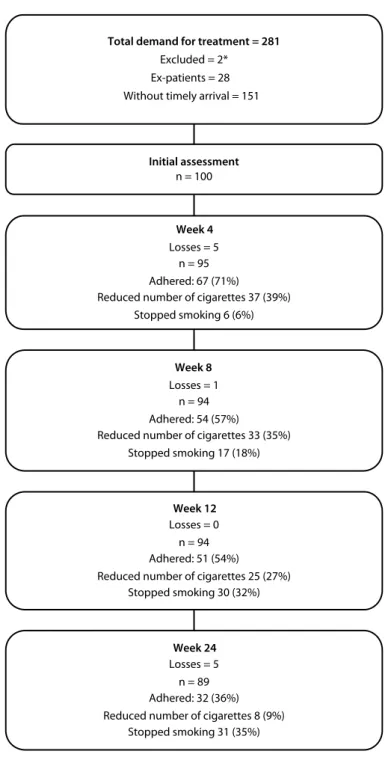
During the study period, 281 people sought treatment for tobacco addiction at the Psychoactive Substances Outpatient Clinic of the Clinical Hospital, Unicamp. Of these, 151 people did not arrive for the irst day of treatment suiciently early to be interviewed prior
to the group meeting and were not included in the study. Further -more, 28 subjects had previously been patients at the clinic and were making a new attempt because of a relapse, and were there-fore excluded. Two subjects were excluded due to psychological or
cognitive impairment: one showing signiicant cognitive impair -ment and the other showing symptoms of intoxication during the interview. hus, we evaluated 100 smokers who sought treatment to stop smoking for the irst time at ASPA (Figure 1).
here was a loss of 11% of the patients over the subsequent six months. he highest rates of loss were concentrated within the irst and fourth weeks (5%) and from the 12th to the 24th week (5%).
Of the smokers evaluated in this study, the majority (64%) had begun smoking before reaching 15 years of age and 72% had smoked for 30 years or more.
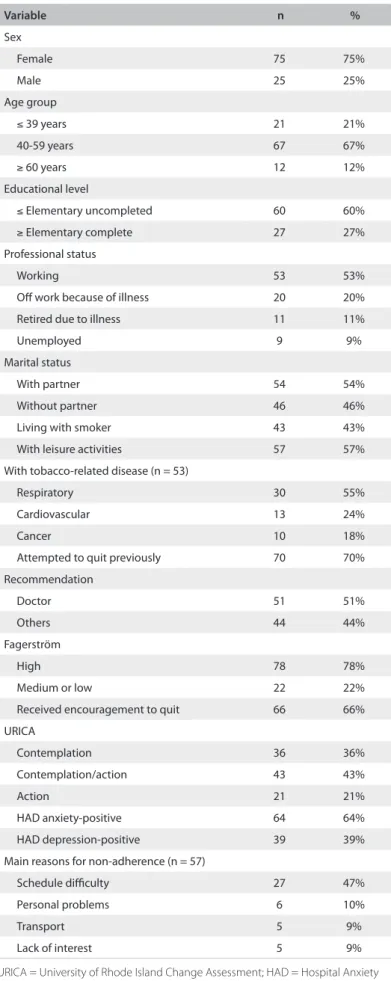
Other data relating to the patients’ proile are shown in Table 1.
Table 2 presents the proiles of the patients who succeeded in stopping and failed to stop smoking ater six months.
he quitting rate was 66% among those who adhered to the treatment and 17% among those who did not adhere (P < 0.001). he criterion for compliance was at least four weeks in group motivational sessions. he reasons given for noncompliance were oten diiculty in inding time (27% of the patients), dii-culty in obtaining transportation (5%) or personal health prob-lems (8%).
he variables included in logistic regression analysis on the failure to quit smoking were gender, age, education level, pro-fessional status, marital status, living with smoker, leisure
activ-ities, religion, religious practice, tobacco-related disease, Fag
-erström, URICA, HAD for depression and anxiety and main
encouragement.
he results from multivariate logistic regression analysis indi-cated that the variables of tobacco-related disease, leisure and edu-cation level were signiicantly associated with treatment failure at 24 weeks. Moreover, the subjects with a high risk of failure were those without tobacco-related disease (2.7 times), without leisure (3.9 times) and with higher education (4.5 times) (Table 3).
DISCUSSION
he main objective of this study was to investigate factors asso-ciated with failure to quit smoking, among a group of smokers who sought treatment at a specialized clinic. Our intention was to contribute towards increasing the quitting rate based on iden-tifying factors that inluence the failure to quit smoking.
he sociodemographic proile of the smokers who sought treatment was that they were mostly women, within the age
range of 40 to 59 years; they lacked complete elementary education, were employed, were Catholic and had a partner. his is compatible with data from the Brazilian literature.16 hese data suggest that stud-ies addressing two aspects of treating tobacco addiction are
impor-tant: the reasons why lower rates of men seek treatment (even though
the prevalence of smoking is higher among males); and the need to develop strategies to raise smokers’ awareness that they should seek, and health professionals’ awareness that they should recommend,
Figure 1. Monitoring of patients during the study.
Total demand for treatment = 281 Excluded = 2*
Ex-patients = 28 Without timely arrival = 151
Week 4 Losses = 5
n = 95 Adhered: 67 (71%)
Reduced number of cigarettes 37 (39%) Stopped smoking 6 (6%)
Week 8 Losses = 1
n = 94 Adhered: 54 (57%)
Reduced number of cigarettes 33 (35%) Stopped smoking 17 (18%)
Week 12 Losses = 0 n = 94 Adhered: 51 (54%)
Reduced number of cigarettes 25 (27%) Stopped smoking 30 (32%)
Week 24 Losses = 5 n = 89 Adhered: 32 (36%) Reduced number of cigarettes 8 (9%)
Stopped smoking 31 (35%) Initial assessment
n = 100
treatment at an earlier age. hrough this, the harmful conse-quences relating to long-term exposure to cigarette smoke may be minimized.
In terms of smoking history, most of the patients in this study started the habit at 15 years of age or younger, had smoked for 30 years or more and had a high degree of addiction
accord-ing to the Fagerström test. hese data are consistent with other
work in this ield.17 Moreover, most of the patients had previously attempted to quit smoking and had been encouraged to do so and seek treatment. his may indicate that this was a subgroup of patients with greater chances of success.7
he data from this study emphasize the harmful conse-quences of smoking,15 such as the high rates of tobacco-related disease, with prevalence of respiratory diseases. Furthermore,
approximately one-third of the patients were of work or had retired due to illness. Moreover, it is possible that because of their diseases, such individuals may have received more encour-agement from physicians and other health professionals to stop smoking because they used greater quantities of health services in addressing their health problems.18
he comorbidity rates relating to depression and anxiety, eval-uated using the HAD Scale (39% and 64%, respectively), were higher than the rates for the population in general.19 hese variables were not associated with the outcome studied, probably because of the limitations imposed by the number of subjects. However, it is important for these comorbidities to be assessed by healthcare pro-fessionals, with the aim of achieving a broader approach to tobacco addiction.
One study20 has suggested that lower rates of compliance with treatment are directly associated with lower rates of abstinence from smoking. In the current study, success in stopping smoking was signiicantly higher among those who adhered to the treat-ment (66% versus 17% among non-adherents). he relationship between adherence and success indicates the importance of stud-ies that contribute towards optimizing the adherence strategstud-ies. Moreover, this inding suggests that there is a need for studies to deepen the understanding of success rates higher than the spon-taneous quitting rate (around 5% to 10%),6 even among patients who do not adhere to treatment.
he quitting rate of 35% in this study is similar to the ind-ings in other Brazilian and international studies.17,21 his result should encourage expansion of services for smokers, so as to contribute towards reducing the morbidity-mortality associated with tobacco.
One factor that was related to treatment failure in the multi-variate analysis was the lack of leisure activities. It was shown in one study22 that participation in meetings outside of the work-place, at church or with family members was predictive of suc-cess among daily smokers, thus suggesting that social participa-tion promotes successful treatment for smokers. Another study18
Variable n %
Sex
Female 75 75%
Male 25 25%
Age group
≤ 39 years 21 21%
40-59 years 67 67%
≥ 60 years 12 12%
Educational level
≤ Elementary uncompleted 60 60%
≥ Elementary complete 27 27%
Professional status
Working 53 53%
Of work because of illness 20 20%
Retired due to illness 11 11%
Unemployed 9 9%
Marital status
With partner 54 54%
Without partner 46 46%
Living with smoker 43 43%
With leisure activities 57 57%
With tobacco-related disease (n = 53)
Respiratory 30 55%
Cardiovascular 13 24%
Cancer 10 18%
Attempted to quit previously 70 70%
Recommendation
Doctor 51 51%
Others 44 44%
Fagerström
High 78 78%
Medium or low 22 22%
Received encouragement to quit 66 66%
URICA
Contemplation 36 36%
Contemplation/action 43 43%
Action 21 21%
HAD anxiety-positive 64 64%
HAD depression-positive 39 39%
Main reasons for non-adherence (n = 57)
Schedule diiculty 27 47%
Personal problems 6 10%
Transport 5 9%
Lack of interest 5 9%
Table 1. Proile of the study population (n = 100)
reported that smokers who engaged in other activities in their routine and did not need to smoke to pass the time had greater success in the treatment. his indicates that there is a need to integrate strategies considering this variable, in order to facilitate stopping smoking.
he second noteworthy factor associated with failure was a higher education level. his inding was not corroborated by other studies,23 which showed an inverse relationship. It is likely that this inding relates to the fact that the present study evalu-ated individuals who sought treatment at a public university hos-pital with a care proile characterized by high demand, limited space and participation of students and other professionals in training as observers. In addition, the language adopted in the groups indicated that most participants in this study had a low educational proile. However, other studies, particularly among Brazilian populations, should be undertaken in order to exam-ine this hypothesis.
One factor cited in the multivariate analysis as associated with failure to quit smoking was the absence of tobacco-related disease. A recent study24 noted that the presence of tobacco-re-lated disease was corretobacco-re-lated with seeking treatment and
pre-senting greater motivation to quit. From these data, it can be
suggested that smokers could be targeted with greater empha-sis on the beneits associated with prevention of tobacco-re-lated disease, as well as the quality-of-life beneits from stopping smoking, even before the emergence of any disease related to smoking.
Some limitations of this study should be highlighted. he irst relates to the small number of subjects evaluated, which lim-ited the power of statistical analysis. Another limitation was the non-inclusion of individuals who did not arrive on the irst day with suicient time to undergo the interview before their par-ticipation in the host group. Although this method prevented us from including a signiicant number of smokers in the study, it was used because we considered it to be more important for the patients not to be compromised in their search for treatment (i.e. by not starting their care on the desired day) as a result of our research project. A further limitation was that stopping smoking was measured through self-reporting, without biological
valida-tion such as serum cotinine measurement. Finally, it is important
to mention that the study was conducted using a convenience sample (a population that sought treatment with voluntary com-pliance), which imposes limitations on extrapolating the data to diferent populations.
CONCLUSION
he variables of lack of leisure activities, higher education and/ or absence of tobacco-related disease were correlated with failure to quit smoking, among smokers who sought medical care at an outpatient clinic in a tertiary general hospital.
Variable n Failure (%) Success (%) P
Total 89* 58 (65) 31 (35)
Sex
Female 67 43 (74) 24 (77)
0.7
Male 22 15 (26) 7 (23)
Age group
< 50 years 45 30 (52) 15 (48)
0.7
≥ 50 years 44 28 (48) 16 (52)
Schooling
≤ Elementary uncompleted 67 40 (69) 27 (87) 0.05 ≥ Elementary complete 22 18 (31) 4 (13) Professional status
Working 48 33 (57) 15 (48)
0.4
Unemployed 41 25 (43) 16 (52)
Marital status
With partner 48 31 (53) 17 (55)
0.9
Without partner 41 27 (47) 14 (45)
Living with smoker
Yes 39 28 (48) 11 (35)
0.2
No 50 30 (52) 20 (65)
Leisure activities
With leisure activities 50 28 (48) 22 (71) 0.04 Without leisure activities 39 30 (52) 9 (29) Tobacco-related disease (n = 53)
With tobacco-related disease 48 26 (45) 22 (71) 0.01 Without tobacco-related disease 41 32 (55) 9 (29) Attempted to quit previously
Yes 61 38 (66) 23 (74)
0.4
No 28 20 (34) 8 (26)
Recommendation
Doctor 49 31 (53) 18 (58)
0.1
Others 40 27 (47) 13 (42)
Fagerström
High 68 44 (76) 24 (77)
0.8
Medium or low 21 14 (24) 7 (23)
Received encouragement to quit 60 41(71) 19 (61) 0.3 URICA
Contemplation 32 23 (40) 9 (29)
0.3 Contemplation/action 38 25 (43) 13 (42)
Action 19 10 (17) 9 (29)
HAD anxiety-positive 58 38 (66) 20 (64) 0.9
HAD depression-positive 35 24 (59) 11 (35) 0.5
*Losses over the course of the monitoring (n = 11).
Table 2. Proile of failure and success regarding quitting smoking
Variable P OR 95% CI
Leisure Yes
0.010 3.91 1.39-11.01
No Education
≤ Elementary
0.024 4.51 1.22-16.58
> Elementary Tobacco-related disease
Yes
0.049 2.70 1.01-7.25
No
OR = odds ratio; CI = conidence interval.
REFERENCES
1. Organização Panamericana de Saúde. Tabaco e pobreza: um ciclo vicioso. Available from: http://www.opas.org.br/MOSTRANT. CFM?CODIGODEST=213. Accessed in 2011 (Jun 2).
2. World Health Organization. WHO Report on the Global Tobacco Epidemic, 2009: Implementing smoke-free environments. Geneva: World Health Organization; 2009. Available from: http://whqlibdoc.who. int/publications/2009/9789241563918_eng_full.pdf. Accessed in 2011 (Jun 2).
3. Brasil. Ministério do Planejamento, Orçamento e Gestão. Instituto Brasileiro de Geograia e Estatística (IBGE). Pesquisa Nacional por Amostra de Domicílios. Tabagismo 2008. Available from: http://www.ibge.gov. br/home/estatistica/populacao/trabalhoerendimento/pnad2008/ suplementos/tabagismo/tab3_2.pdf. Accessed in 2011 (Jun 2). 4. Brasil. Ministério da Saúde. Instituto Nacional de Câncer. Estimativas de
incidência e mortalidade por câncer em 2003. Available from: http:// www.inca.gov.br/releases/press_release_view_arq.asp?ID=34. Accessed in 2011 (Jun 17).
5. Azevedo, RCS, Boscolo MM, Higa CM. Diretrizes para abordagem do tabagista. Available from: http://www.fcm.unicamp.br/diretrizes/d_n_c/ diretr_abord_tabagista/diretr_abord_tabagista_pag_1.html. Accessed in 2011 (Jun 2).
6. Jain A. Treating nicotine addiction. BMJ. 2003;327(7428):1394-5. 7. van Loon AJ, Tijhuis M, Surtees PG, Ormel J. Determinants of smoking
status: cross-sectional data on smoking initiation and cessation. Eur J Public Health. 2005;15(3):256-61.
8. Melo WV, Oliveira MS, Ferreira EA. Estágios motivacionais, sintomas de ansiedade e de depressão no tratamento do tabagismo [Motivational stages, anxiety and depression symptoms during smoking treatment]. Interação Psicol. 2006:10(1):91-9.
9. Fagerström KO. Measuring degree of physical dependence to tobacco smoking with reference to individualization of treatment. Addict Behav. 1978;3(3-4):235-41.
10. Figlie NB, Pillon SC, Dunn J, Laranjeira R. The frequency of smoking and problem drinking among general hospital inpatients in Brazil – using the AUDIT and Fagerström questionnaires. Sao Paulo Med J. 2000;118(5): 139-43.
11. McConnaughy EA, DiClemente CC, Prochaska JO, Velicer WF. Stages of change in psychotherapy: a follow-up report. Psychotherapy: Theory/ Research/Practice/Training. 1989;26(4):494-503. Available from: http:// www.sciencedirect.com/science/article/pii/S0033320409605283. Accessed in 2011 (Jun 2).
12. Prochaska JO, Di Clemente CC. Transtheoretical therapy: toward a more integrative model of change. Psychotherapy: Theory, Research and Practice. 1982;19(3):276-88. Available from: http://www.deepdyve.com/ lp/psycarticles-reg/transtheoretical-therapy-toward-a-more-integrative-model-of-change-c76zXPn7tM. Accessed in 2011 (Jun 2).
13. Zigmond AS, Snaith RP. The hospital anxiety and depression scale. Acta Psychiatr Scand. 1983;67(6):361-70.
14. Botega NJ, Bio MR, Zomignani MA, Garcia C, Pereira WA. Transtornos do humor em enfermaria de clínica médica e validação de escala de medida (HAD) de ansiedade e depressão [Mood disorders among inpatients in ambulatory and validation of the anxiety and depression scale HAD]. Rev Saude Publica. 1995;29(5):355-63.
15. Brasil. Ministério da Saúde. Instituto Nacional do Câncer. Fique atento! Doenças associadas ao uso dos derivados do tabaco. Conheça o cigarro
por dentro. Available from: http://www.inca.gov.br/tabagismo/frameset. asp?item=atento&link=conheca.htm. Accessed in 2011 (Jun 2). 16. Haggsträm FM, Chatkin JM, Cavalet-Blanco D, Rodin V, Fritsher CC.
Tratamento do tabagismo com bupropiona e reposição de nicotinica [Smoking cessation with bupropion and nicotine replacement]. J Pneumol. 2001;27(5):255-61.
17. Sales MPU, Figueiredo MRF, Oliveira MI, Castro HN. Ambulatório de apoio ao tabagista no Ceará: peril dos pacientes e fatores associados ao sucesso terapêutico [Outpatient smoking cessation program in the state of Ceará, Brazil: patient proiles and factors associated with treatment success]. J Bras Pneumol. 2006;32(5):410-7.
18. Abdullah AS, Yam HK. Intention to quit smoking, attempts to quit, and successful quitting among Hong Kong Chinese smokers: population prevalence and predictors. Am J Health Promot. 2005;19(5):346-54. 19. Kessler RC, McGonagle KA, Zhao S, et al. Lifetime and 12-month prevalence
of DSM-III-R psychiatric disorders in the United States. Results from the National Comorbidity Survey. Arch Gen Psychiatry. 1994;51(1):8-19. 20. Slovinec D’Angelo ME, Reid RD, Hotz S, et al. Is stress management
training a useful addition to physician advice and nicotine replacement therapy during smoking cessation in women? Results of a randomized trial. Am J Health Promot. 2005;20(2):127-34.
21. Croghan IT, Ebbert JO, Hurt RD, et al. Gender diferences among smokers receiving interventions for tobacco dependence in a medical setting. Addict Behav. 2009;34(1):61-7.
22. Lindström M, Isacsson SO, Elmståhl S. Impact of diferent aspects of social participation and social capital on smoking cessation among daily smokers: a longitudinal study. Tob Control. 2003;12(3):274-81.
23. Broms U, Silventoinen K, Lahelma E, Koskenvuo M, Kaprio J. Smoking cessation by socioeconomic status and marital status: the contribution of smoking behavior and family background. Nicotine Tob Res. 2004;6(3):447-55.
24. Castro MRP, Matsuo T, Nunes SOV. Características clínicas e qualidade de vida de fumantes em um centro de referência de abordagem e tratamento do tabagismo [Clinical characteristics and quality of life of smokers at a referral center for smoking cessation]. J Bras Pneumol. 2010;36(1):67-74.
Sources of funding: This article was based on the master’s thesis of RF
Fernandes, titled “Factors involved in the search, adherence and therapeutic
success in treatment of smokers”, presented to the postgraduate program at
Universidade Estadual de Campinas (Unicamp), 2010
Conlict of interest: None
Date of irst submission: October 1, 2010
Last received: June 16, 2011
Accepted: June 29, 2011
Address for correspondence:
Renata Cruz Soares de Azevedo
Rua Severo Penteado, 131/9
Cambuí — Campinas (SP)
CEP 13025-050
Tel. (55 19) 3308-6630