Revista Gaúcha
de Enfermagem
How to cite this article: Nunes EMGT, Gaspar MFM. Leadership in nursing and patient satisfaction in hospital context Rev Gaúcha Enferm. 2016 jun;37(2):e55726. doi: http://dx.doi. org/10.1590/1983-1447.2016.02.55726.
DOI: http://dx.doi.org/10.1590/1983-1447.2016.02.55726
Leadership in nursing and patient
satisfaction in hospital context
A liderança em enfermagem e a satisfação dos pacientes em contexto hospitalar
Liderazgo en enfermería y satisfacción del paciente en contexto de hospital
a Universidade Católica Portuguesa, Instituto de
Ciên-cias da Saúde. Lisboa, Portugal.
b Escola Superior de Enfermagem de Lisboa. Lisboa,
Portugal.
Elisabete Maria Garcia Teles Nunesa
Maria Filomena Mendes Gasparb
ABSTRACT
Objectives: to know the quality of the leadership relationship from the perspective of a chief nurse and nurse, patient satisfaction, the relationship between the quality of the relationship perceived for both and patient satisfaction.
Methods: a quantitative, transverse and correlational approach. Non-probabilistic convenience sample consists of 15 chief nurses, 342 nurses, 273 patients. Data collected at the Central Lisbon Hospital Center, between January and March 2013, through the LMX-7, CLMX-7 and SUCEH21 scales. Statistical analysis was performed through SPSS ® Statistics 19.
Results: the chief nurse considers the quality of the leadership relationship good, the nurses consider it satisfactory, patients are con-sidered to be satisfied with nursing care; there is a statistically significant correlation between the quality of the leadership relationship from the perspective of chief nurses and patient satisfaction, there is no statistically significant correlation between the quality of the leadership relationship in the nurse’s perspective and satisfaction.
Conclusion: the chief nurse has a major role in patient satisfaction. Keywords: Nursing services. Nursing care. Leadership. Patient satisfaction.
RESUMO
Objetivos: conhecer a qualidade de relação de liderança na perspetiva do enfermeiro-líder e do enfermeiro, a satisfação dos pacien-tes, a relação existente entre a qualidade de relação percebida por ambos e a satisfação dos pacientes.
Métodos: abordagem quantitativa, transversal e correlacional. Amostra não probabilística por conveniência constituída por 15 enfermeiros-líderes, 342 enfermeiros, 273 pacientes. Dados recolhidos no Centro Hospitalar de Lisboa Central, entre janeiro e março de 2013, através das escalas LMX-7, CLMX-7, SUCEH21. Análise estatística através de SPSS® Statistics 19.
Resultados: O enfermeiro-líder considera boa a qualidade de relação de liderança; os enfermeiros consideram-na satisfatória; os pacientes consideram-se satisfeitos com os cuidados de enfermagem. Existe correlação estatisticamente significativa entre a quali-dade de relação de liderança na perspetiva do enfermeiro-líder e a satisfação dos pacientes. Não existe correlação estatisticamente significativa entre a qualidade de relação de liderança na perspetiva do enfermeiro e a satisfação.
Conclusão: O enfermeiro-líder tem um papel preponderante na satisfação dos pacientes.
Palavras-chave: Serviços de enfermagem. Cuidados de enfermagem. Liderança. Satisfação do paciente.
RESUMEN
Objetivo: Conocer la calidad de la relación de liderazgo desde la perspectiva del enfermero líder y del enfermero, la satisfacción de los pacientes, y la relación entre la calidad de la relación percibida por ambos y la satisfacción de los pacientes.
Métodos: Investigación cuantitativa, transversal y con enfoque correlacional. Muestra de conveniencia no probabilístico que consta de 15 enfermeros líderes, 342 enfermeros y 273 pacientes. La investigación se llevó a cabo en el Centro Hospitalario de Lisboa Central, entre enero y marzo de 2013, a través de escalas LMX-7, CLMX-7 y SUCEH21. Análisis estadístico se realizó utilizando el software estadístico IBM® IPSS® Statistics 19.
Resultados: El enfermero líder considera buena la calidad de relación de liderazgo y los enfermeros la consideran satisfactoria, los pacientes se consideran satisfechos con la atención de enfermería y hay una correlación estadísticamente significativa entre la calidad de relación del liderazgo en la perspectiva del enfermero líder y la satisfacción de los pacientes. No existe una correlación estadística-mente significativa entre la calidad de la relación de liderazgo en enfermería perspectiva y la satisfacción del paciente.
INTRODUCTION
Across Europe, changes in health policies accelerat-ed from the eighties in order to contain the expenditure growth and ensure the sustainability of the health systems (1). Within these social systems, which present complexity in terms of change, leadership is seen as a key ingredient, pointed out in several studies as having the capacity to influence the results that are sensitive to nursing care(2). Nurses, as leaders, are the cornerstone for “influencing their team in order to achieve shared goals, with the main purpose of meeting the health needs of patients and their families” (3). (Free translation)
The Leader-Member Interaction Theory (LMX) is based on the process of social change and the theory of roles built on the relationship established between the leader and their subordinate. It is one of the first theories that included the subordinate in the leadership process, fo-cusing on the mutual exchange between the leader and the employee, and recognizing that both parties contrib-ute to the development and maintenance of the ongoing quality of the relationship. Through this theory, it can be verified that the person who is led no longer has a static and passive role, exercising influence over the leader, and that the interactions among them are based on processes of social exchange that aim to achieve common interests. The leader establishes different interactions with each member that are based on the respective roles that both negotiate. It is the magnitude of this negotiation that allows differences in the behavior of leaders and subor-dinates, and the consequences that behavior has both to them and the organization to be identified. The main concept is that effective leadership occurs when lead-ers and subordinates have the ability to develop mature relationships, affection, loyalty, respect, partnership and reciprocity, taking into account the existing agreement on the relationship nature established between them (4). As such, it is a process of interaction between leaders and the subordinates, where the leader influences the behav-ior of those led to achieve shared goals.
The study of leadership is possible under different per-spectives. This research is part of the dyadic perspective, which involves the interaction between the leader and the subordinates, and how they relate. It focuses on the rela-tionship and the development of roles between the leader and each of the persons under their command (5).
Studying the leader in this perspective is considered very important, for the focus of most LMX research to date has been on the role of the subordinate. Thus, the perspec-tives of the leaders, or shared perceptions of leaders and
employees are under-represented, with an asymmetry in the available knowledge base (4).
Patient satisfaction is an indicator of results that is ap-plicable in assessing the quality of services (6). Also, the Portuguese Professional Association of Nurses (7) consid-ers the satisfaction of patients related to nursing care as an important and legitimate indicator of quality of care. In this sense, the analysis of satisfaction is an important tool in the planning and organization of care in order to adapt its response to the needs of patients (8). Patient satisfaction is understood as the degree to which nursing care meets patient expectations in terms of the art of care, technical quality, physical environment, availability, continuity and efficacy / outcome (9).
Relational leaders have a positive influence on the health and well-being of nurses and, ultimately, patient outcomes (10). However, scientific literature that evaluates the influence of the leader and his leadership in satisfac-tion is limited. Considering the fact, the influence of nurs-ing leadership in patient satisfaction with nursnurs-ing care is relevant.
Considering the exposed, research questions arise: what is the perception of the leadership relationship be-tween the nurse and the chief nurse? What is the extent of patient satisfaction with nursing care? Is there a relation between the quality of leadership relationship and patient satisfaction? The objective to know the quality of the lead-ership relationship from the perspective of a chief nurse and nurse, patient satisfaction, the relationship between the quality of the respect perceived for both and patient satisfaction arose from these questions.
METHOD
Quantitative, analytical, cross study. It originates from an excerpt in the dissertation drafted for the Doctorate pro-gram in Nursing at the Portuguese Catholic University (11).
The study took place at the Central Lisbon Hospital Center (Centro Hospital de Lisboa Central), in 15 inpatient units (areas of Medicine, Neurosciences, Cardiology Units, Cardiothoracic Surgery and Vascular Surgery). Participants were considered relevant to the issue under study, includ-ing chief nurses, nurses and patients.
least 3 nights was considered, in order to certify there was prolonged contact with the team; physical and psycholog-ical conditions to fill out the questionnaire independently, so that the point of view expressed was a personal per-spective, not that of family / caregivers; and knowledge of Portuguese. All participants who did not meet the inclu-sion criteria mentioned were excluded.
The data collection instrument was a questionnaire consisting of several assessment instruments, previously validated for the Portuguese population:
LMX-7 Scale – Leader Member Exchange, version for subordinates (13). It is composed of seven statements (ex-ample of an item: To what extent does your boss recognize your potential?). The selection of answers is based on the use of a Likert scale with five positions, each of which sig-nify the likelihood of choice, as follows: “Rarely”, “nothing”, “none”, “strongly disagree” and “extremely inefficient” (1) “often”, “a lot”, “very high”, “agree completely” and “extremely effective” (5 ). 2.5 is considered as the cut-off point.
CLMX-7 Scale – Leader Member Exchange, version for leaders (13). Includes questions similar to the version for subordinates, but adapted for the leader, in order to know the perspective of the leader on the nature of the relationship with the employee (example of an item: To what extent does the leader recognize the potential of their employees?). The selection of responses is equal to the previous scale.
SUCEH 21 – Patient Satisfaction with Hospital Nursing Care (14). Composed of 21 items and assesses six dimensions of satisfaction: Effectiveness in Communication, Use of In-formation, Service Quality, Timely Service, Maintenance of Therapeutic Environment and Promotion of Care Continu-ity. It is divided into two groups of items that are answered using a Likert scale with four positions. The first group typ-ifies the probability of choice as follows: “No opinion” (0) “never” (1) “sometimes” (2) and “always” (3) (example of an item: did you feel that nurses cared about your problems?); and the second group: “No opinion” (0) “dissatisfied” (1) “not satisfied / not dissatisfied” (2) and “satisfied” (3) (example of an item: regarding how you were welcomed by the hospi-tal’s nurses).
The studied variables were: the quality of leadership relationship from the perspective of the nurse leader; the quality of the leadership relationship in the nurse’s per-spective, thus, forming a dyad, and patient satisfaction with nursing care.
Data collection followed the previously established rules, and was made known to all participants in order for the dyads to be obtained. Regarding nurses, the LMX-7 scale was provided in an envelope previously encoded
per unit and per respondent. For chief nurses, the CLMX-7 scale was placed in an envelope, corresponding to the number of nurses in that unit. Each scale was coded per unit and per nurse. Chief nurses were asked to make a list, known only to them, with the code that would corre-spond to each nurse, in order for each answer to match one professional, and so that only the investigator could later combine both instruments, forming the dyads. All envelopes were returned unopened to the investigator, thereby maintaining data confidentiality and anonymity of participants. Regarding patients, the instrument was applied during 3 consecutive months, between January and March 2013, and was always applied after the re-leased patient was notified, and delivered by the official administrative department of each hospital unit, to mini-mize the bias of the responses.
Statistical analysis was performed using IBM® SPSS® Statistics 19 statistical software. Statistical tests were per-formed considering a 0.05 significance level.
To verify the normality of the distributions, the Kolm-ogorov-Smirnov tests with Lilliefors correction were used; as the significance levels had values under 0.05, they led to the rejection of the normality of all distributions. In order to assess the psychometric properties of the in-struments, the factor analysis of the instruments and the analysis of internal consistency were performed by cal-culating Cronbach’s alpha coefficient, considering a val-ue greater than 0.80 as a good indicator. To investigate the association between the quality of the leadership relationship and the satisfaction of patients, the Mann Whitney test was performed, where the variable patient satisfaction (SUCEH 21) was previously transformed into a dichotomous variable. Multiple logistic regression was used in order to verify the variables leadership ratio (LMX-7 and CLMX-(LMX-7) to a greater patient satisfaction (SUCEH 21), more associated in statistical terms. As for the ethical aspects, the investigation was authorized by the Ethics Committee for Health of the Central Lisbon Hospital Cen-ter. The non-identification of units under study and the participants was guaranteed by the assignment of codes, also used for the purpose of forming dyads and alloca-tion of patient satisfacalloca-tion to the respective nursing team. A Free and Informed Consent Form was also provided be-fore filling out the instruments.
RESULTS
were considered valid. The chief nurses responded in re-lation to all participating nurses from their teams, form-ing 342 dyads. 273 questionnaires were considered valid regarding the patients.
The sample of nurses consisted mostly of female ele-ments 80.5%, 19.5% of males, with ages between 23 and 59 years, the median is 29 years (mean 31 and standard deviation 6.9). The sample of patients had a median of 61 years old (mean 60 and standard deviation of 11.8), with a minimum of 19 and maximum of 84 years; 54.6% are males and 45.4% of females.
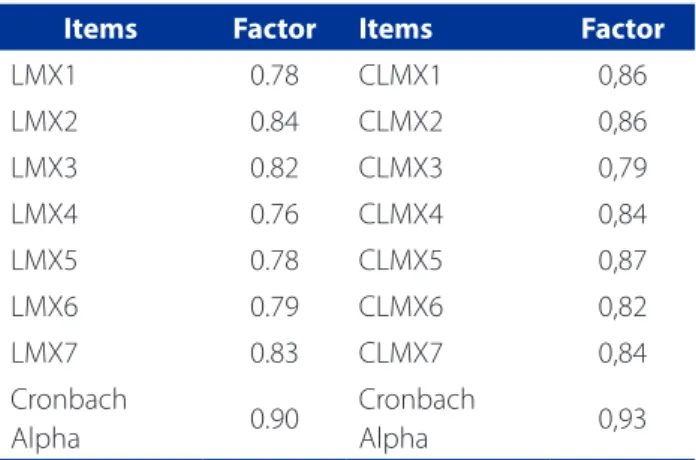
Through factor analysis, it was found that the LMX-7 and CLMX-LMX-7 instruments only saturated in one factor, which supports a one-dimensional construct. The factor explains 64.85% of the variance in the case of the LMX-7, and 71.84% for CLMX-7. The results showed a high internal consistency of the scales (Table 1).
Regarding the SUCEH 21 questionnaire results, they indicated high internal consistency with Cronbach’s alpha of 0.88. As for the nurse’s perspective related to the leader’s relationship quality, a response trend that is proximal to the average was found. As for the assess-ment by the leaders of the quality of their relationship, it was verified that there was a response trend always superior to the average, meaning that these leaders per-ceive their leadership relationship with the direct em-ployees as good. The values obtained through SUCEH 21 found that patients are very satisfied with the quality of nursing care, and that there is little variability in opinions (Table 2).
A rating for each unit was given according to the assessment made by patients, taking into account the median satisfaction with nursing care, thus becoming a dichotomous variable with two categories: below the median (units with the lowest ratings) and above the me-dian (units with highest ratings).It was found that there was no statistically significant difference among nurses of units classified as best and those classified as worst
when speaking of patient satisfaction compared to the LMX (U = 8814.50, p = 0.115).On the other hand, there was a significant statistical difference among nurses of units classified as best and those classified as worst when speaking of patient satisfaction compared to the CLMX (U = 8277.00, p = 0.019). Nurses belonging to the units classified as best showed a better assessment by the chief nurse of their quality ratio (3.71 vs. 3.57) (Table 3)
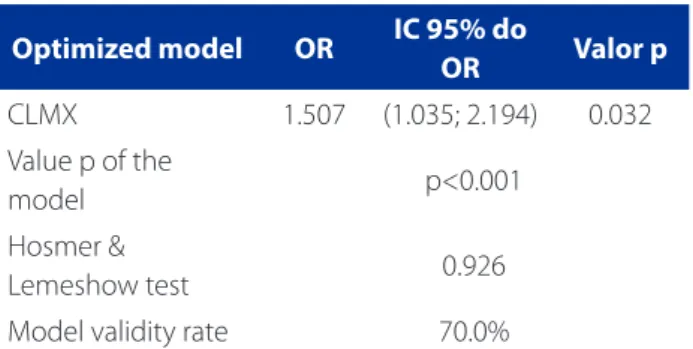
The adjusted model with the variable that showed statistically significant values (p 0.05) in the bivariate sta-tistical analysis (CLMX) was built. The backward method, controlled by the investigator, was used for this purpose, resulting in the optimized model presented in Table 4. It was found that the model is statistically significant (p <0.001), showing good adjustment to the data (Hosmer and Lemeshow p = 0.926) and with a good rate of validity (70%). It was found that, regarding the the better the lead-ership relationship quality from the perspective of the chief nurse, the greater the patient satisfaction.
Items Minimum Maximum Average Median Standard D.
LMX 1.57 5.00 3.24* 3.28 0.72
CLMX 1.86 5.00 3.80* 3.71 0.69
SUCEH21 0.86 3.00 2.67** 2.76 0.35
Table 2 – Minimum, maximum, mean, median and standard deviation values of the quality in leadership relationships and patient satisfaction. Lisbon, 2013
Source: research data, 2013.
Note: * Average according to the Likert scale, with 1 to 5 ** Average value according to the Likert scale, with 0 to 3
Items Factor Items Factor
LMX1 0.78 CLMX1 0,86
LMX2 0.84 CLMX2 0,86
LMX3 0.82 CLMX3 0,79
LMX4 0.76 CLMX4 0,84
LMX5 0.78 CLMX5 0,87
LMX6 0.79 CLMX6 0,82
LMX7 0.83 CLMX7 0,84
Cronbach
Alpha 0.90
Cronbach
Alpha 0,93
Table 1 – LMX-7 (n = 342) and CLMX-7 (n = 15) Scale: Cron-bach Alpha Value, respective item factors and saturation. Lisbon, 2013
DISCUSSION OF THE RESULTS
This study evaluated the quality of the leadership rela-tionship perceived by chief nurses and nurses, evaluating the level of patient satisfaction with nursing care and also the relationship between the leadership perceived by chief nurses and nurses in patient satisfaction with nursing care.
It was found that nurses consider their leadership rela-tionship with the chief nurse satisfactory. These results are slightly lower than those obtained by Trybou et al, where the average LMX was 3.59 (15). In research by Joo (16), whose sample consisted of employees of various companies in the Korean industry, the average was 3.30. Despite the several scenarios where investigations take place, the lead-ership relationship remains at the median level from the perspective of employees.
The assessment of the nature of the leadership ex-ercised by the chief nurse is evaluated as good, with the identification of some discrepancies when evaluating the quality of the relationship between both participants. This inflated assessment by the leader can relate to the fact that the items of the LMX-7 scale focus heavily on attitudes, cognitions and actions of the leader (17). In this sense, the leader has a tendency to perceive them as an evaluation of himself, rather than an assessment of the dyadic relation-ship. On the other hand, one can also read this result as a way chief nurses try to give / provide all nurses good rela-tionship quality, making leadership more effective. There is less variation in the responses of chief nurses in relation to nurses, which is suggestive of a lower power discriminant by the former in their relationships.
Referring to the satisfaction of patients, as in other studies (18), the patients are very satisfied with the care they received during hospitalization. As previously mentioned,
the quality of care in health services is directly linked to patient satisfaction (6). As such, it is recognized that the pa-tients feel they have enjoyed quality nursing care during hospitalization. However, attention should be payed to this evaluation, because there are situations in which patients recognize that the service did not improve their health, but are quite pleased. This can be explained, among other fac-tors, by the low expectations of people in relation to public health services, and the gratitude that hinders the expres-sion of negative opinions and the relationship of depen-dence established with the professionals (8).
As for the influence of the quality of the leadership re-lationship, the results may indicate that the chief nurse, in their relationship with the patient, can consistently trans-mit feelings of trust and confidence placed in the team they lead, managing to positively influence patient satis-faction. Satisfaction is a subjective phenomenon and suf-fers direct or indirect multifactorial influences. Of these, some are related to the expectations of patients and the level of understanding of the guidance provided by health professionals (19). We can thus conclude that continuous and systematic daily presence of chief nurses in care units, besides allowing an individual and personalized relation-ship with each patient, also allows the exposure of its man-agement functions not only to the team they manage, but also in the management of material resources and equip-ment that are made available for patient care. On the other hand, the efforts in coordinating the various health team professionals in the attempt to promote a continuous and comprehensive care are also made visible.
These results are consistent with other studies which highlight the key role of the chief nurse in patient satis-faction (18), and the fact that they can improve the results with respect to this aspect betting on their commitment
Worst rating Highest
rating
Value p
LMX
Median Min.- Máx.
3.29 1.71 – 5.00
3.00
1.71 – 4.71 0.115
CLMX
Median Min.- Máx.
3.57 2.43 – 5.00
3.71
1,86 – 5.00 0.019
Table 3 – Median, minimum and maximum, and p value of leadership regarding the quality relative to patient satis-faction. Lisbon, 2013
Source: Research data, 2013
Table 4 – Multiple Logistic Regression Model for Satisfac-tion. Lisbon, 2013
Optimized model OR IC 95% do
OR Valor p
CLMX 1.507 (1.035; 2.194) 0.032
Value p of the
model p<0.001
Hosmer &
Lemeshow test 0.926
Model validity rate 70.0%
to work and improving the work environment (20). It is considered that chief nurses are a key dynamic element of the teams they lead, have a leading role in creating supportive work environments and as guidance provid-ers, through the interaction and relationship they es-tablish with each team member and the patients. Thus, chief nurses have a key role in ensuring the implemen-tation of the mission, values and principles set by head management, with the tool of choice being relational leadership.
CONCLUSION
In order to know the quality of leadership regarding the satisfaction of patients, and the connection between the quality of this relationship and patient satisfaction, those chosen for the study were chief nurses and nurs-es who, through the tasks they perform, unequivocally contribute to the fulfillment of the mission of hospital organization, and patients who have an opinion on the recognition of how their needs were met during their stay in the organization.
It is hereby concluded that nurses consider themselves as having a satisfactory relationship with the chief nurse, while the chief nurse considers the relationship as good.
As for the influence of the quality of the leadership relationship in patient satisfaction, it is concluded that, in respect of nurses, it does not influence satisfaction. How-ever, when evaluating the quality of the leadership rela-tionship from the perspective of the chief nurse, the latter is decisive in the satisfaction with nursing care, insofar as it is a variable which determines such satisfaction with great consistency.
In terms of the implications of the results, it seems to be noticeable that chief nurses try to create an environment that is conducive to the construction of dyadic partner-ships, as well as the supply of this type of interaction to all team members, although the need for research to this level is still needed.
On the other hand, it is necessary for the leaders to fur-ther improve and develop their interpersonal skills through training so to develop open, congruent relationships, based on mutual trust, and to put them into practice every day, assuming that a LMX high quality relationship involves mutual respect and trust.
Limitations of this study point to the close collabo-ration needed from chief nurses to obtain the data on nurses, aiming to form dyads. This aspect has always been discussed with the leaders, but dyads were rarely opera-tionalized through another approach.
On the other hand, because it is a cross-sectional study, it was not possible to assess the influence of the leader from a perspective of the relationship’s life cycle, as advo-cated by theorists.
Given the sample characteristics, there is also the im-possibility of generalizing the results.
This research may serve as a starting point for further studies in other health care settings, as well as for the study of the construction of dyadic relationships in these contexts.
REFERENCES
1. Silva MV. Políticas públicas de saúde: tendências recentes. Sociol, Probl Práticas. 2012;69:121-8.
2. Melo RC. Liderança e gestão: desenvolvimento de competências relacionais. Loures: Lusodidacta; 2014. 182 p.
3. Amestoy SC, Backes VMS, Thofehrn MB, Martini JG, Meirelles BHS. Trindade L. Gerenciamento de conflitos: desafios vivenciados pelos enfermeiros-líderes no ambiente hospitalar. Rev Gaúcha Enferm. 2014 jun;35(2):79-85.
4. Schyns B, Day D. Critique and review of leader–member exchange theory: issues of agreement, consensus, and excellence. Eur J Work Organ Psychol. 2010;19(1):1-29.
5. Yukl G. Leadership in organizations: global edition. 8th ed.Essex: Pearson
Educa-tion Limited; 2013. 513 p.
6. Carina F, Brás M, Anes E. Satisfação dos utentes com os cuidados de enfermagem nos centros de saúde de uma Unidade Local de Saúde do Nordeste de Portugal. In: Moura C, Pereira I, Monteiro MJ, Pires P, Rodrigues V, corrdenadores. Novos olhares na saúde. Chaves: Escola Superior de Enfermagem Dr. José Timóteo Montalvão Machado; 2014. p. 264-73.
7. Satisfação dos utentes com os cuidados de enfermagem. Ordem Enfermeiros. 2005;16:52.
8. Rosa RB, Pelegrini AHW, Lima MADS. Resolutividade da assistência e satisfa-ção de usuários da Estratégia Saúde da Família. Rev Gaúcha Enferm. 2011 jun;32(2):345-51.
9. Doran, DM, editor. Nursing outcomes: the state of the science. 2nd ed. Sudbury
(MA): Jones & Bartlett Learning; 2011. 522p.
10. Cummings GG, MacGregor T, Davey M, Lee H, Wong CA, Lo E, Muise M, et al. Leadership styles and outcome patterns for the nursing workforce and work environment: a systematic review. Int J Nurs Stud. 2010;47(3):363-85. 11. Nunes EMGT. A liderança relacional, o empenhamento e a qualidade do
exer-cício profissional dos enfermeiros [dissertação]. Lisboa: Universidade Católica Portuguesa; 2013.
12. Naido LJ, Scherbaum CA, Goldstein HW, Graen GB. A longitudinal examination of the effects of LMX, ability, and differentiation on team performance. J Bus Psychol. 2011;26(3):347-57.
13. Graen G, Novak M, Sommerkamp P. The effects of leader-member exchange and job design on productivity and satisfaction: testing the dual attachment model. Organ Behav Human Perform. 1982;30(1):109-31.
14. Ribeiro ALA. O percurso da construção e validação de um instrumento para avaliação da satisfação dos utentes em relação aos cuidados de enfermagem. Ordem Enfermeiros. 2005;1):53-60.
nursing professionals: the moderating effect of professional and organizational identification. J Adv Nurs. 2014;70(2):373-82.
16. Joo BK. Organizational commitment for knowledge workers: the roles of per-ceived organizational learning culture, leader–member exchange quality, and turnover intention. Human Resour Dev Q. 2010;21(1):69-85.
17. Sin H, Nahrgang J, Morgeson FP. Understanding why they don’t see eye to eye: an examination of leader–member exchange (LMX) agreement. J Appl Psychol. 2009;94(4):1048-57.
18. Boev C. The relationship between nurses’ perception of work environment and patient satisfaction in adult critical care. J Nurs Scholars. 2012;44(4):368-75. 19. Sharma A, Goel S, Singh A. Patient satisfaction. In: Goel S, Singh A, Gupta AK.
Hospital administration: a problem-solving approach. New Delhi: Elsevier; 2013. Section IX, 46.
20. Bamford M, Wong C, Laschinger H. The influence of authentic leadership and areas of worklife on work engagement of registered nurses. J Nurs Manag. 2013;21(3):529-40.
Corresponding author:
Elisabete Maria Garcia Teles Nunes E-mail: [email protected]