a Article based on the final work of the Nursing Programme at the Pontifical Catholic University of Paraná (PUCPR). b Nurse. Degree from PUCPR. Curitiba-PR, Brazil
c Nurse. Degree from PUCPR. Curitiba-PR, Brazil
d Nurse. PhD student of Nursing at EEUSP. Faculty member of the Undergraduate Nursing Programme at the PUCPR. Curitiba-PR, Brazil
IMPACT OF VACCINATION IN THE REDUCTION
OF HEPATITIS B IN PARANÁa
Priscila PUDELCOb, Andreia Eloize KOEHLERc, Lúcia Helena Linheira BISETTOd
ABSTRACT
This study identified the impact of hepatitis B vaccine over reducing incidence of this disease in Paraná State, between 2001 and 2011, and discussed the role of nursing in immunization. Descriptive documental and quantitative research. Utilized secondary data of hepatitis B, between 2001 and 2011 and vaccination coverage of hepatitis B vaccine between 1995 and 2011 in Paraná State, available in DATASUS, SINAN and Immunization Programs. Data has been collected from May to July 2012. Included cases of hepatitis B confirmed by laboratory testing. Of the 14,434 selected cases, 81,8% was in urban residents, 86,5% belonged to 20 to 59 age group and 45,3% were infected by sexual transmission. In the correlation of vaccine coverage with the incidence, was identified reducing this rate in the range of 0 to 9 years old, in places with vaccination coverage’s above 95%. It concludes that hepatitis B vaccination had impact over disease reduction in Paraná State.
Descriptors: Hepatitis B. Vaccination. Epidemiology. Public Health Nursing.
RESUMO
Este estudo identificou o impacto da vacinação contra hepatite B na redução da incidência dessa doença no Paraná, de 2001 a 2011, e discutiu a atuação da enfermagem na imunização. Trata-se de pesquisa descritiva documental, quantitativa. Foram utilizados dados secundários de hepatite B, de 2001 a 2011, e de coberturas da vacina hepatite B, de 1995 a 2011, no Paraná, disponíveis no DATASUS, SINAN e Programa de Imunizações. Os dados foram coletados de maio a julho de 2012, incluídos casos de hepatite B confirmados laboratorialmente. Dos 14.434 casos selecionados, 81,8% residiam na zona urbana, 86,5% pertencia à faixa etária de 20 a 59 anos e 45,3% foram infectados por via sexual. Na correlação das coberturas vacinais com a incidência, identificou-se a redução desta taxa nas faixas de 0 a 9 anos, que apresentavam coberturas vacinais acima de 95%. Concluiu-se que a vacinação levou à redução da HB, no Paraná.
Descritores: Hepatite B. Vacinação. Epidemiologia. Enfermagem em Saúde Pública.
Título: Impacto da vacinação na redução da hepatite B no Paraná. Impacto da vacinação na redução da hepatite B no Paraná.
RESUMEN
Este estudio identificó el impacto de la vacuna contra hepatitis B en la reducción de esta enfermedad en Paraná, de 2001 a 2011, y discutió la actuación de la enfermería en la inmunización. Investigación descriptiva documental, cuantitativa. Utili-zados datos secundarios de hepatitis B, de 2001 a 2011 y coberturas de la vacunas hepatitis B, de 1995 a 2011, en Paraná, disponibles en el DATASUS, SINAN y en el Programa de Inmunización. Se recogieron datos de mayo-julio de 2012. Incluye los datos de hepatitis B confirmados por laboratorio. De los 14.434 casos seleccionados, 81,8% residían en zona urbana, 86,5% pertenecían al grupo de 20 a 59 años y 45,3% fueron infectados sexualmente. Por alta cobertura de vacunación, ocurrió re-ducción de la incidencia de hepatitis B de 0-9 años que tenían la cobertura de vacunación por encima del 95%. Se concluye que la vacunación ha impactado en la reducción de la enfermedad.
Descriptores: Hepatitis B. Vacunación. Epidemiología. Enfermería de Salud Pública.
INTRODUCTION
Hepatitis B (HB) is a health problem all over the world. According to estimates, two billion peo-ple have been infected with the HB virus (HBV), 370 million suffer from chronic infection and around one million die every year from diseases related to hepatocellular carcinoma(1).
In Brazil, 120,343 cases of HB were notified to the Notifiable Diseases Information System of the Ministry of Health (SINAN/MS) from 1999 to 2011, in the south-east (36.3%), south (31.6%), north (13.1%), central-west (9.9%) and north-east (9.2%) regions. Since 2002, the south region has recorded the highest incidence rate in the country (2).
HB occurred with high and moderate ende-micity in western Amazonia, the west and south-west of Paraná, south-west of Santa Catarina, Vale do Jequitinhonha, in Minas Gerais, and in some areas of the state of Mato Grosso(3).
HBV has high infectivity and can be transmit-ted directly or indirectly, especially through mucous membrane or percutaneous exposure to body fluids or blood contaminated with the virus. The most frequent transmission is sexual, followed by verti-cal, which can be transplacental, at the moment of childbirth, during breastfeeding and when caring for a newborn child(4). It can also be transmitted parentally, through blood transfusions, reused sy-ringes and unsterilized needles, piercing, tattoos, invasive medical and dental procedures, accidents with cutting or puncturing instruments and by sharing items of personal hygiene (toothbrush, shavers and razor blades)(5).
HB is considered the most serious viral hepa-titis as it can cause chronic liver disease, hepatic cirrhosis and hepatocellular carcinoma, annually resulting in 500 to 700 thousand deaths worldwide (6). In Brazil, from 2000 to 2011, a total of 9659
deaths were caused by this disease, mostly in the south-east (47.3%) and south (20.4%) regions(2).
In 1989, the National Immunizations Pro-gramme (PNI), seeking to prevent HB, imple-mented the HB vaccines for children under one year of age, initially in western Amazonia and then, ten years later, all over the country (6,8). The HB vaccine is highly immunogenic and induces a protective response after the administration of 3 doses in more than 90% of healthy adults and 95% of healthy children and adolescents (3).
In the 90s, endemicity for HBV infection dropped due to vaccination, considered the main form of prevention(7). With these results, the PNI, in 2001, extended vaccination to individuals under 20 years of age. In view of the vulnerability of some population groups to HBV infection, the vac-cine was made available in 2011 to the 20 to 24 age group and, in 2012, to all individuals under 29 (6,8).
The public health system provides the HB vaccine to other vulnerable groups that were not included in the national vaccination calendar, such as manicurists, truck drivers, fire fighters, blood donors and rubbish collectors, regardless of age group (8).
In view of the seriousness of HBV infection, the Ministry of Health adopted other control mea-sures that helped to reduce the incidence of HB, including obligatory serum screening for HBV in haemotherapy units, and the recommendation of this screening for pregnant women (4,7). Currently, to prevent vertical transmission, newborn babies of HBV-positive mothers receive a dose of the HB vaccine and anti-HB immunoglobulin after birth(4). Considering the risk of infection during childbirth, regardless of the serological status of the mother, the PNI/MS establishes the administration of a dose of the HB vaccine to all newborn babies within the first 12 hours after birth. The vaccine prevents vertical infection in more than 90% of cases and ensures breastfeeding free of the risk of HBV infection (4).
In the healthcare services, for the effectiveness of HB diagnosis, treatment and control measures, healthcare professionals must have knowledge of the risks of HB, methods of transmission and the importance of prevention to orientate the general public. They must also know the health require-ments of the population to propose and trigger healthcare prevention and promotion actions(9).
In the Brazilian national health system (Sistema Único de Saúde - SUS), the immunization programme is mostly conducted by the nursing team and is based on storage, conservation and administration of immunobiologicals, planning of vaccination strategies, coordination and evaluation of vaccine coverage (10).
wards or emergency units. During vaccination, it is essential to provide users with guidelines on vac-cines, the requirement to comply with the vaccine calendar established by the PNI and the importance of returning to the healthcare unit in case of any adverse post-vaccination event. Assistance must be based on integrality, thus intervening in the health and sickness process of users(11).
In the UBS, users do not receive adequate guidelines on vaccines when nursing professionals conduct other activities in other sectors concur-rently with vaccination. The practice is restricted to applying the immunobiological, which can cause fear, insecurity and indifference or resistance from the user during the vaccine schedule. Consequently, there can be a drop in vaccine coverage and increased incidence of vaccine-preventable diseases(11).
This study addresses the incidence of HB and vaccination against HBV infection in Paraná, Brazil, with the aim of contributing to the practices of nurses during the vaccine programme and HB disease inspection, and providing information for the creation of public policies related to this field. The leading question was, has the risk of getting HB been reduced in Paraná, after the introduction of vaccination by the PNI? The objective was to identify the impact of vaccination in the reduction of HB in Paraná, from 2001 to 2011, and to discuss the actions of nursing in immunization.
METHODS
This is a descriptive documentary study based on quantitative research. Records comprised sec-ondary data on HB cases in Paraná from 2001 to 2011, obtained at the SUS Information Department (DATASUS) and the Notifiable Diseases Information System of the Ministry of Health (SINAN/MS). Study interest variables were age group, sex, location of residence (urban/rural) and infection mechanism. Inclusion criteria were HB case confirmed in labora-tory, residing in Paraná, and exclusion criterion was HB case associated to other hepatitis.
Data provided by DATASUS were compared with data from SINAN/MS to identify possible differences. Given the quality of SINAM/MS records, all of which were reviewed, this database was selected for the study.
Secondary data of HB vaccine coverage in Paraná was also used, from 1995 to 2011, available
in the Information System of the National Immu-nization Programme/Ministry of Health (SI-PNI), with vaccine coverage on children under one year of age and accumulated vaccine coverage in the under 29 age group, contemplated by PNI/MS in routine vaccination.
HB and vaccine coverage data was collected from May to July.
The incidence rate was calculated for 100,000 inhabitants and data on residents of Paraná from 2001 to 2011, according to the Brazilian Institute of Geography and Statistics (IBGE), was collected in July 2012.
To assess the impact of vaccination on the incidence of HB, data on HB and vaccine coverage were compared from 2001 to 2011.
Data were arranged in tables and graphs using TABWIN 3.2 and Microsoft™ Excel®, presented as absolute and relative frequency, and discussed ac-cording to available literature on this topic.
The study was not submitted to the Research Ethics Committee as it was based on documentary research comprising content that is available to the general public.
RESULTS
The SINAN/PR yielded 17,851 viral hepatitis notifications. Of these cases, 14,434 HB laboratory-confirmed cases from individuals residing in Paraná were selected for the study.
A total of 91.4% records contained infor-mation on incidence according to sex, of which
6,627 (50.3%) occurred in men and 6,557 (49.7%)
in women. A total of 81.8% of cases lived in
ur-ban areas.
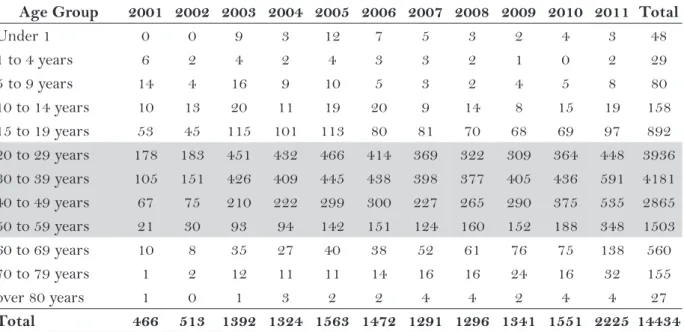
Case distribution by year and age group showed that during the study period the 20 to 59 age group was the most affected, with 86.5% noti-fications (Table 1).
The source/mechanism of infection refers to the year in which transmission occurred and was
identified in only 33.5% of cases, with emphasis
on sexual transmission (Table 2). Data showed that during the study years, 42 children from 0 to 9 years of age were infected by HBV.
In relation to vaccine coverage by age group, records showed low coverage in the 15 to 19 age group and the 25 to 29 age group (Graph 2).
The highest HB incidence rates were in the 20 to 69 age group (Table 3).
DISCUSSION
The search for HB cases in the SINAN/PR resulted in 14,434 records, with similar distribution between men and women. However, there was a
Table 1 – Number of laboratory-confirmed HB cases by age group and year of notification, of residents of Paraná, 2001 to 2011.
Source: SINAN/MS.
Age Group 2001 2002 2003 2004 2005 2006 2007 2008 2009 2010 2011 Total
Under 1 0 0 9 3 12 7 5 3 2 4 3 48
1 to 4 years 6 2 4 2 4 3 3 2 1 0 2 29
5 to 9 years 14 4 16 9 10 5 3 2 4 5 8 80
10 to 14 years 10 13 20 11 19 20 9 14 8 15 19 158
15 to 19 years 53 45 115 101 113 80 81 70 68 69 97 892
20 to 29 years 178 183 451 432 466 414 369 322 309 364 448 3936 30 to 39 years 105 151 426 409 445 438 398 377 405 436 591 4181 40 to 49 years 67 75 210 222 299 300 227 265 290 375 535 2865 50 to 59 years 21 30 93 94 142 151 124 160 152 188 348 1503
60 to 69 years 10 8 35 27 40 38 52 61 76 75 138 560
70 to 79 years 1 2 12 11 11 14 16 16 24 16 32 155
over 80 years 1 0 1 3 2 2 4 4 2 4 4 27
Total 466 513 1392 1324 1563 1472 1291 1296 1341 1551 2225 14434
Table 2 – Frequency of confirmed HB cases, by source/mechanism of infection and year of notification, Paraná, 2001 to 2011.
Source: SINAN/MS
Source/Mech-.
of Infection 2001 2002 2003 2004 2005 2006 2007 2008 2009 2010 2011
Total
N %
Sexual 15 34 170 168 187 224 268 258 283 251 333 2191 45,3
Others 63 49 74 78 108 92 45 58 62 69 115 813 16,8
Home 7 6 100 57 61 55 53 51 53 65 154 662 13,7
Vertical 3 4 20 30 40 60 44 55 56 55 76 443 9,1
Dental treat. -- -- -- -- -- -- 33 36 27 67 79 242 5
Dental/Surg.
treat. 0 5 25 24 36 22 8 2 1 12 11 146 3
Transfusion 0 1 8 19 20 26 25 25 19 28 44 215 4,5
Inject. Drug use 0 0 6 5 7 6 3 13 8 9 19 76 1,6
Work accident 0 1 3 8 5 5 9 3 8 3 7 52 1
significant difference in location of residence,
be-ing that the majority (81.8%) lived in urban areas,
corroborating findings of a study conducted in Chapecó(12), and can be related to the perception of individuals of the health and sickness process and access to healthcare services.
A study on medical care showed that residents of urban areas mostly used healthcare services for routine exams and prevention due to easy access and the influence of private healthcare plans. Resi-dents of rural areas only sought healthcare services when they felt sick, due to difficult access to testing, treatment and rehabilitation. Another factor that can influence this behaviour are biologicists
prac-tices that target disease and are still present in the SUS(13). These practices hinder early HBV diagnosis as most cases are asymptomatic and require epide-miologic investigation with complementary tests (12).
The 20 to 59 age group was the most affected by HB, with 86.5% of notifications (Table 1). This tendency was also found in other studies conducted in Brazil that showed that HBV onset was higher in individuals of the 20 to 40 age group, which is the sexually active population (14), corresponding to 38.6% of cases confirmed in the southern region of Brazil (2).
In 2011, there was an increase in the number of cases in adolescents, considered a vulnerable
Graph 1 – HB vaccine coverage of children under 1 year of age, Paraná, 1995-2011. Source: PNI/MS
Graph 2 – Accumulated HB vaccine coverage, by age group from 1 to 29 years, Paraná, 1995-2011. Source: PNI/MS
98,7
106,3
99,7 100,5 103,5 99,7
80,5
102,3
64,7
population group due to its characteristics and tendency for illegal drug use, unprotected sex and multiple partners, resulting in a high risk of HBV exposure (5,15) (Table 1). The positive rates in adolescence is a cause for concern because they are maintained during adulthood (5,15).
In relation to the source/mechanism of
infec-tion (Table 2), in 66.5% of records this information
was not provided, probably because the user did not know how he or she was infected or due to devia-tions in the quality of collected data. This finding is greater than the 60.4% of users registered in the southern region and 30% of users found in studies conducted in other countries(1).
HBV infection predominantly occurred through sexual transmission (45%) (Table 2), showing a similar tendency to data obtained in a
study conducted in Pará(15), but higher than results
found in the southern region of Brazil(2). In 2011,
the increase in number of infected cases through blood transfusions, vertical transmission and work accidents requires investigation, as there are public health policies that target the inspection of blood and haemoderivatives, child care and prenatal care for mothers, care during birth and post-natal care, worker’s health and immunization (Table 2).
It should be noted that 9.1% of cases that identified source/mechanism of infection (Table 2)
were from vertical transmission, considering that HBV of the newborn has a 90% chance of becom-ing chronic, which could be avoided with vaccina-tion(4). During this period, the HB vaccine was al-ready implemented for newborn babies in maternity hospitals and wards during the first 12 hours after birth with a protective efficiency of 95%(3-4).
These findings show the need to reinforce immunization actions in hospitals and maternity wards, with involvement of healthcare profession-als in permanent awareness activities on this topic. There is a report of unsatisfactory knowledge of obstetricians and nursing professionals on the use of immunoglobulin and the HB vaccine, which could affect the quality of provided services(4,6).
HBV infection through work accidents can also be avoided with vaccination, although some employees in the infirmary stated they were not vaccinated because they receive little information on HB and do not have time to go to a healthcare unit (UBS)(6), which reinforces the need for actions that target worker’s health.
Research at a hospital found that the adoption of vaccine accessibility measures for infirmary staff, such as applying vaccines at the workplace or dur-ing work hours, awareness strategies that inform and encourage, and the widespread promotion of vaccination, resulted in high vaccine coverage (17).
Table 3 – HB incidence rate (100,000 inhabitants), by age group and notification year, Paraná, 2001 to 2011.
Source: SINAN/MS.
Age Group 2001 2002 2003 2004 2005 2006 2007 2008 2009 2010 2011
Under 1 0,0 0,0 5,0 1,6 6,4 3,7 3,3 2,1 1,4 2,8 2,1
1 to 4 years 0,8 0,3 0,5 0,3 0,5 0,4 0,4 0,3 0,2 0,0 0,3
5 to 9 years 1,5 0,4 1,7 0,9 1,0 0,5 0,3 0,2 0,4 0,7 1,0
10 to 14 years 1,1 1,4 2,1 1,1 1,9 2,0 1,0 1,5 0,9 1,7 2,1 15 to 19 years 5,5 4,6 11,7 10,2 11,1 7,8 8,5 7,4 7,2 7,4 10,4 20 to 29 years 10,5 10,7 26,0 24,6 25,9 22,7 19,7 17,2 16,4 20,4 25,0 30 to 39 years 6,8 9,7 27,2 25,8 27,4 26,6 24,7 23,3 24,7 26,9 36,2 40 to 49 years 5,8 6,4 17,8 18,6 24,5 24,3 16,1 18,4 19,8 25,6 36,2 50 to 59 years 2,8 4,0 12,1 12,1 18,0 18,9 12,7 15,8 14,5 17,4 32,0 60 to 69 years 2,1 1,6 7,1 5,4 7,9 7,4 8,8 9,9 11,9 11,2 20,6 70 to 79 years 0,4 0,8 4,8 4,3 4,2 5,4 4,9 4,7 6,8 4,5 8,9
over 80 years 1,2 0,0 1,1 3,4 2,2 2,2 3,1 2,9 1,3 2,7 2,7
The assessment of HB vaccine coverage in children under the age of one (Graph 1) showed coverage below standards established by the PNI/ MS during the first years of vaccine implementa-tion caused by, among other things, a shortage of this product (12). After 1999, vaccine coverage rose and remained steady until 2011 due to nursing ac-tivities in the immunization programme, especially in the UBS, where there is a continuity of the HB vaccine scheme initiated at the maternity hospital. A study conducted in two UBS identified the actions of nurses in the vaccination room in rela-tion to conservarela-tion, storage and administrarela-tion of immunobiologicals, and the provision of user guidelines. Nurses participated in this process through team training, healthcare awareness activi-ties during growth and development supervision of children, in groups for expectant mothers and home visits (11).
The Ministry of Health annually calculates accumulated HB vaccine coverage to identify the residual susceptible population and evaluate the need to initiate intensified vaccination and/or ex-pand the age group of routine vaccination.
Although Paraná maintains high vaccine cov-erage in children under the age of one, accumulated coverage from 1995 to 2011 (Graph 2) has dropped in the 15 to 19 age group (80.6%) and the 25 to 29 age group (64.8%) due to non-vaccination of people contemplated in the basic vaccine calendar, result-ing in an accumulation of susceptible individuals. A study conducted in Piauí also identified low HB vaccine coverage in adolescents. Surveying of pos-sible causes showed lost vaccination opportunities during attendance at the UBS and lack of informa-tion on the vaccine (16).
The accumulation of activities of nursing teams that provide care and administer healthcare services can lead to the scarcity of awareness practices that adolescents and adults mentioned as being the motive for non-vaccination (6,11). To improve vaccine coverage of this population group, immunization practices must be restructured and co-responsibility for protection must be discussed. In spite of the availability of immunobiologicals, the decision to have a vaccine is individual (16).
The high vaccine coverage obtained in the 20 to 24 age group is a reflection of the population’s response to the vaccination campaign for this age group in 2011.
Analysis of HB incidence in Paraná from 2001 to 2011 (Table 3) showed lower values in the 0 to 9 age group, which have high vaccine coverage (Graph 2). In the remaining age groups, the increased incidence can be justified by non-vaccination of population groups that were not contemplated in the basic vaccination calendar since vaccine implementation. The situation of these segments can also be worsened by the high risk of HBV exposure via sexual transmission.
Although the 10 to 14 age group has high accumulated vaccine coverage (Graph 2), many chil-dren under one year of age were not vaccinated in a timely manner in 1997 and 1998 (Graph 1), which generated an accumulation of people susceptible to HBV infected during this period.
The vaccine coverage correlation (Graphs 1 and 2) with HB incidence (Table 3) showed the impact of vaccination in the reduction of HB in Paraná, confirmed by results from other studies that show vaccine efficiency in 90% of healthy adults and more than 95% of healthy children and adolescents (3).
Data found in this study corroborate research results that identified a significant reduction in the prevalence of chronic HB carriers in western Amazonia, possibly linked to vaccination (3).
The impact of vaccination in the reduction of HB incidence was also identified in studies conducted in Taiwan and Italy. In Taiwan, after the start of vaccination, there was a reduction of 75% in the incidence of hepatocellular carcinoma in children from 6 to 9 years of age, and of 68% in mortality due to fulminant hepatitis. In Italy, after the introduction of HB vaccines for children and adolescents, the incidence of hepatocellular carcinoma dropped from 11 out of every 100,000 cases, recorded in 1987, to 1.6 out of every 100,000 cases, recorded in 2006. In the south of this country, previously considered hyperendemic, prevalence dropped from 13.4% to 0.9% 20 years after the vaccine was introduced (1).
In Paraná, in 2011, an increase in the records of HB incidence can be associated to improved disease control actions for viral hepatitis and the quality of information from the SINAN/MS.
CONCLUSIONS
Paraná in the 0 to 9 age group, and confirmed the efficiency of the vaccine as a control measure for this disease.
It also provided extended knowledge on the epidemiological profile of HB and HB vaccine coverage in the state, and discussions on nursing practices for immunization.
It was therefore concluded that maintenance of high vaccine coverage is essential for effective HB control, and that nursing actions significantly contributed to the obtainment of these results.
Active participation of the nursing team was detected in immunization programme coordination, planning, evaluation and follow-up of vaccine cov-erage, in vaccine administration, provision of user guidelines, and vaccination activities outside the UBS.
The nursing team also helped to maintain high vaccine coverage by providing users with guidelines on the vaccine scheme during prenatal care, nursing consultations, in groups for expectant mothers and home visitations.
It is important to emphasize the importance of reinforcing the work of nursing professionals outside these areas and finding alternatives for the inclusion of the most vulnerable groups currently without access to vaccination and information by means of healthcare promotion and prevention actions that contribute to HB control.
The HB scenario in Paraná, with an increased number of cases from vertical transmission, trans-fusion and work accidents, reveals the need to implement immunization programmes in maternity wards, hospitals, blood banks and other healthcare services with greater involvement of healthcare professionals to allow vaccination of the popula-tion and healthcare providers, and orientapopula-tion on HB prevention through vaccination.
In light of these findings, which identified a high risk of HBV infection in the 30 to 59 age group, currently without access to routine vaccina-tion, the PNI should consider the inclusion of this age in the national vaccination calendar.
Study limitations were related to secondary HB data and sub-notification of cases, mostly caused by the characteristics of this infection, which moves silently, and the passive health inspec-tion system adopted by the Ministry of Health. Furthermore, there were possible deviations in the quality of information from the SINAN due to incomplete notification records.
REFERENCES
1 Michel ML, Tiollais P. Hepatitis B vaccines: protec-tive efficacy and therapeutic potential. Pathol Biol [Internet]. 2010 [citado 2013 ago 6]; 58(4):288-95. Available in: http://www.sciencedirect.com/science/ article/pii/S0369811410000246
2 Ministério da Saúde (BR), Secretaria de Vigi-lância em Saúde, Departamento de DST, AIDS e Hepatites Virais. Boletim epidemiológico: he-patites virais. Brasília; 2012. [citado 2012 nov 12]. Available in: http://www.aids.gov.br/sites/ default/files/anexos/publicacao/2012/51820/ boletim_epidemiol_gico_hepatites_virais_2012_ ve_12026.pdf
3 Moraes JC, Luna EJA, Grimaldi RA. Imunogenicida-de da vacina brasileira contra hepatite B em adultos. Rev Saúde Publica [Internet]. 2010 [citado 2012 set 13]; 44(2):353-9. Available in: http://www.scielo.br/ pdf/rsp/v44n2/17.pdf
4 Conceição JS, Diniz-Santos DR, Ferreira CD, Paes FN, Melo CN, Silva LR. Conhecimento dos obstetras sobre a transmissão vertical da hepatite B. Arq Gas-troenterol [Internet]. 2009 [citado 2012 ago 27]; 46(1):57-61. Available in: http://www.scielo.br/pdf/ ag/v46n1/15.pdf
5 Attilio JS, Rodrigues FP, Renovato RD, Sales CM, Alvarenga MRM, Moreira MT, et al. Cobertura vacinal contra hepatite B entre usuários de drogas ilícitas. Acta Paul Enferm [Internet]. 2011 [citado 2013 ago 5]; 24(1):101-6. Available in: http://www. scielo.br/pdf/ape/v24n1/v24n1a15.pdf
6 Carvalho AMC, Araújo TME. Análise da produção científica sobre hepatite B na pós-graduação de enfer-magem. Rev Bras Enferm [Internet]. 2008 [citado 2012 nov 15]; 61(4):518-22. Available in: http:// www.scielo.br/pdf/reben/v61n4/20.pdf
7 Tauil MC, Amorim TR, Pereira GFM, Araújo WN. Mortalidade por hepatite viral B no Brasil, 2000-2009. Cad Saúde Pública [Internet]. 2012 [citado 2012 set 25]; 28(3):472-8. Available in: http://www. scielo.br/pdf/csp/v28n3/07.pdf
9 Queiroz AS, Moura ERF, Nogueira PSF, Oliveira NC, Pereira MMQ. Atuação da equipe de enfermagem na sala de vacinação e suas condições de funcionamen-to. Rev RENE [Internet]. 2009 [citado 2012 nov 6];10(4):126-35. Available in: http://www.revista-rene.ufc.br/vol10n4_pdf/v10n4a15.pdf
10 Bisetto LHL, Cubas MR, Malucelli A. A prática da enfermagem frente aos eventos adversos pós-vacina-ção. Rev Esc Enferm USP [Internet]. 2011 [citado 2012 nov 9]; 45(5):1128-34. Available in: http:// www.scielo.br/pdf/reeUSp/v45n5/v45n5a14.pdf
11 Oliveira VG, Pedrosa KK, Monteiro AI, Santos AD. Vacinação: o fazer da Enfermagem e saber das mães e/ou cuidadores. Rev RENE [Internet]. 2010 [ci-tado 2012 nov 12];11:133-41. Available in: http:// www.revistarene.ufc.br/revista/index.php/revista/ article/view/478/pdf_1
12 Moschetta F, Peres MA. Perfil epidemiológico dos portadores de hepatite B no município de Chapecó-SC no período de 1996 a 2006 [Internet]. Florianópolis: Diretoria de Vigilância Epidemiológica; 2007 [citado 2012 set 5]; Available in: http://www.dive.sc.gov. br/conteudos/publicacoes/tcc/Perfil_epidemiolo-gico_dos_portadores_de_hepatite_B_Chapeco.pdf
13 Kassouf AL. Acesso aos serviços de saúde nas áreas urbana e rural do Brasil. Rev Econ Sociol [Internet]. 2005 [citado 2012 nov 13];43(1):29-44. Available in: http://www.scielo.br/pdf/resr/v43n1/25834.pdf
14 Anastácio J, Johann AA, Silva AL, Colli SJRC, Pana-gio LA. Prevalência do vírus da hepatite B em indi-víduos da região centro-ocidental do Paraná, Brasil. SaBios: Rev Saúde e Biol [Internet]. 2008 [citado 2012 nov 13]; 3(2):10-5. Available in: http://revista. grupointegrado.br/revista/index.php/sabios2/arti-cle/view/119/44
15 Aquino JA, Pegado KA, Barros LP, Machado LFA. Soroprevalência de infecções por vírus da hepatite B e vírus da hepatite C em indivíduos do Estado do Pará. Rev Soc Bras Med Trop [Internet]. 2008 [citado 2013 ago 4];41(1):334-7. Available in: http://www. scielo.br/pdf/rsbmt/v41n4/a03v41n4.pdf
16 Carvalho AMC, Araújo TME. Fatores associados à cobertura vacinal em adolescentes. Acta Paul Enferm [Internet]. 2010 [citado 2013 ago 5];23(6):796-802. Available in: http://www.scielo.br/pdf/ape/ v23n6/13.pdf
17 Vieira RHG, Erdmann AL, Andrade SR, Freitas PF. Vacinação contra Influenza em profissionais de enfermagem: realidade e desafios. Acta Paul Enferm [Internet]. 2012 [citado 2013 ago 31]; 25(spe2):104-9. Available in: http://www.scielo.br/pdf/ape/ v25nspe2/pt_16.pdf
18 Pudelco P, Koehler AE. Impacto da vacinação na redução da hepatite B no Paraná [monografia]. Curitiba (PR): Curso de Enfermagem, Pontifícia Universidade Católica do Paraná; 2012.
Author’s address / Endereço do autor / Dirección del autor
Lúcia Helena Linheira Bisetto
Escola de Saúde e Biociências, Curso de Graduação em Enfermagem
Rua Imaculada Conceição, 1155, Prado Velho 80242-980, Curitiba, PR
E-mail: [email protected]