AR
TIGO ORIGINAL / ORIGINAL AR
TICLE
INTRODUCTION
Acute diarrheic disease (ADD) is one of the main causes of childhood morbidity and mortality in developing countries, and an important cause of malnutrition(38).Mortality of children under 5 years of age was estimated to be 1.5 million in 2009(34). Eight of 10 deaths occur during the irst 2 years of life(38).
Although oral rehydration therapy has reduced the hospitalization rate of children with acute diarrhea worldwide, the condition is still relevant(20),200.000 hospitalizations/year still occurring in the United States(19).In Brazil, diarrhea accounted for 7.2% of
ACUTE DIARRHEA IN HOSPITALIZED
CHILDREN OF THE MUNICIPALITY
OF JUIZ DE FORA, MG, BRAZIL:
prevalence and risk factors associated
with disease severity
Monica Couto Guedes Sejanes da
ROCHA
1, Delaine La Gatta
CARMINATE
1,
Sandra Helena Cerrato
TIBIRIÇÁ
2, Iná Pires de
CARVALHO
3,
Maria Luzia da Rosa e
SILVA
4and Júlio Maria Fonseca
CHEBLI
5ABSTRACT - Context - Acute diarrhea is a common cause of hospitalization among children under 5 years of age. Knowing the
prevalence and risk factors associated with the severity of acute diarrhea is essential to control morbidity and mortality. Objective -
Describe the prevalence of demographic, epidemiologic and clinical features of children under 6 years of age hospitalized for acute diarrhea, and investigate the association between these determinants and the severity of the diarrheic episode. Method - Retrospective, cross-sectional study, during the period from January, 2005 through December, 2008, in the municipality of Juiz de Fora, MG, Brazil. Files from 6,201 children from 0 to 6 years of age, hospitalized in two public teaching institutions (which account for 84% of all the hospitalizations in the municipality), were assessed. Acute diarrhea was deined as the presence of at least three evacuations of liquid or loose stools, within 24 hours, for a maximum period of 14 days. The patients with acute diarrhea were divided in two groups, according to disease severity, severe diarrhea being considered whenever hospitalization lasted for at least 4 days. Epidemiologic and clinical data were assessed and compared through the application of the chi-squared test and the binomial logistic regression model.
Results - The prevalence rate for admission due to acute diarrhea was 8.4%. The factors signiicantly associated with the severity of
the diarrheic episode were: age under 6 months (P = 0.01, OR = 2.762); disease onset during fall (P = 0.033, OR = 1.742), presence of fever (P = 0.017, OR = 1.715) and antibiotic use during hospitalization (P = 0.000, OR = 3.872). Conclusions - Diarrhea is the
third most common cause of hospitalization among children under 6 years of age in Juiz de Fora. Young age (under or equal to 6 months), fever, antibiotic use during hospitalization and disease onset during fall are risk factors associated with longer hospital stay.
HEADINGS – Diarrhea, infantile, epidemiology. Child hospitalized. Risk factors. Juiz de Fora, MG, Brazil.
Declared conflict of interest of all authors: none.
This study was carried out in the Enfermaria de Pediatria, Hospital Universitário, Universidade Federal de Juiz de Fora and Berçário, Enfermaria e CTI de Pediatria, Santa Casa de Misericórdia de Juiz de Fora, MG.
1 Faculdade de Medicina, Universidade Federal de Juiz de Fora (UFJF), Juiz de Fora, MG; 2 Departamento de Histologia, Instituto de Ciências Biológicas, UFJF; 3
Depar-tamento de Virologia, Instituto de Microbiologia, Universidade Federal do Rio de Janeiro, RJ; 4 Departamento de Microbiologia, Instituto de Ciências Biológicas, UFJF; 5 Disciplina de Gastroenterologia, UFJF.
Correspondence: Dr. Monica Couto Guedes Sejanes da Rocha - Rua Marechal Deodoro, 953 - apt. 901 - Centro - 36015-460 - Juiz de Fora, MG, Brazil. E-mail: [email protected]
hospitalizations in 2008(7),being responsible for 2.5% of all deaths of children under 5 years of age(8).
The etiology of ADD involves a host of bacteria, viruses and parasites, with fecal-oral transmission occurring through contaminated food or water and interpersonal contact(35).
Once the treatment of ADD is based on the clinical features and not on the etiologic agent, laboratory conir-mation is frequently not sought, comprehensive and careful history-taking and physical examination being then para-mount(19, 35, 38).In Brazil diagnosis is generally presumptive, being based on the natural history of the disease and the risk factors of the population involved(35).
The risk factors associated with disease severity and the need of hospitalization may be explained by a multi-causal model of the inter-relation of socioeconomic, demographic, biological and cultural variables(13, 14). Identiication of these factors can effectively contribute to a greater understanding of the eco-epidemiologic patterns of ADD, and for the adoption of preventive measures(30). Morbidity and severity of diarrheic episodes are closely related to the child’s age and nutritional status, being more important in children under 6 months of age(10, 37) and those malnourished(11).Morbidity seasonality is directly related to the etiologic agent. While vi-ral infections are commonly associated with winter diarrhea, bacterial diarrhea predominates during hot, rainy periods(17).
Prolonged fever and the need of antibiotics point to an unfavorable course of the diarrheic episode, suggesting more severe infection with a poorer prognosis and higher risk of death(4, 36).
Epidemiologic features of the host, etiologic agent and environment are responsible for the regional differences in prevalence and severity of ADD. The aim of this study was to assess the prevalence of ADD, and identify the possible association of sociodemographic and biological determi-nants with ADD severity in children under 6 years of age hospitalized in public institutions of the municipality of Juiz de Fora, MG, Brazil.
METHODS Study design
This is a retrospective, cross-sectional study involving data extraction from iles of pediatric patients hospitalized in the University Hospital of the Federal University of Juiz de Fora (HU-UFJF), during the period January 2005 to December 2008, and in the Santa Casa de Misericórdia de Juiz de Fora (SCMJF), during the period January 2005-December 2005 and January 2008-December 2008, both public hospitals in the municipality of Juiz de Fora.
The two institutions were chosen for the study because they offer a total of 117 pediatric beds (95 at SCMJF and 22 at HU-UFJF), a igure which represents 84% of all available pediatric beds offered by the Uniied Health System (Sistema Único de Saúde - SUS)(5).
The study periods were chosen because they represent periods before and after the introduction of the oral rotavirus vaccine in the public services, which occurred in March 2006.
Study population
The study population was composed of all children with ages between 0 and 6 years, hospitalized for any reason in either institution, during the study periods, with the exception
of newborns whose admission was due to delivery occurring during the study periods. A total of 6 201 iles were assessed, 1 933 from the HU-UFJF and 4 268 from the SCMJF. Prevalence was measured in relation to the total number of admissions due to ADD.
There was no sample selection, as knowledge about the total number of hospitalizations and their causes is impor-tant for the generation of still non-existent data in our state and municipality.
File review and questionnaire application were under-taken by the irst author, who rigorously followed the same analysis criteria for all iles, keeping the repeatability and reproducibility of the procedure. Files not found in the institutions’ archives were electronically tracked, the hos-pitalization diagnosis being considered the one recorded in the authorization for hospital admission. In this parti-cular case, when ADD was the diagnosis but other data for completion of the questionnaire were not available, these iles were considered losses, representing 0.9% (n = 56) of the total number of iles. In the event of the same patient being hospitalized in different periods, each admission was considered a new case.
Assessment of the features related to ADD patients The control variables age and cause of hospitalization were assessed in all iles, so as to determine the prevalence of ADD in children under 6 years of age in relation to the total number of hospitalizations for other causes at the same age range.
The presence of the dependent variable diarrhea was deined, according to ile recording, based on information provided by the mother and health team about the symp-tom: a report of at least three liquid evacuations a day, for a maximum period of 14 days(35, 38).
In the cases where diarrhea was present, the following independent variables were analyzed: sex, age, weight, signs and symptoms (vomiting, fever, coughing, rhinorrhea, ab-dominal pain, headache), nutritional status (according to the World Health Organization’s standardized percentile curves, 2006/2007), year and month of disease onset, length of hospital stay, number of diarrheic episodes, dehydration, need of intravenous rehydration, use of antibiotics, and admitting institution.
Assessment of ADD severity
The patients with diarrhea were divided in two groups, according to the mean length of hospital stay. Group I was classiied as less severe diarrhea, and was composed of pa-tients staying in the hospital for 3 days or less. Group II was classiied as more severe diarrhea, and was composed of those staying in the hospital for at least 4 days.
Statistical analysis
All the study variables were assessed and compared for the two groups, in order to estimate the magnitude of their association with disease severity.
Quantitative variables were expressed as mean ± standard deviation, when normally distributed. All relevant variables had their descriptive statistics calculated. Comparison between the two groups (less severe, more severe) was made through bivariate analysis with the chi-squared test, a P<0,05 value being signiicant. The variables which were signiicant on bivariate analysis were further studied with multivariate analysis in a binomial logistic regression model.
Ethical considerations
A consent form for research undertaking, permitting data collection and publication, and preserving the patients’ iden-tities, was signed by the heads of the Pediatrics Divisions of both institutions. The study was approved by the Committee of Ethics on Research of the HU-UFJF, SCMJF and the
Federal University of Juiz de Fora. (protocol n. 990.036.2007, approved in 17/05/2007).
RESULTS
General features of the study population
Of all the hospitalized patients, 56 (0.9%) were excluded because of incomplete data in their iles. A total of 6 201 iles of children under 6 years of age, hospitalized in either institution, were then included in the study. Mean age was 16.5 ± 17.8 months. With the exception of ADD, the main diagnoses were: respiratory diseases (2 006 patients; 32.3%), neonatal disorders (1 033 patients; 16.7%), and infectious and parasitic diseases (374 patients; 6%).
Features of the patients with acute diarrhea
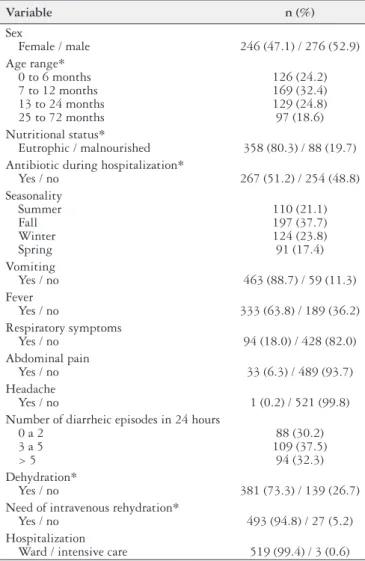
Acute diarrhea accounted for 522 (8.4%) hospitalizations during the study period. There was no death during hospitali-zation for ADD. Mean hospital stay (including admissions due to ADD complications) was 4.8 days (median 4, range: 1-57 days). The mean age of the patients with diarrhea was 16.4 ± 13.4 months. The descriptive analysis of the indepen-dent variables is shown on Table 1.
Comparison between the two groups: less severe diarrhea versus more severe diarrhea
Regardless of age, patients with diarrhea were divided in two groups, according to the mean length of hospital stay: group I – less severe diarrhea; group II – more severe diarrhea. Group I was composed of 219 patients (42%), who stayed in hospital for less than 4 days, while group II was composed of 303 patients (58%), who stayed in hospital for at least 4 days. For the inferential analysis of the variables, a bivariate model was used, six variables being identiied as signiicant: age, sex, nutritional status, antibiotic use during hospitalization, season of disease onset, and fever (Table 2
TABLE 1. Demographic, epidemiologic and clinical features of patients with diarrhea (n = 522)
Variable n (%)
Sex
Female / male 246 (47.1) / 276 (52.9)
Age range* 0 to 6 months 7 to 12 months 13 to 24 months 25 to 72 months
126 (24.2) 169 (32.4) 129 (24.8) 97 (18.6) Nutritional status*
Eutrophic / malnourished 358 (80.3) / 88 (19.7)
Antibiotic during hospitalization*
Yes / no 267 (51.2) / 254 (48.8)
Seasonality Summer Fall Winter Spring
110 (21.1) 197 (37.7) 124 (23.8) 91 (17.4) Vomiting
Yes / no 463 (88.7) / 59 (11.3)
Fever
Yes / no 333 (63.8) / 189 (36.2)
Respiratory symptoms
Yes / no 94 (18.0) / 428 (82.0)
Abdominal pain
Yes / no 33 (6.3) / 489 (93.7)
Headache
Yes / no 1 (0.2) / 521 (99.8)
Number of diarrheic episodes in 24 hours 0 a 2
3 a 5 > 5
88 (30.2) 109 (37.5)
94 (32.3) Dehydration*
Yes / no 381 (73.3) / 139 (26.7)
Need of intravenous rehydration*
Yes / no 493 (94.8) / 27 (5.2)
Hospitalization
Ward / intensive care 519 (99.4) / 3 (0.6)
* number of available recorded data, with the exclusion of losses due to lack of information
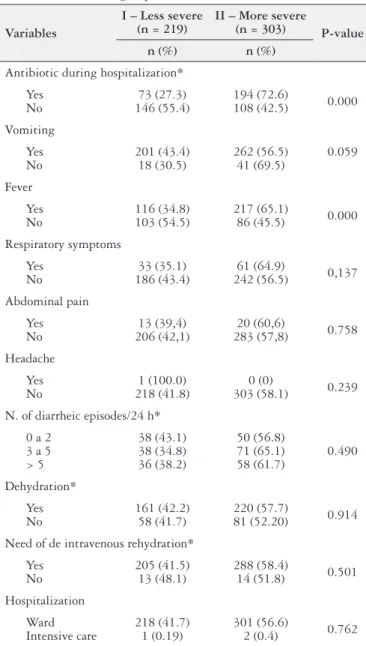
TABLE 2. Relationship among demographic and epidemiologic data between the group with less severe diarrhea and the group with more severe diarrhea (n = 522)
Variables
I – Less severe (n = 219)
II – More severe
(n = 303) P-value n (%) n (%)
Sex Female Male
92 (37.3) 127 (46)
154 (62.6) 149 (53.9)
0.046
Age range* 0 to 6 months 7 to 12 months 13 to 24 months 25 to 72 months
36 (28.5) 78 (46.1) 50 (38.7) 54 (55.6)
90 (71.4) 91 (53.8) 79 (61.2) 43 (44.3)
0.000
Seasonality Summer Fall Winter Spring
39 (35.4) 72 (36.5) 66 (53.2) 42 (46.1)
71 (64,5). 125 (63.4) 58 (46.7) 49 (53.8)
0.010
Nutritional status* Eutrophic Malnourished
149 (41.6) 24 (27.2)
209 (58.3) 64 (72.7)
0.013
DISCUSSION
The study has shown that diarrhea was the third most common cause of hospitalization among children under 6 years of age in the region, young age and the need of antibio-tics, probably due to the development of sepsis or secondary infections, being signiicantly associated with disease severity.
In the case off a retrospective study, it was not possible to control the nature and quality of information obtained. Some of the information iles necessary to ill the questionnaire were incomplete, inaccurate or measures inappropriately. However, the study, allows the inference of the results ob-served for a deined population, within the reality of health practices in the region. The description of the distribution of a health problem in a population is one of the sources that are essential to the planning and management actions for prevention, treatment and rehabilitation, both at collective and individual(26).
ADD as a cause of hospitalization was only surpassed by respiratory diseases (32.3%) and neonatal disorders (16.7%), which is in accordance with literature data(35). Acute diarrhea accounted for 8.4% of all hospitalizations during the study period. This igure is lower than those reported by Snyder et al.(31) in 1982 (10%-20%), and Kosek et al.(20) in 2003 (21%), for hospitalizations of children under 6 years of age. It is disputa-ble whether the lower rates we reported, especially in relation to developed countries, are due do disease under-reporting or a reflex of increasing primary health care standards and 3). The statistically signiicant variables on bivariate
analysis underwent multivariate analysis through the bino-mial logistic regression model (Table 4). In this model, sex and nutritional status were not statistically associated with the development of severe diarrhea (P<0.05). Although nutritional status was not statistically signiicant, eutrophic children were almost half as likely (42%) to develop severe disease. There was a 176% increase in the occurrence of severe disease in the 0-6 months age range compared to the 25-72 months age range. Antibiotic therapy during hospitalization was associated with a higher risk of severe diarrhea (287%) and fever (71%). Summer and fall were the seasons with higher rates of severe diarrhea, with 27% and 74%, respectively.
TABLE 4. Risk factors associated with severe diarrheic disease assessed through the binomial logistic regression model
Variables Odds ratio (IC de 95%) P-value
Sex Female RC: Male
1.356 (0.888–2.071) 0.16
Age range 0 to 6 months 7 to 12 months 13 to 24 months RC: 25 a 72 months
2.762 (1.442–5.288) 1.546 (0.854–2.799) 2.289 (1.213–4.319)
0.01 0.002
0.15 0.01 Nutritional status
Eutrophic
RC: Malnourished 0.585 (0.329–1.043) 0.07
Antibiotic during hospitalization* Yes
RC: No
3.872 (2.483–6.038) 0.000
Seasonality Summer Fall Winter RC: Spring
1.276 (0.646–2.522) 1.742 (0.946–3.208) 0.773 (0.405–1.478)
003 048 0.07 0.44 Fever
Yes RC: No
1.715 (1.100–2.676) 0.02
* number of available recorded data, with the exclusion of losses due to lack of information; RC = reference category; CI = conidence interval
TABLE 3. Relationship among clinical data between the group with less severe diarrhea and the group with more severe diarrhea (n = 522)
Variables
I – Less severe (n = 219)
II – More severe
(n = 303) P-value
n (%) n (%)
Antibiotic during hospitalization*
Yes No
73 (27.3) 146 (55.4)
194 (72.6)
108 (42.5) 0.000
Vomiting
Yes No
201 (43.4) 18 (30.5)
262 (56.5) 41 (69.5)
0.059
Fever
Yes No
116 (34.8) 103 (54.5)
217 (65.1)
86 (45.5) 0.000
Respiratory symptoms
Yes No
33 (35.1) 186 (43.4)
61 (64.9)
242 (56.5) 0,137
Abdominal pain
Yes No
13 (39,4) 206 (42,1)
20 (60,6)
283 (57,8) 0.758
Headache
Yes No
1 (100.0) 218 (41.8)
0 (0)
303 (58.1) 0.239
N. of diarrheic episodes/24 h*
0 a 2 3 a 5 > 5
38 (43.1) 38 (34.8) 36 (38.2)
50 (56.8) 71 (65.1) 58 (61.7)
0.490
Dehydration*
Yes No
161 (42.2) 58 (41.7)
220 (57.7)
81 (52.20) 0.914
Need of de intravenous rehydration*
Yes No
205 (41.5) 13 (48.1)
288 (58.4)
14 (51.8) 0.501
Hospitalization
Ward Intensive care
218 (41.7) 1 (0.19)
301 (56.6)
2 (0.4) 0.762
after the implementation of the Family Health Program (Programa de Saúde da Família, PSF) and the Community Health Agent Program (Programa de Agente Comunitário de Saúde – PACS) in 1996, with the aim of intensifying the actions of health promotion, epidemiologic surveillance, sanitary surveillance and care of risk groups(33). In spite of the scarcity of studies on and controversies surrounding the impact of the PSF on childhood health indicators, there is evidence pointing towards mortality reduction due to infec-tious diseases in the 1-4 years age range(27) and reduction of ADD-related hospitalization rates in the municipalities cov-ered by either program. In uncovcov-ered areas, children under 6 years of age are twice as likely to be hospitalized due to diarrhea, in comparison with those from the other areas(28). It is noteworthy that in the municipality of Juiz de Fora, the PSF and the PACS have 55% and 54% coverage rates of the urban and rural areas, respectively(6).
The behavior of ADD in our population may be tem-porally assessed through the analysis of secondary data recorded in the data bank of the Health Information System (DATASUS). This analysis allows for comparisons with primary data to be made, and also for indirect assessment of the primary and secondary measures implemented for disease control(24).
According to nationwide data from the Brazilian Hospital Information System, rates of hospitalization due to ADD in children under 5 years of age were 8.4% in 2005 and 7.2% in 2008(7), igures which are very close to our indings for the municipality of Juiz de Fora. Yet, when the same data, this time restricted to Juiz de Fora, are analyzed for the same periods, the igures are 1.07% and 0.72%, respectively(9). Such divergence is possibly due to under-reporting. Diarrhea is not part of the set of diseases of compulsory notiication, and its actual igures are little known in Brazil(12).
The mean length of hospital stay in our study was 4,8 ± 4,4 days, a little shorter than the 5,6 days reported by Brandão et al.(4) among patients admitted to a special intensive therapy unit with shock-complicated ADD.
As can be seen in Table 1, the most frequent symptoms were fever, vomiting and dehydration, as reported in the literature(22).
There are no records in the iles of the moment of oral rehydration therapy (ORT), or even if it was done in the cases investigated. At admission, all patients were taken for intravenous hydration, regardless of the severity of the case.
The absence of detailed description of the patient physical examination in ile records, made impossible that dehydration was classiied according to their intensity, allowing a better evaluation of severity and treatment used, moreover, it was not possible to identify the treatment used for these patients in the emergency care, before hospitalization. All reports obtained occurred after admission, not being set if the use of intravenous hydration in most cases was due to failure to ORT or severity. Indicated for children with mild to moderate dehydration, ORT is considered simple, with low cost, free of complications, less traumatic and with similar eficacy to intravenous rehydration therapy (VRT)(4, 9, 10)..
The use of ORT in the treatment of acute diarrhea promotes substantial reduction in infant mortality from the disease, especially in developing countries. However, in some developed countries like United States, no record of low rates of use of ORT, where children with any degree of dehydration are treated with VRT, instead of ORT(12, 17). In Brazil, approximately 30% of pediatricians do not perform ORT for children with vomiting and moderate dehydration(18), in emergency departments. The reasons include issues related to structural support (lack of appropriate physical space and trained personnel), inherent in the attitude of the caregiver and questions regarding the actual effectiveness of ORT. The excessive demand of assistance is also cited as a barrier to the appointment of ORT(16), with possible misuse of the sector. In this sense, and adequate structural support, education and training of doctors and support staff are essential.
Only three patients had to be admitted to intensive care, and there was no death among those hospitalized with ADD.
As for the risk factors associated with disease severity, only age, seasonality, fever, and antibiotic use were statisti-cally signiicant on logistic regression (Table 4). Although the frequency and characteristics of vomiting and diarrheic epi-sodes are important for the deinition of disease severity(1, 3), such data were not recorded in over 20% of the iles analyzed, their statistical analysis not being reliable in consequence.
It is noteworthy that, although not statistically signiicant, the association of the nutritional status with the severity of the diarrheic episode has been reported by several authors(16). Malnourished children are more susceptible to severe infec-tions, leading a higher frequency and longer duration of diarrheic episodes, with further impact on the nutritional status(16).
The mean age of the children hospitalized due to ADD in our study was 16.4 ± 13.4 months, with a higher hospi-talization rate in the 7-12 months age range (32.4%). These data are in accordance with those of Parashar et al.(13), who observed higher hospitalization rates of children under the age of 11 months compared to those in the 1-4 years age range, on a review of studies published between 1990 and 2000. The association of age under 6 months and greater disease severity we found was previously reported by Vander-lei et al.(37) in Pernambuco, Cardoso et al.(12) in Ceará, An-drade et al.(3) and Brandão et al.(4) in São Paulo.
In their irst year of life, children are more vulnerable to unfavorable environmental conditions, aggravated by prema-ture weaning and malnutrition(2, 13, 18, 30). These factors, added to a greater predisposition to electrolytic imbalance and more severe clinical presentations(15), certainly justify our indings. About 40% of diarrhea-related admissions occurred during fall. Furthermore, more serious disease was seen during this season. Summer and winter had very similar hospitalization patterns, with a 23% reduction of severe diarrhea in winter.
from May to September, colder and drier. Most hospitaliza-tions in our study occurred during the warmer and rainier season. Likewise, a study from Ceará(12) reported an increase in diarrhea rates soon after heavy rains, associating it with the possible use of alternative water sources, the possible con-tamination of the underground water-bearing layer by septic latrines, or circulation of other etiologic agents. Nevertheless, those authors did not report on seasonality as a risk factor for disease severity. Conversely, a study undertaken in Rio de Janeiro found the months of May and June as those with higher rates of ADD-related hospitalization and death(17). A large proportion of literature data relates seasonality to the etiologic agent, with a preponderance of bacteria in the hotter months and viruses in fall and winter(32).
The need of antibiotic therapy during hospitalization was the main risk factor for a poorer outcome and longer duration of the diarrheic episode in our study, a fact sugges-ting that the diarrhea may have been the initial presentation of sepsis, as judged by the assistant physician, or may have favored the development of secondary infections(4). Although viruses, with rotavirus in particular(13), are widely recognized as responsible for diarrhea-related hospitalizations among children under 5 years of age, studies undertaken by Souza et al.(32), Brandão et al.(4) and Andrade et al.(9) in São Paulo, have pointed otherwise, reporting classic enteropathogenic Escherichia coli (EPEC), as the main cause of diarrhea in children under 5 years of age, especially those under 6 months and as a risk factor for death. A study undertaken by the International Center for Diarrheal Disease Research, in Bangladesh(34) isolated Shigella lexneri in about 60% of children under the age of 5 years, with acute diarrhea. The histopathological changes caused by bacteria are important in the occurrence of food intolerance, worsening of nutri-tional status and prolonged diarrhea, justifying more severe, antibiotic therapy and prolonged hospitalization.
However, this study demonstrated the use of antibiotics around 50% of patients, while 42% were mild cases, with
hospitalization for a period less than 4 days. These indings probably relate to an indiscriminate use of antibiotics, since in most patients the prescription occurred at admission and not by worsening of the patient.
According to the World Health Organization (WHO)(21), infections cause 25% of deaths worldwide and 45% in less developed countries. One of the causes of this situation is the emergence and spread of antimicrobial resistance, which tends to increase through indiscriminate use of antimicrobi-als. In the hospital, these drugs are often prescribed by prac-titioners with less clinical experience (interns and residents) who feel pressure in emergency situations.
Over 50% of requirements prove inappropriate(21). Anoth-er common occurrence is the automatic repeat requirements, making the duration of antibiotics course extends beyond the rational. There are problems of indication, selection and prescription of antimicrobials. There is also the use of anti-biotics as symptomatic drugs. Fear of litigation on medical error or negligence is concurrent factor of use of antibiotics in the United States(21).
There was no record of a study of the etiologic agent of diarrhea in the iles investigated.
Our study did not aim to investigate the microbiology of ADD. Fever was the only symptom associated with greater disease severity. Its presence may indicate colonic inlam-mation, sepsis, or higher virulence of the involved agent, justifying a higher chance of complications(23).
In conclusion, acute diarrhea is an important cause of mor-bidity among children under 6 years of age in the municipality of Juiz de Fora. Under-reporting and inadequately completed hospital iles hamper full epidemiologic understanding and adequate primary and secondary prevention. Children under the age of 6 months were more vulnerable to severe ADD. Persistent fever and the need of antibiotic therapy during hospitalization were signiicant risk factors associated with disease severity. Likewise, the occurrence of ADD during fall was signiicantly associated with disease severity.
Rocha MCGS, Carminate DLG, Tibiriçá SHC, Carvalho IP, Silva MLR, Chebli JMF. Diarreia aguda em crianças hospitalizadas no município de Juiz de Fora, MG: prevalência e fatores de risco associados à gravidade da doença. Arq Gastroenterol. 2012,49(4):259-65.
RESUMO - Contexto - Diarreia aguda é uma causa frequente de internação em crianças menores de 5 anos. O conhecimento da prevalência e dos
fatores de risco associados à gravidade da diarreia aguda é fundamental no controle da morbimortalidade. Objetivo - Descrever a prevalência das características demográicas, epidemiológicas e clínicas de pacientes menores de 6 anos hospitalizados por diarreia aguda e investigar a associação entre esses determinantes e a gravidade do episódio diarreico. Método - Estudo transversal, retrospectivo, realizado no período de janeiro de 2005
a dezembro de 2008, no município de Juiz de Fora, MG. Foram avaliados 6.201 prontuários das crianças de 0 a 6 anos de idade hospitalizadas em duas instituições públicas de ensino que respondem juntas por 84% das internações no município. Diarreia aguda foi deinida como presença de pelo menos três evacuações líquidas ou de consistência amolecida em 24 horas por no máximo 14 dias. Os pacientes com diarreia aguda foram divididos em dois grupos, de acordo com a gravidade do quadro e foi considerado diarreia grave o período de hospitalização maior ou igual a 4 dias. Os dados epidemiológicos e clínicos dos pacientes foram avaliados e comparados através da aplicação do teste do qui ao quadrado e do modelo de regressão logística binomial. Resultados - A prevalência de internações por diarreia aguda foi de 8,4%. Os fatores que mostraram associação signiicativa com gravidade do episódio diarreico foram: idade inferior a 6 meses (P = 0,01, OR = 2,762); início da doença no outono (P = 0,033, OR = 1,742), pre-sença de febre (P = 0,017, OR = 1,715) e uso de antibioticoterapia durante a internação (P = 0,000, OR = 3,872). Conclusões - Diarreia é a terceira
causa de internação em crianças abaixo dos 6 anos em Juiz de Fora. Baixa idade (inferior ou igual a 6 meses), febre, uso de antibiótico na internação e início do episódio diarreico no outono são fatores de risco associados ao maior tempo de hospitalização.
REFERENCES
1. Alam N, Henry FJ, Rahaman MM. Reporting errors in one-week diarrhoea recall surveys: experience from a prospective study in rural Bangladesh. Int J Epidemiol. 1989;18:697-700.
2. Alam NH, Faruque AS, Dewan N, Sarker SA, Fuchs GJ. Characteristics of chil-dren hospitalized with severe deydration and persistent diarrhea in Bangladesh. J Health Popul Nutr. 2001;19:18-24.
3. Bhutta ZA, Nizami SQ, Thobani S, Issani Z. Risk Factors for mortality among hospitalized children with persistent diarrhoea in Pakistan. J Trop Pediatr. 1997;43:330-6.
4. Brandão MB, Lopes CE, Morcillo AM, Baracat EC. Risk factors of death in children with diarrhea and shock admitted to the intensive care unit. Rev Assoc Med Bras. 2005;51:237-40.
5. Brasil. Ministério da Saúde. DATASUS: número de leitos de internação existentes por tipo de prestador segundo especialidade, novembro de 2007 [Internet]. Brasília; 2007. [cited 2010 Feb. 8]. Available from: http://tabnet.datasus.gov.br/tabdata/ cadernos/MG/MG_Juiz_de_Fora_Geral.xls.
6. Brasil. Ministério da Saúde. Sistema de informação da atenção básica: cobertura populacional pelo programa de saúde da família e de agentes comunitários de saúde. 2009/ 2010 [Internet]. Brasília; 2009. [cited 2010 Feb. 8]. Available from: http://189.28.128.178/sage/?saude=http%3A%2F%2F189.28.128.178%2F-sage%2F&botaook=OK&obj=http%3A%2F%2F189.28.128.178%2Fsage%2F. 7. Brasil. Ministério da Saúde. Sistema de informação hospitalar: morbidade
hospitalar do SUS [Internet]. Brasília; 2009. [cited 2010 Feb. 8]. Available from: http://tabnet.datasus.gov.br/cgi/tabcgi.exe?sih/cnv/nimg.def.
8. Brasil. Ministério da Saúde. Sistema de informação sobre mortalidade: mor-talidade hospitalar do SUS MS/SUS/DASIS 2009. [Internet]. Brasília; 2009. [cited 2010 Feb. 8]. Available from: http://tabnet.datasus.gov.br/cgi/deftohtm. exe?idb2008/c06.def.
9. Centers for Disease Control and Prevention (CDC). Rotavirus surveillance -- worldwide, 2001—2008. MMWR Morb Mortal Wkly Rep. 2008;57:1255-7. 10. Costa ADPV, Silva GAP. Indicação de terapia de reidratação oral no setor de
emergência: decisão baseada na clínica? Rev Paul Pediatr. 2010;28:215-20. 11. de Andrade JA, de Oliveira JO, Fagundes Neto U. Lethality in hospitalized
infants with acute diarrhea: risk factors associated with death. Rev Assoc Med Bras. 1999;45:121-7.
12. Façanha MC, Pinheiro AC. Acute diarrhea treated by health care services in For-taleza, Ceará State, Brazil, from 1996 to 2001. Cad. Saúde Pública. 2005;21:49-54. 13. Fuchs SC, Victora CG, Fachel J. [Hierarchical model: a proposal for a model
to be applied in the investigation of risk factors for severe diarrhea]. Rev Saúde Pública. 1996;30:168-78.
14. Fuchs SC, Victora CG. Risk and prognostic factors for diarrheal disease in Brazilian infants: a special case-control design application. Cad Saúde Pública. 2002;18:773-82.
15. Grifin PM, Ryan CA, Nyaphisi M, Hargrett-Bean N, Waldman R J, Blake PA. Risk factors for fatal diarrhea: a case-control study of African children. Am J Epidemiol. 1988;128:1322–9.
16. Guerrant RL, Schorling JB, McAuliffe JF, de Souza MA. Diarrhea as a cause and an effect of malnutrition: diarrhea prevents catch-up growth and malnutri-tion increases diarrhea frequency and duramalnutri-tion. Am J Trop Med Hyg. 1992;47(1 Suppl):28-35.
17. Kalea PL, Fernandes C, Nobre FF. Temporal pattern of diarrhea hospitalizations and deaths in children, 1995 to 1998, Brazil. Rev Saúde Pública. 2004;38:30-7. 18. Karim AS, Akhter S, Rahman MA, Nazir MF. Risk factors of persistent diarrhea
in children below ive years of age. Indian J Gastroenterol. 2001;20:59-61.
19. King CK, Glass R, Bresee JS, Duggan C; Centers for Disease Control and Prevention. Managing acute gastroenteritis among children - oral rehydration, maintenance, and nutritional therapy. MMWR Recomm Rep. 2003;52(RR16):1-16. 20. Kosek M, Bern C, Guerrant RL. The global burden of diarrhoeal disease, as estimated from studies published between 1992 and 2000. Bull World Health Organ. 2003;81:197-204.
21. Lenita W. Uso indiscriminado de antibióticos e resistência microbiana. Uma guerra perdida? Uso racional de medicamentos: v. 1, n.4 [Internet]. Brasília; março 2004. [cited 2011, dec 15] Avaiable from: www.opas.org.br/medicamentos/site/.../ HSE_URM_ATB_0304.pdf
22. Linhares AC. Rotavirus infection in Brazil: epidemiology and challenges for control. Cad Saúde Pública. 2000;16:629-46.
23. Lins MG, Motta ME, Silva GA. Risk factors for persistent diarrhea in infants. Arq Gastroenterol. 2003;40:239-46.
24. Oliveira TCR, Latorre Mdo R. Trends in hospital admission and infant mortality from diarrhea: Brazil, 1995-2005. Rev Saúde Pública. 2010;44:102-11. 25. Parashar UD, Gibson CJ, Bresee JS, Glass RI. Rotavirus and severe childhood
diarrhea. Emerg Infect Dis. 2006;12:304–6.
26. Roberto AM, Diana MC, Guilherme LW, Katia VB, Ronir RL, editores. Epide-miologia. São Paulo: Atheneu; 2006.
27. Rocha RCB, Soares RR. Impacto de programas de saúde a nível familiar e comunitário: evidências do programa saúde da família [Internet]. Niterói; 2008. [cited 2010 Feb. 10]. Available from: http://www.anpec.org.br/encontro2008/ artigos/200807211610510-.pdf.
28. Roncalli AG, Lima KC. Impact of health family program concerning child health indicators in large towns from Brazilian Northeast region. Ciênc Saúde Coletiva. 2006;11:713-24.
29. Ruiz-Palacios GM, Pérez-Schael I, Velázquez FR, Abate H, Breuer T, Clemens SC, Cheuvart B, Espinoza F, Gillard P, Innis BL, Cervantes Y, Linhares AC, López P, Macías-Parra M, Ortega-Barría E, Richardson V, Rivera-Medina DM, Rivera L, Salinas B, Pavía-Ruz N, Salmerón J, Rüttimann R, Tinoco JC, Rubio P, Nuñez E, Guerrero ML, Yarzábal JP, Damaso S, Tornieporth N, Sáez-Llorens X, Vergara RF, Vesikari T, Bouckenooghe A, Clemens R, De Vos B, O’Ryan M; Human Rotavirus Vaccine Study Group. Safety and eficacy of an attenuated vaccine against severe rotavirus gastroenteritis. N Engl J Med. 2006;354:11-22. 30. Silva GA, Lira PI, Lima Mde C. Risk factors for diarrheal disease in infants: a
case-control study. Cad Saúde Pública. 2004;20:589-95.
31. Snyder JD, Merson MH. The magnitude of the global problem of acute diar-rhoeal disease: a review of active surveillance data. Bull World Health Organ. 1982;60:605-13.
32. Souza EC, Martinez MB, Taddei CR, Mukai L, Gilio AE, Racz ML, Silva L, Ejzenberg B, Okay Y. Etiologic proile of acute diarrhea in children in São Paulo. J. Pediatr (Rio J.) 2002;78:31-8.
33. Teixeira C. Passado, presente e futuro da prevenção. Rev APS 2002;5:92-101. 34. Teka T, Faruque AS Fuchs GJ. Risk factors for deaths in under-age-ive children
attending a diarrhoea treatment centre. Acta Paediatr. 1996;85:1070-5. 35. The United Nations Children’s Fund (UNICEF). World Health Organization.
Diarrhoea: why children are still dying and what can be done. New York: The United Nations Children’s Fund; 2009.
36. Uysal G, Sökmen A, Vidinlisa S. Clinical risk factors for fatal diarrhea in hospi-talized children. Indian J Pediatr. 2000;67:329-33.
37. Vanderlei LCM, Silva GAP, Braga JU. Risk factors for hospitalization due to acute diarrhea in children under two years old: a case-control study. Cad Saúde Pública. 2003;19:455-63.
38. World Health Organization. The treatment of diarrhoea: a manual for physicians and other senior health workers. 4th ed. rev. Geneva: WHO; 2005.