Abstract
Objective: Dysfunction of serotonin 1A receptors (HTR1A) may play a role in the genesis of suicidal behavior. We studied the association between a functional polymorphism in the HTR1A gene and suicidal behavior. Method: We performed a meta-analysis of published genetic association studies by searching through Medline, PubMed, and Web of Science databases to analyze a possible correlation between the rs6295 polymorphism and suicidal behavior in different populations. Results: Four studies comprising a total of nine hundred and ifty seven patients with suicidal behavior and nine hundred and ifty seven controls were the eligible. The G allele of the rs6295 polymorphism may not be associated with suicidal behavior (Random-effects model: OR = 1.08; 95% CI: 0.80-1.45; p(Z) = 0.80) in presence of heterogeneity (Q = 17.84, df = 4, p = 0.0013). In a second analysis that presented no heterogeneity, a negative association was also observed (OR = 0.94; 95%CI: 0.79-1.13; p(Z) = 0.99). Conclusion: To our knowledge, the present study is the irst meta-analysis searching for a correlation between rs6295 of HTR1A and suicidal behavior. Our results showed no association between HTR1A and suicidal behavior. However, more studies assessing different populations, as well as larger samples, are needed.
©2012 Elsevier Editora Ltda. All rights reserved.
No association between the HTR1A gene and
suicidal behavior: a meta-analysis
Miriam Rivera Angles,
1Deysi Bermúdez Ocaña,
1Beatriz Camarena Medellín,
2Carlos Tovilla-Zárate
11 Universidad Juárez Autónoma de Tabasco, División Académica Multidisciplinaria
de Comalcalco, Comalcalco, Tabasco, México
2 Departamento de Genética Psiquiátrica, Instituto Nacional de Psiquiatría
“Ramón de la Fuente Muñiz”, México D. F., México
Received on December 2, 2010; accepted on February 13, 2011
DESCRIPTORS Suicide; Serotonin;
Serotonin Receptor 1A; Meta-Analysis.
ORIGINAL ARTICLE
Corresponding autor: Dr. Carlos Alfonso Tovilla Zárate; División Académica Multidisciplinaria de Comalcalco Ranchería Sur, Cuarta Sección, C.P. 86650; Comalcalco, Tabasco, Mexico; Phone: (52) 9933581500 ext. 6900; E-mail: [email protected]
1516-4446 - ©2012 Elsevier Editora Ltda. All rights reserved.
Official Journal of the Brazilian Psychiatric Association
Volume 34 • Number 1 • March/2012
Psychiatry
A não associação entre o gene HTR1A e comportamento suicida: uma metanálise
Resumo
Objetivo: É possível que uma disfunção nos receptores 1A de serotonina (HTR1A) desempenhe um papel na origem do comportamento suicida. Estudamos a associação entre um polimorismo funcional no gene HTR1A e comportamento suicida. Método: Realizamos uma metanálise de estudos de associação genética já publicados através de uma busca nos banco de dados do Medline, PubMed e Web of Science para identiicar uma possível correlação entre o polimorismo rs6295 e comportamento suicida em diferentes populações. Resultados: Foram selecionados quatro estudos com um total de 957 pacientes com comportamento suicida e 957 controles. O alelo G do polimorismo rs6295 não pôde ser associado a comportamento suicida (modelo de efeitos aleatórios: OR = 1,08; 95%CI: 0,80-1,45; p(Z) = 0,80) na presença de heterogeneidade (Q = 17,84, df = 4, p = 0,0013). Em uma segunda análise, sem heterogeneidade, também foi observada uma associação negativa (OR = 0,94; 95%CI: 0,79-1,13; p(Z) = 0,99). Conclusão: Pelo que nos consta, trata-se da primeira metanálise cujo objetivo é identiicar uma correlação entre o polimorismo rs6295 do HTR1A e comportamento suicida. Os nossos resultados não demonstraram existir uma correlação entre o HTR1A e comportamento suicida. No entanto, são necessários estudos adicionais que incluam outras populações, assim como amostras maiores.
©2012 Elsevier Editora Ltda. Todos os direitos reservados. DESCRITORES:
Suicídio; Serotonina; Receptor 1A de Serotonina; Metanálise.
Introduction
Suicidal behavior is a major health problem worldwide.
Several lines of evidence suggest that suicide has a genetic component.1 Attempted and completed suicides are
fa-miliar behaviors with an inheritability of about 40-50%.2-4
To date, many studies have suggested that at least three neurobiological systems are involved in the pathogenesis of
suicidal behavior: serotonergic system (5-HT) deiciency,5
hypothalamic-pituitary-adrenal axis hyperactivity,6 and an excess release of norepinephrine followed by a deiciency
of this neurotransmitter.7 There is strong neurobiological
evidence showing that serotonergic dysfunction is implicated in suicidal behavior.
Brain 5-HT1A receptors can be found both pre- and post-synaptically. Somatodendritic 5-HT1A autoreceptors are located on serotonergic neurons in the dorsal and medial raphe nuclei providing a negative feedback mechanism in serotonergic systems.8 These autoreceptors control the iring
rate of the serotonergic neurons resulting in the regulation of serotonin synthesis and release.9,10
The 5-HTR1A gene is located on the long arm of chromo-some 5 (5q11.2-13).11 A functional C(-1019)G variant has
been reported.12,13 This polymorphism (rs6295) is a common
SNP in the promoter region of the gene, within a 26 bp palindromic region, which binds the nuclear DEAF-1-related (NUDR) proteins and Hess5. The G allele abolishes repression by NUDR to produce higher expression of 5-HTR1A, which in turn enhances the negative feedback inhibition exerted by 5-HTR1A autoreceptors on serotonergic raphe neurons, thus leading to a decrease in serotonergic neurotransmission.14
This rs6295 polymorphism of the 5-HTR1A promoter has been associated with a number of disorders including anxi-ety,15,16 major depression,16,17 aggression, and impulsivity.18 It
has also been associated with suicidal behavior (attempted
or completed suicide). Its possible involvement in suicide has been suggested by the abnormal HT1A receptor signaling in brains of suicide victims or attempters.19,20 Several studies
have investigated the association between this functional polymorphism and suicidal behavior with contradicting re-sults. Therefore, a meta-analysis of all published data was performed to investigate the true association between this polymorphism and suicidal behavior.
Method
Identiication and selection of publications
A literature search was performed from April to June 2010.
Relevant publications were identiied using the following
search terms in Medline, PubMed and Web of Science data-bases: “HTR1A and suicidal behavior”, “HTR1A and suicide”, “rs6295 and suicidal behavior”, “rs6295 and suicide”, and “HTR1A C-1019G and suicide”. These words were combined to retrieve the summaries. The search also implicated the review of the bibliography cited at the end of various research articles. To be selected, the publications had to meet the
following criteria: (1) be published in peer-reviewed journals,
(2) contain independent data, (3) be case-control association studies in which the frequencies of three genotypes were clearly stated or could be calculated, and (4) use of healthy individuals as controls.
Data extraction
The following data were obtained for each of the studies: authors, year of publication, region, number of cases and controls, age, and ethnical origin.
not-sick. The “sick” term refers to subjects exhibiting
suicidal behavior and the “exposed” term refers to the risk allele.
Data analysis
For the meta-analysis procedures, we used the EPIDAT 3.1 program (http://dxsp.sergas.es). This software is freely available for epidemiologic analysis of tabulated data. Data was analyzed with the random-effects model following the reports in literature.21,22 Sample
heteroge-neity was analyzed with the Dersimonian and Laird’s Q test. The Q test result was complemented with graphs to help visualize those studies that favor heterogeneity. The meta-analysis results are expressed as an odds ratio (OR). To address the problem of publication bias, funnel plots were calculated by the EPIDAT 3.1 software. This plotting standardized the effect of each of the published studies on the vertical axis and its correspondent precision on the
horizontal axis. Finally, a chi-squared (χ2) analysis was used
to calculate the Hardy-Weinberg equilibrium to evaluate genotype distribution.
Results
Regarding literature search, a total of 13 papers were
identi-ied, but only 4 were included in this meta-analysis.14,23-25 The
other nine studies were excluded for not complying with the inclusion criteria.8,26-33 One of the selected studies consisted
of two populations that were analyzed separately.25
The selected studies comprised a total of nine hundred
and ifty seven patients and nine hundred and ifty seven con -trols. All genotyped populations, both patients and controls, were in Hardy-Weinberg equilibrium (p > 0.05), excluding the patients described by Lemonde et al.14 (χ2 = 0.18; p < 0.019).
When the genotypes of all populations were combined,
they still remained in equilibrium (χ2 = 0.92; OR = 1.06; p = 0.33 and χ2 = 0.92; OR = 0.94; p = 0.33 for patients and
controls, respectively). Four populations were Caucasians and one Asian. The proportion of the least common genotype in Caucasians was GG (24%), whereas for the Asian population it was CC (6%).
The pooled OR derived from all studies indicated a
non-signiicant association of the G allele of rs6295 with suicidal
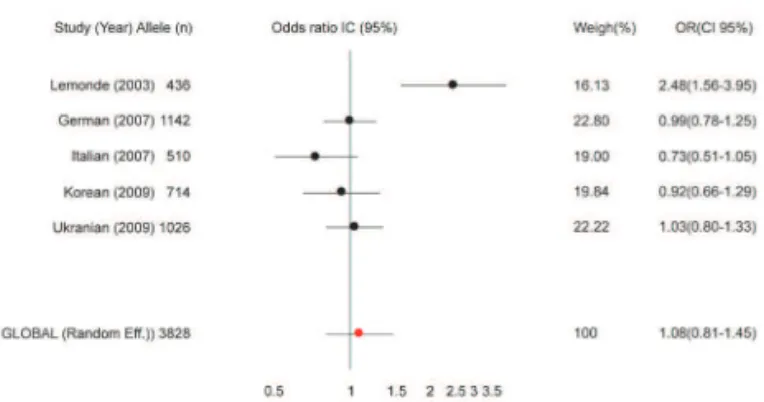
behavior (Random effects model: OR = 1.08; 95%CI: 0.80-1.45; p(Z) = 0.80) — Figure 1. Heterogeneity was observed in all studies (Q = 17.84; df = 4; p = 0.0013). Subsequently, we performed a second analysis, which only included studies inside the heterogeneity curve (Italian, German, Ukrainian,
and Korean populations). However, we could not ind an as -sociation (OR = 0.94; 95%CI: 0.82-1.09; p(Z) = 0.30; Q = 2.54; df = 3; p = 0.46) — Figure 2. In addition, when we included an explorative analysis of each of the Caucasian samples, no
sig-niicant heterogeneity was found (Q = 2.51; df = 2; p = 0.28). Also, we could not detect a signiicant association between
G allele and suicidal behavior (OR = 0.94; 95%CI: 0.79-1.13; p(Z) = 0.99). Finally, in an analysis of the studies containing only suicide victims (Ukrainian, Koran, and French-Canadian population), the results were also negative (OR = 1.29; 95%CI 0.78-2.13; p(Z) = 0.40) in presence of heterogeneity (Q = 13.02; df = 2; p = 0.0015).
Discussion
In the present study, we could not ind an association between
the rs6295 of the HTR1A gene and suicidal behavior. To our
knowledge, this is the irst meta-analysis considering HTR1A
and suicidal behavior. A search for trends in PubMed showed only a few publications analyzing this gene and suicidal behavior. These reports involve populations of European descent and only one study considered an Asian popula-tion. Therefore, to analyze a possible correlation between HTR1A and suicidal behavior, studies including populations from Asia, Latin America, and Africa must also be taken into consideration.
Currently, serotonin is probably the most studied neu-rotransmitter involved in suicidal behavior. Experiments have shown that 5-HTR1A receptors are upregulated in prefrontal cortex; this could be a compensatory mechanism to the low activity of serotonergic neurons.33 A functional polymorphism
in the gene encoding for this receptor has been investigated. However, only few reports have analyzed the association of this regulatory region and suicidal behavior.
In association studies, contradicting results have been obtained, which makes it hard to speculate the true asso-ciation between this polymorphism and suicidal behavior.
Figure 1 Odds ratios for the G allele of the rs6295
polymorphism in the HTR1A gene of individuals with suicidal behavioral.
Figure 2 Random-effects model, 95% CI, and OR of each
One must bear in mind that these association studies were conducted in various populations, different criteria were used for the phenotype definition, and sample sizes were relatively small. Although our meta-analysis consisted of a considerable sample, no association between the G allele of rs6295 and suicidal behavior could be obtained. Hence, we decided to test the probability association with completed suicide. As a result, we found that G allele of rs6295 was not associated with completed suicide. Though the OR value is 1.29, the CI contains values smaller than 1, which indicates no association. The sample sizes of the studies included in our meta-analysis are in the low range compared to genetics studies for other diseases. Therefore, future studies comprising larger samples of completed sui-cide are important to determine this association. We also consider that, given the small number of studies available, the association is not observable.
In a irst approach we observed heterogeneity; however
this variation was given by a sole study reporting a positive association. A second analysis, in which the study that gave rise to heterogeneity was discarded, also presented no as-sociation between rs6295 and suicidal behavior (Figure 2). Our study presents some limitations, publication bias has to be considered, as negative studies are less likely to get published; moreover, there might be an overrepresentation of the results showing an association between the polymorphism and the investigated disorder.34 Although, in the case of the
polymorphism rs6295 and suicidal behavioral, most reports show negative associations, the present analysis includes positive and negative reports. Other limitations are inherent in many meta-analysis of association, including this one: their retrospective nature and the inclusion of study-level data.
In conclusion, our results suggest that the G allele of the rs6295 polymorphism in the 5HTR1A gene is not associated with suicidal behavioral. However, more comprehensive stud-ies and larger samples are necessary to determine conclu-sively an association between 5HTR1A and suicidal behavior.
Disclosures
Miriam Rivera Angles
Employment:Universidad Juárez Autónoma de Tabasco, Mexico.
Deysi Bermúdez Ocaña
Employment:Universidad Juárez Autónoma de Tabasco, Mexico.
Beatriz Camarena Medellín
Employment:Instituto Nacional de Psiquiatría “Ramón de la Fuente Muñiz”, Mexico.
Carlos Tovilla-Zárate
Employment:Universidad Juárez Autónoma de Tabasco, Mexico.
* Modest
** Signiicant
*** Signiicant: Amounts given to the author’s institution or to a colleague for
research in which the author has participation, not directly to the author. For more information, see Instructions for Authors.
References
1. Savitz JB, Cupido CL, Ramesar RS. Trends in suicidology: personality as an endophenotype for molecular genetic investigations. PLoS Med. 2006;3(5):e107.
2. Garinkel BD, Froese A, Hood J. Suicide attempts in children and adolescents. Am J Psychiatry. 1982;139(10):1257-61.
3. Linkowski P, de Maertelaer V, Mendlewicz J. Suicidal behaviour in major depressive illness. Acta Psychiatr Scand. 1985;72(3):233-8.
4. McGufin P, Marusic A, Farmer A. What can psychiatric genetics offer suicidology? Crisis. 2001;22(2):61-5.
5. Mann JJ, Henteleff RA, Lagattuta TF, Perper JA, Li S, Arango V. Lower 3H-paroxetine binding in cerebral cortex of suicide victims is partly due to fewer high afinity, non-transporter sites. J Neural Transm. 1996;103(11):1337-50.
6. Yerevanian BI, Feusner JD, Koek RJ, Mintz J. The dexamethasone suppression test as a predictor of suicidal behavior in unipolar depression. J Affect Disord. 2004;83(2-3):103-8.
7. Ordway GA, Widdowson PS, Smith KS, Halaris A. Agonist binding to alpha 2-adrenoceptors is elevated in the locus coeruleus from victims of suicide. J Neurochem. 1994;63(2):617-24.
8. Benko A, Lazary J, Molnar E, Gonda X, Tothfalusi L, Pap D, Mirnics Z, Kurimay T, Chase D, Juhasz G, Anderson IM, Deakin JF, Bagdy G. Signiicant association between the C(-1019)G functional polymorphism of the HTR1A gene and impulsivity. Am J Med Genet B Neuropsychiatr Genet. 2010;153B(2):592-9. 9. Pazos A, Palacios JM. Quantitative autoradiographic mapping of
serotonin receptors in the rat brain. I. Serotonin-1 receptors. Brain Res. 1985;346(2):205-30.
10. Hall H, Lundkvist C, Halldin C, Farde L, Pike VW, McCarron JA, Fletcher A, Cliffe IA, Barf T, Wikström H, Sedvall G. Autoradiographic localization of 5-HT1A receptors in the post-mortem human brain using [3H]WAY-100635 and [11C]way-100635. Brain Res. 1997;745(1-2):96-108.
11. Kobilka BK, Frielle T, Collins S, Yang-Feng T, Kobilka TS, Francke U, Lefkowitz RJ, Caron MG. An intronless gene encoding a potential member of the family of receptors coupled to guanine nucleotide regulatory proteins. Nature. 1987;329(6134):75-9. 12. Stahl S. 5HT1A receptors and pharmacotherapy. Is serotonin
receptor down-regulation linked to the mechanism of action of antidepressant drugs? Psychopharmacol Bull. 1994;30(1):39-43. 13. Wu S, Comings DE. A common C-1018G polymorphism in the
human 5-HT1A receptor gene. Psychiatr Genet. 1999;9(2):105-6. 14. Lemonde S, Turecki G, Bakish D, Du L, Hrdina PD, Bown CD,
Sequeira A, Kushwaha N, Morris SJ, Basak A, Ou XM, Albert PR. Impaired repression at a 5-hydroxytryptamine 1A receptor gene polymorphism associated with major depression and suicide. J Neurosci. 2003;23(25):8788-99.
15. Lesch KP, Zeng Y, Reif A, Gutknecht L. Anxiety-related traits in mice with modiied genes of the serotonergic pathway. Eur J Pharmacol. 2003;480(1-3):185-204.
16. Strobel A, Gutknecht L, Rothe C, Reif A, Mossner R, Zeng Y, Brocke B, Lesch KP. Allelic variation in 5-HT1A receptor expression is associated with anxiety- and depression-related personality traits. J Neural Transm. 2003;110(12):1445-53. 17. Lanfumey L, Hamon M. 5-HT1 receptors. Curr Drug Targets CNS
Neurol Disord. 2004;3(1):1-10.
18. Parsey RV, Oquendo MA, Simpson NR, Ogden RT, Van Heertum R, Arango V, Mann JJ. Effects of sex, age, and aggressive traits in man on brain serotonin 5-HT1A receptor binding potential measured by PET using [C-11]WAY-100635. Brain Res. 2002;954(2):173-82.
19. Hsiung SC, Adlersberg M, Arango V, Mann JJ, Tamir H, Liu KP. Attenuated 5-HT1A receptor signaling in brains of suicide victims: involvement of adenylyl cyclase, phosphatidylinositol 3-kinase, Akt and mitogen-activated protein kinase. J Neurochem. 2003;87(1):182-94.
20. Pitchot W, Hansenne M, Pinto E, Reggers J, Fuchs S, Ansseau M. 5-Hydroxytryptamine 1A receptors, major depression, and suicidal behavior. Biol Psychiatry. 2005;58(11):854-8.
21. Tovilla-Zarate C, Camarena B, Apiquian R, Nicolini H. Association study and meta-analysis of the apolipoprotein gene and schizophrenia. Gac Med Mex. 2008;144(2):79-83.
23. Videtic A, Zupanc T, Pregelj P, Balazic J, Tomori M, Komel R. Suicide, stress and serotonin receptor 1A promoter polymorphism -1019C>G in Slovenian suicide victims. Eur Arch Psychiatry Clin Neurosci. 2009;259(4):234-8.
24. Yoon HK, Kim YK. TPH2 -703G/T SNP may have important effect on susceptibility to suicidal behavior in major depression. Prog Neuropsychopharmacol Biol Psychiatry. 2009;33(3):403-9. 25. Serretti A, Mandelli L, Giegling I, Schneider B, Hartmann
AM, Schnabel A, Maurer K, Möller HJ, Rujescu D. HTR2C and HTR1A gene variants in German and Italian suicide attempters and completers. Am J Med Genet B Neuropsychiatr Genet. 2007;144B(3):291-9.
26. Serretti A, Calati R, Giegling I, Hartmann AM, Moller HJ, Rujescu D. Serotonin receptor HTR1A and HTR2C variants and personality traits in suicide attempters and controls. J Psychiatr Res. 2009;43(5):519-25.
27. Wasserman D, Geijer T, Sokolowski M, Rozanov V, Wasserman J. The serotonin 1A receptor C(-1019)G polymorphism in relation to suicide attempt. Behav Brain Funct. 2006;2:14.
28. Kishi T, Tsunoka T, Ikeda M, Kawashima K, Okochi T, Kitajima T, Kinoshita Y, Okumura T, Yamanouchi Y, Inada T, Ozaki N, Iwata N. Serotonin 1A receptor gene and major depressive disorder: an association study and meta-analysis. J Hum Genet. 2009;54(11):629-33.
29. Huang YY, Battistuzzi C, Oquendo MA, Harkavy-Friedman J, Greenhill L, Zalsman G, Brodsky B, Arango V, Brent DA, Mann JJ. Human 5-HT1A receptor C(-1019)G polymorphism and psychopathology. Int J Neuropsychopharmacol. 2004;7(4):441-51. 30. Brezo J, Klempan T, Turecki G. The genetics of suicide: a
critical review of molecular studies. Psychiatr Clin North Am. 2008;31(2):179-203.
31. Savitz J, Lucki I, Drevets WC. 5-HT(1A) receptor function in major depressive disorder. Prog Neurobiol. 2009;88(1):17-31. 32. Wang S, Zhang K, Xu Y, Sun N, Shen Y, Xu Q. An association study of the serotonin transporter and receptor genes with the suicidal ideation of major depression in a Chinese Han population. Psychiatry Res. 2009;170(2-3):204-7.
33. Mann JJ. Neurobiology of suicidal behaviour. Nat Rev Neurosci. 2003;4(10):819-28.