Original Article
Rev. Latino-Am. Enfermagem2015 Jan.-Feb.;23(1):106-13 DOI: 10.1590/0104-1169.0150.2531 www.eerp.usp.br/rlae
Copyright © 2015 Revista Latino-Americana de Enfermagem This is an Open Access article distributed under the terms of the Creative Commons Attribution Non-Commercial License (CC BY-NC).
This license lets others distribute, remix, tweak, and build upon your work non-commercially, and although their new works must also acknowledge you and be non-commercial, they don’t have to license their derivative works on the same terms.
Corresponding Author: Alexandre Pazetto Balsanelli
Universidade Federal de São Paulo. Escola Paulista de Enfermagem Rua Napoleão de Barros, 754
Vila Clementino
CEP: 04024-002, São Paulo, SP, Brasil E-mail: [email protected]
1 Paper extracted from doctoral dissertation “Leadership of nurses in ICU and its relation to the work environment”, presented to Escola Paulista de Enfermagem, Universidade Federal de São Paulo, São Paulo, SP, Brasil. Supported by Coordenação de Aperfeiçoamento de Pessoal de Nível Superior (CAPES), Brazil, process # 008898340001-08.
2 Doctoral student, Escola Paulista de Enfermagem, Universidade Federal de São Paulo, São Paulo, SP, Brazil. RN, Escola Paulista de Enfermagem, Universidade Federal de São Paulo, São Paulo, SP, Brazil. Scholarship holder from Coordenação de Aperfeiçoamento de Pessoal de Nível Superior (CAPES), Brazil.
3 PhD, Associate Professor, Escola Paulista de Enfermagem, Universidade Federal de São Paulo, São Paulo, SP, Brazil.
Nursing leadership in intensive care units and its relationship to the
work environment
1Alexandre Pazetto Balsanelli
2Isabel Cristina Kowal Olm Cunha
3Aim: To establish whether there is any relationship between the work environment and nursing
leadership at intensive care units (ICUs). Method: Correlational study conducted at four ICUs
in southern São Paulo (SP), Brazil. The study population was comprised of 66 pairs (nurses
and nursing technicians) established by lottery. The nurses responded to three instruments:
1) characterization; 2) a validated Portuguese version of the Nursing Work Index Revised
(B-NWI-R); and 3) Grid & Leadership in Nursing: ideal behavior. The nursing technicians
responded to 1) characterization and to 2) Grid and Leadership in Nursing: actual behavior,
relative to the corresponding randomly-assigned nurse. The data were analyzed by means of analysis of variance (ANOVA) at p ≤ 0.05. Results: The work environment was not associated with actual nursing leadership (p = 0.852). The public or private nature of the institutions where
the investigated ICUs were located had no significant effect on leadership (p = 0.437). Only the
nurse-physician relationship domain stood out (p = 0.001). Conclusion: The choice of leadership
styles by nurses should match the ICU characteristics. Leadership skills could be developed, and
the work environment did not exert any influence on the investigated population.
Introduction
The labor market has been increasingly demanding
active leadership from nurses. To meet this demand,
understanding the relationship between this variable
and other variables is critical for the formulation of
action plans that promote the development of this skill.
Concern with nursing leadership is crucial in
intensive care units (ICUs) due to their dynamic nature,
which results from the severe condition of the admitted
patients and which requires nurses to provide highly
complex care. Within this setting, nurses must lead their
staff to achieve the best outcomes, for which leadership
skills are essential. Thus, the relationship between that
dynamic, interactive environment and nursing leadership
represents an appropriate subject of study.
The correlation between leadership and the work
environment has been studied by several authors at the institutional level but not speciically in the ICU setting. A total of 24 studies included in a systematic review(1)
showed that leadership styles focusing on people and
relationships contributed to improving the outcomes of
the nursing workforce, the work environment, and the
productivity and effectiveness of health organizations.
By contrast, the staff satisfaction was lower in 10 studies
in which leadership focused on tasks.
Transformational leadership increased the nurses’
satisfaction in all institutional areas, reduced burnout,
and provided a favorable work environment(2).
Another study(3) designed a test model in which the
authentic leadership of managers was combined with the
nurses’ perception regarding structural empowerment,
performance, and personal satisfaction. The sample consisted of 280 nurses who responded to instruments
for data collection on each of the assessed variables. Leadership had a signiicant and positive inluence on all the investigated attributes.
A study that investigated the role of organizational power and the leader’s personal inluence in the creation of a high-quality professional practice environment for
nurses(4) found a direct and positive relationship.
To summarize, leadership impacts the work
environment. However, the measure in which the
environment might interfere with the development of
leadership is still a gap that deserves investigation,
especially in intensive care units because no studies
assessing that relationship in this particular setting
could be located.
Thus, the present study poses the following research
question: Is there a relationship between the ICU work
environment and nursing leadership? The answer to
this question will help advance the knowledge on this
subject and support nursing management, modifying
the development of that skill based on the results. In
addition, the critical nature of the ICU setting, the use
of high technology, and the presence of interdisciplinary
staffs further stimulate this type of inquiry. Thus, the
aim of the present study is to investigate whether there
is any relationship between the ICU work environment
and nursing leadership.
Method
The present correlational study involved a
systematic investigation of the nature of the relationship
or association between variables(5). The study was
conducted at four ICUs in the southern area of São Paulo
County, SP, Brazil. Those ICUs were located at tertiary
hospitals and provided general intensive care to adults
with clinical or surgical problems. Two ICUs belonged to
private institutions (A and B) and two to public teaching
hospitals (C and D). The reason for that choice was to
compare public and private settings as well as for the
investigators’ convenience.
ICUs at public and private institutions were
selected based on the assumption that from the
macromanagement perspective, they exhibited
differences. That is, the management of the physical,
material, and human resources, quality, and safety
was different. This assumption was based on the
investigators’ professional work experience in both
settings.
The study population consisted of registered nurses
and nursing technicians with at least six months of work
experience in an ICU. This criterion was established to
ensure that the participants had the minimum experience
in intensive care required for a sound assessment.
The procedure for data collection started with the
principal investigator’s making contact with the nurses
to inform them of the aims of the study. Next, the nurses
randomly selected one of the nursing technicians on
staff, who was also consulted, by lottery. After agreeing
to participate, all of the volunteers signed an informed
consent form.
The nurses were blind as to the nursing technicians they had selected, as the latter were identiied by numbers that were only known to the principal investigator. By
contrast, the nursing technicians were aware of the
identity of the leader they had to evaluate, as his or her
Anonymity was ensured to avoid any inluence that could interfere with the subjects’ responses.
An envelope containing the following three
instruments for data collection was delivered to the
nurses: 1) characterization: comprising data on age,
gender, time since graduation, job at the institution
and in the ICU, attendance of graduate courses, and
acquaintance with the topic of leadership. Those
variables were selected based on the investigators’
experience and the intention to assess their relationship
to leadership; 2) a validated Portuguese version of the
Nursing Work Index Revised (B-NWI-R)(6);and 3) Grid & Leadership in Nursing: ideal behavior(7).
The selected nursing technicians were given
an envelope that contained the following: 1) the
aforementioned instrument for characterization; and
2) Grid & Leadership in Nursing: actual behavior(7) to
complete relative to the corresponding
randomly-assigned nurse.
As a result, pairs were formed between a nurse and
the nursing technician randomly selected by him or her
to evaluate the former’s perception on ideal leadership
behavior and the assessment made by the latter on the
actual performance of the nurse as his or her immediate
leader.
The participants responded to the instruments
away from the work environment. A date was scheduled
to hand the questionnaire directly to the principal
investigator. The principal investigator did not hold a
leadership position at any of the investigated ICUs.
The characteristics of each instrument are described
in the following. The B-NWI-R(6)is based on the Nursing
Work Index (NWI), which was drafted in 1989. It
consists of 65 items. The Nursing Work Index Revised
(NWI-R)(8) was formulated to make the NWI shorter and
also to measure particular characteristics of the work
environment that are favorable to nursing professional
practice.
The NWI-R consists of 57 items, 15 of which
were conceptually distributed across three subscales:
autonomy, control over the practice setting, and the
nurse-physician relationship. A total of 10 of these
15 items were clustered to form a fourth subscale:
organizational support(8).
Conceptually, the subscales are deined as follows(8): autonomy (ive items) and control (seven
items) represent the freedom nurses have to solve
problems that affect the quality of nursing care; the
nurse-physician relationship (three items) concerns the
professional respect needed for effective communication
regarding shared goals in patient care; organizational
support (10 items derived from the three aforementioned
subscales) concerns the situations in which the
organization provides the necessary support for nursing
professional practice.
The measurement scales are 4-point Likert
scales; the lower the score, the greater the presence
of attributes favorable to professional nursing practice.
The score of each subscale is calculated based on the
average scores of the responses given by subjects and
ranges from one to four(8).
Because the NWI-R was translated and adapted
for the Brazilian population(9) and the subscales were
validated (B-NWI-R)(6), they were used in the present
study.
Grid & Leadership in Nursing: ideal and actual
behavior(7) consists of two instruments based on the grid theory to assess the ideal leadership behavior of nurses
and the actual views of staff members in this regard. One
instrument is thus responded to by the staff leader, and
the other by a staff member. As both instruments are
appropriate for the Brazilian setting and were subjected
to apparent and content validation(7), they are used in
the present study.
The instrument consists of 25 statements with
four answer options, attributed different scores and
categorized as follows: entirely desirable (four points),
desirable (three points), undesirable (two points), and
entirely undesirable (one point)(7).
Each statement concerns one style of leadership
(1.1; 1.9; 5.5; 9.1; and 9.9)(7). The leadership style
attributed the highest score represents how a nurse
exerts leadership as a function of his or her conception
of ideal behavior and the view of a member of his or her
staff regarding the actual situation(7).
The data were collected from October 2012 to
March 2013. The study was approved by the research
ethics committee (Comitê de Ética em Pesquisa - CEP)
of the Federal University of São Paulo (Universidade
Federal de São Paulo - UNIFESP) under protocol number
0839/10.
Before the onset of data collection and following
the CEP approval, a pretest was performed with a
random sample comprising 13 nurses and 13 nursing
technicians who did not participate in the full study. No dificulty in the interpretation of the questionnaires used was reported.
The data on characterization were analyzed by
means of descriptive statistics. Analysis of variance
used to investigate the correlation between the work
environment and actual nursing leadership, which were
the variables of interest in the present study.
Results
The response rate was 54.5%, i.e., 121 nurses
and nursing technicians returned the questionnaires.
However, the sample consisted of 66 nurse-nurse
technician pairs, distributed as follows: ICU A = 34, ICU
B = 3, ICU C = 16, and ICU D = 13.
Of the 66 nurses who were interviewed, 48
(72.7%) were female; their shift distribution was as
follows: morning, 15 (22.7%); morning and afternoon,
5 (7.6%); afternoon, 11 (16.7%); and night, 35 (53%).
The morning and afternoon shift was included because
the work schedule at one of the institutions was 12x36
h during the day.
All of the nurses (100%) had been introduced to
the subject of leadership during their undergraduate
studies; 29 (43.99%) had attended lectures, and 28
(42.4%) had been given special training on the subject.
A total of 60 nurses (90.9%) had attended specialized
courses, most of which were on intensive care, 28
(46%); 10 among the latter had attended specialized courses in other ields.
Of the group of nursing technicians, 41 (62.1%)
were female, worked the same shifts as their superiors,
and had been less exposed to the subject of leadership:
42 (63.6%) in a technical course, 18 in lectures (27.3%),
16 (24.3%) in training sessions, and 7 (10.6%) in other
contexts, in addition to coursework for 11 (16.7%) who
were studying nursing.
The technicians were slightly older (average age:
34.7 years old) than the nurses (average age: 32.9
years old), and their time since graduation was longer
(on average, 10 years). The length of work at the
institution and ICU was longer among the nurses (on
average, 6 and 5.2 years, respectively) compared to
the nursing technicians (on average, 5.1 and 4.8 years,
respectively). The fact that 35 pairs (53%) worked the
night shift is deserving of particular attention.
The average scores on the B-NWI-R were similar
among the four investigated ICUs (mean = 1.95; 95%
CI: 1.85-2.05): ICU A, 1.88 (95% CI: 1.74-2.02); ICU
B, 2.29 (95% CI: 1.87-2.71); ICU C, 1.90 (95% CI:
1.69-2.10); and ICU D, 2.10 (95% CI: 1.83-2.37).
The internal consistency of the B-NWI-R domains
was assessed by means of Cronbach’s alpha, the
values of which were: total B-NWI-R = 0.819;
B-NWI-R autonomy = 0.645; B-NWI-R control over
practice setting = 0.732; B-NWI-R nurse-physician
relationship = 0.702; and B-NWI-R organizational
support = 0.748.
Among the population of 66 responding nurses,
65 (98.5%) rated leadership style 9.9 as the ideal
leadership style. However, when their actual leadership
style was assessed by the nursing technicians, the
results were as follows: 9.9 was attributed to 42 nurses
(63.6%); 9.1 to eight (12.1%); 5.5 to 9 (13.6%); 1.9
to six (9.1%); and 1.1 to one (1.5%). Thus, 42 (63.6%)
leaders were assessed in a satisfactory manner (95% CI
[50.8%; 74.8%]).
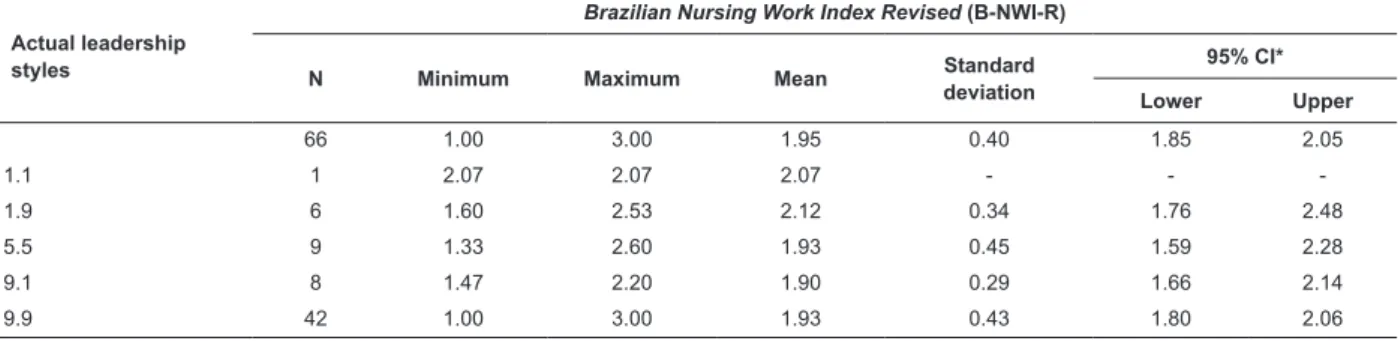
Table 1 shows the intersection between the average
scores on the B-NWI-R and the actual leadership styles
of nurses independent of the particular ICUs.
The data presented above show that there was no
difference between the work environment and actual
nursing leadership (p = 0.852). Styles 9.9 and 9.1
were associated with the lowest average scores on the
B-NWI-R. In comparison, the means for styles 1.1 and 1.9 tended to be higher but not signiicantly.
Actual leadership style was not signiicantly related to the various B-NWI-R domains, as shown in Table 2.
Table 1 – Descriptive statistics corresponding to the total score on the B-NWI-R per actual leadership style. São Paulo,
SP, Brazil, 2013.
Actual leadership styles
Brazilian Nursing Work Index Revised (B-NWI-R)
N Minimum Maximum Mean Standard deviation
95% CI*
Lower Upper
66 1.00 3.00 1.95 0.40 1.85 2.05
1.1 1 2.07 2.07 2.07 - -
-1.9 6 1.60 2.53 2.12 0.34 1.76 2.48
5.5 9 1.33 2.60 1.93 0.45 1.59 2.28
9.1 8 1.47 2.20 1.90 0.29 1.66 2.14
9.9 42 1.00 3.00 1.93 0.43 1.80 2.06
Table 2 – Descriptive statistics corresponding to the B-NWI-R domains per actual leadership style. São Paulo, SP,
Brazil, 2013.
Brazilian Nursing Work Index Revised (B-NWI-R)
domain
Group N Minimum Maximum Mean Standard deviation
95% CI*
p Lower Upper
Autonomy All 66 1 3.4 1.92 0.49 1.79 2.04
1.1 1 2 2 2 - -
-1.9 6 1.6 2.4 2.03 0.32 1.7 2.37 0.977
5.5 9 1 3.2 1.87 0.7 1.33 2.41
9.1 8 1.2 2.4 1.9 0.41 1.55 2.25
9.9 42 1 3.4 1.91 0.49 1.76 2.06
Control over practice setting All 66 1 3.57 2.01 0.51 1.88 2.13
1.1 1 2 2 2 - -
-1.9 6 1.71 2.86 2.24 0.55 1.66 2.81 0.847
5.5 9 1.57 2.71 1.97 0.36 1.69 2.25
9.1 8 1.43 2.57 1.95 0.41 1.6 2.29
9.9 42 1 3.57 2 0.55 1.82 2.17
Nurse-physician relationship All 66 1 3 1.85 0.47 1.74 1.97
1.1 1 2.33 2.33 2.33 - -
-1.9 6 1 3 2 0.76 1.2 2.8 0.632
5.5 9 1 2.67 1.96 0.51 1.57 2.36
9.1 8 1 2.67 1.79 0.56 1.32 2.26
9.9 42 1 2.67 1.81 0.4 1.69 1.93
Organizational support All 66 1 3.1 1.96 0.43 1.86 2.07
1.1 1 2.2 2.2 2.2 - -
-1.9 6 1.8 2.6 2.22 0.37 1.83 2.61 0.539
5.5 9 1.4 2.7 1.97 0.45 1.62 2.31
9.1 8 1.4 2.1 1.84 0.28 1.61 2.07
9.9 42 1 3.1 1.95 0.46 1.8 2.09
*95% conidence interval
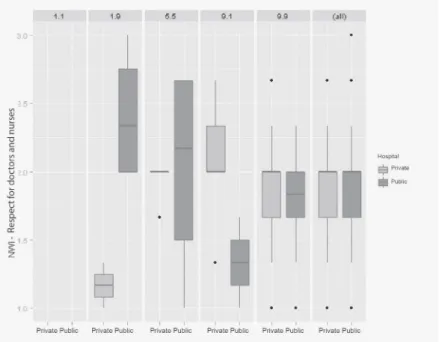
Figure 1 – Boxplot representing the nurse-physician relationship domain per actual leadership style and hospital
type. São Paulo (SP), Brazil, 2013.
As the number of pairs was heterogeneous among
the investigated ICUs and to test for differences in
the B-NWI-R scores and the actual leadership styles
between the nurses at the private (ICU A and B) and
public (ICU C and D) hospitals, the corresponding ICUs
The average total score on the B-NWI-R was 1.91
(95% CI: 1.83-2.15) in the ICUs at the private hospitals
and 1.99 (95% CI: 1.78-2.05) in the ICUs at the public
hospitals, p = 0.459. The correlation of those scores
with the actual nursing leadership style exhibited p =
0.437.
The average score for each B-NWI-R domain was
analyzed relative to the actual leadership style of the
nurses at the public and private hospitals. The results
were as follows: autonomy, p = 0.629; control over
practice setting, p = 0.676; nurse-physician relationship,
p = 0.001; and organizational support, p = 0.254.
The ANOVA showed that the effect of the interaction
between hospital type and actual nursing leadership style was signiicant only in the nurse-physician relationship domain (p = 0.001), as shown in Figure 1.
The scores on the B-NWI-R nurse-physician
relationship domain relative to leadership style 9.1
were lower at the public hospital ICUs. The scores on
the B-NWI-R relative to leadership style 1.9 were lower
at the private hospital ICUs. Thus, the most favorable(6)
correlation between the leadership style in which the
professional is most involved (9.1)(7) and the mutual
respect between nurses and doctors corresponded to
the public hospital ICUs.
Discussion
The interest in studies assessing the impact of
the work environment on the outcomes of care and
management arose in the 1980s, when the American
Academy of Nursing conducted a nationwide study to
establish which characteristics of the work environment
favored nursing professional practice. The institutions
known as magnet hospitals shared the following
features: management, professional practice, and
professional development(8).
Those attributes are assessed by the NWI-R(8),
which is the basis for B-NWI-R(6) and which is anchored
in the Nursing Professional Practice Model(10). The latter is deined as a system (structure, process, and values) that lends support to nurses to control the care provided
to patients and the setting in which care is provided.
On those grounds, the results of the present study
show that the work environment at the investigated
ICUs is favorable for daily nursing practice (mean =
1.95; 95% CI: 1.85-2.05), regardless of the hospital
being analyzed.
One might thus infer that the ICU work environment
is attractive for nursing professionals. This claim is
corroborated by a study conducted in South Korea(11)
that investigated nurses’ perceptions of the work
conditions at the hospital and the ICU simultaneously
by means of the NWI-R subscales. The sample consisted
of 817 nurses from 39 ICUs at 15 hospitals. Based on
the results of the multiple regression analysis, the work
environment at the investigated hospitals was rated
good, moderate, or poor as follows: good, two (13.4%);
moderate, 10 (66.6%); and poor, three (20%). The
corresponding assessment of the ICUs was as follows:
good, nine (23.1%); moderate, 24 (61.5%); and poor,
six (15.4%).
The average score of 17 rural ICUs in the state
of São Paulo (SP), Brazil(12), on the B-NWI-R was
2.13, which was higher than the score found in the
present study. Thus, the work environment at the four
investigated ICUs was found to be healthy.
However, no signiicant association was found between the average score on the B-NWI-R and the
actual nursing leadership styles (p = 0.852). The same
held true for the scores on the B-NWI-R subscales.
Thus, the work environment was not found to inluence the nursing leadership styles in the present study. However, only four of the B-NWI-R domains
were validated for use in Brazil(6). Once validated,
the remaining domains might allow for a broader
assessment of the work environment characteristics
than the domains available at the present time.
When the ICUs at the public and private hospitals were analyzed separately, no signiicant difference was found in relationship between the average B-NWI-R
score and the nurses’ actual leadership styles (p =
0.437). Only the nurse-physician relationship domain
exhibited p = 0.001. It should be noted that the ICUs
at the public hospitals exhibited the most favorable
correlation between the leadership styles in which the
professional is most involved, 9.1(7), and the nurse-physician relationship domain. This inding leads us to relect on how professional relationships occur, taking into consideration the fact that as teaching hospitals,
the public hospitals might have been more favored.
Nevertheless, experience in the ICU allows the inference
that interdisciplinary interactions do occur and that they
are generally healthy, given the severity of the patients
under staff care.
Leadership has been associated with several
variables, including patient satisfaction. There is
strong evidence(12) of an association between positive
leadership behaviors and increased patient satisfaction
In one study(13), 29% of job satisfaction, 22% of
organizational commitment, and 9% of productivity
were explained by the use of leadership behavior. Those indings are in accord with the results of three studies(14-16) in which the variables of interest were job
satisfaction, organizational climate(14-15), and burnout(16). Leadership was found to exert a positive, direct inluence on those indicators(14-16).
Based on those indings and the fact that the work environment might attract and retain excellent
professionals, according to the Nursing Professional
Practice Model(10), it was hypothesized that such strong characteristics might inluence nursing leadership styles, given the lack of studies in the literature that seek to
answer this question.
The results of the present study show that the work
environment is similar at the four investigated ICUs. No
relationship is found between the work environment and
nursing leadership in the assessed population. These indings give rise to several questions that might be answered by future studies: Are ICUs different from
other hospital areas? Would the application of the entire
NWI-R, following its validation for the Brazilian context,
allow for a better assessment of work environments
and subsequent replication of the method used in the
present study? Would the inclusion of additional ICUs
allow for a more comprehensive analysis of this problem
within the intensive care setting?
Conclusion
The work environment was not associated with
actual nursing leadership (p = 0.825), and the same held
true in the case of the B-NWI-R subscales. The public or
private nature of the hospitals where the investigated
ICUs were located did not exhibit a direct relationship
with leadership (p = 0.437). Only the nurse-physician
relationship domain stood out, p = 0.001.
The present study had the following limitations:
sample size and convenience sampling; application of
only four of the B-NWI-R domains; few studies that used
the NWI-R in the intensive care setting; and the fact that
the leadership framework used dates from the 1990s.
Based on these results, nursing managers might
conclude that nurses ought to develop leadership skills and that the work environment does not exert inluence on the study population. Thus, nurses require individual
development plans that include the types of knowledge,
skills, attitudes, values, and deliverables needed to
exert leadership. Within this context, the role of Nursing
Training Centers also stands out because they are tasked with the training and development of leaders it for work in the intensive care setting, using the indings of the present study.
Because the work environment was not associated
with nursing leadership in the investigated ICUs, further scientiic studies with larger samples might be conducted to conirm this result and to identify other variables the may interfere with nursing leadership in the intensive
care setting.
References
1- Cummings GG, MacGregor T, Davey M, Lee H, Wong
CA, Lo Eliza, Muise M, Stafford E. Leadership styles and
outcome patterns for the nursing workforce and work
environment: a systematic review. Int J Nurs Stud.
2010;47:363-85.
2-Weberg D. Transformational leadership
and staff retention. Nurs Adm Q. 2010
julho-setembro;34(3):246-58.
3-Wong CA, Laschinger HKS. Authentic leadership,
performance and job satisfaction: the mediating role of
empowerment. J Adv Nurs. 2012;69(4):947-59.
4- Lankshear S, Kerr MS, Laschinger HKS, Wong CA.
Professional practice leadership roles: the role of
organizational power and personal influence in creating
a professional practice environment for nurses. Health
Care Manage Rev. 2013;38(4):349-60.
5-Sousa VD, Driessnack M, Mendes IAC. An overview of
research designs relevant to nursing: Part 1: quantitative
research designs. Rev. Latino-Am. Enfermagem.
2007;15(3):502-7.
6-Gasparino RC, Guirardello EB, Aiken LH. Validation of
the Brazilian version of the Nursing Work Index-Revised
(B-NWI-R). J Clin Nurs. 2011;20:3494-501.
7-Higa EFR, Trevisan MA. The style of lidership
idealized by nurses. Rev. Latino-Am. Enfermagem.
2005;13(1):59-64.
8- Aiken LH, Patrician PA. Measuring organizational traits
of hospitals: the Revised Nursing Work Index. Nurs Res.
2000;49(3):146-53.
9- Gasparino RC, Guirardello EB. Tradução e adaptação
para a cultura brasileira do “Nursing Work Index-
Revised”. Acta Paul Enferm. 2009;22(3):281-7.
10- Hoffart N, Woods CQ. Elements of a nursing professional
practice model. J Prof Nurs. 1996;12(6):354-64.
11- Cho SH, Mark BA, Yun SC, June KJ. Differences
in intensive care unit work environments among and
measure of the Revised Nursing Work Index. J Adv Nurs.
2011;67(12):2637-48.
12- Panunto MR, Guirardello EB. Professional nursing
practice: environment and emotional exhaustion among
intensive care nurses. Rev. Latino-Am. Enfermagem
2013;21(3):765-72.
13- Wong CA, Cummings GG. The relationship between
nursing leadership and patient outcomes: a systematic
review. J Nurs Manage. 2007;15:508-21.
14-Loke JCF. Leadership behaviours: effects on
job satisfaction, productivity and organizational
commitment. J Nurs Manage. 2001;9:191-204.
15-Sellgren SF, Ekvall G, Tomson G. Leadership behavior
of nurse managers in relation to job satisfaction and
work climate. J Nurs Manage. 2008;16:578-87.
16- Kanste O, Kyngas H, Nikkila J. The relationship
between multidimensional leadership and Burnout
among nursing staff. J Nurs Manage. 2007;15:731-9.
Received: May 15th 2014