CONSTRUCTION OF AN EDUCATIONAL TECHNOLOGY FOR TEACHING ABOUT NURSING ON PERIPHERAL VENIPUNCTURE
a Nurse. PhD Student from Nursing Graduate Program at Federal University of Ceara (UFC). Fortaleza, Ceara, Brazil. b Nurse. Master’s Graduate Program in Nursing from UFC. Fortaleza, Ceara, Brazil.
c PhD Professor, Department of Nursing, Federal University of Maranhao (UFMA). Empress, tangle, Brazil. d Nurse. Resident in Oncology from Cancer Institute of Ceara (ICC). Fortaleza, Ceara, Brazil.
e Nurse. PhD Student from Nursing Graduate Program from UFC. Capes scholarship. Fortaleza, Ceara, Brazil. f PhD Professor, Department of Nursing at UFC. Fortaleza, Ceara, Brazil.
Natasha Marques FROTAa, Lívia Moreira BARROSb, Thiago Moura de ARAÚJOc,
Luana Nunes CALDINId, Jennara Cândido do NASCIMENTOe, Joselany Áfio CAETANOf
ABSTRACT
The aim of the study was to describe the construction of a course on peripheral venipuncture using the Information and Communication Technologies. This is a methodological research, developed at the Federal University of Ceara from January to March 2012. The construction phases are: the analysis, design and development according to the theoretical framework of Galvis-Panqueva. In the analysis, objectives, content, target audience, the study environment and technology infrastructure were delimited. During the design phase the environment, interface and navigation structure of the course were evaluated. The development consisted in the materialization of all that was designed in the previous phase. Once all three phases of construction of the course were conducted, it was available in the Virtual Learning Environment SOLAR. The final product of the course is presented as support of nursing students and consequently the training of future nurses in their care practice on peripheral venipuncture.
Descriptors: Technology educational. Education, nursing. Higher education. Catheterization, peripheral.
RESUMO
O objetivo do estudo foi descrever a construção de um curso sobre punção venosa periférica utilizando as Tecnologias da Infor-mação e Comunicação. Trata-se de uma pesquisa metodológica, desenvolvida na Universidade Federal do Ceará, de janeiro a março de 2012. As etapas de construção constituem-se em análise, desenho e desenvolvimento de acordo com o referencial teórico de Galvis-Panqueva. Na análise, foram delimitados os objetivos, o conteúdo, o público-alvo, o ambiente de estudo e a infraestru-tura tecnológica. Na fase do desenho, foi avaliado o ambiente, a estruinfraestru-tura de navegação e a interface do curso. O desenvolvimento consiste na materialização de todo o desenho elaborado na fase anterior. Realizadas as três fases de construção do curso, este foi disponibilizado no Ambiente Virtual de Aprendizagem SOLAR. O produto final do curso apresenta-se como suporte aos estudantes de enfermagem e, consequentemente, na formação de futuros enfermeiros na sua prática assistencial sobre punção venosa periférica.
Descritores: Tecnologia educacional. Educação em enfermagem. Educação superior. Cateterismo periférico.
Título: Construção de uma tecnologia educacional para o ensino de enfermagem sobre punção venosa periférica.
RESUMEN
Objetivo del estudio fue describir la construcción de un campo de cateterismo periférico utilizando la información y la comuni-cación. Se trata de una metodología de investigación, desarrollado en la Universidad Federal de Ceará de enero a marzo 2012. Los pasos que se están acumulando son el análisis, el diseño y el desarrollo de acuerdo con el marco teórico de Galvis-Panqueva. El análisis fue limitado a los objetivos, los contenidos, el público objetivo, el medio ambiente y la infraestructura de la tecnología de estudio. En la fase de diseño se evaluaron el ambiente, la interfaz y la estructura de navegación del curso. El desarrollo consiste en la materialización de cualquier diseño preparado en la etapa anterior. Se realizaron tres etapas de construcción del campo, el mismo estaba disponible en el entorno de aprendizaje virtual SOLAR. El producto final del curso se presenta como el apoyo de los estudiantes de enfermería y en consecuencia la formación de los futuros enfermeros en la práctica asistencial de cateterismo periférico.
Descriptores: Tecnología educacional. Educación en enfermería. Educación superior. Cateterismo periférico.
INTRODUCTION
The growth in the use of Information and Communication Technologies (ICT) occurs rapidly in the area of information management, as well as in the health area. The expansion of Internet access in hospital, clinic and teaching environments pro-vide an expansion of communication networks in services of health, changing both the professional and the population profile with regard to access to health information(1) .
Intermediation in the educational process through the use of ICT has increased the pos-sibilities for communication and information ac-quisition, which changed the way we live, work, organize ourselves socially and also the way we learn today. Due to the fact there is a merge of three techniques (computing, telecommunications and electronic media), the use of ICT offers the possibility of developing new theories, especially in the educational field(2).
Thus, the use of computational resources in education is a reality that has been intensified in recent years. The new technological possibilities are being incorporated into teaching practices, especially with initiatives with universities, either as support for classroom teaching or developing distance activities(3).
Facing this context, the Virtual Learning Environment (VLE) may be used to mediate the use of ICT, since the VLE uses methods by which the student will be responsible for their own study, which optimizes the dynamic of the classroom, pro-vides a better utilization of theoretical framework, making them more attractive, and personalizes learning as it allows the student the possibility to access the environment at the time and local ac-cording to their availability(4,5).
The VLE has brought a significant impact on traditional educational paradigm, which promotes changes in the way we teach and learn, causing dis-tinct modes of knowledge production and the rela-tionship between the professor/tutor and students(6).
Thus, the use of educational technologies provides training for students to perform certain nursing procedures safely, from media resources that make students closer to reality. This fact helps in professional training, by providing the student to ac-quire the knowledge needed to successfully overcome the insecurity in performing nursing procedures(2).
In this context, we identify the importance of using ICT that aims to promote distance learning, making it flexible and collaborative training for nursing students in a relevant subject to the health area which is peripheral venipuncture (PVP).
This theme was chosen due to the fact PVP is commonly performed by the nursing staff, it is necessary to know the material available and the correct technique for this procedure and the pos-sible complications of PVP, which may be systemic and/or local(4,6).
Thus, to be a safe practice with quality in PVP, factors such as prior knowledge and agility in deci-sion-making should be considered as a significant influence on the preservation and maintenance of the intravenous catheter. The training of students and professionals aims to contribute to the reduc-tion of risks in this way of administrareduc-tion and provide safety to the patient’s health in nursing clinical practice, which may be acquired through educational technologies(7).
Given these considerations, it is appropriate to conduct this study in the search for completing the gaps observed in the teaching of this subject, such as: procedure’s little practice; unavailability of resources and attractive educational materials; and supporting lectures and laboratory. It is also con-sidered in this justification, the significant increase in the use of information technology in nursing education, approaching the student with the practi-cal reality of their area of expertise. Therefore, the objective of this study was to describe the construc-tion of a course on peripheral venipuncture using the Information and Communication Technologies.
METHOD
The study consisted of an applied method-ological research of technmethod-ological production. The applied methodological research was adopted due to its process of developing/creating a new prod-uct, activity or service(8), as in the present study
there was a course construction on peripheral venipuncture through ICT.
Phase 1: Analysis and design
This phase consists in finding the accurate real need or demand for courses which justify the theme as well as the creation and usage of the VLE. Even at this phase, elements are analyzed as objectives, content, target audience, learning environment and technological infrastructure. The development comprises the materialization of used media in the virtual learning environment(9).
The target public chosen were nursing students, with the purpose of being a material to support classroom teaching and contribute to the training of the professional about the theme. However, nurses who want updates on PVP may also take the course.
As for educational purposes, we used Bloom’s Taxonomy, which consists of a suitable instrument for use in teaching. In recent years, this taxonomy was evaluated and updated considering the strategic and technological advances incorporated into the educational environment(10).
The educational objectives were elaborated according to the cognitive, affective and psychomo-tor Bloom’s Taxonomy(11), considering that at the
completion of the course the student is able to: Know the anatomy of the venous network, the most suitable sites for puncture and appropriate devices; analyze main nursing interventions in the peripheral venipuncture procedure; identify the complications of peripheral venipuncture; Realize the importance of the study for professional life; Formulate a study plan to actively participate in the course; build their own learning path by Navigation through the VLE; and demonstrate acquisition of knowledge during the course of the solution through the activities and participation in the forums.
The construction of the course occurred from January to March 2012, during that period we researched on the topic to be addressed, which was explored by means of an integrative review in national and international databases; books of evidence-based nursing, and Fundamentals books of Nursing, as well as in protocols from the Infu-sion Nurses Society (INS)(12).
Human resources for preparing the content was composed by two nurses, masters in Nursing with experience in hospital practice; a student from the master’s program; and two scientific initiation students with scholarships for description of the layout of the media and to define the way learning
could be assessed. There was also the support of the Virtual technical staff from the Federal Uni-versity of Ceara (UFC) scanning the material and developing the graphic designer.
Phase 2: Development
The development consisted in the materializa-tion of the design prepared in the previous phase, in which softwares were chosen, such as Adobe Flash® Professional CS6, to perform the interactive effects and the selection of the programming lan-guage(10). The organization of the material occurred
through the storyboard technique, which consists of a sketch of how the application is organized, al-lowing the detailed sequence of content, structure, navigation, and layout of the interface(12).
The implementation and use of ICT might be done through some interactive features of com-munication such as synchronous and asynchronous tools. The term “synchronous” refers to the com-munication that takes place in real time (phone) and “asynchronous” refers to communication that does not happen in real time (e-mail and discussion list). This modality and learning provided by ICT favors the process of teaching and learning at the same time, creates an environment of interaction among participants of the process, making learning more attractive, stimulating and motivating(2,13).
The course was developed in the HTML (Hyper Text Makup Language), using the Micro-soft Office Word 2003- 2007®, since the language is suitable for developing websites(14). As for the
language used in the interface, it must provide simplicity, clarity and objectivity, making content more accessible to the user, so that he/she can learn and advance in studies with greater ease(15).
The organization of material for preparing the course took place through the selection of the tools used in VLE SOLAR. These tools were developed in order to make possible and encourage as much interaction and collaboration among students as possible. It also aims to foster students’ autonomy allowing free navigation through the links cre-ated in the environment, they can also express themselves freely and exercise the new knowledge acquired in the proposed activities(8).
RESULTS
The course is available at the Solar Platform from the Federal University of Ceara (UFC), avail-able at http://solarpresencial.virtual.ufc.br/. The choice of Solar VLE as support for the course was due to the fact it is an open source and also because the UFC uses this environment to support class-room teaching in many areas of education.
In order for the student to have access to the course, it is necessary to subscribe in the VLE with username and password so that they are available to perform the login. Access to the environment is possible only after approval of the tutor/professor from the registration application by the user.
During the course, the use of different tools allows interaction between students, where videos, photos, hypertext, hyperlinks and exercises were made available. This diversity also enables these tools to become attractive as they are being used by students. In addition, the incorporation of various media provides learning, from multiple potentiali-ties, abilities and interests of learners, because it contributes to the construction of individual and collective learning(3).
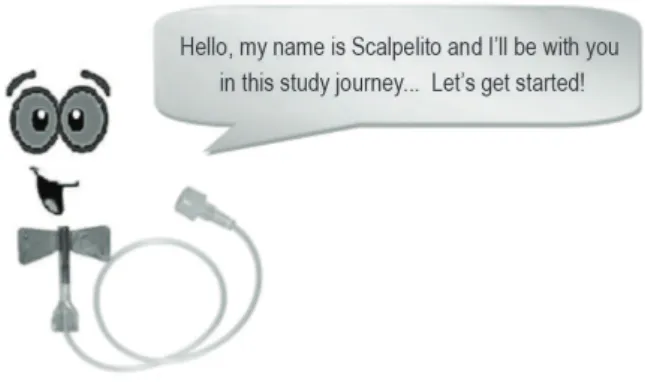
The media were made available during the modules. This organization helps the student to find their topic of interest more easily, it also makes the content not tiresome. On the homepage of the environment, the student has access to classes, each with an exposure of content covered, in which there are all phases to be followed by the student. At this time, the presentation of a learning object is done: the “Scalpelito” (Figure 1), whose aim is to be a tool that strengthens the transmission of knowledge ac-cording to the particularities of the target audience. This avatar provides interaction between the student with the VLE, strengthening the dynam-ics of the learning process in various stages of the course, since the “Scalpelito” appears to interact with students through questions, exercises and reading supplementary articles suggestions on the topic.
After the initial presentation of the course, students will have access to classes, organized into six modules, which are subdivided into topics, which are: Module 1: Introduction to peripheral venipunc-ture; Module 2: Venous network anatomy; Module 3: Peripheral venipuncture procedure; Module 4: Lo-cal and systemic complications of PVP; Module 5:
Figure 1 – Educational object’s image: “Scalpelito”. Fortaleza-Ceara, 2012.
Peripheral venipuncture in special patients, and Module 6: Non-compliance actions of PVP.
In Module 3, which addresses the peripheral venipuncture procedure, there is a video showing the step by step process using the flexible cath-eter. The video was constructed in the laboratory of Nursing from Federal University of Ceara by nurses involved in this research. For video editing, we used the software Windows Live Movie Maker 2011 version and a 14.1 megapixel digital camera. The development stages of the video were: struc-turing the proposed construction of educational video, script development to video production, human resources training and video production. At the end, the video had a duration of 8 minutes.
The standardization of the procedure of pe-ripheral venipuncture occurred through a Standard Operating Procedure (SOP), based on the Infusion Nurses Society (INS). The SOP has been made available in print version, so that the student may use it as a support material(11).
It is noteworthy that the student may watch the video presentation as many times as desired. Thus, it is expected that there will be more pos-sibilities for knowledge acquisition and consolida-tion. The course has three more related videos to the procedure, which they are presented as: Video 2: Peripheral venipuncture with needled catheter; Video 3: Peripheral venipuncture with ultrasound; and Video 4: Non-compliance actions in PVP.
venous puncture were included, and the Regulatory Standard 32, which comes to the safety and health at work in health services(16).
Throughout the course, the glossary option is available to students in the form of hyperlinks to the terms that are considered necessary. This tool was used for assuring students with a better understanding of the content.
The inserted photographs in VLE were ad-equate to editing colors, size, contrast, brightness and duplication of images as well as the inclusion or exclusion of details and/or texts in images. Photographs and pictures were saved in JPEG ex-tension (Joint Photographic Experts Group) which is the proper format for images that contain subtle changes of colors, shadows and depth, without altering its quality. The photographs used in the content of the modules belong to the personnel file of the authors and the figures were obtained from the websites of academic characteristic, the corresponding reference is indicated on each image.
Exercises were available in Modules 3 and 4. In the first of these modules, the issue was reflec-tive, which must be developed from the reading of a scientific article on the subject; whereas in the second, the exercise consisted of a case study. At the end of the resolution of the exercises, the answers should be available in the portfolio, so that they could be shared with other participants.
This type of sharing with the group aims to increase interaction and socialization among course participants and to promote cooperation between them, because the topics offered in the portfolio may generate issues to be discussed at the forum.
DISCUSSION
The experiments reported in the literature show that the development and use of ICT have im-pacted and created opportunities for growth of the nursing profession. The construction of courses in health technological resources shows a varied way to address emerging issues and specific qualification of students and professionals. Most educational resources that are presented in the literature points to the Internet as a communication mechanism(17).
As regards to the application of this technol-ogy in nursing education, a study was conducted at the School of Nursing and the Center for Distance Education (CEAD) at Federal University of Alf-enas, Minas Gerais, whose objective was to assess
the use of the virtual environment as a strategy for teaching and learning the discipline of Fundaments of Basic Nursing I. The results showed that the vir-tual learning environment was considered positive by most nursing students evaluated, encouraging the creation of new educational possibilities and keeping an open channel for information and com-munication(17).
In another study conducted at the School of Nursing of a public university in the state of São Paulo, with 53 students enrolled in the nursing program, a VLE was built on endocrine physiology. The results showed that the tools used in the course increased autonomy and student engagement in the learning process, due to its simplicity and pleasant interface(18).
Although ICT has its importance in learning process of nursing students, intense rigor in the forms and content covered becomes required in the instruments that will be used as well as the pedagogical framework that form the basis for the final product(17).
Consequently, the proposed objectives should be clear and concise, since they aim to guide the instructional design and assist in the evaluation of the educational process. Besides the objectives to be achieved at the end of the course, the content pre-sented by ICT must follow a logical sequence, with a self-explanatory approach, and at the same time dynamic. The content offered in a distance learning course is an aspect that has been debated by educa-tors, in the pursuit of understanding and facilitating student’s interest in the subject of the study(16,19).
In a study conducted in Santa Catarina with a web-based simulation on intensive care, it was observed that the authors used similar tools for technology development, such as pedagogical ar-chitecture of the environment, educational goals and theoretical content. In addition they used an ergonomic assessment through a specific tool to technically evaluate the developed environment(20).
System tools from a learning environment are essential tools to facilitate the process of teaching and learning. However, the choice of these elements is directly linked to the type and function of the VLE wish to produce, the type of target audience to which it is directed and teaching methodology they intend to use(8).
accessibility and functionality make learning effec-tive and understandable, minimizing obstacles for the use of this technology.
With regard to the language used, it was decided to use HTML (Hyper Text Markup Lan-guage) to build the course, which resembles the course of adverse events in nursing, which shows the similarity in the construction of educational technologies in the area of health(11).
The use of videos, hypertext, hyperlinks, pictures and exercises allow information to be pre-sented in various ways, enhancing learning of this information and widening associations relevant to the concepts presented in the students’ cognitive structure(12). Literature brings favorable
experi-ences regarding the use of learning objects in the construction and development of a VLE, such as in the course of oxygen therapy, in the vocational course on medication administration and cardiopul-monary resuscitation in neonatology(2,4,8).
The video is considered a learning facilitator technology, as an example there is a video to pro-mote secure attachment between seropositive moth-ers and their children. Studies like this allow us to identify that the process of teaching and learning is facilitated by such technological product, which also makes the learning lasts longer when compared to the traditional system of education(1).
In addition to video, hypertext offers the student the opportunity to choose their own way according to their interests or needs, strengthen-ing the principle of autonomy and encouragstrengthen-ing the establishment of connections and relationships between mental texts and visited links. Thus, it allows the student to produce different meanings for the material studied, as well as the assimilation and transformation of the material into the life experience of each one(8).
It is known that the content provided in class is not enough for student learning, so that, to address this deficiency, we have the hyperlink as supplementary material. This feature provides stu-dents with easy access to various materials, with the possibility of complementing their knowledge(3).
Another type of tool used in the course to pro-mote students` interest is photography. This media emphasizes that visual images have strong power of representation, allowing a better understanding and recall of the text, causing the individual to be able to design it, favoring memorization of image, text or information conveyed by them(18).
After studying the content, it is recommended that there is some kind of assessment of learning. This evaluation consists of a review method and fixation of acquired knowledge that can be ac-complished through learning exercises. Students receive feedback regarding the learning acquired, which reveals their main difficulties(5).
In addition to the above media, we used a tool called “Scalpelito”, which serves as a means of im-proving the forms of transmission of knowledge, it also provides an approximation of the user with the learning environment.
Similar to this tool, the Faculty of Medicine from University of Sao Paulo (FMUSP), uses the Virtual Man, which is a dynamic and directed method of communication. It consists of three-dimensional graphical representation of specialized information in an interactive, dynamic and objec-tive way. The Virtual Man is an efficient resource to transmit knowledge of anatomy, physiology, pathophysiology and molecular mechanisms by facilitating and expediting student understanding in relation to a particular topic(1).
Beyond the educational object, “Scalpelito” as a means of communication and interaction with stu-dents, the student is able to communicate with other users and with the tutor/professor in individual and collective spaces through chats and forums.
The forum consists of a very versatile asyn-chronous tool, it can be structured in different ways, such as general discussion with various themes, questions and answers or a single discussion. The forum also provides a quantitative and qualitative assessment of each message(8). On the other hand
the chat consists of an application for real-time communication (online), which can be used to discuss specific issues, with the participation of a mediator (tutor/professor)(18).
So, among the qualities potentiating the ac-tivities mediated by ICT are autonomy; flexibility of time for study; and the pace of learning and self-organization, made possible by the innovation of teaching methods and new possibilities for as-sessment of learning(20).
train-ing of health professionals, through changes in the educational process(1).
However, we should not only increase the pro-duction of digital materials, but the possibilities of criticism appropriation of ourselves and overcom-ing the limits, goovercom-ing beyond those that classroom teaching can offer(3). Therefore, it is necessary not
only to build a technological product, but also to make it essential for the target population for whom it is intended.
CONCLUSION
The use of new technologies in nursing educa-tion provides students a new way of learning, since it uses instructional strategies that facilitate learn-ing in an interactive and unattended perspective while offering opportunities for new experiences through teaching in distance mode.
This product will provide technological sup-port for classroom teaching for nursing students and consequently the development of future nurses in their care practice of peripheral venipuncture.
The educational approach can be used as an educational resource support or reorientation in nursing services by presenting information with current clinical evidence. Technological resources help illustrate nursing procedures realistically, which facilitates its acceptability and effectiveness on student learning.
It is also important to highlight the inter-disciplinary feature in the construction of this material, since it is necessary to include other courses of other related areas such as education and computer science. Each area has specific ex-pertise that complement each other and make the technology more attractive, in order to facilitate teaching and consequently the possibility of im-proved health care.
REFERENCES
1 Prado C, Peres HHC, Leite MMJ. Tecnologia da informação e da comunicação em enfermagem. São Paulo: Editora Atheneu; 2011.
2 Aguiar RV. Desenvolvimento, implementação e avaliação de ambiente virtual de aprendizagem em curso profissionalizante de enfermagem. [tese]. São Paulo (SP): Escola de Enfermagem de Ribeirão Preto, Universidade de São Paulo; 2006.
3 Cogo ALP, Pedro ENR, Silva ANSS, Schatkoski AM, Catalan VM, Alves RHK. Digital educational materials in nursing: assessment by professors from an undergraduate course. Rev Esc Enferm USP. 2009;43(2):295-9.
4 Silva APSS, Cogo ALP. Learning vein puncture using digital educational material in a Nursing Undergraduate Course. Rev Gaúcha Enferm. 2007;28(2):187-92.
5 Tanakan RY, Catalan VM, Zemiack J, Pedro ENR, Cogo ALP, Silveira DT. Digital learning objects: an assessment of a tool for the practice of nursing education. Acta Paul Enferm. 2010;23(5):603-7.
6 Modes PSSA, Gaíva MAM, Rosa MKO, Granjeiro CF. Nursing care during complications caused by newborn venous puncture. Rev RENE. 2011;12(2):324-32.
7 Dychter SS, Gold DA, Carson D. Intravenous The-rapy. J Infus Nurs. 2012;35(2):84-91.
8 Polit DF. Fundamentos de pesquisa em enfermagem. 3ª ed. Porto Alegre: Artes Médicas; 1995.
9 Galvis-Panqueva A, Mendoza P. Virtual learning environments: una methodology for creation. Inform Educ. 1999;12(2):295-317.
10 Ferraz APCM, Belhot RV. Bloom’s taxonomy and its adequacy to define instructional objective in order to obtain excellence in teaching. Gest Prod. 2010;17(2):421-431.
11 Furtado LCR. Maintenance of Peripheral Venous Access and Its Impact on the Development of Phle-bitis. J Infus Nurs. 2011; 34(6):382-390.
12 Xelegati R, Évora YDM. Development of a virtual learning environment addressing adverse events in nursing. Rev Latinoam Enferm. 2011;19(5):1181-7.
13 Robazzi MLCC, Marziale MHP. Regulatory standard 32 and its implications for nursing workers. Rev Latinoam Enferm. 2004;2(5):834-6.
14 Goyatá SLT, Chaves ECL, Andrade MBT, Pereira RJS, Brito TRP. Teaching the nursing process to undergraduates with the support of computer te-chnology. Acta Paul Enferm. 2012;25(2):243-8.
te-aching endocrine physiology. Acta Paul Enferm. 2011;24(3):327-33.
16 Machado DI, Nardi R. Construction of concepts of modern physics and on the nature of science with the support of hypermedia. Rev Bras Ens Fís. 2006; 28(4):473-485.
17 Dal Sasso GT, Souza ML. A simulação assistida por computador: a convergência no processo de educar--cuidar da enfermagem. Texto & Contexto Enferm. 2006;15(2):231-239.
18 Lopes MVO, Araújo TL. Evaluation of students and teachers concerning the “vital signs” software. Rev Esc Enferm USP. 2004;38(4):438-47.
19 Telles Filho PCP; Cassiani SHB. Creation and evaluation cycle of a distance module for nursing undergraduates, named “medication administration”. Rev Latinoam Enferm. 2008;16(1):78-85.
20 Barbosa SFF, Marin HF. Web-based simulation: a tool for teaching critical care nursing. Rev. Latinoam. Enferm. 2009;17(1):7-13.
Author’s address / Endereço do autor / Dirección del autor
Natasha Marques Frota
Rua Coronel Jucá, 291, ap. 103, Aldeota 60170-320, Fortaleza, CE
E-mail: [email protected]