ABSTRACT: High productivity of eucalypt plantations is the result of advances in research that have led to gradual improvements in intensive silvicultural technology. High productivity notwith-standing, eucalypt plantations remain the focus of environmental concerns. Our study aimed to compare the soil water regime, litter fall and nutrients dynamics either in a fragment of native forest or in an adjacent stand of growing eucalypt. We took field measurements during the first three years of eucalypt plantation in a sandy soil in the southeastern region of Brazil. Soil mois-ture and internal drainage were higher during the early stages of growth of the eucalypt stand, as compared with native vegetation. However, one and a half years after planting, available soil water was similar in both vegetations. Higher water availability under the eucalypt stand during the first year occurs because of silvicultural operations (soil preparation and weed control) and the small size of eucalypt trees; these factors increase water infiltration and decrease transpira-tion. Total leaf fall, over the study period, was similar for both ecosystems; however, differences were observed in the winter and early spring of 2010. The transfer of nutrients to soil by leaf fall was similar except for N and S, which was higher in native vegetation. Nitrogen concentration in the soil solution was higher in native vegetation, but K was higher under the eucalypt stand, mainly to a depth of up to 0.2 m.
Keywords: Initial growth, soil water flow, soil solution, nutrient cycling
Introduction
The widespread occurrence of eucalypt in natu-ral areas in Austnatu-ralia has generated different genotypes (species and origin) that have high productivity for com-mercial use in several regions of the world. Furthermore, over the past few decades, the development of effective silvicultural techniques (Pallett and Sale, 2004) have contributed to doubling average eucalypt productivity in Brazil, increasing from 20 m3 ha–1 year–1 in 1970 to more than 40 m3 ha–1 year –1 currently (Gonçalves et al., 2013). Brazilian silviculture has shown advances over the years with regard to economic, environmental and social con-cerns. Changes have been observed at all stages of wood production, from nursery to harvesting of the forest (Sta-pe et al., 2001; Dias Junior et al., 2005).
Many researchers have brought competitive ad-vantages to commercial eucalypt plantations through improvements in productivity. But there are also several studies that have contributed to appropriate environ-mental management of eucalypts stands. The studies are related to invasiveness (Silva et al., 2011; Gordon et al., 2012), flammability (Gill and Zylstra, 2005), nutrient cy-cling (Laclau et al., 2005) and water consumption (Lima et al., 1990; Almeida and Soares, 2003).
The most important concerns in eucalypt planta-tions are probably related to water and nutrition, which are both strongly linked to the productivity of the forest stand. The productivity of eucalypts in tropical regions is most likely constrained by water supply, and water affects the efficiency of nutrient uptake (Stape et al., 2004).
Our study monitored and compared eucalypt stands during the first three years of growth (half of the commercial rotation in Brazil) and seasonally dry native forest vegetation. We evaluated soil water dynamics at depths of 0.2 and 0.9 m, N and K concentration in the soil solution, and litter fall nutrient dynamics.
Materials and Methods
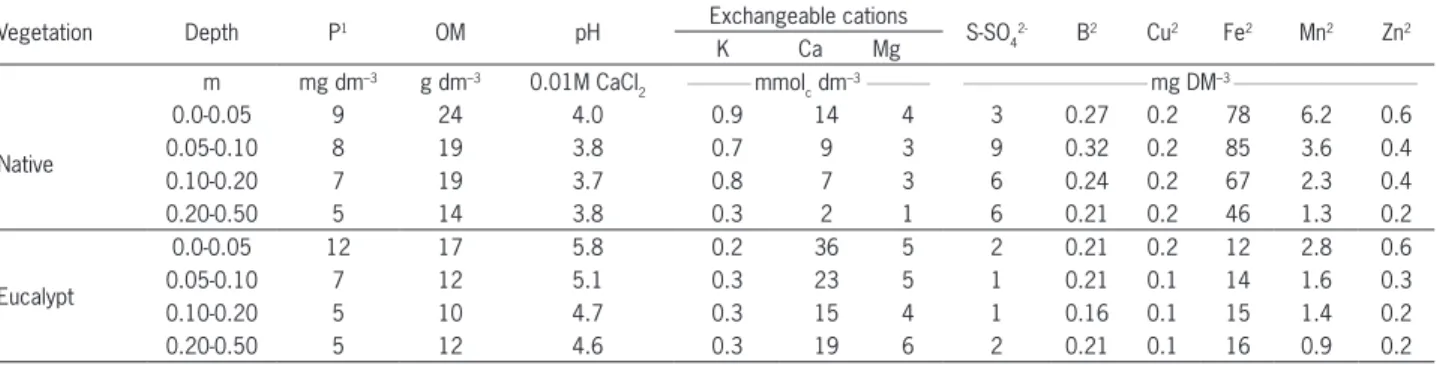
The experiment was set up in Jan 2009 in An-hembi, in the state of São Paulo, Brazil (22º47' S; 48º09' E; 500 m a.s.l.). The climate of the region is hot with rainy summers and moderately cool, dry winters, in be-tween the Cwa and Aw groups (Köppen classification). The mean annual air temperature is 21.8 °C, and mean annual rainfall is 1,240 mm, with mild to moderate wa-ter stress during winwa-ter. The soil is a deep (<10m) Fer-ralic Arenosol- AR (FAO) or Quartzipsamment (USDA), and the slopes are gently rugged (5 – 10 %) with low natural fertility (Table 1). The soil is 90 % sand with a very homogeneous profile (Table 2). The surface horizon contains organic matter in the first 10 or 15 cm. The A horizon is followed directly by C horizon, as the high sand content does not favor the formation of B horizons. The soil analyzes were performed based on Sparks et al. (1996) formulations.
Eucalypts stand: The site had been previously cultivat-ed with a commercial plantation of a Eucalyptus grandis. After seven years, in Aug 2008, the area was cut down and cleared. In Jan 2009, a new stand was established using a hybrid of Eucalyptus urophylla and E. grandis
Received October 03, 2013
Accepted March 28, 2014
1Forest Science and Research Institute, Av. Pádua Dias, 11, C.P. 530 – 13400-970 – Piracicaba, SP – Brazil.
2University of São Paulo/ESALQ, Forest Sciences Dept., Av. Pádua Dias, 11, C.P. 09 – 13418-900 – Piracicaba, SP – Brazil.
3University of São Paulo/ESALQ, Dept. of Biosystems Engineering, Av. Pádua Dias, 11, C.P. 09 – 13418-900 – Piracicaba, SP – Brazil.
*Corresponding author <[email protected]>
Edited by: Tairone Paiva Leão
Soil water dynamics and litter production in eucalypt and native vegetation in
Paulo Henrique Muller da Silva1*, Fabio Poggiani2, Walter de Paula Lima1,2, Paulo Leonel Libardi3
(C041H) with 1,333 trees ha–1. Silvicultural practices in-cluded herbicide application for weed control (glypho-sate in total area), soil preparation (subsoiling to 0.45 m deep), leaf-cutting ant control (manual application of baits), planting and fertilizer application. The fertiliza-tion was performed manually, simulating commercial application procedures, applying 80 kg of N, 32 kg of P 105 kg of K per hectare. The N and K were top-dressed four times (at 3, 6, 12 and 18 months). Total height and diameter at breast height (DBH) of the eucalypts were measured at 12, 24 and 36 months after planting to es-timate the stem volume. The stem volume in our study (Table 3) is representative of eucalypt productivity in this type of soil and climatic conditions in southeastern Brazil (Silva et al., 2011).
Native vegetation: Thevegetation comprised an early-successional forest remnant of Seasonally Dry Forest (with hyper-abundant and light-dependent lianas) insert-ed in an ecotone between Cerrado (Neotropical Savan-nah) and Seasonal Semideciduous Atlantic Forest. The canopy of native vegetation has an approximate height of 5 m and almost all treetops are covered by hyper-abundant, light-dependent lianas, most of them belong-ing to the Bignoniaceae and Sapindaceae families. Just a few trees, like Aspidosperma polyneuron and Anandenan-thera spp. from Apocynaceae and Leguminosae families respectively, are taller reaching about 15 m. The soil forest is colonized by invasive grasses, such as Urocloa (Brachiaria) spp., mainly in forest clearings and borders. The eucalypt stand and native vegetation are separated by a narrow rural road (6 m apart). Plot selection was restricted to the experimental area with the same soil
and topography. We used three replications for both veg-etation types.
Soil moisture was measured by tensiometers, which allowed for the calculation of internal drainage (soil water flow) using the Darcy–Buckingham equation.
in which: qz = soil water flow density; K(θ) = soil hy-draulic conductivity as a water content function; = soil water potential (m day–1).
The K(θ) and at 0.2 and 0.9 m soil depth were calculated from weekly readings of tensiometers installed at depths of 0.15, 0.25, 0.85 and 0.95 m. The tensiometer readings were monitored for 36 months (Feb 2009 to Jan 2012). To calculate the soil water flux density, we determined the soil water retention curve to obtain the soil water content from tensiometer read-ings and then the soil hydraulic conductivity K from the equation of K as a function of volumetric water content obtained at both depths (0.2 and 0.9 m) by the instanta-neous profile method (Ghiberto et al., 2011).
In the determination of soil water retention curve, ten undisturbed soil samples of 100 cm3 were collected at depths of 0.2, 0.4, 0.6, 0.8, 1.0 and 1.2 m. The sam-ples were submitted to tensions from 0 to 90 kPa using porous plate funnels (funnels of Haines) and from 100 to 1,000 kPa using a porous plate air pressure chamber (Richards chamber).
For the chemical analysis, we collected soil solu-tion samples monthly, when the soil moisture content allowed, using solution extractors (porous cup). Extrac-tors were installed at a depth of 0.2 and 0.9 m, and the
Table 1 – Soil analysis of both vegetation types.
Vegetation Depth P1 OM pH Exchangeable cations S-SO
4
2- B2 Cu2 Fe2 Mn2 Zn2 K Ca Mg
m mg dm–3 g dm–3 0.01M CaCl 2
__________ mmol
c dm
–3__________ _____________________________ mg DM–3 _____________________________
Native
0.0-0.05 9 24 4.0 0.9 14 4 3 0.27 0.2 78 6.2 0.6
0.05-0.10 8 19 3.8 0.7 9 3 9 0.32 0.2 85 3.6 0.4
0.10-0.20 7 19 3.7 0.8 7 3 6 0.24 0.2 67 2.3 0.4
0.20-0.50 5 14 3.8 0.3 2 1 6 0.21 0.2 46 1.3 0.2
Eucalypt
0.0-0.05 12 17 5.8 0.2 36 5 2 0.21 0.2 12 2.8 0.6
0.05-0.10 7 12 5.1 0.3 23 5 1 0.21 0.1 14 1.6 0.3
0.10-0.20 5 10 4.7 0.3 15 4 1 0.16 0.1 15 1.4 0.2
0.20-0.50 5 12 4.6 0.3 19 6 2 0.21 0.1 16 0.9 0.2
1Resin extraction; 2Extractable amounts.
Table 2 – Soil particle size.
Depth Clay Silt Total Sand
m _______________________________% _______________________________
0.0-0.05 4 2 94
0.05-0.10 4 3 93
0.10-0.20 6 3 91
0.20-0.50 6 3 91
0.0-0.05 8 3 89
Table 3 – Mean and current annual stem increment of the eucalypt stand in the 1st, 2nd and 3th year after planting.
Increment 1st year 2nd year 3th year
--- m3 ha–1 year–1
---Mean Annual Increment 10.6 38 45
samples comprised three sub-samples collected in each replication of the experiment at both depths. Soil solu-tion samples were collected to compare the N and K con-centration. To extract the soil solution, we used a pump to suck the air from the extractor, generating a pressure of at least -80 kPa relative to atmospheric pressure in the extractor. Preservative (thymol-2-isopropyl-5-methyl-phenol) was added to the soil solution samples, which were stored at 8 °C. The analyses were performed using flow injection analysis (Laclau et al., 2010).
Leaf fall and nutrient return to the soil were as-sessed for 24 months from the 12th to the 36th month af-ter eucalypt planting. The leaf fall was collected monthly using three leaf-traps (0.25 m2 each) in each replication, giving a total of nine per vegetation type. The samples were dried, weighed and chemically analyzed following procedures described by Laclau et al. (2009). Composite samples were prepared for the chemical analysis to en-able the concentrations of N, P, K, Ca, Mg and S to be determined. We estimated the transfer of nutrients from the trees’ canopy to the soil through leaf fall by multiply-ing the dry matter by the nutrient concentration (Laclau et al., 2010).
These measurements were analyzed using a t-test to identify whether the average result from the euca-lypts stand and native vegetation differed. Analyzes were performed for every period that measurements were evaluated.
Results and Discussion
Fertilization of eucalypts produced proper growth similar to that observed in commercial plantations in Brazil with adequate silvicultural practices in place (Stape et al., 2010), including genotypes with good ad-aptative qualities, soil preparation, weed, pest and dis-ease control and mineral fertilization (Gonçalves et al., 2013). Under the eucalypt stand the soil had higher pH, P, Ca and Mg and lower OM, S and K content than in native vegetation (Table 1). Such differences can be at-tributed to the effect of previous mineral fertilizations in agricultural cropscultivated in the same area where the treatment with eucalypts was allocated in this ex-periment.Fertilization is necessaryto maintain eucalypt productivity and nutrient stocks in infertile tropical soils over successive rotations (Laclau et al., 2010). Silva et al. (2013) found that doses of fertilizers applied to euca-lypt affected nutrient dynamics differently. Fertilization increases the nutrient concentration in the leaves, the nutrient cycling and the growth of the eucalypts stand.
Water dynamics in the soil and soil solution
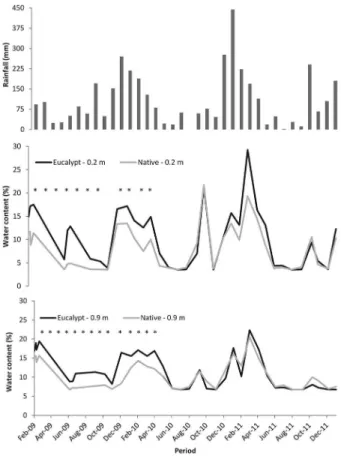
During the early stage of eucalypt growth, the water content in the soil under the eucalypt stand was higher than under the remnant native vegetation. How-ever, when the plantation was one and a half years old, this difference in available soil water was no longer ob-served (Figure 1). The water content in the soil followed
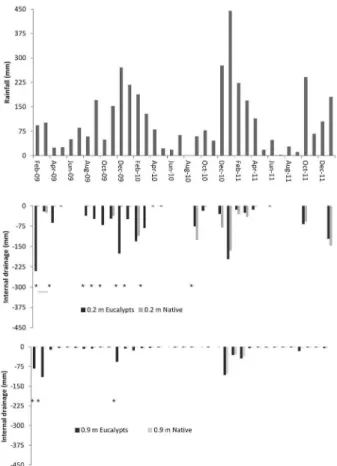
the monthly precipitation. The largest difference (p < 0.05) in internal drainage was found in the first year af-ter planting (Table 4), when 22 % of the rainfall drained below 0.9 m deep at the eucalypt stand. One and a half years after the eucalypts planting, internal drainage was similar for both vegetations (Figure 2). In the second year, less than 10 % of the rainfall drained below the 0.9 m depth for both vegetations.
Up to one and a half years after planting, the eu-calypt stand had higher water content in the soil than the native forest remnant (Table 4). Higher soil water content during the first year occurs due to the establish-ment process of the eucalypt stand: soil preparation, weed control and the small size of young eucalypts.
Table 4 – Rainfall and soil internal drainage at depths of 0.2 and 0.9 m during the first 3 years after eucalypt planting.
Time Rainfall Drainage 0.2 m Drainage 0.9 m --- L m–2
---Eucalypts Native Eucalypts Native Feb 2009 - Jan 2010 1299 -752 -66* -297 -10* Feb 2010 - Jan 2011 1405 -532 -484 ns -131 -112 ns Feb 2011 - Jan 2012 1227 -243 -277 ns -102 -75 ns Comparison of vegetation types in same depth: ns – no difference; *p < 0.05. Figure 1 – Rainfall and water content in the soil at depths of 0.2 and
These factors increased water infiltration, changed the soil bioporosity (Shipitalo and Protz, 1987) and de-creased transpiration (Newton and Preest, 1988). How-ever, this difference soon disappeared and soil water content became similar in both types of vegetation, due
to greater expansion of the roots and shoots of
euca-lypts that start the competition among the eucaeuca-lypts trees, when canopies closed.
High drainage could be attributed to rainfall distri-bution throughout the year. In our study the rainfall was 444 mm in Jan 2011 (Figure 1), which corresponded to
more than 30 % of the total annual rainfall and resuled in high drainage in both vegetations. The drainage is a combination of distribution, gross rainfall and through-fall (after leaf interception) that has been studied for a long time in forests (Helvey and Patric, 1965). In our study, high drainage from Jan to Mar 2011 was observed in both vegetations because of the cumulative rainfall during this period, even at the stage when the eucalypt roots had already explored a considerable soil volume (Laclau et al., 2013).
The high density of lianas in native vegetation reduces sources of soil water, mainly at the beginning of the dry season, and sap flow is similar in lianas and trees (Andrade et al., 2005; Tobin et al.; 2012). Lianas can grow approximately seven times more in height than the trees, during the dry season, though only twice as much during the wet season. Over time, the advan-tage in the dry season may allow the lianas to increase in abundance in seasonal forests (Schnitzer, 2005). In our study, the native vegetation with high liana infes-tation had the same availability of soil water as that in the eucalypt stand between 18 and 36 months after the eucalypt planting. In order to correctly apply the eucalypt zoning, differences in water drainage during the rotation must be taken into account (Laclau et al., 2005; Lima et al., 2012).
After one year of eucalypts planting, N concen-tration in the soil solution was higher under native vegetation than under the eucalypts stand. In the first two years after planting, higher concentration of K was found under the eucalypts stand at 0.2 m than under na-tive vegetation (Table 5).
N and K concentrations in the soil solution in our study were higher than those found by Laclau et al. (2003) in eucalypt plantation on sandy soil in a savan-nah. Although other factors may have contributed to the results in our study, the amount of fertilizers was higher than found in Laclau et al. (2003).
The difference in N and K concentrations in the soil solution observed in our study (Table 5) between the two types of vegetation reflects the higher OM content in the soil under native vegetation and the presence of
leguminous plant species. The high K concentration in
the soil solution under the eucalypt stand was a direct effect of the mineral fertilization in the first year after eucalypt planting.
Table 5 – Average N and K concentration in the soil solution at depths of 0.2 and 0.9 m deep in the native vegetation and eucalypt stand.
Year
Nitrogen (mg L–1) Potassium (mg L–1)
0.2 m 0.9 m 0.2 m 0.9 m
Euc Nat Euc Nat Euc Nat Euc Nat
2009 8.9 11.6 ns 7.5 4.1 ns 14.5 7.6* 2.8 2.5 ns
2010 1.5 9.8** 0.7 4.9* 10.6 2.4* 0.6 0.4 ns
2011 3.9 9.7* 3.2 2.3 ns 1.3 1.9 ns 0.7 0.7 ns
Average 4.8 10.4 3.8 3.8 8.8 4.0 1.4 1.2
Comparison of vegetation types at the same depth: ns – no difference; *p < 0.05; **p < 0.01. Figure 2 – Monthly rainfall and soil internal drainage at depths of 0.2
Nutrient cycling
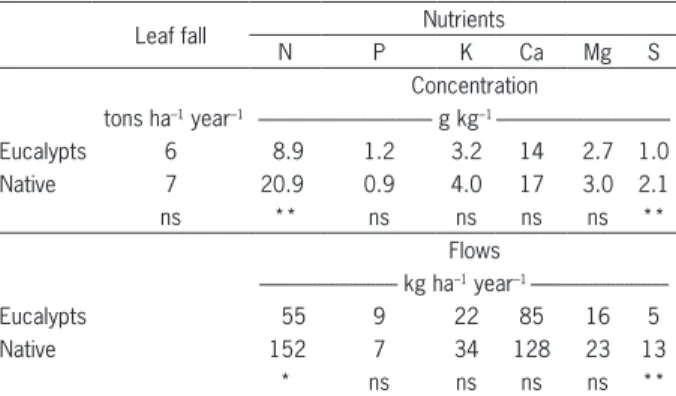
The annual leaf fall from Jan 2010 to Dec 2011 was similar in native vegetation and eucalypts (≈ 6,500 kg year–1), but differed in the months of July and Sept 2010 (Figure 3). Leaf fall concentration and flow from the canopy to ground of N and S were higher in native vegetation than in the eucalypts stand (Table 6). During the dry season, many trees lose their leaves as a strategy to overcome the typical water deficit and re-sprout at the beginning of the rainy season.
The annual leaf litter fall production of the two vegetation types was similar to the results found by Sil-va et al. (2011) under similar climatic conditions. Few factors affect the litter fall and the most important are tree genotypes and climatic variations (Parrotta, 1999). Climatic conditions played an important role in litter fall production. In both vegetation types, high litter fall production was observed during the dry season between 2010 and 2011(Figure 3) and the smallest litter fall pro-duction was in Jan and Oct 2011, when high rainfall was observed.
The N flow through the litter fall was greater in the native vegetation than in the eucalypt stand. Laclau et al. (2005) studied nutrient cycling in the Congo (4o08’ S; 12o08’ E; 80 m) comparing a clonal stand of eucalypts with an adjacent savannah ecosystem and found that
le-guminous plant species in the native vegetation are re-sponsible for substantial N uptake by symbiotic fixation. In commercial stands, however, legumes were eliminat-ed during weeliminat-ed control applications. Nitrogenous con-tents should be monitored during eucalypt stand rota-tions, because N presents a negative budget in eucalypts stands (Silva et al., 2009).
Acknowledgments
We thank the Conpacel-Suzano company for its support and the laboratory coordinators for their as-sistance. We also thank our colleagues Pedro Henrique Santin Brancalion (ESALQ/USP), Otávio Camargo Cam-poe (IPEF), the reviewers and editor for their contribu-tion.
References
Almeida, A.C.; Soares, J.V. 2003. Comparison of water use in
Eucalyptus grandis plantations and Atlantic rainforest in eastern coast of Brazil. Revista Árvore 27: 159-170 (in Portuguese, with abstract in English).
Andrade, J.L.; Meinzer, F.C.; Goldstein, G.; Schnitzer, S.A. 2005. Water uptake and transport in lianas and co-occurring trees of a seasonally dry tropical forest. Trees 19: 282-289.
Dias Junior, M.S.; Leite, F.P.; Lasmar Junior, E.; Araujo Junior, C.F. 2005. Traffic effects on the soil preconsolidation pressure due to eucalyptus harvest operations. Scientia Agricola 62: 248-255. Ghiberto, P.J.; Libardi, P.L.; Brito, A.S.; Trivelin, P.C.O. 2011.
Components of the water budge in soil with sugarcane crops. Agricultural Water Management 102: 1-7.
Gill, A.M.; Zylstra, P. 2005. Flammability of Australian forests. Australian Forestry 68: 87-93
Gonçalves, J.L.M.; Alvares, C.A.; Higa, A.R.; Silva, L.D.; Alfenas, A.C.; Stahl, J.; Ferraz, S.F.B.; Lima, W.P.; Brancalion, P.H.S.; Hubner, A.; Bouillet, J-P.D.; Laclau, J-P.; Nouvellon, Y.; Epron, D. 2013. Integrating genetic and silvicultural strategies to minimize abiotic and biotic constraints in Brazilian eucalypt plantations. Forest Ecology and Management 23: 222-235. Gordon, D.H.; Flory, L.S.; Cooper, A.L.; Morris, S.K. 2012.
Assessing the invasion risk of Eucalyptus in the United States using the Australian weed risk assessment. International Journal of Forestry Research. DOI: http://dx.doi. org/10.1155/2012/203768.
Helvey, J.D.; Patric, J.H. 1965. Canopy and litter interception of rainfall by hardwoods of eastern United States. Water Resources Research 1: 193-206.
Laclau, J-P.; Ranger, J.; Nzila, J.D.; Bouillet, J-P.; Deleporte, P. 2003. Nutrient cycling in a clonal stand of Eucalyptus and an adjacent savanna ecosystem in Congo: 2. Chemical composition of soil solutions. Forest Ecology and Management 180: 527-544. Laclau, J-P.; Ranger, J.; Deleporte, P.; Nouvellon, Y.; Saint-Andre,
L.; Marlet, S.; Bouillet, J-P. 2005. Nutrient cycling in a clonal stand of Eucalyptus and an adjacent savanna ecosystem in Congo. 3. Input–output budgets and consequences for the sustainability of the plantations. Forest Ecology and Management 210: 375-391.
Table 6 – Average leaf litterfall, nutrient concentration and flows (canopy to soil), from Jan 2010 to Dec 2011.
Leaf fall Nutrients
N P K Ca Mg S
Concentration
tons ha–1 year–1 --- g kg–1
---Eucalypts 6 8.9 1.2 3.2 14 2.7 1.0
Native 7 20.9 0.9 4.0 17 3.0 2.1
ns ** ns ns ns ns **
Flows
--- kg ha–1 year–1
---Eucalypts 55 9 22 85 16 5
Native 152 7 34 128 23 13
* ns ns ns ns **
Comparison of vegetation types: ns – no difference; *p < 0.05; **p < 0.01. Figure 3 – Monthly leaf litterfall production in the eucalypt stand and
Laclau, J-P.; Almeida, J.C.R.; Gonçalves, J.L.M.; Saint-André, L.; Ventura, M.; Ranger, J.; Moreira, R.M.; Nouvellon, Y. 2009. Influence of nitrogen and potassium fertilization on leaf lifespan and allocation of above-ground growth in Eucalyptus plantations. Tree Physiology 29: 111-124.
Laclau, J-P.; Ranger, J.; Gonçalves, J.L.M.; Maquere, V.; Krusche, A.V.; M’bou, A.T.; Nouvellon, Y.; Saint-Andre, L.; Bouillet, J-P.; Piccolo, M.C.; Deleporte, P. 2010. Biogeochemical cycles of nutrients in tropical Eucalyptus plantations main features shown by intensive monitoring in Congo and Brazil. Forest Ecology and Management 259: 1771-1785.
Laclau, J-P.; da Silva, E.A.; Rodrigues Lambais, G.; Bernoux, M.; le Maire, G.; Stape, J.L.; Bouillet, J-P.; Gonçalves, J.L.M.; Jourdan, C.; Nouvellon, Y. 2013. Dynamics of soil exploration by fine roots down to a depth of 10 m throughout the entire rotation in Eucalyptus grandis plantations. Frontiers in Plant Science 4: 243.
Lima, W.P.; Zakia, M.J.B.; Libardi, P.L.; Sousa Filho, P.A. 1990. Comparative Evapotranspiration of Eucalyptus, pine and natural cerrado vegetation measured by the soil water balance method. IPEF International 1: 5-20.
Lima, W.P.; Laprovitera, R.; Ferraz, S.F.B.; Rodrigues, C.B.; Silva, M.M. 2012. Forest plantations and water consumption: a strategy for hydrosolidarity. International Journal of Forestry. DOI: http://dx.doi.org/10.1155/2012/908465.
Newton, M.; Preest, D.S. 1988. Growth and water relations of Douglas Fir (Pseudotsuga menziesii) seedlings under different weed control regimes. Weed Science 36: 653-662.
Pallett, R.N.; Sale, G. 2004. The relative contributions of tree improvement and cultural practice toward productivity gains in
Eucalyptus pulpwood stands. Forest Ecology and Management 193: 33-43.
Parrotta, J.A. 1999. Productivity, nutrient cycling, and succession in single- and mixed-species plantations of Casuarina equisetifolia, Eucalyptus robusta, and Leucaena leucocephala in Puerto Rico. Forest Ecology and Management 124: 45-77. Schnitzer, S.A. 2005. A mechanistic explanation for global
patterns of Liana abundance and distribution. The American Naturalist 166: 262-276.
Shipitalo, M.J.; Protz, R. 1987. Comparison of morphology and porosity of a soil under conventional and zero tillage. Canadian Journal of Soil Science 67: 445-456.
Silva, P.H.M.; Poggiani, F.; Brito, J.O.; Stape, J.L.; Moreira, R.M. 2009. Production of essential oil and nutrient budget in
Corymbia citriodora fertilized with sewage sludge in different spacing = Produção de óleo essencial e balanço nutricional em
Corymbia citriodora adubado com lodo de esgoto em diferentes espaçamentos. Cerne 15: 346-354 (in Portuguese).
Silva, P.H.M.; Poggiani, F.; Laclau, J-P. 2011 Applying sewage sludge to Eucalyptus grandis plantations: effects on biomass production and nutrient cycling through litterfall. Applied Environmental Soil Science. DOI: http://dx.doi.org/10.1155/2011/710614. Silva, P.H.M.; Poggiani, F.; Libardi, P.L.; Gonçalves, A.N. 2013.
Fertilizer management of eucalypt plantations on sandy soil in Brazil: initial growth and nutrient cycling. Forest Ecology and Management 301: 67-71.
Sparks, D.L. 1996. Methods of soil analysis: chemical methods. Soil Science Society of America, Inc. American Society of Agronomy, Inc. Madison, Wisconsin, USA. Part 3.
Stape, J.L.; Gonçalves, J.L.M.; Gonçalves, A.N. 2001. Relationships between nursery practices and field performance for Eucalyptus
plantations in Brazil: a historical overview and its increasing importance. New Forests 22: 19-24.
Stape, J.L.; Binkley, D.; Ryan, M.G. 2004. Eucalyptus production and the supply, use and efficiency of use of water, light and nitrogen across a geographic gradient in Brazil. Forest Ecology and Management 193: 17-31.
Stape, J.L.; Binkley, D.; Ryan, M.G.; Fonseca, S.; Loos, R.A.; Takahashi, E.N.; Silva, C.R.; Silva, S.R.; Hakamada, R.E.; Ferreira, J.M.A.; Lima, A.M.N.; Gava, J.L.; Leite, F.P.; Andrade, H.B.; Alves, J.M.; Silva, C.G.G.; Azevedo, M.R. 2010. The Brazil Eucalyptus Potential Productivity Project: influence of water, nutrients and stand uniformity on wood production. Forest Ecology and Management 259: 1684-1694.